DEVELOPING DEFUZZIFYING METHOD OF FUZZY TIME-VARIANT SERIES FOR FORECASTING PRODUCT DEMAND
SAEED AKBARNATAJBISHEH
A thesis submitted in fulfilment of the requirements for the award of the degree of Master of Engineering (Industrial Engineering)
Faculty of Mechanical Engineering Universiti Teknologi Malaysia
iii
2 DEDICATION
iv
3 ACKNOWLEDGEMENT
All praises are to Allah Al-Mighty for his grace and blessing and bestowing me with health and opportunity to gain this treasure of knowledge. Apart from the efforts of author, the success of any research project depends largely on the encouragement and guidelines of many others. I take this opportunity to officially express my gratitude to the people who have been instrumental in the successful completion of this thesis.
Foremost, I would like to express my sincere gratitude to my supervisor, Dr. Syed Ahmad Helmi Bin Syed Hassan for the continuous support of my Master study and research, for his patience, motivation, enthusiasm, and immense knowledge. His guidance helped me in all the time of research and writing of the thesis. Besides my supervisor, I would like to appreciate one of my best friends, Seyed Navid Seyedi for his assistance and comments on some parts of this thesis.
v
4 ABSTRACT
vi
5 ABSTRAK
vii
6 TABLE OF CONTENT
CHAPTER TITLE PAGE
DECLARATION ii
DEDICATION iii
ACKNOWLEDGEMENT iv
ABSTRACT v
ABSTRAK vi
TABLE OF CONTENT vii
LIST OF TABLES xi
LIST OF FIGURES xiii
LIST OF ABBREVIATIONS xiv
LIST OF APPENDICES xv
1 INTRODUCTION 1
1.1 Introduction 1
1.2 Background 1
1.3 Problem Statement 2
1.4 Objective 3
1.5 Scope 3
1.6 Summary of Literature 4
viii
1.8 Significance of the Study 5
1.9 Overview and Conclusion 6
1.10 Conclusion 7
2 LITERATURE REVIEW 8
2.1 Introduction 8
2.2 Fuzzy Time series forecasting 8
2.2.1 Fuzzy logic 9
2.2.2 Fuzzy Set 9
2.2.3 Fuzzy Time Series Concept 10
2.2.4 Modeling the Fuzzy Time Series 16
2.2.5 Fuzzy Time-invariant Method 17
2.2.6 Fuzzy Time-variant Method 22
2.3 Artificial Neural Network (ANN) 27
2.3.1 Biological Pattern of ANN 27
2.3.2 Neural Network Model 28
2.3.3 Multilayer Neural Network 30
2.3.4 Back Propagation Networks 31
2.3.5 Advantages and Disadvantages of ANN 32
2.4 ARIMA 33
2.4.1 ARIMA Model 33
2.4.2 Steps of Applying ARIMA Model 35
3 RESEARCH METHODOLOGY 38
3.1 Introduction 38
3.2 Research Framework 38
ix
3.3.1 Error Estimation Methods 40
3.3.2 Defuzzifying Fuzzy Time-variant Series by
MAE&Trend 41
3.3.3 Proposed Defuzzification Method 43
3.3.4 Method Validation 44
3.3.5 Comparing Defuzzifying of Proposed Method
and Neural Network 48
3.4 Conclusion 49
4 DATA GATHERING AND ANALYSIS 50
4.1 Introduction 50
4.2 Summary of case study 51
4.3 Data Collection 51
4.4 Data Analysis for Fuzzy Time series 52
4.5 Conclusion 56
5 RESULTS AND CONCLUSION 57
5.1 Introduction 57
5.2 Fuzzy Time-invariant Method 57
5.2.1 Song‘s Method Results 58
5.2.2 Chen‘s Method Results 60
5.3 Fuzzy Time-variant Method 62
5.3.1 Results of Defuzzifying by Proposed Model of
MAE&Trend 62
5.3.2 Results of Defuzzifying by Neural Network 65
5.4 Results of ARIMA Model 69
5.5 Comparison of Applied Methods 72
x
5.5.2 Graphs of Actual Demand and Forecasted
Demand for All Methods 74
5.6 Conclusion, Significance of the Study and
Recommendations 77
REFERENCES 79
xi
7 LIST OF TABLES
TABLE TITLE PAGE
2.1 Vectors of memberships of the intervals of fuzzy sets 14 2.2 Enrollments and memberships of (Song and Chissom 1993) 15 2.3 Defuzzified values of fuzzy time-invariant model (Song and
Chissom,1993) 19
2.4 Fuzzy logical transitions group (Chen 1996) 21
2.5 Output results for time-invariant model (Song and Chissom,1994) 24
3.1 MAPE of time-invariant for 42
3.2 Primary forecasting of fuzzy time-variant model 43
3.3 Proposed time-variant forecasting 44
3.4 Results of Assumption (a) 45
3.5 Results of Assumption (b) 46
3.6 Results of Assumption (c) 47
3.7 Comparing MAPE of proposed model and neural network results 48
4.1: Bina Paint Company's Products 51
4.2 Actual demand from 2009 to 2012 52
4.3 Membership vectors of fuzzy time-invariant series 55
4.4 Fuzzified Demand from 2009 to2011 56
5.1 Song‘s fuzzy time-invariant method‘s forecasting 59
5.2 Group of transitions 60
5.3 Calculation of forecasting for each group of Chen‘s method 60
5.4 Chen‘s method forecasting results 61
5.5 Fuzzy membership outputs and primary forecasting 63
5.6 Calculation of MAE 64
xii
5.8 Training data for the network 66
5.9 Output of defuzzifying by neural network 68
5.10 ARIMA forecasting results 72
xiii
8 LIST OF FIGURES
FIGURE TITLE PAGE
1.1 Conceptual Framework 5
2.1 Neuron scheme (Jain, Mao et al. 1996) 28
2.2 Neuron model (Negnevitsky 2005) 28
2.3 Graph of three different Activation functions (Negnevitsky 2005) 30 2.4 Multilayer perceptron with two hidden layers (Negnevitsky 2005) 30 2.5 Three-layer back-propagation neural network (Negnevitsky 2005) 32
3.1 Research framework 39
4.1 Membership function plot 54
5.1 Neural network model 67
5.2 Autocorrelation of error 67
5.3 Correlation between input and error 68
5.4 ACF for actual demand 70
5.5 PACF for actual demand 70
5.6 Residual plots for ARIMA model 71
5.7 Time-invariant methods‘ plot 74
5.8 Time-variant and ARIMA plot 75
5.9 ARIMA results 75
5.10 Proposed MAE&Trend method plot 76
xiv
9 LIST OF ABBREVIATIONS
MAE Mean Absolute Error
MAPE Mean Absolute Percentage Error
ANN Artificial Neural Network
ARIMA Autoregressive Integrated Moving Average
ACF Autocorrelation Function
xv
10 LIST OF APPENDICES
APPENDIX TITLE PAGE
Appendix A Work Report Evaluation Form for Bina Paint Manufacturing
CHAPTER 1
1 INTRODUCTION .
1.1 Introduction
In this chapter firstly background of study is explained which is mostly about anticipating future demand with historical data. Secondly, potential problems are stated which is generally about limitations of using neural network for defuzzifying fuzzy time-variant method. In addition, reaching new way of defuzzifying fuzzy time-variant method with mean absolute error (MAE) and trend of primary forecasting with better accuracy is stated for the objective. After defining scope of this thesis, a brief summary of literature as well as conceptual framework and significance of study is explained. Finally, in thesis organization, the overview of each chapter is given.
1.2 Background
2
linguistic and numerical data the most useful approach to deal with data is fuzzy logic (Song and Chissom, 1993b) which is able to use both types of data as an input and produce fuzzy data as output. Fuzzy time series are classified into two categories, fuzzy time-invariant and fuzzy time-variant series(Song and Chissom, 1993b). Defuzzifying of fuzzy time-invariant series is applied by two methods, Song‘s method(Song and Chissom, 1993a) and Chen‘s method(Chen, 1996); but the only defuzzification method for fuzzy time-variant series is by neural network (Song and Chissom, 1994). Neural network uses fuzzy memberships as input as well as actual data for target values. The major disadvantage of neural network is the process of model identification. It means that you may not reach the best result in the first train. Hence, it is proposed a new way of defuzzification for fuzzy time-variant series to cope with this problem.
Forecasting by various methods gives us the chance to evaluate that which method has better accuracy. ARIMA method is selected to be compared with the proposed method because of its robustness and dealing with demand fluctuation over time (Wang, 2011). It is also able to cover time series with seasonality and nonseasonality. Making the best decision among results could be achieved by suitable comparison between methods. Hence, the results of methods would be compared by MAPE (mean absolute percentage error). Output of MAPE is percentage of error which is difference between actual data and forecasted data.
1.3 Problem Statement
3
In this paper, reaching a method to defuzzifying time-variant series is targeted that lead to less error in comparison with ANN. Dealing with this problem it is proposed new defuzzification method based on MAE and trend of forecasting. Considering MAE as well as trend of time series would affect positively on accuracy that means reaching less error.
1.4 Objective
In this project, it is proposed a new way of defuzzifying fuzzy time-variant method which firstly proposed by Song and Chissom (1994). The previous method has utilized neural network for defuzzifying that has some limitations and disadvantageous such as model identification which would be explained in further sections. Proposed defuzzification method of fuzzy time-variant method is developed by consideration of MAE and trend of primary forecasting.
Comparison of proposed model by ARIMA and previous method of defuzification would be applied by MAPE to determine the accuracy of proposed model.
1.5 Scope
The scope of this project is as follow:
a) Data has been collected in paint manufacturing company ―BINA Integrated‖.
4
1.6 Summary of Literature
Fuzzy time series was proposed in 1993 by Song et al. as ―a special dynamic process with linguistic values‖ (Song and Chissom, 1993b) that is able to forecast future by use of fuzzy sets and variables. Two main categories of fuzzy time series are fuzzy time-invariant and fuzzy time-variant series: In fuzzy time-invariant series, for example, forecasting month is done by use of data of , but in fuzzy time-variant series sets of data is considered for forecasting month . In addition defuzzifying methods of these two categories are different; two methods of defuzzifying fuzzy time-invariant series, Song‘s method and Chen‘s method, are defined in this project as well as one method of defuzzifying fuzzy time-variant series which is defuzzification by neural network. Neural network is a system, in which an input is presented to this system, and a corresponding desired response is set at the output, an error is extracted from the difference of the desired response and the real system output.
One of the issues in forecasting is comparison various methods to determine that which one has the best accuracy or lower MAPE (mean absolute percentage error); hence, another method which is considered to be compared with fuzzy time series, is ARIMA (Autoregressive integrated moving average) model. This method is proposed by Box and Jenkins (1970) and it is a linear combination of pervious points (past observations or historical data) and random errors.(GE, 1970)
1.7 Conceptual Framework
5
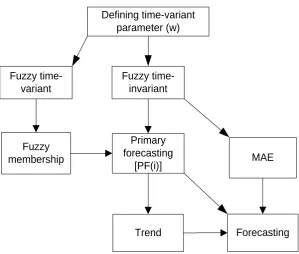
factor which is considered. Finally, the results are defuzzified values (forecasting) for time-variant method by multiplying , and .
MAE Trend Defining time-variant parameter (w) Fuzzy time-invariant Primary forecasting [PF(i)] Fuzzy membership Fuzzy time-variant Forecasting
Figure 1.1: Conceptual Framework
1.8 Significance of the Study
6
1.9 Overview and Conclusion
This thesis is inclusive of 5 chapters; the first one is generally gives an overview of project; in this chapter introduction and background of project are stated then set the objective due to stated problem. The objective is proposing new method of defuzzification for fuzzy time-variant series. To manage the project, some methods and software for the scope of this thesis are considered. Significance of study and theoretical framework are brought to give us the image of what have been done in this thesis.
Chapter 2 is about reviewing the literatures for the topic; in this part, background of project is explained more and definitions and application of each method is clarified. Some advantages and disadvantages of each method are discussed according to related papers.
In Chapter 3 the properties of the proposed model are explained. Then the methodology of applying new way of defuzzification for fuzzy time-variant series is clarified. Finally, the result of applying proposed model for enrollment for University of Alabama are compared with neural network defuzzification method.
Chapter 4 is dedicated to data collection and analysis. Demand of paint manufacturing company is gathered to justify the robustness of the proposed method. Since this data is fluctuated, performance of any methods would be measured by comparing the MAPE of results.
7
Finally results of methods are compared by MAPE (mean absolute percentage error) in which the lower MAPE of method illustrates its better accuracy in forecasting.
1.10 Conclusion
REFERENCES
Azadeh, A., Saberi, M., Asadzadeh, S. & Khakestani, M. 2011. A hybrid fuzzy mathematical programming-design of experiment framework for improvement of energy consumption estimation with small data sets and uncertainty: The cases of USA, Canada, Singapore, Pakistan and Iran.
Energy.
Chen, S. M. 1996. Forecasting enrollments based on fuzzy time series. Fuzzy sets
and Systems, 81, 311-319.
Chu, H. H., Chen, T. L., Cheng, C. H. & Huang, C. C. 2009. Fuzzy dual-factor time-series for stock index forecasting. Expert Systems with Applications, 36, 165-171.
Day, M. 1995. Research of Applying Genetic Algorithms to Fuzzy Forecasting— Focus on Sales Forecasting. MS thesis, Tamkang Univ., Taipei, Taiwan, ROC.
Du, T. C.-T. & Wolfe, P. M. 1997. Implementation of fuzzy logic systems and neural networks in industry. Computers in industry, 32, 261-272.
Ediger, V. Ş. & Akar, S. 2007. ARIMA forecasting of primary energy demand by fuel in Turkey. Energy Policy, 35, 1701-1708.
Ge, P. 1970. Box., and G. M, Jenkins.,―Time series analysis, forecasting and control‖. San Francisco, CA: Holden Day.
Hong, W. C., Dong, Y., Chen, L. Y. & Wei, S. Y. 2011. SVR with hybrid chaotic genetic algorithms for tourism demand forecasting. Applied Soft Computing,
11, 1881-1890.
Huarng, K. 2001. Heuristic models of fuzzy time series for forecasting. Fuzzy sets
and Systems, 123, 369-386.
80
Jilani, T. A. & Burney, S. M. A. 2008. A refined fuzzy time series model for stock market forecasting. Physica A: Statistical Mechanics and its Applications,
387, 2857-2862.
Klir, G. J., St Clair, U. & Yuan, B. 1997. Fuzzy set theory: foundations and
applications, Prentice-Hall, Inc.
Li, S. T. & Cheng, Y. C. 2007. Deterministic fuzzy time series model for forecasting enrollments. Computers & Mathematics with Applications, 53, 1904-1920. Liu, G. Q. 2011. Comparison of regression and ARIMA models with neural network
models to forecast the daily streamflow of White Clay Creek, University of Delaware.
Morley, C. L. 1993. Forecasting tourism demand using extrapolative time series methods. Journal of Tourism Studies, 4, 19-25.
Negnevitsky, M. 2005. Artificial intelligence: a guide to intelligent systems, Addison-Wesley Longman.
Nihan, N. L. & Holmesland, K. O. 1980. Use of the Box and Jenkins time series technique in traffic forecasting. Transportation, 9, 125-143.
Pareto, V. & Page, A. N. 1971. Translation of Manuale di economia politica (―Manual of political economy‖). AM Kelley, ISBN, 1037475820.
Qiu, W., Liu, X. & Li, H. 2011. A generalized method for forecasting based on fuzzy time series. Expert Systems with Applications, 38, 10446-10453.
Shi, J., Guo, J. & Zheng, S. 2012. Evaluation of hybrid forecasting approaches for wind speed and power generation time series. Renewable and Sustainable
Energy Reviews, 16, 3471-3480.
Singh, S. 2007a. A robust method of forecasting based on fuzzy time series. Applied
mathematics and computation, 188, 472-484.
Singh, S. 2007b. A simple method of forecasting based on fuzzy time series. Applied
mathematics and computation, 186, 330-339.
Singh, S. 2008. A computational method of forecasting based on fuzzy time series.
Mathematics and Computers in Simulation, 79, 539-554.
Song, Q. & Bortolan, G. 1994. Some properties of defuzzification neural networks.
Fuzzy sets and Systems, 61, 83-89.
81
Song, Q. & Chissom, B. S. 1993b. Fuzzy time series and its models. Fuzzy sets and
Systems, 54, 269-277.
Song, Q. & Chissom, B. S. 1994. Forecasting enrollments with fuzzy time series— part II. Fuzzy sets and Systems, 62, 1-8.
Sullivan, J. & Woodall, W. H. 1994. A comparison of fuzzy forecasting and Markov modeling. Fuzzy sets and Systems, 64, 279-293.
Tsaur, R. C., O Yang, J. C. & Wang, H. F. 2005. Fuzzy relation analysis in fuzzy time series model. Computers & Mathematics with Applications, 49, 539-548. Wang, C. C. 2011. A comparison study between fuzzy time series model and ARIMA model for forecasting Taiwan export. Expert Systems with
Applications, 38, 9296-9304.
Yu, H. K. 2005. Weighted fuzzy time series models for TAIEX forecasting. Physica
A: Statistical Mechanics and its Applications, 349, 609-624.
Zadeh, L. A. 1965. - 8, - 353.
Zadeh, L. A. 1975. The concept of a linguistic variable and its application to approximate reasoning—I. Information Sciences, 8, 199-249.
Zhang, G., Eddy Patuwo, B. & Y Hu, M. 1998. Forecasting with artificial neural networks:: The state of the art. International Journal of Forecasting, 14, 35-62.