ISSN (e): 2250-3021, ISSN (p): 2278-8719
Vol. 09, Issue 6 (June. 2019), ||S (IV) || PP 63-67
Pilot based Channel Estimation of OFDM aided with KGMO
Algorithm
P.Sreesudha
1, Dr.B.L.Malleswari
21Assistant Professor, Department of Electronics & Telematics Engineering, GNITS, Hyderabad, India 2Principal, Department of Electronics & Communication Engineering, Sridevi Women’s Engineering College,
Hyderabad, India
Corresponding Author:P.Sreesudha
Abstract:
Now a days there is a huge demand for wireless communications. To accommodate huge number of users new methods are required. Orthogonal Frequency Division Multiplexing (OFDM) is one of the promising technology for modern wireless communications. In this paper OFDM system performance is investigated by estimating the channel with the help of Kinetic Gas Molecule Optimization (KGMO) algorithm. Comb type pilot arrangement is used for estimating the channel with Least Square (LS) estimation method. Results are simulated with Matlab and shown at the end of the paper.Keywords:
OFDM; Channel Estimation; Least Square Estimation; Optimization Algorithm.--- --- Date of Submission: 23-06-2019 Date of acceptance: 28-06-2019 --- ---
I.
INTRODUCTION
In OFDM the data is transmitted using several carriers. Each carrier is separately modulated that means the bandwidth is shared by several carriers. OFDM is same as FDMA and the difference between OFDM and FDMA is, OFDM uses orthogonal carriers. Because of orthogonal carriers, OFDM provides high spectral efficiency [1].In mobile communication system when the signal is propagated through free space its strength varies due to the presence of obstacles. In order to combat these difficulties channel must be equalized perfectly. For equalizing the channel receiver must have Channel State Information (CSI). And the performance of wireless system highly depends on channel characteristics. To detect the original transmitted signal, receiver must have the knowledge of channel information. For estimating the channel various techniques are introduced.
One such technique is pilot based channel estimation. Pilot based channel estimation is called training based channel estimation. Where the training sequence is known to both transmitter and receiver. As compared to blind channel estimation, training based channel estimation provides better performance [2]. Placement of pilots and number of pilot tones are also major issues in channel estimation.
Recently nature inspired algorithms are used for solving many optimization problems. Since these algorithms provides optimum solution for any complex problem. Channel Estimation is one of the complex problems in mobile wireless communication system. In the proposed system pilots are optimally placed with the help of optimization algorithm.There are many optimization algorithms, and they are classified in to several types. All the algorithms are divided into four categories depending upon the source of inspiration,namely Swarm intelligence based, Bio-inspired based, Physics/Chemistry based, and others.
Several types of optimization algorithms are used for channel estimation. Particle Swarm Optimization (PSO) is one popular optimization algorithm, provides optimum solution with simple equations. In [3], OFDM system channel estimation carried out using LS-PSO algorithm. Kinetic Gas Molecule Optimization (KGMO) is a type of meta-heuristic optimization algorithm works based on heat-transfer search [4]. And KGMO is inspired by the law of thermodynamics and heat transfer. In this, search agents are gas molecules that interact with one another as well as with the surrounding to attain thermal equilibrium state.KGMO also works similar to PSO. The position update of gas agents is similar to PSO and in KGMO the kinetic energy parameter is used for measuring the performance. One advantage of KGMO is its quick convergence toward global optima.
The proposed pilot based Orthogonal Frequency Division Multiplexing (OFDM) system block diagram is shown in figure 1.
Figure 1: Block diagram of pilot based OFDM system
OFDM transmits the data through multiple carriers, that converts selective fading into flat fading. Multipath fading is the major problem in wireless communication system. One great advantage of multi carrier
transmission is overcoming the fading impediment. The data is divided into severalnarrowbandstreams, so that
does not affect the complete data. As shown in the Figure 1, the binary data is modulated and passed through the IFFT block along with pilot symbols, then cyclic prefix is added and transmitted through antenna. And at the receiver side cyclic prefix is removed first then FFT is applied. After FFT pilot symbols are separated and with the help of these pilots channel state information is estimated. After that channel is equalized, then demodulated to obtain the original transmitted data.
III.
PROPOSED CHANNEL ESTIMATION
There are several methods for channel estimation. They are Least Square (LS), Minimum Mean Square Error (MMSE), Least Mean Square (LMS) etc., In this paper Least Square (LS) channel estimation is used. Since LS method is one of the simplest methods for estimation, does not require any other channel statistics. It needs only training sequence information for estimation.Pilot based channel estimation is done by inserting pilot symbols in the original data. There are three types of pilot structures available. They are block type pilot arrangement, comb pilot arrangement and third one is lattice pilot structure arrangement. In this paper comb type pilot arrangement is used.
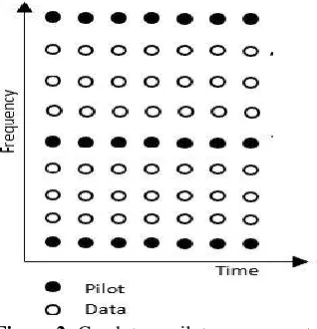
Figure 2: Comb type pilot arrangement
In comb type pilot arrangement, pilot symbols are inserted periodically in to the data subcarriers. Means each OFDM symbol includes data and pilots [5].
In Comb-type pilot arrangement, every OFDM symbol has pilot tones at the periodically-located subcarriers.
𝑥𝑝 𝑚 𝑙 = 0
𝐷𝑎𝑡𝑎 𝑙 = 1,2, … . 𝑁𝑓− 1 (1)
Where X(k) – information includes pilot and data of all subcarriers,
𝑥
𝑝𝑚
- value of m
thsubcarrier
pilot,
𝑁
𝑓- frequency interval of inserted pilot respectively, N – number of subcarriers,
𝑁
𝑝- Number
of pilot carriers,
𝑁
𝑓= N/Np.
After inserting the pilots the data is transmitted through multiple carriers. At the receiver side the data
is added with AWGN. Then the channel is estimated with the help of transmitted and received
pilots.The channel coefficients are estimated using Least Square Estimation method. The least-square
(LS) channel estimation method finds the channel estimate
H
in such a way that the following
function is minimized:
J(H) = Y − X H 2 (2)
By setting the derivative of the function with respect to H to zero, the estimate is given as
𝜕J(H )
𝜕H = −2 (X
HY )∗+ 2 ( XH X H )∗= 0 (3)
HLS= (XH X )−1XH Y(4)
Once the channel coefficient values are estimated then to obtain the channel information at data carriers, interpolation operation is required. In the proposed system Time Domain Interpolation operation is performed to obtain the CSI at other carriers. Comb type pilot based estimation is suitable for the channel which is moving dynamically.
A. Proposed Optimal Channel Estimation System
Step 1: The data D[n] is generated randomly and modulated with BPSK modulation. The modulated data is S[n].
Step 2: After adding CP the data becomes
Q = [CP IFFT (S[n])] (5)
Step 3: The symbols are propagated through Rayleigh channel and added with additive white gaussian noise at the receiver.
Step 4: At the receiver side, receiver estimates the channel with the help of KGMO algorithm.
Step 5: At the receiver pilot positions are randomly initialized randomly between 0 and 127. And that forms the population of the algorithm.
Step 6: Fitness value is computed for all gas molecules. Once fitness is computed then the position and velocity equations are updated according to KGMO [4] and the fitness is computed by using equation 6 below [6].
The fitness = 1
LE h − ℎ 2
(6)
and the equivalent form of fitness is given as 𝑅𝑚𝑎𝑥
𝑃
Step 7:Again fitness is find using the updated gas molecules. Based on the fitness, position best and fitness best is determined.
The procedure is repeated for desired number of iterations. Finally global position best and global fitness best is determined. The solution gives the optimum pilot position values.
Step 8: Now the optimal pilots are inserted in the system and evaluated the performance.
The parameters are BER and MSE for evaluating the system performance.
KGMO Algorithm:
KGMO works based on gaseous theory. The steps for KGMO algorithm are [4]; 1. Initialization of parameters
2. Fitness calculation
3. Update velocity and kinetic energy 4. Update position
III.
NUMERICAL RESULTS
Simulation parameters of proposed system is shown in table 1 and table 2. Data is modulated with
BPSK modulation and the system is simulated for 1000 symbols. simulations are carried out for different Eb/No
values.
Table 1. OFDM Simulation Parameters
Parameters Value
Modulation BPSK
Number of subcarriers 128
Pilot tones 16
Pilot interval 8
Cyclic Prefix FFT/4=32
Channel Length 16
Channel estimation LS, KGMO based LS
Table 2: KGMO simulation parameters
Parameters Value
Population size 20
Number of Iterations 1000
Inertia weight 0.85 to 0.2
C1 1.5
C2 2.5
m (mass) 0.1
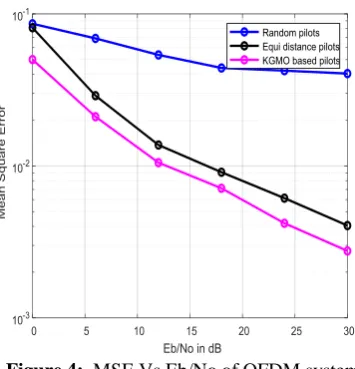
Figure 4: MSE Vs Eb/No of OFDM system
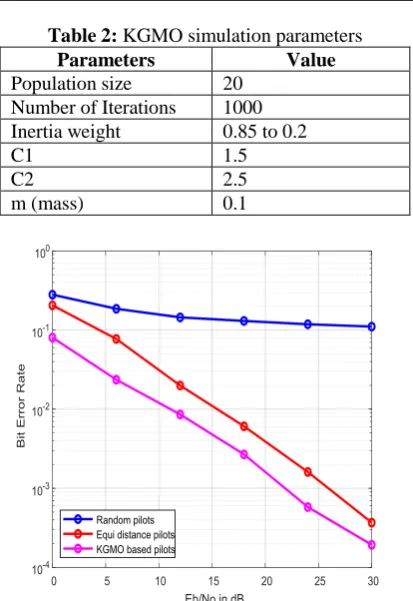
In figure 3, the graph is plotted between BER and Eb/No values. As Eb/No value is increases BER is
reducing for equal spaced pilots and KGMO based pilot systems. And there is no improvement in case of random pilot based system. From the figure with Equal spaced pilots, at 12 dB the BER value is 0.0199 and for KGMO based system the value is 0.0086. That shows significant performance improvement. The population size is 20 and the number of iterations are 1000 for obtaining the optimal solution of pilots for KGMO based
system.In Figure 4, Mean Square Error is plotted against Eb/No values. From the graph we observed that the
optimized pilots providing minimum MSE as compared to equal spaced pilots and random position pilots.
IV.
CONCLUSION
Orthogonal Frequency Division Multiplexing is a form of multi carrier modulation technique with high spectral efficiency, robustness to channel fading, uniform average spectral density capacity of handling very strong echoes and less nonlinear distortion.
In this paper OFDM system performance is evaluated with and without optimization methods. Pilots are optimally placed with the help of KGMO algorithm. BER and MSE in both graphs we observed that the performance is improved as compared to conventional technique. In the proposed system we implemented SISO-OFDM system. In future we can include multiple antennas at both transmitter and receiver side.
REFERENCES
[1]. N. LaSorte, W. J. Barnes and H. H. Refai (2008). The History of Orthogonal Frequency Division
Multiplexing. IEEE GLOBECOM 2008 - 2008 IEEE Global Telecommunications Conference, New
Orleans, LO, Jan, 1-5.
[2]. Surinder Singh, Hari Ram, Sandeep Singh Gill (2011). Performance Evaluation of Channel Estimation in
OFDM System for Different QAM and PSK Modulations. International Journal of Electrical and Computer Engineering (IJECE), 1(2), 140-150.
[3]. Nahar, Ali &Ezzaldean, Mohammed Moanes, &Gitaffa, Sabah & K. Khleaf, Hussain (2016).OFDM
channel estimation based on novel local search particle swarm optimization algorithm. Review of Information Engineering and Applications, 3(2), 11-21.
[4]. Moein S, Logeswaran R. (2014). KGMO: A swarm optimization algorithm based on the kinetic energy of
gas molecules. Inf Sci 275, 127–144.
[5]. Hsieh, M. H. and Wei, C. H. (1998). Channel estimation for OFDM system based on comb-type pilot
arrangement in frequency selective fading channels. IEEE Transactions on Consumer Electronics, 44, 217–225.
[6]. Taşpınar, Necmi&Simsir, Sakir (2018). An efficient technique based on firefly algorithm for pilot design
process in OFDM-IDMA systems. Turkish Journal of Electrical Engineering and Computer Sciences. 26, 817-829.
[7]. Eberhart, J. Kennedy and Russell (1995). Particle swarm optimization. IEEE International Conference, 4,
1942-1948.
[8]. Xiaodong Cai and Georgios B. Giannakis (2004). Error Probability Minimizing Pilots for OFDM With
M-PSK Modulation Over Rayleigh-Fading Channels. IEEE transactions on vehicular technology, 53(1),146-155.
[10]. Tufvesson, F. and Hoeher, P. (1999). Channel Estimation with Superimposed pilotSequence. IEEE GLOBECOM'99.