ABSTRACT
CATETÉ, VERONICA MEREDITH. A Framework for the Rapid Creation of Quality-Assured Programming Rubrics for New K-12 Computer Science Teachers. (Under the direction of Tiffany Barnes.)
When this research began, AP Computer Science comprised only 0.9% of all AP tests taken in 2014, with roughly 39,000 students[Col97]. After initiatives such as America Competes, CS10K, CSforAll, and the official launch of the new AP CS Principles course in 2016, this number jumped to 2.1% or 104,000 students. This tremendous surge in Computer Science enrollment is a success for the programs, but also reflects the rapid rise in the number of K-12 teachers teaching computer science.
Because of the increasing demand for new CS Principles teachers, they have been recruited from diverse backgrounds. Many CS Principles teachers do not have any background in Computer Science and others have taken just one or two programming courses in college. This lack of expe-rience makes it difficult for new teachers to identify learning goals and provide student feedback on programming lab assignments. With the rapid growth in novice Computer Science Principles teachers, new resources are needed to help teachers not only identify the computational thinking learning objectives in student lab assignments, but also to help teachers grade these programming assignments.
For CS Principles (CSP), several curricula were first designed for the college level and then used as a basis for high school CSP classes. This means that lab assignments were not already annotated with CSP-aligned learning objectives. I sought to provide rubrics that would help new teachers grade the CSP labs and give students feedback on whether they were achieving the CSP learning objectives. I first systematically made rubrics based on common Computer Science grading standards for auto graders and intelligent tutors used in college programming courses. Through this process, I found that the standards used for college Computer Science courses were not detailed enough to assess beginner-level computational thinking in projects. The small portion of the initial rubric focused on learning was biased towards expert programmers as opposed to those still learning the beginning skills taught in CS Principles. Therefore, I reoriented the rubric-making process to be focused on targeting CSP learning objectives.
to make them was too inefficient to use to create new rubrics for every CSP lab. Instead, I used the lessons learned from the Delphi studies to create a new process based on the Nominal Group Technique using ‘almost experts.’ This new process incorporates both frames of ‘think-pair-share’ and group decision making to expedite the creation process.
Through a series of reliability studies on the initial rubrics, I found that trained Computer Science undergraduates were as reliable as the CS Principles Master Teachers using the rubrics, and could act as surrogate ‘almost experts’ in systematically generating 32 learning-based rubrics using the new methods. I tested these new learning-based rubrics with active CS Principles teachers. I provided teachers high, medium, and low samples of student work, and had teachers mark in code where they were looking for the associated computational thinking concepts. I analyzed the consistency of grade distributions between graders, and also created a visualization to investigate the reliability and usefulness of the rubrics. The visualization helped me verify that teachers using our learning-based rubrics were on the right track for identifying computational thinking in code, but it also revealed that more support is needed for novice CSP teachers to grade code samples that were substantially different from the typical correct solution. These results confirmed that the modified Nominal Group Technique using almost-experts is sufficient to create learning-based rubrics that are reliable for assessing computational thinking in code.
I next applied Baartman’s Wheel of Competency Assessment (WoCA) to further investigate the validity and appropriateness of the learning-based rubrics. Using WoCA, the rubrics can be measured on 12 different quality criteria, including fitness of purpose, cost-effectiveness, meaningfulness, and cognitive complexity. Most of the criteria (10.5 of 12) focus on usability and appropriateness for teachers and the course content. The newly developed learning-based rubrics meet all 10.5 of these teacher-focused WoCA criteria. This analysis shows that the newly created learning-based rubrics are a validated method of support for identifying and understanding learning objectives in student code by novice CS Principles teachers.
© Copyright 2018 by Veronica Meredith Cateté
A Framework for the Rapid Creation of Quality-Assured Programming Rubrics for New K-12 Computer Science Teachers
by
Veronica Meredith Cateté
A dissertation submitted to the Graduate Faculty of North Carolina State University
in partial fulfillment of the requirements for the Degree of
Doctor of Philosophy
Computer Science
Raleigh, North Carolina
2018
APPROVED BY:
James Lester II Aaron Clark
Sarah Heckman Tiffany Barnes
DEDICATION
BIOGRAPHY
ACKNOWLEDGEMENTS
I am grateful to the members of my committee, Dr. Tiffany Barnes, Dr. Aaron Clark, Dr. Sarah Heckman, and Dr. James Lester II for their time, encouragement, and expertise throughout this project.
There are people in everyone’s lives who make success both possible and rewarding. My husband, Daniel McMullen, and mother Diana Pasquinelli, steadfastly supported and encouraged me. Daniel, without you I may have well starved to death 30 times over throughout my doctoral studies, thanks for putting food in front of my face.
Additionally I’d like to thank all hands and researchers who have worked on this project, including undergraduates: Lady Kathleen (Wassell) Brennan, Erin Snider, Alex Rouse, Samuel Schoeneberger, Meghana Subramaniam, and Kunj Patel; post-graduate student: David Warren; post-doctoral stu-dent: Jen Albert; and CS Principles teachers: Marney Hill and Mark Ruckstuhl.
I’d also like to thank both the SIGCSE and CSTA communities for completing so many surveys and studies and my lab mates for dealing with so many of my frustrations and jubilations as told through songs and winded sagas.
Last but not least, I’d like to thank Caroline Law and Carla Bendezu for being awesome mentees who make me proud of them so so often. And also Neil Robson, I taught you computer science as a middle school student, and now you’re majoring in it at state, and I’m still here to see it.
TABLE OF CONTENTS
LIST OF TABLES . . . .viii
LIST OF FIGURES. . . ix
Chapter 1 Introduction. . . 1
1.1 Research . . . 2
1.2 Contributions . . . 3
Chapter 2 Literature Review . . . 5
2.1 CS Principles . . . 5
2.1.1 Beauty & Joy of Computing . . . 8
2.2 Measuring Computational Thinking . . . 11
2.3 Delphi . . . 14
2.3.1 Classic Delphi . . . 15
2.3.2 Criticisms of Delphi . . . 17
2.3.3 Applications of Delphi . . . 18
2.4 Discussion on CS Education . . . 21
Chapter 3 Study 1: Systematic Rubric Development for CS Principles . . . 22
3.1 Introduction . . . 23
3.1.1 Brick Wall Assignment . . . 24
3.2 Rubric Creation . . . 25
3.2.1 Rubrics in CS Ed . . . 25
3.2.2 Criteria Selection . . . 26
3.2.3 Performance Descriptions . . . 26
3.3 Study Design and Methods . . . 28
3.3.1 Context and Data Sources . . . 28
3.3.2 Methods . . . 28
3.4 Results . . . 29
3.4.1 Code Examples . . . 31
3.4.2 Rubric Refinement . . . 32
3.5 Conclusions and Future Work . . . 35
Chapter 4 Study 2: Task vs. Learning Based Rubric Evaluation. . . 37
4.1 Introduction . . . 37
4.2 Background . . . 38
4.3 Summer 2015 Delphi . . . 39
4.3.1 The Panelists . . . 40
4.3.2 Hangman Lab Description . . . 40
4.3.3 Survey Rounds . . . 41
4.4 Rubric Evaluation Methods . . . 42
4.5 Results . . . 44
4.5.2 Learning-Based Rubric Results . . . 45
4.5.3 Between Rubrics . . . 47
4.6 Discussion . . . 47
4.6.1 Reliability . . . 48
4.6.2 Ease of use . . . 49
4.6.3 Score distribution . . . 50
4.7 Conclusions . . . 51
Chapter 5 Study 3: Delphi Methods in CS Principles Rubric Creation. . . 53
5.1 Introduction . . . 54
5.2 Background . . . 54
5.2.1 U.S. K-12 Computing Teachers . . . 54
5.2.2 Computational Thinking Rubrics . . . 55
5.2.3 Delphi Process . . . 55
5.3 Methods . . . 56
5.3.1 Lab Assignment Descriptions . . . 57
5.3.2 Panelists . . . 58
5.3.3 Survey Rounds . . . 58
5.3.4 Delphi Application . . . 59
5.3.5 Rubric Evaluation . . . 61
5.4 Results . . . 63
5.5 Discussion . . . 64
5.5.1 Delphi Process . . . 64
5.5.2 Effectiveness of Rubrics . . . 64
5.5.3 Cost-Benefit Analysis of Methods . . . 65
5.6 Conclusions and Future Work . . . 65
Chapter 6 Study 4: A Streamlined Approach to the Systematic Creation of Rubrics for CS Principles. . . 67
6.1 Introduction . . . 67
6.2 Background . . . 68
6.2.1 Rubrics in CS . . . 68
6.2.2 NGT vs. Delphi . . . 70
6.3 Methods . . . 72
6.3.1 Training new ’Masters’ . . . 72
6.3.2 Streamlining the Process . . . 73
6.3.3 Quality Assurance . . . 73
6.4 Results and Discussion . . . 74
6.4.1 A Modified NGT . . . 74
6.4.2 Rubric Quality and Distribution . . . 76
6.4.3 Limitations . . . 76
6.5 Conclusions and Future Work . . . 77
Chapter 7 Study 5: An Evaluation of BJC Rubrics with Active CS Principles Teachers . . . . 79
7.2 Methods . . . 80
7.2.1 Participant Procedure . . . 80
7.2.2 Lab Assignment Descriptions . . . 81
7.3 Results . . . 83
7.3.1 Intra-class correlations . . . 83
7.3.2 Heat Mapping and Visualization Analysis . . . 85
7.4 Discussion . . . 91
7.5 Conclusions . . . 95
Chapter 8 Rubric Development Assessment Using WoCA . . . 96
8.1 Introduction . . . 96
8.2 Background . . . 97
8.2.1 Reliability . . . 97
8.2.2 Validity . . . 98
8.2.3 Low-Stakes Problem-Based Assessments . . . 100
8.3 Measuring Criteria for Assessment . . . 102
8.3.1 Why Rigorously Evaluate Rubrics . . . 102
8.3.2 How to Evaluate Rubrics Meaningfully . . . 102
8.4 Aligning Research to the Wheel of Competency Assessment . . . 103
8.5 Discussion . . . 108
8.6 Conclusions . . . 109
8.7 Future Work . . . 110
Chapter 9 Conclusions . . . .112
9.1 Review . . . 112
9.2 Research Questions . . . 112
9.3 Hypotheses . . . 113
9.4 Contributions . . . 116
9.5 Future Work . . . 117
Bibliography . . . .119
APPENDICES . . . .130
Appendix A Resources . . . 131
A.1 Beauty and Joy of Computing Lesson Plans . . . 131
Appendix B Survey Instruments . . . 161
B.1 Study 3 (Delphi) Consent forms and Survey instruments . . . 161
LIST OF TABLES
Table 1.1 The research questions, associated hypotheses, and their locations in this
research. . . 3
Table 2.1 Differences between AP Computer Science A and Computer Science Principles as noted by the College Board[Col15]. . . 6
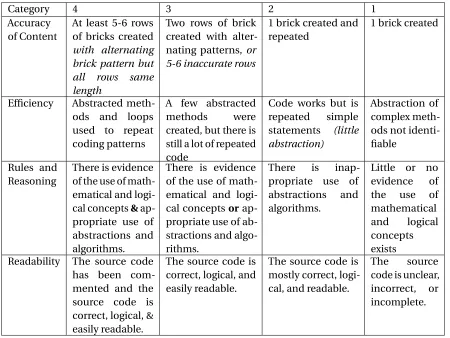
Table 3.1 Final rubric used for initial grading of student projects in Brick Wall assignment. NOTE: item in italics are additions made to the rubric for clarity. . . 27
Table 4.1 Hangman Rubric developed from Learning Objectives and Essential Knowl-edge selected by Delphi panelists. . . 43
Table 4.2 Hangman Rubric developed from performance-based rubric criteria in work by Cateté. . . 45
Table 4.3 Descriptive statistics for a comparison of means test on Group 1 vs. Group 2. (In each category Group 1 is the top line.) . . . 47
Table 5.1 Summary of metrics used in Delphi Process implementation. . . 58
Table 5.2 Sample Parameters category on learning-based rubric for Hangman lab. . . 60
Table 5.3 A breakdown of rubric grading metrics. . . 62
Table 5.4 Avg. Brick Wall project scores[0-4]using a learning-based rubric. . . 63
Table 5.5 Avg. Hangman project scores[0-4]using a learning-based rubric. . . 63
Table 6.1 Common learning objectives between between assignments with similar me-chanics . . . 75
Table 7.1 Participant breakdown for the Spring 2017 study. Participants in the middle row are part of both data sets. . . 83
Table 7.2 A sample of the categories and learning goals for the Binary Conversion Rubric. 86 Table 7.3 A sample of the categories and learning goals for the C-Curve Rubric. . . 89
Table 8.1 A summary of processes for meeting Wheel of Competency Criteria . . . 103
Table 8.2 Evidence for Wheel of Competency Assessment pt. I . . . 105
Table 8.3 Evidence for Wheel of Competency Assessment pt. II . . . 106
LIST OF FIGURES
Figure 2.1 (a) Computational Thinking Pattern Spiral shows concepts from the simple
to the complex (b) Comparison of CTP Graphs: Sim-Sokoban combination . . 13
Figure 2.2 A traditional approach to carrying out the classic Delphi method. . . 15
Figure 3.1 Levels of abstraction for the Brick Wall assignment . . . 24
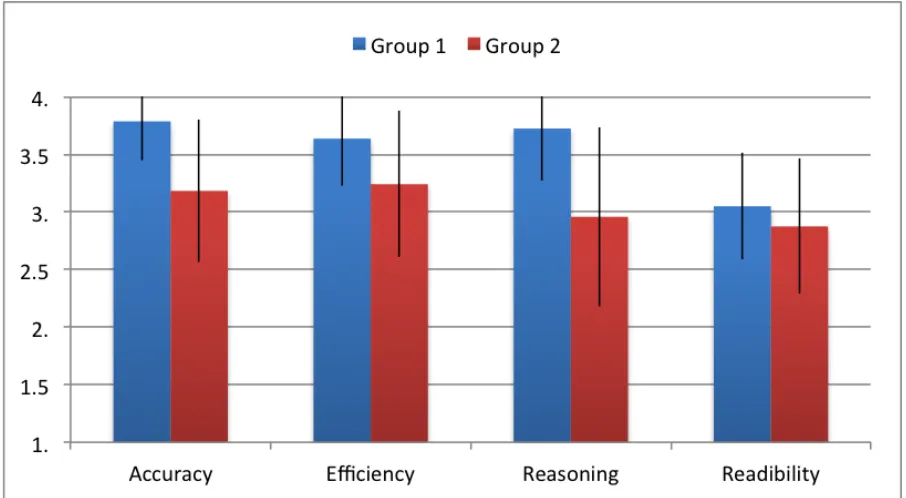
Figure 3.2 Rubric scores for group 1 and group 2 . . . 30
Figure 3.3 Low-level example, scored as: Accuracy=3, Efficiency=2, Reasoning=1, and Readability=1. . . 31
Figure 3.4 Medium-level example, scored as: Accuracy=4, Efficiency=3, Reasoning= 2, and Readability=3. This program shows lack of loops and logic . . . 32
Figure 3.5 High-level example, scored as: Accuracy=4, Efficiency=4, Reasoning=4, and Readability=3. Program uses loops & math to generate correct output. . 33
Figure 3.6 Two brick walls with differing row alignment on the right side. . . 34
Figure 3.7 Blocks showing student misunderstandings. . . 34
Figure 4.1 (a) New block to display a secret word ‘Hangman’ style. (b) Beginning structure of a ‘Word-list’ block. . . 41
Figure 4.2 This figure compares projects evaluated by a performance-based rubric be-tween group 1 and group 2. . . 46
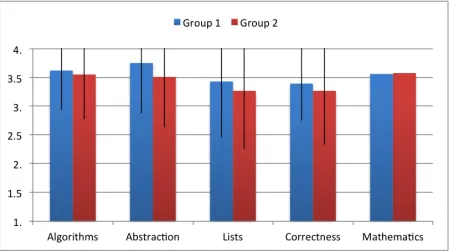
Figure 4.3 This figure compares projects evaluated by a learning-based rubric between group 1 and group 2. . . 48
Figure 4.4 Student score correlations across rubrics . . . 49
Figure 5.1 A simplified version of the Delphi Process. . . 56
Figure 5.2 Levels of abstraction for the Brick Wall assignment . . . 57
Figure 5.3 Block displays a secret word ‘Hangman’ style. . . 57
Figure 5.4 A portion of the code sample critiqued by Delphi Panelists in Round 3. . . 60
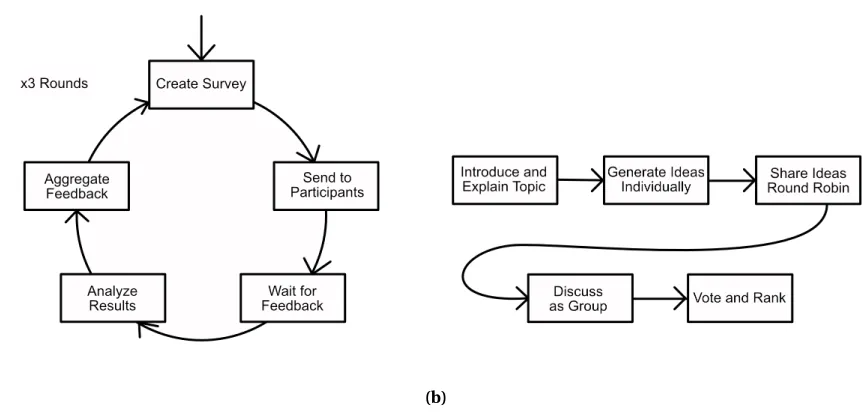
Figure 6.1 (a) The Delphi Process hinges on iterative cycles of survey generation and response aggregation. (b) The Nominal Group Technique encourages partici-pants to write ideas down individually prior to sharing with the group. . . 71
Figure 6.2 Our Modified Nominal Group Technique pairs participants prior to group discussion. . . 74
Figure 7.1 Base Snap!code for a Decimal to Binary conversion block. . . 81
Figure 7.2 Level 1 and 2 of the C-Curve algorithm . . . 82
Figure 7.3 Extended recursion levels of the C-Curve . . . 82
Figure 7.4 Heat map of areas that influenced grader decision for ‘Mathematics’ in Binary Conversion 1 . . . 87
Figure 7.5 Heat map of areas that influenced grader decision for ‘Mathematics’ in Binary Conversion 2 . . . 87
Figure 7.7 Heat map of areas that influenced grader decision for ‘Mathematics’ in
C-Curve Sample 1 . . . 90
Figure 7.8 Heat map of areas that influenced grader decision for ‘Mathematics’ in C-Curve Sample 2 . . . 90
Figure 7.9 Heat map of areas that influenced grader decision for ‘Mathematics’ in C-Curve Sample 3 . . . 91
Figure 7.10 Combined score distribution for C-Cure Sample 2, ICC(2,14)=.75. . . 92
Figure 7.11 Teacher score distribution for C-Cure Sample 2, ICC(2, 6)=.74. . . 92
Figure 7.12 Student score distribution for C-Cure Sample 2, (ICC2, 8)=.31. . . 93
CHAPTER
1
INTRODUCTION
In 2010, six different pilot courses were proposed for the new Advanced Placement Computer Science Principles course being developed by the College Board. One such proposal was to refit the college-level Beauty and Joy of Computing course into the CS Principles framework. Both courses were designed using the 7 Big Ideas of computing (Abstraction, Creativity, Algorithms, Programming, the Internet, Big Data, and Social Impacts of Computing) so relatively minor adjustments had to be made to align to the new framework. Unfortunately, throughout the initial pilot years, the CS Principles framework as well as the BJC curriculum underwent numerous changes. This created a situation where teachers participating in the CS Principles (BJC) pilot program were unsure of the intended learning objectives of the BJC labs. Several of the original BJC assignments were more rigours than what was required for AP CS Principles so teachers were less prepared to teach them or provide sufficient student feedback for them. Furthermore, as BJC was originally a college course, required documentation for K-12 school systems didn’t exist. This includes things like pacing guides, blueprints, and other documents linking the course materials back to the national standards in the AP CS Principles Framework.
it difficult for teachers to identify what learning goals were associated with each lab assignment. Those who originally made the lab assignments had moved on or were no longer available to work on the project. While the pilots for CS Principles were occurring, there was another national movement, CS10K, where Universities and other groups were working to train 10,000 new high school computing teachers. This eminent growth in novice Computer Science Principles teachers, meant that new resources would have to be built to help teachers not only identify the computational learning objectives in student lab assignments, but also to help teacher grade these programming assignments. As one of our newer BJC professional development attendees stated, “I’m not sure what my students are supposed to be be learning from this lab or even how to tell if they did.”
There are over 42,000 high schools in the United States and despite the critical and growing importance of computer science, only 2,100 of them are certified to teach Advanced Placement1
Computer Science A (AP Computer Science). When this research was first proposed, AP Computer Science comprised only 0.9% of all AP tests taken in 2014, roughly 39,000 students[Col97]. After initiatives such as America Competes, CS10K, CSforAll, and the official launch of the new AP CS Principles course in 2016, this number jumped to 2.1% or 104,000 students. This tremendous surge in computer science enrollment is a success for the programs, but also reflects how many new computing teachers are entering the fold and teaching AP level courses.
1.1
Research
Due to the increased need for computer scientists and the unprecedented growth of CS Principles, I have decided to focus on how we can help novice CS Principles teachers identify student learning of computational thinking through coding assignments by investigating the following set of questions listed in Table 1.1. My overriding research goal is to identify and clarify core lessons of the CS Principles curriculum, specifically in BJC, in order to provide teachers with a rubric system to evaluate student artifacts for evidence of achieving the computational learning objectives.
I begin by first creating rubrics using methods from auto graders and intelligent tutoring systems (Chapter 3). I then refactor the rubric design to use learning objectives established by an expert Delphi panel and compare it to the initial rubric design (Chapter 4). I compare a more traditional Delphi method to a modified version that is more time efficient (Chapter 5). The lessons from that study, I then apply to a more streamlined process in Chapter 6 in order to create the full set of rubrics for BJC teachers. In the final study, I analyze those rubrics for reliability and teacher helpfulness in their ability to identify computational learning objectives in code (Chapter 7). I conduct an overall level of quality analysis in Chapter 8 to conclude this research. My contributions are listed briefly in
the next section. Then Chapter 2 presents relevant background literature. Those familiar with my proposal may wish to start at Chapter 5.
Table 1.1The research questions, associated hypotheses, and their locations in this research.
Research Questions & Hypotheses Chapter
How can we help teachers better understand learning objectives for labs and identify whether they are achieved in student artifacts?
[H1]We can use the Delphi method to create learning-based rubrics that per-form better than traditional task-based rubrics at helping teachers grade assign-ments meaningfully.[H2]Use of the Delphi method to create rubrics will lead to sufficient levels of inter-rater reliability among novice graders for low-stakes assessments such as lab programming projects.
Chapter 4; Chapter 5
How can we modify educational psychology methods to meet our needs for creating a large set of rubrics for classroom settings?
[H3]We can use a modified NGT approach to efficiently and quickly produce a full suite of quality assured rubrics for BJC lab assignments.[H5]We can apply the Wheel of Competency Assessment to show that the created rubrics are appropriate for low-stakes assessment of CS Principles labs.
Chapter 6 & 7; Chapter 8
How well do teachers identify computational thinking in student artifacts using task-based and learning-based rubrics?
[H4]Learning-based rubrics will help support beginning CS Principles teachers consistently assess important computational thinking elements in student code.
Chapter 7
1.2
Contributions
1. I conducted the first application of the Delphi Method to create content-validated rubrics for a K-12 computing course. Using these methods we were able to gain insights on stream-lining a robust process for creating a large quantity of quality rubrics, which benefits the rapidly expanding CS Principles program and can be applied to other newly developed novice computing courses.
adjust as students in lower grades become more experienced. Thus, being able to generate new reliable rubrics quickly and so that they support novice teachers will be beneficial.
3. I proved that the rubrics created with the new modified NGT process and almost-experts are as reliable as the initial Delphi generated rubrics. As our modified NGT method was more cost-effective and efficient due to using surrogate experts, it was critical to ensure that they held up to the same standards as the initial Delphi rubrics. Ensuring a level of quality assessment to our rubrics is important for their adoption by teachers.
4. I devised a novel application of the Baartman’s Wheel of Competency Assessment to establish a high level of validity, value and acceptability of the rubrics. By aligning our rubrics to the Wheel of Assessment we were able evaluate whether these rubrics met their intended goals. As we used new tools and open-ended processes to assess student work, it is important to evaluate their appropriateness for use by new CS Principles teachers.
CHAPTER
2
LITERATURE REVIEW
As Jeannette Wing first posed in 2006, “computational thinking involves solving problems, designing systems, and understanding human behavior, by drawing on the concepts fundamental to Computer Science[Win06]." The National Research Council (NRC) believes that computational thinking is a skill necessary for all persons in every field. When they met to discuss the scope and nature of computational thinking in the classroom, leaders deliberated on how we recognize computational thinking in students and their work[Nat10]? As a part of this research, I intend to help answer this question. In order to do so, I draw on frameworks and methods from Computer Science and Education literature. Below I present background information on CS Principles and the Beauty and Joy of Computing followed by measures of computational thinking and approaches to conducting Delphi studies.
2.1
CS Principles
[ACM15]. In fact, AP Computer Science A was the least diverse AP course1from 2010-2014 with 85% male and 84% Asian or Caucasian students[Col97]. Advocates for CS Principles reiterate that CS Principles is not a replacement and is instead a complement to the original AP Computer Science course. The primary difference between the two courses is that AP Computer Science is an applica-tions course with over 20 hours of hands on lab and Java programming assignments recommended, whereas CS Principles has programming as only a small portion of the class focus, and even then, the programming is typically done in a non-syntax specific manner (e.g. Snap!, AppInventor etc). In CS Principles, the creators want to bring home the global impacts and widespread influence of computing technologies. See Table 2.1 below for key difference between the two courses.
Table 2.1Differences between AP Computer Science A and Computer Science Principles as noted by the College Board[Col15].
AP Computer Science A AP Computer Science Principles
Curriculum is focused on object ori-ented programming and problem solving
Curriculum is built around fundamentals of computing including problem solving, working with data, under-standing the Internet, cyber security, and programming Java is the designated programming
language
Teachers choose the programming language(s)
Encourages skill development among students considering a career in com-puter science or other STEM fields
Encourages a broader participation in the study of com-puter science and other STEM fields, including AP Com-puter Science
AP assessment experience: Multiple-choice and free-response questions (written exam)
AP assessment experience: Two performance tasks stu-dents complete during the course to demonstrate the skills they have developed (administered by the teacher; students submit digital artifacts) Multiple-choice ques-tions (written exam)
Researchers have found that the disconnection between computer programming in AP Computer Science and its implications for people and everyday lives has impacted the overall representation of females interested in taking the course[Col97]. We see from other STEM courses that females are interested and capable in Math, Biology, and other science courses[Mod12]. Women have the same capability to take a programming course, however they don’t see how it relates to or impacts societal good. Based on this evidence, the NSF and College Board paired up to create a computing principles course that focuses on the people and societal impacts of computer science.
The CS10K project mentioned previously is focused on two new courses: Exploring Computer Science (ECS) and Computer Science Principles. Both courses focus on making computing relevant to underrepresented minorities; however, their benefits are slightly different. AP courses are often the only high school courses that offer college credit, which make them attractive to students and schools. They also offer a point of national leverage and hold students to the same standard of final exam. ECS is important for those who might be intimidated by an AP course. ECS offers a broad range of ideas and counts towards college prep and Career and Technical Education credit (CTE).
One of computer science education’s landmark publications is the bookStuck in the Shallow End(SSE), by Margolis, which discusses the racial inequities in the computing classroom. This book is the culmination of several years of research on the Los Angeles Unified School District (LAUSD). The findings included a lack of qualified teachers and minimal community support for CS teachers in low-income schools[Mar08].
Three case studies are detailed in SSE; the first study is in a lower income school with a pre-dominantly Latino and English learner population. This school had computer labs and equipment available, although the only computer programming course stopped being offered during the third year of the study. The promotional videos showcasing the school’s status as a Digital High School show students using computers for courses like art and design. The programming teacher was primarily a mathematics teacher who was self taught in computing. The students copied programs from a projector and wrote them into a computer; rarely would an activity or assignment go beyond calculations. Furthermore, when there was a class being offered, not many minorities were in it, as guidance counselors would relegate these students to the vocational wing. The minority students were often seen as lacking the ability to do the higher level thinking required for computing. It was the view of administration that since many students did not know English well enough, it was foolish to teach them higher level courses.
minorities and girls felt excluded. So even though the students had access to quality programs, they did not want to take part because of what their peers might think, or how their counselors viewed them.
This research gave way to the enhancements of teacher training and enrichment to AP Computer Science. Unfortunately, for many of the students, this barrier was too high for those lacking prior CS knowledge or experience. ECS was the answer to the gap in LA and other similar areas. It targets 9th and 10th grade mostly (although some use it in middle school or higher grades) and includes the cultural aspects of students in the course. ECS also has a very tight knit community of teachers and teacher training available. In order to ensure the same quality of teaching and student experience, ECS also features a very strict curriculum (albeit an engaging one). Researchers still wanted to produce a high enough level computing course to count as AP while addressing the similar diversity problems. CS Principles was created to be both informative enough and flexible enough to work as an AP credit.
CS Principles is a course framework for teaching the principles of computer science. The creators of this framework identified seven big ideas central to computing. In addition to programming; abstraction, algorithms, and social impact are also central to this course. It is important for students in CS to not only know about syntax while programming, but also to focus on the bigger picture, such as using abstraction to simplify problems and break things down into sensible pieces. The creators want students to be able to abstract algorithms and apply them to different areas. An example of this is researchers at Microsoft using the same kind of algorithms for detecting spam mail to help identify bad blood cells for those with HIV[Cla11]. Being able to make connections between ‘boring’ tasks and life saving techniques is a brilliant way to attract a more diverse demographic into computing. A research study on women and career perspectives, found that women want careers that help people[Mod12; Cec09; Sch08]. Highlighting the global impact of computing can make computer science a viable option for those who want to focus on projects helping people. The AP exam for CS Principles has also been modified compared to other standard exams. Students turn in a Performance Task portfolio that contains both collaborative and individual projects. Projects entail both written response and creation of a digital artifact. The performance tasks are designed to allow students to have broad latitude in personally selecting their focus and topics.
2.1.1 Beauty & Joy of Computing
the University of Washington Bothell, who joined CS Principles after working with Larry Snyder (a Phase 1 CS Principles host), started a digital thinking course focused on game development[Mor13; SS14]. BJC on the other hand uses a syntax free language called Snap!as its main vehicle; it also incorporates mobile apps, and game development. Each course has been implemented with specific goals in mind and has separate strengths. I will discuss a few of these and then give an in depth look into the BJC curriculum.
Each of the CS Principles implementations revolves around the 7 big ideas of computation: creativity, abstraction, algorithms, programming, the Internet, big data and global impact. What distinguishes the implementations is how much time they devote to each topic, and what tools they use to do so. In the first phase of CS Principles pilots, coverage ofalgorithmsranged from 13% to 29%[Sny12]. In the case of our first CS Principles example, Mobile CSP by Morelli, the core programming aspects of the class are done through MIT’s AppInventor technology. Mobile CSP is broken into 7 units, the first being a setup and pre-course unit, the others revolving around mobile applications and creativity. These units are: Mobile computers and mobile apps; Graphics and Drawing; Animation, Simulation, and Modeling; Algorithms and Procedural Abstraction; Lists, Databases, Data and Information; The Internet[Tri15]. The first three units utilize AppInventor tutorials and activities from CS Unplugged[Can15]. For the data section AppInventor allows students to use built-in database features highlighting tagging, persistent data, and shared data. Mobile CSP features 32 CS Principles (or non-programming) lessons and 28 programming lessons. Morelli offers a miniature Massive Open Online Classroom (MOOC) to train teachers in using MIT’s AppInventor software and allows teachers to pick and choose which modules they apply to their course[Mor15]. In Mobile CSP students learn computer science by building socially useful mobile apps.
and Conditionals; Computational Complexity; AI; Instruction Execution; Networking and DNS; and finally WWW: Search and Tagging. This course focuses much more on the lower level details of computing and digitization than other implementations like Mobile CSP.
BJC aligns with Mobile CSP in that it uses a graphical language approach and usesBlown to Bitsas a reading companion for the class. Blown to Bits: Your Life, Liberty, and Happiness After the Digital Explosion gives a balanced perspective on personal data and the digital age. A large portion of the book covers ethics in computing and the dangers of having information stored on the Internet, some by choice others not. Both the high school teachers and students find this book very intriguing and socially relevant. Unlike a traditional textbook, this one is written as pop fiction and is meant to engage the reader. BJC teachers have been very quick to pick up the literature and are able to facilitate discussions around the different chapters. The book does a good job at relating to topics the students are learning like bits and binary to information or technology they use every day.
BJC emphasizes reflection on the impacts of computing on society because the designers want students to be critical thinkers, understanding the (often unintended) social, ethical, and economic implications of technology and computing. In each implementation of BJC, current events and interdisciplinary applications are emphasized to connect with students and maintain relevance. The latest version of the course offers 20 topical units, the first fifteen being organized by pro-gramming concept, and the remaining five as extensions (e.g. Simulation in Science)[Uni15]. The programming units are accompanied by additional videos and resources on a non-programming topic such as ethics in computing or social implications of computing. What separates BJC is its inclusion of recursion and higher order functions. From the program’s funding grant, “BJC invokes passion, beauty, joy, and awe through engaging students in a rigorous computing curriculum that promotes creativity and collaboration using Snap!’s visually rich programming environment, while also provoking thought around current events and how computing relates to people’s lives”[Gar11]. The researchers believe that recursion and higher order functions (HOF) exemplify this beauty of abstraction, one of the core ideas in computer science and in the CS Principles course design.
A higher order function is one whose domain or range includes other functions[AS96]. Higher order functions are an extremely powerful means to capture patterns of control flow in a program, eliminating the need to keep track of index variables and individual array elements. In order to successfully teach recursion and HOF the researchers built the Snap!programming language to support these implementations[Har14]. An example of this is using functions as data in the
“map
over”
block where a user can map an operation like 5×x over a list resulting in each elementallows students to implement and grapple with the ideas of these at a much earlier point. Where as Digital Thinking focused on an authentic programming environment, BJC focuses on authentic programming problems.
With many of our CS Principle teachers being new to the curriculum or even subject, we must be able to support them and help them identify what students are learning, how they are learning, and ways in which we can facilitate teachers teaching. Shulman suggests that teachers should have a strong background in three main areas: subject matter, curriculum knowledge, and pedagogical experience[Shu86]. Teachers can go to professional development training for curriculum and have pedagogical experience already. The main part where CS educators can help is in the subject matter. Without strong preparation in the subject matter, teachers are consistently just a step ahead of their students. Many teachers can get flustered when students ask questions that they don’t know the answers to[CST08]. Gal-Ezer recommends that teachers need to have the computing skills, plus the ability to convey it to kids[GES10]. It’s difficult to convey knowledge at a lower level when you don’t know the knowledge to begin with.
2.2
Measuring Computational Thinking
As researchers have begun exploring the space of computational thinking (CT), the definition has morphed; specifically to include “formulating problems so their solutions can be represented as computational steps and algorithms"[Aho12]. From a recent survey of the field, Shuchi Grover and Roy Pea compiled a list of elements that are now widely accepted by the academic community as comprising computational thinking:
• Abstractions and pattern generalizations (including models and simulations)
• Systematic processing of information
• Symbol systems and representations
• Algorithmic notions of flow of control
• Structured problem decomposition
• Iterative, recursive, and parallel thinking
• Conditional logic
• Efficiency and performance constraints
• Debugging and systematic error detection
connections between other concepts or applications, by expressing themselves through computing or asking questions[BR12]. Pulling code from children in the Scratch community, they used the Scrape tool[Wol11]to analyze code for frequencies of block use. They compared a new member’s project (1 week in community) to a more active member’s project (3 year member, 49 projects). Results show there is a clear distinction in number and type of blocks used, demonstrating the differences in understood CT concepts. However, their results were limited as they were unable to identify practices or perceptions of the designers. The researchers followed up with in-person interviews and asked kids what parts of their code did. The researchers were surprised however, to find out that the kids did not always know for sure. In one case, researchers were interviewing a student about his project, and the kid told them that he borrowed the code from someone else because the results looked cool. From this the researchers found that presence does not equal deep understanding. They also asked about practices, however the kids claimed to never get stuck and had lapses in memory. The third stage of research for studying computational thinking involved a classroom setup with design scenarios. Students in class were given external programs over the course of the semester and were told that another student needed help fixing his program. From this, researchers could get a more accurate report on strategies and practices involved, but again learning about perspectives was difficult. Limited observations did not provide the appropriate level of insight into the thought formation process of the students.
In Brennan and Resnick’s research, they were trying to develop a framework for studying the development of computational thinking. One of the difficulties they had in analyzing Scratch projects was the projects from Scratch Online that were remixed from others. They were unaware of the students’ lack of knowledge. In Snap!projects, students do not have the ability to remix other works, which alleviates the problem of copy-paste. Students would have to understand what is going on before they finish. Therefore, if the students received directions for a project instead of a nearly completed project, they would be able to demonstrate CT concepts.
Further work by Koh attempts to develop a method for the automatic recognition of compu-tational thinking. In Koh’s 2010 paper, they use a compucompu-tational thinking spiral; see Figure 2.1 (a), developed for the Scalable Game Design course to analyze what computational thinking patterns are in students’ code. When analyzing the student project (written using AgentSheets) the researchers look at program behavior similarity as well as use latent semantic analysis (LSA) to evaluate student code. They illustrate the frequency and types of critical thinking patterns implemented in their Computational Thinking Pattern (CTP) Graph (a star plot with CT’s listed as the outer vertices), Figure 2.1 (b).
(a) (b)
Figure 2.1(a) Computational Thinking Pattern Spiral shows concepts from the simple to the complex (b) Comparison of CTP Graphs: Sim-Sokoban combination
The authors hope that use of the graph will allow reviewers to more easily see the degree to which concepts are present. Current limitations include, as Koh states, the “arbitrary nature" of the speci-fied computational thinking patterns used in the graph as well as the number of them. The patterns specified in the CT spiral include items such as diffusion and hill climbing that aren’t necessarily generalizable concepts. The researchers also had difficulty in differentiating the concepts. We agree that the CTP graph could be useful for an at-a-glance overview of particular concepts that show up in students’ code.
there were lower learning gains2(NG≤0.3) compared to 85% of interactive-engagement courses (0.3≤NG≤0.7)[Hak98]. The strength of this study was that is was able to use the FCI (now a gold standard for other CIs) as a common measure among institutions and instructors.
Taylor performed an extensive literature review in 2014 investigating the development, use, and difficulties of CIs for Computer Science[Tay14]. Only two validated CIs for Computer Science exist. They are both at the University level, one for Digital Logic created in 2010[HH10], and another for CS1 (language independent) created in 2011[TG11]. The CS1 concept inventory is actually described as a computational assessment, and question answers do not follow the typical creation process as other CIs, but is nonetheless valid via mass distribution testing. Other unvalidated or incomplete CIs have been created for Operating systems[WT14], Computer architecture[Por13], Algorithms and Data structures[PV13], and Binary Search Trees and Hash tables[KW14].
The typical process for creating a concept inventory is very lengthy and involves determining the topics, identifying student thinking, creating open-ended survey questions, creating forced-answer tests, validating test questions through interviews with experts, followed by administering and statistically analyzing the inventory[AW11]. The importance of identifying student thinking is to add valuable distractor answers to multiple choice questions. The distractor draws students with misconceptions toward the associated distractor, which gives test administrators (teachers) insight into which concepts and misconceptions students are struggling with.
Other common practices for developing a CI include using a Delphi Process to facilitate reaching a consensus among CI developers for key concepts[Gol08]. Taylor discusses difficulties unique to the computing discipline. One of the main arguments is that, unlike the older fields of Calculus and Newtonian mechanics, Computer Science is changing rapidly. The time and effort being used in other STEM fields is worth it because those fields are not as likely to change in the next 20 years. BJC and CS Principles teachers are requesting materials to identify learning objectives, for themselves, in course materials. They are unclear of the current learning goals in the programming assignments, and would benefit from a rubric letting them know what a particular concept looks like in code. As a concept inventory asks coding questions that reveal particular understandings, the rubric would reveal code that applies to known objectives. In order to proceed with this development of a rubric, we can use similar practices to those used for concept inventories, particularly Delphi Processes.
2.3
Delphi
The Delphi process is a technique originating in the 1950s to obtain the most reliable consensus of opinion from a group of experts using intensive questionnaires interspersed with controlled opinion
feedback[DH63]. Instead of relying on random samples, Delphi studies represent the best thinking and opinions of a group of people chosen for their special knowledge and experience[AZ96; Lec84]. As emphasized by Adler, expertise is not tied to having a Ph.D. in the subject, but rather knowledge and practical engagement with issues under investigation[AZ96].
The Classical Delphi is characterized by four pillars: anonymity of participants, iteration for participants to refine their views, controlled feedback informing participants of other perspectives, and statistical aggregation of the group response to allow for quantitative analysis and interpretation of data[RW99]. As part of the Delphi Process, panelists complete a series of questionnaires which are analyzed and processed, with the results integrated into the next stage of survey rounds; Figure 2.2 outlines this process.
Figure 2.2A traditional approach to carrying out the classic Delphi method.
As outlined by Skulmoski, the typical Delphi method can vary greatly in application[Sku07]. The modified Delphi comes in many forms and has evolved over the last few decades. We’ll explain the Classical and some of these modified Delphi the subsection below.
2.3.1 Classic Delphi
Project Delphi was originally used in the early 1950s by the U.S. Air Force to apply expert opinion to the estimation of bombing requirements to reduce enemy munitions output[DH63]. In this process, experts were identified and independently answered a series of questions eliciting the creation of recommendations. Researchers then had a moderator team collate the responses, and give the information back to the experts (again independently) so that they could narrow down their responses and reach an agreement. The researchers used a moderator team as a go between to help eliminate researcher bias in the coding of responses in the study.
In the 1970’s Linstone and Turoff used the Delphi method to make policy judgments. They valued the Delphi as a tool for policy type questions that involved aspects such as goal formation for which their were no overall experts, only advocates and referees. For these policy questions, the resolutions must take into consideration the conflicting goals and values espoused by various interest groups as well as facts and staff analysis[LT75]. Linestone and Turoff use the Delphi to help stakeholders formulate ideas, expose options, determine positions, explore disagreement, and evaluate underlying reasons all while maintaining an objective perspective. They found 3 rounds to be sufficient in attaining stability in responses. When analyzing Delphis they found that the most common judgment indicators were simple rank and likert type questions. Linstone and Turoff also set the standard for consensus to be when the interquartile range is no larger than two units on a ten unit scale.
By the 1980’s the Delphi method had started being used for futures predictions. In order to make informed decisions on policies and funding that would impact the mentally ill for the next 20 years, Lecklitner surveyed 345 persons that played the most prominent roles in decisions regarding the rights of the mentally ill. In this situation, stakeholders now included current and former mental health care recipients, parents and family, mental health and social service providers as well as patient rights advocates, community representatives, and academics and researchers in related areas. In Lecklitner’s study the samples represented the best thinking and opinions of a group of people chosen for their special knowledge and experience[Lec84]. Only two rounds were conducted in this study, the first to generate forecasts on quality of care and concerns that the group had. The second round to generate plausible solutions to these issues. The main goal was not to come to a single consensus, but rather to get people talking about and making informed decisions about the future.
The systematic process of opinion gathering that is the classical Delphi has been outline by Brooks in the following eight steps[Bro79]:
1. Panel of experts is identified.
3. Individual input on a given issue is gathered and combined into basic statements.
4. The data provided by the panel are analyzed (by a moderator team).
5. The assembled group input (questionnaire) is mailed to each panel member for assessment.
6. The new input is analyzed (by the moderators). The results, indicating the distribution of responses, are returned to the panel.
7. Each participant is asked to examine the data and to reassess his own position based on the group’s responses. A participant whose personal position varies significantly from the group norm is asked to provide a rationale to support the divergent view. The length of the rationale (remarks) is limited to keep responses brief.
8. The input is analyzed by the researcher. The input is shared, in addition to the minority supporting statements, with the panel. Each member is asked again to review his position; and, if still not within a specified range, to support that position with a brief rationale.
From the early days of the Delphi, the process has begun to morph in new ways to accommodate the growth in diverse sets of research questions. One variation to the classical Delphi has been scope of response in the first round. In Friend’s research, panelists were given an initial set of narrow questions based on literature derived content instead of generating the initial statements or opinions to a problem[Fri01]. This is further expanded in Cabaniss’ study on computer-related technology use by counselors, Delphi panelists were tasked with submitting written examples of CRT use by counseling professionals[Cab01]. This deviated from the traditional survey format of Likert type questions, providing a richer context of understanding to the researchers.
2.3.2 Criticisms of Delphi
Since its inception, the Delphi model has drawn criticism and support. The primary source of criticism comes from a report from RAND researcher Harold Sackman who identified perceived failings of the method[Sac74]. Many scholars have built on this work either using it to refute or expand further criticism. In general, criticism of the method falls along three lines; those relating to the role of the researcher, those relating to the role of the experts, and those related to the process itself.
losing expert participation[Jud72]. Supporters respond primarily by trying to outline what is and is not a true Delphi study[RW99]citing poor implementation as incorrect use by the researcher. In addition new technologies such as the internet minimize “hurry and wait” by shortening the delivery time of next rounds to participants[Sku07].
Criticism of the method also focuses on the use and behavior of experts. Sackman argued that Delphi’s use of valid expert opinion is “scientifically untenable and overstated”[SZ75]and Delphi responses are likely to be ambitious[Sac74]. In addition, experts are not held accountable for their opinions even when their views are extreme[Sac74]. The use of a group of experts is motivated by the principle assumption that group decisions are better than those made by a single individual[MJH95a]. Delphi’s effectiveness in forecasting[Win97]gives support to that claim. Further, supporters argue that even in scenarios where extreme expert opinions are present, those with more extreme views are more likely to drop out of the study leading to consensus[Bar84].
Finally, criticism also exists of the process itself with critics arguing that Delphi falls outside mainstream methods of scientific questionnaire development[Sac74]. Supporters argues, however, that the Delphi method is no less methodically rigorous than other qualitative methods such as interviews[Tur70]. Ultimately, criticisms and support for Delphi reflect biases inherent with the process. Delphi’s anonymity can be seen as eliminating the adversary process[Sac74]or minimizing the effects of domineering experts[Mar91]. Delphi’s iterative examination can either be seen as discouraging exploratory thinking[Sac74]or reaching consensus[MJH95b]. It is the goal of the researcher to understand what this system affords and removes to identify whether or not the process is appropriate for their target goals. As there is longstanding support for the process’s effectiveness in educational planning[WS74], rubric creation through Delphi is well motivated. The section below highlights several of these educational uses as they pertain to computer science.
2.3.3 Applications of Delphi
experts; 10 high school science teachers and 15 science education researchers from Tier 1 research universities. In order to ensure a wide variety of teachers and get varying viewpoints, high school teachers were selected from across the country with no more than two teachers working in the same state. For the university researchers, it was decided no more than two per university. Expert qualifications for both parties were determined by national or state honors, level of degree, and years of experience either teaching high school science, or teaching teachers[Klo14]. After the three rounds of voting on 10 starter practices and 50 nominated ones, the group came up with 9 teaching practices for high school teachers that they found to be very important. This also included coming up with a common language that would satisfy all of the experts, as discourse around certain terms was high.
were a list of recommendations related to both implementation and research of computer science education, in addition to a list of different computer science definitions for Business Education, Mathematics, and Science. Some of the key recommendations are in the computer science support section, such as: a course on the methods of teaching computer science, a skills requirement that includes becoming more knowledgeable about the subject matter and the mastery of different instructional techniques that are more appropriate to higher levels of instruction, and a certification requirement. As mentioned earlier these types of certifications and requirements are not as prevalent as one might hope. As of 2011, only South Carolina had a certification requirement for high school computer science teachers[Wil11].
A newer use of Delphi has been in the recommendations for competencies and learning objec-tives for a Game Art and Design class in North Carolina[Mac11]. In this four-round Internet-based study, the Delphi panel consisted of experts from the Independent Game Developers Association (IGDA) game education special interest group. Members were solicited and those interested re-sponded to the accompanying demographics survey. The required criteria that determined which members were chosen as expert panel members included having at least two years of experience with gaming, and having at least two semesters experience teaching gaming. Thirty three members were selected, three for the review panel, and thirty for the expert panel. The expert panel was utilized for creating the list of learning objectives and the review panel was used to maintain consistency with the instruments and editing. The initial instrument sent out in round one was based on the nine Core Topics developed by IGDA. Panelists had space to add additional competencies or modify the wording of the ones provided. Once results were sent back in, the researcher made edits and sent the instrument to the review panel to approve. This helped eliminate bias that the researcher might have introduced. Round Two gave experts the option to Accept, Reject, Modify, or Add new competencies and rate them on a scale of 1 to 5, five being the highest. Competencies and objectives with a rating of 3.01 or higher were then moved on to round three. Round three involved ranking the remaining competencies for importance. These results allowed the researcher to correlate the ratings to the medians from previous rounds and enable the researcher to further observe favored competencies while identifying consensus if any. The final round was a simple Accept or Reject of the remaining competencies; no modifications were allowed at this stage.
suggested concept. Again the data were summarized and sent back; this time when panelists went to rate an item they would have to provide a justification if their vote was outside the interquartile range of the previous round. Meaning that if their vote was one deviation outside the group average, they would have to justify their strongly contrasting opinion. Finally, in Phase 4, expert panelists were given one last chance to rate the suggested concepts. Findings showed that over time the standard deviation dropped, as expected. A final list of the top 10 concepts for each class was created. Goldman et al. suggest that readers should take the concepts at face value, as experts agree these are important things that need to be focused on. However difficulty rating should be taken with a “grain of salt" as teachers might have different difficulty gauges and have incomplete understanding of student learning. Goldman suggests future interviews with students to get a wider view of concept difficulty. Experts might have a blind spot to concepts where students have frequent misconceptions.
2.4
Discussion on CS Education
CHAPTER
3
STUDY 1: SYSTEMATIC RUBRIC
DEVELOPMENT FOR CS PRINCIPLES
(Best Paper Nominee) Cateté, V., Snider, E., & Barnes, T. (2016, July). Developing a rubric for a creative cs
principles lab. In Proceedings of the 2016 ACM Conference on Innovation and Technology in Computer Science Education (pp. 290-295). ACM.
Abstract
3.1
Introduction
Beauty and Joy of Computing (BJC) is a version of Computer Science Principles (CSP), a new Ad-vanced Placement course, created as an attractive and engaging introduction to computer science that can be taken in high school for college credit. BJC is a rigorous course that uses open-ended
Snap!programming problems to teach the seven big ideas of CSP: creativity, abstraction, data and information, algorithms, programming, the internet, and global impact. With funding from the National Science Foundation, the BJC project has provided professional development for over 140 high school teachers nationwide. Teachers enjoy the course and it is well-received by students from diverse backgrounds[Pri15], but teachers report that it is difficult to assess student work and provide students the detailed feedback they need to grow in their computing skills. Most BJC teachers do not have a computer science background, and therefore have no experience evaluating code, or even in understanding how the complex, open-ended programming labs relate to the seven big ideas of the course. Therefore, it is critical that we help new teachers understand how the tasks students undertake in their labs can be assessed, and how their performance relates to the course’s learning objectives.
To address this need, we are defining rubrics for BJC labs that teachers can use to grade student programs. We envision that these rubrics will be usable by new teachers for assessment, and for providing students with meaningful feedback that links to the course’s important content. This paper represents the first step in our process - identifying common novice programming grading criteria, adapting them to a specific BJC lab, testing their application on student programs, and refining the rubric to obtain good inter-rater reliability. While grading student programs is straightforward for experienced computer scientists, inexperience with computing and the variety of student code makes this a difficult task for teachers. Less experienced graders must rely on the stated assignment objectives, which can be difficult to translate into numeric grades.
science (CS) teacher with those taught by novice undergraduates.
This work is important in demonstrating that it is possible to create a rubric based on computer science education literature, that can be reliably applied by people with no computing background, to programs that are actually created by novice programmers. Our results show that we can achieve high inter-rater reliability between a computer scientist and a science educator with no computing background, on diverse programs created in labs with teaching assistants with no prior programming experience. These results provide strong evidence that we can adapt a general rubric to help novice computing teachers evaluate student programs for particular BJC labs. In the remainder of Section 1, we present the Brick Wall assignment. In Section 2, we explain the development of the Brick Wall rubric. In Section 3, we describe the study methods and phases. In Sections 4 and 5, we present our results and conclusions.
3.1.1 Brick Wall Assignment
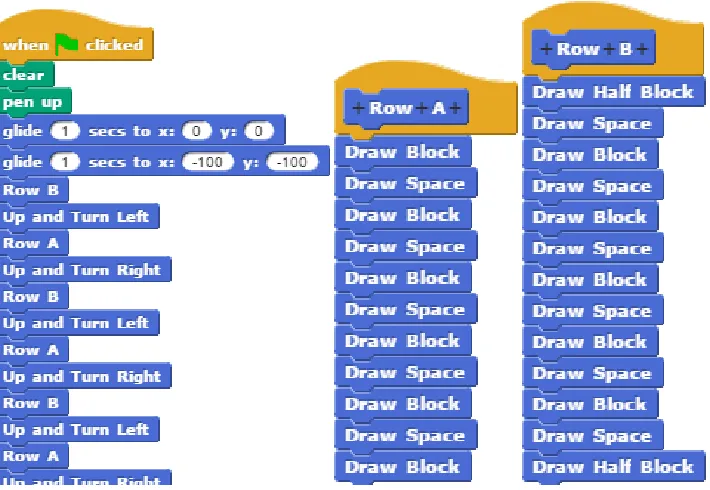
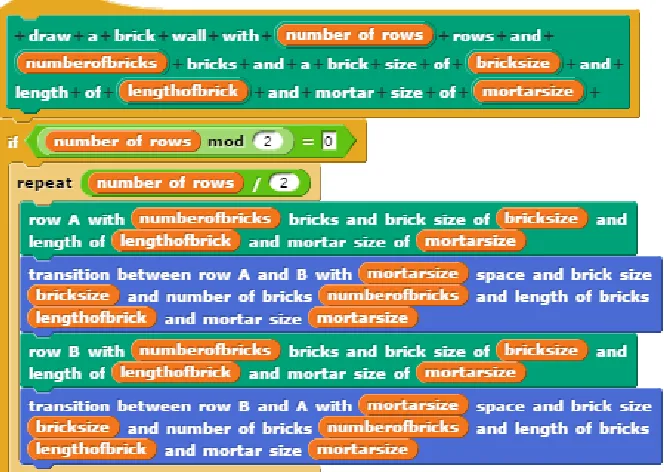
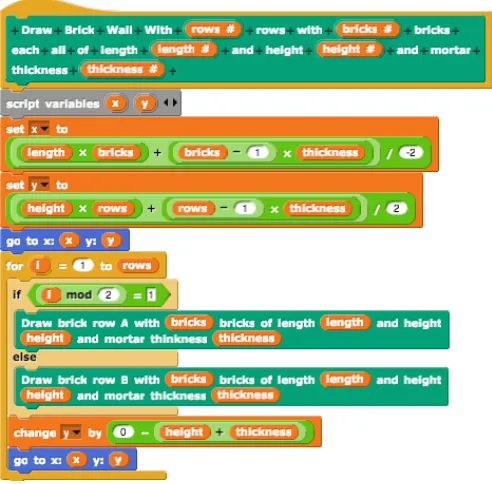
Surveys show that most high school BJC teachers from 2012-2014 used Brick Wall, so we chose it for rubric development. BJC’s Brick Wall lab was designed to demonstrate abstraction and the value of creating a function that can be called to perform the same task multiple times, and with different parameters. The main objective of the Brick Wall lab is to create a brick wall with an alternating pattern of bricks. In the assignment, two row types A and B are defined, where an A row is made up of whole bricks, and a B row starts and ends with half-bricks. The assignment specifies that students should create a new block inSnap!that takes ‘number of rows’ as input and draws a brick wall that alternates A and B type rows accordingly, as shown in Figure 3.1. Students are instructed to create one method that generates a brick wall, two separate methods that draw the two row types, and a method that draws an individual brick. These specific instructions are explained as levels of abstraction for solving the problem. The visual nature of the task and the clear and simple repetitive structure of a brick wall are affordances that should help make iteration and functions seem to be natural solutions to the problem.
3.2
Rubric Creation
To support new teachers to teach computer science, we would ideally build automated systems that could provide both students and teachers with feedback on student performance. Several such intelligent tutoring systems (ITS) have been used to teach programming to novice students. However, the new BJC course strives to inspire new and diverse students to explore computing with modern tools that can be used to express creativity, such as theSnap!programming language. To more quickly support teachers with these new environments, we determined it would be helpful to develop rubrics to help teachers understand the goals of each programming assignment. Our rubric development was strongly influenced by ITSs for programming, since we wish to make an objective system that can be used reliably by teachers with different backgrounds to accurately grade student work. In this section, we describe our process to create a rubric based on computer science education literature. We draw strongly from the literature in intelligent tutoring, where researchers have expended great effort to automate the processes needed to evaluate student code.
3.2.1 Rubrics in CS Ed
In education, rubrics are used as performance-based assessment for student projects. Rubrics use descriptive measures to separate levels of performance on a given task[SL05]. Then, each level of performance for a particular task is assigned a value. Values in rating scales on rubrics can be either holistic or analytic[Bro13]. Holistic rubrics are quick and efficient, evaluating projects as a whole. Analytic rubrics take longer to design, but offer multiple dimensions that are evaluated separately. Since our goal was to enable teachers to provide more detailed feedback, we chose to design an analytic rubric.
3.2.2 Criteria Selection
The first step in designing a rubric is to identify a coherent set of criteria for evaluation[Bro13]. When designing our rubric to help teachers evaluate student projects by hand, we wanted to focus on evidence that would be clearly observable in student programs. Since automated systems rely upon objective and observable criteria, they are a natural source for our rubric criteria: Accuracy (correctness), Efficiency (as measured by the number of times blocks are repeated in code), Rea-soning (domain knowledge), and Readability (style). These criteria were inspired by Pillay, Zeller, Jackson and Usher as we discuss here.
In 2003, Pillay studied four separate programming tutors and identified four common ways they evaluate student code[Pil03], including: accuracy or correctness of topic, efficiency of the code, adherence to style guidelines, and algorithmic domain knowledge. Domain knowledge is comprised of procedural knowledge on how to write programs and declarative knowledge on how to apply different programming concepts. Since these were common features, we included all four in our initial rubric design.
Jackson and Usher’s ASSYST auto-grading system was built to alleviate the errors that people are prone to make when grading, while still keeping a human tutor involved[JU97]. ASSYST assesses student code for: correctness, efficiency, style, complexity, and test data adequacy. ASSYST measures correctness by how well the student program’s output matches the output from a known correct program. Correctness, in BJC, corresponds to whether the program achieves the stated goal, and corresponds to the accuracy metric in Pillay’s work and our rubric. ASSYST measures efficiency by keeping track of how often a particular block of code is executed. This assigns higher efficiency to a loop which runs a single command 10 times than code for the same task that uses 10 separate commands each executed once[Hic13]. When scoring code by hand, we estimate this by observing whether the projects contain identical code that is written more than once. Repetitive commands in code represent less efficient code, where a loop could have been used instead of copy-paste. ASSYST’s style metric includes features such as indentation and variable naming. A similar metric can be found in Pillay’s work, as well as in Zeller’s readability metric, that refers to how easily another person can read and understand how the project code achieves the goals[Pil03; Zel00]. We combined these to produce a single Readability criterion for our rubric.
3.2.3 Performance Descriptions
descriptive, and cover the whole range of performance[Bro13]. We started by identifying Level 3 for meets expectations, as described in the assignment. Level 1 descriptions were basically the opposite of these. We developed Level 2 descriptions by identifying how students might have just missed meeting expectations. To develop Level 4 descriptions, we added language about how students might enhance their programs along the lines of the given criteria. Table 3.1 lists our rubric, with initial descriptions in plain text and the refinements made to create the final rubric added in italics.
Table 3.1Final rubric used for initial grading of student projects in Brick Wall assignment. NOTE: item in italics are additions made to the rubric for clarity.
Category 4 3 2 1
Accuracy of Content
At least 5-6 rows of bricks created
with alternating brick pattern but all rows same length
Two rows of brick created with alter-nating patterns,or 5-6 inaccurate rows
1 brick created and repeated
1 brick created
Efficiency Abstracted
meth-ods and loops
used to repeat coding patterns
A few abstracted
methods were
created, but there is still a lot of repeated code
Code works but is
repeated simple
statements (little abstraction)
Abstraction of complex meth-ods not identi-fiable
Rules and Reasoning
There is evidence of the use of math-ematical and logi-cal concepts& ap-propriate use of abstractions and algorithms.
There is evidence of the use of math-ematical and logi-cal conceptsor ap-propriate use of ab-stractions and algo-rithms.
There is
inap-propriate use of abstractions and algorithms.
Little or no
evidence of
the use of
mathematical
and logical
concepts exists Readability The source code
has been com-mented and the source code is correct, logical, & easily readable.
The source code is correct, logical, and easily readable.
The source code is mostly correct, logi-cal, and readable.
The source
3.3
Study Design and Methods
Our hypothesis was that we could develop a well-defined, analytic rubric, that raters can use to achieve an acceptable level of inter-rater reliability (with Kappa at least 0.7). The following sections describe the context, data selection, and methods for rating and rubric refinement.
3.3.1 Context and Data Sources
Student code samples for rating were drawn randomly from three classes: two high school elective BJC classes taught by the same teacher in Fall 2013, and one college introductory non-majors computing course taught in Spring 2014. The high school data was from one high school teacher teaching two sections of BJC in Fall 2014. Of the original 42 students, one joined the course halfway through and 2 were missing files, leaving a total of 39 high school submissions. In the Spring 2014 college course with 78 students, 57 files were submitted but 2 were unusable, leaving 55 college submissions. A total of nineteen projects were randomly chosen for analysis, with nine (three from each course) for the initial round, and 10 from the college course for the final round. These projects ranged from completely accurate walls, to one brick telling a joke to a circle.
The two high school classes were taught by an experienced AP Computer Science high school teacher. The college course had lectures by a Computer Science professor, but the seven lab sections were facilitated by five undergraduate teaching assistants (UTAs) with no prior experience in teaching or in BJC. This is similar to the preparation that new BJC high school teachers have, ranging from inexperienced teachers with no computing background to an expert with 20 years of experience teaching advanced computer science in high schools. The five UTA majors were: computer science, civil engineering, materials science, paper science, and textile technology. The UTAs had no prior teaching experience, and no similar computing course. The course professor led the UTAs through the lab the week before students did it, in much the same way that high school teachers keep one step ahead of their students when they teach a new class for the first time. We therefore felt that code from the college course would be representative of work we might expect from students taught by an inexperienced high school teacher with no computing background. Therefore, random samples were chosen from the college course for the evaluation of the final rubric.
3.3.2 Methods
samples from the three courses (three samples from each). To make the selections, we skimmed the programs and determined that the high school submissions were similar, so we selected three from each high school course at random. Since we wished to have programs demonstrating diverse performance levels, we
![Table 2.1 Differences between AP Computer Science A and Computer Science Principles as noted by theCollege Board [Col15].](https://thumb-us.123doks.com/thumbv2/123dok_us/1177991.1148128/19.612.94.536.312.507/table-differences-computer-science-computer-science-principles-thecollege.webp)