© Shiraz University
"Research Note"
BUILDING REPUTATION FOR SERVICE-ORIENTED AMI:
MODELING, ALGORITHMS, AND ANALYSIS*
H. ZHANG1**, Z. SHOU2, J. ZHANG3, Q. HE4 AND J. QIAN5
1,3,5Guangxi Key Laboratory of Trusted Software, Guilin University of Electronic Technology, China 2,4Key Laboratory of Cognitive Radio and Information Processing of the Ministry of Education,
Guilin University of Electronic Technology, China Email: [email protected]
Abstract– Service reputation is a key factor for service selection and service composition in Service-Oriented Ambient Intelligence systems. Hence, service reputation computing should fully reflect the feature of multi-rating fusion and the utility value dynamic attenuation characters of the rating. The paper combines D-S evidence theory with dynamic attenuation and puts forward a service reputation computing algorithm based on multi-rating fusion, which is adapted to the Ambient Intelligence systems. First, a layered computing model of the service reputation is given. Then, a mechanism of dynamic attenuation based on time windows, an objective rating and advertisement honesty rating of service, and a user credibility computing algorithm are presented. Afterward, the rating information is combined with the D-S evidence theory to raise an aggregation algorithm of the service general reputation for the Ambient Intelligence environments. Finally, a prototype test is carried out to verify the effectiveness and availability of the model together with the algorithms.
Keywords– Service reputation, trust, evidence theory, AmI
1. INTRODUCTION
The fusion of Ambient Intelligence (AmI) and Service-Oriented Computing (SOC) is the present research trend in AmI. From the point-of-system paradigm, AmI has evolved into an open and loose coupling service-oriented system. With the rapid increase of services on the web, more and more services with similar functions can be reached by hands. Hence, how to choose an appropriate service from a variety of candidates becomes a problem. Unfortunately, some service providers may publish false information. What’s worse, many service consumers are very likely to have no interactive information or prior knowledge about these services, except for those issued by the providers. Therefore, selecting an appropriate and trustworthy service is a key problem in AmI systems. An effective way of addressing this issue is to build a reputation/trust management mechanism for the services [1-4]. It can obtain the forecasting information from the past interactive activities and user rating based on reputation mechanism, and the information will influence the following operations in the future and provide trusted factors for the service selection. There have been many important works on reputation computing, but these works are not suitable for the AmI systems. Therefore, further study is essential to build a service reputation mechanism in AmI.
In order to enable the service reputation computing to meet the needs of AmI environments, first the multi-dimensional representation of service reputation concept and its computing model are studied. Then
H. Zhang et al.
IJST, Transactions of Electrical Engineering, Volume 38, Number E1 June 2014
100
we design and implement related key algorithms adapted to the service-oriented AmI. Finally, we give some test results and analysis. To present our objectives, the paper is organized as follows. Related works are introduced in section 2. Section 3 presents the concept and model of reputation in AmI environment. Key algorithms of service rating and their implementation are discussed in section 4. Service reputation aggregation algorithm is detailed in section 5. Section 6 gives the analysis and test results of our study. Finally, Section 7 states the conclusions and some open issues.
2. RELATED WORKS
Reputation computing is an open problem. Several institutes have proposed some resolutions from their research domains. Audun [5] detailed relative works about the reputation and trust. In the following, we give a brief overview of the most recent research developments which are closely related to our work.
In order to design and deploy context specific and reputation-based trust model in pervasive environments, Sheikh [6] proposed a multi-hops recommendation protocol and behavioral model to describe the interaction among devices. The model established the trust relationship by using devices’ interactive behavior information. Alexandre proposed the objective rating conceptual and its computing method in SOA environments, and then it provided a trustable services selection policy based on services reputation which were aggregated from the objective rating. Unfortunately, the service reputation value was for single QoS attribute, so it cannot provide an overall performance assessment for services. Chang and [7-9] adopted a temporal fading mechanism for the service reputation value. However, the fading for reputation value is a coarse granularity policy and is different from the human’s cognitive process. At the same time, both Chang and Malik studied the credibility of rating entity. The latter, especially, concentrated on the research of rater credibility and achieved good theoretical results. In order to evaluate the reliability of electric power system, Ehsani employed a Markov state space model [10].
In Yu [11], the Dempster-Shafer evidence theory was introduced into reputation computing. It considered the user rating as evidence and obtained the reputation value through evidence combination. This method had important theoretical value, but it had some limitations. First, it did not consider the temporal sensitivity of user rating. Second, only the user subjective rating information was used in the reputation and it also assumed all users had the same weight. Third, the conflict evidence combine method could be improved. Malik and Bouguettaya [12] presented a complete solution which was based on subjective evaluation to calculate the service reputation in SOA environment. It considered the evaluation credibility, mainstream evaluation, the history information of evaluation body, personal assessment preference, evaluation of time decline and so on. However, this paper only considers the effect the subjective rating information has on the reputation, and this makes the foundation which, when calculated, the reputation is single. Another question was whether its dynamic attenuation mechanism could fully reflect the user experience.
3. REPUTATION COMPUTING MODEL
The study of reputation mechanism has received great attention worldwide [13-16]. Based on [17,18], the
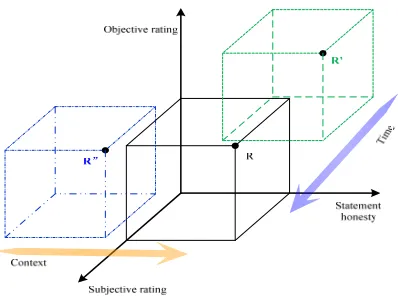
reputation of service in AmI can be defined as a quintuple R=
(subjective Rating, objective Rating,Fig. 1. Quintuple relationship of reputation
From the definition, we can see that service reputation computing involves many interactions among algorithms. Figure 2 illustrates a model of reputation computing, it abstracts all key algorithms and their interactions at each tier.
Fig. 2. A computing model of reputation
The current study focuses on the rating tier and reputation aggregation tier. The former is introduced to transform all kinds of raw data into corresponding ratings. Its core algorithms include advertisement honesty rating (HR), objective rating (OR), and user credibility assessment (UC). Additionally, a service clustering method is designed according to services’ QoS, which classifies the candidate services into some subclasses.
The latter focuses the aggregate rating information into a corresponding reputation. Its main aggregation algorithms include user local reputation aggregation algorithm ψ, general reputation aggregation algorithm ξ, and bootstrap reputation algorithm ζ. Among these algorithms, only the user subjective rating is used to compute the user local reputation, whereas subjective rating, objective rating, service advertisement honesty, and user credibility information are used to compute the general reputation. The details of bootstrap reputation computing are discussed in [19, 20]. In addition, all kinds of rating information must be pre-processed by dynamic attenuation mechanism ρ. The attenuation mechanism transforms initial rating information into utility value, which attenuates with time.
4. RATING ALGORITHM AND ATTENUATION MECHANISM
a) Subjective rating and dynamic attenuation mechanism
IJST, Transac
102
0.7,0.8,0.9,1
constitute a rating sets {
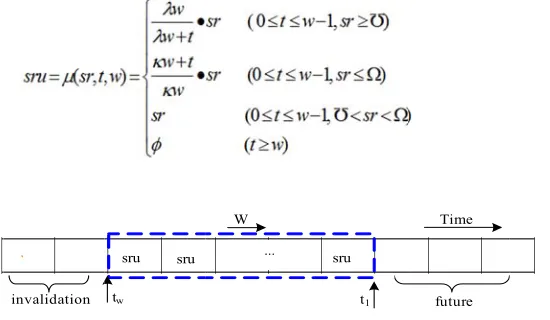
has a better service sele 0.2 attenuat its reference follows: In formula default valu
w is an atten placed into and Ω are correspondi Ω, then the determined λ and κ is to less than Ʊ =0.6, Ω =0.
b) Objective In the performanc There required Qo deviation of requirement service is im invoked, it advertiseme operator), re
ctions of Electr
1.0}, ∈ ) a rating set S {1.0,1.0,1.0,
r reputation t ection, s2 has tes as time p e value is go
(1), the user ue is filled if nuation time the time win
two thresh ing service p e correspond if the rating o guarantee in a time w 3, λ=2, κ =1
e rating and
AmI environ e of the serv are three ser oS ( ) fo f and t. OR is calc mplemented s OR and H
ent, requirem espectively.
rical Engineeri
) on the perf
S, and its le
0.7,0.6,0.2,0
than s1 beca a higher trus passes. The u one. To expre
invalidation
subjective r the service i e window. Th ndow contin holds (0.1 performance
ding service is between Ʊ that the cred window or be and t represe
d advertiseme
nment, sever vices. These m
rvice QoS ve or user requ
, the culated using
according to
HR are com ment, and m Compared w
H
ing, Volume 38
formance of a ength grows
0.2} and {0.2,
ause s2 gets b stworthy val utility rating ess such a dy
tw
sru sru
Fig. 3. Utilit
rating or the is not used by he window g nually, and th Ʊ 1 is satisfactor performanc Ʊ and Ω. λa dible utility v
efore the exp ents a week’
ent honesty r
ral pieces of monitored Q ectors: the a uest, and als , indicates g . The o its advertis mputed using monitored va with SR, the e
H. Zhang et al.
8, Number E1
a service afte with time a
,0.2,0.6,0.7, better ratings ue. Therefor value becom ynamic chan ··· W
ty value slidin
average of m y users in a t goes forward he oldest val 1.0). If the
ry and trusta ce is unsatis and κ are atte value is grea piration of th
s time.
rating
f monitoring oS values ar advertisemen so the monit how actual p deviation of ement. g formulas alues of the estimation of
er use. The h and user num
1.0,1.0,1.0}
s as time go re, both the g mes lower an nge process,
t1
sru
ng window
multiple ratin time frame (I
with time, a ue may be s rating is g able. If the ra sfactory. The enuation fact ater than Ω, a
he rating inf
g equipment re used to est nt QoS (
tored QoS ( performance f and
is used to c 2 and 3, w e QoS’ jth
f OR and HR
history record mbers. For in
for s1 and s2 es on, where good rating 1 nd closer to t a utility func
Time
future
ngs is located
It is recomm
as shown in F slipped out o greater than ating value i
e service pe ors. A basic and the mist formation. In
are deploye timate OR an ) used in se ( ) in se e of the servi
, the compute the where ,
attribution
R prevents th
ds of subject nstance, ther . From the tw eas s1 gets w 1.0 and the p the median v ction ( ) is d
d in time fra
mended to fill
Fig. 3. A new of the time w
or equal t s less than o erformance c
principle of trustful utility n the paper,
d to obtain t nd HR [21]. ervice registr ervice execu ice satisfied , reveals ho
HR. Once a , (normalized he calculation
June 2014
tive rating re are two wo sets, s2 worse. For
oor rating value until defined as
(1)
ame t. The
l 0.5). The w rating is window. Ʊ
to Ʊ, the or equal to
cannot be f assigning
y value is
w =10, Ʊ
the actual
prejudice and malice of user’s subjective rating. The utility value of or and sah are also attenuated over time, and can be computed using formula 1.
1
10 * 1 0.1 ( 1.0 )
(2) 1
10 * 1 0.1 ( 1.0)
rmd
rmd
rmd e
or
rmd e
(2)
where
1
1 1
j j n
qos qos j j qos
R M
rmd
n R
1
10 * 1 0.1 ( 1.0 )
(3) 1
10 * 1 0.1 ( 1.0)
amd
amd
amd e
sah
amd e
(3)
where
1
1 1
j j n
qos qos j j qos
A M
amd
n A
c) User rating credibility
All the SRs are aggregated into reputation. However, not all of the SRs are fair and unbiased. Even for fair users, they may give different ratings for a same service due to the different contexts or professional background. Thus, the credibility of user rating should be assessed. Generally, user credibility can be computed by using some key factors in AmI systems, such as subjective rating fluctuation (srf ), subjective and majority rating similarity (sms), and the similarity of subjective rating and objective rating (sos). The user credibility is expressed as formula 4.
1/ ∗ ∗ ∗ (4)
where 0 , , 1, 1 and 0.3,0.4,0.3.
1. User rating fluctuations: Fora service, the same user’s rating may fluctuate in different contexts. This
fluctuation should be kept at a reasonable range. The ratings greatly fluctuate when the user behaves irrationally or lacks professional knowledge. In the current study, the standard deviation of the user subjective rating sequence was used to define the user rating discrete degree, as shown in formula 5.
2 1
( tw ( t ) )
srf
sr sr cw (5)t
sr is the user subjective rating and sr(
wt1sr cwt) . cw represents a user rating reliability window. A higher srf indicates lower user credibility, and vice versa.2. Similarity of subjective rating and objective rating: Subjective and objective ratings measure the
performance of the services from different views. Therefore, the two rating sequences should be consistent or similar, the similarity between sr=(sr1,sr2,…, srn) and or=(or1, or2,…,orn) represented with Euclidean
distance, as shown in formula 6.
2 2 2
1 1 2 2
( ) ( ) ... ( n n)
H. Zhang et al.
IJST, Transactions of Electrical Engineering, Volume 38, Number E1 June 2014
104
sos represents the reciprocal of similarity and or,sr are the objective rating and subjective rating
sequences respectively. 0sri sr 1,and 0orior1.
3. Similarity of subjective rating and majority subjective ratings: The ratings of users in a time
windoww are clustered using the K-Means clustering algorithm. Then, the centroid of the majority cluster can be used as users’ majority rating inw, as shown in formula 7 [22].
smr
center max
(
( (
sr
k)))
(7)smr denotes the subjective majority ratings. The majority of users’ ratings were assumed to be reasonable and credible. Therefore, takingsmras a reference, smscan be obtained by computing the Euclidean distance between the vectors sr and smr using formula 6. A smaller sms means a more credible subjective rating.
5. DYNAMIC WEIGHTED REPUTATION AGGREGATION
For meeting the needs of AmI, a novel D-S evidence theory based algorithm of service reputation aggregation is proposed. Compared with that of Yu, there are three advantages: first, the utility value was used instead of the original rating value in order to avoid the inaccuracy brought in by its time-dependent effect. Second, multi-ratings were introduced and detailed for reputation computing to revise single subjective rating, since information collected from a single subjective rating is usually unilateral due to biased or professional background. Third, the weighted evidence combined rules were adopted to aggregate the general reputation. Every subjective rating is supposed to assign a different weight to represent how important the rating is among the multi-ratings [23, 24].
a) D-S evidence theory
Dempster and Shafer [25] proposed the evidence theory, which can be applied to uncertain decisions. The knowledge, experience, and feelings of a user in certain circumstances are advantageously used as the evidence of a decision. For any subset A in the frame of discernment
1, , ,2 N
, m A( )is assigned asa basic support degree, which is constrainted by the following conditions:
( ) 0
(8) ( ) 1
A
m m A
(8)Every element of is considered as an incompatible event or assumption, and m(A) is the basic probability assignment (BPS) indicating the support for set A. Different pieces of evidenceEiandEjmay
have different BSPm Ai( )i andm Aj( )i for the same subset Ai. Hence, the basic D-S combining rule of
multi-evidences can be expressed as follows (suppose ( ) ( ) 1
i j
i i j j A A
K m A m A
):
( ) ( )
( ) 1 (9)
0
i j
i i j j A A A
m A m A A
m A K
A
(9)
The larger the value of K, the more conflict there is between the two evidences. The combined results
b) BPS of the rating
BPS of the rating needs to be obtained to compute the service reputation. Contrary to that of Yu, we take the ratings utility values instead of the original ratings value as the computing evidence of BPS. It is assumed that the user ui invokes service sjn times in time window w and ui gives the subjective rating srl after using the service ( , 0 ). Hence, its utility value is , , . Threshold Ʊ and Ω are introduced to divide the ratings into three parts: trust ( Ʊ), uncertainty (Ʊ Ω), and distrust domains ( Ω). Function f(x) is used to map x as its probability in time window w. According to the D-S evidence theory, the BPS of is assigned as follows:
∑ Ʊ ,
∑ ,and , ∑ Ʊ . , and
, represent the degree of trust, distrust, and uncertainty degrees respectively. Similarly, BPS
of OR can be obtained as follows: , and , and HR: , and , .
c) General reputation aggregation
General reputation (GRep) indicates the trustworthiness of service in AmI environment. It can be expressed as ∙ ∙ ∙ , where msr represents the combined multi-user
subjective rating, mor denotes the combined multi-objective ratings, msahr is the degree of combined multi-service honesty degree, and , , represent the corresponding weights.
User ui may call and rate a service repeatedly in a time window, and the ratings are listed in the sequence of srl ∈ , 0 ). For different users ui and uj ( j), the two rating sequences for the same service in an identical time window may differ. Hence, the corresponding , and , are also different. Furthermore, each user has a credibility uc. The user credibility can be used as the weight of BPS to compute msr. Then the weighted average of BPS is computed [27]. Finally, the method in [28] was adopted to combine the evidences. The computing process as follows:
i. Normalizing and obtaining the standard user credibility uci;
ii. Computing the multi-user weighted average (mwa) for attenuation-based user rating:
=∑ ∙ ,
=∑ ∙ ,
, =∑ ∙ , ;
iii. Combing mwa N-1 times, and obtaining the combined multi-user BPSmsc;
iv. Computing and using msc. The general user comprehensive reputation value,
msr, is 10*( ).
To prevent ratings (evidence) conflict caused by different contexts, Murphy’s multi-evidence combing rule was used to compute mor and msahr. Its computing process is similar to the msr
computation.
GRep can be easily worked out as soon as the values of msr, mor, and msahr are calculated. According to actual experience, the settings of corresponding weights are: =0.4, =0.4, =0.2. The GRep
is stored in the service register center and shared by all users. The service is continuously called and rated when the time window moves on, and the value of GRep is dynamically updated.
6. TEST AND ANALYSIS
IJST, Transac 106 definition) w users, reque real-time Qo a) Analysis Figure window and (1) The ma change of th using the d change, and
b) Analysis
Three and high lev make it dy correspondi experts’ SR
objective ra is medium; with high si details were
ctions of Electr
were deploy est and rate t
oS of the ser
of the dynam
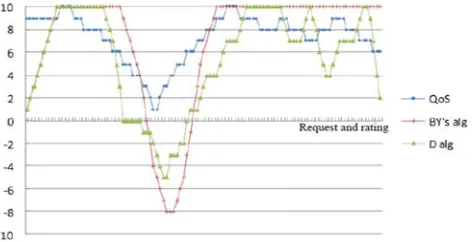
4 shows the d the other w apping relatio he QoS more dynamic atten d is able to gi
F
of the OR a
domain exp vel of QoS r ynamically c ing OR valu sequences a ating algorith the perform imilarity. So e not provide
rical Engineeri
ed on Java a the services. rvices.
mic attenuat
e results of t was that of Y on of reputa e accurately; nuation mec ive an early w
Fig. 4. Time
and HR algor
erts with dif requirement) changeable. ue for OR4,
are shown in hm is. From mance decline
o, the OR alg ed because th
F
H
ing, Volume 38
and Jena 2.6 A large num
tion mechan
two differen Yu. Figure 4 ation value a (2) It agrees chanism; (3)I warning whe
window-bas
rithm
fferent requi ) were select According t
OR7, and O n Fig. 5. The
Fig. 5, the O
es when the gorithm prop hey were sim
Fig. 5. Perform
H. Zhang et al.
8, Number E1
.2 platforms mber of mon
nism
nt methods: o makes it cle and its QoS
s with the rat It is more se en the service
sed dynamic
irements (SR ted to assess
to the moni OR9 can be closer the O OR algorithm user requirem posed in the p milar to the ob
mance of obje
. Users, inclu nitoring devic
one is based ear that there
is more reas tional judgm
ensitive to th e QoS drops
attenuation m
R4, SR7, and a service. T itored QoS e computed.
OR sequence m performs th
ment becom paper perfor bjective ratin ective rating uding domai ces were dep
d on the dyn e are three ad sonable, and ments and pre
he perceptio .
mechanism
d SR9 repres The service Q value and u Both the O
s to the expe he best when mes very high rms better. F ng algorithm
in experts an ployed to me
amic attenua dvantages to d reflects the dictions of h on of the ser
senting low, QoS was con user requirem
OR sequence erts’ SR, the n the user req h or very low or HR comp .
June 2014
nd general easure the
c)Analysis
Genera assigned for groups. The can adapt to
d) Analysis Figure not conside unreasonabl The reputat attenuation which can r because of reputation, preference accurately r
The paper p and detailed were tested
of the user c
ally, high cre r the irration e results show o the requirem
of the gener
7 shows the er the user
ly high level tion value c
mechanism reflect the c the combine the S reputa
and specific reflects the re
presented a m d related key
and analyze
credibility al
edibility sho nal or collusi w that the u ments of Am
Fig. 6 ral reputatio e reputation rating credi l (exorbitant computed by
and user cre hange of ser ed objecting ation only ref
c context o eal changes o
Fig. 7.
7. CO
model of serv y algorithms.
d. The paper
lgorithm
ould be assig ion ratings. user credibilit mI.
6. Analysis of
on aggregatio
values for th ibility factor
user rating f y S reputati edibility fact rvice QoS. I g rating and flects the pe f the user, of service Qo
Analysis of th
ONCLUSION
vice reputati . Finally, the r’s main cont
gned for the Figure 6 sho ty is about 4
f the user cred
on algorithm
he same serv rs, thus mak factor) and en ion algorithm tor was adop It can preven
user credibi ersonal feelin although th oS.
he general rep
NS AND FU
ion computin e feasibility a tributions inc
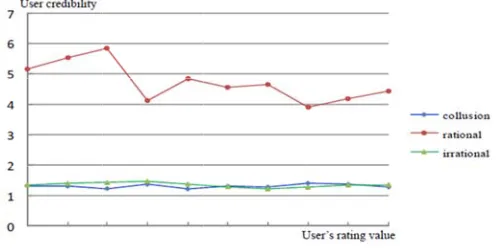
rational rati ows the user 4:1:1. Hence
dibility algorith
m
vice compute king the BY nlarging the m is more pted. The G
nt the influe ility. Compa ng of the use he general r
putation algori
UTURE WO
ng modeling and effective clude:
ing and low r credibility o , it has a go
hm
ed by differe Y reputation
fluctuation ( reasonable b reputation w nce of irrati ared with the er and is rest reputation is
ithms
ORK
for service-o eness of the
credibility of the rating od differenti
ent algorithm (Yu) incre (irrational us because the was the most
onal subject e G reputati tricted to the s more obje
oriented Am model and a
should be gs of three iation and
ms. Yu did ase at an er factor).
dynamic t accurate, tive rating on and R e personal ctive and
H. Zhang et al.
IJST, Transactions of Electrical Engineering, Volume 38, Number E1 June 2014
108
1) Designing a service reputation computing model for AmI systems. The model is consistent with the basic information processing: data information knowledge, and it summarizes the core algorithms and their interactions. Researchers can concentrate on the core algorithms design and so simplify the complexity of reputation implementation.
2) Designing and implementing the time window based dynamic attenuation mechanism, objective rating and user credibility algorithm, and also presenting a multi-ratings based service reputation aggregation algorithm. Based on these algorithms, the reputation value can better reflect the service’s historical information, effectively forecast the service future behavior, and thus provide more accurate and reliable information for the service selection and composition in AmI systems.
3) Some algorithms, for instance dynamic attenuation mechanism and user credibility, are easily applied to other information systems. For example P2P, to improve the validity of reputation computing.
In the future, the rating semantic model and rating conflict combining rules for AmI system will be further studied to enhance the practicality of the service reputation mechanism in AmI environment.
Acknowledgment: The authors would like to thank Guangxi Natural Science Foundation
(2012GXNSFBA053171, 2013GXNSFAA019324), the Key Laboratory of Cognitive Radio and Information Processing (Guilin University of Electronic Technology), Ministry of Education (2011KF11), Guangxi Experiment Center of Information Science,the Dean's fund of Guangxi Key Laboratory of Trusted Software (kx201214, kx201203) and National Nature Science Foundation of China (61363005, 61063002) for their support in the research.
REFERENCES
1. Skopik, F., Schall, D. & Dustdar, S. (2010). Modeling and mining of dynamic trust in complex service-oriented systems, Information Systems, Vol.35, pp. 735-757.
2. Yan, S., Zheng, X. & Chen, D. (2010). Dynamic service selection with reputation management. International Conference on Service Sciences, pp. 9-16.
3. Louta, M. (2008). Towards a collaborative reputation based service provider selection in ubiquitous computing environments. UIC 2008, LNCS 5061, pp. 520-534.
4. Chang, J. S. & Wong, H. J. (2011). Selecting appropriate sellers in online auctions through a multi-attribute reputation calculation method. Electron. Comm., Vol. 10, No. 2, pp. 144-154.
5. Jøsang, A., Ismail, R. & Boyd, C. (2007). A survey of trust and reputation systems for online service provision.
Decision Support Systems, Vol.43, No. 2, pp. 618-644.
6. Ahamed, S. I. & Haque, M. M. (2010). Design, analysis, and deployment of omnipresent Formal Trust Model (FTM) with trust bootstrapping for pervasive environments. The Journal of Systems and Software, Vol. 83, pp. 253–270.
7. Maximilien, E. M. & Singh, M. P. (2005). Agent-based trust model involving multiple qualities. Proceedings of the Fourth International Joint Conference on Autonomous Agents and Multi-agent Systems, pp.519-526. 8. Kuo, Y. H., Wu, F., Hsiao, R. L. & Hsiao, A. (2007). Trust evaluation to help on-line consumers to choose the
provider in auction web site. Proceedings of the 4th IEEE Conference on Service Systems and Service Management, pp. 61-66.
9. Schmidt, S., Steele, R., Dillon, T. & Chang, E. (2007). Fuzzy trust evaluation and credibility development in multi-agent systems. Applied Soft Computing, Vol. 7, No. 2, pp. 492-505.
11. Yu, B. & Singh, M. P. (2002). Distributed reputation management for electronic commerce. Computational Intelligence, Vol. 18, No. 4, pp. 535-49.
12. Malik, Z. & Bouguettaya, A. (2009). RATEWeb: reputation assessment for trust establishment among web services. The VLDB Journal, Vol. 18, pp. 885-911.
13. Nguyen, H. T., Zhao, W. & Yang, J. (2010). A trust and reputation model based on bayesian network for web services. 2010 IEEE International Conference on Web Services,pp. 251-258.
14. Nepal, S., Malik, Z. & Bouguettaya, A. (2009). Reputation propagation in composite services. 2009 IEEE International Conference on Web Services, pp. 295-302.
15. Li, X. & Gui, X. (2009). Tree-trust: a novel and scalable P2P reputation model based on human cognitive psychology. International Journal of Innovative Computing, Information & Control, Vol. 5, No. 11A, pp. 3797-807.
16. Lo, Chi-Chun, Huang, Chun-Chieh, Lee, Fang-Yi. (2011). A flexible access control mechanism for web services. ICIC Express Letters, Vol. 5, No. 4B, pp. 1377-1383.
17. Jøsang, A., Ismail, R. & Boyd, C. (2007). A survey of trust and reputation systems for online service provision.
Decision Support Systems, Vol. 43, No. 2, pp. 618-644.
18. Malik, Z. & Bouguettaya, A. (2009). Reputation bootstrapping for trust establishment among web services.
IEEE Internet Computing, Vol. 13, No. 1, pp. 40-47.
19. Wang, Y. & Vassileva, J. (2007). Toward trust and reputation based web service selection: A survey. Multi-Agent and Grid Systems, Vol. 3, No. 2, pp. 118-132.
20. Marti, S. & Garcia-Molina, H. (2006). Taxonomy of trust: Categorizing P2P reputation systems. Computer Networks, Vol. 50, No. 4, pp. 472-484.
21. Alexandre, G. & LuciPirmez, L. (2007). SATYA: A reputation-based approach for service discovery and selection in service oriented architectures. WIDM '07: Proceedings of the 9th annual ACM international workshop on Web information and data management, pp. 153-160.
22. Malik, Z. & Bouguettaya, A. (2008). Rater credibility assessment in web services interactions. World Wide Web Journal (WWWJ), pp. 1-23.
23. Liang, C., Chen, Z., et al. (2005). A method of dispelling the absurdities of Dempster-Shafer’s rule of combination. Systems Engineering - Theory & Practice,Vol. 3), pp. 7-12.
24. Horiuchi, T. (1998). Decision rule for pattern classification by integrating interval feature values. IEEE Transactions on Pattern Analysis and Machine Intelligence, Vol. 20, No. 4), pp. 440-448.
25. Shafer, G. A. (1976). Mathematical theory of evidence.Princeton University Press,Princeton, pp. 19-63. 26. Fengbao Yang, Xiaoxia Wang. (2010). Combination method of conflictive evidences in D-S evidence theory.
Natioal Defense Industry Press.
27. HuLifang, GuanXin, He You. (2010). Evidence fusion method based on reliability. Signal Processing, Vol. 26, No. 1, pp. 17-22.
28. Murphy, C. (2000). Combining of belief function when evidence conflicts, Decision Support Systems, Vol.29, pp. 1-9.