ABSTRACT
TROWBRIDGE, FRANCIS ALEX. Action and Analogical Problem Solving. (Under the direction of Dr. Anne McLaughlin.)
Evidence from previous research suggests that spontaneously produced gestures as well as conscious enactments of information can give information about how an individual is thinking about something, and also change the way an individual thinks about information. Possible mechanisms include a reduction in cognitive load, gesture adding action to mental
representations of information, and gesture being tied to mentally simulated action. The current research examined the impact of consciously enacting information vs. being allowed to
Action and Analogical Problem Solving
by
Francis Alex Trowbridge
A thesis submitted to the Graduate Faculty of North Carolina State University
in partial fulfillment of the requirements for the degree of
Master of Science
Psychology
Raleigh, North Carolina 2015
APPROVED BY:
_____________________________________ _____________________________________
Dr. Douglas Gillan Dr. Jing Feng
______________________________________ Dr. Anne McLaughlin
BIOGRAPHY
Francis A. Trowbridge (Alex) is a doctoral student in the North Carolina State University’s Human Factors and Applied Cognition program in the Psychology Department. Alex received an
ACKNOWLEDGEMENTS
I would like to thank my advisor, Dr. Anne McLaughlin for her continued support, guidance, and inspiration throughout my career, both within and outside of academia. I would also like to thank the members of my advisory committee: Dr. Jing Feng and Dr. Douglas Gillan, for their time and helpful comments as this work was formulated.
TABLE OF CONTENTS
LIST OF TABLES ... vi
INTRODUCTION ...1
Gesture-as-Simulated-Action-Framework ... 2
Overview of the Current Study ... 8
METHOD ...9
Participants ... 9
Materials ... 10
Design ... 10
RESULTS ... 12
WMC, Gesture Condition, and Convergence Solution ... 14
Radiation Solution Components and Gesture Condition ... 15
DISCUSSION ... 16
REFERENCES ... 21
APPENDICES ... 23
Appendix A. The Rebel Leader Story ... 24
Appendix B. The Radiation Problem ... 25
LIST OF TABLES
INTRODUCTION
When the term ‘gesture’ is encountered, many people probably first think of gestures that have conventional meanings within a culture, such as a ‘thumbs-up’ gesture meaning ‘good’ or ‘good job’. These are referred to as symbolic gestures because there is nothing inherent in the gesture that relates to its meaning, in much the same way the words ‘good job’ only have meaning because they are accepted symbols. Formal sign language systems fall under this category of gesture, and are similar to verbal language systems. This type of gesture is not likely to reveal or guide knowledge structures in the gesturer in a different manner than language. However, representational gestures are those that represent some action or concept but whose meaning is determined by the context and form of the gesture. An example would be flicking of all of the fingers away from the body, which could refer to drying one’s hands (without a towel), or adding spice to a dish, or a desire to ‘push an idea away’ from the current discourse. These representational gestures are spontaneous, and they are different than enactments. Enactments are intentional and planned representations of an event or an idea in space. Enactments are less ambiguous than spontaneous gestures. These are explicit enactments of an event or idea. Sometimes the distinction between the gesture and enactment is not clear, with gestures taking the form of enactments, or enactments being interrupted with less explicit spontaneous gestures. The difference between the two lies mainly in the degree of intentionality in the individual producing the action. Individuals producing spontaneous gestures are doing so unconsciously and automatically, while individuals producing enactments are intentionally creating a representation of an event or idea is space.
spontaneous gestures and enactments effect cognitive processes in different ways, or to different extents. Also unclear is the mechanism by which these actions effect cognitive processes. One useful framework from Hostetter and Alibali (2008) is the gesture-as-simulated-action-framework
Gesture-as-Simulated-Action-Framework
Hostetter and Alibali’s Gestures-as-Simulated-Action-Framework (GASAF; 2008) proposed that gesture production is an external process related to the internal process of simulated action. This simulated action is an internal recreation of an action, including a neural response in line with the neural response generated from actually performing the action. GASAF relates perception and action to cognition, representing a more embodied approach to cognition. Embodied cognitive frameworks (e.g. Barsalou, 2008, 2010; GASAF, Hostetter & Alibali, 2008) generally emphasize the relationship between cognition and experience, whether simulated or actual.
The GASAF argues that simulated action plays a central role in problem solving and mental model formation, and is tied to the same motor and pre-motor processes as gesture production. Proponents of the GASAF argue that gesture content reveals implicit knowledge in the gesturer, which is in the form of simulated action about an event or idea. This implicit knowledge can often be unconscious for the gesturer. A compelling line of evidence for this claim is that gesture use reveals transitional stages of learning via gesture-speech mismatches (Church & Goldin-Meadow, 1986; see Goldin-Meadow & Alibali 2013 for a review). Church and Goldin-Meadow (1986) conducted a study on children that had yet to reach the developmental milestone of conservation. Conservation involves the ability to know that a quantity remains constant as its shape is changed, like the conservation of matter. The researchers had a group of non-conserving children attempt a
checkers, and record their attempts and explanations. The researchers coded the recorded interactions for gesture content, specifically the presence of gesture-speech mismatches. Gesture-speech mismatches were present if the child verbally indicated that they didn’t understand conservation (said the top row had more checkers) but indicated through gesture a one to one mapping of the checkers (i.e. by pointing to checkers in the top row and their corresponding checkers in the bottom row), or that the top row had simply been spread out (i.e. gesturing about a spreading of the top row). Non-conserving children attempting conservation tasks who produce gestures expressing an understanding of conservation were quicker to understand conservation during later instruction (Church & Goldin-Meadow, 1986). That is to say, some children who are verbally giving incorrect answers to conservation problems produce gestures that do indicate understanding of conservation, and it is these children who later benefit from instruction on conservation. This finding is interesting, because the children are understanding something about conservation, but are not yet able to verbalize it.
In a study using a similar paradigm, Ping and Goldin-Meadow (2010) had children do liquid conservation tasks, and try to remember two unrelated words during the task. In half of the trials children were told not to gesture, and in the other half they were told to gesture, but not in specific ways. Children were better at recalling the words when told to gesture compared to being told not to gesture. The researchers take this as evidence that gesture reduced the cognitive load of the conservation task, but an important aspect of the manipulation is that children were told to gesture or not to gesture. It is widely held that gestures are spontaneously produced during speech, and it has been suggested that spontaneous gestures constitute biologically primary information and require little to no cognitive effort to produce (Paas & Sweller, 2012), so it may be that instructing the children not to gesture was actually introducing working memory load. It is unclear if
could yield clearer insights into whether or not action reduces cognitive load. Another assumption of GASAF is that gesture does not only reveal aspects of a person’s thoughts, but also can facilitate thought.
Gesture and Reasoning
Hostetter and Alibali’s GASAF links cognition to the biological system it resides within, where gestures, a product of sensory and motor processes, represents a direct link between perception, action, and cognition. This perspective proposes that gestures arise from mental simulation, with the degree of mental simulation being carried out affecting gesture production in a systematic way. The authors define simulation as the re-creation of the neural state that underlies an actual action. There is neurological evidence in support of this theory. Hauk, Johnsrude, and Pulvermueler (2004) found using fMRI that reading descriptions about words such as ‘lick, pick, and kick’ activated the same areas in the pre-motor cortex that were activated by physically performing these actions. This findings supports the assumption that motor and pre-motor processes are closely related to cognitive processes. This findings also gives credence to the claim that cognition involves simulated action, which literally recreates the neural activity of actually performing an action. Relatedly, people gesture more when speaking about actions they have actually done, compared to actions that they have only viewed (Hostetter & Alibali, 2007), again supporting the coupling of gesture, simulated action, and thought. Gesture may be thought of as a sort of window into knowledge structures underlying concepts.
‘2’ on the left side of the equation to determine the number in the blank on the right side of the equation. These children are performing guided enactments of the mathematical operation. Children who generated enactments outperformed children instructed to generate a partially correct enactment and children told not gesture (Broaders et. al, 2007; Goldin-Meadow, Cook, & Mitchell, 2009), lending evidence to the stronger claim that action can both reduce cognitive load (Ping & Goldin-Meadow, 2010) and add information to the mental model of the learner.
Adults benefit cognitively from action as well. Goldin-Meadow et al. (2001) found that action reduces cognitive load while solving math problems by testing adults solving factoring problems (e.g. x2 – 5x + 6 = ( )( __)). The study used a secondary task of remembering words presented before solving the problem and testing participants afterward to determine if telling participants to gesture while solving the problem would reduce cognitive load, and found such an effect. This study only differentiated between participants told to gesture and told not to gesture, so the possibility that the cognitive cost of effortful inhibition of gesture was the cause of the between group differences is present in this research design.
solution time was found across trials. Individuals who did not explain their strategies with gesture did improve their solution times on the second trial despite the manipulation. Participants seemed to be adding action to their mental models of the solution to the problem by using one-handed gestures in explanations of their strategies. Interestingly, in this study participants were not told whether or not to gesture, but rather their strategy expressed in gesture arose spontaneously in the participants.
There is also evidence that adults can benefit from guided enactments during abstract reasoning. Catrambone, Craig, and Nersessian (2006) examined the relationship between action during the explanation of a story involving a ‘converging forces schema’, and the subsequent application of this schema to a novel problem, in a method adapted from Gick and Holyoak (1980, 1983). Participants read a story (‘Rebel Leader Story’; Appendix A) about a rebel leader attacking a dictator’s fortress. To avoid setting off sensitive mines, he had to split his army into weaker sub-armies and have them ‘converge’ at the dictator’s compound. After studying the story for 3 minutes participants either: 1) verbally recounted the story without gesture, 2) recounted the story with a simple drawing, or 3) recounted the story in physical space using a set of wooden blocks to represent the armies and the dictator’s compound.
After recounting the rebel leader story, participants were asked to solve a problem, which they were led to believe was part of another study. The problem involved using a radiation technique to eradicate a tumor in a patient (Duncker, 1945; radiation problem; Appendix B). This problem could optimally be solved using a ‘converging forces schema’ similar to the one in the rebel leader story, involving splitting up rays of radiation to target a tumor in a patient to avoid killing any healthy tissue. The researchers found that participants assigned to the physical enactment condition were more likely to transfer the converging forces schema from the rebel leader story to the
conditions. It seems that the physical enactment of the rebel leader story added or made salient the spatial converging forces schema to the participants. It may also be the case that other participants were hindered by having gestures restricted, since all other participants were either drawing, or explicitly instructed against using their hands. This authors suggest this analogical transfer of a converging forces schema as a method of comparing the contents of mental models in learners after interacting with information, with those participants with greater likelihood of transferring the converging forces schema having included action information in their representational structure of the rebel leader story, priming them to apply the converging forces schema in the radiation problem. This is an important step in understanding how action may complement a learning or problem solving situation. This study found that individual’s performing guided enactments of information were more likely to form comprehensive mental models of the information including both the abstract and motoric information in the story.
Overview of the Current Study
The current study sought to examine the effect of action on problem solving. Previous research has determined that action, broadly defined, can reveal aspects of an individual’s knowledge structure. Research has also shown that action can guide problem solving and the formation of knowledge structures. Missing is an understanding of whether and how different types of action, specifically spontaneous gesture and guided enactment, affect problem solving in
different ways, especially for individual’s with varying levels of working memory capacity.
Additionally, the extent to which each of these types of action facilitate problem solving compared to inhibiting gesture has not been directly tested. These are important problems because a
Aim 1: To compare the effects of gestures and enactments compared to gesture restriction on cognitive processes, we compared the problem solving outcomes of individuals from 3 randomized groups on the outcome of a problem adapted from Catrambone, et al. (2006) designed to target the structure of knowledge representations.
Aim 2: To determine if differences in working memory capacity differentially effect the relationship between gesture and enactment and cognitive processes, we examined if patterns of analogical reasoning between 3 randomized groups changed when controlling for working memory capacity. To control for working memory capacity we took a measure of working memory capacity using an operation span task (see Conway et al., 2005 for a review of complex-span tasks and measuring working memory capacity), and used this measure as a covariate in our testing of group differences.
METHOD
Participants
One hundred and eight undergraduate psychology students (36 in each of three conditions) from a large southeastern research university were recruited as participants from a participant pool in return for partial satisfaction of a curriculum requirement. To determine how many participants would be needed, a power analysis was conducted for a chi-square test of independence at an alpha of .05 and power of .8, with 2 degrees of freedom and a medium effect size (w = .3). This effect size was computed from the data reported in a previous study using a similar experimental task
Materials
Automated operation span task. An automated operation span task (AOSPAN) was administered. This task involved being presented letters between completions of simple math problems then recalling the letters in order. The task was automatically presented and scored via automated E-Run programs obtained from the Attention and Working Memory Lab at Georgia Technical University in Atlanta, GA (see Conway et al., 2005 for a review of complex-span tasks and measuring working memory capacity). These span tasks are used to measure WMC to determine the extent to which participants are able to hold information in working memory. The AOSPAN took about 20 minutes to complete.
Experimental task. The rebel leader story was presented as a printout to participants on a standard 8.5 x 11 sheet of paper. The story was adopted from Catrambone, et al.(2006; originally from Gick and Holyoak, 1980, 1983). The rebel leader story was about a rebel leader who must use a converging forces schema to overtake a dictator’s compound. The radiation problem was adapted from Duncker (1945; also used by Gick and Holyoak, 1980, 1983, and Catrambone, et al. 2006), and serves as a transfer task for the converging forces schema in the rebel leader story. The entire experimental task took approximately 20 minutes.
Design
Independent variable. The independent variable was level of action while interacting with the rebel leader story. There were three conditions, in which participants were either given
instructions to recreate the story with their hands accompanying their verbal recounting of the story (enact condition), given no instructions about gesture use (spontaneous condition), or instructed to keep their hands still and move as little as possible to ensure quality video recording (inhibit condition).
Dependent variable. The dependent variable was production of the converging forces solution to the radiation problem, and served as an indirect measure transferability of information encoded from the rebel leader story to a novel context. As per Catrambone, et al. (2006), successful analogical transfer was coded according to specification in a proposed solution of: (1) the use of separate beams of radiation, (2) the use of weakened radiation (3) the use of strong radiation, (4) the use of both strong and weak radiation, (5) the use of multiple treatments or doses of radiation over a period of time, and (6) the use of radiation from different angles. Solutions that included Features 2 and either 1 or 6, but not 3, 4, or 5, were considered successful analogical transfer solutions. This was a dichotomous outcome. There were two outcome measures: an initial outcome measure, then an outcome measure after being given a hint to solve the problem on the basis of the rebel leader story from earlier.
Control variable. Working memory capacity was included as a control variable, and was measured using the AOSPAN.
Procedure
Next, participants were given the rebel leader story on a piece of paper and asked to study it for 3 minutes, so that they would be able to recreate the events of the story later on. After studying the story, participants were asked to recreate the story in their own words for a recording, taking as much time as needed. Participants were asked to focus on what the protagonist did in the story – both what he planned to do, and what he did in the end. The studying and recounting of the rebel leader story took about 8 minutes.
Participants were then given one of three sets of instructions based on their random condition assignment, and recounted the story taking as much time as they needed. Participants took about 5 minutes recounting the story. Participants were then told that the second portion of the experiment would be about problem solving. Participants were given the radiation problem on a computer screen, and had 8 minutes to produce as many solutions as they could. Participants were told that the problem was difficult, but not impossible, and that there were no tricks involved in the wording of the problem. After this 8 minute period, participants were given a new copy of the problem, and asked to produce a solution on the basis of the ‘rebel leader story’ that they had read earlier, and given 2 and half minutes This was the hint that yielded the second outcome variable.
Participants were then given a short questionnaire asking them if they were familiar with any of the contents of the study.
RESULTS
One participant’s data was not recorded due to technical or experimenter error. This resulted in a sample of 107 participants (Age M = 20.9 (2.36), 59 Female), 36 in the
A one-way ANOVA was used to compare WMC across conditions, and WMC did not differ as a function of condition (F (2, 107) = 2.129, p = .124). Descriptive statistics of the sample are provided in the table below.
Table 1: Descriptive Statistics of the Sample by Condition
Condition Age (SD) Female / Total N WMC (SD)
Enact (N = 36) 20.92 (2.612) 19 / 36 53.39 (12.715) Spontaneous (N = 36) 21.00 (2.995) 24 / 36 56.17 (12.148) Inhibit (N = 35) 20.63 (1.031) 16 / 35 59.31 (11.381) Total (N = 107) 20.85 (2.362) 59 / 107 56.26 (12.228)
Convergence Solution and Gesture Condition
Before the hint to use the rebel leader story as a basis for a solution to the radiation problem, 4 of 107 total participants (3.74%) produced the convergence solution, with 2 of 36 (5.56%) in the enact condition, 0 of 36 in the spontaneous condition, and 2 of 35 (5.71%) in the inhibit condition. This was not a significant difference (χ2 (2, 107) = 2.05, p = .36). Due to a lack of variance in production of the convergence solution before being given the hint, all subsequent analyses examine only production of the convergence solution after being given the hint.
After the hint, 48 of 107 participants (44.86%) produced the convergence solution, with 13 of 36 (36.11%) in the enact condition, 17 of 36 (47.22%) in the spontaneous condition, and 18 of 35 (51.43%) in the inhibit condition. This was not a significant difference (χ2 (2, 107) = 1.806, p = .41). Table 2: Percentage of Participants Producing Convergence Solution to the Radiation Problem as a Function of Condition
Condition Before Hint After Hint N
Enact 5.56% 36.11% 36
Spontaneous 0% 47.22% 36
Inhibit 5.71% 51.43% 35
WMC, Gesture Condition, and Convergence Solution
To first see if there was an overall relationship between WMC and production of the convergence solution, a point-biserial correlation was run with OSPAN score and the dichotomous correct/incorrect variable for production of the convergence solution. The correlation was not significant (rpb = -.033, n = 107, p = .734).
To determine if working memory capacity was differentially predictive of convergence solution production between gesture conditions, a binary logistic regression was run. The dependent variable was dichotomous, whether or not the convergence solution to the radiation problem was produced by participants after being given a hint. Gesture condition was entered as a categorical covariate, with the enact condition serving as the reference group, and OSPAN score was entered as a continuous covariate. The model was constructed step-wise, first entering the
condition variable, and then adding the WMC measure in a second step.
In the initial binary logistic regression model, neither spontaneous condition membership compared to enact membership (Wald χ2 = .910, p = .340, Exp(B) = 1.58), nor inhibit condition membership compared to enact membership (Wald χ2 = 1.68, p = .195, Exp(B) = 1.87) made significant contributions to the model.
Radiation Solution Components and Gesture Condition
The dichotomous dependent variable of production of the convergence solution to the radiation problem was determined by classifying answers as containing the following components (also in appendix C):
1. The use of multiple beams of radiation 2. The use of weak radiation
3. The use of strong radiation
4. The use of mixed weak and strong radiation 5. The use of multiple doses of radiation over time 6. The use of radiation from different sides, or angles
A solution was classified as the convergence solution if it contained (2), either (1) or (6), and not (3), (4), or (5).
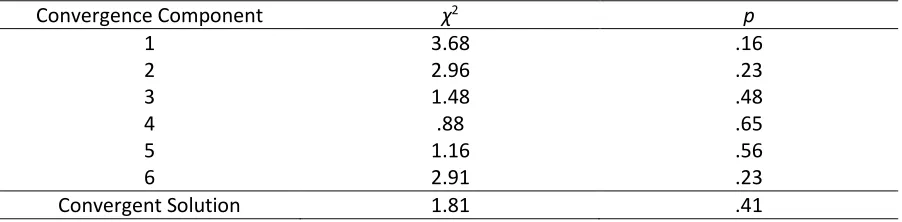
To determine if participants in gesture conditions differentially produced specific components of the convergence solution after given a hint to form a solution based on the rebel leader story, a series of chi-square tests of independence were conducted on the presence or absence of each component of the convergence solution. There were no differences between conditions on any of the components of the convergence solution.
Table 3: Chi-Square Tests for Differences between Gesture Conditions on Production of Components of the Convergence Solution to the Radiation Problem
Table 3
Chi-Square Tests for Differences Between Gesture Conditions on Production of Components of the Convergence Solution to the Radiation Problem
Convergence Component χ2 p
1 3.68 .16
2 2.96 .23
3 1.48 .48
4 .88 .65
5 1.16 .56
6 2.91 .23
DISCUSSION
The results of the study do not support the hypothesis that conditions in which participants produce more hand gestures while encoding information are more likely to transfer that
information to a novel context. The relationship between gesturing condition during encoding of information and transfer of information to new contexts, though non-significant, was in the opposite direction of a priori hypotheses. It was hypothesized that participants either instructed to enact the rebel leader story or allowed to spontaneously gesture while recounting the rebel leader story would produce a convergence solution to the radiation problem at higher rates than
participants not allowed to gesture, but there were no differences by condition on production of the convergence solution.
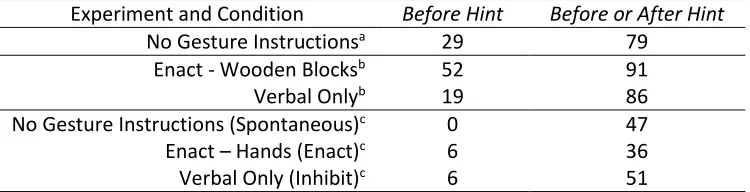
Compared to previous studies using very similar methods, participants in the current study had much lower rates of producing the convergence solution to the radiation problem. This was true compared to data from Catrambone et al. (2006) after being given the hint, and true of data from both Catrambone et al. (2006) and Gick and Holyoak (1983) before the hint was given. The table below shows solution rates in Gick and Holyoak (1983), Catrambone et al. (2006), and the current study.
Table 4: Percentage of Participants Producting the Convergence Solution to the Radiation Problem in Current and Comparable Past Studies
Table 4
Percentae of participants producing the convergence solution to the radiation problem in current and comparable past studies
Experiment and Condition Before Hint Before or After Hint
No Gesture Instructionsa 29 79
Enact - Wooden Blocksb 52 91
Verbal Onlyb 19 86
No Gesture Instructions (Spontaneous)c 0 47
Enact – Hands (Enact)c 6 36
Verbal Only (Inhibit)c 6 51
aGick and Holyoak, 1983, Experiment 2 bCatrambone et al., 2006
The large discrepancies between solution rates in the current and previous studies is difficult to account for, as the discrepancies are evident even in conditions matching exactly the procedure and experimental manipulation. In Gick and Holyoak, the main methodological difference is that participants in the current study, but not the Gick and Holyoak (1983) study, were led to believe that the study was actually two separate studies. Methodologically, the current study was more similar to the Catrambone et al. (2006) study, in that participants were explicitly told that there were two separate studies, one involving comprehension (reading the rebel leader story and recounting the story) and a separate second study involving problem solving (solve the radiation problem). The protocol and verbal instructions provided to participants were very similar in the current study to the Catrambone et al. (2006) study, and the ‘inhibit’ condition of the current study included no deviations from the protocol of the verbal-only condition in Catrambone et al. (2006). Unlike the other studies, the current study had participants complete a challenging cognitive measure (AOSPAN) before studying the rebel leader story and trying to solve the radiation problem. The AOSPAN is a challenging task that may have induced fatigue in participants, and future
researchers may wish to consider administering any challenging cognitive measures either after the experimental manipulation, or in a separate session.
rebel leader story in the current study would allow deeper processing of the story, and its converging forces schema. If this were the case, individuals with lower WMC would benefit especially from producing gesture while recalling the rebel leader story, but this pattern of results was not found in the current study. It would seem that the benefit of action on analogical problem solving under certain conditions is not related to WMC or a general cognitive load mechanism.
The dichotomous outcome predictor used in the current study as an indirect measure of the encoding of spatial information may have been a somewhat insensitive measure. In an attempt to address this concern, components of the solution to the radiation problem were examined as a function of condition, but the components of solutions produced by participants did not differ across conditions. To understand the absence of a benefit to analogical transfer of information resulting from gesturing condition, it may be helpful to consider differences between studies finding a benefit of gesture on analogical transfer, and studies that do not.
A recent study used a paradigm similar to the current study, but rather than experimentally manipulating aspects of the recounting of the story, as was the case in the current study, the researchers coded post-hoc for the presence of a specific ‘redistribution gesture’ in participant’s spontaneously produced gestures (Cooperrider & Goldin-Meadow, 2014). The researcher’s
predicted, similarly to the current study, that participant’s spontaneously producing more gestures when describing the rebel leader story (or an analogically similar ‘fire-chief’ story) would be more likely to produce a convergence solution to the radiation problem later on. The researcher’s reasoned that the schematic nature of gestures might lead to their making ideas more schematic, and more transferrable to new contexts. Results from the Cooperrider and Goldin-Meadow (2014) study did not support this hypothesis either, and in fact gave evidence of the reverse being true; participants who produced the ‘redistribution gesture’ while recounting the stories were
To understand why participant’s encouraged to enact the rebel leader story with their hands and participant’s allowed to or that do spontaneously gesture were not more likely (and possibly less likely) to produce the convergence solution to the radiation problem, it may be helpful to highlight differences between the actions of participants in the current study and the study from Cooperrider and Goldin-Meadow (2014), and the actions of participants in a similar study that found a benefit of acting out the rebel leader story to production of a convergence solution to the
radiation problem (Catrambone, et al., 2006). In the Catrambone et al. (2006) study, participants acted out the rebel leader story using non-descript blocks of wood to represent the actions of the rebel leader’s army (i.e. splitting and converging of the army by the rebel leader), whereas the studies finding no action benefit had participants use their hands, without specific instruction or affordance for acting out specific parts of the story.
Catrambone et al. (2006) attributed their results to stronger encoding of kinesthetic information (perceptual structures related to space and force) in participant’s mental
representation of the rebel leader story due to enactment. The researchers argue that encoding of kinesthetic information tied to the rebel leader story made this information more salient, and thus more retrievable when later solving the radiation problem. Findings from the studies showing no evidence for a benefit of hand gesture production during recounting of the rebel leader story on analogical transfer of the convergence solution suggest an alternative hypothesis, that kinesthetic information that is tightly linked with the mental imagery of the source of the information is less likely to be transferred to novel contexts when compared to kinesthetic information that is encoded in a more abstract form, decoupled from the mental imagery of the source of the kinesthetic information.
likely to produce the convergence solution to the radiation problem because the kinesthetic
information was less strongly linked to the mental imagery of the rebel leader story specifically, due to the abstract and schematic nature of the medium of story enactment, wooden blocks. It is possible, as suggested by Cooperrider and Goldin-Meadow (2014) that the schematic convergence information from the rebel leader story is more likely to be transferred to the radiation problem when it is less concretely linked to the mental imagery of the rebel leader story itself, and mentally represented more abstractly or schematically.
Using the video recordings of participants verbal recall of the rebel leader story, the researchers plan to code for the production of the specific ‘dispersion’ gesture coded for in the Cooperrider and Goldin-Meadow (2014) study to test if a similar pattern is found in which
participants producing the dispersion gesture during recall of the rebel leader story are less likely to produce the convergence solution to the radiation problem.
REFERENCES
Barsalou, L. W. (2008). Grounded cognition. Annual Review of Psychology, 59, 617–645. Barsalou, L. W. (2010). Grounded cognition: Past, present, and future. Topics in Cognitive
Science, 2(4), 716-724.
Beilock, S. L., & Goldin-Meadow, S. (2010). Gesture changes thought by grounding it in action. Psychological Science, 21(11), 1605-1610.
Broaders, S. C., Cook, S. W., Mitchell, Z., & Goldin-Meadow, S. (2007). Making children gesture brings out implicit knowledge and leads to learning. Journal of Experimental Psychology: General, 136(4), 539.
Catrambone, R., Craig, D. L., & Nersessian, N. J. 2006. The role of perceptually represented structure in analogical problem solving. Memory & Cognition 34(5). 1126–1132.
Church, R. B., & Goldin-Meadow, S. (1986). The mismatch between gesture and speech as an index of transitional knowledge. Cognition, 23(1), 43-71.
Conway, A., Kane, M., Bunting, M., Hambrick, D., Wilhelm, O., & Engle, R. (2005). Working memory span tasks: A methodological review and user’s guide. Psychonomic Bulletin & Review, 12(5), 769–786.
Cooperrider, K. and Goldin-Meadow, S. (2014). The role of gesture in analogical problem solving, Proceedings of the 36th Annual Meeting of the Cognitive Science Society, 2068-2072. Austin, TX: Cognitive Science Society
Duncker, K. (1945). On problem-solving. Psychological Monographs, 58(5, Whole No. 9).
Gick, M. L., & Holyoak, K. J. (1980). Analogical problem solving. Cognitive Psychology, 12, 306-335.
Gick, M. L., & Holyoak, K. J. (1983). Schema induction and analogical transfer. Cognitive
Goldin-Meadow, S., & Alibali, M. W. (2013). Gesture’s role in speaking, learning, and creating
language. Annual Review of Psychology, 64, 257.
Goldin-Meadow, S., Cook, S. W., & Mitchell, Z. A. (2009). Gesturing gives children new ideas about
math. Psychological Science, 20(3), 267-272.
Goldin-Meadow, S., Nusbaum, H., Kelly, S. D., & Wagner, S. (2001). Explaining math: Gesturing
lightens the load. Psychological Science, 12(6), 516-522.
Hauk, O., Johnsrude, I., & Pulvermüller, F. (2004). Somatotopic representation of action words in
human motor and premotor cortex. Neuron, 41(2), 301-307.
Hostetter, A. B., & Alibali, M. W. (2007). Raise your hand if you’re spatial: Relations between verbal
and spatial skills and gesture production. Gesture, 7, 73-95.
Hostetter, A. B., & Alibali, M. W. (2008). Visible embodiment: Gestures as simulated action.
Psychonomic Bulletin & Review, 15(3), 495–514.
Paas, F., & Sweller, J. (2012). An evolutionary upgrade of cognitive load theory: Using the human
motor system and collaboration to support the learning of complex cognitive
tasks. Educational Psychology Review, 24(1), 27-45.
Ping, R., & Goldin-Meadow, S. (2010). Gesturing saves cognitive resources when talking about
non-present objects. Cognitive Science, 34(4), 602–619.
Appendix A. The Rebel Leader Story
In the woods in the middle of a small country is a dictator’s compound. Although the
Appendix B. The Radiation Problem
Suppose you are a doctor faced with a patient who has a life-threatening stomach tumor. It is impossible to operate on the patient, but unless the tumor is destroyed the patient will die. A new form of radiation may be used to destroy the tumor, but there is a complication: A beam of
Appendix C. Convergence Solution Criteria to Radiation Problem Solutions were coded based on their inclusion of the following criteria:
1. The use of multiple beams of radiation 2. The use of weak radiation
3. The use of strong radiation
4. The use of mixed weak and strong radiation 5. The use of multiple doses of radiation over time 6. The use of radiation from different sides, or angles