EFFECTIVENESS OF OPEN SOURCE DATA LOSS PREVENTION TOOL IN CLOUD COMPUTING
MAHATHIR BIN SULAIMAN
A project report submitted in partial fulfillment of the requirement for the award of the degree of Master of Computer Science (Information Security)
Advanced Informatics School Universiti Teknologi Malaysia
iii
ACKNOWLEDGEMENT
iv
ABSTRACT
v
ABSTRAK
vi
TABLE OF CONTENTS
CHAPTER TITLE PAGE
DECLARATION ii
ACKNOWLEDGEMENT iii
ABSTRACT iv
ABSTRAK v
TABLE OF CONTENTS vi
LIST OF FIGURES x
LIST OF TABLES xi
LIST OF ABBREVIATIONS xii
LIST OF APPENDICES xiii
1 INTRODUCTION 1
1.1.Background 1
1.2.Background of the Problem 2
1.3.Problem Statement 4
vii
1.5. Research Objectives 6
1.6. Project Aim 6
1.7. Project Scope 7
1.8. Summary 7
2 LITERATURE REVIEW 9
2.1. Introduction 9
2.2. Hardened Cloud Computing Infrastructure 10 2.3. Third Party Authentication Provider 11
2.4. Data Loss Prevention Tool 13
2.4.1. Definition of Data Loss Prevention 14 2.4.2. Data Loss Prevention (DLP) 15 2.4.3. DLP Main Technology Components 17
2.4.4. DLP Enforcement Actions 18
2.4.5. DLP Data Classification 19
2.4.6.
DLP
Keyword Matching 192.4.7. DLP Regular Expressions 20
2.4.8.
DLP
Fingerprinting 202.4.9. DLP Machine Learning Algorithms 22
2.4.10. Conceptual/Lexicon 23
2.5. Comparative Table 24
2.6. Summary 25
3 RESEARCHMETHODOLOGY 26
viii
3.2. Research Method 27
3.2.1. Planning 28
3.2.2 Literature Review 28
3.2.3 Requirement Specification 28
3.2.4 Design on Experiment Platform 29
3.2.5 Data Collection and Analysis 30
3.2.6 Hardware and Software Requirement 30
3.2.7 Possible Attack Scenario 31
3.3. Research Deliverables 31 3.4. Summary 32 4 DESIGN ON EXPERIMENT PLATFORM 34 4.1. Introduction 34 4.2. Current DLP Products in Market 34 4.3. Objective of Experiment 35 4.4. Requirement for the Experiment 35 4.5. Data Loss Prevention Software 35 4.6. Data Loss Prevention Tool Policy 35 4.7. Sampling Confidential Data 37 4.8. Experiment Architecture 38 4.8.1.Experiment 1: Determine DLP tool effectiveness 39 4.8.2. Experiment 2: Identify the weakness of DLP deployment
ix
4.9. Experiment Equipment 40
4.9.1. Hardware Equipment 40
4.9.2. Virtualisation Software 41
4.10. Summary 42
5 RESULT AND ANALYSIS 44
5.1.Introduction 44
5.2. Determining DLP Market Leader 44
5.2.1.Gartner Evaluation Method 45
5.2.2.Symantec DLP 46
5.2.3. Websense DLP 47
5.2.4. RSA The Security Division of EMC 47
5.3.Open Source DLP Products 48
5.3.1.OpenDLP 48
5.3.2.MyDLP 49
5.4. Results and Performance Evaluation 48
5.4.1. Results for Experiment 1 50
5.4.2. Results for Experiment 2 51
5.5. Analysis 52
5.6. Proposed DLP System Deployment Architecture 54
5.7.Summary 55
x
6.1. Conclusion 56
6.2. Contribution 57
6.3. Recommendation for Future Works 58
REFERENCES 59 - 61
xi
LIST OF FIGURES
FIGURE NO. TITLE PAGE
1.1 Snapshot of End User Level Agreement 3
1.2 Technological Approaches on Data Leakage 4
2.1 Attacks on Existing IDM System 12
2.2 Data Types 14
3.1 Data Security Lifecycle 26
3.2 Research Operation Framework 27
3.3 Standard DLP System Deployment 29
4.1 Experiment 1 Architecture Setup 37
4.2 Experiment 2 Architecture Setup 39
4.3 List of Virtual Server on Each Workstation 42
5.1 Gartner Magic Quadrant on DLP tool 45
5.2 Standard DLP System Architecture 53
xii
LIST OF TABLES
TABLE NO. TITLE PAGE
2.1 DLP Tool Feature Capability 16 3.1 Hardware & Software Requirement 29 3.2 Research Deliverable Table 30
4.1 Data Loss Prevention Policy 34
4.2 Experiment 1 Finding Checklist 38 4.3 Experiment 2 Finding Checklist 39 4.4 Hardware Equipment 40 4.5 List of Virtual Server on each workstation 41
5.1 Result from Experiment 1 51
xiii
LIST OF ABBREVIATIONS
ABBREVIATIONS DESCRIPTION
DLP - Data Loss Prevention
OS - Operating System
DOS - Disk Operating System
IT - Information Technology
SP - Service Provider
HTTP - Hyper Text Transfer Protocol
SMTP - Send Mail Transfer Protocol
xiv
LIST OF APPENDICES
Appendix TITLE PAGE
A Project Gantt Chart 62
B Sample File 1 63
C Sample File 2 64
D Sample File 3 65
E MyDLP Policy Setting 66
CHAPTER 1
INTRODUCTION
1.1. Background
Cloud computing, an emerging information technology approach was a transformed from grid computing architecture. The cloud computing terminology, as defined by NIST is “a model for enabling ubiquitous, convenient, on-demand network access to a shared pool of configurable computing resources that can be rapidly
provisioned and released with minimal management effort” (Mell and Grance, 2011). This new information technology (IT) infrastructure model is positioned as a cost reduction approach in IT operation and acquisition of server, storage and data center for non IT business organization. The primary benefit for customers of cloud computing infrastructure is that they would be able to focus more on core business operations and will not have to deal with the high cost of IT operations. Their IT cost would be minimized to subscription cost for the IT operations to the cloud computing service provider (SP) and save operation cost on the maintenance of the data center operation, servers, storage and network cost.
2
issues and processes that need to be addressed by cloud computing SP in order to attract customers. According to a survey by IDC in 2008, which was conducted on 244 IT executives/CIOs and their line-of-business colleagues about their companies’ use of, and views about IT Cloud Services; the finding was 74.6% of IT managers and CIOs believed that the primary challenge that hinders them from using cloud computing services is the security issue on cloud computing (IDC, 2008). The cloud service providers struggle with the cloud environment security issues because the cloud model is very complicated and has a many dimensions that must be evaluated when establishing a comprehensive security model (Almorsy et al, 2010).
One of the cloud computing security concerns is on the data integrity privacy. This is due to the technology complexity on the cloud computing. According to Subashini and Kavitha (2010), there are three types of cloud computing delivery models which are the Service as a Server (SaaS), Platform as a Service (PaaS) and Infrastructure as a service (IaaS). These service models have a different level of security requirement in the cloud environment. IaaS is the under-laying foundation of all cloud services, with PaaS built upon it and SaaS in turn built upon it. Just as capabilities are inherited, so are the information security issues and risks.
1.2. Background oftheProblem
3
information with their customers. Multi-tenancy which results in virtualizing the boundaries among the hosted application services of different customers and tenants and thus the cloud platform need to security harden such boundaries with new category of security controls (AlMorsy et al., 2011). This is to protect the security of the data center and part of physical security strategy.
Secondly, major cloud computing providers do actually state in their agreement that they had no warranties to ensure data preservation. They have clearly stated in their Service Level Agreement that they would not be held responsible for any security incidents and information leakage (Hoffman, 2012). For example, Amazon in its offering of cloud computing services, mentioned in end user level agreement (EULA) (as per Figure 1 below), among others means that their services are provided as is and that data hosted provided by the customers or third party vendor is not error free and may be damage or loss.
Figure 1.1: Snapshot of Amazon Cloud End User Level Agreement
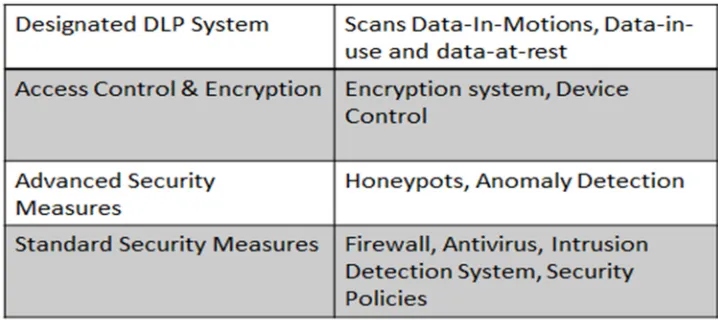
Because of these concerns, there had been various studies and researches that are looking into the area to ensure the interest of consumers are protected. Shabtai mentioned as per in Figure 1.2 that there are several techniques of data loss prevention including designated DLP system, access control, advanced and standard security measures (2012). Ristenpart et al. (2009) showcased that Amazon cloud is prone to side-channel attacks and it would be possible to capture and steal data, once the malicious virtual machine is placed on the same server as its target. It is possible to carefully
4
monitor how access to resources fluctuates and thereby potentially glean sensitive information about a victim. However, they acknowledge, that there are a number of factors that would make such an attack significantly more difficult in practice.
Typical security measures in guarding the data leakage, SP is putting up protection tools as per Figure 1.2. Starting from standard security measures which are network firewall, intrusion detection system and other network related security devices, this layer help to mitigate the network layer attacks. But as the attack had moved up to the application layer, DLP is needed as the security assurance, in case the bottom level were compromised.
Figure 1.2: Technological Approaches on Data Leakage
1.3. Problem Statement
5
the data stored could be sitting next to business competitors’ data. Secondly, cloud computing data is based on distributed data structure system where the data is hosted in unknown location which made it more worrisome. Moreover, the data owner does not have any visibility on SP system administrator’s activities. Even though, they are bound by policy, the fact that human weakness for the corruption could be weakness that worried customers. Based on preliminary research finding, there is few studies was done in preserving the data integrity on the cloud using data loss protection (DLP) software tool.
1.4. Research Questions
Data loss prevention (DLP) tool is the software of preventing sensitive data from leaving a user’s device to the unauthorised destination (Liu, 2010). The objective of this paper would be leading to providing the solution of ensuring the data integrity even though they are hosted on the cloud computing infrastructure. Acknowledging the critical of data security, there had been studies in the long term that there are cloud infrastructure can be implemented with the secured cloud in the design as per discussed by Shaikh and Haider (2011). This thesis would study the functional metric comparison of the existing data loss protection tools and to elaborate the effectiveness of DLP implementation in preserving data integrity in cloud computing. The research questions are as follows:
1) What are the available data loss prevention solutions available in the market and which one is market leader in the industry?
2) How effective open source DLP in IaaS type of cloud computing infrastructure in preventing data loss?
6
1.5. Research Objectives
1) To examine the available data loss prevention solutions available in the market and identify market leader in the industry.
2) To evaluate on the effectiveness of open source DLP in IaaS type of cloud computing infrastructure.
3) To identify security weaknesses in the standard open source DLP system architecture deployment and propose an improved DLP system architecture.
1.6. Project Aim
The aim of this project is address to the effectiveness of the data integrity preservation in cloud computing infrastructure by using DLP software tool and analyse the functionality and features for major DLP software in the market. We are targeting to complete the following:
1) Conclude the investigation on data integrity preservation can be compromised in cloud computing without the presence of data loss protection tool.
2) Identify and produce comparison metric for the available data loss protection tools in the market that can be deployed in cloud computing environment.
7
1.7. Project Scope
The thesis will be using both the experimental research methodology and the latest available research data on data loss prevention. There are three types of cloud computing infrastructures: Platform as a Service (PaaS), Software as a Service (SaaS) and Infrastructure as a Service (IaaS). For this thesis, we will only be covering for the type of Infrastructure as Services (IaaS) due to the only platform that the customers can have installation and configuration done on the cloud and have full control of the server. For this research purpose, there will be the setting up of cloud computing using open source virtualization software of Oracle VM VirtualBox. Once the mini cloud is ready, there will be proof of concept of to verify the data stored in the cloud are exposed to the risk of unauthorized access and evaluate the standard DLP system architecture is sufficiently secured and reliable. The project would focus on setting up of open source DLP tool deployment and configuration and demonstrate the potential data risk. The verification of proposed DLP tool would be done on the same cloud architecture and prove the data is protected even though it is hosted on the cloud computing infrastructure which the data center can be operated from foreign countries.
1.8. Summary
8
59
REFERENCES
A. Shabtai et al., (2012) A Survey of Data Leakage Detection and Prevention
Solutions, SpringerBriefs in Computer Science. 20 – 25
Baliga, J; Ayre,R; Hinton,K; Tucker, R. (January 2011). Green Cloud Computing:
Balancing Energy in Processing, Storage, and Transport. Proceedings of the IEEE. Vol. 99(1).151
Boritz, J. (Aug 2011). "IS Practitioners' Views on Core Concepts of Information
Integrity". International Journal of Accounting Information Systems.
Bosworth, M. (2008) ChoicePoint Settles Data Breach Lawsuit.
ConsumerAffairs.Com. 27 January 2008. [online]. Retrieved Feb 15, 2013 http://www.consumeraffairs.com/news04/2008/01/choicepoint_settle.html
Chen, D; Zhao H. (2012) Data Security and Privacy Protection Issues in Cloud
Computing. 2012 International Conference on Computer Science and Electronics Engineering. 647-651
Gartner (2013). Magic Quadrants and Market Scopes: How Gartner Evaluates
Vendors Within a Market. Gartner. [online]. Retrieved Feb 20, 2013. http://www.gartner.com/DisplayDocument?doc_cd=131166
Gessiou, Eleni, Vu, Quang Hieu and Ioannidis, Sotiris(2010). IRILD: an Information
Retrieval based method for Information Leak Detection. Institute of Computer Science, FORTH, Greece and Etisalat BT Innovation Center, Khalifa University, UAE.
Hoffman, M. (2012) Cloud Computing: The Next Headache. Cloud Computing
Security Seminar at SKMM Office, Cyberjaya.
Hart, Michael, Manadhata, Pratyusa and Johnson, Rob. Text Classification for Data
Loss Prevention. s.l. : Springer Berlin / Heidelberg, 2011. Vol. 6794, pp. 18-37.
IDC, IT Cloud Services User Survey, pt.2: Top Benefits & Challenges [Online].
Retrieved on Dec 10th ,2012 at http://blogs.idc.com/ie/?p=210
Info-Tech (2012). Vendor Landscape Storyboard: Data Loss Prevention [Online]. Retrieved on March 15, 2012. From http://www.infotech.com/research/it-storyboard-select-an-enterprise-data-loss-prevention-solution
J. Albuquerque, H. Krumm and P. de Geus,(2008) "Model-based management of
60
Kanagasingham,P (Aug 15, 2008 ). Data Loss Prevention. SANS Institute InfoSec
Reading Room. [Online]. Retrieved on March 15, 2012.from http://www.sans.org/ reading_room/ whitepapers/ dlp/ data-loss-prevention_32883
Kandukuri BR, Paturi VR, Rakshit A. (2009) “Cloud security issues”. IEEE
international conference on services computing, 517–20.
Keila, P.S. and Skillicorn, D.B.(2005) Detecting Unusual Email Communication..
2005 conference of the Centre for Advanced Studies on Collaborative research
Liu, S; Kuhn,R. (2010) Data Loss Prevention, IT Professional Vol. 12(2), p10–13.
M. Almorsy, J. Grundy, I. Mueller,(2010) An analysis of the cloud computing
security problem, 2010 Asia Pacific Cloud Workshop Australia.
M. Almorsy, J. Grundy, S. Amani, (2011) Collaboration-Based Cloud Computing
Security Management Framework. 2011 IEEE 4th International Conference on Cloud Computing. 364-371
Ranchal, R.; Bhargava, B.; Othmane, L.B.; Lilien, L.; Anya Kim; Myong Kang;
Linderman, M.; (2010) Protection of Identity Information in Cloud. 29th IEEE
International Symposium on Reliable Distributed Systems. Vol 29, 368 - 372
Mell,P; Grance, T. (2011) The NIST Working Definition of Cloud Computing v14,
Nat.Inst. Standards Technology, [Online]. Retrieved on Mar 15, 2012 from: http://csrc.nist.gov/publications/nistpubs/800-145/SP800-145.pdf
Mishra, R.; Dash, S.K.; D.P.; Tripathy, A. (2011). A Privacy Preserving Repository
for Securing Data across the Cloud. Electronics Computer Technology (ICECT), 3rd International Conference:6-10
Miranda & Siani,(2009).A Client-Based Privacy Manager for Cloud Computing,
COMSWARE‘09, Dublin, Ireland
Mogull, Rich. Best Practices for Endpoint Data Loss Prevention. Securosis, L.L.C.,
2009.
Manuel, Stephane (2008) Classification and Generation of Disturbance Vector for
Collision Attacks Against SHA-1. iacr.org. [Online]. Retrieved Feb 15, 2013 http://eprint.iacr.org/2008/469.pdf.
Polatcan, Onur, Mishra, Sumita and Pan, Yin (2011) New York : E-mail Behavior
Profiling based on Attachment Type and Language, 6th Annual Symposium on Information Assurance (ASIA '11). 6-10.
Phua C,(2009), Protecting organisations from personal data breaches. Computer
61
R. Gellman (2009), Privacy in the Clouds: Risks to Privacy and Confidentiality from
Cloud Computing, World Privacy Forum, Feb. 2009. [Online]
http://www.worldprivacyforum.org/pdf/WPF_Cloud_Privacy_Report.pdf
Rongxing et al, (2010) ”Secure Provenance: The Essential Bread and Butter of Data Forensics in Cloud Computing”, ASIACCS '10 Proceedings of the 5th ACM Symposium on Information, Computer and Communications Security, Beijing, China.
Reddy, VK and Reedy, L.S.S. (September 2011). Security Architecture of Cloud
Computing. International Journal of Engineering Science and Technology (IJEST). Vol. 3( 9)
Rohit,R; Bharat, B; Othmane, L; Leszek,L;( 2010) Protection of Identity Information
in Cloud Computing without Trusted Third Party. 29th IEEE International Symposium on Reliable Distributed Systems:389
Subashini S , Kavitha V, (2010) A survey on security issues in service delivery
models of cloud computing. Journal of Network and Computer Applications.
Shaikh, F.B. and Haider, S. (December 2011) Security Threats in Cloud Computing.
6th International Conference on Internet Technology and Secured Transactions, Abu Dhabi, United Arab Emirates.
SUN Microsystems (2010) Sun Cloud Architecture Introduction White Paper.
[Online]. Retrieved on April 1, 2012 from http://developers.sun.com.cn/blog/ functionalca/ resource/ sun_353cloudcomputing_chchine.pdf.
T. Ristenpart, E. Tromer, H. Shacham, S. Savage (2009) Hey, You, Get Off My
Cloud: Exploring Information Leakage in Third-Party Compute Clouds. 6th ACM conference on Computer and Communications Security, Chicago. 199-212.
Trend Micro (2010). Trend Micro DLP Administrator's Guide. s.l. : Trend Micro.