SOME NUMERICAL METHODS OF DIFFUSION EQUATION FOR DIC
TECHNIQUE
Norma Alias1, Hafizah Farhah Saipan Saipol2 and Asnida Che Abd. Ghani3
1
Ibnu Sina Institute, Faculty of Science, Universiti Teknologi Malaysia, 81310 UTM, Johor Bahru, MALAYSIA.
2,3Department of Mathematics, Faculty of Science, Universiti Teknologi Malaysia, 81310 UTM, Johor Bahru,
MALAYSIA.
Email: [email protected], {2msc.hafizah, 3msc.asnida}@gmail.com
ABSTRACT
Food drying is one of the common techniques for preserving food to decrease the moisture content and minimize the biochemical reactions of degradation. This paper focuses on the mathematical modeling of tropical fruits dehydration using instant controlled pressure drop (Détente Instantanée Controlée or known as DIC) technique. The mathematical model is described based on the Fick’s second type law [1]. Neglecting the effects of shrinkage, the Fick’s law is transformed into one dimensional partial differential equation (PDE) with parabolic type. The discretization of the PDE is based 3 points weighted finite difference approximation. The simulation of the diffusion equation is illustrated through some numerical iterative methods; Jacobi, Gauss Seidel, Red Black Gauss Seidel and Successive Over Relaxation (SOR) methods. The sequential algorithm is developed by using Matlab 7.6.0 software with R2008a version supported by Intel®CoreTM Processor. The numerical analyses of these iterative methods are compared in terms of number of iterations, time execution, maximum error, root mean square error and computational complexity cost.
KEYWORDS
Food drying, DIC technique, Diffusion equation, Finite difference approximation, Sequential algorithm.
1INTRODUCTION
Drying is an industrial preservation technique to reduce the water content of the food product and to minimize biochemical reactions of the degradation [2]. The dehydration process of fruits, vegetables and other products are implemented to enhance storage stability, to
minimize packaging requirements and to decrease the food weight by maintaining the food nutrient. The most applicable techniques to keep the fruits fresh and dry including freeze, vacuum, osmotic, cabinet, fluidized bed, spouted bed and microwave drying, and combinations thereof [3].
Another alternative technique of dehydrating process is DIC technique. The DIC technology was initially developed by Allaf et al., (since 1988) in the University of La Rochelle, France. The instant pressure-drop modifies the texture of the material and intensifies functional behavior, [4]. There are three stages involved in DIC drying. At the first stage, the vacuum condition is created. The second stage, the steam is injected to the material for several second and proceeds with the sudden pressure drop toward vacuum. The third stage, the sudden pressure drop causes quick cooling of the treated material and massive evaporation of the water content. The diagrammatic layout of the DIC can be shown in Figure 1 [5].
during drying process are as following [4].
(i) internal heat transfer transmits the energy by heat conduction condition,
(ii) external heat transfer carries out the energy based on convection or radiation process,
(iii) internal moisture mass transfer carries out the water content in liquid and vapor phase,
(iv) external mass transfer process.
The high accuracy of mathematical model generates the high impact in designing and analyzing the simultaneous heat and moisture transfer modeling. Drying models can be classified into three major groups; empirical, semi-empirical and theoretical equation. Empirical equations are valid for specific processes. The basic heat and mass transfer models forming the simultaneous linear of equations systems based on Fick’s diffusion theory. This comprehensive model associates with energy, mass and momentum transport equations and thermodynamically interactive fluxes [6]. Empirical and semi-empirical models such as Newton (or Exponential), Page, Henderson & Pabis, Simplified Fick’s diffusion, Logarithmic, two term, two term exponential, Verma et al., Wang & Singh and many other models have been used to describe the extensive of the drying kinetics [7-10]. The theoretical model based on the numerical simulation has been reported by Wang & Sun [11].
[4, 12, 13] adopted Crank Nicolson’s scheme to the geometry of solid matrix and diffusion equation [14].Zarguili et al. [15] solved the first order PDE of mass transfer equation by using integration and numerical methods. All programs were run using the SIGMAPLOT software. Al Haddad et al. [16] reported that the Fick’s law for the drying kinetics was controlled the mass transfer within the food material.
The theoretical studies on dehydration process are based on the pure mass transfer, heat transfer properties and its effects on drying process [1]. The diffusion and capillary action of the mass transfer equation are based on Fick’s second law as the following,
m eff
m w
m M
M grad D
v v M
M
(1)
where M is the apparent density of water in the food material, Mm is the apparent density of dry material, vw is absolute velocity of water flow
within porous medium, vm is the absolute
velocity of solid medium and Deff is the effective diffusivity of water within the solid medium.
Using the hypothesis of diffusion equation and the effects of drying shrinkage, equation (1) becomes
2 2
x M D
t M
eff
(2)
Some assumptions have been made to solve the PDE with parabolic type [17]:
1. Solid temperature remained constant and equal to air temperature during drying process.
2. Uniform initial moisture distribution.
3. Fruits slice was considered as a thin slab of thickness Lo=2l. Both sides of the slice are exposed to uniform airflow at constant temperature.
4. External resistance to the mass transfer was negligible.
The initial and boundary condition are as follows [18];
o
M x
M( ,0) at x0, 0
x M
the moisture balance can be written as
i air
air m dp
eff h M M
x M
D
where dp is the density of drying process, air is the density in ambient air flow, hm is the mass transfer coefficient, Mi is the interface moisture content (kg water vapor/kg dry air) and
air
M is the air moisture content (kg water vapor/kg dry air). The effective diffusion coefficient, Deff can be represented as,
) 273 ( exp T R E D D a o
eff (3)
where Deffis the effective diffusivity coefficient (m2/s); Do is pre-exponential factor Arrhenius equation (m2/s); Eais activation energy (kJ/mol);
R is gas constant, 8.3 J/mol K; and T is air temperature (oC).
The mass transfer coefficient, hm is computed using the following relationship [9]
0.5 0.33
Re 522 . 0 2 Sc L D h air
m (4)
Reynolds number, Re and Schmidt number, Sc
are defined as
VL
Re and
air
D
Sc (5)
where Dair, L, and V are diffusivity of vapor into air, length of food, kinematic viscosity of air and air velocity, respectively. Assuming one-dimensional equation is investigates involving some parameters of moisture transfer, homogeneous and spherical shape of the product sample. The initial condition is uniform moisture distribution with non-shrinking. The analytical solution of Fick’s equation [14] is given by equation (6),
1 2 2 2 2 2 exp 1 6 n eff e o e L t D n n M M M M MR (6)where Meis the equilibrium moisture content, L
is the half thickness of the slice and n is the Fourier’s series number.
2.1Discretization
The weighted finite difference approximation for
Equation (2) at
2 1 , j i t
x grid is given by
Equation (7) with
2 1
0 and 1
2 1
,
2
2 ( 1)
2 ( )
) ( ) 1 (
1 x ij
j i x eff j i j i M M x D t M
M
(7)
governing the 3 points formula
i j i j
eff
i jeff j i eff j i j i eff M D M M D M D M M D , , 1 , 1 1 , 1 , 1 1 , 1 1 2 1 1 2 1 (8)
where i1,2,...,m, j1,2,...,T and
2x t .
Equation (8) can be considered for three methods. There are an explicit, Crank Nicolson and implicit methods. The equation depends on
the value of variables,
2 1 , 0
or 1 respectively.
The methods used to solve the discretization are Jacobi, Gauss Seidel (GS), Red-Black Gauss Seidel (RBGS) and Successive Over Relaxation (SOR). These methods will be discussed in the next section.
2.2Iterative Methods
simultaneous linear system of equations into matrix form is used to solve Equation (8).
Jacobi method is a simple and fundamental iterative method. Jacobi method computes the value of u for each component respect to x andy.
( )
, ) 1 ( ii k j ij i ki b a M a
M
i1,2,3,...,m.Gauss Seidel method is an enhanced version of the Jacobi method. The calculation of this method is as follows
, ) 1 ( ) ( ) 1 ( ii k j i j ij k j i j ij i k
i b a M a M a
M
. ,..., 3 , 2 , 1 m iRed Black Gauss Seidel method contains two subdomain, R
and M. Red point depends on the black point, and vice-versa. The loop starts by computing the odd points, from the bottom left and then going up to the next row and so on. When the all odd points are finished, do the black ones. The red black grid is illustrated in Figure 2.
Figure 2. The grid for red and black points.
i) The grid calculation at R
, ) 1 ( ) ( ) 1 ( ii k j i j ij k j i j ij i k
i b a M a M a
M
. 1 ,..., 5 , 3 , 1 m iii) The grid calculation at M
, ) 1 ( ) ( ) 1 ( ii k j i j ij k j i j ij i k
i b a M a M a
M
. ,..., 6 , 4 , 2 m iSOR method is a variant of the Gauss Seidel method resulting in faster convergence. The formula is given by
1
( ) ( ) ( 1) ,) 1 (
kj i j ij k j i j ij i ii k j k
i b a M a M
a M
M
, 2
0 i1,2,3,...,m.
However, for1, the SOR method reduces to Gauss Seidel method.
These methods are repeated until it reaches the stopping criterion such that ( 1) (k)
i k
i M
M
whereis the convergence criterion.
3SEQUENTIAL ALGORITHM
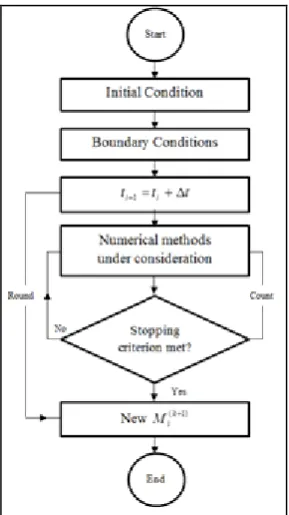
Figure 3 shows the sequential algorithm for numerical simulation of the parabolic equation. The computation iterates until it fulfills the stopping criterion.
4NUMERICAL ANALYSIS
Based on the weighted finite difference approximation, a computer program was developed and implemented in MATLAB software to simulate the fruit drying process using some numerical methods which are Jacobi, Gauss Seidel, Red Black Gauss Seidel and SOR methods. The CPU is supported by Intel®CoreTM based on Dualcore processors. The initial and boundary conditions are stated in Section 2 while the properties of fruits and physical conditions are illustrated in Table 1. In order to validate the numerical results, the obtained data were compared with the analytical solution, Equation (6).
Table 1. Fruits properties and physical conditions
eff
D 1.06109
L 5mm
0
M 3kg/kg T 600s
The numerical analysis of the weighted finite difference schemes for each method is illustrated Table 2. The analysis of the iterative methods is based on the time execution, number of iteration, computational cost, maximum error and root mean square error (RMSE). The formula for RMSE is given by
N
i
k i k
i M N
M
RMSE ( 1) ( ) 2 /
The comparison between the iterative methods was done for 1.0e5 tolerance rate and
100
N data size.
Table 2. Numerical analysis for different methods based on Crank-Nicolson and implicit formula.
From Table 2, SOR method shows the best performance which is more accurate and performs faster than RBGS, GS and Jacobi. SOR provides the lowest number of iteration and the shortest time of execution to converge. The accuracy method is determined by computing RMSE. The lowest value of RMSE represents the most accurate method. Absolute error also can describe the accuracy of each method. From Table 2, it is shown that SOR is the most accurate method due to the smallest value of RMSE. Therefore, from the obtained results, SOR is the alternative method with the lowest computational complexity, time of execution, number of iteration and convergence rate.
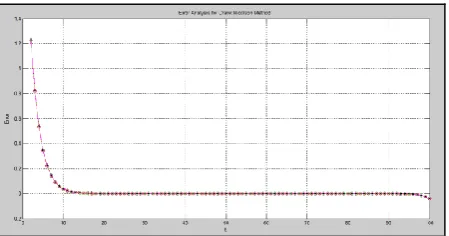
The visualization of the mass transfer is shown in Figure 4 and 6. Figure 4 and 6 show the moisture content based on the numerical and
analytical solution for 2 1
and 1. As time
goes on, the rate of evaporation of moisture decreases. Figure 5 and 7 illustrated the error between the analytical and numerical which are range between 1.23 and 6.521015 for
2 1
and between 2101 and 71011 for
1
.
Figure 4. Numerical and analytical analysis of moisture content when
2 1
Figure 5. The analysis of error between the numerical and analytical solution when
2 1
.
Figure 6. Comparison between numerical and the analytical for moisture content values when 1.
Figure 7. The analysis of error between the numerical and analytical solution when 1.
5CONCLUSION
A mathematical modeling based on PDE with parabolic type is used to present the mass transfer of drying process using DIC technique. The discretization of the governing equation is solved based on the Crank Nicolson method
(when
2 1
) and implicit method (when
1
). The weighted finite difference schemes are solved using Jacobi, Gauss Seidel, Red Black Gauss Seidel and SOR method. The result of the
time execution, number of iteration, computational cost, maximum error and root mean square error (RMSE). In order to validate the numerical results, the obtained data were compared with the analytical solution [14]. The visualization of the mathematical modeling using MATLAB software has shown that the rate of evaporation of moisture decreases as time goes on. The results obtained have proved that the mathematical model is capable to simulate the mass transfer distribution through numerical method approach.
6ACKNOWLEDGEMENT
The authors acknowledge the Institute of Ibnu Sina, UTM Johor Bahru, Ministry of Higher Education (MOHE) and Ministry of Science, Technology and Innovation Malaysia (MOSTI) for the financial support under vote 78646.
7REFERENCES
1. Allaf, K.: Transfer Phenomena and Industrial Applications. Teaching book published by the Lebanese University, Faculty of Science (1982). 2. Doymaz, I., Pala, M.: The Thin-Layer Drying
Characteristics of Thin Layer Corn. Journal of Food Engineering 60(2), 125--130 (2003).
3. George, S.D.S., Cenkowski, S., Muir, W.E.: A Review of Drying Technologies for the Preservation of Nutritional Compounds in Waxy Skinned Fruit. North Central ASAE/CSAE Conf, Winnipeg, pp. MB 04--104, 24-25 September, Manitoba, Canada, (2004). 4. Setyopratomo, P., Fatmawati, A., Allaf, K.: Texturing
by Instant Controlled Pressure Drop DIC in the Production of Cassava Flour: Impact on Dehydration Kinetics, Product Physical Properties and Microbial Decontamination. In: World Congress on Engineering and Computer Science. 20-22 October. San Francisco, USA, 112--117 (2009).
5. Haddad, J., Allaf, K.: A Study of the Impact of Instantaneous Controlled Pressure Drop on the Trypsin Inhibitors of Soybean. Journal of Food Engineering 79, 353--357 (2007).
201--222, Kluwer Academic Pub., Dordrecht, Boston & London (1988).
7. Karathanos, V.T., Belessiotis, V.G.: Application of a Thin-Layer Equation to Drying Data of Fresh and Semi-Dried Fruits. J. Agric. Engng Res. 74, 355--361 (1999).
8. Simal, S., Femenia, A., Garau, M.C., Rossello, C.: Use of Exponential, Page’s and Diffusional Models to Simulate the Drying Kinetics of Kiwi Fruit. Journal of Food Engineering 66, 323--328 (2005).
9. Karim, M.A., Hawlader, M.N.A.: Mathematical Modelling and Experimental Investigation of Tropical Fruits Drying. International Journal of Heat and Mass Transfer 48, 4914--4925 (2005).
10. Saeed, I.E., Sopian, K., Zainol Abidin, Z.: Drying Characteristics of Roselle: Study of the Two-term Exponential Model and Drying Parameters. Agricultural Engineering International: The CIGR Ejournal. Manuscript FP 08 016. Vol. X. December, 2008 (2008).
11. Wang, L., Sun, D.: Recent Developments in Numerical Modelling of Heating and Cooling Processes in the Food Industry-A Review. Trends in Food Science & Technology 14, 408--423 (2003). 12. Ben Amor, B., Allaf, K.: Impact of Texturing Using
Instant Pressure Drop Treatment Prior to Solvent Extraction of Anthocyanins from Malaysian Roselle (Hibiscus Sabdariffa). Food Chemistry 115, 820--825 (2009).
13. Pilatowski. I., Mounir, S., Haddad, J., Cong, D.T., Allaf, K.: The Instant Controlled Pressure Drop Process as a New Post-Harvesting Treatment of Paddy Rice: Impacts on Drying Kinetics and End Product Attributes. Food Bioprocess Technology 3, 901--907 (2010).
14. Crank, J.: The Mathematics of Diffusion. 2nd Ed., Clarendon Press, Oxford, London (1975).
15. Zarguili, I., Maache-Rezzoug, Z., Loisel, C., Doublier, J.L.: A Mathematical Model to Describe the Change in Moisture Distribution in Maize Starch during Hydrothermal Treatment. Int. Journal of Food Science and Tech. 44, 10--17 (2009).
16. Al Haddad, M., Mounir, S., Sobolik, V., Allaf, K.: Fruits & Vegetables Drying Combining Hot Air, DIC Technology and Microwaves. International Journal of Food Engineering 4 (6), Article 9 (2008).
17. Ramallo, L.A., Mascheroni, R.H.: Effect of Shrinkage on Prediction Accuracy of the Water Diffusion Model for Pineapple Drying. Journal of Food Processing Engineering. In Press (2011).