(will be inserted by the editor)
Alattin: Mining Alternative Patterns for Defect
Detection
Suresh Thummalapenta ⋅ Tao Xie
the date of receipt and acceptance should be inserted later
Abstract To improve software quality, static or dynamic defect-detection tools accept programming rules as input and detect their violations in soft-ware as defects. As these programming rules are often not well documented in practice, previous work developed various approaches that mine program-ming rules as frequent patterns from program source code. Then these ap-proaches use static or dynamic defect-detection techniques to detect pattern violations in source code under analysis. However, these existing approaches often produce many false positives due to various factors. To reduce false pos-itives produced by these mining approaches, we develop a novel approach, called Alattin, that includes new mining algorithms and a technique for de-tecting neglected conditions based on our mining algorithm. Our new mining algorithms mine patterns in four pattern formats: conjunctive, disjunctive, exclusive-disjunctive, and combinations of these patterns. We show the bene-fits and limitations of these four pattern formats with respect to false positives
This paper is an extended version of our previous work published at ASE 2009 [Thum-malapenta and Xie(2009a)]. Our previous work introduced the concept of balanced and imbalanced patterns that are expressed in theOr pattern format. In this work, we propose
additional new pattern formatsXor and Combo. We also propose new mining algorithms
for mining patterns inOr,Xor, andCombopattern formats. Furthermore, we show the ben-efits and limitations ofAnd,Or,Xor, andCombopattern formats by applying the patterns mined using these formats to the problem of detecting neglected conditions in applications under analysis.
Suresh Thummalapenta
Department of Computer Science North Carolina State University Raleigh
E-mail: [email protected]
Tao Xie
Department of Computer Science North Carolina State University Raleigh
and false negatives among detected violations by applying those patterns to the problem of detecting neglected conditions.
1 Introduction
Programming rules serve as a basis for applying static or dynamic defect-detection tools to detect rule violations as software defects and improve soft-ware quality. However, in practice, these programming rules are often not well documented for Application Programming Interfaces (APIs) due to var-ious factors such as hard project delivery deadlines and limited resources in the software development process [Lethbridge et al(2003)Lethbridge, Singer, and Forward]. To tackle the issue of lacking documented programming rules, various approaches have been developed in the past decade to mine pro-gramming rules from program executions [Ernst et al(2001)Ernst, Cockrell, Griswold, and Notkin, Ammons et al(2002)Ammons, Bodik, and Larus, Yang et al(2006)Yang, Evans, Bhardwaj, Bhat, and Das], individual versions [Engler et al(2001)Engler, Chen, Hallem, Chou, and Chelf,Li and Zhou(2005),Acharya et al(2006)Acharya, Xie, and Xu,Ramanathan et al(2007)Ramanathan, Grama, and Jagannathan,Shoham et al(2007)Shoham, Yahav, Fink, and Pistoia,Chang et al(2007)Chang, Podgurski, and Yang,Acharya et al(2007)Acharya, Xie, Pei, and Xu, Wasylkowski et al(2007)Wasylkowski, Zeller, and Lindig], or version histories [Livshits and Zimmermann(2005),Williams and Hollingsworth(2005)] of program source code. A methodology, commonly referred to as mining soft-ware engineering data (MSED) [DMSE(2010)], adopted by these approaches is to mine common patterns (e.g., frequent occurrences of pairs or sequences of API calls) across a sufficiently large number of data points (e.g., code exam-ples). These common patterns often reflect programming rules that should be obeyed when programmers write code using API calls involved in these rules. Then, these approaches use static or dynamic defect-detection techniques that accept mined patterns as inputs and detect pattern violations as potential defects in applications under analysis.
Since the inception of the MSED methodology, the major focus is to mine various types of patterns and use those patterns for detecting defects in ap-plications under analysis. Although MSED has been shown to be effective in detecting defects in applications under analysis, a major drawback of MSED is that the violations detected by existing MSED-based approaches often in-clude a large number of false positives. This phenomenon is reflected in the empirical evaluations of existing approaches [Engler et al(2001)Engler, Chen, Hallem, Chou, and Chelf, Li and Zhou(2005), Acharya et al(2006)Acharya, Xie, and Xu, Chang et al(2007)Chang, Podgurski, and Yang, Wasylkowski et al(2007)Wasylkowski, Zeller, and Lindig] where majority of detected vio-lations turn out to be false positives.
To illustrate how detected violations turn out to be false positives, we use two code examples (shown in Figure 1) using thenextmethod of theIterator
Example 1:
00:String printEntries1(ArrayList<String> entries){
01: ...
02: Iterator it = entries.iterator();...
03: if (it.hasNext()) {
04: String last = (String) it.next();... }}
Example 2:
00:String printEntries2(ArrayList<String> entries){
01: ...
02: if (entries.size() > 0) {
03: Iterator it = entries.iterator();... 04: String last = (String) it.next();... }}
Fig. 1 Two code examples using thenextmethod of theIteratorclass
ArrayList object without any elements. Programmers can avoid this
excep-tion by using either the condiexcep-tion check “𝑃1: boolean-check on return of Iterator.hasNextbeforeIterator.next” (shown inprintEntries1from
Exam-ple 1) or “𝑃2:const-checkonreturnofArrayList.sizebeforeIterator.next”
(shown inprintEntries2from Example 2). In general, programmers use either
𝑃1or𝑃2but not both, since using both𝑃1and𝑃2is redundant. Consider that a single pattern 𝑃1 is mined from the data points. A static defect-detection technique reports a violation in printEntries2, since the method does not
satisfy 𝑃1. However, the code example does not include any defect on using
Iterator.next, sinceprintEntries2satisfies𝑃2; therefore, the detected viola-tion turns out to be a false positive.
In our empirical investigation of false positives generated by existing ap-proaches [Engler et al(2001)Engler, Chen, Hallem, Chou, and Chelf, Li and Zhou(2005),Acharya et al(2006)Acharya, Xie, and Xu,Chang et al(2007)Chang, Podgurski, and Yang,Wasylkowski et al(2007)Wasylkowski, Zeller, and Lindig], we identify that a major reason for such a large number of false positives is that the focus of MSED is to minesinglepatterns (such as𝑃1) orconjunctive patterns (such as𝑃1∧𝑃2) (more details are presented in Section 5). The con-junctive pattern𝑃1∧𝑃2 describes that both𝑃1and𝑃2often appear together among the data points (e.g., code examples). We identify that these single or conjunctive patterns alone cannot describe the nearly complete behavior among data points, resulting in false positives. The reason why single or con-junctive patterns are not sufficient is that programmers write source code in different ways to achieve the same programming task (as shown in Examples 1 and 2). For example, the pattern 𝑃1⊕𝑃21 describes both the condition checks that can be used before thenextmethod. Furthermore, using the
pat-tern𝑃1⊕𝑃2does not result in violations inprintEntries1andprintEntries2,
thereby reducing false positives. We focus on mining patterns that describe nearly complete rather than complete behavior, since the patterns that de-scribe complete behavior cannot help detect violations as deviations from those patterns, resulting infalse negatives.
1
To reduce both false positives and false negatives among detected viola-tions and to infer patterns that describe nearly complete behavior, in this paper, we propose a novel approach, calledAlattin, that includes new mining
algorithms and a technique that detects neglected conditions (described next) using patterns mined by our mining algorithms. In particular, our algorithms mine patterns in four pattern formats: conjunctive (Andor∧), disjunctive (Or or ∨), exclusive-disjunctive (Xor or ⊕), and combinations of these patterns (referred to as Combo patterns). We use Alternative Patterns to collectively refer to patterns of all four formats and refer to individual patterns such as 𝑃1and𝑃2 in𝑃1∧𝑃2as alternatives.
In general, mining Or andXor patterns is more challenging than mining And patterns, since Or and Xor patterns do not follow the Apriori prin-ciple [Han and Kamber(2000)] in data mining. Given an input database of itemsets for applying mining techniques, the Apriori principle states that if an itemset is frequent, then all its subsets should also be frequent. Existing mining techniques [Burdick et al(2001)Burdick, Calimlim, and Gehrke] that target at miningAnd patterns use this principle for pruning the search space. For example, if an itemset𝑃1 is not frequent, then any superAnd itemset of 𝑃1such as𝑃1∧𝑃2cannot be frequent, and hence can be pruned. However, the Apriori principle does not hold for miningOr andXor patterns. For example, although the itemset𝑃1 is not frequent, its superOr itemset such as 𝑃1∨𝑃2 can be frequent, since 𝑃1∨𝑃2 is supported by more itemsets in the input database compared to𝑃1 or𝑃2 individually.
In this paper, we show the benefits and limitations of these four pattern formats with respect to false positives and false negatives by applying these pattern formats to the problem of detecting neglected conditions. Neglected conditions, also referred to as missing paths, are known to be an important category of software defects and are considered to be one of the primary reasons for many fatal issues such as security or buffer overflow vulnerabilities [Chang et al(2007)Chang, Podgurski, and Yang]. As shown by a recent study [Chang et al(2007)Chang, Podgurski, and Yang], 66% (109/167) of defect fixes applied in the Mozilla Firefox project are due to neglected conditions. In particular, neglected conditions (related to an API call) refer to (1) missing conditions that check the arguments or receiver of the API call before the API call or (2) missing conditions that check the return values or receiver of the API call after the API call. In our approach, we mine patterns that describe necessary condi-tion checks related to an API call in these four formats and use those condicondi-tion checks for detecting neglected conditions in applications under analysis.
This paper makes the following main contributions:
– An empirical investigation of four pattern formats: conjunctive (Andor∧), disjunctive (Or or∨), exclusive-disjunctive (Xor or⊕), and combinations of these patterns (referred to as combo patterns) in software engineering data.
01:public Object evaluate(Object val) { ... 02: if (val != null &&
val instanceof Collection) { 03: Collection coll = (Collection) val; 04: Iterator i = coll.iterator(); 05: if(!coll.isEmpty()) {
06: for (; i.hasNext();) { 07: Object obj = i.next(); 08: if(obj instanceof Node) { 09: Node node = (Node) obj;
10: //...
11: } } } }
12: return new Double(sum); 13:}
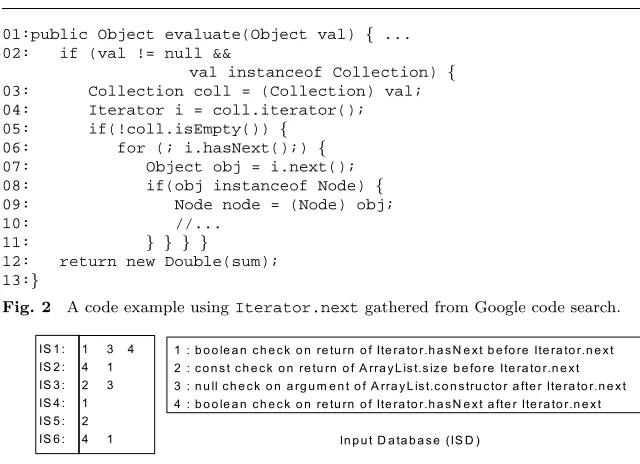
Fig. 2 A code example usingIterator.nextgathered from Google code search.
! ! " # $ !
% &
Fig. 3 An example input database𝐼𝑆𝐷.
– A technique that applies patterns of these four pattern formats for de-tecting neglected conditions around individual API calls in an application under analysis.
– Two evaluations to demonstrate the effectiveness of our approach. Our evaluation results show that the best pattern-mining approach (in terms of reducing both false positives and false negatives) is to first mine And patterns for API methods and next mine Combo patterns. Among viola-tions detected byCombo patterns, the best violation-detection approach is to assign higher priority to the violations of API methods with And pat-terns compared to the violations of API methods without And patterns. The primary reason is that the former violations are more likely to be real defects compared to the latter violations.
2 Example
We next use an illustrative example to describe our approach on how we collect the data that describes necessary condition checks around API calls. We also show how our proposed four pattern formats affect the number of false negatives and false positives among detected violations. Consider that an application under analysis uses theIterator.nextmethod as shown in the printEntries2method in Figure 1.
Initially, we gather relevant code examples that invoke the Iterator.next
nec-essary condition checks around the Iterator.nextmethod. Figure 2 shows a
code example gathered from Google code search. We next construct control-flow graphs (CFG) for collected code examples and perform two traversals (backward and forward) of the CFG from the node corresponding to the
Iterator.next method. In the backward traversal, we collect the condition
checks on the receiver and argument objects preceding the call site of the
Iterator.nextmethod. Similarly, in the forward traversal, we collect the
con-dition checks on the receiver and return objects succeeding the call site of theIterator.next method. For the current code example, our backward and
forward traversals gather the following condition checks.
a: boolean-check on the return of Iterator.hasNext before Iterator.next
b: boolean-check on the return of Collection.isEmpty before Iterator.next
c: instance-check on the return of Iterator.next with org.w3c.dom.Node
d: boolean-check on the return of Iterator.hasNext after Iterator.next
Condition check “a” describes the condition check performed before the call site of thenextmethod, whereas Condition check “d” describes the
con-dition check performedafter the call site of thenextmethod. The reason for
two condition checks is that thenextmethod (Statement 7) is invoked in afor
loop. Section 4 presents more details on how we exploit program dependencies while performing backward and forward traversals. The preceding set of con-dition checks collected from the code example forms an itemset in the itemset database𝐼𝑆𝐷, used as input for mining patterns. We analyze all gathered code examples to generate various itemsets and use different mining algorithms for mining the patterns in formats:And,Or,Xor, andCombo. Section 3 presents more details on our mining algorithms.
Figure 3 shows a sample itemset database 𝐼𝑆𝐷 with six itemsets. This 𝐼𝑆𝐷 includes four distinct items labeled with IDs 1 through 4. The figure also shows the condition check corresponding to each item. We next apply our mining algorithms for mining different pattern formats. The patterns mined by our algorithms with a minimum support threshold valuemin sup of 0.4 are shown below:
– And Pattern: “1∧4”, support: 0.5
– Or Pattern: “1∨2∨3∨4”, support: 1.0
– Xor Pattern: “1⊕2”, support 1.0; “4”, support: 0.5
– Combo Pattern: “(1∧4)⊕2”, support: 0.83
Among the itemsets shown in ISD, Items 1 and 4 often appear together with an ∧ relation, since the methodshasNext and nextare often used in a
loop (as shown in Statements 6 and 7 in Figure 2). Although the And pat-tern captures this behavior, theAnd pattern cannot capture the relation with Item 2, resulting in false positives when applied on code examples such as
in false positives, since the pattern includes all items. However, theOrpattern does not help in detecting violations, resulting in false negatives. Although the Xor pattern can perform better than the Or pattern, the Xor pattern may not detect violations in code examples, which include only Item 1 and do not include Item 4. As shown in this example, the Combo pattern describes the nearly complete behavior and also helps reduce both false positives and false negatives.
Along with the challenges faced while miningOrandXor patterns,Combo patterns pose additional challenges in choosing the suitable operator while combining items. For example, the suitable operator for combining items “1” and “4” is∧, although “1∨4” results in a higher support value than “1∧4”. We describe these challenges in subsequent sections and present our algorithms for mining these patterns.
In summary, this example illustrates the existence of pattern formatsAnd, Or, andXor, and also shows that no single pattern format alone can help in describing the necessary condition checks around API calls.
3 Mining Algorithms for Alternative Patterns
We next describe four pattern formats that we use in our empirical study. We first present formal definitions for the four pattern formats and next de-scribe our algorithms for mining the pattern in four formats with illustrative examples.
3.1 Formal Definitions
Let𝑀 ={𝑚1,𝑚2, ...,𝑚𝑘}be the set of all possible distinctitems. For
exam-ple, an𝑚𝑗 represents a condition check such as “boolean-checkon return of
Iterator.hasNextbeforeIterator.next”. Consider an ItemSet Database𝐼𝑆𝐷
as {𝑖𝑠1,𝑖𝑠2, ...,𝑖𝑠𝑙}, where each itemset𝑖𝑠𝑗 includes different sets of elements
such as{𝑚1,𝑚2, ...,𝑚𝑎} from the set of all possible distinct elements.
Definition 1 Pattern Candidate.A pattern candidate 𝑝𝑐 is a single item 𝑚𝑘 ∈ 𝑀 or a combination of two elements associated by a logical operator 𝑜𝑝∈ {∧,∨,⊕}. Each element in the combination is an item𝑚𝑖∈𝑀 or another
pattern candidate.
The preceding definition is a recursive definition, which defines that a pat-tern candidate can be either a simple or nested patpat-tern candidate. For example, a simple pattern candidate 𝑝𝑐𝑘 : 𝑚𝑖∧𝑚𝑗 is a combination of two items 𝑚𝑖
and 𝑚𝑗 with the operator 𝑜𝑝 ∈ {∧}. On the other hand, a nested pattern
candidate𝑝𝑐𝑙:𝑚𝑖∨𝑝𝑐𝑘 is a combination of an item𝑚𝑖 and the preceding
pat-tern candidate𝑝𝑐𝑘with the operator𝑜𝑝∈ {∨}. We use notations𝑝𝑐𝑘.𝑙𝑒𝑓 𝑡and 𝑝𝑐𝑘.𝑟𝑖𝑔ℎ𝑡 to refer to the left and rightchild pattern candidates, respectively,
notation𝑝𝑐𝑘.𝑜𝑝to refer to the operator𝑜𝑝 of the pattern candidate𝑝𝑐𝑘. We
classify a pattern candidate by its format, especially using its operator.
Definition 2 And Pattern Candidate. An And pattern candidate is a
pattern candidate where the operator 𝑜𝑝 ∈ {∧} and all the child pattern candidates are alsoAnd pattern candidates.
Definition 3 Or Pattern Candidate.AnOrpattern candidate is a pattern
candidate where the operator 𝑜𝑝∈ {∨} and all the child pattern candidates are alsoOr pattern candidates.
Definition 4 Xor Pattern Candidate.AXor pattern candidate is a
pat-tern candidate where the operator𝑜𝑝∈ {⊕} and all the child pattern candi-dates are alsoXor pattern candidates.
Definition 5 Combo Pattern Candidate.ACombo pattern candidate is
a pattern candidate where the operator𝑜𝑝∈ {∧,∨,⊕}.
The category ofCombopattern candidates subsumes the categories ofAnd, Or, and Xor pattern candidates. An example combo pattern candidate is “𝑝𝑐1⊕𝑝𝑐2”, where𝑝𝑐1 and𝑝𝑐2are “𝑚𝑖∧𝑚𝑗” and “𝑚𝑘∧𝑚𝑙”, respectively.
To compute frequent patterns among pattern candidates, we use a thresh-old value, referred to as min sup, that describes the minimum support for a pattern candidate to be classified as a frequent pattern. Algorithm 1,IsSupportedBy,
describes how we compute support values for the preceding pattern formats. In particular,IsSupportedByaccepts a pattern candidate𝑝𝑐𝑘 and an itemset 𝑖𝑠𝑗,
and returns true, if 𝑖𝑠𝑗 supports 𝑝𝑐𝑘, and otherwise returns false. Initially, IsSupportedBy checks whether𝑝𝑐𝑘 is a single item and returnstrueor false
based on whether𝑝𝑐𝑘 is contained in𝑖𝑠𝑗. Otherwise,IsSupportedByrecursively
computes whether𝑝𝑐𝑘.𝑙𝑒𝑓 𝑡and𝑝𝑐𝑘.𝑟𝑖𝑔ℎ𝑡of𝑝𝑐𝑘 are supported by the itemset 𝑖𝑠𝑗, and uses the operator𝑝𝑐𝑘.𝑜𝑝for checking whether𝑖𝑠𝑗supports𝑝𝑐𝑘 (Lines
4 - 15). We compute the support value of a pattern candidate𝑝𝑐𝑘, referred to
as Support(𝑝𝑐𝑘), based on the number of the itemsets (in𝐼𝑆𝐷) that return truefor the algorithmIsSupportedBy.
Definition 6 Frequent Pattern (FP). A pattern candidate𝑝𝑐𝑘 is
consid-ered as a frequent pattern, if Support(𝑝𝑐𝑘)≥min sup.
A frequent pattern𝑓 𝑝𝑘 is considered as anAnd,Or,Xor, orCombopattern
based on the operator𝑓 𝑝𝑘.𝑜𝑝.
3.2 Mining Algorithms
Algorithm 1IsSupportedBy (𝑝𝑐𝑘,𝑖𝑠𝑗)
Require: PatternCandidate𝑝𝑐𝑘, ItemSet𝑖𝑠𝑗
Ensure: true, if𝑖𝑠𝑗supports𝑝𝑐𝑘
Ensure: false, if𝑖𝑠𝑗does not support𝑝𝑐𝑘
1: if𝑝𝑐𝑘is a SingleItemthen
2: return 𝑝𝑐𝑘∈𝑖𝑠𝑗
3: else
4: bool lefts = isSupportedBy(𝑝𝑐𝑘.𝑙𝑒𝑓 𝑡,𝑖𝑠𝑗) 5: bool rights = isSupportedBy(𝑝𝑐𝑘.𝑟𝑖𝑔ℎ𝑡,𝑖𝑠𝑗) 6: if 𝑝𝑐𝑘.𝑜𝑝==∨ then
7: return lefts∨rights
8: end if
9: if 𝑝𝑐𝑘.𝑜𝑝==∧ then
10: return lefts∧rights
11: end if
12: if 𝑝𝑐𝑘.𝑜𝑝==⊕ then
13: return lefts⊕rights
14: end if
15: end if
3.2.1 Mining Or and Xor Patterns
In general, miningOr andXor patterns is more challenging than miningAnd patterns, since these patterns do not follow the Apriori principle [Han and Kamber(2000)]. The Apriori principle states that if an itemset is frequent, then all its subsets should also be frequent. Existing mining techniques that target at miningAnd patterns use this principle for pruning the search space. For example, if an itemset𝑝𝑐1 is not frequent, then any super itemset of𝑝𝑐1 such as𝑝𝑐1∧𝑝𝑐2 cannot be frequent, and hence can be pruned. However, the Apriori principle does not hold for miningOr andXor patterns. For example, even if the itemset𝑝𝑐1is not frequent, then its super itemset such as𝑝𝑐1∨𝑝𝑐2 can be frequent. To address this issue, we propose a greedy algorithm based on the following property for pruning the search space of patterns. This property is inspired by Nanavati et al. [Nanavati et al(2001)Nanavati, Chitrapura, Joshi, and Krishnapuram] and is applicable to bothOr andXor patterns.
Property 1 The support of an Or orXor pattern candidate 𝑝𝑐𝑘, represented
as Support(𝑝𝑐𝑘), formed from two pattern candidates𝑝𝑐𝑘.𝑙𝑒𝑓 𝑡 and 𝑝𝑐𝑘.𝑟𝑖𝑔ℎ𝑡
should have higher value thanSupport(𝑝𝑐𝑘.𝑙𝑒𝑓 𝑡)andSupport(𝑝𝑐𝑘.𝑟𝑖𝑔ℎ𝑡).
The rationale behind the preceding property is based on our objective to mine patterns that describe nearly complete behavior. For example, a pat-tern candidate𝑝𝑐𝑘 =𝑝𝑐𝑖∨𝑝𝑐𝑗, whose support value is less thanSupport(𝑝𝑐𝑖)
and Support(𝑝𝑐𝑗) is not useful compared to individual pattern candidates in
achieving our objective. Algorithm 2, MineXorOr, describes our greedy
algo-rithm for mining Or and Xor patterns. MineXorOr accepts itemset database
𝐼𝑆𝐷,min sup, and𝑝𝑡𝑦𝑝𝑒∈ {∨,⊕}as inputs.
Initially, MineXorOr identifies all distinct items in the itemset database
Algorithm 2MineXorOr(𝐼𝑆𝐷,𝑚𝑖𝑛 𝑠𝑢𝑝,𝑝𝑡𝑦𝑝𝑒)
Require: 𝐼𝑆𝐷,𝑚𝑖𝑛 𝑠𝑢𝑝,𝑝𝑡𝑦𝑝𝑒
Ensure: Set<PC> 𝑃 𝐶𝑆𝑒𝑡
1: 𝑃 𝐶𝑆𝑒𝑡=𝜙
2: Set<M> 𝑑𝑖𝑠𝑡𝑖𝑛𝑐𝑡𝐼𝑡𝑒𝑚𝑠= ComputeDistinct(𝐼𝑆𝐷)
3: for all𝑚𝑖∈𝑑𝑖𝑠𝑡𝑖𝑛𝑐𝑡𝐼𝑡𝑒𝑚𝑠do
4: if 𝑆𝑢𝑝𝑝𝑜𝑟𝑡(𝑚𝑖, 𝐼𝑆𝐷)>=𝑚𝑖𝑛 𝑠𝑢𝑝then
5: 𝑃 𝐶𝑆𝑒𝑡+ =𝑚𝑖
6: end if
7: end for
8: Set<PC> 𝐶𝑢𝑟𝑟𝑆𝑒𝑡=𝑑𝑖𝑠𝑡𝑖𝑛𝑐𝑡𝐼𝑡𝑒𝑚𝑠 9: loop
10: Set<PC> 𝑁 𝑒𝑥𝑡𝑆𝑒𝑡=𝜙 11: Set<PC> 𝐶ℎ𝑖𝑙𝑑𝑆𝑒𝑡=𝜙
12: Set<PC> 𝑃 𝑊 𝑆𝑒𝑡= ComputePairwise(𝐶𝑢𝑟𝑟𝑆𝑒𝑡,𝑝𝑡𝑦𝑝𝑒)
13: for all𝑝𝑐𝑗∈𝑃 𝑊 𝑆𝑒𝑡do
14: 𝑠𝑣𝑎𝑙=𝑆𝑢𝑝𝑝𝑜𝑟𝑡(𝑝𝑐𝑗, 𝑝𝑡𝑦𝑝𝑒)
15: if(𝑠𝑣𝑎𝑙 < 𝑚𝑖𝑛 𝑠𝑢𝑝∣∣𝑠𝑣𝑎𝑙≤𝑆𝑢𝑝𝑝𝑜𝑟𝑡(𝑝𝑐𝑗.𝑙𝑒𝑓 𝑡)∣∣𝑠𝑣𝑎𝑙≤𝑆𝑢𝑝𝑝𝑜𝑟𝑡(𝑝𝑐𝑗.𝑟𝑖𝑔ℎ𝑡))
then
16: Continue
17: end if
18: 𝑁 𝑒𝑥𝑡𝑆𝑒𝑡+ =𝑝𝑐𝑗 19: 𝑃 𝐶𝑆𝑒𝑡+ =𝑝𝑐𝑗
20: end for
21: if 𝑁 𝑒𝑥𝑡𝑆𝑒𝑡.𝑠𝑖𝑧𝑒()≤1then
22: break
23: end if
24: 𝑁 𝑒𝑥𝑡𝑆𝑒𝑡= ApplyGreedy(𝐶𝑢𝑟𝑟𝑆𝑒𝑡,𝑁 𝑒𝑥𝑡𝑆𝑒𝑡)
25: for all𝑝𝑐𝑗∈𝐶𝑢𝑟𝑟𝑆𝑒𝑡do
26: if 𝑝𝑐𝑗∈ {/ 𝑝𝑐𝑘.𝑙𝑒𝑓 𝑡, 𝑝𝑐𝑘.𝑟𝑖𝑔ℎ𝑡},∀𝑝𝑐𝑘∈𝑁 𝑒𝑥𝑡𝑆𝑒𝑡then
27: 𝑁 𝑒𝑥𝑡𝑆𝑒𝑡+ =𝑝𝑐𝑗
28: end if
29: end for
30: 𝐶𝑢𝑟𝑟𝑆𝑒𝑡=𝑁 𝑒𝑥𝑡𝑆𝑒𝑡
31: end loop
32: return 𝑃 𝐶𝑆𝑒𝑡
MineXorOr checks whether the support of any of these items is greater than
min sup and adds those items to𝑃 𝐶𝑆𝑒𝑡(Lines 3 to 7). Next,MineXorOruses
various iterations, where pairwise combinations are computed using the func-tion ComputePairwise from the elements of the previous iteration stored in
CurrSet (Lines 9 to 31). For example, consider Or patterns. For the CurrSet
={𝑝𝑐1, 𝑝𝑐2, 𝑝𝑐3},ComputePairwisereturns a set with three elements, i.e.,PWSet
={𝑝𝑐1∨𝑝𝑐2,𝑝𝑐1∨𝑝𝑐3,𝑝𝑐2∨𝑝𝑐3}. The algorithm next identifies the elements inPWSet, whose support values are greater thanmin sup and satisfy Property
1.MineXorOrnext chooses pattern candidates (from𝑁 𝑒𝑥𝑡𝑆𝑒𝑡) that participate
in the next iteration by greedily choosing one parent pattern candidate in 𝑁 𝑒𝑥𝑡𝑆𝑒𝑡with the highest support value for each pattern candidate in𝐶𝑢𝑟𝑟𝑆𝑒𝑡 using the functionApplyGreedy(Line 24). The rationale behind our greedy
candi-Fig. 4 All possible itemsets with four distinct items.
Fig. 5 MiningXor patterns.
dates in𝐶𝑢𝑟𝑟𝑆𝑒𝑡whose parent pattern candidates do not belong to𝑁 𝑒𝑥𝑡𝑆𝑒𝑡 (Lines 25 - 29).MineXorOradds such pattern candidates to 𝑁 𝑒𝑥𝑡𝑆𝑒𝑡 as well,
since these pattern candidates can still be helpful when combined with other pattern candidates in𝑁 𝑒𝑥𝑡𝑆𝑒𝑡.
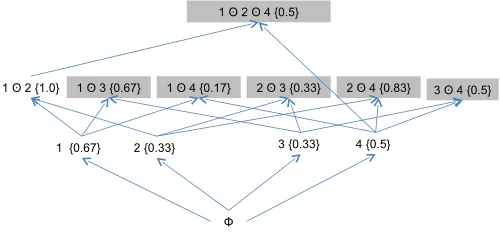
We next explain the algorithm in detail using the itemset database shown in Figure 3. The itemset database includes four distinct items. Figure 4 shows all possible pattern candidates that can be derived using the preceding four distinct items. This figure shows the complete search space of pattern can-didates. We first explain mining Xor patterns and next explain mining Or patterns.
MiningXor Patterns.Figure 5 shows howMineXorOrprunes the search
space and generates patterns “1⊕2” (support 1.0) and “4” (support: 0.5). The value shown in braces next to each pattern candidate indicates support value of that pattern candidate. The pattern candidates shown in gray are pruned byMineXorOrdue to three factors. First, the support value of pattern
candidate is lower thanmin sup. For example,Support(2⊕3) = 0.33, which is
lower than min sup. Second, the pattern candidate does not satisfy Property 1. For example, the pattern candidate “1⊕3” does not satisfy Property 1, since
Support(1⊕3)≤Support(1). Third, the pattern candidate is not the candidate
Fig. 6 MiningOr patterns.
Fig. 7 Phase 1 of miningCombopatterns.
Fig. 8 Phase 2 of miningCombopatterns.
child pattern candidate. For example, the pattern candidate “2⊕4” is pruned, since the pattern candidate “1⊕2” has a higher support value than “2⊕4”. Since all parent pattern candidates of “4” are pruned away, MineXorOradds
this candidate to𝑁 𝑒𝑥𝑡𝑆𝑒𝑡for the next iteration and computes further pattern candidates such as “1⊕2⊕4”.
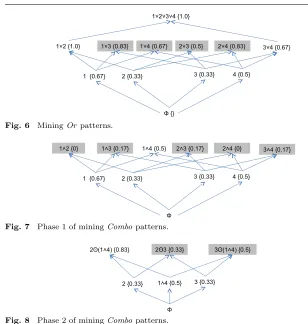
Mining Or Patterns. Figure 6 shows howMineXorOrprunes the search
space and generates theOrpattern “1∨2∨3∨4” (support: 1.0). Similar toXor patterns, the pattern candidates are pruned due to the same three factors.
3.2.2 Mining Combo Patterns
We next describe how we mine combo patterns. The algorithm for mining Combo patterns includes two phases. Phase 1 minesAnd Patterns and Phase 2 minesCombo patterns using the output of Phase 1. We next explain each phase in detail.
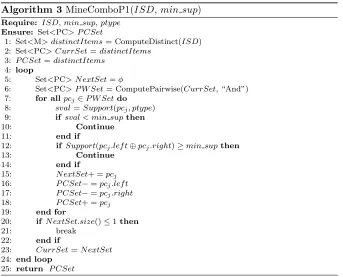
Phase 1.Algorithm 3,MineComboP1, shows Phase 1 of miningCombo
pat-terns. In particular,MineComboP1 computes pairwise And combinations of all
Algorithm 3MineComboP1(𝐼𝑆𝐷,𝑚𝑖𝑛 𝑠𝑢𝑝)
Require: 𝐼𝑆𝐷,𝑚𝑖𝑛 𝑠𝑢𝑝,𝑝𝑡𝑦𝑝𝑒
Ensure: Set<PC> 𝑃 𝐶𝑆𝑒𝑡
1: Set<M> 𝑑𝑖𝑠𝑡𝑖𝑛𝑐𝑡𝐼𝑡𝑒𝑚𝑠= ComputeDistinct(𝐼𝑆𝐷) 2: Set<PC> 𝐶𝑢𝑟𝑟𝑆𝑒𝑡=𝑑𝑖𝑠𝑡𝑖𝑛𝑐𝑡𝐼𝑡𝑒𝑚𝑠
3: 𝑃 𝐶𝑆𝑒𝑡=𝑑𝑖𝑠𝑡𝑖𝑛𝑐𝑡𝐼𝑡𝑒𝑚𝑠 4: loop
5: Set<PC> 𝑁 𝑒𝑥𝑡𝑆𝑒𝑡=𝜙
6: Set<PC> 𝑃 𝑊 𝑆𝑒𝑡= ComputePairwise(𝐶𝑢𝑟𝑟𝑆𝑒𝑡, “And”)
7: for all𝑝𝑐𝑗∈𝑃 𝑊 𝑆𝑒𝑡do
8: 𝑠𝑣𝑎𝑙=𝑆𝑢𝑝𝑝𝑜𝑟𝑡(𝑝𝑐𝑗, 𝑝𝑡𝑦𝑝𝑒) 9: if 𝑠𝑣𝑎𝑙 < 𝑚𝑖𝑛 𝑠𝑢𝑝then
10: Continue
11: end if
12: if 𝑆𝑢𝑝𝑝𝑜𝑟𝑡(𝑝𝑐𝑗.𝑙𝑒𝑓 𝑡⊕𝑝𝑐𝑗.𝑟𝑖𝑔ℎ𝑡)≥𝑚𝑖𝑛 𝑠𝑢𝑝then
13: Continue
14: end if
15: 𝑁 𝑒𝑥𝑡𝑆𝑒𝑡+ =𝑝𝑐𝑗 16: 𝑃 𝐶𝑆𝑒𝑡−=𝑝𝑐𝑗.𝑙𝑒𝑓 𝑡 17: 𝑃 𝐶𝑆𝑒𝑡−=𝑝𝑐𝑗.𝑟𝑖𝑔ℎ𝑡 18: 𝑃 𝐶𝑆𝑒𝑡+ =𝑝𝑐𝑗
19: end for
20: if 𝑁 𝑒𝑥𝑡𝑆𝑒𝑡.𝑠𝑖𝑧𝑒()≤1then
21: break
22: end if
23: 𝐶𝑢𝑟𝑟𝑆𝑒𝑡=𝑁 𝑒𝑥𝑡𝑆𝑒𝑡
24: end loop
25: return 𝑃 𝐶𝑆𝑒𝑡
have higher support values than min sup (Lines 9 - 11). If yes, MineComboP1
computes the support of Xor combination of the two candidates, shown as
Support(𝑝𝑐𝑗.𝑙𝑒𝑓 𝑡⊕𝑝𝑐𝑗.𝑟𝑖𝑔ℎ𝑡) in Line 12. If the preceding support value is
also higher than min sup, then MineComboP1 ignores the And combination.
The rationale behind this decision is that, if both “𝑝𝑐𝑗.𝑙𝑒𝑓 𝑡∧𝑝𝑐𝑗.𝑟𝑖𝑔ℎ𝑡” and
“𝑝𝑐𝑗.𝑙𝑒𝑓 𝑡⊕𝑝𝑐𝑗.𝑟𝑖𝑔ℎ𝑡” have higher values thanmin sup, then the suitable
com-bination of𝑝𝑐𝑗.𝑙𝑒𝑓 𝑡and𝑝𝑐𝑗.𝑟𝑖𝑔ℎ𝑡is “𝑝𝑐𝑗.𝑙𝑒𝑓 𝑡∨𝑝𝑐𝑗.𝑟𝑖𝑔ℎ𝑡”.
Figure 7 shows the output of MineComboP1with the itemset database ISD
shown in Figure 3. As shown in the figure, Phase 1 produces three pattern candidates as output: “1∧4”, “2”, and “3”, which are passed as inputs to Phase 2.
Phase 2.Phase 2 of miningCombo patterns is similar to Algorithm 2 for miningXor andOrpatterns. The major difference is to choosing a suitable op-erator,𝑜𝑝∈ {∨,⊕}, when combining two pattern candidates during the com-putation of pairwise combinations. Given two pattern candidates𝑝𝑐𝑖 and𝑝𝑐𝑗,
Phase 2 chooses the∨operator if “Support(𝑝𝑐𝑖∧𝑝𝑐𝑗)≥𝑚𝑖𝑛 𝑠𝑢𝑝&&Support(𝑝𝑐𝑖⊕ 𝑝𝑐𝑗) ≥𝑚𝑖𝑛 𝑠𝑢𝑝”; otherwise, Phase 2 chooses the ⊕ operator. The rationale
4 Alattin Approach
Our Alattin approach accepts an application under analysis and detects ne-glected conditions around APIs reused by the application. More specifically, Alattin scans the application and gathers APIs reused by the application. Alattin uses our mining algorithms to mine patterns that serve as program-ming rules in reusing those APIs. Then Alattin detects violations of these programming rules. In summary, Alattin includes four major phases. In Phase 1, Alattin gathers relevant code examples that reuse APIs. In Phase 2, Alat-tin analyzes gathered code examples or application under analysis to generate pattern candidates suitable for mining. In Phase 3, Alattin applies mining al-gorithms on pattern candidates to mine patterns. In Phase 4, Alattin detects violations of mined patterns in the application under analysis. We next explain each phase in detail. We use notations𝐶𝑖and𝐹𝑖to denote a class or a method
used by the application under analysis, respectively.
4.1 Phase 1: Gathering Code Examples
In Phase 1, Alattin gathers code examples from existing open source reposito-ries through code search engines (CSE) such as Google code search [GCSE(2006)] and Koders [KODERS(2005)]. These code search engines are primarily used by programmers in searching for relevant code examples from available open source projects on the web. As these CSEs can serve as powerful resources of open source code, these CSEs can be exploited for other tasks such as de-tecting violations in applications that reuse existing open source projects. Our approach uses a CSE to gather relevant code examples and mines gathered code examples to detect violations in an application under analysis.
To collect code examples through a CSE, Alattin constructs queries for each𝐶𝑖and𝐹𝑖. For example, Alattin constructs query of the form “lang:java Iterator next” to collect code examples that invoke the nextmethod of the Iteratorclass. More specifically, our queries include the names of the class and
method along with the language type. Alattin stores gathered code examples in the local file system for further analysis. Alattin uses Google code search (GCSE) [GCSE(2006)] for collecting relevant code examples with two main reasons: (1) GCSE provides client libraries that can be used by other tools to interact with and (2) GCSE has public forums that provide good support. However, our approach is independent of GCSE and can leverage any other CSE to gather relevant code examples.
4.2 Phase 2: Generating Pattern Candidates
Alattin has to associate condition checks in the conditional expressions of If
orWhilestatements with the related method calls. We use theIterator.next
method and its relevant code example in Figure 2 as a running example for explaining Phase 2.
Alattin includes two sub-phases in Phase 2: CFG construction and traver-sal. In the CFG construction sub-phase, Alattin constructs CFGs for each code example with two kinds of nodes: control (𝐶𝑇) and non-control (𝑁 𝑇) nodes. Control nodes represent control-flow statements such as if, while, and for, which control the flow of the program execution. Non-control nodes repre-sent other statements such as method calls or type casts. For example, State-ment 5 in the code example (Figure 2) is a control node and StateState-ment 9 is a non-control node. When encountering a control node, say 𝐶𝑇𝑖 (𝑖 indicates
the statement id), Alattin also extracts all variables, say {𝑉1, 𝑉2, ..., 𝑉𝑛},
that participate in the conditional expression of that node and the condition checks on those variables. For example, the control node 𝐶𝑇2 includes the {(val,null-check), (val,instance-check)}pairs. If the control node includes
comparisons with expressions such as method calls, our approach stores those method calls also as additional information within the control node. When en-countering a non-control node such as a method call, Alattin extracts variables such as{receiver,argument1, ...,argumentN}associated with the method call.
In the CFG traversal sub-phase, Alattin associates gathered condition checks with their related method calls such asIterator.hasNext. The traversal
phase includes two kinds of traversals: backward and forward. Alattin performs a backward traversal from the call site such as𝑁 𝑇7 of the 𝐹𝑖 method to
col-lect condition checks on the receiver and argument objects preceding the call site. Similarly, Alattin performs a forward traversal to collect condition checks on the receiver and return objects after the call site of the 𝐹𝑖 method. In
each traversal, Alattin exploits program dependencies for associating condi-tion checks with method calls. Failing to consider these program dependencies may result in programming rules that are not semantically related as shown in the limitations of the PR-Miner [Li and Zhou(2005)] and DynaMine [Livshits and Zimmermann(2005)] approaches. To exploit program dependencies, Alat-tin uses the concept of dominance with a combination of control-flow and data-flow dependencies.
Definition:A node𝑁 dominatesanother node𝑀 in a control flow graph
(represented as N dom M) if every path from the starting node of the CFG to 𝑀 includes 𝑁.
Initially, Alattin identifies the dominant𝐶𝑇𝑖nodes for each𝑁 𝑇𝑘 node. For
example, the control node𝐶𝑇6 dominates the non-control node𝑁 𝑇7. Alattin computes the intersection between the variable set associated with the 𝐶𝑇𝑖
node, say{𝑉1,𝑉2, ...,𝑉𝑛}, and the receiver or argument variables of the𝑁 𝑇𝑘
node, say{receiver,argument1, ...,argumentN}. If the intersection{𝑉1,𝑉2, ..., 𝑉𝑛} ∩ {receiver, argument1, ..., argumentN} ∕=∅, Alattin checks whether the
𝑁 𝑇𝑘 node is dependent on the 𝐶𝑇𝑖 node, i.e., whether there exists at least
path between𝐶𝑇𝑖 and𝑁 𝑇𝑘 nodes. If the𝑁 𝑇𝑘 node is dependent on the 𝐶𝑇𝑖
node, Alattin adds the condition check to the pattern candidate. For example, the extracted condition check for nodes𝐶𝑇6 and𝑁 𝑇7 in the code example is “boolean-check on return of Iterator.hasNextbeforeIterator.next”, which
indicates that a boolean-check must be done on the return variable of the hasNext method before the call site of Iterator.next. In our experience, we
found that there can be various code examples without any condition checks around an 𝐹𝑖 method. Failing to consider these code examples can assign
incorrect support values to mined patterns. To address this issue, we add an Empty Pattern Candidate to the input database ISD for each such code example.
4.3 Phase 3: Mining Alternative Patterns
In Phase 3, Alattin uses our mining algorithms (described in Section 3) to mine patterns in all four pattern formats:And,Or,Xor, andCombo patterns. Alattin applies our mining algorithms on pattern candidates of each𝐹𝑖method
individually. The reason is that if we apply mining algorithms on all pattern candidates together, the patterns related to an𝐹𝑖method with a few pattern
candidates can be missed due to patterns (related to other𝑀𝑗 methods) with
a large number of pattern candidates. For each𝐹𝑖, Alattin mines patterns in
all four pattern formats. We used amin sup threshold value of 0.4 based on our empirical experience [Thummalapenta and Xie(2009a)].
4.4 Phase 4: Detecting Neglected Conditions
In Phase 4, Alattin detects violations of mined patterns in the application under analysis statically. More specifically, Alattin gathers condition checks around each call site of an𝐹𝑖 method in the application under analysis.
Alat-tin constructs an itemset𝑖𝑠𝑗 using gathered condition checks. For each mined
pattern 𝑝𝑐𝑘 in all patterns of four formats, Alattin uses IsSupportedBy
(Al-gorithm 1) to check whether the itemset𝑖𝑠𝑗 supports the mined pattern𝑝𝑐𝑘.
If the itemset does not support the mined pattern, Alattin reports a viola-tion. For each detected violation, Alattin assigns a support value as the same value as the support value of the associated mined pattern used to detect the violation.
5 Evaluations
of our evaluations are available at
https://sites.google.com/site/asergrp/projects/alattin/. We next present research questions addressed in our evaluations.
5.1 Research Questions
In our evaluations, we address the following research questions.
– RQ1: How high percentage ofAnd,Or,Xor, andCombopatterns represent real programming rules, respectively? Since real programming rules are re-quired for detecting violations in applications under analysis, this research question helps to show the pattern formats that are suitable for detecting violations.
– RQ2: How low percentage of false negatives and false positives exist among violations detected usingAnd,Or,Xor, andCombopatterns, respectively? Since false positives are one of the common issues faced by existing static defect-detection techniques, this research question helps to show that the patterns that describe nearly complete behavior (such as Or or Combo) help reduce the number of false positives with no or low increase of false negatives.
5.2 Subject Applications
We next present subject applications used in our evaluations. In our evalua-tions, we used three Java default API libraries and four popular open source libraries. Table 1 shows the characteristics of the subject applications. Columns “Classes” and “Methods” show the number of classes and methods, respec-tively. For mining patterns of three Java default API libraries, we gathered 49858, 5555, and 15052 code examples for Java Util, Java Transaction, and Java SQL, respectively. Column “KLOC” shows the kilo lines of code in each subject application.
The Java Util package2
includes the collections framework and other popu-lar utilities used by many different applications. Java Transactions3
and Java SQL4
are industry standards for developing multi-tier server-side Java ap-plications. Hibernate5
and HsqlDB6
abstract relational databases to use an object-oriented methodology. Columba7
is an open source email-client appli-cation written in Java. Columba provides a user-friendly graphical interface
2
http://java.sun.com/j2se/1.4.2/docs/api/java/util/package-summary. html
3 http://java.sun.com/javaee/technologies/jta/ 4
http://java.sun.com/j2se/1.4.2/docs/api/java/sql/package-summary. html
5
http://www.hibernate.org/
6 http://hsqldb.org/ 7
Table 1 Subject applications and their characteristics.
Application #Classes#Methods KLOC
Java Util APIs 19 144
-Java Transaction APIs 7 37
-Java SQL APIs 14 93
-Hibernate 478 4334 118
HsqlDB 143 1178 41
Columba 1500 7674 136
BCEL 357 2691 32
Total 2518 16151 327
Table 2 Alternative patterns mined by Alattin
Application And Patterns Or Patterns
Total #RR #PR #FP Total #RR #PR #FP
Java Util 40 34 0 6 51 25 19 7
Java Sql 26 26 0 0 24 21 3 0
Java 3 3 0 0 9 2 4 3
Transaction
Xor Patterns Combo Patterns
Total #RR #PR #FP Total #RR #PR #FP
Java Util 54 35 11 8 50 32 11 7
Java Sql 33 30 3 0 24 21 3 0
Java 8 2 4 2 8 2 4 2
Transaction
RR: Real Rules, PR: Partial Rules, FP: False Positives
and is suitable for internationalization support. The BCEL library8 , devel-oped by Apache, is mainly used to analyze, create, and manipulate Java class files. We selected these applications, since these applications are popular open source applications and are used as subjects in evaluating previous related approaches [Weimer and Necula(2005), Thummalapenta and Xie(2009b)].
5.3 RQ1: Alternative Patterns
We next address the first research question of whether alternative patterns exist in real applications and how high percentage of those patterns represent real programming rules. To address this question, we configured Alattin, which by default accepts an application under analysis and mines patterns for third-party APIs, to accept a set of classes and methods directly. In this mode of operation, Alattin mines patterns (programming rules) for the APIs of the given classes and methods.
Table 2 shows the patterns mined in all four formats: And, Or,Xor, and Combo. For each pattern format, Columns “Total”, “RR”, “PR”, and “FP” show the total number of mined patterns, real rules, partial rules, and false positives, respectively. Real rules describe properties that must be satisfied when using an API method. In real rules, all alternatives are real properties.
8
0 20 40 60 80 100
And
Combo
Or Xor
And
Combo
Or Xor
And
Combo
Or Xor
Mined Patterns
Subject Application
Java Util Java Sql Java Transaction
False positives Partial rules Real rules
Fig. 9 Classification of mined patterns
In contrast to real rules, some alternatives in Partial rules do not represent real properties. The reason for introducing partial rules is that partial rules are as effective as real rules in reducing false-positive defects; however, par-tial rules can increase false-negative defects due to false-positive alternatives among mined patterns.False positives represent mined patterns where none of the alternatives represents real properties. To mine patterns in all four pattern formats, Alattin took 13, 1, and 1 seconds for Java Util, Java Sql, and Java Transaction, respectively. All experiments were conducted on a machine with 2.2GHz Intel processor and 3GB RAM. We used available on-line documenta-tions, JML specifications9
, or source code of applications for classifying mined patterns into these three categories.
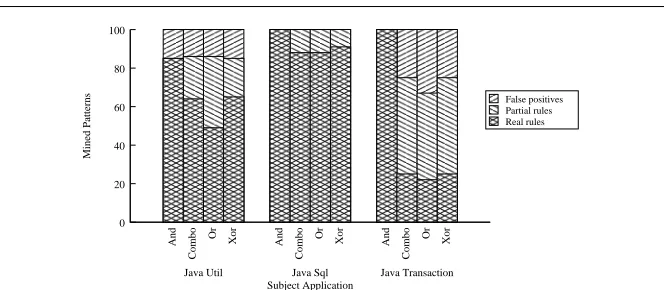
Figure 9 shows the percentages of real, partial, and false-positive rules among mined patterns of each pattern format. In summary, a high percentage of And, Or, Xor, and Combo patterns represent real rules. We also found that Or, Xor, and Combo patterns include new real rules that do not exist amongAnd patterns. Since existing approaches mine onlyAnd patterns, our results show that new defects can be detected using Or, Xor, and Combo patterns. The figure also shows that, exceptAnd patterns, all other pattern formats include a considerable percentage of partial rules. Therefore, although these three pattern formats can help reduce false positives, these three pattern formats can result in false negatives among detected violations. Furthermore, Or patterns have higher percentage of partial rules compared to Xor and Combo patterns, indicating that Or patterns result in more false negatives compared toXor andCombo patterns.
We next present example patterns in each pattern format for the read
method of thejava.util.jar.JarInputStreamclass, which extends theZipInputStream
class. This class is used for reading the contents of a Jar file from any input stream such asFileInputStream. This class includes three methods:getNextEntry, getNextJarEntry, andread. ThegetNextEntrymethod reads the next Zip file
entry, represented as an instance of theZipEntryclass, and positions the stream
9
00: ...
01: JarInputStream in; 02: ZipEntry ze; ...
03: while ((ze = in.getNextEntry()) != null){ 04: if(thePath.equals(zipEntry.getName())){ 05: ByteArrayOutputStream buffer =
new ByteArrayOutputStream(); 06: byte[] bytes = new byte[2048]; 07: int bytesRead;
08: while((bytesRead = in.read(bytes)) != -1){ 09: buffer.write(bytes, 0, bytesRead); 10: }
11: return new ByteArrayInputStream (buffer.toByteArray()); 12: }
13: } ...
Fig. 10 Alternative patterns mined for thereadmethod of theJarInputStreamclass.
at the beginning of the entry data in the Jar file. On the other hand, the
getNextJarEntry method reads the next Jar file entry, represented as an
in-stance of the JarEntry class, and positions the stream at the beginning of
the entry data. Indeed, theJarEntry class extends theZipEntryclass and
in-cludes additional methods such as getAttributes for reading the attributes
specific to the Jar file. In general, programmers use either getNextEntry or getNextJarEntryfor iterating through the entries in the Jar file and for
read-ing the contents usread-ing thereadmethod. Furthermore, if there is only one entry
to read from the Jar file, the readmethod is used directly without using
ei-thergetNextEntry or getNextJarEntry. Figure 10 shows an example usage of getNextEntryandreadmethods. This code example is extracted from Apache’s
Jakarta Cactus project10 .
Figure 11 shows the patterns mined for the read method in all four
for-mats. TheAnd pattern includes only one alternative𝑃1, which describes that there should be a condition check with “-1” on the return value of theread
method. Here, “-1” indicates that the end of the entry is reached. TheOr Pat-tern includes two alPat-ternatives “𝑃1∨𝑃2”, where𝑃2indicates that there should be a null-check on the return of the getNextJarEntry method. The reason
that theAnd pattern could not mine the alternative𝑃2is that there are vari-ous scenarios where𝑃1and𝑃2are not used together. For example, when𝑃2is used, programmers often get the size of the buffer to be read using thegetSize
method of JarEntry, which is the return type of thegetNextJarEntrymethod.
Therefore, programmers often do not explicitly check the return value of the
readmethod, when thegetNextJarEntrymethod is used. Figure 11 also shows
that there are twoXor patterns. Interestingly, the second pattern “𝑃2⊕𝑃3” shows that programmers often use either getNextJarEntry or getNextEntry,
but not both together, since the related pattern “𝑃2∨𝑃3” is not being mined. However, the Xor pattern alone could not mine the relation among all
alter-10
Method:JarInputStream.read (byte[], int, int)
A.And Pattern
Pattern: “𝑃1”, SUP(𝑃1): 0.63
𝑃1: “const-checkon the return ofJarInputStream.read
with -1”
B.Or Pattern
Pattern: “𝑃1∨𝑃2”, SUP(𝑃1∨𝑃2): 0.67
𝑃1: “const-checkon the return ofJarInputStream.read
with -1”
𝑃2: “null-checkon the return of
JarInputStream.getNextJarEntry()before
JarInputStream.read”
C.Xor Patterns
Pattern: “𝑃1”, SUP(𝑃1): 0.63
𝑃1: “const-checkon the return ofJarInputStream.read
with -1”
Pattern: “𝑃2⊕𝑃3”, SUP(𝑃2⊕𝑃3): 0.52
𝑃2: “null-checkon the return of
JarInputStream.getNextJarEntry()before
JarInputStream.read” 𝑃3: “null-checkon the return of
JarInputStream.getNextEntry()before
JarInputStream.read”
D.Combo Pattern
Pattern: “𝑃1∨(𝑃2⊕𝑃3) ”, SUP(𝑃1∨(𝑃2⊕𝑃3)): 0.67
𝑃1: “const-checkon the return ofJarInputStream.read
with -1”
𝑃2: “null-checkon the return of
JarInputStream.getNextJarEntry()before
JarInputStream.read” 𝑃3: “null-checkon the return of
JarInputStream.getNextEntry()before
JarInputStream.read”
Fig. 11 Alternative patterns mined for thereadmethod of theJarInputStreamclass.
natives 𝑃1, 𝑃2, and 𝑃3. The Combo pattern addresses this issue via mining the pattern “𝑃1∨(𝑃2⊕𝑃3)”, and shows the relation among all alternatives.
5.4 RQ2: False Positives and False Negatives
Table 3 Analysis of violations detected in subject applications.
Application#Real And Patterns Or Patterns
DefectsTotal #RD #FN % #FP % Total #RD #FN % #FP %
Columba 49 117 26 23 47 91 78 113 41 8 16.3 72 63.7
Hibernate 22 93 14 8 36 71 76 177 17 5 22.7 160 90.4
Hsqldb 6 13 6 0 0 7 53.8 5 5 1 16.7 0 0
BCEL 1 2 0 1 100 2 100 13 1 0 0 12 92.3
Xor Patterns ComboPatterns
Total #RD #FN % #FP % Total #RD #FN % #FP %
Columba 49 164 49 0 0 115 73 144 47 2 4 97 67
Hibernate 22 214 21 1 4.5 193 90.2 195 19 3 13.6 176 90.3
HsqlDB 6 11 6 0 0 5 45.5 10 6 0 0 4 40
BCEL 1 20 1 0 0 19 95 16 1 0 0 15 93.8
RD: Real Defects, FN: False Negatives, FP: False Positives
0 20 40 60 80 100
And
Combo
Or Xor
And
Combo
Or Xor
And
Combo
Or Xor
And
Combo
Or Xor
Detected Violations
Subject Application
Columba Hibernate HsqlDb BCEL
False negatives Real defects
Fig. 12 Real defects and false negatives among detected violations.
related API methods in source code of these subject applications. In our in-spection, we ignored the violations related to API methods whose all pattern formats include only one alternative, since our objective is to show the ben-efits and limitations of alternative patterns. The primary reason is that such patterns do not help show benefits of alternative patterns, since those patterns have the same number of false positives or false negatives in all pattern for-mats. To compute false negatives, we need a baseline that shows the number of defects exist in subject applications. Since such a baseline does not exist for these applications, we identified all distinct real defects detected using pat-terns in all pattern formats and used those defects as a baseline for computing false negatives among violations detected using each pattern format.
Fig. 13 False positives among detected violations.
findings for each pattern format with respect to real defects, false negatives, and false positives.
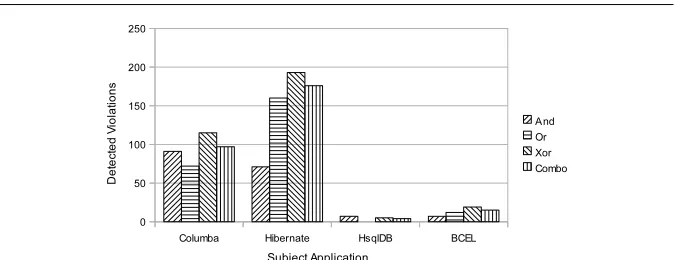
Real defects and False negatives.Figure 12 shows comparison between real defects and false negatives for the four pattern formats in each subject application. The figure shows that Or, Xor, and Combo patterns helped de-tect new defects that are not dede-tected using And patterns. For example, in the Columba application,Or patterns detected 41 real defects, whereasAnd patterns detected only 26 real defects. The reason for new defects is due to the new patterns mined using theOr,Xor, andCombo pattern formats.
Regarding false negatives, our results show that the violations detected usingAnd patterns include a high percentage of false negatives in 3 out of 4 applications. SinceAnd patterns represent patterns that can be mined by ex-isting approaches, the results show the ineffectiveness of exex-isting approaches in detecting defects in applications under analysis. AmongOr,Xor, and Combo patterns, violations detected usingOr patterns have a higher number of false negatives compared to the violations detected usingXor andCombo patterns. For example, in the Columba application, violations detected using Or pat-terns include 8 (16.3%) false negatives compared to 0 (0%) and 2 (4%) false negatives among violations detected using Xor and Combo patterns, respec-tively. The primary reason is thatOr patterns often include partial rules (as shown in Figure 9), resulting in false negatives among detected violations. The results show that Xor patterns are quite effective in detecting defects compared to all three other pattern formats:And,Or, andCombo. However, Combo patterns are also shown to be effective than Or patterns and have similar effectiveness as that ofXor patterns.
Fig. 14 False positives among detected violations related to API methods withAnd pat-terns.
Fig. 15 False positives among detected violations related to API methods withoutAnd
patterns.
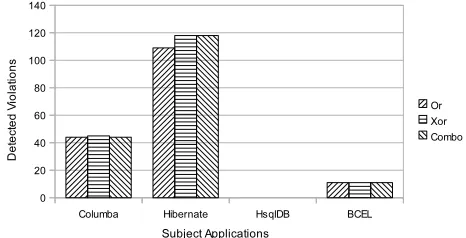
Figure 15 shows the classification of false positives for API methods with-out And patterns. As shown in the figure, neither Or nor Combo patterns help reduce false positives among violations detected usingXor patterns. The primary reason is that most of these mined patterns are false positives, result-ing in false positives among their detected violations. We next summarize our findings.
5.5 Summary
In summary, based on our results, comparing toOr,Xor, andCombopatterns, Andpatterns are not effective in detecting defects and result in both false pos-itives and false negatives among detected violations. Although Xor patterns are effective in detecting defects, these patterns result in a large number of false positives among detected violations. On the other hand,Or patterns are effective in reducing false positives, but, result in false negatives as shown in our results.Combo patterns can perform reasonably well with respect to both false positives and false negatives. However,Or orCombopatterns often result in false-positive patterns for those API methods without any And patterns. Therefore, based on our empirical results, the best pattern-mining approach (in terms of reducing both false positives and false negatives) is to first mine And patterns for API methods and next mine Combo patterns. Among vio-lations detected usingCombo patterns, the best violation-detection approach is to assign higher priority to the violations of API methods with And pat-terns compared to the violations of API methods withoutAnd patterns. The primary reason is that the former violations are more likely to be real defects compared to the latter violations.
6 Threats to Validity
7 Discussion
Since the inception of the Mining Software Engineering Data methodology, researchers have explored the mining of various pattern types ranging from simple itemsets that represent necessary condition checks around API method calls [Thummalapenta and Xie(2009a)] to complex graph-based pattern types that describe the usage patterns of one or multiple objects [Nguyen et al(2009)Nguyen, Nguyen, Pham, Al-Kofahi, and Nguyen]. In this paper, we focused on mining itemset pattern types in four pattern formats and showed their benefits and limitations. In our future work, we plan to explore other pattern types such as sequences [Srikant and Agrawal(1996)] and graph-based pattern types [Han and Kamber(2000)] to develop new mining algorithms for mining those pat-tern types in various formats and show their benefits and limitations in defect detection.
In this paper, we proposed a greedy technique for mining patterns in Or, Xor, andCombo pattern formats. Our greedy technique (shown as the func-tionApplyGreedy in Algorithm 2) chooses one parent pattern candidate with
the highest support value for each pattern candidate. The primary reason for adopting the greedy technique is to reduce the search space of pattern candi-dates. In future work, we plan to explore other techniques such as clustering techniques [Han and Kamber(2000)]. In particular, we plan to first group items (among itemsets in the input database) that are closely related to each other. We next apply our mining algorithms without the greedy technique on each cluster individually. We expect that the number of items in each cluster could be low and help reduce the search space of pattern candidates significantly. We also plan to adopt some properties used by Zhao et al. [Zhao et al(2006)Zhao, Zaki, and Ramakrishnan] for handling search space of pattern candidates while mining patterns.
Our current implementation sometimes is not precise and cannot identify equivalent but syntactically different conditions. For example, our current im-plementation considers the conditionsa > 0anda ≥ 1as different. In future
work, we plan to address these issues using more precise static analysis that can identify equivalent conditions. Furthermore, we use intra-procedural anal-ysis for detecting violations. Therefore, in a few cases, some detected defects could be false positives with respect to the entire system point of view. How-ever, this limitation does not affect the results of comparing the benefits and limitations of our four pattern formats, since we use the same analysis for all four pattern formats. In future work, we plan to address this limitation by using inter-procedural analysis.
8 Related Work
Zimmer-mann(2005)] uses association rule mining to extract simple rules from software revision histories for Java code and detect defects related to rule violations. PR-Miner or DynaMine may suffer from issues of a high number of false pos-itives since their rule elements are not necessarily associated with program dependencies. Furthermore, these approaches target atonlyfrequent patterns, whereas Alattin can mine alternative patterns that include both frequent and infrequent alternatives.
Another related approach to our Alattin approach is the approach devel-oped by Chang et al. [Chang et al(2007)Chang, Podgurski, and Yang] that applies frequent subgraph mining on C code to mine condition rules and to detect neglected conditions. Both Alattin and their approach target at the same type of defects: neglected conditions. Alattin significantly differs from Chang et al.’s approach in three main aspects. First, their approach cannot mine infrequent alternatives. Second, their approach is limited on a much smaller scale of code repositories (in fact, only one project code base) than Alattin, which exploits a CSE to search for relevant code examples from open source code available on the web. Third, the scalability of their approach is heavily limited by its underlying graph mining algorithms, which are known to suffer from scalability issues. In contrast, Alattin uses our new ImMiner algorithm based on frequent itemset mining, being much more scalable.
Williams and Hollingsworth [Williams and Hollingsworth(2005)] incorpo-rate an API call return value checker for C code, which checks that a value returned by an API call is checked before being used. This type of return-value checking before use falls into a subset of the types of rules being mined by Alat-tin. Different from their tool, Alattin does not require or rely on version histo-ries, which may not include the types of defect fixing (required by their tool) related to the rules being mined. Acharya et al. [Acharya et al(2006)Acharya, Xie, and Xu] developed a tool to mine interface details (such as an API call’s return values on success or failure and error flags) from model-checker traces for C code, and then mine interface robustness properties for defect detection. Similar to the tool of Williams and Hollingsworth [Williams and Hollingsworth(2005)], Acharya et al.’s tool mines only a subset of neglected conditions (e.g., return-value checking before use) mined by Alattin. In addi-tion, as shown by Acharya et al. [Acharya et al(2006)Acharya, Xie, and Xu], only the interface details of 22 out of 60 POSIX API functions can be suc-cessfully mined by their tool, whereas Alattin exploits a CSE to alleviate the issue by collecting relevant API call usages from the web. Furthermore, these approaches cannot mine alternative patterns targeted by Alattin.
Engler et al. [Engler et al(2001)Engler, Chen, Hallem, Chou, and Chelf] proposed a general approach for detecting defects in C code by applying statis-tical analysis to rank deviations from programmer beliefs inferred from source code. Their approach allows users to define rule templates, which are not required by our approach. In addition, their approach also cannot mine infre-quent alternatives targeted by our Alattin approach.
engineering data, a few approaches have been proposed (in the data mining research area) that target at mining patterns in these preceding formats for other applications such as market basket analysis [Agrawal et al(1996)Agrawal, Mannila, Srikant, Toivonen, and Verkamo]. Zhao et al. [Zhao et al(2006)Zhao, Zaki, and Ramakrishnan] proposed an approach, called BLOSOM, that tar-gets at mining itemset patterns in four pattern formats: conjunctive, disjunc-tive, conjunction of disjuncdisjunc-tive, and disjunction of conjunctive. In contrast to their BLOSOM approach, our Alattin approach additionally proposes the exclusive-disjunctive pattern format and includes a greedy technique for han-dling the search space of pattern candidates. In future work, we plan to adopt some properties used by their approach for handling the search space of pat-tern candidates while mining disjunctive patpat-terns. Nanavati et al. [Nanavati et al(2001)Nanavati, Chitrapura, Joshi, and Krishnapuram] proposed an ap-proach for mining disjunctive association rules. Given a minimum confidence min conf, their approach uses concepts from propositional logic for pruning the association rules that do not have confidence higher than min conf. Shimizu and Miura [Shimizu and Miura(2005)] proposed algorithms for mining dis-junctive sequence patterns. In contrast to these two preceding approaches, our Alattin approach targets at mining itemset patterns in disjunctive and exclusive-disjunctive pattern formats.
Finally, our previous approaches PARSEWeb [Thummalapenta and Xie(2007)] and CAR-Miner [Thummalapenta and Xie(2009b)] also exploit code search engines for gathering relevant code samples. PARSEWeb accepts queries of the form “Source →Destination” and mines frequent method-invocation se-quences that accept Source and produce Destination. Although Alattin uses code search engines for gathering relevant code examples, Alattin targets at mining patterns that describe programming rules that should be obeyed while reusing APIs. Unlike PARSEWeb, which mines frequent sequences, Alattin mines alternative patterns with both frequent and infrequent alternatives. CAR-Miner also incorporates a new mining algorithm for mining exception-handling rules in the form of sequence association rules. CAR-Miner and Alat-tin differ significantly in three major aspects. (1) CAR-Miner mines rules for detecting exception-handling-related defects, whereas Alattin mines rules for detecting neglected conditions. (2) Alattin is a more general approach com-pared to CAR-Miner and can be applied to enhance various existing mining-based approaches including CAR-Miner for detecting alternative rules. (3) CAR-Miner mines new kinds of patterns for reducing false negatives (i.e., de-tecting new kinds of exception-handling defects). In contrast, Alattin mines new kinds of patterns for reducing false positives.
9 Conclusion
algorithms mine patterns in four pattern formats:And,Or,Xor, andCombo. In our evaluations, we show the benefits and limitations of these pattern formats with respect to false positives and false negatives among detected violations that represent neglected conditions in applications under analysis. Our evalua-tion results show that the best pattern-mining approach (in terms of reducing both false positives and false negatives) is to first mineAnd patterns for API methods and next mineCombopatterns. Among violations detected byCombo patterns, the best violation-detection approach is to assign higher priority to the violations of API methods withAnd patterns compared to the violations of API methods withoutAndpatterns. The primary reason is that the former violations are more likely to be real defects compared to the latter violations. In this paper, we follow a problem-driven methodology in advancing the field of mining software engineering data. Our current approach and previous approach [Thummalapenta and Xie(2009b)] serve as examples in this direction. More specifically, in our approaches, we empirically investigate problems in the software engineering domain and identify required types of patterns for addressing those problems. We further develop new mining algorithms for mining these required types of patterns, rather than being constrained by available mining algorithms from the data mining community. Our approaches primarily target at reducing false negatives and false positives among detected violations. Our previous approach [Thummalapenta and Xie(2009b)], which mines programming rules as sequence association rules, focuses on reducing false negatives by detecting new kinds of defects. In contrast, our current approach focuses on a new sub-direction of reducing false positives among detected violations. In future work, we plan to further expand our research by investigating broader types of problems, patterns, mining algorithms, and defects.
Acknowledgements This work is supported in part by NSF grant CCF-0725190, ARO
grant W911NF-08-1-0443, and ARO grant W911NF-08-1-0105 managed by NCSU Secure Open Systems Initiative (SOSI).
References
[Acharya et al(2006)Acharya, Xie, and Xu] Acharya M, Xie T, Xu J (2006) Mining inter-face specifications for generating checkable robustness properties. In: Proc. ISSRE, pp 311–320
[Acharya et al(2007)Acharya, Xie, Pei, and Xu] Acharya M, Xie T, Pei J, Xu J (2007) Min-ing API patterns as partial orders from source code: From usage scenarios to specifica-tions. In: Proc. ESEC/FSE, pp 25–34
[Agrawal et al(1996)Agrawal, Mannila, Srikant, Toivonen, and Verkamo] Agrawal R, Man-nila H, Srikant R, Toivonen H, Verkamo AI (1996) Fast discovery of association rules. In: Advances in knowledge discovery and data mining, pp 307–328
[Ammons et al(2002)Ammons, Bodik, and Larus] Ammons G, Bodik R, Larus JR (2002) Mining specifications. In: Proc. POPL, pp 4–16