Review
1
A Trajectory-Based Method to Explore Reaction
2
Mechanisms
3
Saulo A. Vázquez 1, Xose L. Otero 2 and Emilio Martinez-Nunez 1,*
4
1 Departamento de Química Física, Facultade de Química, Campus Vida, Universidade de Santiago de
5
Compostela, 15782, Santiago de Compostela, Spain; [email protected], [email protected]
6
2 Unidade de Bioestadística, Facultade de Medicina, Universidade de Santiago de Compostela, 15782,
7
Santiago de Compostela, Spain; [email protected]
8
* Correspondence: [email protected]; Tel.: +34-881814216
9
10
Abstract: The tsscds method, recently developed in our group, discovers chemical reaction
11
mechanisms with minimal human intervention. It employs accelerated molecular dynamics,
12
spectral graph theory, statistical rate theory and stochastic simulations to uncover chemical reaction
13
paths and to solve the kinetics at the experimental conditions. In the present review, its application
14
to solve mechanistic/kinetics problems in different research areas will be presented. Examples will
15
be given of reactions involved in photodissociation dynamics, mass spectrometry, combustion
16
chemistry and organometallic catalysis. Some planned improvements will also be described.
17
Keywords: automated algorithm; molecular dynamics; graph theory; statistical rate theory; kinetics
18
simulations.
19
20
1. Introduction
21
Theoretical studies of reaction mechanisms can greatly benefit nowadays by leveraging the
22
surge of automated methods developed in the last few years [1-58]. The idea of these new
23
computational protocols is to substitute human intervention by less error-prone and less tedious
24
automated algorithms. The automated methodologies range from chemical heuristics to the use of
25
artificial forces to boost chemical reactions.
26
Our group has contributed with the development of a method called tsscds [43-47], which is
27
based on accelerated molecular dynamics (MD), as are some others [29, 30]. In our trajectories, the
28
bonds of the molecule(s) are broken/formed thanks to large amounts of energy placed in each normal
29
mode/atom of the system [45]. The distinctive feature of tsscds compared to others is the primary
30
target of the post-processing analysis: the search for transition states (TS) rather than minima.
31
Additionally, having determined the TS of a given process, its rate can easily be determined using
32
transition state theory (TST) [59-62]. Thus, finding the relevant TSs on a given potential energy
33
surface (PES), as our method does, is a subject of fundamental importance in chemistry.
34
In tsscds, after completion of a trajectory, an algorithm named bond breaking/formation search
35
(BBFS) [45] is employed to select good TS guess structures, which are then optimized using
36
Eigenvector Following (EF) [63]. In particular, the adjacency matrix, which indicates whether pairs
37
of atoms form a bond, is monitored along each trajectory to identify the atoms/bonds involved in all
38
chemical reactions taking place. Then, for each of the selected candidates, a partial optimization is
39
firstly carried out by freezing the atoms involved in the reaction. The partially-optimized structure is
40
subsequently subjected to TS optimization using the EF algorithm. The resulting TSs are then
41
connected with the minima using intrinsic reaction coordinate (IRC) calculations [64]. Finally, tsscds
42
also features a Kinetic Monte Carlo [65] module that provides the desired kinetic information using
43
the network of TSs and minima. The source code can be downloaded from:
44
http://forge.cesga.es/wiki/g/tsscds/HomePage.
45
The method has been successfully employed to study reactions involved in combustion [66, 67],
46
photolysis [68-70], mass spectrometry [71] and organometallic catalysis [43]. The aim of this review
47
is to go over several examples where tsscds is employed to either discover new mechanisms and/or
48
to explain the experiments. For detailed comparisons among different methods for exploring reaction
49
space, the reader is referred to two recent reviews [58, 72]. Additionally, in the last section, some
50
planned improvements to enhance the efficiency/efficacy or to expand the scope of tsscds will be
51
described.
52
2. Method
53
The method tsscds has been recently put forward by one of the authors as an automated tool to
54
discover reaction mechanisms [44, 45]. The basic idea behind tsscds is to run accelerated MD
55
simulations with the aim to break/form bonds within a few hundred femtoseconds. The simulations
56
are called “accelerated” because the molecules experience breakage or formation of new bonds very
57
rapidly thanks to large amounts of vibrational energy placed in each normal mode of the system. In
58
particular, a range of vibrational energies of 20-50 kcal/mol per normal mode is initially employed.
59
However, this range is automatically adjusted to attain at least 60% reactive trajectories in the MD
60
simulations. Although the default option is to excite all vibrational modes of the system (using
61
microcanonical normal mode sampling [73]), the user can decide to heat only one part of the system
62
selecting a few normal modes to be initially excited. The latter option can be particularly useful for
63
large systems.
64
The trajectory results are then analyzed with a post-processing algorithm (named BBFS), which
65
identifies geometries with partly formed/broken bonds. Those structures serve as TS candidates in
66
subsequent transition state optimizations. As detailed below, BBFS is based on the adjacency matrix,
67
a Graph Theory object that has been employed in other successful automated methods like the one
68
developed by Zimmerman [16]. Similar ideas have also been recently employed to analyze changes
69
in conformations occurring in MD simulations [74].
70
Once the TSs are optimized, a reaction network is constructed by computing the intrinsic
71
reaction coordinates (IRCs) [64] connecting TSs with intermediates [64]. The method employs two
72
levels of theory: semi-empirical and ab initio/DFT. The semi-empirical calculations are performed to
73
run the MD simulations and to obtain approximate TSs structures, while a higher level of theory is
74
used to re-optimize the TSs and run IRC calculations. Two different electronic structure programs
75
are employed: MOPAC2016 [75] and Gaussian09 [76] for the semi-empirical and ab initio/DFT
76
calculations, respectively.
77
Unlike other automated methods like GRRM [42], our methodology has been employed so far
78
to study only the ground electronic state. This is in part due to the fact that, currently, the potential
79
energy and gradients can only be calculated at the semiempirical level of theory. The following is a
80
description of the graph-theoretic tools and kinetic models employed in our method.
81
2.1. Graph Theory
82
A number of graph theoretic tools are employed at various stages of the procedure to find
83
transition states (TS), screen their structures and construct a reaction network. Specifically, the time
84
dependence of the adjacency matrix is employed to discriminate TS-like geometries along the
85
trajectories. The elements of this matrix are defined as:
86
= 1 if < ref
0 otherwise (1)
87
with being the distance between atoms and , and ref a reference value that sets the upper
88
limit for the bond length between the pair; in practice ref is taken 20% greater than the sum of the
89
covalent radii of and [45]. Thus, for an −atom system, is a × symmetric matrix with
90
zeros on its diagonal.
91
Additionally, a weighted adjacency matrix is also employed in tsscds, whose off-diagonal
92
= /
ref
/ ref (2)
94
Values of 6 and 12 have been employed in previous work for and , respectively [44]. Matrix
95
contains information on the 3D geometry of the molecule,[77] and its eigenvalues and eigenvectors
96
can be employed to construct the so-called SPRINT coordinates [77]. An important property of these
97
coordinates is their invariance with respect to translation, rotation and permutation of atoms, which
98
makes them good molecular descriptors in trajectory-based methods. SPRINT coordinates are
99
employed in tsscds to remove redundant structures.
100
Another matrix employed to determine the number of fragments in the system is the Laplacian,
101
which is defined as:
102
( )= − ( ) (3)
103
where is the so-called degree matrix [44], whose elements are defined as:
104
= deg( )if =
0 otherwise (4)
105
where the degree deg( ) of an atom counts the number of contacts. The superscript ( ) on and
106
indicates that the corresponding matrix can either be weighted or not. For a non-weighted graph,
107
the lowest eigenvalue of the Laplacian is always zero, and the total number of zero eigenvalues
108
determines the number of fragments of the system. For a weighted graph, an upper threshold for
109
is employed to identify fragmented structures [44]. The smallest non-zero eigenvalue is called the
110
spectral gap, which is a measure of the degree of fragmentation of the structure. Thus, a small value
111
of the spectral gap is associated with structures presenting non-covalent bonds (like van der Waals
112
complexes), which are usually of no interest in chemical dynamics and kinetics.
113
The invariance of the SPRINT coordinates upon atom permutation is very important for the
114
analyses of trajectories, where scrambling of atoms is frequent, as stated above. However, since the
115
identity of each atom is absent in the adjacency matrix, SPRINT coordinates are identical for two
116
structures where two non-equivalent atoms swap positions. For that reason, another type of
117
molecular descriptor, based on a modified (weighted or not) adjacency matrix, is employed in tsscds.
118
This new matrix, denoted as ( ), contains the atomic numbers of the atoms on the diagonal:
119
, ( )
=
( )
if ≠
1 + if = (5)
120
The expression for the diagonal elements is chosen to provide values comparable to the
off-121
diagonal ones. Most importantly, the eigenvalues of this new matrix are only invariant with respect
122
to the permutation of like atoms, and it is widely employed in tsscds.
123
2.2. Kinetics simulations
124
The kinetics module of tsscds calculates rate constants for all the elementary steps and solves
125
the set of first-order differential equations that describe the time evolution of all species (usually
126
known as chemical master equation).
127
The rate constants can either be obtained as a function of temperature or energy. In the former
128
case, transition state theory is employed [59-62]:
129
( ) =
‡
(6)
130
where is the reaction path degeneracy, is the temperature, ℎ is Planck’s constant, Δ ‡ is the
131
free energy of activation, is 1 bar and Δ = 1 (0) for bimolecular (unimolecular) reactions. The
132
reaction path degeneracy is calculated as = , where and are the number of optical
133
isomers of the reactant and transition states, respectively [78].
134
( ) = ( )
( ) (7)
136
where ( ) is the sum of states at the TS, ( ) is the density of states at the reactant, and is
137
the excitation energy of the system. The sums and densities of states are evaluated by direct count of
138
the harmonic vibrational states using the Beyer-Swinehart algorithm. Once all state-to-state rates are
139
determined, the chemical master equation is solved using Kinetic Monte Carlo simulations [65].
140
3. Overview of the applications of tsscds
141
The tsscds methodology has been employed in our lab to elucidate reaction mechanisms
142
involved in photodissociation dynamics, mass spectrometry, combustion and organometallic
143
catalysis, and in this section, several examples of each type are reviewed.
144
3.1. Photodissociation dynamics
145
The dissociation of molecules can be promoted by using a laser source, which is known as
146
photodissociation. Although many photodissociations take place in excited states, important
147
mechanisms may occur in the ground electronic state following internal conversion. One of the
148
quantities of interest is the product yield, which is usually determined in the experiments. The
149
understanding of the dissociation channels in organic compounds has greatly benefited from the
150
interplay between photolysis experiments and computational studies [70, 79-92].
151
In this section, we summarize the results obtained with our automated method for systems that
152
have also been studied in photodissociation experiments, highlighting the most important
153
conclusions. In particular, the dissociation channels of formaldehyde, formic acid, vinyl cyanide,
154
acrolein, acryloyl chloride and methyl cyanoformate were studied with our tsscds methodology.
155
Formaldehyde was employed as a benchmark system to test tsscds. The system had been
156
previously studied with other automated methods like the scaled hypersphere search [33] and the
157
global reaction route mapping (GRRM) [35]. The results obtained with all algorithms are comparable,
158
and the kinetically-relevant stationary points are found using any procedure.
159
The study of the dissociation channels of formic acid (CO2H2) with tsscds revealed the existence
160
of a new TS for the water-gas shift reaction (WGSR: CO + H2O CO2 + H2) [45]. By contrast, GRRM
161
predicted three consecutive steps for the shortest path of the WGSR [35]. The discovery of the new
162
TS is a consequence of the highly non-IRC [93] nature of the trajectories employed in tsscds [45]; in
163
other words, IRC jumps are not uncommon events [94]. This exemplifies one of the advantages of
164
using trajectory-based methods to discover new reactions: we are not restricted to unimolecular
165
reactions and the only constrain to discover new processes is the molecular formula of the system.
166
Additionally, the large amounts of vibrational energy put in the normal modes enhances
167
configurational space sampling in tsscds, which permits the exploration of all types of reactions.
168
Our automated computational study on the dissociation of vinyl cyanide (VCN) [70] provides a
169
HCN/HNC branching ratio in nearly perfect agreement with experiments for an excitation energy of
170
148 kcal/mol [95]. Besides the traditional 3-center and 4-center elimination mechanisms found in
171
many HX eliminations from CH2=CHX systems, a new HCN elimination pathway involving three
172
TSs was discovered in the tsscds study. The new mechanism involves three TSs and two
173
intermediates and is shown in Figure 1.
174
176
Figure 1. New HCN elimination mechanism from VCN obtained with tsscds. The numbers are
177
relative energies (including the zero-point vibrational energy) with respect to VCN, calculated at the
178
CCSD(T)/6-311++G(3df,3pd)//CCSD/6-311+G(2d,2p) level of theory with the vibrational frequencies
179
obtained using CCSD/6-311+G(2d,2p) numerical Hessians.
180
Although alternative routes for HX elimination were also found for other ethylene analogues,
181
those pathways involved high-energy TSs and were not competitive with the conventional 3-center
182
and 4-center channels. This was the first time a new HX elimination channel competes with the
well-183
known 3-center and 4-center processes in the dissociation of CH2=CHX species.
184
Figure 2 shows the product yields as a function of excitation energy obtained in our kinetic
185
simulations from VCN. As seen in the figure, at low excitation energies (<150 kcal/mol) the new
186
channel (red) is more important than the 4-center channel (green) and accounts for half of the HCN
187
eliminations when the excitation energy is 110 kcal/mol.
188
189
Figure 2. Kinetic simulation results of the different HCN elimination channels from VCN.
190
The tsscds methodology was also employed to study the dissociation of acrolein (ACRL, C3H4O),
191
which comprises many different fragmentation channels involving more than 250 transition states
192
and 66 minima [44]. This system was studied with an enhanced procedure (now fully integrated in
193
the method) consisting in the initialization of the MD simulations from multiple minima. In this new
194
procedure the method works in an iterative manner. In the first iteration all MD simulations start
195
from a starting structure, but once some TSs and intermediates are located, subsequent iterations
196
utilize not only the starting equilibrium structure but also the newly generated intermediates to
197
120 140 160 180
0 20 40 60 80
P
ro
d
u
c
t
y
ie
ld
3-centerNew channel 4-center Other
initialize the MD simulations. Compare to a single-minimum initialization, the use of multiple
198
minima to start the dynamics ensures a better sampling of the PES of the system.
199
200
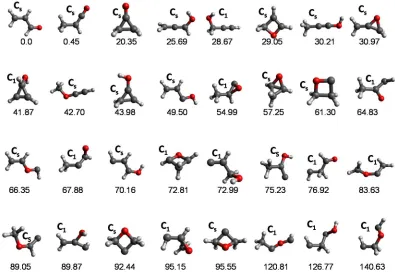
Figure 3. Minima obtained by tsscds for the C3H4O system. The structures are arranged in ascending
201
order of their relative energies (shown at the bottom of each structure), which are obtained at the
202
CCSD(T)/6-311+G(3df,2p)//B3LYP/6-311G(d,p) level of theory. Conformers are not included in the
203
figure and only the lowest lying of each family is displayed.
204
The potential energy surface of the C3H4O system is very complex and the 32 equilibrium
205
structures (not including conformers) shown in Figure 3 were found with tsscds, with ACRL being
206
the global minimum. To exemplify the importance of automated reaction discovery methods, we
207
compare our results with those obtained by Chin et al. [96], who manually located equilibrium
208
structures and TSs. Using the same levels of theory as in our study, Chin et al. only found 6 of the 66
209
minima obtained with tsscds. Most importantly, the relative product abundances obtained with
210
tsscds at 148 kcal/mol (the energy corresponding to the experimental wavelength of 193 nm) are much
211
closer to the experimental results than the computational results of Chin et al., as seen in Table 1.
212
Table 1. Relative product abundances obtained by different computational studies and experiment in
213
the photodissociation of ACRL at 193 nm.
214
Channel Chin et al. [96] tsscds Exp [97]
H2O 0.01 0.03 0.07
CH2O 0.65 0.20 0.07
H2 0.09 0.19 0.00
CO 1.00 1.00 1.00
H2+CO+HCCH 6.82 1.49 1.10
215
Another system that attracted our attention was acryloyl chloride (AC). Overall, around 700
216
stationary points were found using our tsscds strategy. Of all possible dissociation channels from AC,
217
experiments focus on the HCl dissociations. The use of our automated procedure led to the discovery
218
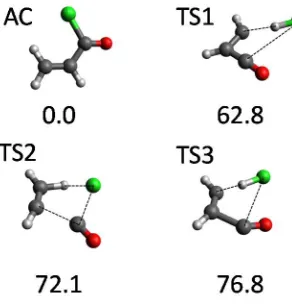
of the three new HCl dissociation TSs [69] displayed in Figure 4; the figure also shows the AC
219
equilibrium structure. The highest-energy TSs (TS2 and TS3) correspond to three-body dissociations
220
high excitation energies. By contrast, HCl elimination over TS1 is predominant at the experimental
222
conditions (148 kcal/mol) [98], showing again that tsscds is capable of finding competitive pathways.
223
224
Figure 4. Structure of AC minimum and the three new TSs found with tsscds for the HCl elimination
225
from AC. Numbers are relative energies in kcal/mol (including the zero-point vibrational energy)
226
with respect to AC, calculated at the CCSD(T)/6-311+G(3df,2p)//B3LYP/6-311+G(2d,2p) level of
227
theory.
228
Finally, with the aim of exploring possible sources of HCN and HNC in astrophysical
229
environments, the dissociation channels of methyl cyanoformate (MCF) were probed with tsscds,
230
excited state calculations and photolysis experiments [68]. In particular, time-resolved infrared
231
spectroscopy measurements indicate that both HCN and HNC are formed after the 193-nm
232
photolysis of MCF [68]. The excited state calculations suggest that most of the dissociations take place
233
in the S2 excited state leading to CH3O + NCCO via a Norrish type I reaction, in agreement with
234
experiment. However, our calculations are also consistent with cascading internal conversion from
235
S2 to produce vibrationally excited ground state MCF.
236
237
Figure 5. Relevant HCN and HNC pathways in the ground-state PES of methyl cyanoformate for an
238
excitation energy of 148 kcal/mol. Relative energies (in kcal mol1) include ZPE contributions and
239
were obtained by CCSD(T)/6-311++G(3df,3pd)//MP2/6-311+G(2d,2p) calculations.
240
To study the dissociation of vibrationally excited MCF molecules in the S0 electronic state, tsscds
241
was employed. Our approach assumes that, after the internal conversion process, intramolecular
242
vibrational redistribution is fast enough to ensure RRKM behavior. With the tsscds procedure several
243
HNC and HCN mechanisms are found, and Figure 5 shows the kinetically-relevant ones at 148
244
kcal/mol. The kinetic simulations predict a HNC/HCN branching ratio of 0.01, which is in
245
further insights into the intriguing observation of overabundance of HNC in astrophysical
247
environments.
248
3.2. Mass spectrometry
249
The prediction of mass spectra remains much of a challenge for the community of computational
250
chemists. The common computational approaches employed for such endeavor include statistical
251
rate theory calculations, MD simulations and electronic structure calculations [99-113]. Our
252
automated method is very useful in this regard and can easily be coupled with MD simulations of
253
collisions to generate theoretically-based mass spectra as described below.
254
In particular, tsscds was employed to simulate mass spectrometry (MS) experiments of
255
protonated uracil, [uracil]H+. Our computational results indicate that the decomposition of [uracil]H+
256
involves more than one thousand stationary points and 751 elementary reactions [71]. Branching
257
ratios for the different fragmentation channels can be automatically obtained from tsscds. However,
258
these fractions are a function of the ion’s internal energy and cannot be directly compared with MS
259
experiments, where the collision energy in the center-of-mass framework ( ) is employed instead.
260
For that reason the tsscds results were combined with collisional dynamics simulations [71], which
261
provide the fraction of transferred to the ion’s internal energy.
262
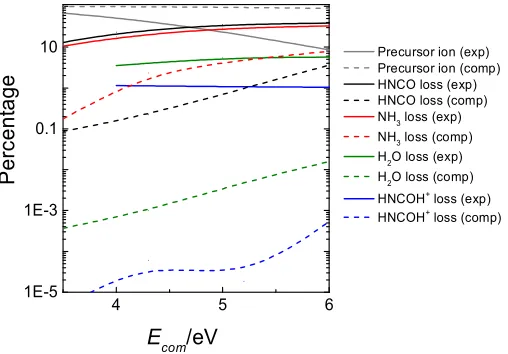
The resulting computationally-predicted product abundances (dashed lines) are compared in
263
Figure 6 with the experimental ones (solid lines). As seen in the figure, for the predominant
264
dissociation channels, the computationally-predicted product abundances are in qualitative
265
agreement with experiment, and formation of HNCO (black), NH3 (red), H2O (green) and HNCOH+
266
(blue) are the major channels. Discrepancies with experiment can be attributed to the possible
267
existence of well-known non-statistical behavior in many collision-induced dissociations [100, 114],
268
which cannot be captured with our statistical model.
269
270
Figure 6. Experimental (exp) and calculated (comp) intensities of precursor and fragment ions
271
produced in the fragmentation of protonated uracil.
272
3.3. Combustion chemistry
273
Modeling the combustion reactions of oxygenated fuels is of great interest due to their potential
274
use as alternatives to conventional petroleum-based fuels. To investigate combustion mechanisms, it
275
is important to use kinetic models and perform computer simulations as a complement to
276
experimental determinations, due to the tremendous complexity of these chemical processes. In
277
general, different approximations are employed in combustion simulations to handle the complicated
278
mechanisms. One of these simplifications consist of considering only the lowest energy rotamers of
279
the involved species, which can lead to large errors in the calculation of rate coefficients.
280
In a recent paper, our group analyzed the influence of multiple conformers and paths in the
281
evaluation of rate constants and relative abundances of products formed in the thermal
282
4 5 6
1E-5 1E-3 0.1
10 Precursor ion (exp)
Precursor ion (comp) HNCO loss (exp) HNCO loss (comp) NH
3 loss (exp) NH3 loss (comp) H2O loss (exp) H
2O loss (comp) HNCOH+ loss (exp) HNCOH+ loss (comp)
P
e
rc
e
n
ta
g
e
decomposition of 1-propanol radicals using different methodologies including tsscds [66].
283
Specifically, the most relevant pathways reported in the literature [115-121] are obtained with tsscds,
284
except for the barrierless dissociation leading to propene + OH, since the present version of tsscds
285
cannot handle this type of reactions. Of significance, an important number of reactant and TS
286
conformers, not described in the previous studies, are obtained with tsscds.
287
A conformational reaction channel (CRC) was defined in our study [66] as the group of all the
288
paths that connect the conformers of a given reactant with the corresponding TS conformers. The
289
influence of these conformers on the rate constants and branchings ratios was investigated in detail
290
[66]. To study such influence, the output of tsscds (families of CRCs) was fed into a computer program
291
to treat torsional anharmonicity named Q2DTOR (also developed in our group) [122]. The results
292
obtained with tsscds and Q2DTOR were finally employed to calculate variational transition state
293
theory (VTST) [123-125] rate constants for all the CRCs. The multipath (MP) approach within VTST
294
was employed [125-129], where the rate constant of a given CRC is calculated using contributions
295
from all the conformers and paths. For comparison purposes the simplest one-well (1W) approach is
296
also considered; in the 1W method only the most stable conformers of reactant and TS are considered.
297
As seen in Figure 7, the product abundances obtained in the temperature range 1000-2000 K are
298
greatly influenced by the selected approach (MP vs 1W), particularly for the major products: ethene
299
+ CH2OH and formaldehyde + ethyl radical [66]. Our results show the importance of using automated
300
codes for discovering reaction mechanisms and sampling potential energy surfaces.
301
302
Figure 7. Branching ratios obtained in the kinetics simulations starting from one of the isomers of
1-303
propanol (only the two major mechanisms are shown). The solid and dashed lines correspond to the
304
MP and 1W results, respectively.
305
Very recently, Fenard et al. developed a detailed kinetic model of the low-temperature oxidation
306
of tetrahydrofuran (THF) based on theoretically-calculated rate constants [67]. The reaction pathways
307
involved in these processes were probed with our automated software tsscds [67] using CBS-QB3 as
308
the choice for the high-level of electronic structure. The rate constants were determined using TST
309
with a tunneling correction using an Eckart potential.
310
The predictions from the model developed by Fenard et al. are overall in good agreement with
311
the different experimental measurements. Namely, it reproduces ignition delay times obtained in a
312
rapid-compression machine and in a shock tube, as well as numerous product mole fractions
313
measured in a jet-stirred reactor.
314
3.4. Organometallic catalysis
315
Computational studies of organometallic catalysis are becoming increasingly more important
316
because they can help elucidate reaction mechanisms, characterize catalytic intermediates,
317
supplement experimental studies, and also because of their predictive power [124, 130-133].
318
1000 1200 1400 1600 1800 2000
0 20 40 60 80 100
Formaldehyde + ethyl radical
Ethene + CH2OH
B
ra
n
c
h
in
g
r
a
ti
o
(
%
)
However, the traditional workflow of most computational studies consists of using chemical
319
intuition in the design of reaction routes and construction of guess TS structures. In recent years the
320
appearance of powerful automated computational methods to study homogenous catalysis [27, 43,
321
134-136] very much eased the tedious work of manual searches.
322
To exemplify the use of tsscds in organometallic catalysis, the cobalt-catalyzed
323
hydroformylation of ethylene was chosen [43]. Very briefly, the first step in our computational study
324
was to generate all combinations of the catalyst Co(CO)3 with any of the starting materials (CO, H2
325
and ethylene), which in this case amounts to eight. Each of these combinations has fewer atoms than
326
the overall system and they were named sub-systems in our original paper [43]. Standard tsscds is
327
then run in each sub-system to build the reaction networks. Finally, the full reaction network is
328
obtained after merging the individual results for each sub-system.
329
Figure 8 shows the tsscds-calculated free energy profile for the formation of propanal (C3H6O),
330
which is the predominant channel; the level of theory employed was B3LYP/6-31G(d,p). As pointed
331
out in the original paper, this is not the best electronic structure method for this system and it was
332
only selected for comparison purposes. Additionally, we simulated the reactivity in the gas phase
333
because, for this system, solvent effects are unimportant [43, 133].
334
The mechanism shown in Figure 8 was obtained in an automated manner, and agrees with the
335
one predict by Heck and Breslow in the 1960s [137] and with more recent mechanistic studies [133].
336
This is a very interesting result as we needed to make no assumptions in our automated calculations.
337
Additionally, our method predicts that hydrogenation of ethylene is a side reaction that can be
338
predominant under low CO partial pressures.
339
340
Figure 8. Free energy profile for the Co-catalyzed hydroformylation of ethylene obtained in our tsscds
341
study using DFT calculations [133].
342
With the full reaction network constructed, the kinetics simulation module of tsscds can provide
343
a rate law for the hydroformylation reaction when a range of different initial conditions for each
344
species is employed. The kinetics calculations consist of transition state theory calculations [59-62] for
345
the thermal rate constants at 423 K, and subsequent Monte Carlo simulations using different initial
346
conditions of the reactants. Table 2 shows the orders of the catalyst and starting materials for the
347
hydroformylation reaction obtained experimentally [138], with tsscds [43], using a kinetic model
348
based on highly-accurate electronic structure calculations by Harvey and co-workers [133], and
349
obtained from another automated method by Habershon [27].
350
As seen in Table 2, tsscds agrees rather well with experiment and with the results obtained by
351
automated method does [27] (last column of Table 2), despite the fact that both employ the same
353
alkene, initial conditions for the kinetics, and level of theory for the electronic structure calculations.
354
Table 2. Orders of the hydroformylation reaction with respect to the catalyst and starting materials.
355
Species Exp [138] tsscds [43] Harvey [133] Habershon [27]
H2 0.6 0.4 0.5 1
CO <0 <0 <0 <0
catalyst 0.8 0.5 0.5 1
alkene 1 1 1 0.55
4. Improvements
356
In this section we describe some improvements we plan to implement in the near future. They
357
include: the use of Spectral Graph Theory, implementation of knowledge-based methods,
358
implementation of rare event acceleration MD simulations, interface with other electronic structure
359
codes, reparametrization of semiempirical methods, and the study of condensed phase reactions.
360
4.1. Use of Spectral Graph Theory to minimize the number of Hessian calculations
361
In standard tsscds, every single structure obtained after the BBFS analysis is subjected to TS
362
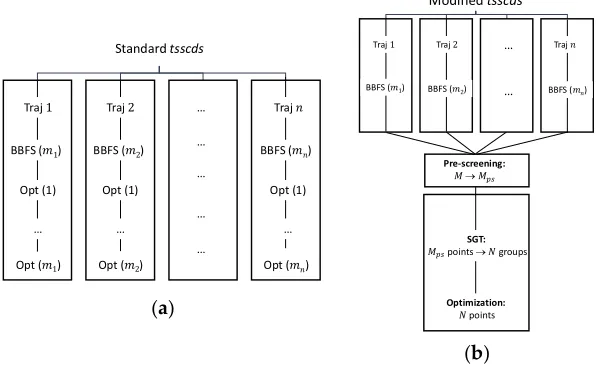
optimization [45]. As seen in Figure 9(a), for a trajectory , BBFS selects TS candidates, which
363
results in = ∑ optimizations, where is the total number of trajectories. On the one hand,
364
these optimizations are the most CPU-time consuming step of the procedure as they involve
365
Hessian calculations, while the integration of the trajectories only requires gradients. On the other
366
hand, a number of those optimizations are repeated. This is so because trajectories visit more often
367
those areas of the configurational space around the kinetically most relevant TSs, leading to multiple
368
optimizations of those structures.
369
370
(a)
(b)
Figure 9. (a) Original tsscds showcasing an example with different trajectories resulting in a total
371
number of = ∑ optimizations. (b) Modified tsscds showcasing the same example as in panel
372
(a) with different trajectories resulting in a total number of optimizations.
373
The workflow of the enhanced procedure is shown in Figure 9(b). Briefly, instead of carrying
374
out the optimizations for every single structure selected by the BBFS algorithm (as in the original
375
implementation), the new procedure will run the MD simulations and store at once the structures
376
for the analysis of all trajectory data. This analysis will consist of a pre-screening, a Spectral Graph
377
Theory (SGT) step, and the final optimization step.
378
Upon completion of the MD simulations, a pre-screening of the structures will be performed
379
based on the eigenvalues of the Laplacian matrix [44]. As pointed out above, the lowest eigenvalues
380
Standard tsscds
Traj1
Opt ( 1)
Opt (1)
…
Traj2
Opt ( 2)
Opt (1)
…
Traj
Opt ( ) Opt (1)
… BBFS ( 1) BBFS ( 2) BBFS ( )
…
…
…
…
… pointsSGT: groups
Optimization:
points
Pre-screening:
Modified tsscds
BBFS ( 1) BBFS ( 2) BBFS ( ) …
…
of this matrix indicate the degree of fragmentation of the molecular system. We aim here to discard
381
highly fragmented structures, i.e., TSs connecting van der Waals complexes, usually of negligible
382
relevance in a kinetics study. In the SGT step the remaining points will be partitioned into groups
383
according to the eigenvalues of a TS adjacency matrix, calculated as the average of the reactant and
384
product adjacency matrices. Finally, we will select the closest point (geometry) to the centroid of each
385
cluster for optimization. With this new scheme the gain in efficiency can easily be quantified as the
386
reduction in the number of optimizations from to .
387
4.2. Implementation of knowledge-based mechanism generators
388
A number of reaction discovery methods are based on the so-called chemical heuristics [23,
48-389
50]. In these methods, molecules are typically represented as graphs, in pretty much the same way as
390
in tsscds. Then, by applying transformations, based on encoded rules or principles inspired by
391
organic chemistry, to the reactant molecule graph, reactions, products and intermediates can readily
392
be obtained. Compared to MD-based methods, heuristic-based methods are less CPU-time
393
demanding.
394
Our idea will be to combine a heuristic-based bias in the MD simulations alongside with our
395
BBFS algorithm to obtain TSs. In particular, having defined a set of encoded rules based on chemical
396
knowledge, every single MD simulation will suffer a different bias, aimed to trigger a particular
397
reaction mechanism. In this way, the problem of multiple optimizations of a given TS mentioned
398
above would be minimized, if not completely avoided. The bias (analytical) potentials will be added
399
on top of the semiempirical potential to steer the dynamics towards a particular intermediate or
400
product.
401
4.3. Implementation of rare-event acceleration MD methods
402
One of the shortcomings of tsscds is the fact that chemical reactions are triggered by using very
403
high energies in the MD simulations. While this approach was successfully employed to tackle
404
different problems, it is biased towards the entropically favored reaction pathways. To alleviate this
405
drawback of the method we propose to replace the current MD strategy by the rare-event acceleration
406
method named Boxed Molecular Dynamics (BXD) [139]. BXD has its roots in work done by one of us
407
and D. Shalashilin more than a decade ago [140]. It introduces several reflective barriers in the phase
408
space of a MD trajectory along a particular collective variable. Those boundaries are employed to
409
push the dynamics along the collective variable into regions of phase space which would be rarely
410
sampled in an unbiased trajectory. However, the use of BXD constrains in configuration space suffers
411
from the same “entropic” bias mentioned above.
412
A generalization of BXD has been very recently put forward by Glowacki and co-workers [141].
413
They show that the BXD bias can also be introduced along the potential energy (E) of the system,
414
which is referred to as BXDE. By scanning through potential energy “boxes”, the energetic
415
“windows” at which different chemical reaction channels switch on or off can be identified. The
416
software design of tsscds is highly modular, which means that interfacing it with BXDE only requires
417
little effort, like the need of compatible input/output geometry formats in both codes and the use of
418
extra keywords in tsscds.
419
4.4. Interface with other electronic structure codes
420
At present tsscds has been only interfaced with the MOPAC2016 [75] and the G09 [76]
421
electronic structure packages. The MD simulation employs gradients calculated at the semiempirical
422
level of theory, and the optimization step is carried out at both the semiempirical level with
423
MOPAC2016 and using higher levels (ab initio/DFT) with G09. Although we plan to reparametrize a
424
semiempirical Hamiltonian for use in organometallic catalysis (see below), we do not want to be
425
limited to this low-level electronic structure calculations. Therefore, we will use the ASE package[142]
426
to interface tsscds with other electronic structure codes like NWCHEM [143] or ORCA [144].
427
4.5. Reparametrization of semiempirical methods
429
The application of the tsscds method relies on the use of semiempirical Hamiltonians for
430
exploring potential energy surfaces. For this reason, it is important that the semiempirical method
431
provides a reasonably accurate representation of the system under investigation. Although
432
significant improvements in these methods have been made over the last years [145], there are still
433
known limitations, which claim for further developments and more accurate parametrizations. Two
434
important limitations concern the non-covalent interactions for large systems and ligand dissociation
435
energies for transition metal complexes. In both cases, the performance of the semiempirical methods
436
is, in general, quite poor. Our goal is therefore to improve the description of both non-covalent
437
interactions and transition metal complexes in PM7.
438
Regarding non-covalent interactions, we aim to develop an analytical correction for PM7. To this
439
end, we will consider a set of small molecules, which are representative of the most important
440
functional groups. All pairs of molecules will be considered to calculate interaction energies at three
441
levels of theory: coupled-cluster (CC), DFT and PM7. For every pair, various orientations will be
442
considered, each one emphasizing a different two-body interaction.
443
Then, sums of two-body Buckingham potentials (supplemented with damping functions for the
444
dispersion) will be fit to the CC, DFT and PM7 interaction energies using our genetic algorithm
445
program GAFit [146]. Finally, the resulting potentials fit,CC, fit,DFT and fit,PM7 will be employed to
446
build corrections X to the PM7 interaction energies:
447
X = fit,X− fit,PM7 (8)
448
where X is either CC or DFT. Whereas the DFT correction term will be employed to validate this
449
methodology as explained below, the highly-accurate CC correction will be used once the
450
validation succeeds.
451
The correction will be added to the PM7 energy PM7 so that the PM7 Hamiltonian corrected for
452
non-covalent ( ) interactions would read:
453
PM7,X = PM7+ X (9)
454
The strategy of using small representative molecules and sums of two-body functions was
455
successfully employed in the development of intermolecular potentials for interactions of protonated
456
peptides and silyl ions with perfluoroalkane self-assembled monolayers [147, 148]. Nevertheless, this
457
strategy will be validated for the new functional groups by running DFT calculations for large
458
systems. This will allow us to compare the DFT-calculated energies with those obtained with
459
PM7,DFT.
460
The semiempirical methods, and particularly PM6 and PM7, do not perform well for
transition-461
metal complexes [149]. Our strategy here will be to reoptimize the PM7 Hamiltonian as in previous
462
studies of our group (e.g., see ref. [68]). We will select popular transition metals and ligand molecules
463
used in organometallic catalysis, and will carry out high-level ab initio calculations for our own
464
benchmark database. To gain flexibility in the parametrizations, we will consider the possibility of
465
defining “atom types” for the ligand atoms, depending on the functional groups, in much the same
466
way as that done for the parametrization of the hpCADD NDDO Hamiltonian [150].
467
4.6. Study of condensed phase reactions
468
Our method is not limited to gas phase reactions. Although currently it only handles reactions
469
in the gas phase, its modular design allows for a smooth adaptation of tsscds to deal with condensed
470
phase reactions. For instance, to study solvent effects, the easiest way would be to use an implicit
471
model, which in practice would only entail adding the appropriate keywords to the templates
472
employed for the different electronic structure programs.
473
On the contrary, if one wants to use explicit solvent molecules, the MD module must be changed
474
or substituted. At present, the MD module is a modified version of DRC routine in MOPAC2016,
475
which includes different strategies for enhanced sampling, as detailed in the tutorial of tsscds [47].
476
or to adapt DRC. Finally, if the interest is a gas surface reactions, VENUS [152] would be the choice
478
to run the MD simulations because the authors have vast experience using this program.
479
Author Contributions: Writing-Review & Editing, S. A. V., X. L. O. and E.M.-N.
480
Funding: This research was funded by “Consellería de Cultura, Educación e Ordenación Universitaria, Xunta
481
de Galicia”, grant number ED431C 2017/17)”, and by “Ministerio de Economía y Competitividad of Spain”, grant
482
number CTQ2014-58617-R.
483
Acknowledgments: The authors thank “Centro de Supercomputación de Galicia (CESGA)” for the use of their
484
computational facilities.
485
Conflicts of Interest: The authors declare no conflict of interest. The funders had no role in the design of the
486
study; in the collection, analyses, or interpretation of data; in the writing of the manuscript, and in the decision
487
to publish the results.
488
489
References
490
1. Schlegel, H. B., Geometry optimization. Wiley Interdisciplinary Reviews: Computational Molecular
491
Science 2011, 1, 790-809.
492
2. Davis, H. L.; Wales, D. J.; Berry, R. S., Exploring potential energy surfaces with transition state
493
calculations. J. Chem. Phys. 1990, 92, 4308-4319.
494
3. Sun, J. Q.; Ruedenberg, K., Gradient Extremals and Steepest Descent Lines on Potential Energy
495
Surfaces. J. Chem. Phys. 1993, 98, 9707-9714.
496
4. Tsai, C. J.; Jordan, K. D., Use of an eigenmode method to locate the stationary points on the potential
497
energy surfaces of selected argon and water clusters. J. Phys. Chem. 1993, 97, 11227-11237.
498
5. Abashkin, Y.; Russo, N., Transition state structures and reaction profiles from constrained
499
optimization procedure. Implementation in the framework of density functional theory. J. Chem. Phys.
500
1994, 100, 4477-4483.
501
6. Bondensgard, K.; Jensen, F., Gradient Extremal Bifurcation and Turning Points: an Application to the
502
H2CO Potential Energy Surface. J. Chem. Phys. 1996, 104, 8025-8031.
503
7. Doye, J. P. K.; Wales, D. J., Surveying a potential energy surface by eigenvector-following. Zeitschrift
504
für Physik D Atoms, Molecules and Clusters 1997, 40, 194-197.
505
8. Quapp, W.; Hirsch, M.; Imig, O.; Heidrich, D., Searching for Saddle Points of Potential Energy Surfaces
506
by Following a Reduced Gradient. J. Comput. Chem. 1998, 19, 1087-1100.
507
9. Černohorský, M.; Kettou, S.; Koča, J., VADER: New Software for Exploring Interconversions on
508
Potential Energy Surfaces. J. Chem. Inf. Comput. Sci. 1999, 39, 705-712.
509
10. Westerberg, K. M.; Floudas, C. A., Locating all transition states and studying the reaction pathways of
510
potential energy surfaces. J. Chem. Phys. 1999, 110, 9259-9295.
511
11. Wales, D. J.; Doye, J. P.; Miller, M. A.; Mortenson, P. N.; Walsh, T. R., Energy Landscapes: From
512
Clusters to Biomolecules. Adv. Chem. Phys. 2000, 115, 1-111.
513
12. Irikura, K. K.; Johnson, R. D., Predicting unexpected chemical reactions by isopotential searching. J.
514
Phys. Chem. A 2000, 104, 2191-2194.
515
13. Müller, E. M.; Meijere, A. d.; Grubmüller, H., Predicting unimolecular chemical reactions: Chemical
516
flooding. J. Chem. Phys. 2002, 116, 897-905.
517
14. Dallos, M.; Lischka, H.; Ventura Do Monte, E.; Hirsch, M.; Quapp, W., Determination of Energy
518
Minima and Saddle Points Using Multireference Configuration Interaction Methods in Combination
519
with Reduced Gradient Following: The S0 surface of H2CO and the T1 and T2 surfaces of acetylene. J.
520
Comput. Chem. 2002, 23, 576-583.
521
15. Baker, J.; Wolinski, K., Isomerization of stilbene using enforced geometry optimization. J. Comput.
522
Chem. 2011, 32, 43-53.
523
16. Zimmerman, P. M., Automated discovery of chemically reasonable elementary reaction steps. J.
524
Comput. Chem. 2013, 34, 1385-1392.
525
17. Zimmerman, P. M., Growing string method with interpolation and optimization in internal
526
coordinates: Method and examples. J. Chem. Phys. 2013, 138, 184102.
527
18. Zimmerman, P., Reliable Transition State Searches Integrated with the Growing String Method. J.
528
19. Zimmerman, P. M., Single-ended transition state finding with the growing string method. J. Comput.
530
Chem. 2015, 36, 601-611.
531
20. Zimmerman, P. M., Navigating molecular space for reaction mechanisms: an efficient, automated
532
procedure. Mol. Simul. 2015, 41, 43-54.
533
21. Jafari, M.; Zimmerman, P. M., Reliable and efficient reaction path and transition state finding for
534
surface reactions with the growing string method. J. Comput. Chem. 2017, 38, 645-658.
535
22. Dewyer, A. L.; Zimmerman, P. M., Finding reaction mechanisms, intuitive or otherwise. Org. &
536
Biomol. Chem. 2017, 15, 501-504.
537
23. Rappoport, D.; Galvin, C. J.; Zubarev, D. Y.; Aspuru-Guzik, A., Complex Chemical Reaction Networks
538
from Heuristics-Aided Quantum Chemistry. J. Chem. Theory Comput. 2014, 10, 897-907.
539
24. Schaefer, B.; Mohr, S.; Amsler, M.; Goedecker, S., Minima hopping guided path search: An efficient
540
method for finding complex chemical reaction pathways. J. Chem. Phys. 2014, 140, 214102.
541
25. Wales, D. J., Perspective: Insight into reaction coordinates and dynamics from the potential energy
542
landscape. J. Chem. Phys. 2015, 142, 130901.
543
26. Habershon, S., Sampling reactive pathways with random walks in chemical space: Applications to
544
molecular dissociation and catalysis. J. Chem. Phys. 2015, 143, 094106.
545
27. Habershon, S., Automated Prediction of Catalytic Mechanism and Rate Law Using Graph-Based
546
Reaction Path Sampling. J. Chem. Theory Comput. 2016, 12, 1786-1798.
547
28. Zhang, X.-J.; Liu, Z.-P., Reaction sampling and reactivity prediction using the stochastic surface
548
walking method. Phys. Chem. Chem. Phys. 2015, 17, 2757-2769.
549
29. Wang, L.-P.; McGibbon, R. T.; Pande, V. S.; Martinez, T. J., Automated Discovery and Refinement of
550
Reactive Molecular Dynamics Pathways. J. Chem. Theory Comput. 2016, 12, 638-649.
551
30. Wang, L.-P.; Titov, A.; McGibbon, R.; Liu, F.; Pande, V. S.; Martínez, T. J., Discovering chemistry with
552
an ab initio nanoreactor. Nat. Chem. 2014, 6, 1044.
553
31. Yang, M.; Zou, J.; Wang, G.; Li, S., Automatic Reaction Pathway Search via Combined Molecular
554
Dynamics and Coordinate Driving Method. J. Phys. Chem. A 2017, 121, 1351-1361.
555
32. Jacobson, L. D.; Bochevarov, A. D.; Watson, M. A.; Hughes, T. F.; Rinaldo, D.; Ehrlich, S.; Steinbrecher,
556
T. B.; Vaitheeswaran, S.; Philipp, D. M.; Halls, M. D.; Friesner, R. A., Automated Transition State Search
557
and Its Application to Diverse Types of Organic Reactions. J. Chem. Theory Comput. 2017, 13,
5780-558
5797.
559
33. Ohno, K.; Maeda, S., A Scaled Hypersphere Search Method for the Topography of Reaction Pathways
560
on the Potential Energy Surface. Chem. Phys. Lett. 2004, 384, 277-282.
561
34. Maeda, S.; Ohno, K., Global Mapping of Equilibrium and Transition Structures on Potential Energy
562
Surfaces by the Scaled Hypersphere Search Method: Applications to ab Initio Surfaces of
563
Formaldehyde and Propyne Molecules. J. Phys. Chem. A 2005, 109, 5742-5753.
564
35. Ohno, K.; Maeda, S., Global Reaction Route Mapping on Potential Energy Surfaces of Formaldehyde,
565
Formic Acid, and Their Metail-Substituted Analogues. J. Phys. Chem. A 2006, 110, 8933-8941.
566
36. Ohno, K.; Maeda, S., Automated Exploration of Reaction Channels. Phys. Scr. 2008, 78, 058122.
567
37. Maeda, S.; Morokuma, K., Communications: A systematic method for locating transition structures of
568
A+B→X type reactions. J. Chem. Phys. 2010, 132, 241102.
569
38. Maeda, S.; Morokuma, K., Finding Reaction Pathways of Type A + B → X: Toward Systematic
570
Prediction of Reaction Mechanisms. J. Chem. Theory Comput. 2011, 7, 2335-2345.
571
39. Maeda, S.; Ohno, K.; Morokuma, K., Systematic exploration of the mechanism of chemical reactions:
572
the global reaction route mapping (GRRM) strategy using the ADDF and AFIR methods. Phys. Chem.
573
Chem. Phys. 2013, 15, 3683-3701.
574
40. Maeda, S.; Taketsugu, T.; Morokuma, K., Exploring transition state structures for intramolecular
575
pathways by the artificial force induced reaction method. J. Comput. Chem. 2014, 35, 166-173.
576
41. Maeda, S.; Harabuchi, Y.; Takagi, M.; Taketsugu, T.; Morokuma, K., Artificial Force Induced Reaction
577
(AFIR) Method for Exploring Quantum Chemical Potential Energy Surfaces. Chem. Rec. 2016, 16,
2232-578
2248.
579
42. Maeda, S.; Harabuchi, Y.; Takagi, M.; Saita, K.; Suzuki, K.; Ichino, T.; Sumiya, Y.; Sugiyama, K.; Ono,
580
Y., Implementation and performance of the artificial force induced reaction method in the GRRM17
581
43. Varela, J. A.; Vazquez, S. A.; Martinez-Nunez, E., An automated method to find reaction mechanisms
583
and solve the kinetics in organometallic catalysis. Chem. Sci. 2017, 8, 3843-3851.
584
44. Martínez-Núñez, E., An automated transition state search using classical trajectories initialized at
585
multiple minima. Phys. Chem. Chem. Phys. 2015, 17, 14912-14921.
586
45. Martínez-Núñez, E., An automated method to find transition states using chemical dynamics
587
simulations. J. Comput. Chem. 2015, 36, 222-234.
588
46. Rodríguez, A.; Rodríguez-Fernández, R.; A. Vázquez, S.; L. Barnes, G.; J. P. Stewart, J.;
Martínez-589
Núñez, E., tsscds2018: A code for automated discovery of chemical reaction mechanisms and solving
590
the kinetics. Journal of Computational Chemistry 2018, 39, 1922-1930.
591
47. Rodríguez, A.; Rodriguez-Fernandez, R.; Vazquez, S. A.; Barnes, G. L.; Stewart, J. J. P.;
Martinez-592
Nunez, E. tsscds2018, http://forge.cesga.es/wiki/g/tsscds/HomePage.
593
48. Broadbelt, L. J.; Stark, S. M.; Klein, M. T., Computer Generated Pyrolysis Modeling: On-the-Fly
594
Generation of Species, Reactions, and Rates. Ind. Eng. Chem. Res. 1994, 33, 790-799.
595
49. Matheu, D. M.; Dean, A. M.; Grenda, J. M.; Green, W. H., Mechanism Generation with Integrated
596
Pressure Dependence: A New Model for Methane Pyrolysis. J. Phys. Chem. A 2003, 107, 8552-8565.
597
50. Gao, C. W.; Allen, J. W.; Green, W. H.; West, R. H., Reaction Mechanism Generator: Automatic
598
construction of chemical kinetic mechanisms. Comput. Phys. Commun. 2016, 203, 212-225.
599
51. Bhoorasingh, P. L.; West, R. H., Transition state geometry prediction using molecular group
600
contributions. Phys. Chem. Chem. Phys. 2015, 17, 32173-32182.
601
52. Bhoorasingh, P. L.; Slakman, B. L.; Seyedzadeh Khanshan, F.; Cain, J. Y.; West, R. H., Automated
602
Transition State Theory Calculations for High-Throughput Kinetics. J. Phys. Chem. A 2017, 121,
6896-603
6904.
604
53. Suleimanov, Y. V.; Green, W. H., Automated Discovery of Elementary Chemical Reaction Steps Using
605
Freezing String and Berny Optimization Methods. J. Chem. Theory Comput. 2015, 11, 4248-4259.
606
54. Bergeler, M.; Simm, G. N.; Proppe, J.; Reiher, M., Heuristics-Guided Exploration of Reaction
607
Mechanisms. J. Chem. Theory Comput. 2015, 11, 5712-5722.
608
55. Proppe, J.; Husch, T.; Simm, G. N.; Reiher, M., Uncertainty quantification for quantum chemical
609
models of complex reaction networks. Faraday Discuss. 2016, 195, 497-520.
610
56. Simm, G. N.; Reiher, M., Context-Driven Exploration of Complex Chemical Reaction Networks. J.
611
Chem. Theor. Comput. 2017, 13, 6108-6119.
612
57. Simm, G. N.; Reiher, M., Error-Controlled Exploration of Chemical Reaction Networks with Gaussian
613
Processes. J. Chem. Theor. Comput. 2018, 14, 5238-5248.
614
58. Dewyer, A. L.; Argüelles, A. J.; Zimmerman, P. M., Methods for exploring reaction space in molecular
615
systems. WIREs Comput Mol Sci 2018, 8:e1354, doi: 10.1002/wcms.1354.
616
59. Eyring, H., The Activated Complex in Chemical Reactions. J. Chem. Phys. 1935, 3, 107-115.
617
60. Wigner, E., The transition state method. Trans. Faraday Soc. 1938, 34, 29-41.
618
61. Keck, J. C., Variational Theory of Reaction Rates. Adv. Chem. Phys. 1967, 13, 85-121.
619
62. Pechukas, P., Dynamics of Molecular Collisions. Plenum: New York, 1976.
620
63. Baker, J., An algorithm for the location of transition states. J. Comput. Chem. 1986, 7, 385-395.
621
64. Fukui, K., The Path of Chemical Reactions-The IRC Approach. Acc. Chem. Res. 1981, 14, 363.
622
65. Gillespie, D. T., A general method for numerically simulating the stochastic time evolution of coupled
623
chemical reactions. J. Comput. Phys. 1976, 22, 403-434.
624
66. Ferro-Costas, D.; Martínez-Núñez, E.; Rodríguez-Otero, J.; Cabaleiro-Lago, E.; Estévez, C. M.;
625
Fernández, B.; Fernández-Ramos, A.; Vázquez, S. A., Influence of Multiple Conformations and Paths
626
on Rate Constants and Product Branching Ratios. Thermal Decomposition of 1-Propanol Radicals. J.
627
Phys. Chem. A 2018, 122, 4790-4800.
628
67. Fenard, Y.; Gil, A.; Vanhove, G.; Carstensen, H.-H.; Van Geem, K. M.; Westmoreland, P. R.; Herbinet,
629
O.; Battin-Leclerc, F., A model of tetrahydrofuran low-temperature oxidation based on theoretically
630
calculated rate constants. Combustion and Flame 2018, 191, 252-269.
631
68. Wilhelm, M. J.; Martínez-Núñez, E.; González-Vázquez, J.; Vázquez, S. A.; Smith, J. M.; Dai, H.-L., Is
632
Photolytic Production a Viable Source of HCN and HNC in Astrophysical Environments? A
633
69. Perez-Soto, R.; Vazquez, S. A.; Martinez-Nunez, E., Photodissociation of acryloyl chloride at 193 nm:
635
interpretation of the product energy distributions, and new elimination pathways. Phys. Chem. Chem.
636
Phys. 2016, 18, 5019-5026.
637
70. Vazquez, S. A.; Martinez-Nunez, E., HCN elimination from vinyl cyanide: product energy
638
partitioning, the role of hydrogen-deuterium exchange reactions and a new pathway. Phys. Chem.
639
Chem. Phys. 2015, 17, 6948-6955.
640
71. Rossich Molina, E.; Salpin, J.-Y.; Spezia, R.; Martinez-Nunez, E., On the gas phase fragmentation of
641
protonated uracil: a statistical perspective. Phys. Chem. Chem. Phys. 2016, 18, 14980-14990.
642
72. Simm, G. N.; Vaucher, A. C.; Reiher, M., Exploration of Reaction Pathways and Chemical
643
Transformation Networks. J. Phys. Chem. A 2018, doi: 10.1021/acs.jpca.8b10007.
644
73. Hase, W. L.; Buckowski, D. G., Monte carlo sampling of a microcanonical ensemble of classical
645
harmonic oscillators. Chemical Physics Letters 1980, 74, 284-287.
646
74. Bougueroua, S.; Spezia, R.; Pezzotti, S.; Vial, S.; Quessette, F.; Barth, D.; Gaigeot, M.-P., Graph theory
647
for automatic structural recognition in molecular dynamics simulations. J. Chem. Phys. 2018, 149,
648
184102.
649
75. Stewart, J. J. P. MOPAC2016, Stewart Computational Chemistry: Colorado Springs, CO, USA,
650
HTTP://OpenMOPAC.net, 2016.
651
76. Frisch, M. J.; Trucks, G. W.; Schlegel, H. B.; Scuseria, G. E.; Robb, M. A.; Cheeseman, J. R.; Scalmani,
652
G.; Barone, V.; Mennucci, B.; Petersson, G. A.; et al; Gaussian 09 revision A.02; Gaussian Inc.:
653
Wallingford CT, 2009.
654
77. Pietrucci, F.; Andreoni, W., Graph Theory Meets Ab Initio Molecule Dynamics: Atomic Structures and
655
Transformations at the Nanoscale. Phys. Rev. Lett. 2011, 107, 085504.
656
78. Smith, G.; Gilbert, R. G., Theory of unimolecular and recombination reactions. Blackwell Scientific
657
Publications: Oxford, 1990.
658
79. Tarrazo-Antelo, T.; Martinez-Nunez, E.; Vazquez, S. A., Ab initio and RRKM study of the elimination
659
of HF and HCl from chlorofluoroethylene. Chem. Phys. Lett. 2007, 435, 176-181.
660
80. Martínez-Núñez, E.; Vázquez, S., Rotational distributions of HBr in the photodissociation of vinyl
661
bromide at 193 nm: An investigation by direct quasiclassical trajectory calculations. Chem. Phys. Lett.
662
2006, 425, 22.
663
81. Martínez-Núñez, E.; Vázquez, S., Quasiclassical trajectory calculations on the photodissociation of C
664
F2 CHCl at 193 nm: Product energy distributions for the HF and HCl eliminations. J. Chem. Phys. 2005,
665
122, 1.
666
82. Martínez-Núñez, E.; Vázquez, S. A.; Aoiz, F. J.; Bañares, L.; Castillo, J. F., Further investigation of the
667
HCl elimination in the photodissociation of vinyl chloride at 193 nm: A direct MP2/6-31G(d,p)
668
trajectory study. Chem. Phys. Lett. 2004, 386, 225.
669
83. Martínez-Núñez, E.; Vázquez, S., Rovibrational distributions of HF in the photodissociation of vinyl
670
fluoride at 193 nm: A direct MP2 quasiclassical trajectory study. J. Chem. Phys. 2004, 121, 5179.
671
84. Martínez-Núñez, E.; Fernández-Ramos, A.; Vázquez, S. A.; JavierAoiz, F.; Bañares, L., A Direct
672
Classical Trajectory Study of HCl Elimination from the 193 nm Photodissociation of Vinyl Chloride. J.
673
Phys. Chem. A 2003, 107, 7611.
674
85. Gonzalez-Vazquez, J.; Martinez-Nunez, E.; Fernandez-Ramos, A.; Vazquez, S. A., Dissociation of
675
difluoroethylenes. II. Direct Classical Trajectory Study of the HF elimination from
1,2-676
difluoroethylene. J. Phys. Chem. A 2003, 107, 1398-1404.
677
86. Gonzalez-Vazquez, J.; Fernandez-Ramos, A.; Martinez-Nunez, E.; Vazquez, S. A., Dissociation of
678
difluoroethylenes. I. Global potential energy surface, RRKM, and VTST calculations. J. Phys. Chem. A
679
2003, 107, 1389-1397.
680
87. Martínez-Núñez, E.; Estévez, C. M.; Flores, J. R.; Vázquez, S. A., Product energy distributions for the
681
four-center HF elimination from 1,1-difluoroethylene. a direct dynamics study. Chem. Phys. Lett. 2001,
682
348, 81.
683
88. Martínez-Núñez, E.; Vázquez, S. A., Three-center vs. four-center HF elimination from vinyl fluoride:
684
A direct dynamics study. Chem. Phys. Lett. 2000, 332, 583.
685
89. Homayoon, Z.; Vázquez, S. A.; Rodríguez-Fernández, R.; Martínez-Núñez, E., Ab initio and RRKM


![Figure 8. Free energy profile for the Co-catalyzed hydroformylation of ethylene obtained in our tsscds study using DFT calculations [133]](https://thumb-us.123doks.com/thumbv2/123dok_us/7900667.1311509/10.595.121.479.367.579/figure-energy-profile-catalyzed-hydroformylation-ethylene-obtained-calculations.webp)