Article
1
Security and Health as Individual Values in Western
2
Romanian Youth
3
Dana Rad 1*, Valentina Emilia Balas 2
4
1 Faculty of Educational Sciences , Psychology and Social Work, Aurel Vlaicu University of Arad; 310130
5
Arad, Romania; [email protected]
6
2 Faculty of Engineering, Aurel Vlaicu University of Arad; 310130 Arad, Romania; [email protected]
7
* Correspondence: [email protected] ;
8
Abstract: The study of values at European and global level has gained momentum along with the
9
theory of values launched by Schwartz. Values are dormant, hidden, unobservable and impossible
10
to measure directly. They exist somewhere within the human being, manifested by different
11
attitudes, depending on their degree of generality. The paradigm of basic human values implies
12
shared universal values that are encountered in cultures all over the world. The theory of values
13
designed by Schwartz has refined the pool of 19 basic individual values representing principles in
14
individuals and group, further describing the dynamic relationships among them. This study
15
presents practical evidence of the dynamics between individual values, the dynamics theorized by
16
Schwartz in 2012. Following the development of an online questionnaire made up of 46 items with
17
online responses options on a Lickert scale from 1 to 6, where 1 represents less important and 6
18
represent very important, 220 young people from Western Romania voluntarily responded. By
19
testing the hypothesis assuming the dynamic relationship between the two values through multiple
20
regression analysis, the results demonstrate that in Model 1, which involves a linear relationship,
21
health explains 42% of the variance in security with a F =161,215 significant at p <.01. In Model 2,
22
which involves a curvilinear relationship, health explains 50% of the variance in security version
23
with a F = 35,336 significant at p <.01. The incremental prediction optimization of 8% added by
24
including the squared security accounts for the curve in the regression line, indicating the existence
25
of a curvilinear relationship between security and health. The dynamic relationship demonstrates
26
that upper limit and lower limit aspects of security, significantly influence the health value in a
27
negative way. Normal levels of security trigger a high level of prioritization of health value. The
28
implications of this type of relationship are discussed in explaining the value phenomenon at
29
individual level. The study shows limits due to the selected sample, focusing exclusively on young
30
people with higher education from the Western region of Romania. This sample was the target
31
group of "The National Identity of Romanian Youth" project which designed this research.
32
Keywords: values theory, security, trust, dynamic relationship
33
34
1. Introduction
35
Although psychology as science has lately joined the paradigm on sustainable development, one
36
cannot underestimate the crucial role of the human behavior in changing the cognitive frames of
37
individuals and societies, by bringing into the scene attitudes and values that are part of the process
38
of human decision-making. The social integration of youth and vulnerable groups in general is an
39
important aspect of psycho-social sustainability [1].
40
Social sciences dealing with the study of values have not arrived at a definition consensus. As
41
van Deth and Scarbrough [2] highlight, psychology sees value as a way of selectively guiding linked
42
to individual preferences, motives, needs and attitudes, while sociology links the value to norms,
43
habits, ideologies. The debate about the individual or social character of values remains in open
44
continuity between the two sciences. Different interpretations of values in lately psychological
45
literature have empowered consensus among psychologists regarding the individual attribute of
46
values [3], [4], [5], [6].
47
The ten distinct values identified by Schwartz are universal due to the fact that they are sources
48
one of the three overall solicitudes of human existence: biological needs, social interaction, and
49
survival and wellbeing needs of individual and groups [7]. The psycho-social dissonance and
50
congruity that individuals go through when pursuing specific values emerge in a particular system
51
of relations among values [5], [8].
52
53
54
55
56
57
58
Figure 1. Circular motivational continuum of 19 values in the refined value theory [9]
59
60
As depicted in Figure 1, values that come in conflict when individuals try to pursue them
61
simultaneously are in diametric opposition from the center; adjacent to one another, one can find
62
congruent values that are situated in the continuum; the lateral circular proximity gives values the
63
similarity of their latent motivations; the non-proximity of values evokes the more different their
64
motivations, altogether forming a continuum of related motivations [9].
65
Schwartz comprehends the ten values as universal and exhaustive [5], [7], [10], and in 2011 he
66
refines the theory adding to the paradigm the more obvious representation of the motivational
67
continuum of human values. The refined theory is based on the fact that the 10 values are grouped
68
on two polar axes, with the two extremes so called high-value guidelines. The first axis opposes
69
openness to change (stimulation, explaining self-direction, and hedonism) and conservation
70
(security, tradition, conformism). The second of the axis is contrasting self-realization (achievement,
71
power and portion of hedonism) and concern for others (universalism and benevolence).
72
As related to examinations of the correlation between environmental sustainability education of
73
youth and health outcomes, the authors [11] have come up with support of the fact that there were
74
statistically significant optimizations in general health-related quality of life scores after students
75
2. Research methodology
77
The national project Identitatea Nationala a Tinerilor Romani, has been developed with the aim
78
of deeper understanding the dynamicity of national identity aspects and personal values among
79
youth from the West side of Romania. One of the first research questions was the depiction of the
80
relationship between health and security, both conceptualized as conservation values, the first being
81
oriented towards social focus and the second towards personal focus, according to Schwartz (2011).
82
There has been designed an online questionnaire with the purpose of gathering descriptive data, also
83
general perceptions about national identity and values.
84
Starting from Schwartz’s three axes conservatism / autonomy, hierarchy / egalitarianism and
85
mastery / harmony, we have designed a 46 items questionnaire including the following values:
self-86
determination (items 1, 2, 3), stimulation (items 5, 6, 7), hedonism (8, 9, 10), achievement (12, 13, 14),
87
power (16, 17, 18), security (20, 21, 22), conformity (23, 24, 25), tradition (27, 28, 29), benevolence (30,
88
31,32), universalism (33, 34), humor (36, 37, 38), trust (40, 41, 42), health (44, 45, 46) and a dissimulation
89
scale (items 4, 11, 15, 19, 26, 35, 39, 43). We have asked respondents to score on a Likert scale (1 to 6)
90
the relative impact of that value, where 1 means less important and 6 very important. A total of 220
91
responses were gathered between November and December 2018, by sharing them on social media
92
groups of youth, for freely and voluntarily answering.
93
Regarding the internal consistency of the 46 items scale of values, we have obtained an alpha
94
coefficient of 0.839, showing that the scale owns high internal consistency, knowing the fact that a
95
reliability coefficient of0 .70 is accepted in social science research results.
96
Additionally we have investigated the dimensionality of the scale, using the Principal
97
Component Analysis. Results show that the Eigen value for the first factor is twice larger than the
98
Eigen value for the next factor (10.278 versus 5.312). Even more, the first factor accounts for 71% of
99
the total variance, suggesting that the items of the scale are unidimensional.
100
Our hypothesis states that research variables security and health are in a curvilinear relationship.
101
With the purpose of testing our hypothesis, our team has used multiple linear regression analysis,
102
based on multiple regression analysis for curvilinear effects, where health was the dependent variable
103
and the independent variables security.
104
Present research was conducted on a random sample of 220 students from the West side of
105
Romania, of both sexes, 17.3% males and 82.74% females, from both rural 42.7% and urban 57.3%
106
environments, with 50% of participants having high school level of education, 35.5% bachelor and
107
14.5% master degree.
108
3. Results
109
In order to test our hypothesis that states that between health and security both conceptualized
110
as conservation values the first being oriented towards social and the second towards self, one can
111
depict a curvilinear relationship, our team has used a confirmatory factor analysis, based on multiple
112
regression analysis for curvilinear effects. We describe a curvilinear relationship similar to a
113
relationship between two variables that can be graphically seen by anything other than a line. One of
114
particular cases of typical curvilinear relationships is represented by the situation where two
115
variables rise together until a certain point is reached (positive correlation) after this one of the
116
variables increases while the other decreases (negative correlation) or the other way, thus a
117
graphically depiction of the function shows a U or an inverted U.
118
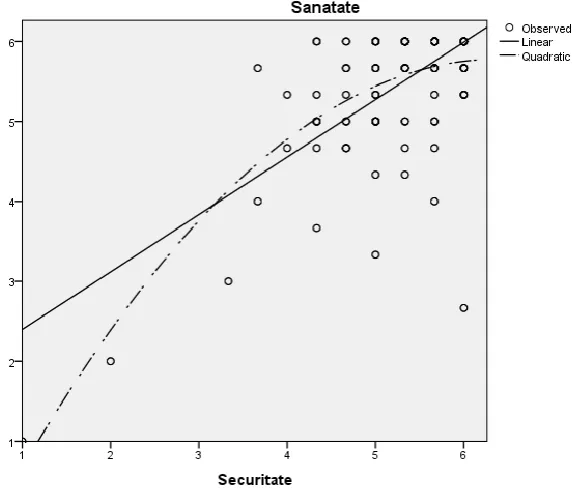
The curvilinear relationship can be graphically identified by a Scatterplot, adding 2 ways of
119
representing the regression line: Linear and Quadratic model, in order to depict nonlinear effects.
120
Figure 2 indicates the non-linear relationship between security and.
121
Figure 2 - Linear and quadratic curve estimation of health (sanatate) and security (securitate)
122
125
126
There is a very high correlation between security (m=5.22, SD=0.79) and health (m=5.43,
127
SD=0.874) of r=.652 significant at a p<.01, which allows us in proceeding with multiple linear
128
regression analysis [12].
129
With the purpose of testing the curvilinear relationship, the present study proposes a
130
hierarchical multiple regression analysis model, having health as dependent variable, and the
131
independent variable in step 1 security, and in step 2 security and squared security.
132
We have comprised in Table 1 the fitting of the 2 models, the first is the linear Model 1 and the
133
second is the curvilinear/ quadratic Model 2. As resulted from Model 1 that supposes linear
134
relationship, health value accounts for 42% of the variance in security value F=161.215 significant at
135
a p<.01. In Model 2 that supposes curvilinear relationship, health accounts for 50% of the variance in
136
security with an F=35.336 significant at a p<.01.
137
138
Table 1. The relationship between health and security as personal values, model summary,
139
ANOVA and coefficients
140
141
142
Model Summary
Model R R
Square
Adjusted R
Square
Std. Error
of the
Estimate
Change Statistics
R Square
Change
F
Change
df1 df2 Sig. F
Change
1 .652a .425 .422 .664 .425 161.215 1 218 .000
2 .711b .506 .501 .617 .081 35.336 1 217 .000
a. Predictors: Security
b. Predictors: Security, sqrt_security
143
144
ANOVAa
Model Sum of Squares df Mean Square F Sig.
Residual 96.101 218 .441
Total 167.170 219
2
Regression 84.526 2 42.263 110.971 .000c
Residual 82.644 217 .381
Total 167.170 219
a. Dependent Variable: Health
b. Predictors: Security
c. Predictors: Security, sqrt_security
145
146
147
Coefficientsa
Model Unstandardized Coefficients Standardized
Coefficients
t Sig.
B Std. Error Beta
1 (Constant) 1.679 .299 5.624 .000
Security .719 .057 .652 12.697 .000
2
(Constant) -1.412 .589 -2.395 .017
Security 2.253 .263 2.044 8.553 .000
sqrt_security -.177 .030 -1.421 -5.944 .000
a. Dependent Variable: Health
148
149
As resulted, the totality of standardized coefficients of Beta (β= .652; β= 2.044 and β=-1.421) show
150
significance at p<.01 that offer high consistency to Mo9del 1 and Model 2. Along with changing Beta
151
coefficient’s sign from - to + signifies that the effect is growing in the other direction, fact that
152
demonstrates the curvilinear relationship between health and security. Further, the incremental
153
predictive capacity of 8 percent that was added in step 2 by including the squared security variable
154
which is accounting for the curve in the regression line, demonstrates the curvilinear relationship
155
between health and security.
156
The computed curvilinear relationship shows that marginal aspects of the continuum, extremely
157
low and extremely increased levels of security, significantly influences the health, in a negative way.
158
Normal levels of security triggers a high level of health value prioritization. Thus a too security
159
oriented person and a low security oriented person will envisage a low level of health value
160
prioritization, compared to a person with normal security value prioritization that is associated with
161
a high level of health value prioritization.
162
163
4. Discussion
164
The theory of basic human values measures universal values that are recognized throughout all
165
major cultures. Schwartz's theory has refined the set of 19 basic individual values that serve as
166
guiding principles in the life of a person or group, further describing the dynamic relationships
167
among them. The present study presents practical evidence of the dynamics between individual
168
values, the dynamics theorized by Schwartz in 2012. Following the development of an online
169
questionnaire made up of 46 items with response options on a Lickert scale from 1 to 6, where 1
170
represents less important and 6 represent very important, 220 young people from Western Romania
171
The questionnaire targets the following set of values: self-determination, stimulation, hedonism,
173
achievement, power, security, conformity, tradition, benevolence, universalism, trust, health and a
174
scale of dissimulation. Regarding the internal fidelity of the 46-item value scale, we obtained a
175
Cronbach alpha of 0.839, proving that items have a high internal consistency. By testing the
176
hypothesis assuming the dynamic relationship between the two values through multiple regression
177
analysis, the results demonstrate that in Model 1, which involves a linear relationship, health explains
178
42% of the variance in security with a F =161,215 significant at p <.01. In Model 2, which involves a
179
curvilinear relationship, health explains 50% of the variance in security version with a F = 35,336
180
significant at p <.01. The incremental prediction capacity of 8% added by including the squared
181
security variable accounts for the curve in the regression line, indicating the existence of a curvilinear
182
relationship between security and health.
183
5. Conclusions
184
The calculated curvilinear relationship demonstrates that upper and lower marginal aspects,
185
extremely low and extremely high levels of security, significantly influence the health value in a
186
negative way. Normal levels of security trigger a high level of prioritization of health value. The
187
implications of this type of relationship are discussed in explaining the value phenomenon at
188
individual level. The study shows limits due to the selected sample, focusing exclusively on young
189
people with higher education from the Western region of Romania. This sample was the target group
190
of "The National Identity of Romanian Youth" project which designed this research.
191
The implication of this finding brings evidence for values intraclass dynamic relations. As the
192
present study shows, inside the conservation value dimension, including the tradition, conformity
193
and security value types, there are dynamic relationship between values such security, oriented
194
towards social and health, the same type of value oriented towards self.
195
196
Author Contributions: Conceptualization, D.R.; methodology, D.R.; software, D.R.; validation, D.R. and V.E.B.;
197
formal analysis, D.R..; investigation, D.R..; resources, D.R. and V.E.B.; data curation, D.R. and V.E.B.; writing—
198
original draft preparation, D.R..; writing—review and editing, D.R. and V.E.B.; visualization, D.R. and V.E.B.;
199
supervision, V.E.B..; project administration, D.R..; funding acquisition, D.R. and V.E.B.”.
200
Acknowledgments: The authors wish to acknowledge Prof. Emeritus Shalom H. Schwartz, Professor in the
201
Psychology Department of The Hebrew University of Jerusalem.
202
Conflicts of Interest:“The authors declare no conflict of interest.”
203
204
References
205
206
1. Bălăuță, D., Neagoe, A., Vasiluță Ștefănescu, M., Toderici, O.F. The Social and Vocational Integration of
207
Former Users of the Child Protection System in Romania: A Qualitative Study, Sustainability, 2019, 11(12),
208
3306; https://doi.org/10.3390/su11123306
209
2. Deth, J., Scarbrough, E. The Concept of Value. In Jan van Deth, Elinor Scarbrough (coord.) The Impact of
210
Values (Beliefs in Government, vol. 4), 1994, Oxford University Press.
211
3. Feather, N.T. Values in education and society. 1975, New York: Free Press.
212
4. Rokeach, M. The nature of human values, 1973, New York: Free Press.
213
5. Schwartz, S. H. Universals in the content and structure of values: Theory and empirical tests in 20 countries.
214
In M. Zanna (Ed.), Advances in experimental social psychology (Vol. 25) (pp. 1-65), 1992, New York: Academic
215
Press.
216
6. Rohan, M. J. A rose by any name? The values construct. Personality and Social Psychology Review, 2000, 4,
217
255-277.
218
7. Schwartz, S. H. Values: Cultural and Individual. Chapter In F. J. R. van de Vijver (Eds.), A. Chasiotis, & S.
219
M. Breugelmans, Fundamental questions in cross-cultural psychology, 463-493, 2011, Cambridge: Cambridge
220
8. Schwartz, S. H. Les valeurs de base de la personne: Théorie, mesures et applications [Basic human values:
222
Theory, measurement, and applications]. Revue française de sociologie, 2006, 42, 249-288.
223
9. Cieciuch, J., Davidov, E., Vecchione, M., Schwartz, S.H. A hierarchical structure of basic human values in
224
a third-order confirmatory factor analysis. Swiss Journal of Psychology, 73, (2014), 177-182.
225
10. Ekenga, C.C., Sprague, N., Shobiye, D.M. Promoting Health-related Quality of Life in Minority Youth
226
through Environmental Education and Nature Contact. Sustainability 2019, 11(13), 3544.
227
11. Schwartz, S. H. (1994). Beyond individualism/collectivism: New cultural dimensions of values. In Kim, U.,
228
Triandis, H. C., Kagitcibasi, C., Choi, S.-C., & Yoon, G. (Eds.), Individualism and collectivism: Theory, method,
229
and applications. 85-119, 1994, Thousand Oaks, CA: Sage.
230
12. Balas Timar, D. Is it Psychology about Linear or Dynamic Systems?. Journal SEA–Practical Application of
![Figure 1. Circular motivational continuum of 19 values in the refined value theory [9]](https://thumb-us.123doks.com/thumbv2/123dok_us/7852189.1302109/2.595.157.460.209.511/figure-circular-motivational-continuum-values-refined-value-theory.webp)