225
Shared context for engineering students learning business
Chi Hong Leunga*, Elvy Pangb
a*, b Department of Management and Marketing, The Hong Kong Polytechnic University, Hong Kong, The People's Republic of China. Email address: [email protected] (Corresponding author)
Corresponding author
ARTICLE HISTORY: Received: 18-Sep-2017 Accepted: 18-Oct-2017 Online available: 01-Nov-2017
Keywords:
Economic Education and Teaching of Economics Higher Education Research Institutions Search
Learning Information and Knowledge Communication Belief Unawareness
ABSTRACT
The shared context is a learning environment in which knowledge sharing is promoted by communication and collaboration among students. This engages students in any learning activity using cooperation, evaluation and interaction to build knowledge socially when coming across disagreement and difference. The communication technologies make it possible for everyone to contribute to the online community for sharing knowledge. The paper discusses the theoretical framework and then provides an example illustrating how to design teaching and learning activities to cultivate the sharing culture in classes with both engineering and business students. Business people tend to be extroverted while engineers are usually introverted. There are usually communication barriers among students from these two disciplines studying in the same subject. A survey was conducted to investigate students’ attitudes to the shared context and results suggest that this can integrate the higher learning motivation into the physical interactions and communications among peers. It encourages knowledge sharing through socialization – an important step towards knowledge creation – in both the online and real worlds. The shared context is effective when it integrates with different skills and interests of students who provide diversity into the traditional classroom learning. This makes knowledge possible to be accumulated, examined, revised and distributed.
Contribution/ Originality
This paper revealed the importance of knowledge sharing in education. The shared context helps students of various disciplines (especially engineering) to collaborate with each other and enhance their learning performance. It is found that online communication is able to facilitate such collaboration and support teaching and learning activities in a traditional classroom
DOI: 10.18488/journal.1007/2017.7.9/1007.9.225.237 ISSN (P): 2306-983X, ISSN (E): 2224-4425
Citation: Chi Hong Leungand Elvy Pang (2017). Shared context for engineering students learning business. Asian Journal of Empirical Research, 7(9), 225-237.
© 2017 Asian Economic and Social Society. All rights reserved
Asian Journal of Empirical Research
Volume 7, Issue 9(2017): 225-237
226
1. INTRODUCTION
Some famous business leaders are engineers like Henry Ford, Thomas Edison, John Frank Stevens, Herbert Hoover, Jimmy Carter and Steve Jobs. Nowadays 44% of Fortune 500 CEOs have business and engineering degrees (Straighterline, 2017) while 33% of the S&P CEOs have engineering degrees and 11% have business degrees (Business Insider, 2011). There are Fortune 100 CEOs (Visually, 2013) with various degrees including engineering (14%), business administration (11%), accounting (9%), economics (8%), chemistry (2%), chemical engineering (2%), mathematics (2%), and history (2%).
Engineers have several qualities defining good business leaders. Engineers like solving problems with information collection. Relevant facts are gathered before diving into problems and this practice also works remarkably well in business areas. Like good businessmen, engineers are good at probing for data and separating them for conclusions and this leads to a better decision making (Sternberg, 2007). In addition, engineers are proficient in data analysis and mathematical modeling. They convert a problem into logical terms and work with databases and programming languages. Engineers are analytical and detail-oriented and take risks after careful calculation. They are good at risk assessment that is a process leading to probabilistic ranking of possible outcomes. Moreover, engineers are not emotional in their decision making and they understand that it is necessary to isolate the factual from the emotional issues (Gurke, 2011). Finally, engineers are intuitive and creative and they are able to solve problems by thinking outside of the box. They identify the reasons of a problem and suggest economical solutions. Creativity and objective analysis equips engineers with the necessary skills for business success (The New York Times, 2009).
Although an engineering degree is a good foundation for business management, there are still some difficulties faced by engineers working in the business areas. Engineering work is vastly different from several business areas like sales and marketing. Some personalities and traits may be good from the perspective of engineers but they are considered undesirable in the field of business. Business people tend to be extroverted and they enjoy meetings and are energized by working with people around. Engineers are usually introverted and they prefer working alone. Engineers are not shy but just need some time to themselves.
Since 1988, M.I.T. has offered a programme called the Leaders of Global Operations that is a specialized crossover master programme between its management and engineering schools (The New York Times, 2009). Graduates of this programme earn both an MBA and a master degree in engineering. This provides a better training for the real business environment in which engineers and businessmen interact and provide a great value to the market. To provide engineers with business skills can help them to address a business problem from a technical perspective. In Britain, to be registered as a chartered engineer requires the demonstration of management and leadership skills. Engineers need to show that they can apply engineering skills in a real business situation.
227
Knowledge is generated, acquired and exchanged in learning and teaching activities. It is necessary to understand how students access right knowledge and how information is exchanged efficiently among students themselves. To handle new knowledge is dependent on sharing of knowledge that, in turn, on communication and cooperation among peers (Mariano and Awazu, 2017; Silva et al., 2012). Knowledge is created when there are interactions among individuals instead of an individual operating alone (Nonaka et al., 2001; Pee and Min, 2017). Therefore, teaching is not only concerned about spreading knowledge but also the capability of adapting and applying acquired knowledge to a new context that needs a shared context to share, create and utilize knowledge.
The purpose of this paper is to discuss the way of developing the curriculum for engineering students studying in business subjects in a tertiary institution. The emphasis will be put on how to establish a sharing culture in which students communicate with others to share knowledge in the learning process. In particular, the relationship of the knowledge management, cognitive process and relevant learning theories will be discussed in order to build a learning context facilitating the knowledge management in this sharing culture. The paper will first introduce the pedagogical background relevant to the curriculum development and then an example of the syllabus design will be provided. Students’ attitudes to the shared context were collected in the survey and the result showed that this could enhance engineering students’ learning capability and, thus, academic performance in business subjects.
2. KNOWLEDGE MANAGEMENT IN SHARED CONTEXT
Managing knowledge can be tricky as knowledge is intangible and dynamic. An important function of knowledge management is to transfer knowledge to people who need it. Knowledge sharing in an organization is to recreate and maintain ambiguous and complicated procedures in a new situation (Intezari et al., 2017; Shih and Tsai, 2016; Szulanski, 1996). The exchange and sharing of knowledge in an organization occurs at different levels: (1) from individuals to individuals and groups, and (2) from groups to groups and the organization (Alavi and Leidner, 2001; Renzl, 2008; Sedighi et al., 2016).
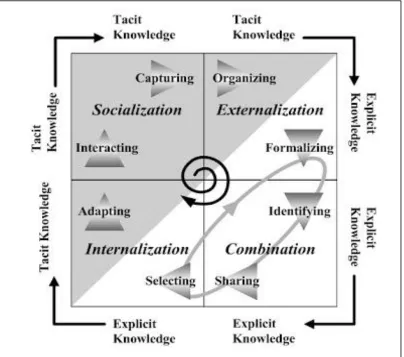
Figure 1 shows the distribution of explicit and tacit knowledge in the knowledge conversion cycle. An individual may learn from the externalization of others (e.g. speech given in a seminar) and further develop his own explicit knowledge from different knowledge sources like reading journals, and finally converts his explicit knowledge into new tacit knowledge in his mind (i.e. from steps “formalizing” to “selecting”). However, if there is no sharing with others (i.e. from steps “adapting” to “organizing”), tacit knowledge is not possible to be acquired normally.
In the educational context, sharing knowledge with peers is mainly performed through collaborative and cooperative learning, which are important features of the student-centered approach. In an ideal educational environment, learning should be social and collaborative instead of being isolated and competitive. Sharing with peers and responding to each other can deepen understanding of a given concept and improve thinking skills (Ashok et al., 2016; Gerdy, 1998; López-Nicolás and Mero˜no-Cerdán, 2011). Learning is intrinsically a social function in which students benefit from knowledge-creating communities inside and outside the school (Henttonen et al., 2016; Jonassen, 1995). In their communication with peers, learners may steadily create, share and interpret others’ knowledge and transform it into their own meaning (Hsu and Sabherwal, 2012; Pea, 1993). Sharing of knowledge not only increases the interest of students in learning, but also enhances analytical thinking. A student who participates in discussion should be responsible for one’s learning and becomes a critical thinker (Palacios-Marqués et al., 2016; Totten et al., 1991). Learners can perform at a higher intellectual level when they work in a collaborative manner than when asked to work unconnectedly (Rosendaal and
Bijlsma-Frankema, 2015; Vygotsky, 1978). Sharing is particularly important when students
228
Figure 1: Distribution of explicit and tacit knowledge in the knowledge conversion cycle (Source: www.jaist.ac.jp/ks/labs/umemoto/km_e.html)
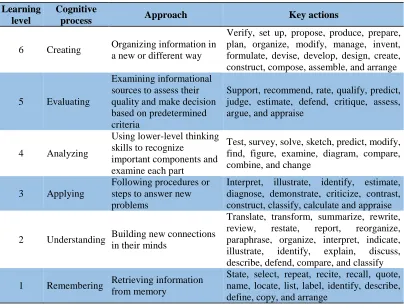
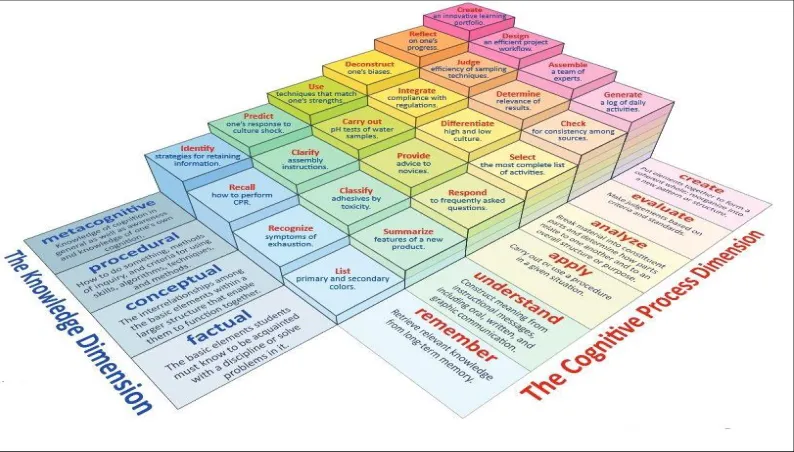
Table 1 presents the relationships among the types of knowledge, steps in the knowledge conversion cycle and cognitive process. Cognitive processes are involved in the capturing and reusing of knowledge and in selecting and replicating the best practices in an organization. Bloom’s original taxonomy described six levels of cognitive domains, namely knowledge, comprehension, application, analysis, synthesis, and evaluation. This was later revised and expanded. Table 2 further elaborates cognitive processes and summarizes the learning actions associated with each level of the revised Bloom’s taxonomy.
229
Table 1: Relationships among types of knowledge, conversion cycle and cognitive process Types of knowledge
(Salisbury, 2009)
Knowledge conversion step involved
Cognitive process involved
(Anderson and Krathwohl, 2001)
Metacognitive
knowledge Mainly collected in socialization
Require metacognitive knowledge to create and evaluate
Procedural knowledge Mainly constructed in
internalization Use procedural and conceptual knowledge to apply and analyze Conceptual
knowledge
Mainly constructed in externalization
Factual knowledge Mainly collected in combination Remember and understand factual knowledge
Table 2: Learning actions at the six levels of the revised Bloom’s taxonomy Learning
level
Cognitive
process Approach Key actions
6 Creating Organizing information in a new or different way
Verify, set up, propose, produce, prepare, plan, organize, modify, manage, invent, formulate, devise, develop, design, create, construct, compose, assemble, and arrange
5 Evaluating
Examining informational sources to assess their quality and make decision based on predetermined criteria
Support, recommend, rate, qualify, predict, judge, estimate, defend, critique, assess, argue, and appraise
4 Analyzing
Using lower-level thinking skills to recognize
important components and examine each part
Test, survey, solve, sketch, predict, modify, find, figure, examine, diagram, compare, combine, and change
3 Applying
Following procedures or steps to answer new problems
Interpret, illustrate, identify, estimate, diagnose, demonstrate, criticize, contrast, construct, classify, calculate and appraise
2 Understanding Building new connections in their minds
Translate, transform, summarize, rewrite, review, restate, report, reorganize, paraphrase, organize, interpret, indicate, illustrate, identify, explain, discuss, describe, defend, compare, and classify 1 Remembering Retrieving information
from memory
State, select, repeat, recite, recall, quote, name, locate, list, label, identify, describe, define, copy, and arrange
230
Figure 2: Relationship between types of knowledge and cognitive processes (Source: www.celt.iastate.edu/wp-content/uploads/2015/09/RevisedBloomsHandout-1.pdf)
3. AN EXEMPLAR OF SYLLABUS DESIGN
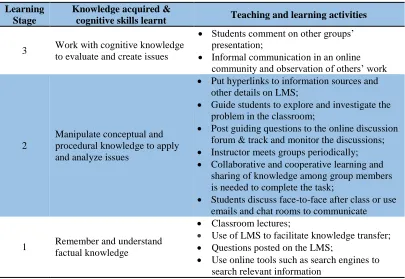
This example describes the use of the shared context to design a group project and related teaching and learning activities for an undergraduate course on management information system. The project involves improving the security of a company’s online store. Students work in groups to act as consultants. There are three main stages in this project. As they work on this project, the students will acquire cognitive skills starting from the bottom of the framework and move up to the top (see Table 3).
In Stage 1, the students need to understand and remember factual knowledge (such as authentication, confidentiality and integrity of networks) in the subject. This is equivalent to lower order thinking in the revised Bloom’s Taxonomy. Sharing among peers is not emphasized here and students mainly obtain explicit knowledge from various sources to construct their own knowledge. In the blended learning, classroom lectures may be used in conjunction with a learning management system (LMS) like Blackboard to facilitate such knowledge transfer (e.g. uploading course materials). After each lecture, questions are posted on Blackboard to help students to check if they understand the concepts. Students are encouraged to use online tools such as search engines to search relevant information for completing these questions.
231
from that of a knowledge transmitter to that of a facilitator. The instructor may meet with the groups at regular intervals to check progress and resolve issues. As they work on this project, the students will convert their explicit knowledge into tacit knowledge (internalization in the knowledge conversion cycle in which procedural knowledge is created). They also need to communicate their ideas and thoughts to group members (externalization in the knowledge conversion cycle in which conceptual knowledge is created). Thus, sharing among peers is more important in the second stage of the project. In blended learning, students may also communicate with each other after class or use e-mails or chat rooms.
In Stage 3, the students present their report and plan of action. Their work is also uploaded on Blackboard. The instructor assesses whether they have learnt and applied sound conceptual and procedural knowledge in identifying the security risks, recommending solutions to strengthen online security and suggesting defending measures against security threats in computer networks. Students are also required to evaluate the work of other groups and make comments. In doing so, they learn from the others, convert tacit knowledge of others into their own one. Sharing in this stage is the most important. Informal communication in an online community and observation of others’ work help students to share metacognitive knowledge.
Table 3: Summary of teaching and learning activities in a group project Learning
Stage
Knowledge acquired &
cognitive skills learnt Teaching and learning activities
3 Work with cognitive knowledge to evaluate and create issues
Students comment on other groups’ presentation;
Informal communication in an online community and observation of others’ work
2
Manipulate conceptual and procedural knowledge to apply and analyze issues
Put hyperlinks to information sources and other details on LMS;
Guide students to explore and investigate the problem in the classroom;
Post guiding questions to the online discussion forum & track and monitor the discussions; Instructor meets groups periodically; Collaborative and cooperative learning and
sharing of knowledge among group members is needed to complete the task;
Students discuss face-to-face after class or use emails and chat rooms to communicate
1 Remember and understand factual knowledge
Classroom lectures;
Use of LMS to facilitate knowledge transfer; Questions posted on the LMS;
Use online tools such as search engines to search relevant information
4. SURVEY RESULTS
232
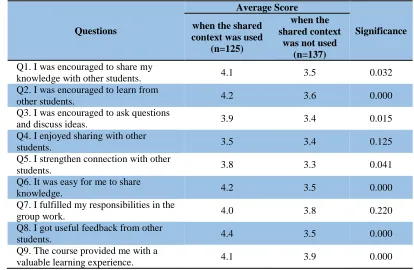
the shared context was not implemented and only the traditional teaching and learning methods like lectures and projects were used.
Table 4: ANOVA test results comparing students’ attitudes to the shared context
Questions
Average Score
Significance when the shared
context was used (n=125)
when the shared context
was not used (n=137) Q1. I was encouraged to share my
knowledge with other students. 4.1 3.5 0.032
Q2. I was encouraged to learn from
other students. 4.2 3.6 0.000
Q3. I was encouraged to ask questions
and discuss ideas. 3.9 3.4 0.015
Q4. I enjoyed sharing with other
students. 3.5 3.4 0.125
Q5. I strengthen connection with other
students. 3.8 3.3 0.041
Q6. It was easy for me to share
knowledge. 4.2 3.5 0.000
Q7. I fulfilled my responsibilities in the
group work. 4.0 3.8 0.220
Q8. I got useful feedback from other
students. 4.4 3.5 0.000
Q9. The course provided me with a
valuable learning experience. 4.1 3.9 0.000
The survey results show that with the exception of Q4 and Q7, there are significantly differences between the average scores in two situations – the shared context is used or not. These results reflect that the shared context can enhance sharing of knowledge and facilitate communication among students.
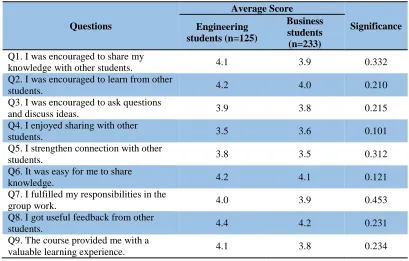
It is also interesting to find out if engineering students and business students have different attitudes to the shared context. In the two subjects mentioned above, there were 233 business students. The average scores of these two types of students are compared and presented in Table 5. The results show that there is no significant difference between average scores of engineering students and business students. Although the purpose of the shared context was originally designed and implemented for business students, this was found to be valuable to other students.
Based on the survey results, the shared context proposed in this paper can integrate the higher learning motivation into the physical interactions and communications among peers. It encourages knowledge sharing through socialization – an important step towards knowledge creation – in both the online and real worlds (Adhikari, 2010; Lee and McLoughlin, 2011; Taranath et al., 2017; Yeo and Marquardt, 2015). Students are presented up-to-date information that stimulates their interest in the subject. They are also encouraged to ask and discuss ideas and questions. In the educational context, sharing knowledge with peers is mainly performed through collaborative and cooperative learning. This is an important feature of the learner-centered approach (Wang et al., 2014; Yen et al., 2015; Younker and Bracken, 2015).
233
García-Peñalvo and Conde, 2014; Young, 2014; Chu, 2016; Cheng, 2017). Through sharing
knowledge students engage in discussion and they are responsible for their own learning and they become critical thinkers (Totten et al., 1991; García-Peñalvo and Conde, 2014; Jonsson, 2015; Younker and Bracken, 2015). Sharing is particularly important when students manipulate metacognitive knowledge to create new structures and concepts.
Table 5: ANOVA test results comparing business and engineering students’ attitudes to the shared context
Questions
Average Score
Significance Engineering
students (n=125)
Business students (n=233) Q1. I was encouraged to share my
knowledge with other students. 4.1 3.9 0.332
Q2. I was encouraged to learn from other
students. 4.2 4.0 0.210
Q3. I was encouraged to ask questions
and discuss ideas. 3.9 3.8 0.215
Q4. I enjoyed sharing with other
students. 3.5 3.6 0.101
Q5. I strengthen connection with other
students. 3.8 3.5 0.312
Q6. It was easy for me to share
knowledge. 4.2 4.1 0.121
Q7. I fulfilled my responsibilities in the
group work. 4.0 3.9 0.453
Q8. I got useful feedback from other
students. 4.4 4.2 0.231
Q9. The course provided me with a
valuable learning experience. 4.1 3.8 0.234
In addition, students acquire useful feedback on their work and enjoy a valuable learning experience because students can communicate with peers and teachers using online communication and social media tools after normal face-to-face learning sessions. This can facilitate the communication among teachers and learners, and enhance the learning experience in both online and offline environments (Escrivao et al., 2011; Yeh et al., 2011; Jambaya and Izadikhah, 2012).
5. CONCLUSION
The aim of this paper is to integrate various relevant learning practices and theories into a framework to achieve educational objectives of knowledge creation and sharing. The example given in this paper has illustrated the use of the shared context in educational institutes and the survey results suggested that this can effectively enhance elaboration and cooperation among students in classes. The objective of knowledge management in an educational institution is to facilitate teaching and learning. When students study, they learn to acquire knowledge and develop cognitive skills starting from lower order thinking and move on to higher order thinking. At each level, a certain type of knowledge is emphasized. For example, students are required to remember and understand factual knowledge at the lowest level while metacognitive knowledge is more important when students learn to create and analyze issues at the highest level (Khorasgani and Moazzeni, 2011; Smiderle and Green, 2011; Laal, 2011; Maio, 2013; Dalkir, 2015).
teacher-234
centered approach will play a more important role here. As students make the progress, acquiring metacognitive knowledge through sharing, collaboration and cooperation among peers (Socialization stage) become more important. This means that the student-centered approach will play a greater role in the later stages of learning in which educational objectives and learning activities should be designed to facilitate cooperation among students (Cheng, 2012; Oye and Salleh, 2013; Segarra-Ciprés et al., 2014). In-class and online discussions and the use of social media tools can enable such a knowledge sharing. Blended learning which brings together the advantages of face-to-face and online learning appears to be the optimal choice for the knowledge shared context (Jayasingam et al., 2013; Rodriguez-Ponce et al., 2013).
Now the communication technologies make it possible for everyone to contribute to the online community and the learning activities are supported by collaboration among students. Learners can access different ideas, resources and perspectives from each other, and collaborate in the online environment beyond the physical environment. The online community is able to break the boundaries of classroom and enables students to learn with others when all provide their perspectives to others. Collaborative learning is successful when all learners contribute knowledge and present ideas and viewpoints to solve problems. The shared context puts emphasis on knowledge dissemination and allows students to learn in a more complex manner. Information technology supports knowledge construction collaboratively and provides media for organizing and restructuring ideas contributed by all in the classroom. The Internet enhances the partnership and interaction among students (Gorry and Westbrook, 2013).
The social negotiation process is involved in learning in which the viability of students’ understanding is evaluated. Presenting contradictory ideas can stimulate learning and understanding process. The shared context engages students in any learning activity using cooperation, evaluation and interaction. They build knowledge socially when coming across disagreement and difference. With clarification, explanation, and justification of one’s idea, students can construct meaning actively and form their own viewpoints. The shared context is effective when it integrates with different skills and interests of students who provide diversity into the traditional classroom learning. This makes knowledge possible to be accumulated, examined, revised and distributed (Castillo and Cazarini, 2014).
Funding: This study received no specific financial support.
Competing Interests: The authors declared that they have no conflict of interests.
Contributors/Acknowledgement: All authors participated equally in designing and estimation of current research.
Views and opinions expressed in this study are the views and opinions of the authors, Asian Journal of Empirical Research shall not be responsible or answerable for any loss, damage or liability etc. caused in relation to/arising out of the use of the content.
References
Adhikari, D. (2010). Knowledge management in academic institutions. The International Journal of Educational Management, 24(2), 94-104. view at Google scholar / view at publisher
Alavi, M., & Leidner, D. E. (2001). Review: Knowledge management and knowledge management systems: Conceptual foundations and research issues. Management Information System Quarterly, 25(1), 107-136. view at Google scholar / view at publisher
Anderson, L. W., & Krathwohl, D. R. (2001). A taxonomy for learning, teaching, and assessing: a revision of Bloom’s taxonomy of educational objectives. Boston: Allyn & Bacon. view at Google scholar
Ashok, M., Narula, R., & Martinez-Noya, A. (2016). How do collaboration and investments in knowledge management affect process innovation in services? Journal of Knowledge
Management, 20(5), 1004-1024. view at Google scholar / view at publisher
http://www.businessinsider.com/ceos-majored-in-engineering-2011-235
3#33-of-the-sp-500-ceos-undergraduate-degrees-are-in-engineering-and-only-11-are-in-business-administration-1, Accessed on Oct 4, 2017.
Castillo, L. A. M., & Cazarini, E. W. (2014). Integrated model for implementation and development of knowledge management. Knowledge Management Research & Practice, 12(2), 145–160. view at Google scholar / view at publisher
Cheng, E. (2017). Knowledge management strategies for capitalising on school knowledge. VINE Journal of Information and Knowledge Management Systems, 47(1), 94-109. view at Google scholar / view at publisher
Cheng, E. C. K. (2012). Exploring a personal knowledge management model of pre-service teachers for effective learning. Asia-Pacific Education Researcher, 21(2), 336–341. view at Google scholar
Chu, K. W. (2016). Leading knowledge management in a secondary school. Journal of Knowledge
Management, 20(5), 1104-1147. view at Google scholar / view at publisher
Dalkir, K. (2015). Special issue on knowledge management for education. Education for Information, 31(1-2), 1-2. view at Google scholar / view at publisher
Escrivao, G., Nagano, M., & Escrivao Filho, E. (2011). Knowledge management in environmental education. Perspectives in Information Science, 16(1), 92-110. view at Google scholar García-Peñalvo, F. J., & Conde, M. A. (2014). Using informal learning for business decision making
and knowledge management. Journal of Business Research, 67(5), 686-691. view at Google scholar / view at publisher
Gerdy, K. B. (1998). If Socrates only knew: expanding law class discourse. Reuben Clark Law School, Brigham Young University. Lawyering Skills Section 9. Available at:
http://w.cali.org/conference/1998/postconf/thursday/25c4a/, Accessed on Oct 4, 2017. Gorry, G. A., & Westbrook, R. A. (2013). Customers, knowledge management, and intellectual
capital. Knowledge Management Research & Practice, 11(1), 92–97. view at Google scholar
/ view at publisher
Gurke, S. (2011). Why engineers could make the best business leaders. Available at: http://www.businessinsider.com/why-engineers-make-the-best-business-leaders-2011-12, Accessed on Oct 4, 2017.
Henttonen, K., Kianto, A., & Ritala, P. (2016). Knowledge sharing and individual work performance: An empirical study of a public sector organization. Journal of Knowledge Management, 20(4), 749-768. view at Google scholar / view at publisher
Herbst, A. S. (2017). Capturing knowledge from lessons learned at the work package level in project engineering teams. Journal of Knowledge Management, 21(4), 765-778. view at Google scholar / view at publisher
Hsu, I., & Sabherwal, R. (2012). Relationship between intellectual capital and knowledge management: An empirical investigation. Decision Sciences, 43(3), 489-524. view at Google scholar / view at publisher
Intezari, A., Taskin, N., & Pauleen, D. J. (2017). Looking beyond knowledge sharing: An integrative approach to knowledge management culture. Journal of Knowledge Management, 21(2), 492-515. view at Google scholar / view at publisher
Jambaya, R., & Izadikhah, Z. (2012). The application and effectiveness of knowledge management systems within Malaysian private higher education. International Journal of Psychology, 47(1), 302. view at Google scholar
Jayasingam, S., Ansari, M. A., Ramayah, T., & Jantan, M. (2013). Knowledge management practices and performance: Are they truly linked? Knowledge Management Research & Practice, 11(3), 255–264. view at Google scholar / view at publisher
Jonassen, D.H. (1995). Supporting communities of learners with technology: A vision for integrating technology with learning in schools. Educational Technology, 35(4), 60-63. view at Google scholar
236
Khorasgani, A., & Moazzeni. (2011). Higher education and knowledge management. International Journal of Information Science and Management, 9(2), 69–87.
Laal, M. (2011). Knowledge management in higher education. Procedia Computer Science, 3(1), 544-549. view at Google scholar
Lee, M. J. W., & McLoughlin, C. (2011). Web 2.0-based e-learning: Applying social informatics to tertiary teaching, Hershey, PA: IGI Global. view at Google scholar
López-Nicolás, C., & Mero˜no-Cerdán, A. L. (2011). Strategic knowledge management, innovation and performance. International Journal of Information Management, 31(6), 502-509. view at Google scholar
Maio, P. D. (2013). Knowledge objects as shared system representation. Knowledge Management Research & Practice, 11(1), 23–31. view at Google scholar / view at publisher
Mariano, S., & Awazu, Y. (2017). The role of collaborative knowledge building in the co-creation of artifacts: Influencing factors and propositions. Journal of Knowledge Management, 21(4), 779-795. view at Google scholar / view at publisher
Nonaka, I., Toyama, R., & Noburu, K. (2001). SECI, Ba and leadership: A unified model of dynamic knowledge creation, In: I. Nonaka, et al (eds.), Managing Industrial Knowledge, Creation, Transfer and Utilization. London, Thousand Oaks, New Delhi, pp. 13-43. view at Google scholar / view at publisher
Oye, N. D., & Salleh, M. (2013). E-Learning barriers and solutions to knowledge management and transfer. International Journal on E-Learning, 12(1), 99-110. view at Google scholar Palacios-Marqués, D., Popa, S., & Mari, M. P. A. (2016). The effect of online social networks and
competency-based management on innovation capability. Journal of Knowledge Management, 20(3), 499-511. view at Google scholar / view at publisher
Pea, R. D. (1993). Learning scientific concepts through material and social activities: Conventional analysis meets conceptual change. Educational Psychologist, 28(3), 265-277. view at Google scholar / view at publisher
Pee, L. G., & Min, J. (2017). Employees’ online knowledge sharing: The effects of person-environment fit. Journal of Knowledge Management, 21(2), 432-453. view at Google scholar
/ view at publisher
Renzl, B. (2008). Trust in management and knowledge sharing: The mediating effects of fear and knowledge documentation. Omega, 36(2), 206-220. view at Google scholar / view at publisher
Rodriguez-Ponce, E., Pedraja-Rejas, L., Araneda-Guirriman, C., & Rodriguez-Ponce, J. (2013). Relationship between knowledge management and academic management: an exploratory study in Chilean universities. Interciencia, 38(2), 88–94. view at Google scholar / view at publisher
Rosendaal, B., & Bijlsma-Frankema, K. (2015). Knowledge sharing within teams: Enabling and constraining factors. Knowledge Management Research & Practice, 13(3), 235–247. view at Google scholar / view at publisher
Salisbury, M. H. (2009). iLearning: how to create an innovative learning organization. San Francisco, CA: Pfeiffer. view at Google scholar
Sedighi, M., van Splunter, S., Brazier, F., van Beers, C., & Lukosch, S. (2016). Exploration of multi-layered knowledge sharing participation: The roles of perceived benefits and costs. Journal of
Knowledge Management, 20(6), 1247-1267. view at Google scholar / view at publisher
Segarra-Ciprés, M., Roca-Puig, V., & Bou-Llusar, J. C. (2014). External knowledge acquisition and innovation output: An analysis of the moderating effect of internal knowledge transfer. Knowledge Management Research & Practice, 12(2), 203–214. view at Google scholar / view at publisher
Shih, W., & Tsai, C. Y. (2016). The effects of knowledge management capabilities on perceived school effectiveness in career and technical education. Journal of Knowledge Management, 20(6), 1373-1392. view at Google scholar / view at publisher
237
Smiderle, D., & Green, P. (2011). How should students prepare for exams: A knowledge management approach. International Journal of Knowledge Management, 7(4), 55-69. view at Google scholar
Sternberg, S. (2007). Why engineers make good business people. Available at: http://pratt.duke.edu/news/why-engineers-make-good-business-people, Accessed on Oct 4, 2017.
Straighterline. (2017). What are the most common majors of Fortune 500 CEOs? Available at: http://www.straighterline.com/blog/common-majors-fortune-500-ceos/, Accessed on Sept 4, 2017.
Szulanski, G. (1996). Exploring Internet stickiness: Impediments to the transfer of best practice within the firm. Strategic Management Journal, 17(Winter Special Issue), 27-43. view at Google scholar / view at publisher
Taranath, M., Senaikarasi, R., & Manchanda, K. (2017). Assessment of knowledge and attitude before and after a health education program in East Madurai primary school teachers with regard to emergency management of avulsed teeth. Journal of Indian Society of Pedodontics and Preventive Dentistry, 35(1), 63-67. view at Google scholar / view at publisher
The New York Times. (2009). Close link between engineering and business management. Available at: http://www.nytimes.com/2009/11/03/education/03iht-riedengin.html?mcubz=1, Accessed on Sept 4, 2017.
Totten, S., Sills, T., Digby, A., & Russ, P. (1991). Cooperative learning: A guide to research. New York: Garland. view at publisher
Visually. (2013). Fortune 100 CEOS. Available at:
https://visual.ly/community/infographic/business/fortune-100-ceos-demographics-education-and-career-path, Accessed on Oct 4, 2017.
Vygotsky, L. S. (1978). Mind in society: The development of higher psychological processes. Cambridge. MA: Harvard University Press. view at Google scholar / view at publisher
Wang, S., Noe, R. A., & Wang, Z. (2014). Motivating knowledge sharing in knowledge management systems: A quasi-field experiment. Journal of Management, 40(4), 978-1009. view at Google scholar / view at publisher
Yeh, Y. C., Huang, L. Y., & Yeh, Y. L. (2011). Knowledge management in blended learning: Effects on professional development in creativity instruction. Computers & Education, 56(1), 146-156. view at Google scholar / view at publisher
Yen, Y. F., Tseng, J. F., & Wang, H. K. (2015). The effect of internal social capital on knowledge sharing. Knowledge Management Research & Practice, 13(2), 214–224. view at Google scholar / view at publisher
Yeo, R. K., & Marquardt, M. J. (2015). To share or not to share? Self-perception and knowledge-sharing intent. Knowledge Management Research & Practice, 13(3), 311–328. view at Google scholar / view at publisher
Young, M. (2010). Alternative educational futures for a knowledge society. European Educational Research Journal, 9(1), 1-12. view at Google scholar / view at publisher
Young, M. L. (2014). The formation of concern for face and its impact on knowledge sharing intention in knowledge management systems. Knowledge Management Research & Practice, 12(1), 36–47. view at Google scholar / view at publisher