J. Phys.: Condens. Matter 3 (1991) 3905-3920. Printed in the UK
Theory of defects in conducting polymers:
11.
Application
to polyacetylene
D S WaIlacet$T, A M Stonehams, W Hayest, A J Fishertt and A Testas t Clmendon Laboratory, Parks Road, Oxford OX1 3PU. UK
$ Theoretical Physics Division, HarweU Laboratory, Didcd, Oxon OX11 ORA, UK $ AEA Industrial Technology, HsrweU Laboratory, Didcot, Oxon OX11 ORA, UK
Received 14 November 1990
Abstract. We exploit the approach of s previous paper, based on self-cawistent quantum-chemical mokcuLar dynamics, to investigate the energetics and dynamics of excitations in conducting polymers. The predictions indude the formation energies of solit- and polarons, the phenomenon of doping by alkali atoms, luminesccolce quendkg in cispolyacetylene. the soliton mobility in tranr-polyacetylene and the non-uistena of breathen in cisplyacetylene.
1. I n t r o d u c t i o n
In the previous paper (hereinafter called paper I) we outlined the development of computational techniques which can be readily used to calculate, for example, the equilibrium geometries, dipole moments and frequencies of vibration of small molecules. Here we extend the techniques to model properties, and especially defect properties, of conducting polymers like polyacetylene (PA). These conjugated polymers are semiconductors with gaps in the range 1-3 eV, but may be doped chemically and reversibly to give conductivities of up to metallic values (see e.g. Hayes 1985). At low dopant levels, conductivity appears to be due to the movement of charged defects along polymer chains but, at higher doping levels, more complicated mechanism (e.g. hopping between chains) may occur (Kivelson 1986).
Much of the theoretical study of conjugated polymers in the past has been based on the model Hamiltonian of Su, Schrieffer and Heeger (the so-called SSH model; Su et a/ 1980) and its continuum approximation due to Takayama et a / (1980); for a review
see Heeger et a / (1988). The SSH approach is based on extended Hiickel theory and is a tight-binding model with electron-phonon, but not electron-electron, interactions; it is a relatively simple approach that has provided a framework to which later calculations could be related. T h e key feature of our present approach is the simultaneous optimization of molecular geometry and the self-consistent calculation of molecular electronic structure. The same approach can be readily exploited for both static and dynamical studies. In our studies of the electronic behaviour and the molecular geometry of polymers we have carried out self-consistent numerical calculations using the SSH Hamiltonian as well as both the CNDO (complete neglect ofdifferential overlap)
7 Present address: Andersen Consulting, 2 Arundel Street, London WCZR 3LT, UK.
3906 D
S
Wallace ei a1and INDO (intermediate neglect of differential overlap) parametrizations of Hartree-
Fock theory. Other authors such as Stafstrom and Bredas (1988) use the MNDO (modified neglect of differential overlap) parametrization, which retains some of two- centre intregals neglected by CNDO and INDO. Sadlej (1985)
has
discussed all three methods.Our method relaxes a molecule by a molecular dynamical technique, and thus requires no second derivatives to be calculated; the first derivatives are calculated analytically rather than numerically. The wavefunction calculation (which involves the recursive diagonalization of an
N
xN
matrix, whereN
is the number of basis orbitalsused) is the timelimiting step of the calculation, except for very small s y s t e m , and is performed in parallel with the molecular geometry calculation so that just a few steps (typically one) of the recursion is performed at each molecular geometry encountered along the minimization path. The concept of simultaneous geometry optimization and self-consistent electronic structure determination has been pioneered by Car and Parrinello (1985).
There are two further advantages to the method of geometry optimization. Since the method has a dynamical basis it can be used t o obtain approximate dynamics merely by refraining from damping out the atomic motion, subject to the limitations discussed in appendix 2 of the previous paper. In particular, there is no need to calculate any second derivatives (which is an intractable process analytically; the calculation of analytic first derivatives is only made possible by the Hellman- Feynman theorem, which enables us to ignore the derivatives of the bond-order matrix). It should be noted, though, that the specific semi-empirical methods used here (INDO, and in particular CNDO) tend to overpredict force constants by a factor of approximately 2 to 3, so that calculated frequencies will tend to be too high by around 50-70%. Fortunately, this overprediction is so regular as to be almost systematic (see the previous paper). The additional advantage inherent in this method of molecular relaxation is i t s flexibility. Indeed, the underlying computer program has been written with this flexibility in mind. External fields (both electric and force fields) can be applied (and they need not be uniform), external potentials representing substrates may be included, and individual atoms may be constrained to remain fixed with respect to motion along any axis. There is, of course, no need to impose symmetry, nor any supposed bonding pattern.
Theory of defecis in conducting polymers:
II
3907The calculation of frequencies and energy surfaces is central to issues of non- radiative transitions and luminescence quenching, and we discuss these matters for PA
in section 4. In section 5 the dynamical behaviour of PA is modelled in order to study three effects. First, we shall examine the way in which the injection of a soliton at the end of a CPA chain results in the defect moving into the chain interior. Second, we shall estimate the mobility of a charged soliton in CPA. Third, we shall analyse the much-studied case of the creation of an electron-hole pair, considering the behaviour of the lowest triplet state of each isomer of PA. The behaviour of &PA on photoexcitation, and in particular its dynamical behaviour, has aroused much interest because of the possibility of formation of a form of dynamical defect known as a breather (Bishop et al
1984), which has been postulated as the species responsible for the 1.35 eV peak in the photoinduced absorption spectrum of CPA. Previous studies have used methods based on extended Hiickel theory, including the SSH model, to predict the possible existence of no fewer than three types of breather, each of which may be formed if the energy injected into the system is appropriate (Wang and Martino 1986). The possibility of the existence of breathers in c-PA has not previously been studied, possibly because of the absence of a satisfactory model. The dynamical nature of the code used here, however, coupled with its flexibility and its high speed of calculation, means that it is ideally suited to investigations of this type (section 6).
2. Defect f o r m a t i o n energies in conjugated polymers
Trans-polyacetylene (CPA) (figure 1) h a s received more attention than any other conjugated polymer. The carbon atoms in the chain are s-p hybridized; if we take the plane of the polymer to be the zy plane there is one p,(a) electron per carbon not included in the u-bond backbone and, in Hiickel theory, the a electrons form a half-filled band. However, 1-PA does not behave as a one-dimensional metal because of the Peierls (1951) instability, which cause4 a doubling of the size of the unit cell and generates a g a p in the ?r band This dimerization was first proposed for tPA by Longuet- Higgins and Salem (1959); in chemical terms, the backbone consists of alternating single and double bonds. However, the use of the terms 'single' and 'double' bond in this context is descriptive rather than precise, since the difference in bond length and bond order is not large. When considering distortion around a defect in a polymer chain it is useful to define a dimerization parameter dn by
where bn,,+l is the length of the bond joining carbon atoms n and n
+
1. The basic defect in t-PA may be imagined as a junction between states (a) and(6)
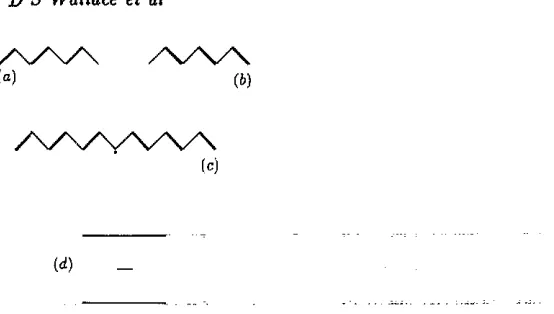
of figure 1;here the switch from state (a) to state (6) is imagined to be abrupt and there is a n unpaired electron localized in the central carbon atom. However, in fact, the change of dimerization pattern is more extended and, in the TLM approximation is proportional to tanh(z/l) where the half-width
I
is about seven C-C spacings. This defect has one localized state, which is at midgap in the Hiickel approximation (figure l(d)); it is known as a bond-alternation defect (Pople and Walmsley 1962) or soliton (Su et a1Other conducting polymers, such as c-PA, polypyrrole and polythiophene do not have the topological degeneracy typical of 2-PA (figure l ) , and hence a soliton is
3908
D S
Wallace et a1(4 -
. . . . ~ ~
.. .
Figure 1. Topological mp-ntation of a solitan in &PA; the defect (state (c)) consists of a change in the backbone of the chain f” state (a) to state ( b ) and gives rise to D localized eledronie state at the centre of the gap (err ( d ) ) .
not possible. The only simple defect that can occur in non-degenerate polymers is represented by a reduction of the dimerization parameter over a limited region of chain. A possible structure for c-PA is represented in figure 2(a). This type of defect is associated with two localized electronic states which, within the SSH approximation,
are symmetrically located about midgap (figure 2(b));
it
is not stable in an uncharged state, and will decay immediately into the ground state. However, the addition of a single charge will stabilize the defect, forming a polaron. One may envisage addition of a second charge; if the doubly charged defect were stable against decay into two polarons we would have a negative U effect and formation of a bipolaron. The localized electronic states of a bipolaron (figure 2) resemble those of a polaron, but are expected to be closer to the centre of the gap because of greater chain distortion.-
-
( 4 ( b )
Figure 2.
localized electronic states in the gap.
(a) Topological representation of a polaron in c-PA with ( b ) ita two
Theory of defects in conducting polymers:
II
3909an odd number of carbons must have a single localized defect.
The calculation of the energy of formation of the defects mentioned above has recently been investigated by Wallace (1989) (see also Fisher et ul 1989) and some results are given here. The calculations involve the self-consistent solution of the SSH Hamiltonian, with an extra term added to model non-degenerate polymers such as c-PA; the electronic part of the Hamiltonian is diagonalized for given atomic displacements and then the atoms are relaxed to make the force acting on each one zero (Wallace 1989, section 2.2). Use of SSH theory for &PA gives a formation energy
EF
of 0.56 eV for charged solitons and 0.34 eV for uncharged solitons; by contrast the calculatedEF
for a polaron is 0.63 eV, suggesting that in &PA solitons are preferentially formed. CNDO predicts somewhat greater values, hut reaches the same conclusions. The SSH value forEF
for a polaron in c-PA is 0.89 eV, and again CNDO predicts a slightly greater lattice distortion. Presumably this is in part because it takes into account repulsion of the charged carbon atoms and so tends to spread the defect out further.For tPA both SSH and CNDO agree that the bipolaron is unstable with respect to decay into two charged solitons. We cannot calculate the energy of a bipolaron since the geometry relaxation routines lead to a decay into solitons. In c-PA the two- soliton route for bipolaron break-up is forbidden and within SSH the energy required to form a bipolaron is 1.51 eV i.e. 0.27 eV less than the calculated formation energy of 2 x 0.89
=
1.78eV (see above) for two separate polarons. It is not surprising that hipolarons are predicted to be stable in the SSH model, since the electron-electron interaction is ignored. We shall discuss the corresponding predictions of CNDO in a subsequent publication.3. Doping by alkali atoms
The important properties of t-PA are controlled by doping, for example by Na. This process is hard to treat realistically in the SSH or similar models; usually the dopant is supposed merely t o donate a charge to the polymer, though Bryant and Glick (1982) did give a simple phenomenological treatment of the distortion due to the dopant. Our approach allows us to handle the charge transfer and deformation consistently, and casts doubt on the usual assumptions.
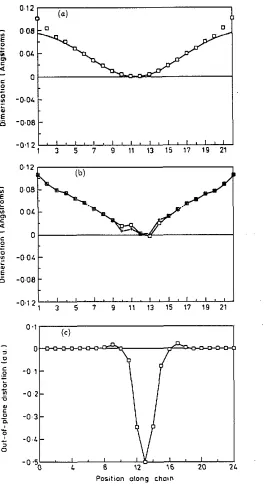
We show in figure 3 the equilibrium positions resulting when a N a atom is placed close t o a t-C,,H,, chain. This is still a relatively simple case, but it shows features relevant to a bulk system. The N a atom moves from an initial asymmetric position to a stable minimum out of the molecular plane and midway between two carbons. The in-plane distortion of the chain has the major effect on the T electron coupling and
dimerization.
Close
examination of the deformation shows two components: one has the shallow but broad distortion of a polaron; the other is a localized term associated with short-range overlap interactions. Not only is the deformation pattern more complex than often supposed, but also the charge transfer is less complete: for Na dopant, the (Mulliken) charge stored in the chain is only 0.71e. For smaller ions like Li and F, less than 0.3e transfer is predicted.4. Luminescence quenching in c-PA
3910
D
S Wallace et a1I
U
- o ' 1 2 1 3 5 7 9 11 13 15 17 19 21
P o ~ t t m n d o n g chain
Figure 3. (a) Dimerization pattern for a polaron in CPA. The full curve iS a fit to the
s u m of two tanh functions, of width 5.1 and separation 9.4 C-C bond lengths; this is the form predicted for a polaron in the SSE model. (b) Dimerination pattem induced in &-PA by the presence of II nearby Na atom # 2.5 A from the chain. f correspond to
a dimerization parameter calculated from the actual bond lengths; 0 refer only to the component of the distation in the plane of the molecule. T h e o w a l l e f f e d is similar
to the polaron shown in (a) but with the addition of short-range distortion near the
Na atom. The plot is slightly asymmetric because relaxation is not complete. ( e )
Out-of-plane component of the distortion of a 1-PA chain produced by doping with a
Theory of defects in conducting polymers: I1 3911
superimposed (Lauchlan et a1 1981). The luminescence requires an excitation energy of 2.05 eV, and has a low quantum efficiency of at most Hayes e t a i (1983) concluded that the luminescence lifetime was shorter than 9 ps and suggested that hot luminescence was involved. Tubino et a1 (1984) suggested that the apparent Stokes shift of 0.15 eV was, in fact, due to a shallow gap state (see also Andrews et al 1989). Shank et al (1982) studied the time dependence of a photoinduced absorption peak of CPA at 1.6 eV. They found that the absorption consisted of two components: one short-lived, with a decay time of order picoseconds, and one long-lived, with a lifetime of at least some milliseconds. The frequency profile of these two components were identical, implying that they arose from the same source, and their intensities were comparable, with the short-lived component having roughly double the strength of the long-lived component. The absorption appeared to start immediately upon excitation, implying a formation time for the species responsible of less than 150 fs.
One of the shortfalls of the SSH model is its failure to account for the low quantum yield of photoluminescence in c-PA (Hayes e l a l 1983, Andrews e t a/ 1983). The SSH model Hamiltonian displays charge-conjugation symmetry
(ccs)
which forbids non-radiative decay from a photoexcited state to the ground state (Danielsen and Ball 1985); there is the possibility that the low efficiency of luminescence is due to a competing non-radiative transition, in violation of this artificial symmetry (Hayes 1985), and various authors (Su et a1 1988, Danielsen and Ball 1985) have suggested possible mechanisms for this symmetry breaking. The use of CNDO in place of SSH automatically breaks the symmetry. We have verified this explicitly by calculations of optical absorption weights (Wallace 1989). The photoluminescence of c-PA is still an area worthy of study, however, since it will become clear below that straightforward competition from a non-radiative decay mode will not explain all of the observed features.The Huang-Rhys factor for an electronic defect in c-PA has a value which depends on the shape of the distortion pattern as well as on its amplitude. However, the dependence on the defect shape (dimerization pattern) is fairly weak (Wallace 1989), so to a first approximation the amplitude can be treal,ed as the most important parameter. We define this amplitude by a ‘depth’ n, the ratio of the maximum change in the dimerization parameter to its ground-state value do:
(2)
Id,
-
dolmaxd0 a =
Typical values for the parameters which define the defect shape give a Huang-Rhys factor of So EJ 2a2 (Wallace 1989). Values of a can be found by self-consistent geometry optimization in either the SSH or semi-empirical Hartree-Fock models and, for an exciton in c-PA, these methods lead to values of 1.05 and 1.8 respectively. Since the Stokes shift is equal to 2S,hw, and the phonon energy hw is 0.18 eV in c-PA (Lefrant et 4 l 1979), it is clear that, if the apparent Stokes shift of 0.15 eV is genuine,
there is a discrepancy between theory and experiment of about an order of magnitude. It can be confirmed that this discrepancy is not due to any of the approximations involved in calculating the Huang-Rhys factor by lookirig at the results of explicit calculations of the energies of various defects within the sSH model. The energy saved by lattice relaxation around a polaron in CPA is 0.08 eV, in good agreement with the calculated value of n of 0.4. For a bipolaron, which is equivalent to an exciton in the
3912
D
S Wallace el a1Within any self-consistent electronic structure calculation, including CNDO, constraining a system to remain in an excited state is not easy. The difficulties occur whenever there is a lower-energy state of the same symmetry to the one under consideration. One way round this problem is to consider an excited state with different spin, and our calculations for an exciton were performed on its triplet state. The accuracy of the calculations for the singlet state reached optically rely on the energy splitting between equivalent (excited) singlet and triplet states not being too great. Relative to the ground-state energy the following values were obtained:
Triplet energy at ground-state geometry
=
3.67 eV. Triplet energy (relaxed geometry) = 1.73 eV.Energy of ‘ground state’ at relaxed triplet geometry
=
2.21 eV.It can be seen that the relaxation energy of the exciton is 1.94 eV, fairly close to the lattice energy of the ground state at the relaxed excited state (exciton) geometry, consistent with vibrational mode frequencies which do not change appreciably on photoexcitation. We remark again that CNDO is primarily a method for calculating good molecular geometries, rather than good energies; it tends to overpredict energies (notably phonon energies), and the energies quoted above might be too large by a factor up to two (see paper I). Given that the phonon energies will be overpredicted, it will still be possible to predict the defect geometry correctly if the band gap (i.e. the triplet energy at the ground state geometry) is also overpredicted, This is the case here, so it is possible to have some confidence in the general features of our calculations.
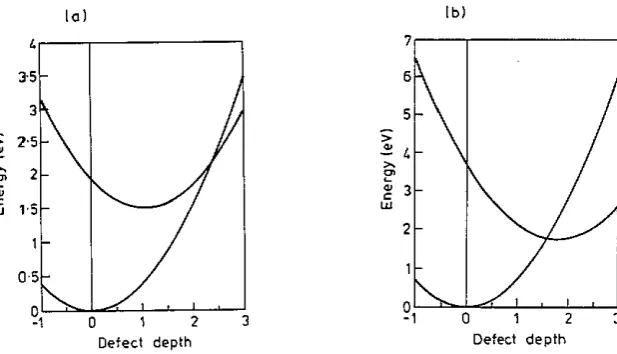
Configuration c-ordinate diagrams for C-PA within the SSH and CNDO models are shown in figure 4. The chain energy has been plotted as a function of the defect depth a, assuming harmonicity and (for the SSH model) that there is no change in vibrational frequency on photoexcitation. With these assumptions, enough is known from calculations of the geometries and energies of the ground and excited states to enable these diagrams to be drawn. The observed Stokes shift is substantially lower than predicted theoretically from both SSH and CNDO calculations, and an explanation for this may be found in the very short lifetime of the luminescence. This would imply that the observed luminescence is actually hot luminescence, occurring before the chain has had time to reach its equilibrium geometry (see Hayes et a/ 1983 and Laughlan e l a/ 1983). The possibility that luminescence quenching is due to a competing non- radiative process is found to be unsupportable within the SSH model. This is because non-radiative decay is forbidden not only by symmetry, but also because the crossover between the ground-state and excited-state energy curves occurs at significantly higher energy than the vertical excitation energy (figure 4 ( a ) ) ; there is no way that the geometry necessary for the proposed non-radiative transition to take place can ever be attained. The SSH model therefore predicts 100% luminescence, irrespective of any symmetries that may or may not forbid non-radiative decay. Clearly this result is in complete disagreement with experiment, and the reason for this discrepancy will be discussed below.
Theory of defects i n conducting polymers:
II
3913la1 I b l
"
Defect deplh Detect depth
Figure 4. Calculated configuration coordinate diagrams for an exciton in C-PA using (a) the SSH and ( b ) the C ND O models.
a significant amount of energy in the system soon after excitation and this could raise the excitons' energy up to the cross-over thereby permitting some fast non-radiative decay and accounting for the short-lived component observed by Shank et al (1982). This explanation of the observed luminescence quenching does not remove the need for chargeconjugation symmetry to he violated, but does allow for the magnitude of the violation to be much smaller than that required by a simple radiative-non-radiative competition model.
The principal difference between the predictions of the SSH and CNDO models occurs because of their differences in the predicted depths of the defect, i.e. the values predicted for the configuration co-ordinate at which the excited-state energy minimum occurs. I t seems that the main reason for the difficulty in reconciling experiment and the SSH predictions for c-PA efficiency of luminescence lies with the method by which the SSH model h a s been adjusted to deal with polymers without ground-state degeneracy. One of the advantages of CNDO is that it makes no comparable arbitrary assumptions.
5. Soliton velocity, sound velocity and soliton mobility h &PA
Su and Schrieffer (1980) studied the effect of setting up a chain of 1 - p ~ with a soliton at one end. This may be done by starting with an odd-length chain and uniform dimerization, so the chain ends with a long bond and an associated localized state (see figure 1).
Su
and Schrieffer (1980) adjusted the parameters of the SSH model so that the defect size was reduced, thereby enabling them to use a smaller chain than otherwise necessary. They found that the soliton moved up the chain with a characteristic velocitysimilar to thespeed ofsound c i n &PA, which had been estimated by Guinea (1984) t o be 1.85 x lO*ms-' within the SSH model. Our quantum molecular dynamic method is ideally suited to the repetition of these calculations within CNDO, and the results are shown in figures 5-7.3914
D
S
Waallace el a/0 006
0.002
=
00
7
-0.002'E
U -0.OoL'
-0.006 - 0 008L 8 12 16 20 2 L
- o o l o o '
'
' 1 ''
''
''
'Time I steps I
Figure 5. Determination of the speed of sound in &PA from the speed at which a pulre injeaed at one end of the chain at t = 0 is calculated to move down the chain. The velocities of carbon atoms Iurtha down the chain are plotted against time (A, atom 3; 4 atom 4;+, atom 5; 0, atom 6). The pulse is attenuated 8s it travels.
0.3 carbon atoms per time step. The pulse was generated by reducing the lengths
of the two bonds at one end of the chain by 0.05.&
and allowing the chain to relax without applying any damping. Even though there is no external damping, the pulse is significantly attenuated as it travels, presumably from dispersion (and indeed the peak positions do suggest more than one component). The time step used was the program's natural unit of time, which isa
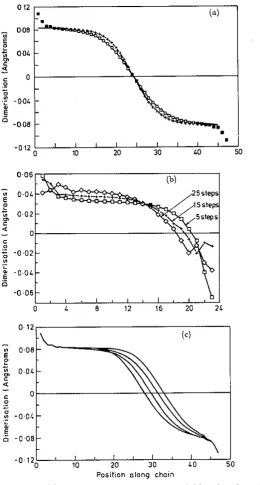
atomic units (or approximately 1.04 fs), representing a sound velocity of c, = 3.5 x IO4ms-'. The overprediction of force constants by a factor of 1.9 is characteristic of CNDO (see paper I) and is responsible for the speed obtained being rather higher than the SSH result.The rcwlts in figure 6 repeat the SSH calculations of Su and Schrieffer for an end- injected soliton, here using the CNDO dynamic model. The dimerization pattern is plotted at three different times. We observe that the relaxation of the defect into a soliton appears to be occurring fairly quickly; further, the speed at which the soliton moves up the chain remains constant to a good approximation. This velocity is 0.10 carbon atoms per time step, corresponding to approximately 1.2 x 10⁴ms-', a figure which is comparable to the speed of sound.
We emphasise that quite different motions are involved in the two cases. T h e sound velocity of 3.5 x 10⁴ms-' describes the propagation of a small deviation from equilibrium, with no bond alternation defect present. The soliton velocity of 1.2 x lo4 ms-' describes the motion of a bond-alternation defect and is, in effect, the product of the soliton mobility (see below) and the effective force field arising because of the lower energy of the soliton a t the chain centre.
The large size of a soliton ( I M 8 carbon units) implies a low effective mass.
Su
etal (1980) calculated
Me,
e 6m,, and hence a high mobility. Our method allows us to calculate the soliton mobility directly within the self-consistent quantum chemical model. Such a calculation uses both the model's dynamical nature and the facility i t provides for the application of an external electric field. Results given in figure 6 ( c )Theory of defects in conducting polymers:
II
0.12
-
0.08E
0 'I 0.OL
a
C O
.:
-0.04.-
E
YI
D
I
0
0
.-
-
CI
- 0 0 8
- 0 12
0.06
0.01 E
0 'I 0.02
D
Q
- 0
c
D
-
._
2 -0.02
Lo
._
- 0 . O L
-0.06
._
0
0 L 12 16 20 2L
3915
0
,
I I II
- 0 . 1 2 1 0 10 20 30 LO 50Position along chain
Figure 6. (a) Dimerization pattems for charged ( 0 ) and uncharged (+) solitons
in &PA. Full curves are fits to tanh curves of half-widths 8.1 and 6.5 C units for the charged and uncharged solitons respectively. (b) Relaxation of the dimerization parameter along an odd-length chain with time: o after 5 time steps.
+
after 15time steps, 0 after 25 time steps. The point at which the dimerization M S S ~ S zero is
3916
the run. This velocity is measured to be 3.9 x 10⁴ms-', corresponding to a mobility p of 0.75cmZV-'s-'. The mobility is itself consistent with the soliton velocity estimated above where, instead of an applied electric field, the soliton moves in response to the gradient of its energy as a function of position along the chain. Experimental evidence for the soliton mobility comes from two sources: magnetic resonance experiments (Conwell and Jeyadev 1989) and picosecond studies of photoconductivity (Sinclair et
al 1986); other sources (e.g. Burroughes et ai 1989, Townsend et a1 1989) measure the mobility limited by interchain hopping, which is a different phenomenon). Both
of these sources yield approximately lcm*V-'s-' f or the mobility, in good agreement with the results of the model used here.
D
S
Wallace et a1I lbl I
.. . .. . . - . .. . . ... ... ~ 0 1 5
I I Id1 I
-
0 10 0 0 52
: o
;
010D
-
P 0 05
-
0E
=
0 15Figure 7. Illustration of breather formation in t-PA. An electmn-hole pair is injected at t = 0 when the chain is uniformly dimcrized. The dimerizstion that develops FS
a function of time repmen& that of a bound solitorrantisotiton pair with a l e d
oscillation of the atoms at the centre of the defect superimposed. The dimerisation is plotted in (a) fort = 0 to 5 ( b ) t = 6 to 1 1 (e) t = 12 to 17 ( d ) t = 18 to 23 time steps (1 time step zz 1 is).
The dependence of the mobility on applied field both confirm our estimate and suggests an upper limit to the soliton velocity. When the calculation was repeated for
Theory of defects in conducting polymers:
II
3917the chain as before. It therefore appears that there is a limit to the soliton velocity of about lo5 ms-’, i.e. a few times the speed of sound in &PA. Bishop et a1 (1984) first remarked that there should be a limit to the soliton velocity, and Guinea (1984) predicted, using a modified SSH model, that this velocity would be 4.8 x 10⁴ms-’, larger by a factor of 2.6 than his value for the speed of sound. Such an effect is clearly carried over into our CNDO calculations. Conwell and Jeyadev (1989) have suggested that, at velocities similar t o the maximum velocity, effects similar to relativistic effects might increase the soliton’s effective mass and hence decrease its mobility.
’ l i m e Istepsl
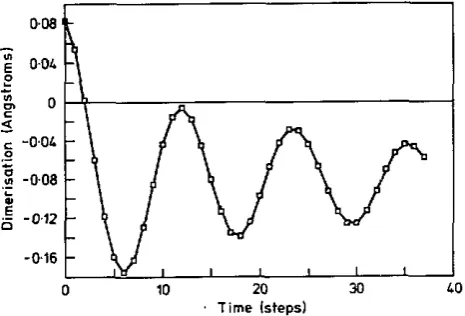
Figure 8. Dimerization at the centre of a breather in &-PA (see figure 7) plotted against time (1 time step E 1 Is) showing the slightly damped oscillation of the bonds.
6. Amplitude breathers
Charged solitons can be created in t-PA by chemical doping. Photo-excitation produces an electron-hole pair which, in CPA, evolves rapidly into a charged soliton-antisoliton pair. The ‘mid-gap’ photo-induced absorption at about 0.5 eV is then clearly similar to the 0.6-0.7 eV absorption in doped &PA. However, the photo-induced absorption contains an extra transition a t 1.35 eV (Grenstein and Baker 1982, Vardeny et ai 1982, Shank et a1 1982) which appears to be associated with a secalled ‘amplitude breather’ (Bishop et a1 1984). The breather is a spatially localized charge-neutral oscillation which emerges as the solitons generated by photo-excitation move apart. If an electron at the top of the valence band is excited into the bottom of the conduction band (requiring the band gap energy A,,) the excitation evolves into a soliton and an antisoliton with rest energy
=
1.3A0, moving apart with kinetic energy=
0.2A0. The ‘breather’ left behind oscillates with a frequency of about 95% of the Raman frequency. It gives rise to two electronic states within the gap; the upper one is empty, the lower is doubly occupied, and the observed 1.35 eV transition is consistent with excitation from the lower state to the upper one.The breather decays by phonon emission, with no electronic transitions involved. An isotope effect is predicted. Consistent with this, Vardeny et a[ (1984) find the breather peak a t 1.39 eV in hydrogenated t-PA (CH), and 1.35 eV in deuterated 1-
3918
D
S Wallace el a1. .- . . ” .”
-0.1 6
-
o L a 12 16 20 2~ 20 Position d o n g chain
Time I steps1
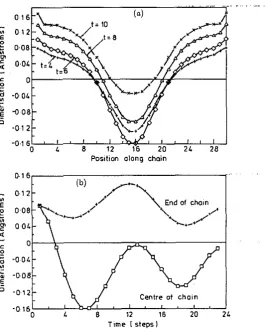
Figure 9. (a) Dimerization pattern in C-PA plotted 115 a function of time ( t = 4 to 10 time steps) after injection of a electron-hole pair at t = 0 (compare figure 7 for t-PA). The oscillation that develops as a function of time represents that of a hound solitomantisoliton pair with an osdbtion of the entire chain (i.e. the LO phonon mode) superimposed. (b) Dimerization st the m t r e 01 the chain (squares) and ne= the end of the chain (crosses) plotted against time. The two &merimtion* separate
initially but after about 10 time s t e p (IO-” s) begin to oscillate in Unison at the frequency of the LO mode.
types of breather. In a dynamical simulation using the SSH extended Hubbard model, Wang and Martino (1986) verify the conclusions of Bishop et al (1984), but find that if the soliton-antisoliton pair has less than a critical energy
E,
they bind to give an ‘excitonic breather’. The excitonic breather has an energy 1.82A0, rather less than the value1.88A1,
of the ‘central breather’. The ‘central breathers’ are themselves of two types: a localized form, like that proposed by Bishop et a1 (1984), and a form which moves up and down the chain.Theory of defects in conducting polymers:
II
3919in our calculation. The motion of the atoms in the breather has a period T = 12 fs
(corresponding to 2800 cm-l)
,
which is close to that of the Raman-active LO mode (2660cm-', see section l ) , in agreement with previous theory.The periodic motion associated with the breather is still dear at the longest times we considered, nearly 40 timesteps (figure 8). In contrast, in c P A there is no stable localized oscillation: the electron-hole pair rapidly becomes an exciton plus longitu- dinal optic vibration of the whole chain (figure 9), consistent with the absence of a breather absorption band in this material.
Acknowledgments
DSW and AJF acknowledge the receipt of Research Studentships from the SERC and AJF thanks St John's College, Oxford, for the award of a Junior Research Fellowship. Part of this work was supported by the Underlying Research Programme of the United Kingdom Atomic Energy Authority and part by the Commission of the European Communities (contract No C11.0324).
References
Andrews J R, Orlowski T E, Gibson H, Slade M L, Knox W and Wittsmerhaus B 1983 Phyr. Rev.
Bishop A R, Campbell D K, Lomdahl P S, Horovitz B and Philpott S R 1984 Phys. Rcu. L e t t . 5 2
Bryant G W and Glick A J 1982 Phys. Rev. B 26 5855
Burroughs J H, Jones C A, Lawrence R A and Friend R H 1989 Pmc. M o m NATO Advanced Study
Car R a n d Parrinella M 1985 Phys. Re". Lett. 55 2471
Conwell E M and Jeyadev S 1989 Synth. Mct. 28 D439
Danielsen P L and Ball R C 1985 J. Phpigae 46 1611
Fisher A 3, Haves W and Wallace D S 1989 J . Phyr.: Condens. Matter 1 5567
B 27 6545
671
Institute at press
Guinea F 1984-Phys. Rev. B 30 1884
Hayes W 1985 Contcmp. Phyr. 26 421
Haves W. Ironside C N. Ryan J
. .
F. Steele R P and Taylor R A 1983 J . Phvs. C: Solid S t a t e Phys.16 L729
Wiley)
Hayes W and Stoneham A M 1985 Defects and Defect Processes in Non-Metallic Solids (New York Heeger A J, Kivelscn S, Schrider J R a n d Su W-P 1988 Rev. Mod. Phys. 60 781
Kivelson S 1986 Solitons ed S E 'Thllinger et 01 (Amsterdam: Elsevier)
Lauchlan L, Chen S P, Etemad S, Kletter M, Heeger A J and MacDiarmid A G 1983 Phys. Rev. B Lauchlan L, Etemad S, Chund T C, Heeger A J and M a c D i d d A G 1981 Phyr. Rev. B 2 4 3701
Lefrant S, Lichtman L S, Temkin H, Fitchen D B, Miller D C, Whitewall D E and Burlitch J M 1979
Longuet-Higgins H C and Salem L 1959 Proc. R. Soc. A 251 172
Peierls R E 1955 Qrrmtsm Themy of Solida p 108 (Oxford: Clmendon) Pople J A and VValmsley S H 1962 Mol. Phys. 5 15
Shank C V, Yen R. Fork R L, Orenstein J and Baker G L 1982 Phys. Rev. Lett 49 1660
Sinclair M, Moses D and Heeger A J 1986 Solid State Commun. 59 343
Stafstrijm S and B&das J L 1988 Phya. Rev. B 28 4180 Su W P and Sdvieffer J R 1980 Prac. N a f . Anrd. Sei. 77 5626 Su W P, S&i&er J R and Heeger A J 1980 Phyr. Rev. B 22 2099
-
1983 Phyr. Re". B 28 1138 erratumT A Y - H, Lin-Liu Y R and Maki K 1980 Phyr. Reu. B 2 1 2388 27 2301
3920
D S
Wallace et a1Tubim R, Piseri L, Dellepiane, Birman J L and Pedretti U 1084 Solid S t d c Commun. 49 161 Vardeny 2, EhKnfreund E, B r a f m 0, Now& M, S M e r H, Heeger A J and Wudl F 1986 Phya.
Vardeny 2 , Strait J, M mD, Chung T C and Heeger A J 1982 Phi.. Reu. Lett. 49 161
Wdlace D S 1989 DPhil Thesis, Ozford Uniuer.it9 and Xenurll Labomtory Theoretical P h p i c r
Wang C L and Martino F 1986 Phts. Rev. B 34 5540
Rev. Lett. 58 671