1
SENSORY ANALYSIS TEST OF POUNDED YAM MADE FROM A POUNDING MACHINE DESIGNED AND FABRICATED IN NIGERIA
Abulude F.O1*., Elemide A.O2., Oladipupo O.K3., and Ale T.A3 1Science and Education Development Institute, Akure, Ondo State, Nigeria 2Department of Agricultural and Bio-Environmental Engineering, Federal College of
Agriculture, Akure, Ondo State, Nigeria
3Department of Agricultural Technology, Federal College of Agriculture, Akure, Ondo State,
Nigeria
*Corresponding author: [email protected]
ABSTRACT
Pounded yam eaten with any type of soup is a delicacy eaten by Nigerians. It is manually prepared by pounding yam, cocoyam or combination with mortar and pestle. Preparation takes 30-45 mins. Researches on the improvements have taken place to reduce the heavy burden on the pounded yam preparation. One of the efforts made is the fabrication of pounding machine from the Department of Engineering, Federal College of Agriculture, Akure, Nigeria. The aim of this study is to carry out the organoleptic analysis of pounded yam produced from the fabricated machine. A ten-man panelist was used to determine the organoleptic analysis of the pounded yam in terms of the appearance, taste, colour, odour and texture. The panelists were scored with a class of quality grading: 22.6-25.0 (excellent), 20.2-22.5 (good), 18.2-20.1 (satisfactory), 16.2-18.1 (less satisfactory), and <15.2 (unsatisfactory). Also, sensory attributes were scored as 1= unsatisfactory, 2= less satisfactory, 3= satisfactory, 4=good, and 5= excellent. The results were statistically analysed. From the results it was found that the mean results of appearance, colour, odour, taste, and texture were 4.55, 4.43, 4.15, 4.32, and 4.08 respectively. Coefficients of variation (%) were 16.89, 17.80, 21.65, 15.67, and 24.40. The Skewness of the parameters was in negative, while only odour has its Kurtosis in negative form (-0.37). All the panelists rated the appearance (19-24%) of all the samples high above all other parameters. The Pearson Coefficient of Correlation and Principal Component Analysis showed elements of relationships between the parameters. In conclusion, the machine pounded yam was scored above satisfactory, which means the fabricated machine was efficient.
Keywords: Pounded yam, cocoyam, machine, panelist, texture, Yorubas, Nigeria
INTRODUCTION
Africans are blessed with local foods, Nigeria one of the countries therein is likewise blessed with different types of local foods. One of the local foods is pounded yam, a very popular delicacy (Olaoye and Oyewole, 2012). Pounded yam is eaten with different soups like vegetable, ogbono, okro, egunsi soups. Most occasions and parties in Nigeria, especially the Yorubas serve pounded yam as the menu. Pounded yam is usually made from yam, cocoyam or the mixtures and pound with mortar and pestle.
Yam an ingredient of pounded yam is a member of the genus Dioscorea is an important staple food in West Africa (Ekwu et al., 2005). It is grown annually and perennially in Africa, the Americas, the Caribbean, South Pacific and Asia. It is indigenous to West Africa (IITA, 2018).
2
The common species available are the Yellow yam (D. cayenensis), Water yam (D. alata), D. rotundata, and D. esculenta. According toFAO (1989), yam has great prospect of contributing to closing the projected food deficit in Africa in the 21st century. Out of the 94% of West African’s production, Nigeria single handedly produce 71%, making a total of more than 37 million tons (IITA, 2018). In Nigeria, February and April tubers are planted and are harvested between180 to 270 days. Nutritionally, yam tubers consist of about 21% dietary fiber and are rich in carbohydrates, vitamin C and essential minerals. Yams are processed into less perishable
products through a drying process to make flour (Jimoh and Olatidoye, 2009).
Cocoyam
Cocoyams are perennial plants, which belongs to the family Araceae. This root and vegetable crop are edible (Deni, 2000). Cocoyams which are planted as food crops belong to either the genus Colocasia or the genus Xanthosoma and are made of a large spherical corm, from which a few large leaves emerge. Colocasia species may also be referred to as taro and originates from Southeast or Central Asia (Rao et al., 2010). Cocoyam has high nutritional values (vitamins, minerals, and protein) when compared with cassava and yam. It can be consumed in different ways by roasting, cooking, frying, baking, pounding and milling. Colocasia species are known to have health benefits like reduction in the symptoms of rheumatoid arthritis, prevents cancer, reduces blood pressure, plays important in the immune system, reduces cramps, boots vision, and enhances learning (Admin, 2016).
Pounded yam production is a tedious process, which is carried out by pounding cooked slices of yam in a mortar using a pestle to a smooth dough consistency (Oluwamukomi and Adeyemi, 2015). However, instant pounded yam flour, which is a modern invention to simplify the tedious traditional process. There are has been a lot of improvements in the processing of pounded yam to eliminate the tedious process. For example, poundo yam flour has been developed, this is just a fortified flour, which is stirred in a pot within 5-10 min, it is ready to be served (Oluwamukomi and Adeyemi, 2015; Ayodeji et al., 2014; Olaoye and Oyewole, 2012; Adeola et al., 2012). Also, is the design and fabrication of machines which are used in the production of pounded yam (Adebayo et al., 2014; Ikechukwu and Munch, 2015). However, these and some others failed due to some limitations like poor pounding, a limited quantity of pounded yam production, stirrer or mixer problems, and production of excessive heat during usage just to mention a few. It is on this premise, the pounding machine used in the study was designed and fabricated to correct the limitations. Part of the evaluation is the organoleptic analysis of the pounded yam produced from the machine. This study evaluated the acceptability, taste, odour, colour, and texture using a ten man panelist.
MATERIALS AND METHODS
The tubers of white yam (Dioscorea alata) and corms of white cocoyam (Colocasia esculenta) varieties, the gas cooker, pestle and mortar used for this work were procured from the Oja Oba market in Akure, Ondo State, Nigeria.
Design and Fabrication of Machine
3
Preparation of Yam tuber and corms of cocoyam for pounding Machine (Fig 1)
1. Cocoyam only pounded with mortar and pestle – 910g (Control) 2. Yam only pounded with mortar and pestle – 910g (Control) 3. A mixture of yam (637g) and cocoyam (273g) – Ratio 3:1 4. A mixture of yam (455g) and cocoyam (455g) - Ratio 1:1 5. Cocoyam only pounded with the machine – 910g
6. Yam only pounded with the machine – 910g
Control
Same quantities were used in the preparations, but mortar and pestles were employed (Fig 2)
Fig 2. Pounded yam made of mortar and pestle
Measurements (Time and volumes)
The volume of water used for cooking - 500cm3 (Enough to cover the yam and cocoyam)
Time of cooking – 12 min (The yam and cocoyam were cut into small pieces). Time of pounding (Machine) – 3mins
Time of pounding (Control) – 10 mins
Production of Pounded Yam Cooking of yam
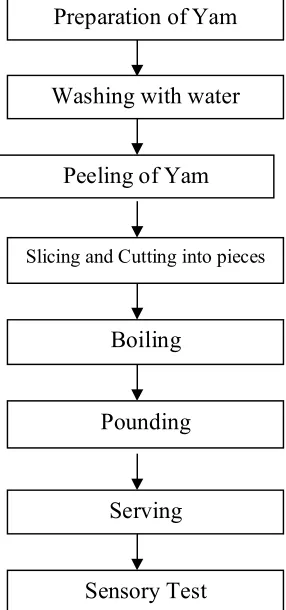
The brown outer layer tubers and combs were peeled, sliced and washed the white part with lots of clean water, transferred into cooking pots and cooked with water. Cooked for twelve minutes, and then checked with a kitchen fork by piercing to see if the yams were soft enough for the pounding. Once the yams were soft enough for pounding then it was ready for the pounding part. The water was not completely dried because it was needed for pounding the yam in the mortar and pestle. The flow chart for the pounding is shown in Figure 3.
Pounded yam and Cocoyam preparations
4
Note
The yam used for the project has stayed for over three months before use. New yam may not be suitable for pounding.
Fig 3: Flow Chart of the Production of Pounded Yam
Sensory Evaluation
The pounded yam made from yam, cocoyam and the mixtures of the yam and cocoyam were compared. Two different groups of (10 members; 5 men and 5 women) consumer type untrained sensory panelists were selected from students of Federal College of Agriculture, Akure, Ondo State. They were briefly trained in the methodologies involved.
Each panelist was provided with a separate score sheet. Water was provided to rinse the palate between two tasting sessions. Also, quality attributes, colour, texture, taste, appearance, and odour were evaluated. The class of quality grading: 22.6-25.0 (excellent), 20.2-22.5 (good), 18.2-20.1 (satisfactory), 16.2-18.1 (less satisfactory), and <15.2 (unsatisfactory). Also, sensory attributes were scored as 1= unsatisfactory, 2= less satisfactory, 3= satisfactory, 4=good, and 5= excellent.
Washing with water
Peeling of Yam
Slicing and Cutting into pieces
Boiling
Pounding
Serving
5
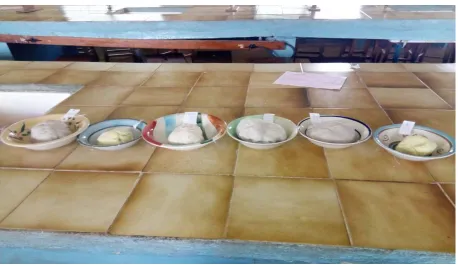
Fig 4. Samples of Pounded Yam produced by the fabricated machine and control
Statistically, the results obtained in the study were analysed using Minitab 18 (Descriptive statistical, correlation coefficient, and matrix) and Excel (charts).
RESULTS AND DISCUSSION
Table 1 depicted the descriptive statistical results of the organoleptic tests of the pounded yam samples. From the results, it was found that the mean results of appearance, colour, odour, taste, and texture were 4.55, 4.43, 4.15, 4.32, and 4.08 respectively. Coefficients of variation (%) were 16.89, 17.80, 21.65, 15.67, and 24.40 the indication of these values showed little margins (variations) in the decisions of the panelists. It could be deduced that all the samples products accepted by the panelists. These results were in agreement with those previously reported (Akissoe et al., 2009; Adeola et al., 2012). The Skewness of the parameters was in negative. This showed that in the distributions, the mean is less than the median, which is always less than the mode. The opposite is the case if it were to be positively distributed. If a normal distribution is skewed it has either of its tails longer than the other. Since the distributions are negatively skewed it means they have long tails in the negative directions. Only odour has its Kurtosis in negative form (-0.37). Since this value is less than 0, it is considered to be a “light-tailed”. Kurtosis as it is known is measured against the normal distribution. When the kurtosis is close to 0, then a normal distribution is often assumed (mesokurtic distributions), but when it is less than 0, then the distribution is light tails (platykurtic distribution). If the kurtosis is greater than zero, then the distribution has heavier tails and is called a leptokurtic distribution (McNeese, 2016).
6
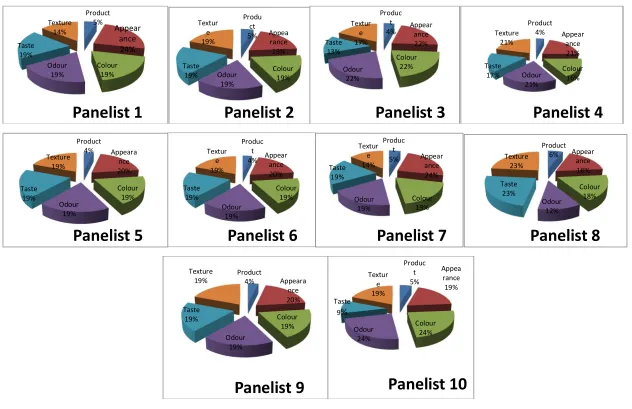
yam. Figure 6, showed the contributions of each organoleptic parameter in the samples. All the panelists rated the appearance (19-24%) of all the samples high above all other parameters. The appearance was not affected by stain from the machine and mortar and pestle, there were no signs of unmashed yam or dirt which could have altered the appearance. The excellent appearance in the samples would assist in the marketing and choice. Colour contributed between 19-22%, the reasons for the differences were due to panelists’ taster status and their different opinions (perceived colour differently). Likewise, the odour was scored between 12 and 24%.
Odour can be an appetizer in food intake and an important characteristic of food, which influences food choice behaviour. The odour recorded by the panelist showed that the pounded
yam obtained using the machine was satisfactory. The results obtained in his study compared with a commercial poundo yam produced by Adeola et al., (2012); “poundmix” (Oladeji and Akanji, 2011); pounded yam (Akissoe et al., 2009), “foutou” (Nindjin et al., 2007); pounded yam (Otegbayo et al., 2007) in terms of the sensory attributes.
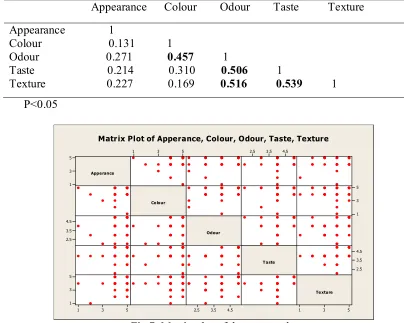
The Pearson correlation coefficient analysis of the organoleptic parameters determined are shown in Table 3. This table presented the overview of the correlations. There were significant correlations between odour and colour (R=0.46), Taste and odour (R=0.51), textureand odour (R=0.52), and texture and taste (R=054). The correlation between odour and colour were a weak correlation, were strong correlations. It implied that it is all the organoleptic parameters used in the test gave a good account of the pounded yam samples from both the control and test (machine). Baah et al. (2009) and Oluwamukomi and Adeyemi (2015) evaluated the quality of pounded yam and composite of poundo yam respectively. The results of the evaluations were similar to ours. The tastes, aroma, the colour of the samples were preferred by the panelists. Fig 7 showed the matrix plot of the results. The plot explained the relationships in appearance, colour, odour, taste, and texture of the samples. The organoleptic tests were in diagonal line with each variable plotted against each other at the top and down (forming mirror image). Where the scatterplot looks alike, it shows a correlation. From the table, it showed that there were relationships between texture, taste and odour; taste and odour, and colour and odour. The Pearson correlation coefficient in Table 2 confirmed this.
7
Table 1. Descriptive Statistical results of organoleptic analysis test Appearance Colour Odour Taste Texture
Mean 4.55 4.43 4.15 4.32 4.08 SE Mean 0.10 0.10 0.12 0.09 0.13 Std Deviation 0.77 0.79 0.90 0.68 1.00 Coef Variation (%) 16.89 17.80 21.65 15.67 24.40 Minimum 1.00 1.00 2.00 2.00 1.00 Maximum 5.00 5.00 4.00 4.00 4.00 Skewness -2.49 -2.02 -0.74 -0.82 -0.92 Kurtosis 8.14 8.14 -0.37 1.02 0.30
Table 2. Pearson Correlation Coefficient of the test results (P-Value)
Appearance Colour Odour Taste Texture
Appearance 1
Colour 0.131 1
Odour 0.271 0.457 1
Taste 0.214 0.310 0.506 1
Texture 0.227 0.169 0.516 0.539 1
P<0.05
5 3 1
5 3 1 5
3
1 2.5 3.5 4.5
5 3 1 4.5
3.5 2.5
4.5 3.5 2.5
5 3 1 5 3 1
4.5 3.5 2.5
Appe rance
Colour
Odour
Ta ste
Te xture
Matr ix Plot of Apperance, Colour , Odour, Taste, Texture
8
Table 3. Principal Component Analysis loading factor of the results
0.6 0.5 0.4 0.3 0.2 0.1 0.0 0.50
0.25
0.00
-0.25
-0.50
-0.75
First Component
S
e
c
o
n
d
C
o
m
p
o
n
e
n
t
Texture Taste
Odour Colour
Apperance
Loading Plot of Apperance, ..., Texture
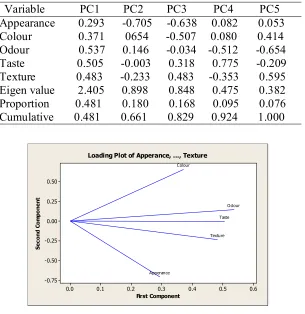
Fig 8. Loading plot of the organoleptic results
CONCLUSION
The organoleptic analysis was performed on the control (pounded yam from mortar and pestle) and test samples (Pounded yam from the fabricated machine) of pounded yam, cocoyam and the mixtures of both. The study revealed that all the samples were accepted by the panelists. The results revealed too, that the appearance of the pounded yam and cocoyam samples only made from the fabricated machine and the control was scored excellent. In conclusion, the fabricated machine’s efficiency was high.
REFERENCES
1. Adebayo A.A., Yusuf K.A., and Oladipo A (2014). Fabrication and Performance Evaluation of a Yam Pounder Cum Boiler. Scientia Agriculturae.8 (3), 2014: 112-120.
2. Adeola A.A, Otegbayo B.O., and Ogunnoiki (2012), Preliminary Studies on the Development and Evaluation of Instant Pounded Yam from Dioscorea alata. J. Appl. Sci. Environ. Manage. Vol. 16 (3) 287 – 290.
3. Adigun E.T (2015). Testing and Renovation of yam pounding machine. Department of Agricultural Technology, Federal College of Agriculture, Akure, Ondo State. ND Project. Unpublished.
9
4. Admin (2016). The nutritional and health benefits of cocoyam. Food and nutrition. Pharmanews. https://www.pharmanewsonline.com/8216-2/.
5. Akissoe N, Mestres C, Hounhouigan J., and Nago M (2009). Sensory and Physicochemical Quality of Pounded Yam: Varietal and Storage Effects. Journal of Food Processing and Preservation 33: 75–90.
6. Ayodeji S.P., Olabanji O.M., and Akinnuli B.O (2014). Development and Performance Evaluation of a Sieving Machine for Poundo Yam Process Plant. Journal of Emerging
Trends in Engineering and Applied Sciences (JETEAS) 5(4): 229-236.
7. Baah F.D, Maziya-Dixon B, Asiedu R, Oduro I and Ellis W.O (2009). Physicochemical and pasting characterisation of water yam (Dioscorea spp.) and relationship with eating quality of pounded yam. Journal of Food, Agriculture & Environment. Vol.7 (2) : 1 0 7 - 1 1 2..
8. Babatunde Oladeji, Cahales Taiwo Akanbi, (2011) "Physico‐chemical and sensory
evaluation of “poundmix” from yam, cocoyam, breadfruit and plantain blends", Nutrition
& Food Science, Vol. 41 Issue: 6,
pp.430-436, https://doi.org/10.1108/00346651111181985.
9. Deni Bown (2000). Aroids: Plants of the Arum Family. Timber Press, Portland
10.Ekwu F.C, Ozo N.O, Ikegwu O.J, (2005). Quality of fufu form white yam varieties (Dioscorea spp). Nigerian Food Journal 23:107-113.
11. FAO (1989). Roots, Tubers, and Plantains in Food Security: In Sub-Saharan Africa, in Latin America and the Caribbean, in the Pacific". FAO. 1989. ISBN 978-92-5-102782-0.
12. IITA (2018). Yam (Dioscorea species). http://www.iita.org/crops/dioscoria/. Accessed 1st October, 2018.
13.Ikechukwu G.A and Munch M.J (2015). Development of a Motorized Yam Pounding Machine Design to Improve Standard of Living for Sustainable Economic Development in Nigeria. Proceedings of the World Congress on Engineering 2015 Vol II. WCE 2015, July 1 - 3, 2015, London, U.K.
14.Jimoh, K.O. and Olatidoye O.P., (2009). Evaluation of physicochemical and rheological characteristics of soybean fortified yam flour. Journal of Applied Biosciences 13:703-706.
15.McNeese B (2016). Are the Skewness and Kurtosis Useful Statistics? https://www.spcforexcel.com/knowledge/basic-statistics/are-skewness-and-kurtosis-useful-statistics. Updated, February 2016.
10
locally based descriptive analysis methodology. Food Quality and Preference. Volume 18, Issue 2, Pages 450-459.
17.Olaoye, J. O., and S. N. Oyewole. (2012). Optimization of some "poundo" yam production parameters. Agric Eng Int: CIGR Journal, 14(2):58-67.
18.Oluwamukomi M.O and Adeyemi A.O (2015). Physico-Chemical, Pasting, and Sensory Properties of “Poundo”-Yam Enriched with Defatted Soy Flour. Applied Tropical
Agriculture. Volume 20 (1): 89-95.
19.Otegbayo, B., Aina, J., Abbey, L., Sakyi‐Dawson, E., Bokanga, M. & Asiedu, R. (2007). Texture profile analysis applied to pounded yam. Journal of Texture Studies, 38(3), 355-372.
11
Right View Left View Top View with Cover
Top View with without Cover Front View Back View
12
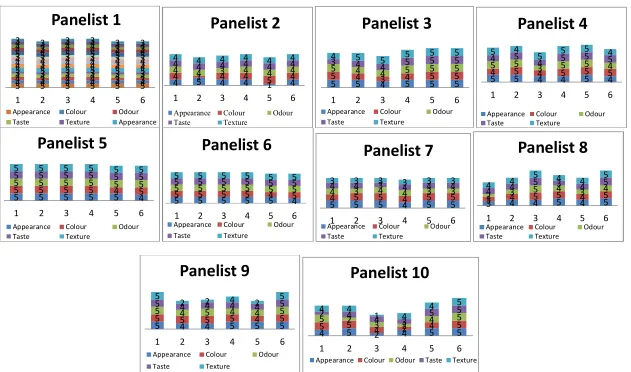
(1)- Cocoyam only pounded with mortar and pestle (Control) (2) - Yam only pounded with mortar and pestle (Control) (3) - Mixture of yam and cocoyam (Ratio 3:1). (4) - Mixture of yam and cocoyam (Ratio 1:1). (5)- Cocoyam only pounded with machine (6) - Yam only pounded with machine
Fig 5. The ratings of the samples by individual panelists (1-10)
5 5 5 5 5 5
4 4 4 4 4 4
4 3 4 4 3 3
4 4 4 4 4 4
3 3 3 3 3 3
5 5 5 5 5 5
4 4 4 4 4 4
4 3 4 4 3 3
4 4 4 4 4 4
3 3 3 3 3 3
5 5 5 5 5 5
4 4 4 4 4 4
4 3 4 4 3 3
4 4 4 4 4 4
3 3 3 3 3 3
1 2 3 4 5 6
Appearance Colour Odour
Taste Texture Appearance
4 5 4 4 1 4
4 1 4 4 5 4
4 4 3 4 4 4
4 4 4 4 4 4
4 4 4 4 4 4
1 2 3 4 5 6
Appearance Colour Odour Taste Texture
5 5 4 5 5 5
5 4 3 4 5 5
5 4 4 5 5 5
3 4
4 5 5 5
4 5 5 5 5 5
1 2 3 4 5 6
Appearance Colour Odour
Taste Texture
5 5 4 4 5 4
4 5 4 5 5 5
5 5 3 5 5 4
4 5 4 5 5 5
5 4 5 5 5 4
1 2 3 4 5 6
Appearance Colour Odour
Taste Texture
5 5 5 5 5 4
5 5 5 5 4 5
5 5 5 5 5 5
5 5 5 5 5 5
5 5 5 5 5 5
1 2 3 4 5 6
Panelist 5
Appearance Colour Odour
Taste Texture
5 5 5 5 5 4
5 5 5 5 4 5
5 5 5 5 5 5
5 5 5 5 5 5
5 5 5 5 5 5
1 2 3 4 5 6
Panelist 6
Appearance Colour Odour
Taste Texture
5 5 5 4 5 5
4 5 5 4 5 5
4 3 4 4 3 3
4 4 3 4 4 4
3 3 3 3 3 3
1 2 3 4 5 6
Panelist 7
Appearance Colour Odour
Taste Texture
3 4 4 5 4 5
3 4 5 5 4 5
2 3 5 4 3 4
4 4 5 3 4 5
4 4
5 4
4 5
1 2 3 4 5 6
Panelist 8
Appearance Colour Odour
Taste Texture
5 4 4 5 5 5
5 5 5 5 4 5
5 4 5 4 4 5
5 4 4 4 4 5
5
2 2 4 2 5
1 2 3 4 5 6
Panelist 9
Appearance Colour Odour
Taste Texture
4 5 2 4 5 5
5 5 4 2 4 5
5 2 3
2 4 5
2 4 4
3 5
5
4 4
1 4
4 5
1 2 3 4 5 6
Panelist 10
13
Fig 6. The contributions of each organoleptic parameter in the samples. ance 24% Colour 19% Odour 19% Taste 19%