Article
1
Effect of Bi
2O
3doping on the mechanical properties
2
of PbO ceramic pellets used in lead-cooled fast
3
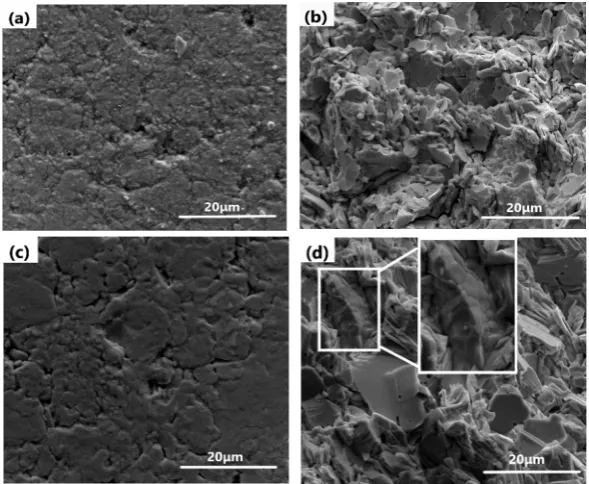
reactors
4
Yan Ma 1,*, Anxia Yang 1, Huiping Zhu 1, Arslan Muhammad 1, Pengwei Yang1, Bokun Huang 1
5
and Fenglei Niu 1
6
1 Key Laboratory of Passive Nuclear Power Safety and Technology, North China Electric Power University,
7
Beijing 102206, P.R. China; [email protected]
8
* Correspondence: [email protected]
9
10
Abstract: In this paper, the effect of Bi2O3 doping on the mechanical properties of PbO ceramic
11
pellets was studied. For this purpose, different ratios of Bi2O3/PbO (i.e., xBi2O3–(1-x)PbO, where x
12
is 0, 1, 3, 5, 7 wt%) were fabricated and sintered at 570, 620, and 670°C. Mechanical properties
13
including density, hardness, flexural strength, and sintering of PbO were studied for the
14
aforementioned compositions. Phase compositions, microstructures, and worn surfaces of the
15
composites were characterized by scanning electron microscopy and X-ray diffraction (XRD). The
16
XRD analysis revealed that a solid solution formed in the composite ceramic. The best suited
17
conditions of temperature and doping of Bi2O3 for optimal sintering are 620°C and 3 wt%,
18
respectively. The hardness of the 3 wt% Bi2O3–97 wt% PbO ceramic was 717 MPa, which is
19
about four times higher than the hardness of pure PbO; in addition, the strength of the composites
20
was 43 MPa, which is two times higher than that of pure PbO. The integrity of the composites was
21
verified using the lead–bismuth eutectic alloy flushing experiment. Results of this research paper
22
are important for future studies of oxygen control in the lead–bismuth eutectic alloy of lead-cooled
23
fast reactors.
24
Keywords: Bi2O3; PbO; sintering temperature; mechanical properties; lead–bismuth eutectic alloy.
25
26
1. Introduction
27
Lead oxide (PbO) ceramic pellets are used in solid-phase oxygen control systems, which are
28
an important constituent of lead-cooled fast reactors (LFRs). In LFRs, the lead–bismuth eutectic (LBE)
29
alloy was chosen as a coolant material [1]. However, LBE can cause severe corrosion of structural
30
materials [2], including pipes and other components. To prevent such corrosion, it is important to
31
consider appropriate protective methods. Studies in the past have shown that oxygen is the most
32
critical element in the corrosion caused by LBE alloys. When oxide layers of a certain thickness get
33
coated on the internal surface of the steel pipes, forming a film of magnetite ferroferric oxide and iron
34
chrome spinel- , it prevents the further penetration of LBEs. The thickness of the oxide
35
layer varies at different levels of oxygen concentration; an oxide layer that is too thick or too thin
36
cannot protect the steel well [3]. Many research studies have shown that solid-phase oxygen control
37
is a promising anti-corrosion method [4]. In this approach, the PbO ceramic pellets are set inside and
38
liquid metal and oxygen ions are released from the ceramic pellets into the liquid metal. The
39
concentration of oxygen ions in the liquid metal can be adjusted by the low rate and temperature of
40
the coolant. To keep the coolant pure and to protect the steel pipe, high-strength PbO ceramic pellets
41
are required, which have fast oxygen concentration regulation and crack resistance during operation.
42
(3 ) 4 [Fe −xCr Ox]
Currently, experiments on solid-phase control systems are being carried out in the LBE test
43
loop CRAFT at SCK•CEN in Mol, Belgium [5], in the Pb–Bi forced convection loop in Ibaraki, Japan
44
[6], and as part of the DEMETRA project by CEA, Saclay in Gif-sur-Yvette, France [7]. Though
45
several studies have been done theoretically and practically on solid-phase control systems, only a
46
few have reported on the mechanical properties and microstructures of PbO. Hence, research on
47
developing sintering techniques of PbO ceramic pellets that will have excellent performance during
48
operation has become a hot topic in this area.
49
Some studies have reported that the PbO ceramic pellets tested in CRAFT loop were cracked in
50
the area of equator during the experiment (Fig. 1). PbO ceramic pellets broken in the loop can result
51
in debris being formed in the coolant, eventually blocking the pipeline in extreme cases [5]. Kondo et
52
al. found that PbO powder was sintered in the form of lumps at 800°C, following which the lumps
53
were mechanically broken into small pieces [6]. The relative density of the PbO ceramic pellets in the
54
above loop was 72.82%. Brissonneau reported that the PbO pellets were generated from PbO powder
55
and water under a force of 45 kN at the pellet for 2 min, and then the pellets were sintered at 620°C
56
for 2h at a slow temperature ramp (2°C•min-1) [7]. The ceramic pellets discussed above are used as
57
PbO pellets in oxygen concentration control experiments, but there is no detailed literature on the
58
properties of PbO ceramic pellets. It can be seen from Fig. 1 that the PbO ceramic pellets used in the
59
experiment were not high in strength and could be easily cracked along the equatorial plane because
60
of their spherical shape.
61
We have enhanced our scope of research to improve the mechanical properties and avoid the
62
cracking of PbO ceramic pellets in the LBE alloy. Doping by Pb powder using liquid-phase sintering
63
improved the mechanical properties of the ceramic pellets [8]. The mechanical properties and
64
microstructures of the Pb, PbO, and Pb3O4 ceramic pellets were also studied in detail, and the results
65
showed that the addition of lead powder facilitates sintering and increases the strength of the
66
ceramic. We also used the microwave sintering technique to improve the strength of the PbO ceramic
67
pellets [9]. However, there was no significant improvement in the mechanical properties and the
68
technique resulted in the occurrence of cracks.
69
In this study, Bi2O3 powder as the sintering aid was added to the PbO precursor. Bi2O3 powder
70
was chosen as the sintering agent for two reasons: (1) the raw material of the ceramic pellets will not
71
cause pollute the coolant or make it impure and (2) the diameter of Bi3+ is similar to the diameter of
72
Pb2+ and their chemical properties are very similar, which is beneficial in the sintering process. In this
73
paper, the mechanical properties and microstructures of Bi2O3/PbO with different compositions (i.e.,
74
xBi2O3-(1-x) PbO, where x is 0, 1, 3, 5, 7 wt%) were investigated in terms of their strength, hardness,
75
and scanning electron microscopy (SEM) data to arrive at the optimal value of x and the sintering
76
temperature. Flushing experiments were then performed to verify the integrity of PbO ceramic
77
pellets.
78
79
80
81
Figure 1. PbO ceramic pellets tested in the CRAFT loop and MEXICO loop[5].
2. Materials and Methods
84
The chemical composition of the ceramic was chosen to be xBi2O3–(1-x)PbO (the value of x is 0,
85
1, 3, 5, 7 wt%) for conventional sintering. The initial Bi2O3 and PbO powders (A.R. 99% purity) were
86
purchased from Sinopharm Chemical Reagent Co. Ltd., Beijing, China. The powders were mixed and
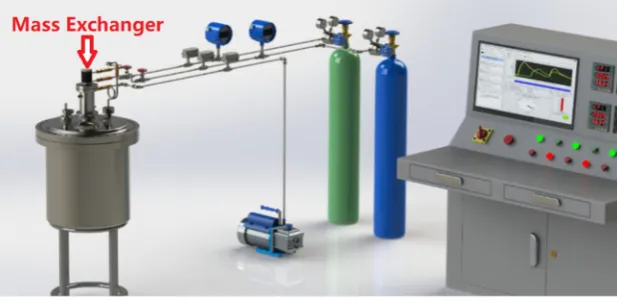
87
ground using a planetary ball mill with 2 wt% deionized water for 24 h. The green compact was
88
fabricated using a cold steel die at a uniaxial pressure of 40 MPa. The rate of pressure during
89
compression and depression was kept controlled below 0.5 MPa/s, in order to reduce the elastic
90
aftereffect and avoid the splitting of the compact. The specimens were then sintered at 570°C, 620°C,
91
and 670°C for 2h at a heating rate of 10°C•min-1, and cooled to room temperature [8].
92
During sintering, the compacts were covered by the PbO powder to further minimize PbO
93
volatilization [10]. It was noticed that the loss of PbO leads to a decrease in density and affects the
94
mechanical properties of PbO ceramic pellets [11]. Disc samples (diameter, 13 mm) and bar samples
95
(4 mm ×3 mm ×35 mm) were fabricated for mechanical property testing. The tablet-like pellets of PbO
96
ceramic pellets (diameter, 6 mm; height, 5 mm) were fabricated to test their integrity using the
97
flushing experiment.
98
Microstructures were observed using a Quanta 200F field emission scanning electron
99
microscope. The crystalline phases were analyzed using a D8 Focus X-ray diffraction with Cu Kα
100
radiation. Hardness was estimated on polished samples by the indentation method using a Micro
101
Vickers Hardness Tester. The indentation test was conducted with a load of 0.98 N held for 15 s. The
102
hardness (Hv) was calculated according to ASTM C1327-15 [12] as below:
103
Hv 1.8544F2 d
= ,
(1)
104
where F is the applied load and d is the mean value of the diagonal length of the indentation. A
105
flexural strength test was conducted by the three-point flexural method (span, 35 mm; crosshead
106
speed, 0.5 mm•min-1) using a WDW-100E computer control electronic universal testing machine. The
107
densities of the specimens were estimated using the Archimedes method by weighing them in air
108
and water. Data were collected for 6–8 samples to obtain an average of results.
109
3. Results
110
3.1 Mechanical properties of Bi2O3-PbO ceramic pellets
111
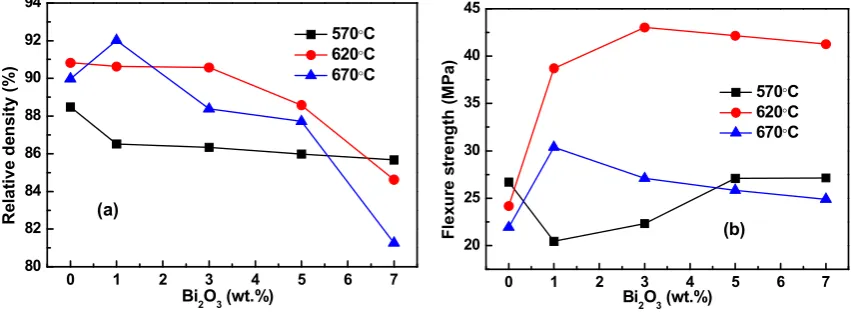
Figure 2(a) shows the relative densities versus sintering temperatures for PbO ceramic pellets as
112
a function of Bi2O3 wt%. The effect of sintering temperature on the density did not show a specific
113
increasing or decreasing trend. The peak value of 92.01% is achieved at 670°C with 1 wt% Bi2O3.
114
Excluding the effects of errors, the best density is achieved at a sintering temperature of 620°C as a
115
whole. From Fig. 2(a), we observe that with the increase in the sintering temperature and the Bi2O3
116
content, the sintering process is prolonged, creating more pores and reducing the relative density of
117
the ceramic pellets.
118
119
0 1 2 3 4 5 6 7
80 82 84 86 88 90 92 94 R el a ti v e d en si ty ( % )
Bi2O3 (wt.%)
570°C 620°C
670°C
(a)
0 1 2 3 4 5 6 7
20 25 30 35 40 45
570°C
620°C 670°C
F lex ur e s tr e n g th ( MP a)
Bi2O3 (wt.%) (b)
Figure 2. (a) Relative density and (b) flexure strength versus sintering temperature for PbO
121
ceramics with different Bi2O3 wt.%.
122
123
At every sintering temperature, the relative density of the ceramic pellets decreases with the
124
increase in the Bi2O3 content. At a sintering temperature of 620°C and an optimum doping value of 3
125
wt% Bi2O3, a high relative density of 90.57% is achieved. Kondo and Takahashi [6] found that the
126
relative density is 72.82% for pure PbO ceramic pellets sintered at 800°C, which is lower than that
127
found in this study. The results indicate that doping by a small amount of Bi2O3 significantly
128
improved the density of PbO ceramic pellets.
129
Figure 2(b) shows the graph of flexural strength with content of Bi2O3 wt% at different sintering
130
temperatures for PbO ceramic pellets. The effect of sintering temperature on the flexural strength is
131
very prominent and changes significantly with changing temperature. The flexural strength of the
132
PbO ceramic pellets sintered at 620°C is much higher than that of the samples sintered at 570°C and
133
670°C.
134
It is well known that pure PbO ceramic pellets are not tough enough to flush in LBE [5]. After
135
doping with 1 wt% Bi2O3 at 620°C, the flexural strength of the PbO ceramic pellets increased by 75%.
136
It reached the peak value of 43 MPa at 3 wt% Bi2O3 and then tended to decrease slightly with further
137
increase in the Bi2O3 content. At 570°C, the strength of the ceramic pellets decreased abruptly when
138
the Bi2O3 increased to 1 wt%, but as the Bi2O3 content continued to increase, the strength also
139
increased and attained a constant value of flexural strength. However, the strength at 670°C was just
140
the opposite. It increased linearly at 1 wt% Bi2O3 and then started to decrease and continued to
141
decrease. The relationship between strength and porosity is defined by the Griffith equation [13] as
142
shown below:
143
, (2)
144
145
, (3)
146
147
where P0and n are constants, P is the porosity, Y is the shape factor, and c0 is the initial crack
148
length. Thus, it may be concluded that the strength of the sample is inversely proportional to its
149
porosity and directly proportional to its density. The strength of the material is also inversely
150
proportional to its grain size according to the Hall–Petch equation [14] as shown below:
151
1 2
f 0 kd
σ
=σ
+ − ,(4)
152
where k is a constant, σ0 is the strength of the infinite single crystal, and d is the grain size. The
153
porosity becomes a dominant factor in decreasing the strength when the Bi2O3 content is increased
154
from 3 to 7 wt% at 620°C or at a higher sintering temperature of 670°C, which was consistent with
155
the results shown in Fig. 2(a).
156
157
0 0
( )
1
3(1 )
P P c c
P
−
= − −
158
Figure 3. Hardness versus sintering temperature of PbO ceramic pellets
159
with different wt% of Bi2O3.
160
161
The hardness of the PbO ceramic pellets at different wt% of Bi2O3 as a function of temperature
162
is plotted in Fig. 3. It is obvious that the hardness of Bi2O3–PbO sintered at 620°C is higher than that
163
at temperatures 570°C and 670°C. At 620°C, the change in hardness is very steep, which increases
164
gradually until the content of Bi2O3 is 3 wt%. After reaching its peak, the hardness starts to decline.
165
The optimum hardness of 717 MPa was achieved with 3 wt% Bi2O3 at temperature 620°C, which is
166
about four times higher than that of pure PbO.
167
3.2 Flushing test
168
Suitable fabricated samples were obtained with a composition of 3 wt% Bi2O3–97 wt% PbO,
169
sintered at 620°C. They were then tested in an experimental apparatus for a solid-phase oxygen
170
control system at Beijing Key Laboratory of Passive Safety Technology for Nuclear Energy of North
171
China Electric Power University (Fig. 4).
172
173
174
175
Figure 4. The experiment bench of the oxygen control system.
176
177
In the flushing experiment, 135 ceramic samples of 3 wt% Bi2O3–97 wt% PbO were placed in the
178
middle of the mass exchanger. LBE flowed through the PbO ceramic pellets at a speed of 110 L/h for
179
100 h. The flushing test was carried out at 450℃ and the oxygen concentration is 3.14×10⁻⁴ wt%.
180
Figure 5 shows the images of the PbO pellets before and after testing. None of the ceramic pellets
181
cracked, which indicated that the strength of the 3 wt% Bi2O3–97 wt% PbO ceramic pellets sintered at
182
620°C is promising to meet the needs of engineering strength requirements.
183
0 1 2 3 4 5 6 7
100 200 300 400 500 600 700 800
570°C
620°C
670°C
Bi2O3 (wt.%)
Har
d
n
e
ss
(
M
P
184
Figure 5. The 3 wt% Bi2O3–97 wt% PbO pellets before and after the flushing experiment.
185
4. Discussion
186
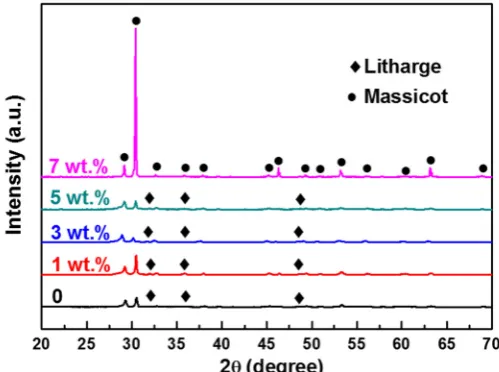
To understand the toughness mechanisms of doping Bi2O3, XRD was used to get the patterns of
187
the PbO ceramic pellets sintered at 620°C with different wt% of Bi2O3 (Fig. 6). The formation of
188
massicot (PbO, PDF No. 72-0094) was identified as the main crystalline phase, with a small amount
189
of litharge (PbO, PDF No.85-0711). The litharge phase disappeared when the doping was done with
190
more than 5 wt% Bi2O3 and the intensity of massicot peaks became stronger. The crystals in the
191
massicot phase were orthogonal (a=5.489, b=4.775, c=5.891) and those in the litharge phase were
192
tetragonal (a=3.973, b=3.973, c=5.022). They are two forms of PbO in nature, and the phase transition
193
temperature is 500℃. The addition of aid promotes the phase transition process, so at high aid
194
content, the main component is massicot. Lead bismuth oxide and Bi2O3 phases were not detected in
195
the XRD patterns for the fabricated samples.
196
Figure 6 indicates that the peaks of the PbO phase are shifted to a large angle, which is attributed
197
to the formation of a solid solution between Bi2O3 and PbO. The radius of Bi3+ (1.03 Å) is smaller than
198
that of Pb2+ (1.19 Å). When Bi3+ ions are substituted with Pb2+ ions, there is a lattice distortion and the
199
resistance to dislocation increases. Therefore, the enhancement of mechanical properties is due to the
200
strengthening of the solid solution of Bi3+ ions.
201
202
Figure 6. XRD patterns of PbO ceramic pellets sintered at 620°C with different wt% of Bi2O3.
203
204
Figure 7 (a)–(j) shows the SEM micrographs and fracture images of PbO ceramic pellets sintered
205
at 620°C with different wt% of Bi2O3. First, with the addition of Bi2O3, the grain size of PbO ceramic
206
pellets increases as compared with the pure PbO ceramic pellets. The grain boundaries cannot be
207
seen clearly, which indicates that the sample is at the initial stage of sintering and metallurgical
208
When doping is done with 1 wt% Bi2O3, the crystals are observed to start growing (Fig. 7(d),
210
indicated by frame). When the Bi2O3 content increases to 3 wt%, grains are seen to aggregate to form
211
with distinct grain boundaries (Fig. 7(e)). When the Bi2O3 content continues to increase, the solid
212
solution is formed, wherein the solute ions Bi3+ replace the host ions Pb2+, resulting in the formation
213
of positive ion vacancies, which is beneficial to the sintering process and metallurgical binding
214
[15,16].
215
Based on the results shown in Fig. 2, xBi2O3-(1-x) PbO (x being 0–3 wt%) can be considered to
216
have the same relative density of ~90.6%. Thus, doping of Bi2O3 intensifies the sintering process by
217
grain growth at 620°C as the amount of Bi2O3 is increased from 0 to 3 wt%. There is almost no change
218
in the size of the grains for 3–7 wt% Bi2O3 ceramic pellets as observed by SEM (Fig. 7(e)–(j)). According
219
to Eqs. (2) and (3), it is seen that the effect of porosity on the performance of ceramic pellets is
220
dominant. It can be seen from Fig. 7(i) that pores are wrapped in grains, indicating that the grain
221
boundaries move rapidly with 7 wt% Bi2O3 at 620°C, which leads to a decline in its mechanical
222
properties. In addition, it can be seen from Fig. 2 that the density of Bi2O3–PbO ceramic pellets drops
223
sharply when the Bi2O3 content exceeds 3 wt%, with almost the same grain size.
224
Figure 8 presents the SEM micrographs and fracture images of 3 wt% Bi2O3–97 wt% PbO sintered
225
at 570°C and 670°C. Also, obvious powder agglomeration is observed in Fig. 8(a) and (b), indicating
226
that sintering is not complete at this low temperature (570°C). Thus, grain growth plays a leading
227
role in enhancing hardness and flexural strength at lower temperature (570°C). However, at 670°C,
228
microcracks are observed on the surface of 3 wt% Bi2O3–97 wt% PbO ceramic pellets (Fig. 8(c)). They
229
are apt to appear at the interface of two ceramic grains and readily propagate through the grains,
230
which causes their hardness and strength to be lower than those of the ceramic pellets at 620°C. Thus,
231
the optimum sintering temperature and doping amount of Bi2O3 for Bi2O3–PbO ceramic pellets are
232
determined to be 620°C and 3 wt%, respectively.
233
234
235
237
238
239
Figure 7. SEM micrograph and fracture images of PbO ceramic pellets sintered at 620°C with
240
different Bi2O3 content (a, b) 0 wt%, (c, d) 1 wt%, (e, f) 3 wt%, (g, h) 5 wt%, (i, j) 7 wt%.
241
242
243
244
sintered at (a, b) 570°C, and (c, d) 670°C.
246
5. Conclusions
247
In this paper, the effects of doping of Bi2O3 and sintering temperatures on the mechanical
248
properties of PbO ceramic pellets were investigated. It was found that doping with a moderate
249
amount of Bi2O3 could significantly enhance the mechanical properties of PbO ceramic pellets. The
250
enhancement is attributed to the formation of solid solution of Bi3+ ions. The optimal sintering
251
temperature and doping amount of Bi2O3 are 620°C and 3 wt%, respectively, for PbO. The hardness
252
increased four times and the strength increased two times as compared with pure PbO. The ceramic
253
pellets showed good performance in the LBE flushing experiment.
254
6. Patents
255
The method of bismuth oxide reinforced lead oxide ceramics introduced in this paper has been
256
applied to China Patent Office for an invention paten.
257
258
Author Contributions: Conceptualization, Yan Ma; Funding acquisition, Huiping Zhu; Investigation, Anxia
259
Yang; Methodology, Yan Ma and Anxia Yang; Project administration, Fenglei Niu; Writing – original draft, Yan
260
Ma and Anxia Yang; Writing – review & editing, Yan Ma, Anxia Yang, Huiping Zhu, Arslan Muhammad,
261
Pengwei Yang and Bokun Huang.
262
Funding: This research was funded by the National Natural Science Foundation of China (Grant No. 11705059,
263
11635005, 11705058), the Beijing Natural Science Foundation (Grant No. 2162040, 1192016) and the Fundamental
264
Research Funds for the Central Universities (Grant Nos.2018ZD10).
265
Acknowledgments: The support of Science and Technology on Reactor System Design Technology Laboratory
266
is also grateful.
267
Conflicts of Interest: The authors declare no conflict of interest.
268
References
269
1. B. F. Gromov; Yu. S. Belomitcev. Use of lead-bismuth coolant in nuclear reactors and accelerator-driven
270
systems. Nucl. Eng. Des.1997, 173, 207-217. 10.1016/S0029-5493(97)00110-6.
271
2. J. Zhang; N. Li. Review of the studies on fundamental issues in LBE corrosion. J. Nucl. Mater.2008, 373,
351-272
377. 10.1016/j.jnucmat.2007.06.019.
273
3. OECD. Handbook on Lead–bismuth Eutectic Alloy and Lead Properties, Materials Compatibility,
Thermal-274
hydraulics and Technologies. http://www.oecd-nea.org/science/reports/2007/nea6195-handbook.html.
275
4. P. N. Martinov; R. S. Askhadullin; A. A. Simakov. Designing mass exchangers for control of oxygen content
276
in Pb-Bi (Pb) coolants in various research facilities. International Conference on Nuclear Engineering 2009,
277
1, 555-561. 10.1115/ICONE17-75506.
278
5. Marino A.; Lim J. l. A mass transfer correlation for packed bed of lead oxide spheres in flowing lead
279
bismuth eutectic at high Péclet numbers. Int. J. Heat Mass Tran. 2015, 80, 737-747.
280
10.1016/j.ijheatmasstransfer.2014.09.079.
281
6. M. Kondo; M. Takahashi. Study on control of oxygen concentration in lead–bismuth flow using lead oxide
282
particles. J. Nucl. Mater.2006,357, 97-104. 10.1016/j.jnucmat.2006.05.051.
283
7. L. Brissonneau; F. Beauchamp. Oxygen control systems and impurity purification in LBE: Learning from
284
DEMETRA project. J. Nucl. Mater.2011, 415, 348-360. 10.1016/j.jnucmat.2011.04.040.
285
8. S. Y. Zhang. Sintering and performance of lead oxide ceramics used for solid phase oxygen control system
286
in LBE (in Chinese). Dissertation for Master Degree. North China Electric Power University, Beijing, China,
287
2016.
288
9. Y. Ma; S. Y. Zhang. Sintering behavior of lead oxide ceramic prepared by microwave sintering. Adv. Mater.
289
Res. 2014, 941-944, 525-528. 10.4028/www.scientific.net/AMR.941-944.525.
290
10. M. Venkata Ramana; S. Roopas Kiran. Investigation and characterization of Pb(Zr0.52Ti0.48)O3
291
nanocrystalline ferroelectric ceramics: By conventional and microwave sintering methods. Mater. Chem.
292
Phys. 2011, 126, 295-300. 10.1016/j.matchemphys.2010.11.023.
11. A. I. Kingon; J. B. Clark. Sintering of PZT Ceramics: I, atmosphere control, II, effect of PbO content on
294
densification kinetics. J. Amer. Cera. Soc.1983, 66, 253-256. 10.1111/j.1151-2916.1983.tb15709.x.
295
12. ASTM C1327-15, Standard Test Method for Vickers Indentation Hardness of Advanced Ceramics. ASTM
296
International, West Conshohocken, PA, 2015, www.astm.org.
297
13. O. Thomas; Z. Alexander. Evolution of young’s modulus, strength, and microstructure during liquid-phase
298
sintering. J. Amer. Cera. Soc.1998, 81, 195-200. 10.1111/j.1151-2916.1998.tb02557.x.
299
14. T. Y. Liu; Y. M. Li. Effect of Pr inoculation and crystal size on the Hall-Petch relationship for
Al-300
30 wt%Mg2Si composites. Mater. Lett.2018, 214, 6-9. 10.1016/j.matlet.2017.11.105.
301
15. S. G. Guo. Powder Sintering Theory (in Chinese), 1st ed. Metallurgical Industry Press: Beijing, China, 1998;
302
pp.292-295.
303
16. N. Liu; Y. D. Xu. Influence of molybdenum addition on the microstructure and mechanical properties of
304
TiC-based cermets with nano-TiN modification. Ceram. Int. 2003, 29, 919-925.
10.1016/S0272-305
8842(03)00046-4.
![Figure 1. PbO ceramic pellets tested in the CRAFT loop and MEXICO loop [5].](https://thumb-us.123doks.com/thumbv2/123dok_us/7929619.1316682/2.595.223.392.572.726/figure-pbo-ceramic-pellets-tested-craft-loop-mexico.webp)