A Study of Facial Expression Reorganization and
Local Binary Patterns
Poonam Verma#1, Deepshikha Rathore*2 #1
MTech Scholar,Sanghvi Innovative Academy Indore *2
Asst.Professor,Sanghvi Innovative Academy Indore
Abstract— Facial Expressions are the results of the action taken through face with respect to conversations. Face muscles are also another way to express the content of conversations. They can help to explain emotion and express the thought of mind. It can consider as the sign of body language to express and represent content through body parts. This way can be better way communication and thought exchange. There is a considerable history associated with the study on facial expressions.
In this paper, work presents recent work done on facial expressions and supportive LBP Algorithm. Especially variants of principal component analysis are investigated for facial representation. Finally, the current status, open problems, and research directions are discussed. This study investigated whether facial expressions can be accurately identified using face region only, how much recognition is impaired relative to the facial parts, and what mechanisms account for the recognition advantage of some expressions. In most of the prior studies, the facial parts were used but there significance in recognition respective of facial expression was not shown.
1. INTRODUCTION
Facial Expressions are the outcome of the moments done through face muscles with respect in the changes on face. These expressions may represent the person’s internal emotional stage as well as thought in a body language manner. Body language is the hidden sign of expression which not only represent the thinking of the person but also help to judge the person. It helps for better communication and thought exchange. There is a considerable history associated with the study on facial expressions.
For illustration, we show some examples of facial expressions in Figure 1.1.
Figure 1.1: Facial Expressions of Barak Obama
Computer recognition of facial expressions has many important applications in intelligent human-computer interaction, awareness systems, surveillance and security, medical diagnosis, law enforcement, automated tutoring systems and many more.
In this work, we present our recent work on recognizing facial expressions using discriminative local
statistical features. Especially variants of principal component analysis are investigated for facial representation. Finally, the current status, open problems, and research directions are discussed. This study investigated whether facial expressions can be accurately identified using face region only, how much recognition is impaired relative to the facial parts, and what mechanisms account for the recognition advantage of some expressions. In most of the prior studies, the facial parts were used but there significance in recognition respective of facial expression was not shown.
Facial expressions can be described at different levels. Two mainstream description methods are facial affect (emotion) and facial muscle action (action unit). Psychologists suggest that some basic emotions are universally displayed and recognized from facial expressions , and the most commonly used descriptors are the six basic emotions, which includes anger, disgust, fear, joy, surprise, and sadness. This is also reflected by the research on automatic facial expression analysis; most facial expression analysis systems developed so far target facial affect analysis, and attempt to recognize a set of prototypic emotions.
However, little is known about facial expression processing in the visual aspect based on facial parts. Facial-expression recognition has been active research fields for several years. Several attempts have been made to improve the reliability of these recognition systems. One highly successful approach is based on Principal Component Analysis (PCA), proposed by Matthew Turk and Alex Pentland proposed in 1991. Since then, researchers have been investigating PCA and using it as a basis for developing successful techniques for facial-expression recognition.
watch emotion eliciting videos but are aware that they are being recorded) can be built fairly easily.
One of the best efforts in recent years in this direction is the creation of the MMI database. Along with posed expressions, spontaneous expressions have also been included. Furthermore, the DB is web-based, searchable and downloadable. Many of the systems still require manual intervention. For the purpose of tracking the face, many systems require facial points to be manually located on the first frame. The challenge is to make the system fully automatic. In recent years, there have been advances in building fully automatic face expression recognizers.
Applications
1. Applications in Robotics
2. Applications in Ambient Intelligence
3. Evaluating Truthfulness and Detecting Deception
2. RELATED WORK
Hamimah Ujir et. al. worked on 3D modular morphable model (3DMMM) is introduced to deal with facial expression recognition. The 3D Morphable Model (3DMM) contains 3D shape and 2D texture information of faces extracted using conventional Principal Component Analysis (PCA). In this work, modular PCA approach is used. A face is divided into six modules according to different facial features which are categorized based on Facial Animation Parameters (FAP). Each region will be treated separately in the PCA analysis. Their work is about recognizing the six basic facial expressions, provided that the properties of a facial expression are satisfied. Given a 2D image of a subject with facial expression, a matched 3D model for the image is found by fitting them to our 3D MMM. The fitting is done according to the modules; it will be in order of the importance modules in facial expression recognition (FER). Each module is assigned a weighting factor based on their position in priority list. The modules are combined and we can recognize the facial expression by measuring the similarity (mean square error) between input image and the reconstructed 3D face model [25].
There is evidence that specific regions of the face such as the eyes are particularly relevant for the decoding of emotional expressions, but it has not been examined whether scan paths of observers vary for facial expressions with different emotional content. In this study, eye-tracking was used to monitor scanning behaviour of healthy participants while looking at different facial expressions. Locations of fixations and their durations were recorded, and a dominance ratio (i.e., eyes and mouth relative to the rest of the face) was calculated. Across all emotional expressions, initial fixations were most frequently directed to either the eyes or the mouth. Especially in sad facial expressions, participants more frequently issued the initial fixation to the eyes compared with all other expressions.
In happy facial expressions, participants fixated the mouth region for a longer time across all trials. For fearful and neutral facial expressions, the dominance ratio indicated that both the eyes and mouth are equally important. However, in sad and angry facial expressions, the eyes received more attention than the mouth. These results confirm the relevance of the eyes and mouth in
emotional decoding, but they also demonstrate that not all facial expressions with different emotional content are decoded equally. Our data suggest that people look at regions that are most characteristic for each emotion [26].
There are several studies done on how to increase the recognition rate under different conditions of lighting, shading, profiling, and orientation. Many of them show that pre-processing by extracting features the original data images has a strong impact on the obtained accuracy. Principal Component Analysis (PCA) is an efficient method to accomplish this task. Linear Discriminant Analysis (LDA) is a handy technique that is based on linearity; however it depends strongly on the first stage related to the trained data. It is suggested therefore by (Wang et al) to combine both methods in order to reach higher accuracy. PCA is also suitable for pre-processing images data for facial expression detection. This is successfully used in the Face Reader model for detecting common universal face expressions, with which the overall accuracy was 89% [27].
Vaibhavkumar J. Mistry, By observing various techniques such as PCA, LDA, Gabor Filter, Local Binary pattern, LEM, Neural Network, ICA, and SVM with the help of appropriate Datasets to detect Human Facial expression and recognize them on the basis of accuracy and computational time. But some of them contain drawbacks in term of recognition rate or timing. The most accurate recognition rate can be achieved though combination of two or more technique, extract features as per our requirements and final comparison will be performed to evaluate the results. The success of methods depends on pre-processing on the images because of illumination and feature extraction [28].
This paper has briefly overviewed automatic expression recognition.Similar architectures
and processing techniques
are often used for facial expression recognition and fac e recognition, despite the duality that exists between th ese recognition tasks. 2-D monochrome facial image sequences are the most p opular type of pictures used for automatic expression r ecognition. Although a variety of face detection techniques have been developed, robust detection and location of faces or their constituents is difficult to att ain in many cases. Features for automatic expression recognition aim to capture static or dynamic facial information specific to individual expressions. Geometric, kinetic, and statistical- or spectral-transform-based features are often used as alternative representation of the facial expression prior to classification.
A wide range of classifiers, covering parametric as well as non-parametric techniques, has been applied to automatic expressionrecognition.Generally speaking, automatic exp ression recognition is a difficult task, which is afflicted
by the usual difficulties faced in pattern recognition and computer vision resear
the expense of constraining the imaging conditions, in many cases. Unresolved
research issues are encapsulated in the challenge of achieving optimal pre-processing, feature extraction or selection, and classification, under conditions of data variability. Sensitivity of automatic expression recognition to data variability is one of the key factors that have curtailed the spread of expression recognisers in the real world. However, few studies have systematically investigated robustness of automatic expression recognition under adverse conditions [29].
3. LOCAL BINARY PATTERNS
This section talks about the method which has been considered in our experiments.
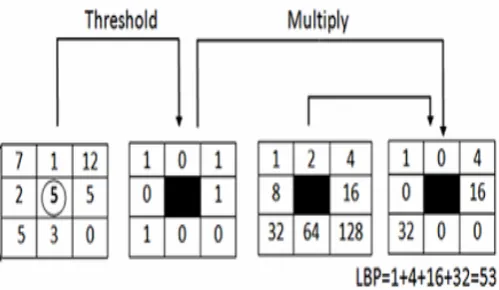
The original LBP operator, introduced by Ojala, is a powerful method of texture description. Figure 2.1 is showing how LBP code is calculated in a 3×3 neighborhood which contains total 9 gray values. For all pixels in an image, a binary code is produced by comparing its neighborhood with the value of the pixel. As shown in Figure 2.1, pixels encircling the central pixel are labeled 1 if their values are greater than or equal to the value of the central pixel; 0, otherwise. The LBP binary code of the centre pixel is composed of those labels anticlockwise. Finally, the local binary pattern for centre pixel is obtained by converting the binary code into a decimal one.
The local binary pattern (LBP) operator is defined as a gray-scale invariant texture measure, derived from a general definition of texture in a local neighborhood. Through its recent extensions, the LBP operator has been made into a really powerful measure of image texture, showing excellent results in many empirical studies. The LBP operator can be seen as a unifying approach to the traditionally divergent statistical and structural models of texture analysis. Perhaps the most important property of the LBP operator in real-world applications is its invariance against monotonic gray level changes. Another equally important is its computational simplicity, which makes it possible to analyze images in challenging real-time settings [12]. The LBP method and its variants have already been used in a large number of applications all over the world.
The recent emergence of Local Binary Patterns (LBP) has led to significant progress in applying texture methods to various computer vision problems and applications. The focus of this research has broadened from 2D textures to 3D textures and spatiotemporal (dynamic) textures. Also, where texture was once utilized for applications such as remote sensing, industrial inspection and biomedical image analysis, the introduction of LBP-based approaches have provided outstanding results in problems relating to face and activity analysis, with future scope for face and facial expression recognition, biometrics, visual surveillance and video analysis [13]. Computer Vision Using Local Binary Patterns provides a detailed description of the LBP methods and their variants both in spatial and spatiotemporal domains.
This comprehensive reference also provides an excellent overview as to how texture methods can be utilized for solving different kinds of computer vision and
image analysis problems. Source codes of the basic LBP algorithms, demonstrations, some databases and a comprehensive LBP bibliography can be found from an accompanying web site. Topics include: local binary patterns and their variants in spatial and spatiotemporal domains, texture classification and segmentation, description of interest regions, applications in image retrieval and 3D recognition - Recognition and segmentation of dynamic textures, background subtraction, recognition of actions, face analysis using still images and image sequences, visual speech recognition and LBP in various applications. Professional engineers and graduate students in computer vision, image analysis and pattern recognition.
The local binary pattern operator is an image operator which transforms an image into an array or image of integer labels describing small-scale appearance of the image. These labels or their statistics, most commonly the histogram, are then used for further image analysis. The most widely used versions of the operator are designed for monochrome still images but it has been extended also for color (multi channel) images as well as videos and volumetric data [14].
The basic local binary pattern operator, introduced by Ojala et al. [15], was based on the assumption that texture has locally two complementary aspects, a pattern and its strength. In that work, the LBP was proposed as a two-level version of the texture unit to describe the local textural patterns [16]. The original version of the local binary pattern operator works in a 3 × 3 pixel block of an image. The pixels in this block are thresholded by its center pixel value, multiplied by powers of two and then summed to obtain a label for the center pixel. As the neighborhood consists of 8 pixels, a total of 28 = 256 different labels can be obtained depending on the relative gray values of the center and the pixels in the neighborhood. See Figure for an illustration of the basic LBP operator. An example of an LBP image and histogram are shown in Figure 2.1.
3.1 Derivation of the Generic LBP Operator
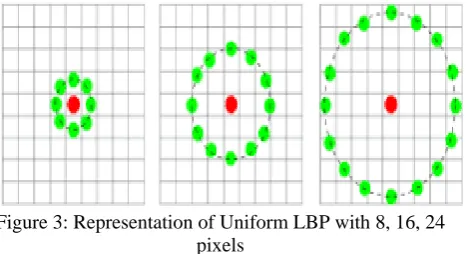
Several years after its original publication, the local binary pattern operator was presented in a more generic revised form by Ojala et al. [17]. In contrast to the basic LBP using 8 pixels in a 3 × 3 pixel block.
Figure 3: Representation of Uniform LBP with 8, 16, 24 pixels
The success of LBP methods in various computer vision problems and applications has inspired much new research on different variants. Due to its flexibility the LBP method can be easily modified to make it suitable for the needs of different types of problems. The basic LBP has also some problems that need to be addressed. Therefore, several extensions and modifications of LBP have been proposed with an aim to increase its robustness and discriminative power. In this section different variants are divided into such categories that describe their roles in feature extraction. Some of the variants could belong to more than one category, but in such cases only the most obvious category was chosen The choice of a proper method for a given application depends on many factors, such as the discriminative power, computational efficiency, robustness to illumination and other variations, and the imaging system used.
4. PROBLEM DOMAIN
The face expression research community is shifting its focus to the recognition of spontaneous expressions. As discussed earlier, the major challenge that the researchers face is the non-availability of spontaneous expression data. Capturing spontaneous expressions on images and video is one of the biggest challenges. If the subjects become aware of the recording and data capture process, their expressions immediately loses its authenticity [6]. To overcome this they used a hidden camera to record the subject’s expressions and later asked for their consents. Although building a truly authentic expression database (one where the subjects are not aware of the fact that their expressions are being recorded) is extremely challenging, a semi-authentic expression database (one where the subjects watch emotion eliciting videos but are aware that they are being recorded) can be built fairly easily.
One of the best efforts in recent years in this direction is the creation of the MMI database. Along with posed expressions, spontaneous expressions have also been included. Furthermore, the DB is web-based, searchable and downloadable. Many of the systems still require manual intervention. For the purpose of tracking the face, many systems require facial points to be manually located on the first frame. The challenge is to make the system fully automatic. In recent years, there have been advances in building fully automatic face expression recognizers.
Efficiency of Feature Extraction Algorithm
Firstly, because the difference between the facial expressions that characterize emotion is small, it requires
an algorithm to extract features that are very sensitive to any change in the facial images. In contrast, it is a problem at training stage that will affect negatively on the system and if it has extracted useless features. Therefore, the pre-processing applied on dataset is a very important stage since it serves to unify the characteristics of images and removes noise.
Secondly, the extracted feature algorithm that is focused to improve and utilized in this project is a principal component analysis (PCA). This algorithm is required to analyze the data set together, which means that the image will not be analyzed and it will not extract its features individually because of the strength of (PCA) that lays the ground for how to extract a feature based on comparing all data sets together to identify the important data. Thus, it is necessary to choose the experimental data set carefully not just for the training stage but also for extracting the feature required for testing the data set. Furthermore, it also means that it cannot extract the feature for one testing image individually; one has to compare the testing results and apply the PCA algorithm to the data set and the testing image to extract its features.
The complete study observe that there is big gap between desire and available. Work requires reducing detection time and looking out to develop a solution to improve facial expression detection during automatic reorganization.
5. CONCLUSION:
The complete study concludes that; To maintain the equilibrium in selecting useful information and reducing unwanted information or less important face regions, we have further applied Adaboost method to get the most important information from a face image i.e. the central region of the face composed of Eyes, Nose and Mouth. To derive the significance of facial parts we have used the most important parts of face as module of M2PCA. It is not only four parts of face image but these are four identification pillars which are Left and Right Eye, Nose and Mouth. Moreover, few expressions seem to be a difficult to correctly classify. This mainly results from the fact that the performance of expressions varies among subjects. The experiments demonstrate that which facial part plays important role in classification of particular expression. For example, angry expression can be recognized correctly with help of two facial parts i.e. Eyes and Mouth .In same manner we identified the facial parts which have significance in recognition of expressions. The complete work will be simulated and evaluated by MATLAB.
REFERENCES:
1. Caifeng Shan and Ralph Braspenning, “Recognizing Facial Expressions Automatically From Video”, published in Handbook of Ambient Intelligence and Smart Environments 2010, pp 479-509.
3. Maja Pantic and Leon J. M. Rothkrantz, “Facial Action Recognition for Facial Expression Analysis from Static Face Images”, IEEE Transactions on Systems, Man, and Cybernetics - Part B: Cybernetics, Volume 34, no. 3, June 2004
4. Nita M. Thakare and V. M. Thakare, “Modular PCA Based Fuzzy Neural Network Approach for Illumination and Expression invariant 3D Face recognition”, published in International Journal of Scientific & Engineering Research Volume 3, Issue 5, 2012
5. José Francisco Pereira, ”Modular Image Principal Component Analysis for Handwritten Digits Recognition”, in proceedings of the Seventeenth International Conference on Systems, Signals and Image Processing , 2010, pp 356-359.
6. Ambika. D, Arathy. B and Srinivasa Perumal. R, “Comparison of PCA and MPCA with Different Databases for Face Recognition”, published in International Journal of Computer Applications, Volume 43, no. 17, 2012
7. Hamimah Ujir and Michael Spann, “Facial Expression Recognition Using FAPs-Based 3DMMM”, published in Topics in Medical Imaging and Computer Vision, Springer, Volume 243, 2013, pp 33-41.
8. Hedwig Eisenbarth, “Happy Mouth and Sad Eyes Scanning Emotional Facial Expressions”, published in American Psychological Association, Volume 11, 2011, no. 4, pp 860-865. 9. Hamimah Ujir and Michael Spann, “Facial Expression Recognition
Using FAPs-Based 3DMMM”, published in Topics in Medical Imaging and Computer Vision, Springer, Volume 243, 2013, pp 33-41.
10. Hedwig Eisenbarth, “Happy Mouth and Sad Eyes Scanning Emotional Facial Expressions”, published in American Psychological Association, Volume 11, 2011, no. 4, pp 860-865. 11. Hassnae Belkasim, ”A survey of Pattern Recognition algorithms and
the link with facial expression detection”, published in Business Mathematics and Informatics Paper, VU University Amsterdam ,October 2012.
12. Vaibhavkumar J. Mistry and Mahesh M. Goyani, “A literature survey on Facial Expression Recognition using Global Features”, published in International Journal of Engineering and Advanced Technology, Volume-2, Issue-4, 2013.