DeScript: A Crowdsourced Corpus for the Acquisition of
High-Quality Script Knowledge
Lilian D. A. Wanzare, Alessandra Zarcone, Stefan Thater, Manfred Pinkal
Universität des SaarlandesSaarland, 66123, Germany
[email protected], [email protected], [email protected], [email protected]
Abstract
Scripts are standardized event sequences describing typical everyday activities, which play an important role in the computational mod-eling of cognitive abilities (in particular for natural language processing). We present a large-scale crowdsourced collection of explicit linguistic descriptions of script-specific event sequences (40 scenarios with 100 sequences each). The corpus is enriched with crowd-sourced alignment annotation on a subset of the event descriptions, to be used in future work as seed data for automatic alignment of event descriptions (for example via clustering). The event descriptions to be aligned were chosen among those expected to have the strongest corrective effect on the clustering algorithm. The alignment annotation was evaluated against a gold standard of expert anno-tators. The resulting database of partially-aligned script-event descriptions provides a sound empirical basis for inducing high-quality script knowledge, as well as for any task involving alignment and paraphrase detection of events.
Keywords:scripts, events, crowdsourcing, paraphrase
1.
Introduction
When carrying out everyday activities, having a conver-sation, watching movies or reading novels or newspapers, we make abundant use of script knowledge, that is, knowl-edge of standardized event sequences describing typical everyday activities, such as baking a cakeoreating in a fast food restaurant(Schank and Abelson, 1977; Barr and Feigenbaum, 1981). Script knowledge plays an important role for the computational modeling of cognitive abilities (in particular for natural language processing), but mak-ing this kind of knowledge available for use in modelmak-ing is not easy. On the one hand, the manual creation of wide-coverage knowledge bases is infeasible, due to the size and complexity of relevant script knowledge. On the other hand, texts typically refer only to certain steps in a script and leave a large part of this knowledge implicit, relying on the reader’s ability to infer the full script in detail. Thus, extraction of script knowledge from large text corpora (as done by Chambers and Jurafsky (2009)) is difficult and the outcome can be noisy.
In this work, we present a large-scale crowdsourced col-lection and annotation of explicit linguistic descriptions of event patterns, to be used for the automatic acquisi-tion of high-quality script knowledge. This work is part of a larger research effort where we seek to provide a solid empirical basis for high-quality script modeling by inducing script structure from crowdsourced descriptions of typical events, and to investigate methods of text-to-script mapping, using naturalistic texts from crowdsourced stories, which describe real-life experiences and instanti-ate the same scripts (Modi et al., 2016). Predecessors of our work are the OMICS and SMILE corpora (Singh et al., 2002; Regneri et al., 2010), containing multiple event-sequence descriptions (ESDs) for specific activity types or scenarios.
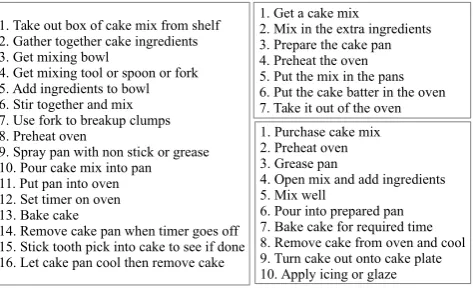
Figure 1 shows some example ESDs for the BAKING A CAKE scenario. As can be seen from the examples, the linguistic descriptions of the same event are different, but
1. Get a cake mix
2. Mix in the extra ingredients 3. Prepare the cake pan 4. Preheat the oven 5. Put the mix in the pans 6. Put the cake batter in the oven 7. Take it out of the oven 1. Purchase cake mix 2. Preheat oven 3. Grease pan
4. Open mix and add ingredients 5. Mix well
6. Pour into prepared pan 7. Bake cake for required time 8. Remove cake from oven and cool 9. Turn cake out onto cake plate 10. Apply icing or glaze 1. Take out box of cake mix from shelf
2. Gather together cake ingredients 3. Get mixing bowl
4. Get mixing tool or spoon or fork 5. Add ingredients to bowl 6. Stir together and mix 7. Use fork to breakup clumps 8. Preheat oven
9. Spray pan with non stick or grease 10. Pour cake mix into pan 11. Put pan into oven 12. Set timer on oven 13. Bake cake
[image:1.595.315.552.322.466.2]14. Remove cake pan when timer goes off 15. Stick tooth pick into cake to see if done 16. Let cake pan cool then remove cake
Figure 1: Example Event Sequence Descriptions (ESDs).
semantically similar (e.g. mixing: stir together and mix, mix in the extra ingredients,mix well). Also, semantically similar event descriptions tend to occur in relatively similar positions in the ESDs.
The extraction of structured script information from these descriptions can be viewed as the task of grouping event descriptions into paraphrase sets exploiting semantic and positional similarities, then inducing the script structure from the paraphrase sets. Figure 2 shows a possible in-duced script structure for the BAKING A CAKEscenario, with nodes representing events in the scenario linked to paraphrase sets of semantically similar linguistic descrip-tions of the same event.
choose recipe
buy ingred.
add ingred.
prepare ingred.
put cake into oven
get ingred. Choose Recipe
– look up R – find R – get your R
Get Ingredients – take out box of ING
from shelf – gather all ING – get ING
B – bowl, pan O – oven C – cake
ING – cake mix, cake ingredients, flour, sugar, … R – recipe, cake recipe
Buy Ingredients – purchase ING – buy ING – buy proper ING
Put cake in oven – place C into O – put C in O Prepare Ingredients
– stir to combine – mix well
– mix ING together in B – stir ING
[image:2.595.107.485.54.217.2]Add Ingredients – pour ING in B – add ING to B – add ING
Figure 2: Example of an induced script structure for theBAKING A CAKEscenario.
add_ingredients
Add water, sugar, beaten egg and salt one by one,
Whisk after each addition,Add the dry mixture to the wet mixture,
Mix the dry ingredients in one bowl (flour, baking soda, salt, etc), Add ingredients in mixing bowl, get mixing bowl, ...
prepare_ingredients
Mix them together, Open the ingredients, Stir ingredients, Combine and mix all the ingredients as the recipe delegates, Mix ingredients with mixer, ...
buy_ingredients
Buy other ingredients if you do not have at home, Buy cake ingredients, Purchase ingredients, ...
get_ingredients
Gather all ingredients, Set out ingredients, Gather ingredients, gather together cake ingredients such as eggs, butter, ...
put_cake_oven
Put the mix in the pans,Put the cake batter in the oven, Put cake in oven, Put greased pan into preheated stove,
Store any leftovers in the fridge, Cover it and put it on a oven plate Put the prepared oven plate inside oven ...,
choose_recipe
Review desired recipe, Look up a cake recipe, Print out or write down the recipe, Read recipe, ...
Figure 3: Example clusters (event labels are underlined, outliers are in italics).
Script events are temporally ordered by default, but their order can vary. For example, when baking a cake, one canpreheat the oven before or after mixing the ingredi-ents. MSA does not allow for crossing alignments, and thus is not able to model order variation: this leads to an inappropriately fine-grained inventory of event types.
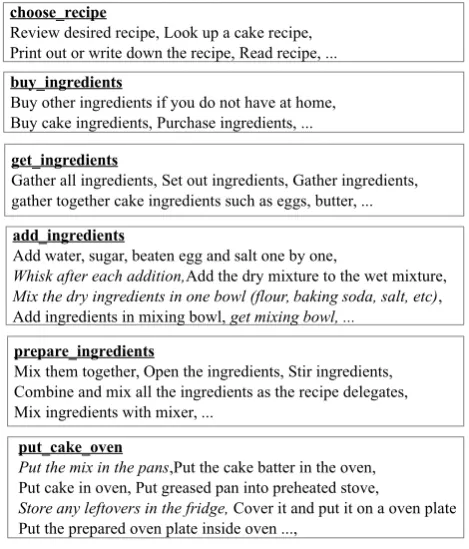
Clustering algorithms using both semantic similarity and positional similarity information provide an alternative way to induce scripts. They can be made sensitive to or-dering information, but do not use it as a hard constraint, and therefore allow for an appropriate treatment of order variation. We have experimented with several clustering algorithms. Figure 3 shows an example output of the best-performing algorithm, Affinity Propagation (AP, Frey and Dueck (2007)). The outcome is quite noisy. For instance, in the last cluster, which mainly consists of descriptions of the “putting cake in oven” event, put the mix in the pans
andstore any leftovers in the fridge clearly are outliers. The noise is to some degree due to the complex nature of script structures in general, but it is also the price one has to pay for a gain in flexibility of event ordering.
Clustering algorithms rely on good estimates of similar-ity among the data points. To appropriately group event descriptions into paraphrase sets, the clustering algorithm would need information on script-specific semantic simi-larity that goes beyond pure semantic simisimi-larity. For in-stance, in theFLYING IN AN AIRPLANEscenario, it is not trivial for any semantical similarity measure to predict that walk up the rampandboard planeare functionally simi-lar with respect to the given scenario. To address this is-sue, we collect partial alignment information that we will use as seed data in future work on semi-supervised clus-tering. The alignment annotations are also suitable for a semi-supervised extension of the event-ordering model of Frermann et al. (2014).
In this work, we have taken measures to provide a sound empirical basis for better-quality script models, by ex-tending existing corpora in two different ways. First, we crowdsourced a corpus of 40 scenarios with 100 ESDs each, thus going beyond the size of previous script collec-tions. Second, we enriched the corpus with partial align-ments of ESDs, done by human annotators. The result is a corpus of partially-aligned generic activity descriptions, theDeScriptcorpus (DescribingScriptStructure). More generally, DeScript is a valuable resource for any task in-volving alignment and paraphrase detection of events. The corpus is publicly available for scientific re-search purposes at this url: http://www.sfb1102. uni-saarland.de/?page_id=2582.
2.
Data Collection
2.1.
ESD Collection
[image:2.595.57.292.254.529.2]Purchase cake mix Preheat oven Grease pan
Carefully follow instructions step by step Open mix and add required ingredients Mix well
Pour into prepared pan Set timer on oven Bake cake for required time Remove cake from oven and cool Turn cake out onto cake plate Apply icing or glaze
No Linking Possible
Take out box of cake mix from shelf
Gather together cake ingredients
Get mixing bowl, or spoon or fork
Add ingredients to bowl
Stir together and mix
Use fork to breakup clumps
Preheat oven
Spray pan with non stick or grease
Pour cake mix into pan
Put pan into oven
Bake cake
Remove cake pan when timer goes off
Stick tooth pick into cake to see if done
Let cake pan cool then remove cake ED-to-ED
ED-to-inbetween
no link
SOURCE ESD
TARGET ESD
(a) Single-target case
Purchase cake mix Preheat oven Grease pan
Carefully follow instructions step by step Open mix and add required ingredients Mix well
Pour into prepared pan Set timer on oven Bake cake for required time Remove cake from oven and cool Turn cake out onto cake plate Apply icing or glaze
No Linking Possible
Take out box of cake mix from shelf
Gather together cake ingredients
Get mixing bowl, or spoon or fork
Add ingredients to bowl
Stir together and mix
Use fork to breakup clumps
Preheat oven
Spray pan with non stick or grease
Pour cake mix into pan
Put pan into oven
Bake cake
Remove cake pan when timer goes off
Stick tooth pick into cake to see if done
Let cake pan cool then remove cake
SOURCE ESD
TARGET ESD
[image:3.595.109.487.50.433.2](b) Multiple-target case
Figure 4: Examples of possible annotations for theBAKING A CAKEscenario.
Activity descriptions were crowdsourced via Amazon Me-chanical Turk (M-Turk)1. A total of 320 workers (native speakers of English) described everyday activities in small sequences of short sentences. Each worker could write at most one ESD per scenario, and 5 to 16 event descriptions per ESD. They were paid 0.20 USD per ESD and took on average 2.78 minutes per ESD. After a pilot study on 10 scenarios with 10 ESDs per scenario, we collected the full corpus of 40 scenarios with 100 ESDs per scenario. Once the data was collected, it was manually checked to remove ESDs that had unclear language or where the worker mis-understood the task (7% of the ESDs).
Although the collected dataset has high conformity, there are interesting scenario-specific differences, which can be captured by different metrics. Easier scenarios show lower vocabulary variance than more complex ones as measured by type-token ratio (TTR) per scenario: e.g. TAKING A SHOWERhas the smallest vocabulary variance with a TTR of 0.07 and shortest event descriptions on average at 3.89 tokens, whileRENOVATING A ROOMhas the highest TTR of 0.16 and among the longest event descriptions on aver-age at 4.90 tokens, with the longest beingSENDING FOOD BACK (IN RESTAURANT) at 5.52 tokens. ESDs for one scenario or another also differ with regard to the amount of knowledge workers share about them. For example, ESDs forTAKING A SHOWERandRENOVATING A ROOMdiffer
1https://www.mturk.com/mturk/
not only for their TTR and length, but also in their homo-geneity: ESDs for TAKING A SHOWER are most similar to one another (average Dice ESD word-type overlap of 0.46) while ESDs forRENOVATING A ROOMare least sim-ilar to one another (average Dice ESD word-type overlap of 0.2). While everyone has common knowledge about taking a shower,renovating roomsis not something we all share expertise about or do in the same way.
2.2.
Alignment Annotation
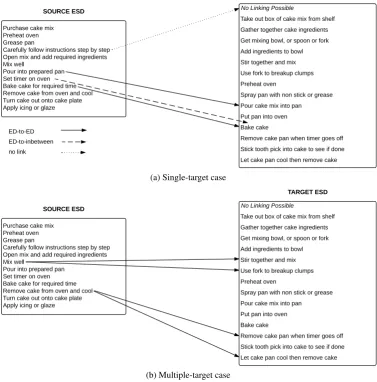
A second step in the data collection enriched the ESD corpus with partial alignment information, to be used as seed data in semi-supervised clustering of event descrip-tions into semantically similar paraphrase sets. The partial alignment information was also crowdsourced via M-Turk. We chose a representative set of 10 scenarios, with approx-imately 100 ESDs each, to be used in the alignment study. The workers were presented with a source and a target ESD and asked to link highlighted descriptions from the source ESD with those event descriptions from the target ESD that were semantically similar to those in the source ESD (see Figure 4). They had the option of either finding asingle-targetdescription in the target ESD or multiple-targetdescriptions.
Single target
ESD (ED-to-ED link, e.g.pour into prepared pan→pour cake mix into pan in Figure 4a). If the target ESD did not contain any matching event description, the workers could either select a position between two event descrip-tions on the target side where the source event would usu-ally take place (ED-to-in-between links, e.g.,set timer on ovencould take place betweenput pan into ovenandbake cake), or they could indicate that no linking at all is possi-ble (no-links). This latter option is useful in case of spuri-ous events (e.g.,carefully follow instructions step by step is not really an event) but also for alternative realizations of a script (e.g.paying cashvs.with a credit card).
Multiple target
If the workers felt that the source event was described in more detail in the target ESD compared to the source ESD, they could link the source event description to more than one event description in the target ESD (e.g.mix well→
stir together and mix, use fork to break up clumps, which can be broken down to two or moreED-to-ED links, see Figure 4b). Also when linking the source description to multiple descriptions in the target ESD, workers could choose in-between positions (ED-to-in-between links).
Seed data selection
In order to minimize the amount of seed data that would be needed for semi-supervised clustering, we employed sev-eral criteria for choosing the most informative event de-scriptions to be aligned. Informative seeds are expected to have the strongest corrective effect on the clustering algo-rithm. Thus, the event descriptions to be aligned should be the borderline cases that are the most difficult for the algorithm. In order to select the borderline cases, hence-forth calledoutliers, we used two methods. First, we ran the Affinity Propagation clustering algorithm varying the preference parameter that determines the cost of creating clusters, thus leading to different configurations of clusters (i.e. to a varying number of clusters and cluster sizes), and we chose those event descriptions that changed their neigh-bors and cluster centers as the number of clusters increased or decreased. Secondly, we chose those event descriptions that were not well clustered as measured by the Silhouette index, which takes into account the average dissimilarity of an item to the members of its cluster and its lowest average dissimilarity to the members of the other clusters. The two criteria used would select the most difficult cases for the algorithm, that is, cases whose true alignment is expected to be most informative.
We also included event descriptions that were not outliers, henceforth calledstable cases, that were used as a baseline when evaluating the inter-annotator agreement to show the difficulty of the outliers. The stable cases were randomly selected from those event descriptions that were not out-liers. We expect more annotator agreement in stable cases as compared to the outliers. Approximately 20% of the event descriptions per scenario were selected as outliers and 10% were selected as stable cases and presented to the workers to align with another event2.
2Note that we refer to the number of descriptions per scenario.
The annotated alignments are less than the 1% of all possible alignments (c.a. 0.1-0.2%).
Additionally, we includedgold seeds, that is a small subset of the event descriptions aligned by experts as part of our gold standard annotation (see Section 2.3.), to be used for an evaluation of the workers’ annotation. 5% of the event descriptions per scenario were included as gold seeds. The workers were not aware of what alignments were outliers, stable cases or gold seeds.
Each source ESD containing outlier, stable or gold event descriptions was matched with 3 target ESDs. Each source-target ESD pair was annotated by 3 different an-notators. In total approximately 600 outlier event descrip-tions, 300 stable event descriptions and 120 gold seeds were selected for each scenario and presented to workers for annotation. 292 workers (native speakers of English) took part in the annotation study. They were paid 0.35 USD per ESD and took on average 1.05 minutes per ESD.
2.3.
Gold Standard Alignment Annotation
The DeScript corpus also includes a gold standard cor-pus of aligned event descriptions annotated by experts, to be used in the evaluation of semi-supervised clustering of event descriptions. A small subset of the gold standard alignments were used to evaluate the quality of the crowd-sourced alignments. The gold standard covers 10 scenar-ios, with 50 ESDs each.
Four experts, all computational linguistics students, were trained for the task and were presented with a source and a target ESD in an interface where (unlike the M-Turk in-terface) no event description in the source ESD was high-lighted. They were to link all event descriptions in the source ESD with all event descriptions in the target ESD that were semantically similar, with respect to the given scenario, to those in the source ESD. Every ESD in a given scenario was paired with every other ESD in the same scenario. In the end, all similar event descriptions were aligned and the full alignments were used to group the event descriptions into gold paraphrase sets.
Scenario EDs Gold
annotated excluded sets
baking a cake 513 29 20
borrowing a book from the library
389 46 16
flying in an airplane 504 46 24
getting a haircut 418 52 23
going grocery shopping
505 95 18
going on a train 357 45 12
planting a tree 344 41 13
repairing a flat bicycle tire
363 40 16
riding on a bus 358 23 14
taking a bath 479 29 20
[image:4.595.306.553.525.729.2]Total/Average 4230 446 (10.5%) 18
Scenario ED-to-ED links ED-to-in-between links No-links Total links
baking a cake 1836 831 448 3115
borrowing a book from the library 1787 1146 254 3187
flying in an airplane 1676 1219 192 3087
getting a haircut 1887 926 292 3105
going grocery shopping 1863 997 251 3111
going on a train 1937 884 285 3106
planting a tree 1902 845 343 3090
repairing a flat bicycle tire 1500 1019 612 3131
riding on a bus 2226 750 114 3090
taking a bath 1898 891 314 3103
Total 18512 9508 3105 31125
Table 2: All links drawn for all source-target ESD pairs by all annotators. Note: the first column includes both ED-to-ED links fromsingle-targetcases and each single ED-to-ED link (arrow) inmultiple-targetcases.
In creating the gold paraphrase sets, we assumed script-specific functional equivalence, that is, we instructed the annotators to group event descriptions serving the same function in the script as semantically similar (e.g,scan bus pass,pay for fareandshow driver ticketare grouped into the same paraphrase set in theRIDING ON A BUSscenario, as they all represent the “pay” event). Each paraphrase set was annotated with an event label that indicated the event being expressed in the given paraphrase set (e.g. in Figure 2, choose_recipeand buy_ingredients are example event labels for BAKING A CAKE). Event labels were harmo-nized with those used in the annotation of stories in Modi et al. (2016) (see Section 4.).
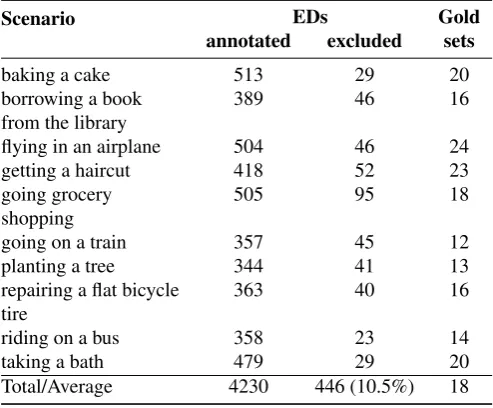
Paraphrase sets that were singletons (e.g. in BAKING A CAKE,return to ovenoccurred only once) were considered not representative of the events in the scenario, and hence were removed based on the gold annotation. Likewise, event descriptions that were not related to the script (e.g., in RIDING ON A BUS,pray your bus is on time) or that were related to the scenario but not really part of the script (e.g., inBAKING A CAKE,store any leftovers in the fridge), were also removed. In the end, approximately 10.5% of the annotated event descriptions were excluded. Table 1 indi-cates the number of excluded event descriptions and the number of gold clusters per scenario.
The result of the gold standard annotation is a rich resource of full alignments for all event descriptions in 500 ESDs (10 scenarios with 50 ESDs each) grouped in gold para-phrase sets, each containing different linguistic variations of the events in the scenario.
3.
Data Analysis and Evaluation
The alignment links we collected (Table 2) show an in-teresting degree of variability across scenarios and across the ESDs within a scenario. A high number of ED-to-in-between links andno-links shows that not all events are verbalized in every ESD for the same scenario: the source ESD may contain optional events which are either not ex-plicitly mentioned in the target ESD (ED-to-in-between links) or event descriptions in source ESD that are not considered events in the scenario (no-links). Recall that workers could either find a single-target description in the target ESD or multiple-target description. They showed a strong preference for single-target links (which werecho-sen 30021 times) over multiple-target links (which were chosen 238 times).
We distinguish between one-to-one alignments, that is, cases which all three annotators considered to be single-target cases, since they used exactly one link between source and target ESD (includingin-between-linksand no-links), andone-to-manyalignments, that is cases which at least one annotator considered to bemultiple-targetcases, using more than one link between source and target ESD. Note that, as annotators preferred single-target links over multiple-target links, most source event descriptions are annotated asone-to-onealignments (Table 3).
Many workers were involved in the alignment annotation task and not all of them aligned the complete set of high-lighted event descriptions. For this reason, we computed agreement as the number of times where the majority of workers agreed in an alignment instance, instead of the Kappa (Fleiss, 1971).
One-to-one alignments
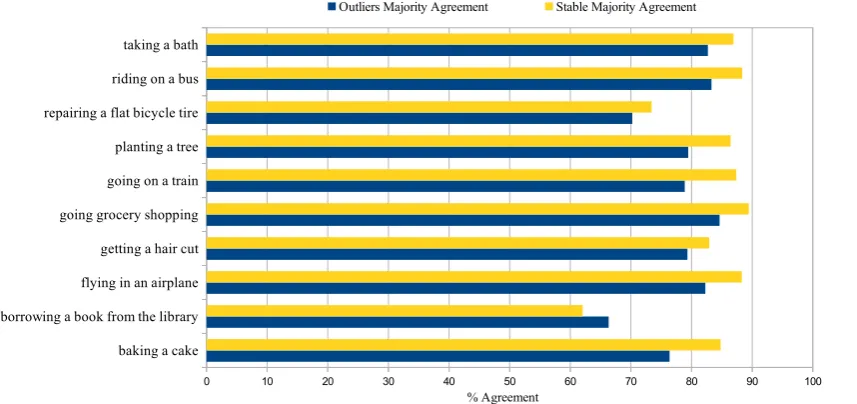
Figure 5 shows how well the workers agreed with each other in the annotation of theoutliersandstable casesfor one-to-onealignments. As expected, on average, workers tended to agree more instable casesas compared to out-liers. The relatively low agreement figures forBORROW -ING A BOOK FROM THE LIBRARYcan be explained by the variety and complexity of the scenario: e.g. given a source event descriptionfind the book on the shelf, andselect a bookandtake the book off the shelf on the target ESDs, it is not obvious if the source event is most similar tofind the book on the shelf,take the book off the shelforin between the two.
One-to-many alignments
Scenario One-to-one alignments One-to-many alignments
tot maj. agreem. % agreem. tot overlap avg Dice
baking a cake 1091 885 0.81 37 28 0.38
borrowing a book from the library 1081 718 0.66 55 30 0.4
flying in an airplane 1081 904 0.84 14 13 0.36
getting a haircut 1003 810 0.81 13 12 0.44
going grocery shopping 993 856 0.86 28 23 0.41
going on a train 982 810 0.82 34 32 0.45
planting a tree 1000 822 0.82 21 18 0.63
repairing a flat bicycle tire 991 708 0.71 29 17 0.2
riding on a bus 1074 914 0.85 28 25 0.46
taking a bath 1101 933 0.85 26 24 0.38
[image:6.595.81.510.277.479.2]Total 10397 8360 0.80 285 222 0.41
Table 3: Number of source event descriptions that all workers annotated as single-target (one-to-onealignments), and number of descriptions where at least one chose the multiple-target option (one-to-manyalignments), with majority counts and overlap counts.
Sheet2
Page 17
3541 9963
0
59 162
baking a cake borrowing a book from the library flying in an airplane getting a hair cut going grocery shopping going on a train planting a tree repairing a flat bicycle tire riding on a bus taking a bath
0 10 20 30 40 50 60 70 80 90 100
Outliers Majority Agreement Stable Majority Agreement
% Agreement
Figure 5: Worker agreement foroutliersandstable casesinone-to-onealignments.
two scenarios are among those with the highest complexity and variability in how the script could be carried out. The overall average Dice is 0.41, that is, the agreement is quite good on corresponding core events, although there may be disagreement about the precise sequence in the tar-get ESD that corresponds to a given source event. For in-stance, in Figure 4b workers may agree on the correspond-ing core event (asmix wellis semantically similar tostir to-gether and mix), but they may not agree on the correspond-ing span, whether it is most similar only tostir together and mixor it also entailsuse fork to break up clumps.
Gold seeds
Recall that besides the outliers (the difficult cases) and the stable cases (which were used as a baseline), we also in-cluded gold seeds for evaluation purposes, in order to com-pare the workers’ annotation against expert annotation. Unsurprisingly, majority agreement in both stable cases and gold seeds was higher than agreement on outliers (87% for gold seeds, 82% forstable cases and 78% for outliers), showing that, while our outlier selection method effectively selects more challenging cases, the quality of the annotation is still very satisfactory.
Agreement between the worker’s majority vote and the gold annotation was 81%. The cases where the workers did not agree with the gold annotation also illustrate the inher-ent complexity of the scripts. For example, inBORROW -ING A BOOK FROM THE LIBRARY, the workers aligned take the book homein the source ESD to the position be-tweenleave libraryandread bookin the target ESD, while the experts aligned the same description toleave library. This shows that the workers were not necessarily wrong in all the cases where they did not agree with thegold seeds.
No-links
clustering algorithm to group in any meaningful way.
4.
Comparison with the InScript Stories
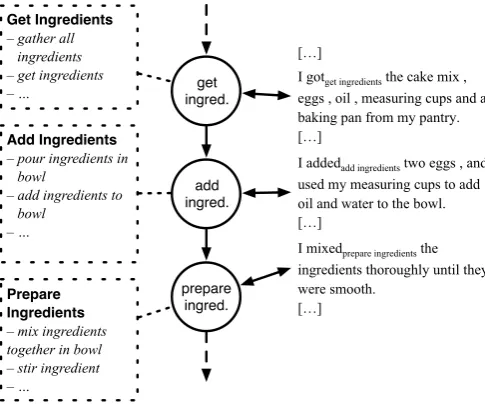
As mentioned in the introduction, this work is part of a larger research effort where we seek to provide a solid empirical basis for high-quality script modeling. As part of this larger project, Modi et al. (2016) crowdsourced a corpus of simple scenario-related stories, the InScript cor-pus (Narrative TextsInstantiatingScriptstructure). They asked workers on M-Turk to write down stories narrating recent real-life experiences instantiating specific scenar-ios (e.g.EATING IN A RESTAURANT). The induced script structure from the ESDs will be used to investigate meth-ods of text-to-script mapping, as well as to model the in-stantiation of script structures in naturalistic texts from the crowdsourced stories, as depicted in Figure 6.
Modi et al. (2016) createdscript templatesthat described script-specific event labels and participant labels for each scenario (e.g., event labels inGOING TO A RESTAURANT: get_restaurant, take_seat, look_menu and participant la-bels: restaurant, waiter, menu), which were used to anno-tate the stories. They annoanno-tated event-denoting verbs in the stories with the event labels and participant-denoting NPs with the participant labels. Event labels used in the annota-tion of stories in the InScript corpus were harmonized with the gold paraphrase sets from the DeScript corpus (Section 2.3.) to reach a one-to-one correspondence.
We compared the two resources with regard to their lex-ical variety, which is higher in the narrative texts than in the ESDs. We chose not to use the type-token ratio (TTR), as it is known to be sensitive to text length, and in this case the narrative texts are generally longer and would result in very low TTR values for the InScript data. In-stead, we compared the lexical variety using the Measure of Textual Lexical Diversity (MLTD, McCarthy and Jarvis (2010)), which computes the mean length of word strings that are needed to maintain a set threshold level of lex-ical variation. We used a threshold TTR value of 0.71,
get ingred.
add ingred.
prepare ingred.
Get Ingredients
– gather all
ingredients
– get ingredients
– …
Prepare Ingredients
– mix ingredients together in bowl – stir ingredient – …
Add Ingredients
– pour ingredients in
bowl
– add ingredients to
bowl – …
I gotget ingredients the cake mix ,
eggs , oil , measuring cups and a baking pan from my pantry.
I addedadd ingredients two eggs , and
used my measuring cups to add oil and water to the bowl.
I mixedprepare ingredients the
ingredients thoroughly until they were smooth.
[…]
[…]
[image:7.595.315.567.68.161.2][…] […]
Figure 6: Connecting DeScript and InScript: an example from the BAKING A CAKE scenario (InScript participant annotation is omitted for better readability).
bathbicycle bus cake flightgroceryhaircutlibrary train tree 20
25 30 35 40 45 50 55
[image:7.595.58.301.543.745.2]DeScript InScript
Figure 7: MTLD values for DeScript and InScript, per sce-nario.
which was empirically set by the authors (high MTLD cor-responds to high lexical variety). We noted that the narra-tive texts have higher MTLDs across all scenarios, ranging between 40 and 47, as compared to ESDs with MTLDs ranging between 26 and 44 (Figure 7). That is, in the nar-rative texts more tokens are needed to reach the set TTR of 0.71; hence, the narrative texts are more lexically diverse in comparison to the ESDs.
As expected, the DeScript corpus, a collection of generic descriptions of script-related activities, has a lower lexical diversity compared to the InScript corpus, which in turn contains naturalistic texts describing real-life experiences. Our next goal is to exploit script structures induced from the ESDs in DeScript for a text-to-script mapping of the script-related naturalistic texts in InScript.
5.
Conclusions
We collected a corpus of 3,948 event sequence descriptions (40 different scenarios, approximately 100 different event sequence descriptions descriptions per scenario), ranging from simpler ones to ones that show interesting variation with regard to their granularity, to the events described, and to different verbalizations of the same event within a sce-nario. The corpus, which is to our knowledge the largest collection of event sequence descriptions available, is en-riched with partial alignment information on difficult event descriptions. Multiple-targetannotations andin-between links are of particular interest, because they can capture differences between event descriptions in terms of granu-larity and optionality of events.
We also collected full alignments by experts for 10 dif-ferent scenarios (50 event sequence descriptions per sce-nario), grouped into labeled paraphrase sets, to be used in the evaluation of semi-supervised clustering of event de-scriptions. We expect that the crowdsourced corpus and the gold standard alignment set will provide a sound basis for high-quality script models and will be used as a valu-able resource for any task involving alignment and para-phrases of events.
6.
Acknowledgements
7.
Bibliographical References
Barr, A. and Feigenbaum, E. A. (1981). Frames and scripts. InThe Handbook of Artificial Intelligence, vol-ume 3, pages 216–222. Addison-Wesley, California. Chambers, N. and Jurafsky, D. (2009). Unsupervised
learning of narrative schemas and their participants. In Proceedings of 47th Annual Meeting of the ACL and the 4th IJCNLP of the AFNLP, pages 602–610, Suntec, Sin-gapore.
Durbin, R., Eddy, S., Krogh, A., and Mitchison, G. (1998). Biological Sequence Analysis: Probabilistic Models of Proteins and Nucleic Acids. Cambridge University Press, Cambridge, UK.
Fleiss, J. (1971). Measuring nominal scale agreement among many raters. Psychological Bulletin, 76(5):378– 382.
Frermann, L., Titov, I., and Pinkal, M. (2014). A hier-archical Bayesian model for unsupervised induction of script knowledge. InProceedings of the 14th Confer-ence of the European Chapter of the Association for Computational Linguistics, pages 49–57, Gothenburg, Sweden.
Frey, B. J. and Dueck, D. (2007). Clustering by pass-ing messages between data points. Science Direct, 315(5814):972–976.
McCarthy, P. M. and Jarvis, S. (2010). MTLD, vocd-D, and HD-D: A validation study of sophisticated ap-proaches to lexical diversity assessment. Behavior Re-search Methods, 42(2):381–392.
Modi, A., Anikina, T., Ostermann, S., and Pinkal, M. (2016). InScript: Narrative texts annotated with script information. In Proceedings of the 10th International Conference on Language Resources and Evaluation (LREC 16), Portoro˘z, Slovenia.
Raisig, S., Welke, T., Hagendorf, H., and der Meer, E. V. (2009). Insights into knowledge representation: The influence of amodal and perceptual variables on event knowledge retrieval from memory. Cognitive Science, 33(7):1252–1266.
Regneri, M., Koller, A., and Pinkal, M. (2010). Learning script knowledge with web experiments. InProceedings of the 48th Annual Meeting of the Association for Com-putational Linguistics, pages 979–988, Uppsala, Swe-den.
Schank, R. C. and Abelson, R. P. (1977). Scripts, Plans, Goals, and Understanding: An Inquiry into Human Knowledge Structures. Hillsdale, NJ: Erlbaum.