CommonCOW: Massively Huge Web Corpora from CommonCrawl Data
and a Method to Distribute them Freely under Restrictive EU Copyright Laws
Roland Schäfer
German Grammar Freie Universität BerlinHabelschwerdter Allee 45, 14195 Berlin [email protected]
Abstract
In this paper, I describe a method of creating massively huge web corpora from the CommonCrawl data sets and redistributing the result-ing annotations in a stand-off format. Current EU (and especially German) copyright legislation categorically forbids the redistribution of downloaded material without express prior permission by the authors. Therefore, stand-off annotations or other derivates are the only format in which European researchers (like myself) are allowed to re-distribute the respective corpora. In order to make the full corpora available to the public despite such restrictions, the stand-off format presented here allows anybody to locally reconstruct the full corpora with the least possible computational effort. In Section 1., I briefly introduce the technology behind the COW project (Corpora from the Web), which is used to create the CommonCrawl-derived corpora. In Section 2., I provide some details about the resulting CommonCOW (COCO) web corpora. Finally, in Section 3., I introduce a method to circumvent restrictive EU copyright laws by distributing only the corpus annotations (under a CC-BY license) together with a tool that allows users to locally reconstruct the corpus from the annotations and the original CommonCrawl files.
Keywords:web corpora, stand-off annotation, legal issues
1.
Web corpora and COW
Over the past decade, web corpora have been created by various research groups (Biemann et al., 2007; Baroni et al., 2009; Pomikalek et al., 2009; Schäfer and Bildhauer, 2012; Schäfer and Bildhauer, 2013), and they have been actively used in Computational Linguistics and Corpus Linguistics. The COCO project introduced in this paper uses the exist-ing technology developed by the COW (Corpora from the Web) project at Freie Universität Berlin (Schäfer and Bild-hauer, 2012; Schäfer et al., 2013) in the COW14 version (Schäfer, 2015b).1
The backbone of this technology is the texrex web page cleaning tool.2 Using a bundle of computational methods
described in previous publications,texrex(in its 2015 ver-siontexrex-behindthecow):
1. filters out perfect and near-duplicate documents (Schäfer and Bildhauer, 2012),
2. strips HTML markup and scripts,
3. converts encodings (to UTF-8) and performs NFC Unicode normalization,
4. detects and annotates the document language, 5. classifies paragraphs as boilerplate or good text
(Schäfer, 2015a),
6. classifies documents as containing more or less coher-ent text (Schäfer et al., 2013),
7. extracts meta information from the crawl headers and the HMTL source,
8. performs IP-based server geolocation.
Linguistic annotation (for Dutch, English, French, German, Spanish, Swedish) is done using available tools. For ex-ample, English COW corpora are tokenized using Ucto
1
http://corporafromtheweb.org/
2http://texrex.sourceforge.net/
(van Gompel et al., 2012), part-of-speech tagged and chun-ked using TreeTagger (Schmid, 1994), and dependency parsed with the Malt Parser (Nivre et al., 2007). German is tokenized, tagged, and chunked using the same tools, named entity recognition is performed using the Stanford NER tool and available German models (Faruqui and Padó, 2010), and morphological analysis is performed using Mate tools (Björkelund et al., 2010). The data are processed on the high performance cluster of Freie Universität Berlin, which is based on SLURM.3 This is arguably much eas-ier than using Map-Reduce frameworks like Hadoop, and it allows us to create corpora the size of 10 or more billion tokens in weeks’ time.4 More details about the annotations can be found in (Schäfer, 2015b).
2.
CommonCOW
So far, the COW project has been based entirely on self-crawled data (Schäfer and Bildhauer, 2012; Schäfer et al., 2014) using the Heritrix web crawler (Mohr et al., 2004). Other projects have either used the same or similar avail-able software (Baroni et al., 2009) or created their own software in order to optimize the efficiency of the crawl-ing process (Suchomel and Pomikálek, 2012). Crawlcrawl-ing is a time-consuming and costly process (Olston and Najork, 2010), and a lot of the crawled data (up to roughly 95%) are usually not used in the final corpus because it does not pass one of the usual quality assessment algorithms or is duplicate material (Schäfer and Bildhauer, 2012; Suchomel and Pomikálek, 2012; Biemann et al., 2013; Schäfer and Bildhauer, 2013; Schäfer et al., 2014). It is thus desirable from a web corpus creation perspective to make crawling as efficient as possible or re-use available crawl data. The CommonCOW (COCO) project uses CommonCrawl crawl data that are available via https and the Amazon S3
3
http://slurm.schedmd.com/
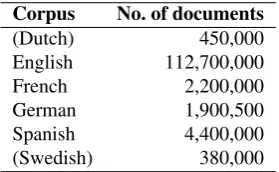
Corpus No. of documents
(Dutch) 450,000
English 112,700,000
French 2,200,000
German 1,900,500
Spanish 4,400,000
[image:2.595.99.239.68.154.2](Swedish) 380,000
Table 1: Conservatively estimated sizes of the COCO1507 corpora; bracketed languages have been dropped due to low yield
cloud protocol.5 The CommonCrawl initiative (with which I am not affiliated in any way) offers free access to very huge archived crawled snapshots of the web, and the data are archived by Amazon under their Public Datasets pro-gram.6 I am are currently optimizing the COW tool chain for the processing of the CommonCrawl data using the July 2015 CommonCrawl snapshot. This snapshot con-sists of 33,957 WARC crawler archive files of an average 0.88 GB (gzipped), totalling at roughly 30 TB. Process-ing them on my university’s high performance cluster with
texrextakes about one week, and removing near-duplicates is expected to take another five to ten days. The corpus sizes for the COCO1507 corpora derived from this single CommonCrawl snapshot (estimated based on a test run with 100 WARC files from the same snapshot) are given in Ta-ble 2. Dutch and Swedish data will not be used to create corpora because they are represented too sparsely in the original data sets. However, based on the previous expe-rience with similar crawl data, the English COCO1507 cor-pus is expected to be 110 billion tokens large.7The linguis-tic annotation should take about a month based on previous experience (Schäfer, 2015b).
3.
Redistribution
3.1.
Problem and solution
The redistribution of corpora—and especially web corpora—usually involves legal issues, especially in countries without a Fair Use doctrine that would allow non-commercial use of copyright-protected digital material for research purposes (Samuelson, 1995). For example, German copyright law (“Urheberrecht”) requires that corpus designers explicitly ask the author of any text (that reaches a certain threshold of creativity) for their permission before inclusion of the text in the corpus.8 This is clearly infeasible for large web corpora as described in Section 2. As a workaround, corpora are sometimes
5https://commoncrawl.org/ 6http://aws.amazon.com/de/
public-data-sets/
7A reviewer suggested that I should provide more statistics
about other languages represented in the CommonCrawl data. While I agree that such statistics would be a great thing to have, my tools do not perform general-purpose language detection, but merely look for those languages for which we have linguistic an-notation tool chains in the COW project.
8This holds regardless of whether the resulting corpus is
dis-tributed commercially or for academic purposes.
distributed as sentence shuffles under the assumption that single sentences never reach the required threshold of creativity, for example COW (Schäfer and Bildhauer, 2012; Schäfer, 2015b) or the Leipzig Corpora Collection (Biemann et al., 2007). This approach is outright unsat-isfactory for users who need larger linguistic contexts or whole documents for their research. Even worse, it is not even clear whether there is a reliable copyright exemption for single sentences.9
For the redistribution of COCO, a unique solution for the distribution of corpora consisting ofintactdocuments was developed that results in very high legal safety for the cor-pus creators. The method can be summarized as follows:
1. All annotations (including meta data and token-level annotations) from the COCO corpora are distributed freely in the form of stand-off annotation files under a maximally permissive Creative Commons CC-BY li-cense as COCO Annotation (COCOA) files.10
2. In these COCOA files, the original tokens (at least most of them, cf. below) are replaced by an offset into a normalized version of original document such that they can later be retrieved from that original doc-ument. Since the COCOA format alone does not allow anyone to reconstruct the original work, I see little to no legal risk for the corpus creators.
3. A tool is deployed which automates the process of downloading both the COCOA files and the original CommonCrawl data and recreating a full corpus from both sources on the end user side. Thus, no copy-righted data are actually redistributed by the COW/ COCO corpus creators.
The crucial point is that the CommonCrawl initiative, being located in the U. S., are allowed to distribute the data be-cause they can claim Fair Use. This doesnotmean that the data are free of copyright, and from a European perspective the problem arises that any derived data (in my case high quality annotated corpora) cannot be re-distributed if the original copyrighted material is included in the derivative work. In order to get the data to the end user regardless, I therefore separate the annotations from the data and dis-tribute only the annotations along with the tools required to merge them with the original data. Of course, end users still need to make sure that it is legal for them to work with CommonCrawl data.11 The solution proposed here fo-cusses only on de facto legal safety for corpus creators. In the remainder of the paper, I provide technical details and estimates of the overhead incurred for the end user based
9A legal assessment recently commissioned by the
Ger-man Research Council (DFG) is sceptical about the shuffle approach (DFG, 2015, 14). In the famous Infopaq case, snippets of eleven words were considered to reach the level of threshold (https://en.wikipedia.org/ wiki/Infopaq_International_A/S_v_Danske_
Dagblades_Forening).
10http://creativecommons.org/licenses/by/
3.0/
11
WARC
COCOA annotations
Python
simple token stripper COCO
corpus
FreePascal / diverse tools
texrex web page cleaner
COW annotation
crawler COCO
corpus
CommonCrawl Fair Use?Public COW (FU Berlin / HPC) CC-BYPublic Corpus user
simple token stripper
Python
diff
token aligner
patch
[image:3.595.49.542.66.304.2]token retrieval
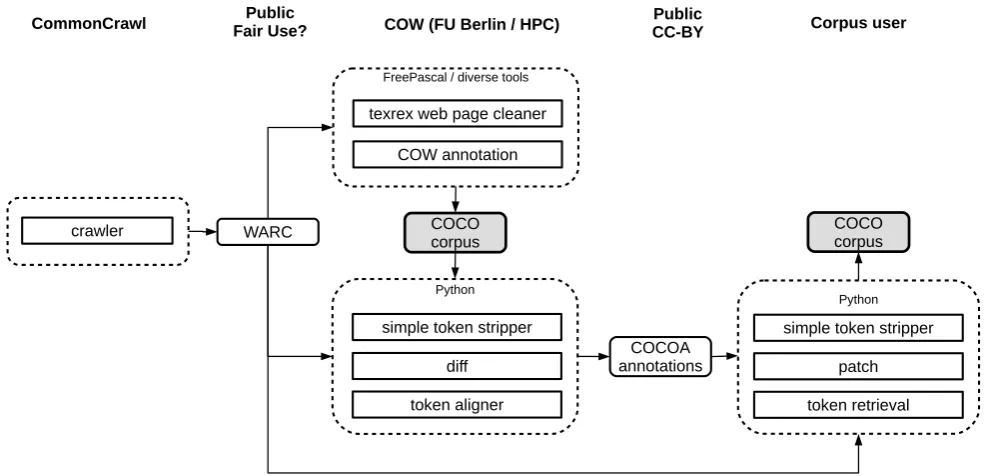
Figure 1: Workflow of COCO/COCOA corpus construction
on the current versions of the tools. Technically, two major problems have to be solved. One has to make sure that the alignment works perfectly (Section 3.2.), and one has to make sure sure that the process of reconstructing the corpus is feasible for potential users in terms of bandwidth and runtime (Section 3.3.).
3.2.
Workflow and data integrity
Figure 3.1. summarizes the entire workflow. The Common-Crawl project runs a crawler to collect the primary HTML data, and they make them available for download in a stan-dardized web archive (WARC) format. The COW project downloads the WARC files and creates clean, normalized, and annotated corpora from them usingtexrexand the COW annotation pipeline. The resulting CommonCOW (COCO) corpora are then aligned (cf. below) with the WARC data and transformed into stand-off CommonCOW Annotation (COCOA) files in such a way that end users can re-create the full corpora from those COCOA files. The end user then downloads both the COCOA and the WARC files in order to reconstruct the COCO corpus with a Python tool provided by me.
To illustrate the format in which the annotations are de-ployed, I provide Figure 2. The files are in CWB-compatible format (Evert and Hardie, 2011) with minimal XML and inlined one-token-per-line data where the annota-tion levels are separated with tabs. For each document (en-closed in a<doc>tag), the byte offset in the corresponding WARC file and its byte-length are specified. Instead of to-kens, the indicesiof the token in the original document are specified as @i@. For performance reasons, and because they are legally irrelevant, all tokens which do not con-sist entirely of letters are inserted literally (here's
and.). To further obscure the original sentence (especially for languages without rich inflectional morphology like En-glish), lemma annotations are replaced by@id@if they are
<doc ... offset="92575231" length="12331"> <s>
<vc>
@8702@ VB check 1 0 null </vc>
<nc>
@8703@ DT @id@ 2 6 det @8704@ NP @id@ 3 6 poss 's POS 's 4 3 possessive </nc>
<nc>
@8705@ NP @id@ 5 6 nn @8706@ NN @id@ 6 1 dobj </nc>
<advc>
@8707@ RB @id@ 7 1 advmod </advc>
<pc>
@8708@ IN @id@ 8 1 prep <nc>
@8709@ NNS update 9 8 pobj </nc>
</pc>
. SENT . 10 1 punct
[image:3.595.325.512.362.568.2]</s>
Figure 2: Simplified extract of a COCOA annotation file; the sentence shown isCheck the EU’s Customs website pe-riodically for updates.
identical (up to capitalization) to the token. Clearly, dis-tributing data as shown in Figure 2 does not violate the original authors’ copyright.
procedure that effectively solves this problem.12
After the COCO corpus has been created, a Python tool goes through the WARC files again and applies fast and robust HTML stripping to the original data (document by document) and converts everything to UTF-8 (using the
BeautifulSouppackage).13 From this extracted text, only
the alphabetic characters and the blanks are retained, re-sulting in the source token buffer. Then, the tool ex-tracts those tokens from the COCO corpus that consist exclusively of alphabetic characters (without annotations), creating the target token buffer. Ideally, the two text buffers should be identical, but because of the aforemen-tioned normalizations, this is usually not the case. Us-ing Google’sdiff_patch_matchlibrary, a diff-based patch is created which, if applied to the source token buffer, yields the target token buffer.14 The patch object is pickled (i. e.,
serialized), compressed with zlib, Base64-encoded and in-cluded as non-human-readable textual data in the COCOA output within a custom XML tag.15 The COCOA token
information is then created from COCO by replacing all purely alphabetic tokens with their offsets in the target to-ken buffer.
When the COCO corpus is re-created from WARC and CO-COA files by the end user, the same type of HTML strip-ping and UTF-8 conversion is run on the document from the WARC file before the patch is applied. The clean corpus to-kens can then be retrieved from the patched text buffer by looking up the indices stored in the COCOA file.
One further measure is taken to reduce the legal risk for the corpus creators. The URL of the original web page and its IP address are included as meta data in COCO corpora. In COCOA, they are encrypted in a way that they cannot be decrypted without also downloading the WARC files. In other words, the sources of the documents are obfuscated. This is achieved by creating a digest from the raw HTML document as found in the WARC file and using this digest as a key to encrypt the URL and IP address (by simply ap-plying a byte-wise XOR). The user-side tool decrypts the meta data using the same method.
The Python reference implementations are released under a permissive BSD open-source license. By the time of this writing, they have been implemented and tested on small data sets but not on the actual large data sets. However, both the COCOA data files and the Python tools will be made available still in 2016.
12
I previously had hopes that the plain-text versions offered di-rectly by CommonCrawl, the so called WET files, could be used at least for the process that is run by the end user. The quality of the text extraction in the WET files is too low to be usable, however.
13
http://www.crummy.com/software/ BeautifulSoup/
14
https://code.google.com/archive/p/ google-diff-match-patch/
15The serialized patch inflates the size of the COCOA files by
roughly 10%. Since the procedure described here is both highly reliable and makes processing on the end user side very effective, this overhead is a small price to pay.
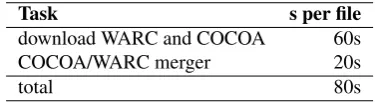
Task s per file
download WARC and COCOA 60s
COCOA/WARC merger 20s
[image:4.595.326.514.68.119.2]total 80s
Table 2: Estimated overhead for end users involved in the corpus reconstruction process on a single Intel Core i7 CPU with a 100 Mbit/s downstream.
3.3.
Feasibility for the end user
On the corpus creators’ side, running the simple token strip-per, creating the diff/patch, and aligning the tokens takes 300ms per document on average on a single Intel i7 or Xeon core. On my university’s high performance cluster, pro-cessing the whole July 2015 CommonCrawl snapshot can be achieved in well under one day.16 Based on the current development version, the performance on a standard con-sumer computer is estimated in Table 3.3.
Since there are approximately 34,000 files in the Com-monCrawl July 2015 snapshot, in order to reconstruct the English 112 million document (110 billion token) CO-COC1507 corpus (Table 2.), the tool will run for 80s× 34,000 = 31.5d.17 Most better equipped computers will
be able to run several instances of the tool simultaneously, thus reducing the total time needed. For a 112 million doc-ument/110 billion token corpus, this is clearly acceptable.
4.
Outlook
The process of reconstructing a COCO corpus requires some effort, and the end users referred to in this paper are most likely predominantly institutions and research groups with well equipped machines and a high download bandwidth rather than individuals. Therefore, I hope that providers in countries with more permissive legislation use the tools described here to reconstruct COCO corpora and make them accessible (ideally also in convenient interfaces) while respecting the CC-BY license for the annotations and giving the COCO/COW project the required credit by refer-encing this paper. In the long run, I hope that initiatives like COCO will help to undermine the restrictive and anachro-nistic EU copyright laws and pave the way for a Fair Use doctrine in the EU.
In my own work, I will continue to process CommonCrawl snapshots (ideally all of them), mostly in order to increase corpus sizes for languages other than English. I will also include COCO data in current evaluations of the quality and composition of web corpora (partly joint work with Felix Bildhauer).
5.
Acknowledgements
Research presented in this paper was funded by the Ger-man Research Council (DFG), grant SCHA1916/1-1. I would like to thank the Zedat data center of Freie Univer-sität Berlin for computing time on their high-performance
16
This is just the extra time needed for creating the COCOA files.
17
cluster (HPC). I am also grateful to Felix Bildhauer for his ongoing collaboration on the COW and COCO projects.
Baroni, M., Bernardini, S., Ferraresi, A., and Zanchetta, E. (2009). The WaCky Wide Web: A collection of very large linguistically processed web-crawled corpora.
Language Resources and Evaluation, 43(3):209–226. Biemann, C., Heyer, G., Quasthoff, U., and Richter, M.
(2007). The leipzig corpora collection - monolingual corpora of standard size. InProceedings of Corpus Lin-guistic 2007, Birmingham, UK.
Biemann, C., Bildhauer, F., Evert, S., Goldhahn, D., Quasthoff, U., Schäfer, R., Simon, J., Swiezinski, L., and Zesch, T. (2013). Scalable construction of high-quality web corpora. Journal for Language Technology and Computational Linguistics, 28(2):23–60.
Björkelund, A., Bohnet, B., Hafdell, L., and Nugues, P. (2010). A high-performance syntactic and semantic de-pendency parser. In Coling 2010: Demonstration Vol-ume, pages 33–36, Beijing.
DFG. (2015). Handreichung: Informationen zu rechtlichen Aspekten bei der Handhabung von Sprachkorpora. Technical report, Deutsche Forschungs-gemeinschaft.
Evert, S. and Hardie, A. (2011). Twenty-first century cor-pus workbench: Updating a query architecture for the new millennium. InProceedings of the Corpus Linguis-tics 2011 conference, Birmingham. University of Birm-ingham.
Faruqui, M. and Padó, S. (2010). Training and evaluating a german named entity recognizer with semantic gen-eralization. In Proceedings of KONVENS 2010, Saar-brücken, Germany.
Mohr, G., Stack, M., Ranitovic, I., Avery, D., and Kimpton, M. (2004). Introduction to Heritrix, an archival quality web crawler. InProceedings of the 4th International Web Archiving Workshop (IWAW’04).
Nivre, J., Hall, J., Nilsson, J., Chanev, A., Eryigit, G., Kübler, S., Marinov, S., and Marsi, E. (2007). Malt-parser: A language-independent system for data-driven dependency parsing. Natural Language Engineering, 13(2):95–135.
Olston, C. and Najork, M. (2010). Web Crawling, volume 4(3) ofFoundations and Trends in Information Retrieval. now Publishers, Hanover, MA.
Pomikalek, J., Rychly, P., and Kilgarriff, A. (2009). Scal-ing to billion-plus word corpora.Research in Computing Science, 41. Special issue: Advances in Computational Linguistics.
Samuelson, P. (1995). Copyright’s fair use doctrine and digital data. Publishing Research Quarterly, 11(1):27– 39.
Schmid, H. (1994). Probabilistic part-of-speech tagging using decision trees. In Proceedings of International Conference on New Methods in Language Processing, September.
Schäfer, R. and Bildhauer, F. (2012). Building large cor-pora from the web using a new efficient tool chain. In Nicoletta Calzolari, et al., editors, Proceedings of the Eight International Conference on Language Resources
and Evaluation (LREC’12), pages 486–493, Istanbul. ELRA.
Schäfer, R. and Bildhauer, F. (2013). Web Corpus Con-struction. Synthesis Lectures on Human Language Tech-nologies. Morgan and Claypool, San Francisco.
Schäfer, R., Barbaresi, A., and Bildhauer, F. (2013). The good, the bad, and the hazy: Design decisions in web corpus construction. In Stefan Evert, et al., editors, Pro-ceedings of the 8th Web as Corpus Workshop (WAC-8), pages 7–15, Lancaster. SIGWAC.
Schäfer, R., Barbaresi, A., and Bildhauer, F. (2014). Fo-cused web corpus crawling. In Felix Bildhauer et al., editors, Proceedings of the 9th Web as Corpus work-shop (WAC-9), pages 9–15, Stroudsburg. Association for Computational Linguistics.
Schäfer, R. (2015a). Accurate and efficient general-purpose boilerplate detection. in prep.
Schäfer, R. (2015b). Processing and querying large web corpora with the COW14 architecture. In Piotr Ba´nski, et al., editors,Proceedings of Challenges in the Manage-ment of Large Corpora 3 (CMLC-3), Lancaster. UCREL. Suchomel, V. and Pomikálek, J. (2012). Effcient Web crawling for large text corpora. In Adam Kilgarriff et al., editors,Proceedings of the seventh Web as Corpus Work-shop, pages 40–44.