R E S E A R C H
Open Access
A privacy protection-oriented parallel fully
homomorphic encryption algorithm in
cyber physical systems
Zhaoe Min
1, Geng Yang
1,2*, Arun Kumar Sangaiah
3, Shuangjie Bai
1and Guoxiu Liu
1Abstract
Cyber physical system (CPS) is facing enormous security challenges because of open and interconnected network and the interaction between cyber components and physical components, the development of cyber physical systems is constrained by security and privacy threats. A feasible solution is to combine the fully homomorphic encryption (FHE) technique to realize the efficient operation of ciphertext without decryption. However, most current homomorphic encryption algorithms only support limited data types, making it difficult to be widely applied in actual environment. To address this limitation, we propose a parallel fully homomorphic encryption algorithm that supports floating-point numbers. The proposed algorithm not only expands the data types supported by the existing fully homomorphic encryption algorithms, but also utilizes the characteristics of multi-nodes in cloud environment to conduct parallel encryption through simultaneous group-wise ciphertext computations. The experimental results show that, in a 16-core 4-node cluster with MapReduce environment, the proposed encryption algorithm achieves the maximum speed-up exceeding 5, which not only solves the limited application problem of the existing fully homomorphic encryption algorithm, but also meets the requirements for the efficient homomorphic encryption of floating-point numbers in cloud computing environment.
Keywords: Privacy protection, Fully homomorphic encryption, Encryption of floating-point number, Parallel encryption, Cyber physical system
1 Introduction
The cyber physics system is a multi-dimensional compli-cated system that integrates computation, communica-tion, and physical environments. The system emphasizes the interaction between cyber and the physical system, so secure information transmission between physical components and information system has become more important [1–3]. For the cyber physical system, a rela-tively complete secure service should provide privacy protection, data confidentiality, information integrity, ID certification and access control. Therefore, how to pro-vide privacy and security protection to users in the cyber physics system in a secure and effective manner has be-come a hotspot in the current academic research [4,5].
In recent years, various technologies have been broadly used for data privacy protection, such as private informa-tion retrieval [6–11], searchable encryption [12–17], and secure multi-party computation [18–23], but these tech-nologies can only provide limited functions, such as key-word search, order search, range query, and subset search. However, for many application scenarios in the cloud envir-onment, it requires various types operations of ciphertext data. For example, based on the medical data of thousands of patients, we could conduct analysis of drug effects, summarize frequently searched words by users in the search engine to release-related advertisement, and conduct statistical analysis of encrypted financial information of company. Most traditional encryption methods do not sup-port ciphertext operation. According to the traditional method, these data are sent to the cloud after encryption, and when processing the data, the user needs to download data to a local system and uses the data after decryption. This approach tends to cause exposure of privacy, and in * Correspondence:[email protected]
1
School of Computer Science, Nanjing University of Posts and Telecommunications, Nanjing 210046, China
2Jiangsu Key Laboratory of Big Data Security& Intelligent Processing, Nanjing
210046, China
Full list of author information is available at the end of the article
the meantime, when the user has frequent use of data to conduct communication with service provider and realize encryption and decryption of data, it will consume massive network bandwidth and user’s time, which will significantly reduce the usability of cloud computing.
Another solution is to adopt the homomorphic en-cryption technique [24]. This technique supports cipher-text data management under privacy protection, which can be used to realize various operations such as direct search, computation, and statistics of ciphertext at cloud, and the result can be returned to the user in the form of ciphertext. Compared to the traditional encryption algo-rithms, this method does not require frequent encryp-tion and decrypencryp-tion operaencryp-tions between the cloud and user, which can reduce the overhead of communication and computation resources. The user’s private data are saved in the form of ciphertext at cloud, and the service provider cannot know the data content, which can pre-vent them from exploring user’s privacy through illegal embezzling and tampering of user data. It has provided a security basis for the users to fully utilize the cloud computing resources to conduct massive data analysis and processing, and in particular, it can be combined with the secure multi-party computation protocol to well solve the privacy security issue when the user out-sources the computation service.
Most current homomorphic encryption schemes support integer homomorphic operation, but do not support homomorphic operation of floating-point data, so they cannot satisfy the requirement of actual application. By combining the cloud computing envir-onment, this paper proposes a fully homomorphic encryption algorithm that supports floating-point op-eration, and the objective is to expand encryption al-gorithm from integer to floating-point number. This scheme has combined the MapReduce framework to realize fully homomorphic encryption of parallel floating-point number. In the meantime, the cluster advantage is used to improve the execution efficiency of algorithm, realize efficient encryption and decryp-tion operadecryp-tion, and effectively reduce the time of homomorphic operation. Both the theoretical analysis and experiment results show that the parallel homo-morphic encryption algorithm supports floating-point operation, which can be used to conduct fast and effi-cient encryption and decryption operation of massive floating-point data. It has high security and practical-ity, and it is applicable to the cloud computing scenario.
The main contributions of our work are summarized as follows:
(1) We propose a fully homomorphic encryption algorithm supporting Floating-point operation
(FFHE) in this paper, which has solved the problem that direct operation of many floating-point cipher-texts cannot be carried out in the real environment. (2) We design a parallel homomorphic encryption
scheme in order to address the low efficiency of homomorphic encryption algorithm. This scheme is based on the MapReduce environment, which can realize parallel performance of algorithm through data blocks. The experimental result shows that, in a 16-core 4-node cluster, this encryption algorithm can reach the maximum speed-up ratio exceeding 5. (3) In addition to improve the security of algorithm, we
add an operation to disrupt the ciphertext order in the proposed homomorphic encryption scheme that supports floating-point operation, which has elimi-nated the association between the child ciphertext and key pair.
The rest of this paper is organized as follows. Related work is summarized in Section 2. Section 3 introduces the background knowledge. The homomorphic encryp-tion scheme that supports floating-point number is pro-posed in Section 4, and the homomorphic performance and security of algorithm are also proved. In Section 5, parallel design of algorithm is conducted, and specific realization method is provided. Section 6consists of ex-periment and analysis, and the exex-periment results and discussion are presented in the form of a chart. Finally, we conclude this paper in Section7.
2 Related work
In 1978, Rivest et al. proposed the concept of homo-morphic encryption for the first time in Literature [25], which is also called the“privacy homomorphism,” and in the same year, they also proposed that the RSA public key encryption algorithm has multiplication homomorphism [26], and the security of this scheme is based on integer factorization. Later, many homomorphic encryption schemes have been proposed, such as the ElGamal [27] encryption scheme with multiplication homomorphism and the Paillier [28] encryption scheme with the addition of homomorphism, but none of these methods have the feature of fully homomorphic encryption, and are called partial homomorphic encryption (PHE).
(learning with errors) problem [31], its main idea is to ad-dress the defects of ideal lattice-based scheme through the re-linearization technique. Stehle et al. introduced the NTRU (number theory research unit) algorithm for the first time to improve the efficiency of initial FHE scheme [32]. Its security assumption is based on RLWE (ring learning with errors). Brakerski et al. proposed the BGV scheme in literature [33], which can support multi-bit operation, and the computation complexity is much lower than that of Gentry’s initial scheme. From the initial scheme of Gentry to BGV scheme, the research on the homomorphic encryption scheme has made remarkable progress, but still far away from the actual application.
In recent years, some mature homomorphic encryp-tion schemes are proposed in literatures [34–41], es-pecially, Garg et al. proposed a fully homomorphic algorithm based on the LWE and RLWE problems, which utilizes the addition and multiplication opera-tions of matrix to realize homomorphic computation of ciphertext, and it is believed as an ideal scheme at present. Based on the approximate greatest common divisor problem, Liu proposed a fully homomorphic encryption (LFHE) that supported integer operation [42], and a fully homomorphic encryption is realized through complicated algebraic equation, which has high execution efficiency. He also applied this scheme to cloud computing environment [43]. Liu et al. [44, 45] designed a computation framework and toolkit that support privacy protection, this scheme supports multi-key encryption, and it can be expanded to ra-tional number computation.
In real scenarios, some homomorphic encryption techniques have been used in the cloud environment for privacy protection. According to the data privacy problem in cloud computing environment, Brenner et al. [46] adopted a fully homomorphic encryption technique to realize safe execution of confidential program at third-party server. For the multimedia in-formation retrieval problem in cloud computing en-vironment, Lu et al. [47] proposed SIFT (the security scale invariant feature transform) scheme based on Paillier encryption scheme. The feasibility and effi-ciency problems of existing homomorphic encryption schemes are discussed in literatures [48–56], and some application scenarios were combined to analyze the requirement for homomorphic algorithms. In ac-cordance with the low efficiency problem of Paillier encryption algorithm, Min et al. [57] proposed a homomorphic encryption algorithm that can conduct parallel encryption in the cloud environment, but be-cause most practical computations involve integer and floating-point number operation, this method still has its shortages.
Literatures [58–60] expanded the homomorphic encryption scheme of integer domain to the fixed--point and floating-fixed--point parts, which has extended the ap-plication scenarios of homomorphic algorithm. Literature [61] specifically analyzed the theoretical basis and charac-teristics of above homomorphic encryption schemes in theory, stipulated various terms, related concepts and defi-nitions used in the homomorphic schemes, and made uni-form description of above concepts based on mathematical knowledge.
As most current homomorphic encryption schemes support integer homomorphic operation, we propose a fully homomorphic encryption algorithm that supports floating-point operation. The proposed algorithm can not only solve the problem of limited application in the existing fully homomorphic encryption, but also conduct parallel encryption based on the characteristics of multi-nodes in cloud environment, and as a result, the efficiency can be improved.
3 Background 3.1 The LFHE algorithm
LFHE algorithm allows the ciphertext to contain huge noise, and the ciphertext generated after mul-tiple homomorphic operations can still be accurately decrypted, no matter how big noise volume has been accumulated during this process. This scheme is mainly based on the approximate greatest common divisor problem, which depends on complicated alge-braic operation, so it has higher efficiency than the homomorphic encryption scheme based on the ideal lattice problem. The specific encryption scheme is as follows: ciphertexts encrypted by elements in Θ, which is Φ = [Encl(K(n),θ1),…,Encl(K(n),θl), Encl(K(n),1)]. Then the private keys are K(n) and Φ.
2. Encryption algorithm
LFHE algorithm generally consists of two parts: the lower level encryption algorithm and the upper level en-cryption algorithm. Given the secret keyK(n) and an in-teger v∈Zq, the lower level encryption algorithm can be expressed as Encl= (K(n),v) = (c1, …, cn+ 1); the specific
cΠð Þi ¼
integers uniformly sampled fromZq. For correctness, we
require a≠0 ti≠0 for 1≤i≤h, andS(i)is defined as SðiÞ
¼Pmj¼1sijrsj.
The lower level encryption algorithm is only used to generate the key element in the fourth partΦof key. As-sume in keyK(n),Θ= [θ1,…,θl] has been defined, and it
And the specific definition ofϕiis:
ϕi¼
EnclðK nð Þ;θiÞ i≤l EnclðK nð Þ;1Þ i¼lþ1
ð3Þ
where ϕl+ 1 is the ciphertext result obtained through
encryption of integer 1. If it satisfies the requirement of low-order encryption algorithm, it can use maximaln−
1 constraints.
Assume ru1,…,rul-1, and rul are all random integers samples fromΖq,rul+ 1and plaintextvare satisfiedrulþ1
¼v−Pli¼1ruiθimodq . In key K(n), the third and fourth parts are Θ= [θ1,…θl] and Φ=[ϕ1,⋯,ϕl+ 1]
re-spectively, every plaintext can be encrypted intol+ 1 ci-phertexts. And then, the upper level encryption algorithm can be expressed as Eq. (4).
Enc K nð ð Þ;vÞ ¼ðc1;…;cnþ1Þ ð4Þ
whereci=ru1× cθ1i+…+ rul +1× cθ(l + 1)i.
3. Decryption algorithm
The decryption algorithm uses keyK(n) to decrypt ci-phertext (c1,…,cn + 1) into plaintext v, and it mainly
in-In the above definition, the decryption algorithm is de-scribed in five steps by using intermediate variables, such asRSuandF. Actually, we can fuse these steps and
then we can get a linear form of the decryption algo-rithm as Eq. (5).
v¼dk1cΠð Þ1 þ…þdknþ1cΠðnþ1Þ modq ð5Þ
Compared to the common fully homomorphic encryp-tion algorithm, LFHE can provide good execuencryp-tion effi-ciency, which has certain practical value and realistic significance. The defects mainly consist of two aspects: (1) the algorithm can only support integer homomorphic operation, but do not support homomorphic operation of floating-point data, so they cannot satisfy the require-ment of actual application; (2) it has certain limitation on the aspect of security, which has the risk of leaking the key. The reason why the attacker is able to decode all ciphertexts information based on the PEK is that the relative location of key elements ki is maintained the same when the LFHE scheme uses the key to encrypt plaintext data, so the attacker is still able to decode the key information by solving the equations.
In this chapter, a new fully homomorphic encryption algorithm is proposed to support floating-point oper-ation, which increase its application scene range, and makes further improvements in the areas of security flaws. In the meantime, in order to improve the execu-tion efficiency of algorithm, we combine the MapReduce framework to realize fully homomorphic encryption of parallel floating-point number.
3.2 MapReduce model
The MapReduce parallel computation framework is a parallel program execution system, and it provides the parallel processing model and process that consists of the two stages of Map and Reduce. The Map function and Reduce function provide two high-level abstract models and interfaces for parallel programming, and the programmer only needs to realize these two interfaces to quickly complete parallel programming.
The basic processing procedure of MapReduce parallel programming model is as follows:
– Various Reduce nodes also conduct parallel
computation, and they are responsible of processing the datasets of different intermediate results; – The processing of all Map nodes must be completed
before the Reduce processing, so it requires a synchronous barrier (Barrier) before the Reduce processing.
– By summarizing the output results of Reduce nodes, the final result can be obtained.
4 The proposed full homomorphic encryption algorithm supporting floating-point operation 4.1 The proposed FFHE algorithm
The FFHE encryption scheme proposed in this paper supports both integer and floating-point number opera-tions (in the following part, it will be illustrated with floating -point number as example), which simultan-eously has the characteristics of addition homomorph-ism and multiplication homomorphhomomorph-ism. This algorithm mainly consists of three parts: generation of key, encryp-tion algorithm, and decrypencryp-tion algorithm.
Generation of key: assume k and s are n-dimension key vectors, set K(n) = [(k1,s1),…, (kn,sn)], where ki∈R,
si∈R andn> 3, and they satisfy Eq. (6). ki≠0;∀1≤i≤n
s1þ⋯sn−1≠0;sn≠0
ð6Þ
Encryption algorithm: assume v is the floating-point number that needs to be encrypted. The specific encryp-tion process mainly consists of the following steps:
1. Randomly generaten−1 pairs of floating-point number setsP= [(r1,p1),…,(rn-1,pn-1)] as the encrypted noise.
2. Compute the order ciphertextC′which includes nciphertexts, and the specific computation Equation is:
ci¼ kiðsivþpiÞ þri;1≤i≤n−1 knsnXn−i¼11ðpiþri=kiÞ;i¼n
(
ð7Þ
in whichv∈R.
3. Define the mapping functionΠ:
Πð Þ ¼i j 1≤i;j≤n ð8Þ
Rearrange the ciphertext fragments according to the output result of mapping function Π, and generate out-of-order ciphertext C″; according to the mapping
result of functionΠ, map theith child ciphertextciof order ciphertext C′ into the jth child ciphertext of out-of-order ciphertextC″, denoted ascdj, sodj=i. In which, the sub-scriptjindicates thatcdjis at the jth position of ciphertext
C″. Fori∈[1,2,…,n], define the set of all mapping results as
J, so the child ciphertextsciandcdjsatisfy:
∀cdj∈C
00
;∃ci∈C0;cdj¼C
00 j
½ ¼C0½ ¼i ci ð9Þ
According to Eq. (9), function Π maintains the rela-tionship among the child ciphertexts ofC′and C″. The mapping results of function Πare random, and the map-ping results for different ciphertext C′ are independent from each other. Therefore, the child ciphertexts order of different ciphertexts do not influence each other, and they are all random arrangement.
4. Use the AES (Advanced Encryption Standard) encryption algorithm to encrypt mapping arrayJ and generate child ciphertextcn + 1, i.e.,cn + 1= Enc(J), and ciphertextC′and child ciphertextcn + 1 are the final encryption resultC¼ ½cd1;⋯cdn;cnþ1
of plaintextv.
Decryption algorithm: the process to decrypt cipher-textCinto plaintext v mainly consists of the following three steps:
(1) Use the AES algorithm to decrypt ciphertextcn + 1 and obtain arrayJ, determine the child ciphertextci according to Eq. (9), and build corresponding relationship betweenciand key elementskiandsi; (2) ComputeS:
S¼X n−1
i¼1
si ð10Þ
(3) Compute plaintextv:
v¼Xn−i¼11ci=ðkiSÞ−cn=ðknsnSÞ ð11Þ
Dec Cð Þ
For this scheme, the security parameter isn. During the homomorphic addition and multiplication operations, the n child ciphertexts of ciphertext C″are believed as participating in computation by default. Unless it is pointed out otherwise, child ciphertextcn + 1 is only used as the ciphertext to reflect the mapping relation, which does not participate into the addition and multiplication operations of child ciphertext. In the improved FFHE scheme, the encryption and decryption operations can be reflected by the following expressions:
Enc K nð ð Þ;vÞ ¼½cd1;⋯;cdn;cnþ1
DecðK nð Þ;½cd1;⋯;cdn;cnþ1 ¼v
ð13Þ
4.2.1 Addition homomorphism
For plaintexts v1 and v2, assume their ciphertext data after encryption areC1andC2, respectively, then
C1¼ c1d1;⋯;c1dn;c1ðnþ1Þ
In this scheme, the homomorphic addition operation of ciphertextsC1andC2is defined as vector addition.
How-ever, because the child ciphertexts have been randomly shuffled, the child ciphertextsc1djandc2djat correspond-ing locations ofC1and C2are not necessarily encrypted
from the same key pair kiand si, so the child ciphertexts at corresponding locations cannot be directly added.
If ciphertext C is decrypted as original ciphertext C′, and addition homomorphism operation is completed by adding the child ciphertexts at corresponding locations ofC1′andC2′, the attacker might obtain corresponding
location relation between child ciphertextci and keys ki andsi, and crack the keys.
This paper utilized the mapping function to regenerate a group of new mapping relationships, denoted as J-adj. Based on J-adj, adjust the arrangement of the child ci-phertexts of out-of-order cici-phertexts C1″and C2″into
new out-of-order arrangement. Assume the ciphertexts are C″1adj¼ ½c1d1;⋯;c1dn and C
″
2 adj¼ ½c2d1;⋯;c2dn
after adjustment, and the adjustment method is:
C00adj½J adj i½ ¼C ″1_adj and C″2_adj, and use the new mapping relation
J-adjas child ciphertextcn + 1, i.e.,
C1⊕C2¼½c1d1þc2d1;⋯c1dnþc2dn;cnþ1 ð16Þ
where ⊕denotes the addition operation of ciphertext vectors. Using the Eq. (12), we decrypt the ciphertext of homomorphic addition:
Dec K nð ð Þ;C1⊕C2Þ
¼Xn−i¼11cð1dþ2dÞi=ðkiSÞ−cð1dþ2dÞn=ðknsnSÞ
¼v1þv2¼Dec K nð ð Þ;C1Þ þDec K nð ð Þ;C2Þ
ð17Þ
In other words, they are the corresponding results of plaintext addition. In summary, it can be inferred that the FFHE scheme has additive homomorphism.
4.2.2 Multiplication homomorphism
Assume C1 and C2 are the generated ciphertexts of
plaintexts v1and v2 after using key K(n) for encryption
(K(n) can be different). The child ciphertext cn + 1 has
mapping relation, which does not participate in the op-eration, then we can obtain an∗nciphertext matrix:
C1C2¼
Using Eq. (13), we conduct decryption operation of ci-phertext matrix according to rows or lines (here, we conduct decryption based on lines), i.e.:
c2d2i¼Dec K nð Þ; c1d11c2d2i;⋯;c1d1nc2d2i;c1ðnþ1Þ
LFHE scheme supports the multiplication operation between plaintext constant and ciphertext vector. As-sume d∈Zn, then d⊙C= (d∗c1modq,…, d*cn+ 1 mod q)
CiphertextC*is the result of ciphertext multiplication, and its ciphertext dimension and child ciphertext order are the same as that of ciphertextC2. Similarly, if the de-cryption is conducted based on rows, the dimension of ciphertextC*and the order of child ciphertext should be maintained the same as ciphertextC1, and by decrypting ciphertextC*, we can obtain the product ofv1∗v2.
Dec Cð 1C2Þ ¼Dec Cð Þ ¼Dec vð 1⊙C2Þ
¼v1Dec Cð 2Þ ¼v1v2¼Dec Cð 1Þ Dec Cð 2Þ ð21Þ
In conclusion, this scheme has multiplication homo-morphism. After executing the homomorphic multipli-cation operation, the number of child ciphertexts will be maintained the same, which will not cause the expansion of ciphertext data.
4.3 Security analysis
In order to avoid the problem of cracking the key through the linear equations in the LFHE algorithm that may occur in this algorithm, this paper introduces a new mapping function Π, and through the mapping function Π, it can turn the order ciphertext after reach encryption to ran-domly generate out-of-order ciphertext. The mapping func-tion can ensure that the orders of ciphertext fragments obtained from plaintext datavand v′through encryption algorithm are independent and irrelevant, and each map-ping is random with no rules. For random and independent mapping relationship Π, during execution of certain en-cryption operation, it requires using a convenient and ef-fective method to save the relative order of result ciphertext (i.e., the specific mapping relationship of this mapping Π into the result ciphertext for subsequent homomorphic op-eration or decryption opop-eration). Without the assistance of mapping relationship, even the legitimate user cannot ac-curately match the corresponding relationship between key
kiand ciphertext fragmentciand accurately decrypt the ori-ginal plaintext.
This paper encrypts each specific corresponding rela-tionship of mapping relarela-tionship Π as critical data and adds it to the end of result ciphertextCas additional ci-phertext fragmentcn+ 1, which can be used as the baseline
to localize ciphertext fragment during subsequent oper-ation. Therefore, in this paper, the final ciphertext after encryption is Cv, Π= (cΠ(0),⋯,cΠ(n)), and for different
plaintext v, the child ciphertext arrangement [d1,…,dn] of
different ciphertextCis independent and random, without any relationship between them. Based on the above ana-lysis, we can draw the following conclusion.
Theorem 1 Adopting the Chosen-ciphertext attack model, the probability of obtaining key from known ci-phertexts is1/n!n.
Proof We assume that the order of ciphertext C′ is randomly disrupted, which containsn child ciphertexts,
and there aren! different arrangements. If thenchild ci-phertexts are chosen to crack the key, the accurate coef-ficients 1/(ki*S) and 1/(kn*sn*S) of decryption algorithm can only be obtained when the arrangements ofn child ciphertexts are completely consistent. Because each ci-phertext C′ has n! different arrangements, n groups of ciphertexts have n!ncombinations and the probability of accurately obtaining the coefficients isn!/n!n. Even after obtaining the accurate coefficients 1/(ki*S) and 1/ (kn*sn*S), there are stilln! possible arrangements, so the probability of obtaining accurate coefficients and recov-ering the original relative order is 1/n!n, and the time complexity isO(n!n). That is, the probability of obtaining the key is 1/n!n. According to Lemma 1, we have that this scheme cannot be cracked within linear time, and related information of key cannot be obtained.
5 Design of parallel algorithm based on MapReduce
This paper proposes a parallel floating-point number en-cryption scheme based on MapReduce, which combines the parallel characteristics of cloud computing with the floating-point encryption algorithm to realize parallel encryption through plaintext blocking, and it has signifi-cantly increased the encryption efficiency.
5.1 Algorithm procedure
In the MapReduce programming model, the Split function is used to split the input data into data blocks with fixed size according to the user’s require-ment, and then, these blocks will be distributed to different slave nodes by the master node based on
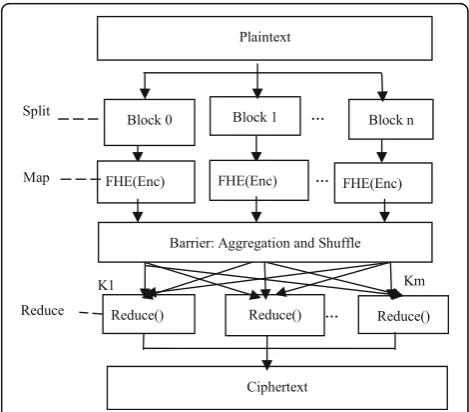
corresponding scheduling mechanism. The Map func-tion conducts corresponding operafunc-tion of each data block after splitting based on the user-defined encryp-tion algorithm. Each Map completes one part of final result, and each Reduce is responsible of integrating all partial results completed by Maps. Each encryption computation of parallel encryption scheme is inde-pendent, so it can be distributed to multiple Maps for simultaneous encryption. It can be defined as a cubic polynomial time algorithm ∏= (Split,Map,Reduce), and the specific process is as shown in Fig. 1.
5.2 Split algorithm
Assume the plaintext file size isL(MB), the number of clus-ter processing nodes isP, and the original file is split intot
data blocks (t≥1). We give the specific split algorithm as algorithm 1. In which,posrefers to the location of currently processed data in the original file;irepresents theith data block;lirepresents the size of theith block (i≤t). The spe-cific process is as follows: Open the big-data file to be encrypted, use theposvariable to save the offset of first byte in the file, and when current data under processing has not reached the end of file, use Eq. (22) to calculate the length
liof theith fragment. Filebuffer refers to the content saved in the ith block; Key refers to the offset of the start ofith block in the file; value is the value saved in each filebuffer.
pospoints to the next shard The size of each data blockli can be calculated based on Eq. (22).
li¼ 220dL=te;i<n
220½L−dL=te ðt−1Þ;i¼n
ð22Þ
5.3“Map”function and“Reduce”function
After the splitting stage, each Mapper will independently compute part of ciphertext. Each Mapper will conduct the encryption process of steps 1 ~ 4 in the encryption algo-rithm of Section4.1, before each encryption of data, gen-erate n−1 pairs of encrypted noise; then, compute the order child ciphertextciaccording to Eq. (7); finally,
gen-erate out-of-order ciphertext with the mapping function. The definition of the specific interface of Map ( ) func-tion is as follows: public void map (Object key, Text value, Context context) throws IOExecption, Interrupted Exception. In which, the parameter key is the key value passed into map; value is the value of corresponding key value; and context is the context object parameter, which is the context object of Hadoop to accessed by the program. For each floating-point number in each data block, repeat executing the Map algorithm in Algorithm 2.
Reduce function waits for the partial ciphertext com-putation by all Map functions to be completed and then conducts sorting according to the key value. Because the key value is the offset of text, the sorting result is the read-in order of file. When writing in the file, only the value part is output, and the final file splices partial ci-phertexts based on the order and forms splices cipher-text for output.
5.4 Performance analysis
The encryption process of floating-point number FFHE scheme can be divided into two stages: the preparation stage and encryption stage. The first stage mainly in-volves the generation and check of key, the second stage mainly involves the data encryption operation, and they are the main parts of algorithm performance analysis. In the improved FHE scheme, the operation granularity is floating-point number. In the computer, the addition op-eration, shift operation and assignment operation have close complexity. AnXoperation is defined in this paper to uniformly express the above three operations.
Assume the file with the size of L(MB), contains N
floating-point numbers, the total encryption time of plaintext file is Tseq, the generation and check time of key isTkey, the encryption time isTEnc, and Tseq can be expressed by Eq. (23).
Tseq ¼TkeyþTEnc ð23Þ
conditions, the preparation stage consists of2nfixed as-signment operations, soTkeyconsists of2n Xoperations. The data encryption stage mainly involves the addition, multiplication, division, and assignment opera-tions. The part to generate random noise involves 2(n−
1) assignment operations. Execute encryption algorithm to real number v and obtain n-dimension ciphertext array. In which, the first n−1 child ciphertexts corres-pond to 2(n−1) multiplication operations and 2(n−1) addition operations, and there are 4(n−1)X operations in total. The child ciphertext cn mainly consists of two multiplication operations, n−1 addition operations and
n−1 division operations, which can be expressed as 2(n
−1) + 2X operations. The random sorting operation in-volves nmapping and nassignment operations of map-ping function Π, as well as deterministic encryption operation that includes m X operations, which can be expressed as2n + m Xoperations, and it require the fol-lowing number of X operations in order to encrypt N
floating-point number plaintexts:
2ðn−1Þ þ4ðn−1Þ þ2ðn−1Þ þ2þ2nþm
½
N ð24Þ
Assume one X operation takes time of Tfc, then, the FHE parallel encryption algorithm that includes N
floating-point number takes time ofTseq:
Tseq ¼TkeyþTEnc
¼½2nþNð10n−6þmÞTfc ð25Þ
When N> >n, the value of 2n (i.e., Tkey) can be ig-nored; however, with the increase of N, the encryption time generally presents linear increase.
During the parallel encryption process, assume there is no overlapping during the operation process, and the execution time of parallel encryption algorithm consists of four parts, i.e.:
Tn¼TcommþTkeyþTMapþTreduce ð26Þ
In which,Tcommis the communication time,Tkeyis the generation and check time of key, TMap is the parallel encryption time of Map, andTreduceis the time to merge encrypted ciphertexts according to the key value.
During the parallel encryption stage of Map, each slave node would have communication with host during the start and ending stages of task, and the plaintext of N
floating-point numbers are divided intotdata blocks, so it requires overhead for at least 2tdata communications, and we can setTcomm=ξ1tTfc.
Assume each data block contains x floating-point numbers, then x=N/t. Ti represents the time required to encrypt theith data block, thenTi=x× (10n-6 +m) ×
Tfc. SetSTas the speed-up ratio of each Map during the parallel encryption stage, then
ST¼
Tseq TcommþTkeyþTi
¼ ξ ½2nþNð10n−6þmÞTfc
1tþ2nþxð10n−6þmÞ
½ Tfc
¼ 2nþNð10n−6þmÞ
ξ1tþ2nþxð10n−6þmÞ
ð27Þ
In the actual application scenario, both the file partition number tand the number of child ciphertextsnare sig-nificantly smaller than the floating-point numberMin the plaintext, i.e., t, n< <M. In addition, the communication time can be ignored, so we can know that the speed-up ra-tioSTis close toN/x, i.e., the block numbertof plaintext.
For plaintext data with the same size, the generated ci-phertexts also have the same size. Assume it requires re-duce time of Tric for each floating-point number to generate ciphertext, then the plaintext that contains N
floating-point numbers requires the time of Treduce=
N×Tric, and it can be seen thatTreduceis proportional to the size of generated ciphertext.
Table 1Software and hardware configuration
Product name The parameter and model
Cash 3.2 GHz/8 M
Memory bank 16 GB(2 × 8 GB)1333 MHz
Dual ranked RDIM
Hard disk 1 TB 3.5-in. 7200 RPM SATA II Operating system CentOS Linux Server6.6
JAVA VM JAVA 1.7.0
Considering Reduce takes a lot of time, and the experi-ment involves 16 nodes, so in this experiexperi-ment, the num-ber of Reduce is 15, and the time required by parallel encryption can be expressed as:
ST¼ Tseq TcommþTkeyþTi
¼ ξ ½2nþNð10n−6þmÞTfc
1tþ2nþxð10n−6þmÞ
½ Tfc
¼ξ 2nþNð10n−6þmÞ
1tþ2nþxð10n−6þmÞ
ð28Þ
when the value ofNis high,TkeyandTcommcan be ig-nored. Therefore, it can be seen that during parallel en-cryption, ifNstays the same, with the increase of t, the time consumed by Reduce also stays the same, the time consumed by Map gradually declines, and the time con-sumed by Reduce gradually becomes dominant.
IfSPis used to represent the overall speed-up ratio,SP can be expressed as:
SP¼
Tseq
Tn ¼
TkeyþTEnc
TcommþTkeyþTMapþTreduce
¼ξ ½2nþNð10n−6þmÞ Tfc
1tTfcþ2nTfcþTfc½ð10n−6þmÞ N=t dt=pe þN=15Trci
≈ t
t=p
d e þt=15Trci=Tfc1=ð10n−6þmÞ
ð29Þ
It can be seen that under fixed core number p, when t∈(kp,kp+p] (in which k is a natural number), the speed-up ratio ηTpresents growth trend, and it will not exceedp.
6 Experimental results and analysis
The hardware platform of experiment includes 1 Master node and 3 Slave nodes. The Master node is responsible of the monitoring and scheduling of tasks, and the Slave nodes are responsible of the distributive storage data file and computation task, see “Table 1-experiment cluster node configuration” for the specific hardware configur-ation and software environment for each node.
In this experiment, data test was conducted from two main different perspectives: in the first scenario, plain-text data with different sizes were chosen to compare their encryption speed and speed-up ratio in different serial and parallel environment; in the second situation, Table 2The test results of different size file
File size (MB) Serial time (seconds) Parallel time (seconds) Max Map time (seconds) Reduce time (seconds) SP
256 61 33 16 13 1.8
512 123 44 17 22 2.8
768 186 51 18 30 3.6
1024 254 58 17 36 4.4
1280 312 83 18 45 3.8
1536 378 88 17 51 4.3
1792 443 97 17 58 4.6
2048 516 104 18 63 5.0
Fig. 2The encryption time of different size file. The figure compares the encryption time under different file sizes in serial and
parallel environments
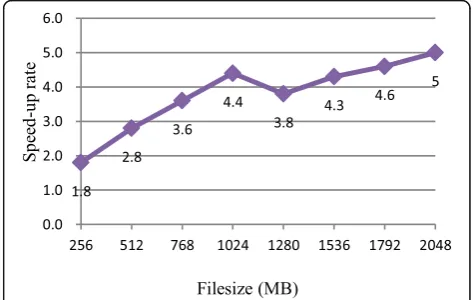
Fig. 3The speed-up rate of different size file. The figure shows the overall speed-up rate under different file sizes in
plaintext data with fixed size were chosen to compare their encryption speed and speed-up ratio under differ-ent block sizes. In the first situation, the chosen plain-text data had the sizes of 256 MB, 512 MB, 768 MB, 1024 MB, 1280 MB, 1536 MB, 1792 MB, and 2048 MB, the default data block size was 64 MB in the parallel en-vironment, and the encryption test was conducted in both serial and parallel environment. For the second situation, the plaintext data with the sizes of 2G and 4G were chosen in the experiment, the data fragment num-bers were 1, 4, 8, 12, 16, 20, 24, 28, and 32, respectively, and their encryption speeds were tested. In the experi-ment, the size of float-point numbers is 32 bit, and the dimension of the security parameternis 128 bit.
In the experiment, 4 computation nodes were used, and each node had 4-core CPU, so the CPU had total 16 cores. In the parallel experiment, we found that with the increase of plaintext data volume, the time occupied by Reduce would keep growing, and in order to increase the effi-ciency, the number of Reduce was all set as 15 in parallel experiment.
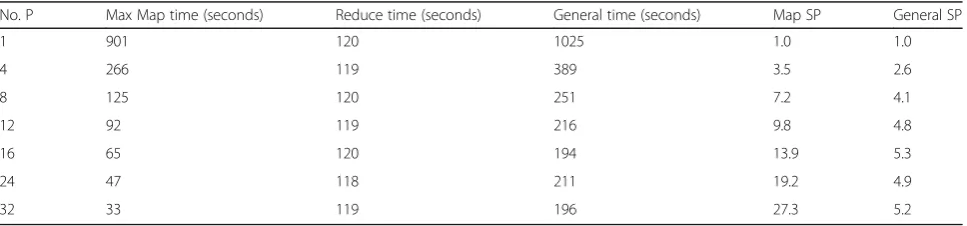
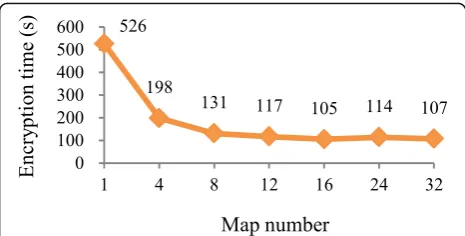
In this paper, the file encryption time and overall speed-up ratio under different file sizes are summa-rized in the serial and parallel environment, and the results are shown in Table 2, Figs. 2 and 3. Tables 3 and 4 have recorded the overall encryption time of file, the execution time of Map process, and the over-all speed-up ratio and the speed-up ratio of Map process when the plaintext size is 2G and 4G, respectively.
According to Table2 and Figs.2and 3, it can be seen that under fixed number of nodes: (1) the time required by serial encryption is basically proportional to the plaintext size; (2) the time required by parallel encryp-tion will increase with the increase of plaintext; (3) when
t<p, the time consumed by Reduce function will grad-ually increase with the increase of t, and with the time consumed by Map function stayed the same, the propor-tion of time consumed by Reduce funcpropor-tion in the overall parallel encryption process will gradually increase; (4) whent<p, the increase of speed-up ratioSPis fast, and it will reach the highest value whent=p. Whent>p, for each t∈(kp,kp+p], the speed-up ratio presents the trend of slow growth, and it will reach the highest value when
t= (k+ 1) ×p.
Figures4and5show the encryption time of 2-GB and 4-GB files allocated to different cores in parallel environ-ments. According to Figs.4 and 5, we can see that with the increase of usable cores and file partitions in the cluster: (1) for plaintext big-data file with certain length, with the increase of Map quantity, the file encryption time presents a general trend of decline, and the time consumption will be the lowest when the Map quantity equals the node number; (2) the time consumed by max Map will gradually decline, because with the increase of Map quantity, the size of each Map data block will de-cline, and the time-consuming of Map mainly concen-trates on the encryption operation, so the time consumed by this part will be low. The time consumed by Reduce is basically the same, because no matter how Table 3The test results of a 2-GB file on different cores
No. P Max Map time (seconds) Reduce time (seconds) General time (seconds) Map SP General SP
1 456 65 526 1.0 1.0
4 129 62 198 3.5 2.6
8 61 64 131 7.4 4.0
12 47 64 117 9.7 4.5
16 33 63 105 13.8 5.0
24 25 64 114 18.2 4.6
32 17 63 107 26.8 4.9
Table 4The test results of a 4-GB file on different cores
No. P Max Map time (seconds) Reduce time (seconds) General time (seconds) Map SP General SP
1 901 120 1025 1.0 1.0
4 266 119 389 3.5 2.6
8 125 120 251 7.2 4.1
12 92 119 216 9.8 4.8
16 65 120 194 13.9 5.3
24 47 118 211 19.2 4.9
high the Map quantity is, the number of Reduce is al-ways 15.
Figures6and7compares the Map speed-up and Gen-eral speed-up of 2-GB and 4-GB files under different cores in parallel environments. According to Figs. 4and 5, we can see that with the increase of usable cores in the cluster: (1) the speed-up ratio of Map will increase with the increase of Map quantity, and it will always be lower than the Map quantity, which is consistent with the theoretical analysis in previous section; (2) the speed-up ratio of general also increase with the increase of Map quantity, but the acceleration ratio tends to be stable when the Map quantity equals the node number. During the early stage, with the increase of usable cores, the file encryption time presents significant decline, and the cluster performance can be effectively carried out; when all cores of cluster are used in the computation equation, the increase of Map quantity will have little in-fluence on the improvement of cluster performance, and the file encryption time will become stable.
7 Conclusions
With the rapid development of cyber physical systems technology, the privacy protection problem of data in
cyber physical systems has become more and more important. Most of the existing fully homomorphic encryption algorithms are limited to process the inte-ger type. In order to expand the practical application range of the existing fully homomorphic encryption algorithm, we propose a parallel fully homomorphic encryption scheme that supports floating-point oper-ation. The proposed scheme can enhance the algo-rithm security by using out-of-order ciphertexts operations. In addition, we also design and implement an efficient algorithm performed on the MapReduce platform based on the proposed scheme. Specifically, during the encryption process, a file is divided into different number of data blocks, and the algorithm’s parallelism can be controlled by specifying the usable cores and the number of partitions. Meanwhile, the multiple Reduce functions can be parallel carried out to alleviate the high real-time cost of Reduce oper-ation. The experimental results show that, compared to the traditional linear encryption algorithm, the pro-posed algorithm obtains the greater speed-up ratio when processing big data files in MapReduce cluster.
Fig. 4The encryption time of 2 GB on different cores. The figure shows the encryption time of a 2-GB file allocates to different cores in parallel environments
Fig. 6The speed-up rate of 2 GB on different cores. The figure compares the Map speed-up and General speed-up of a 2-GB file under different cores in parallel environments
Fig. 5The encryption time of 4 GB on different cores. The figure shows the encryption time of a 4-GB file allocates to different cores in parallel environments
Funding
This work was supported in part by the National Natural Science Foundation of China under the Grant 61872197, Grant 61572263, Grant 61502251 and Grant 61502243, in part by the Colleges and Universities in Jiangsu Province plans to graduate research and innovation under Grant KYLX_0816, and in part by the Natural Science Foundation of Jiangsu Province under the Grant BK20151511 and Grant BK2016151.
Availability of data and materials
We declared that materials described in the manuscript will be freely available to any scientist wishing to use them for non-commercial purposes, without breaching participant confidentiality.
Authors’contributions
ZM and GY designed the study, performed the research, analyzed the data, and wrote the paper. All authors read and approved the final manuscript.
Competing interests
The authors declare that they have no competing interests.
Publisher’s Note
Springer Nature remains neutral with regard to jurisdictional claims in published maps and institutional affiliations.
Author details
1School of Computer Science, Nanjing University of Posts and
Telecommunications, Nanjing 210046, China.2Jiangsu Key Laboratory of Big Data Security& Intelligent Processing, Nanjing 210046, China.3School of
Computing Science and Engineering, Vellore Institute of Technology (VIT), Vellore, Tamil Nadu, India.
Received: 16 October 2018 Accepted: 11 December 2018
References
1. F. Pasqualetti, F. Dörfler, F. Bullo, Attack detection and identification in cyber-physical systems. IEEE Trans. Autom. Control58(11), 2715–2272 (2013) 2. R. Rajkumar, I. Lee, L. Sha, et al., 44.1 Cyber-physical systems: The next
computing. Theol Rev.14(6), 731–736 (2010)
3. J. Wang, R. Zhu, S. Liu, A differentially private unscented Kalman filter for streaming data in IoT. IEEE Access6(99), 6487–6495 (2018)
4. R. Zhu, X. Zhang, X. Liu, et al., ERDT: Energy-efficient reliable decision transmission for intelligent cooperative spectrum sensing in industrial IoT. IEEE Access.3(28), 2366–2378 (2015)
5. K. Zhu, R. Zhu, H. Nii, et al., PaperIO: a 3D interface towards the internet of embedded paper-craft. IEICE Trans inf System.97(10), 2597–2605 (2014) 6. B. Dan, E. Kushilevitz, R. Ostrovsky, W.E. Skeith,Public key encryption that
allows PIR queries, Advances in Cryptology CRYPTO(2007), pp. 50–67 7. H. Avni, S. Dolev, N. Gilboa, X. Li, inProc. of ALGOCLOUD, Patras, Greece.
SSSDB: Database with private information search (2015), pp. 49–61 8. Q. Liu, G. Wang, J. Wu, Secure and privacy preserving keyword searching for
cloud storage services. J. Netw. Comput. Appl.35(3), 927–933 (2012) 9. K. Gu, W.J. Jia, J.M. Zhang, Identity-based multi-proxy signature scheme in
the standard model. Fund. Inform.150(2), 179–210 (2017)
10. X.B. Shen, W. Liu, I.W. Tsang, et al., Multilabel prediction via cross-view search. IEEE Trans. Neural Netw. Learn. Syst.29(9), 4324–4338 (2018) 11. X.B. Shen, F.M. Shen, Q.S. Sun, et al., Semi-paired discrete hashing: Learning
latent hash codes for semi-paired cross-view retrieval. IEEE Trans. Cybern.
47(12), 4275–4288 (2017)
12. C.Y. Yin, J.W. Xi, R.X. Sun, J. Wang, Location privacy protection based on differential privacy strategy for big data in industrial internet of things. IEEE Trans. Ind. Inf.14(8), 3628–3636 (2018)
13. S.K. Pasupuleti, S. Ramalingam, R. Buyya, An efficient and secure privacy-preserving approach for outsourced data of resource constrained mobile devices in cloud computing. J. Netw. Comp. Appl.64(C), 12–22 (2016) 14. S. Gajek,Symmetric Searchable Encryption from Constrained Functional
Encryption, in Cryptographers’Track at the RSA Conference(Springer, Cham, 2016), pp. 75–89
15. M. Long, F. Peng, H.Y. Li, Separable reversible data hiding and encryption for HEVC video. J. Real-Time Image Proc.14(1), 171–182 (2018)
16. J. Wang, C.W. Ju, Y. Gao, A.K. Sangaiah, G.J. Kim, A PSO based energy efficient coverage control algorithm for wireless sensor networks. Comp. Mater. Continua56(3), 433–446 (2018)
17. J. Wang, Y. Cao, B. Li, H.J. Kim, S.Y. Lee, Particle swarm optimization based clustering algorithm with mobile sink for WSNs. Futur. Gener. Comput. Syst.
76, 452–457 (2017)
18. Y. Lindell, B. Pinkas, Secure multiparty computation for privacy -preserving data mining. J. Priv. Confid.25(2), 761–766 (2009)
19. I. Damgård, A. Polychroniadou, V. Rao, inProc. of PKC, New York. Adaptively secure multi-party computation from LWE via equivocal FHE (2016), pp. 208–233
20. X.B. Shen, F.M. Shen, L. Li, et al. Multiview discrete hashing for scalable multimedia search, in Proc. of ACM TIST, 2018
21. Q. Zhou, G. Yang, S. Li, L. Chen, An integrity-checking private data aggregation algorithm. J. Electron. Inform. Technol,35(6), 1277–1283 (2013) 22. J. Wang, Z.Q. Zhang, B. Li, S.Y. Lee, R.S. Sherratt, An enhanced fall detection system for elderly person monitoring using consumer home networks. IEEE Trans. Consum. Electron.60(1), 23–29 (2014)
23. E.B. Tirkolaee, A.A.R. Hosseinabadi, M. Soltani, A.K. Sangaiah, J. Wang, A hybrid genetic algorithm for multi-trip green capacitated arc routing problem in the scope of urban services. Sustain10, 5 (2018)
24. D. Micciancio, A first glimpse of cryptography’s holy grail. Commun. ACM
53(3), 96–96 (2010)
25. R.L. Rivest, L. Adleman, M.L. Dertouzos, inFoundations of Secure Computation, London. On data banks and privacy homomorphisms (1978), pp. 169–179
26. R.L. Rivest, L. Adleman, M.L. Dertouzos, A method for obtaining digital signatures and public key cryptosystems. Commun. ACM21(2), 120–126 (1978) 27. T. Elgamal, A public key cryptosystem and a signature scheme based on
discrete logarithms. IEEE Trans. Inform. Theor.31(4), 469–472 (1985) 28. P. Paillier, inProc. of Eurocrypt’99. Public-key cryptosystems based on
composite degree residuosity classes (1999), pp. 223–238
29. C. Gentry, inProc. of the Annual ACM Symposium on Theory of Computing , Bethesda. Fully homomorphic encryption using ideal lattices (2009), pp. 169–178
30. M. Dijk, C. Gentry, S. Halevi, V. Vaikuntanathan, inProc. of EUROCRYPT’2010. Full homomorphic encryption over the integers (Springer, Berlin, 2010), pp. 24–43 31. Z. Brakerski, V. Vaikuntanathan, inFoundations of Computer Science. IEEE. Efficient
fully homomorphic encryption from (standard) LWE (2011), pp. 97–106 32. D. Stehlé, R. Steinfeld,Making NTRU as Secure as Worst-Case Problems over
Ideal Lattices, in Proc. of EUROCRYPT’2011, LNCS(2011), pp. 27–47 33. Z. Brakerski, C. Gentry, V. Vaikuntanatha, inProc. of the 3rd Innovations in
Theoretical Computer Science Conf, New York. (Leveled) fully homomorphic encryption without bootstrapping (2012), pp. 309–325
34. Z. Brakerski, V. Vaikuntanathan, inProc. of CRYPTO, Berlin. Fully homomorphic encryption from ring-LWE and security for key dependent messages (2011), pp. 505–524
35. A. López-Alt, E. Tromer, V. Vaikuntanathan, inProc. of the Annual ACM Symposium on Theory of Computing, New York. On-the-fly multiparty computation on the cloud via multikey full homomorphic encryption (2012), pp. 1219–1234
36. C. Gentry, A. Sahai, B. Waters, inProc. of the 33rd Annual International Cryptology Conference, Berlin. Homomorphic encryption from learning with errors: Conceptually- simpler, asymptotically-faster, attribute -based (2013), pp. 75–92
37. J.H. Cheon, J.S. Coron, J. Kim, M.S. Lee, T. Lepoint, inProc. of CRYPTO 2013, Berlin. Batch full homomorphic encryption over the integes (2013), pp. 315–335 38. J.N. Gaithuru, M. Bakhtiari,Insight Into the operation of NTRU and a
Comparative Study of NTRU, RSA and ECC public key cryptosystems, in Software Engineering Conference(2014), pp. 273–278
39. H. Chen, Y.P. Hu, Z. Lian, Double batch for RLWE-based leveled fully homomorphic encryption. Chin. J. Electron.24(3), 661–666 (2015) 40. J.H. Cheon, J. Kim, M.S. Lee, A. Yun, CRT-based fully homomorphic
encryption over the integer. Inform. Sci. An Intern. J310(C), 149–162 (2015) 41. S. Garg, C. Gentry, S. Halevi, A. Sahai, B. Waters, inProc. of 33rd Annual
Cryptology Conf , Berlin. Attribute-based encryption for circuits from multilinear map (2013), pp. 479–499
42. D. Tan, H. Wang, Fully homomorphic encryption based on the parallel computing. KSII Trans. Int. Inform . Syst12(1), 497–522 (2018) 43. D. Liu, Practical Fully Homomorphic Encryption without Noise Reduction.
44. D. Liu,Efficient processing of encrypted data in honest-but-curious clouds, IEEE cloud (2017), IEEE Computer Society(2017), pp. 970–974
45. X. Liu, R.H. Deng, K.K.R. Choo, J. Weng, An efficient privacy-preserving outsourced calculation toolkits with multiple keys. IEEE Trans. Inform. Forensics Sec.11(11), 2401–2414 (2016)
46. X. Liu, R. Choo, R. Deng, R. Lu, J. Wengl,Efficient and Privacy-Preserving Outsourced Calculation of Rational Numbers, IEEE Trans on Dependable and Secure Computting, PP(99), 27–39(2018)
47. M. Brenner, J. Wiebelitz, G.V. Voigt, M. Smith, inProc. of IEEE International Conference on Digital Ecosystems and Technologies Conference(DEST). Secret program execution in the cloud applying homomorphic encryption (2011), pp. 114–119
48. C.S. Lu, Homomorphic encryption-based secure SIFT for privacy-preserving feature extraction. Proc. of SPIE7880(2), 788005 (2011)
49. M. Naehrig, K. Lauter, V. Vaikuntanathan, inProc. of ACM CCSW, ACM, Chicago. Can homomorphic encryption be practical? (2011), pp. 113–124 50. K. Gjøsteen, M. Strand. Fullyhomomorphic encryption must be fat or ugly?
Cryptology ePrint Archive, [Online]. Available: http://eprint.iacr.org/2016/ 105.pdf
51. M. Chase, K. Lauter, J. Benaloh, A.Z. Horvitz,Patient controlled encryption: Patient privacy in electronic medical records , in Proc of Cloud Computing Security Workshop(2009), pp. 103–114
52. Y. Tu, Y. Lin, J. Wang, J.U. Kim, Semi-supervised learning with generative adversarial networks on digital signal modulation classification. Comp. Mater. Continua55(2), 243–254 (2018)
53. D.J. Zeng, Y. Dai, F. Li, R.S. Sherratt, J. Wang, Adversarial learning for distant supervised relation extraction. Comp. Mater. Continua55, 121–136 (2018) 54. J. Wang, J.Y. Cao, S. Ji, J.H. Park, Energy efficient cluster-based dynamic
routes adjustment approach for wireless sensor networks with mobile sinks. J. Supercomput.73(7), 3277–3290 (2017)
55. J. Yao, K. Zhang, Y.T. Yang, J. Wang, Emergency vehicle route oriented signal coordinated control model with two-level programming. Soft. Comput.
22(13), J4283–J4294 (2018)
56. Y.J. Ren, Y.P. Liu, S. Ji, A.K. Sangaiah, J. Wang, Incentive Mechanism of Data Storage Based on Blockchain for Wireless Sensor Networks, Mobile Information Systems, Volume 2018, Article ID 6874158 2018, 10.1155/2018/ 6874158/
57. Z. Min, G. Yang, J.Q. Shi, A privacy-preserving parallel and homomorphic encryption scheme. Open Physics15(1), 135–142 (2017)
58. J.H Cheon , A. Kim , M. Kim and Y Song. Floating-Point Homomorphic Encryption, [Online]. Available: http://eprint.iacr.org/2016/421.pdf 59. Arita S, Nakasato S. Fully Homomorphic Encryption for Point Numbers ,
[Online]. Available:http://eprint.iacr.org/2016/402.pdf
60. Costache A, Smart N P, Vivek S, et al. Fixed point arithmetic in she schemes, [Online]. Available:http://eprint.iacr.org/2016/250.pdf