AN ANALYSIS OF AVAILABILITY OF HUMAN AND PHYSICAL
RESOURCES FOR SMALL AND MEDIUM ENTERPRISES IN SRI
LANKA
N.P. Ravindra Deyshappriya
Senior Lecturer, Faculty of Management, Uva Wellassa University, Sri Lanka.
ABSTRACT
Article History
Received: 16 August 2019 Revised: 23 September 2019 Accepted: 28 October 2019 Published: 12 December 2019
Keyword
s
Small and medium enterprises Physical resources Human resources Skilled labour
Infrastructure development.
This study attempts to recognize level of human and physical resources available for SMEs in both Central and Uva provinces along with preparing a diagnostic framework for SMEs. The results highlight lack of/non- availability of appropriate physical and human resource impacts most existing and new SMEs. Issues related to physical resources include limited access to modern technology, machinery and upgraded infrastructure. Moreover, despite, the availability of human resources the lack of skilled and experienced workers is a critical factor in SME development in these regions. As per the quantitative results, Badulla and Monaragala districts lag the Matale and Nuwara Eliya districts in terms of availability of resources and its level of satisfaction among SME holders. According to the SWOT analysis, the key strengths of both Uva and Central provinces include availability of land and other natural resources, favorable weather conditions, suitable geographic landscape and natural beauty, cultural and religious sites of archaeological value, adequate human resources, availability of raw materials, sufficient infrastructure and availability of skilled labour in the garment sector. Main weaknesses which SMEs in both Uva and Central province experience include lack of skilled labour, lack of modern technology, unavailability of sufficient market opportunities, lack of initial capital and indebtedness, lack of expertise, land ownership issues and dependency mindset of inhabitants.. The study recommends employing necessary policies which can ensure required resources for SMEs while addressing both weakness and threats faced by SMEs in both provinces.
Contribution/ Originality:
This study contributes the existing literature by assessing the sufficiency of available resources for SMEs in Sri Lanka. Despite existing literature examined the relationship between the resources and performance of SMEs, an assessment on aforementioned was not carried out and the study fills that vacuum in the literature.1. INTRODUCTION
1.1. Background of the Study
The recent literature on SME repeatedly confirms that contribution of SME on economic growth and employment is vital and should be continued to ensure a steady growth in long run. Countries define SMEs based on different bases and dimensions and therefore different counties have different definitions of SMEs. In the United State of America (USA) definition of SMEs varies by industry as well. SMEs in manufacturing sector should have 500 or less employees while in trade and wholesale sectors should be 100 or less employees. In contrast, SMEs in mining, quarrying and oil and gas extraction sectors are eligible to have up to 1500 employees while SMEs in silver
International Journal of Asian Social Science
ISSN(e): 2224-4441ISSN(p): 2226-5139
DOI: 10.18488/journal.1.2019.912.636.650 Vol. 9, No. 12, 636-650.
ore mining can have 250 employees (Ward, 2018). The Industry of Canada (2017) identified four types of SMEs considering the number of employees. Industries with 1-4, 5-99 and 100-499 employees defined as micro, small and medium industries while the industries with more than 500 are considered as large industries. As table 03.1 indicates, China has considered number of employees, annual revenue and assets in defining SMEs. According to the classification provided by China‟s Ministry of Industrial and Information Technology (2011) the number of employees accommodate in SMEs can vary from 200 to 2000 while the revenue changing from 100 m (RMB) to 400m (RMB). In fact, European Commission has considered three dimensions such as number of employees, annual turnover and total balance sheet as well (European Commission, 2005).
However, it is crucial to focus on Sri Lankan definition of SME as this study based on SMEs in Sri Lanka. Sri Lanka has also considered two dimensions such as number of employees and annual turnover in order to classify SMEs into micro, small and medium categories. Under the present SME policy framework in Sri Lanka, SMEs are defined based on the number of employees and annual turnover. In order to qualify as a SME, an enterprise must employ less than 300 people and generate an annual turnover less than LKR 750.0 million.
Table-1. SME classification in Sri Lanka.
Company
category Number of Manufacturing sector Service sector
employees Annual turnover (Million) Number of employees Annual turnover (Million)
Micro 1-10 ≤ LKR 15 1-10 ≤ LKR 15
Small 11-50 ≤ LKR 16-250 11-50 ≤ LKR 16-250
Medium 51-300 ≤ LKR 251-750 51-200 ≤ LKR 251-750
Source: Ministry of Industry and Commerce (2002).
Sri Lanka has also identified slightly different thresholds in terms of number of employees for manufacturing and service sectors. The current study applies SME classification indicated in Table 1.
In Sri Lanka, as of 2014, SMEs which made up nearly 90% of enterprises (over one million SMEs), contributed 52% to the country‟s GDP and produced 45% of its employment (MIC, 2016).
Table-2. Number of persons and percentage distribution economic sector wise.
Scale of the establishment Persons engaged Sector-wise distribution, percentages
No % Industry Trade Service
Total 3,003,119 100 100 100 100
Micro 1,338,675 44.6 29.7 68.1 44.6
Small 529,751 17.6 14.0 16.8 22.6
Medium 386,756 12.9 16.7 5.5 13.9
Large 747,937 24.9 39.6 9.5 18.9
Source: MIC (2016).
Table 2 indicates the persons engaged in each type of SME and the sector wise percentage distribution. The
total number employed in the micro scale is 1.3 million which is 45% of the total, although micro scale represented almost 92% of the establishments Table 3. The large scale business sector represents almost 25% of the employment despite the fact they account for only 0.2% of the establishments as the number employed per establishment is high.
Table-3. Number of establishments and percentage distribution economic sector wise.
Scale of the establishment Total number of establishments Industry % Trade % Service %
Total 1,019,681 100% 25.6 41.0 33.4
Micro 935,736 91.8% 25.3 42 32.7
Small 71,126 7.0% 28.8 31.3 39.9
Medium 10,405 1.0% 32.0 19.6 48.4
Large 2,414 0.2% 31.6 36.9 31.5
Out of the over million establishments, a great number fell under micro enterprises where the trade sector was most dominant. This may be due to the significant prevalence of retail shops. However, in both small and medium businesses, there was a higher engagement in the service sector. A breakdown of SME composition reveals that, as of 2014, 75% of SMEs relate to the following industries: food, beverage and tobacco; textile, apparel and leather; mining. Large companies still dominate the export market, while SMEs only contribute to about 5% of total exports. Of the total SME production only 6% to 11% are exported.
In the overall development strategy spelled out by the Government in its Vision 2025 document, there is a move to steer the economy towards a private sector led export strategy. (This approach has been endorsed in a recent book “Export Competitiveness and Poverty Alleviation in South Asia with special reference to Sri Lanka, by Lloyd Yapa”. Therefore harnessing the SME sector towards this development objective should form a main part of the government‟s economic policy. Recent policy pronouncements, budget speeches and practical actions such as the Grama Shakthi programme and Enterprise Sri Lanka are indicative of the government being conscious of the need to uplift the SME sector. Combined with the export led strategy there are studies that have recommended a development strategy of increasing food production. In the long term this will result in bringing down food prices thus reducing wages cost, allowing for more competitive pricing of exports. An added developmental benefit is that it would increase disposable incomes of households which in turn increases purchasing power allowing for increased demand for goods and services produced in the domestic economy. That the SME sector is naturally positioned to play a significant role in this development strategy is clear. Hence a conducive and enabling policy environment is vital to leverage the potential of this sector to be a key player in the country‟s development trajectory.
1.2. Key Challenges Faced by SMEs in Sri Lanka and Objectives of the Study
A large number of empirical studies have identified key challenges faced by SMEs in general. However, a study formed by International Finance Corporation (IFC) observed that 77% of Sri Lankan SMEs out of total SMEs included in the study, highlighted the requirement of medium and long term loans for their businesses. Among them only 53% of SME holders had access to bank loans and however out of this 53%, only 29% SMEs could successfully secure their financial requirements (Nanayakkara, 2011). However, Attygalle et al. (2014) argued that government has formed special banks such as Lankaputhra Development Bank to provide loans for SMEs while other banks such as Peoples‟ Bank, Sanasa Bank and Regional Development Banks are also providing such loan schemes. In contrast, Gamage (2003) highlighted that SMEs face severe difficulties in accessing loans as banks and financial institutions ask for heavy collateral and also charge higher interest rates. Abeyratne (2006) conducted a survey in Monaragala district in order to analyze the key challenges faced by SMEs. The study had identified 27% of SME holders in Monaragala district as having been negatively affected by un-supporting government policies. In contrast, only 16% of SMEs in Monaragala district had mentioned about financial difficulties faced by them. This is mainly due to availability of informal financial institutions and they provide loans without any collateral with repayment collected on a daily or weekly basis. However, interest rates attached to these loans schemes are extremely high and the borrowers do not even know the interest rate. In addition to financial constraints highlighted by the authors, non-financial barriers such as lack of technology and managerial skills also hinder the efficiency and performance of SMEs.
aggressive field administration. ASEAN got together and launched a blue print for ASEAN SMEs which got traction but Sri Lanka could not latch on to this. Athukorala (2017) further stressed, it would approximately take 258 days to complete business registration process together with a cost of 5% of the land value, which is not conducive to foster entrepreneurship. The lack of business development services, inadequate research and development facilities, quality certification at district level and the linkage to export markets not being readily available, come up as key issues whilst the biggest issue is the difficulty in having access to concessionary finance. Another point highlighted by Athukorala (2017) is that, the SMEs pay on average 28 types of taxes which are highly complex and time consuming. Similar to Athukorala (2017); Priyanath and Premaratne (2014) also criticized the policy framework related to SMEs in Sri Lanka.
The government SME development programs do not facilitate SMEs to access sufficient and reliable information which lead to more rational decision making, to safeguard transactions from opportunism and to select a suitable governance mechanism. SME development programs have neglected in supporting formal governance; As a result, there is a high possibility that SMEs in Sri Lanka have a greater transaction cost which impedes the growth of SMEs (Priyanath and Premaratne, 2014). Vijayakumari (2012) highlighted that there is only a very poor growth in SMEs, in terms mean value of assets, value of turnover and mean value of number of employees as well as growth stages of SMEs. Despite the literature highlighted number of challenges related to SME sector of Sri Lanka, it is very rare to find studies which focus on availability of local resources related to SMEs in Sri Lanka. However, availability of local resources such as human and physical resources are crucial to expand existing SMEs and also to start up new SMEs. Therefore, it is timely important to address availability of such resources in order to facilitate for SME sector of Sri Lanka. Hence, the current study attempts to accomplish the following objectives:
1. To assess the level of human and physical resources available for SMEs in both Central and Uva Provinces. 2. To develop a diagnostic framework that would enable identification of limitations and opportunities related to SMEs in both Central and Uva Provinces. The next sections of the paper include methodology followed by result and discussion. After that, conclusions and recommendations were elaborated along with references of the study.
2. METHODOLOGY
2.1. Location of the Research and Study area
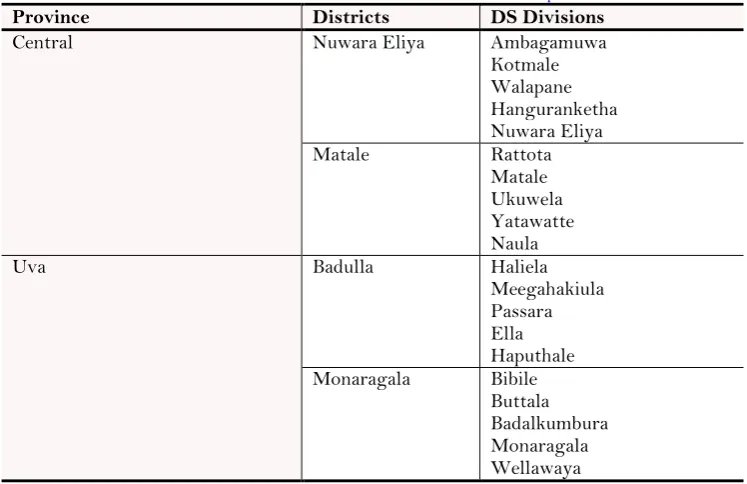
The current study focuses on both Central and Uva provinces of Sri Lanka and all two districts of Uva province (Badulla and Monaragala) and two districts (Nuwara Eliya and Matale) from Central province were selected as study area. Moreover, five Divisional Secretariat (DS) divisions from each district (altogether 20 DS divisions) were selected considering the distribution of current SMEs and also in consultation with relevant government officials in respective districts. Table 4 indicates the selected DS divisions against the respective districts and provinces.
2.2. Data Collection and Analysis 2.2.1. Enterprise Survey
Table-4. Selected districts and DS divisions in Uva and central provinces.
Province Districts DS Divisions
Central Nuwara Eliya Ambagamuwa
Kotmale Walapane Hanguranketha Nuwara Eliya
Matale Rattota
Matale Ukuwela Yatawatte Naula
Uva Badulla Haliela
Meegahakiula Passara Ella Haputhale
Monaragala Bibile
Buttala Badalkumbura Monaragala Wellawaya
2.2.2. Focus Group Discussions (FGDs) and Key Informant Interviews (KIIs)
It is important to note that FGDs and KIIs are used as the key sources of qualitative data in this study. The main objectives of the FGDs and KIIs are to obtain comprehensive and in-depth understanding about the MSMEs in both provinces and also from key national level informants. Similarly, FGDs and KIIs provided a crucial platform for policy oriented recommendations. Therefore, altogether 4 FGDs were conducted at district level along with 5 KIIs per district. 5 KIIs at district levels include KIIs with 2 government sector officers and 3 private sector officers.
2.2.3. Data Analysis
The collected data was analyzed by using a descriptive approach in order to accomplish the objectives of the research. Thus, graphs, charts and table have been frequently used along with some direct quotations from the interviews and the desk review. Apart from that, SWOT analysis were conducted to prepare a diagnostic framework for SMEs in both provinces.
3. RESULTS AND DISCUSSION
3.1. Examining the Availability of Local Resources for SMEs
3.1.1. Availability of Human and Physical Resources – Survey based findings
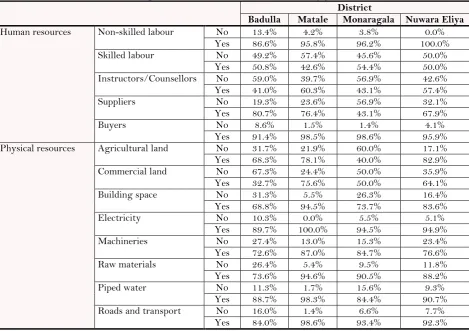
Availability of human, physical and natural resources are essential to establish new SMEs and also to sustain existing SMEs. Similarly, local availability of such resources can be considered as a highly positive factor for development of SMEs. This section examines the availability and sufficiency of local resources (Human, Physical and Natural) in the select districts. As revealed in the survey and displayed in Table 5, the lack of skilled labor can be considered a major issue. It is evident that SMEs who require skilled labor in all four districts have fulfilled only a half of their skilled labor requirement. A similar pattern can be seen in the availability of instructors/counsellors as well. The availability of skilled labor in the Monaragala district is reportedly the highest (54.4%) among the districts. Moreover, only 43.1% of SMEs in the Monaragala district have suppliers while availability of suppliers for SMEs in the other three districts ranges from 80.7% - 67.9%.
Table-5. Percentage of SMEs who have access to selected human and physical resources. District
Badulla Matale Monaragala Nuwara Eliya
Human resources Non-skilled labour No 13.4% 4.2% 3.8% 0.0%
Yes 86.6% 95.8% 96.2% 100.0%
Skilled labour No 49.2% 57.4% 45.6% 50.0%
Yes 50.8% 42.6% 54.4% 50.0%
Instructors/Counsellors No 59.0% 39.7% 56.9% 42.6%
Yes 41.0% 60.3% 43.1% 57.4%
Suppliers No 19.3% 23.6% 56.9% 32.1%
Yes 80.7% 76.4% 43.1% 67.9%
Buyers No 8.6% 1.5% 1.4% 4.1%
Yes 91.4% 98.5% 98.6% 95.9%
Physical resources Agricultural land No 31.7% 21.9% 60.0% 17.1%
Yes 68.3% 78.1% 40.0% 82.9%
Commercial land No 67.3% 24.4% 50.0% 35.9%
Yes 32.7% 75.6% 50.0% 64.1%
Building space No 31.3% 5.5% 26.3% 16.4%
Yes 68.8% 94.5% 73.7% 83.6%
Electricity No 10.3% 0.0% 5.5% 5.1%
Yes 89.7% 100.0% 94.5% 94.9%
Machineries No 27.4% 13.0% 15.3% 23.4%
Yes 72.6% 87.0% 84.7% 76.6%
Raw materials No 26.4% 5.4% 9.5% 11.8%
Yes 73.6% 94.6% 90.5% 88.2%
Piped water No 11.3% 1.7% 15.6% 9.3%
Yes 88.7% 98.3% 84.4% 90.7%
Roads and transport No 16.0% 1.4% 6.6% 7.7%
Yes 84.0% 98.6% 93.4% 92.3%
In addition to human resources, availability of physical resources such as land, infrastructure, raw materials and machinery are also essential for production process of SMEs. As Table 5 indicates, only 40% of agriculture related SMEs own their land, while the figure for other districts exceed 68%.
In fact, this issue is more about land ownership as a considerable number of agricultural SME holders in the Monaragala district do not possess deeds for their lands. Non - availability of deeds is a significant challenge when registering businesses and applying for loans.
Further, it was revealed that a few SMEs in Badulla (10.3%), Monaragala (5.5%) and Nuwara Eliya (5.1%) do not have access to electricity, impacting their production process. This provides an opportunity for non-grid options (e.g. solar panels) to be explored.
The availability of piped water and raw materials are shown to be sufficient in all four districts. However unavailability of road and transportation in rural areas particularly in the Badulla district has become a major challenge to transport goods and raw materials.
“My main difficulty is getting this production to the market. I now sell my products in the fair at Meegahakiula. We are from 15km away from Meegahakiula and the road from here to there is extremely difficult. Only one bus is coming to the village just for two trips. I wanted to sell my handicraft product in Ella where tourists are gathering. But hiring a vehicle from here to there is highly expensive” (A handicraft producer, Dickwewa-Badulla).
i. SMEs‟ Level of Satisfaction on Human and Physical Resources – Survey based Findings
revealed that more than 70% of SME holders in the Badulla, Matale, Nuwara Eliya districts and 68% of SMEs in the Monaragala district are satisfied with available human resources in general.
Figure-1. Entrepreneurs‟ level of satisfaction of human resources.
Figure 2 depicts SMEs‟ level of satisfaction on physical resources such as infrastructure, land and machineries etc. The level of satisfaction were highest in the Matale district, where 86% were reportedly “satisfied‟. However, those “satisfied” SMEs in Badulla (62%) and Monaragala (66%) are lower than that of Matale and Nuwara Eliya districts. On the other hand, SMEs who are reportedly „not satisfied‟ on physical resources were higher in Badulla (20%) and Monaragala (11%).
Figure-2. Entrepreneurs satisfaction level on physical resource.
.
3.1.2. Sufficiency of Human, Physical and Natural Resources – Qualitative Evidence
Table-6. Sufficiency of locally available human, physical and natural resources.
Sectors
Districts
Common Issues related to each type of resource
Badulla Monaragala Matale Nuwara Eliya
Types of
resource FGD KIIs FGD KIIs FGD KIIs FGD KIIs
Agriculture
Human Sufficient Sufficient Sufficient H. Sufficient H. Sufficient Sufficient M. Sufficient M. Sufficient people to engage in agriculture Lack of willingness of young
Physical Sufficient Sufficient Sufficient Sufficient M. Sufficient M. Sufficient M. H. Sufficient H. Sufficient Lack of technology and irrigation
Natural Sufficient H. Sufficient H. Sufficient Sufficient H. Sufficient Sufficient H. Sufficient H. Sufficient Environment pollution and natural disasters
Industries
Human Sufficient Sufficient Sufficient Sufficient Sufficient Sufficient H.N.Sufficient Not Sufficient Lack of skill labour Physical Sufficient Sufficient Not Sufficient Not Sufficient Not Sufficient Sufficient Sufficient M. Sufficient Lack of modern technology and machinery
Natural Sufficient H. Sufficient Sufficient Sufficient Sufficient Sufficient Sufficient Sufficient Environment pollution
Service
Human Sufficient Not Sufficient M. Sufficient M. Sufficient M. Sufficient Sufficient H.N.Sufficient Not Sufficient Lack of skill and trained labour
Physical Sufficient Sufficient M. Sufficient M. Sufficient M. Sufficient Sufficient M. M. Sufficient M. Sufficient Standard related issues and policy related issues
As per the survey findings, human resources for agriculture related SMEs appear sufficient in all four districts except Nuwara Eliya where reported as “moderately sufficient”. However, traditional agriculture related SMEs face difficulty in procuring human resources as a majority of the younger generation have a lack of interest to engage in agriculture related employment opportunities.
“After A/L or After A/L, boys don‟t stay at home. They even don‟t want to involve with our business. Their dream is getting a three wheeler and hire it in the junction. Sometime, they force their parents to buy them a three wheeler. It‟s now become a fashion of semi-educated youth” (FGD, Badulla).
Further it was revealed that a section of the youth in Nuwara Eliya district are engaged in the plantation sector. However an increasing number of youths migrate to nearby cities or even Colombo to find employment opportunities as they do not enjoy the estate culture.
Physical and natural resources related to agriculture related SMEs were revealed to be sufficient in all four districts with Nuwara Eliya reporting “highly sufficient” in terms of both physical and natural resources. However, the condition of physical resources in the Monaragala and Matale districts are not considered to be at a “satisfactory level” compared to other two districts. Further, it was noted that rural areas in the Monaragala district as well as remote and hilly areas in the Matale district do not have an adequate infrastructure and road systems.
The main human resource issue faced by industrial related SMEs is the lack of skill labour. This is heightened in the Nuwara Eliya district due to labour migration and plantation sector accessing a majority of the skill laborers. In contrast, Badulla and Monaragala districts have excess skill labour related to the garment industry. This is mainly as a result of most females who are currently unemployed in these districts having worked in Colombo and Katunayake based garment factories prior to marriage. With marriage, they discontinued work and opted to stay in their village. This resulted in Badulla and Monaragala districts having excess skill labor particularly related to the garment sector.
“It is really difficult to find a well-trained and experienced technicians for any kind of industry. Our institute also conducts number of vocational courses related to carpentry, plumbing, welding and other aluminum products. However, it is sad to say that only very few students are following these courses. They just need to make instant money. Therefore, it is not a wonder that we are having a lack of skilled labor” (FGD, Monaragala).
Additionally it was revealed that industry related physical resources are not at a satisfactory level in the Monaragala and Badulla districts. Particularly the lack of technology and modern machinery are key drawbacks highlighted by entrepreneurs in these two districts.
“Technology is the main difficulty for us to expand our business. I am not aware of any new technology used for banana chip production. This banana cutter was fabricated by myself. At least, if we can see a factory where advanced technology and machineries are used, it is great opportunity for us. Technology has not come to our villages yet and also don‟t know when it will happen.” (A banana chip producer, Badalkumbura).
“There is a lack of well-experienced and professionally qualified travel guides in Ella. Therefore, foreigners sometimes used to travel by themselves. Even a majority of hotel staff are outsiders. Apart from that, a majority of homestays in Ella (more than 600) are not registered and thus there is no way of ensuring a quality service from them” (KII with NGO officer, Badulla).
The sluggish growth of service related SMEs is highly apparent in Monaragala districts and in some DS divisions in Badulla such as Meegahakiula, there appears to be at an insignificant level of tourism.
3.2. SWOT Analysis on SMEs in Uva and Central Provinces and Women‟s Participation in SME sector
The main objective of this SWOT analysis is to develop a diagnostic framework that enables identification of strengths, weaknesses, opportunities and threats faced by SMEs in the Uva and Central provinces. FGDs and KIIs are used as the main sources of information for this SWOT analysis. Apart from that, secondary evidence from the desk review is also used to further strengthen the SWOT analysis. It is understood that strengths, weaknesses, opportunities and threats faced by SMEs in these two provinces are more or less comparable. This perception was experienced during the field visits and also through the information gathered from FGDs and KIIs conducted in the Uva and Central provinces. Therefore, a common SWOT analysis wis presented in Table 7 for both provinces, highlighting district-specific strengths, weaknesses, opportunities and threats with appropriate examples.
3.2.1. Strengths
Availability of land and other natural resources is highlighted as one of the main strengths in both the Uva and Central Provinces. The access to land and other natural resources facilitates engagement in agriculture related SMEs including traditional agricultural activities. In addition favourable weather conditions further strengthens such occupations.
“The Climate in Bandarawela is ideal for greenhouse farming. We can cultivate any vegetable which is grown in Nuwara Eliya due to this favourable weather condition. Therefore, we should take advantage of this in order to be successful as greenhouse farmers” (FGD, Badulla).
Monaragala district encompasses a vast geographical area which has large extents of land that are not utilized for economic activities. Furthermore, high temperatures and strong sunlight in Monaragala is ideal for solar energy projects which are recommended as viable enterprise options. In contrast, Badulla, Nuwara Eliya and Matale are rich with scenic locations such as undulating landscapes, waterfalls and mountain ranges that are ideal for the tourism sector. In fact, the geographic landscape in Ella is the main reason behind its success as an isolated tourism destination. However, cultural and religious sites in both Badulla and Monaragala have yet not gained popularity among tourists but in the future they can be considered as strengths in the Uva province. Availability of raw materials and human resources can be considered as a common strength in both provinces. In fact, there is an abundance of unskilled labor together with some skilled labour related to a few specific industries such as garments and apparels which has been highlighted in the previous sections as well. Moreover, raw materials for existing industries are sufficiently available in both districts of the Uva Province. For instance, a young entrepreneur who creates gem studded portraits and handicrafts in Buttala said that;
“I can find all of my raw materials from Monaragala district. My suppliers are from Okkampitiya, Buttala and Badalkumbura. They have access to enough minerals and gem related raw materials.” (Enterprise survey, Buttala).
Monaragala district and the A9 road which connects Kandy and Jaffna passing through the Matale district. As a result of road development projects within the estate and rural villages, ease of access is also identified as a strength for SMEs. Carpeted roads connect the DS divisions in Matale and Nuwara Eliya except in the case of interior villages and estates.
Table-7. SWOT analysis for Uva and central province.
Strengths Weaknesses
Land and other natural resources Lack of skilled labour
Favourable weather conditions for agriculture Lack of modern technology
Geographic landscape, natural beauty, cultural and religious sites of archaeological value attracts tourists
Unavailability of sufficient market opportunities
Adequate human resources Lack of initial capital and Indebtedness
Availability of raw materials Lack of expertise
Sufficient infrastructure Land ownership issues
Availability of skilled labour in the garment sector
Dependency mindset
More than 100 private sector companies
buying SME oriented produce (list provided)
Patriarchal value systems (affects women)
Weak policy mechanisms to handle the economic
dynamics of agricultural prices
High post-harvest loss. According to research about
40% of production is lost due to poor infrastructure in terms of facilities for storage, chilling, dehydrating, transport etc.
Innovation is low in the country with only a few
patents registered each year.
Opportunities Threats/Constraints
State and non-state sponsorship Competition from local and foreign brands
Abandoned tea factories Complex government regulation procedures
Government programmes e.g. Grama Shakthi,
Enterprise Sri Lanka
& Taxes, business registrations, etc.
USAID programme for Milk Production High interest rate on loans
UN led programmes e.g. ILO Natural disasters and extreme weather events
(droughts/floods) The Vision 2025 provides a clear emphasis on
the government's focus on developing the SME industry
Politicization in implementing government's
initiatives
The government's strive to increase the country's exports.
Political and economic instability in the country. Oncoming election season may intensify this instability.
State and private sector supermarket chains aim to increase its retail presence. For e.g. Keells alone plans to open over 200 outlets in the next 3 years
Uncertainty in the global economy due to trade wars
Several initiatives by the Ministry of
Education is to strengthen vocational skillset
Labour out-migration
FTA with regional economies High chemical usage
OBOR initiative - Colombo Port City,
Hambantota Industrial Zone (border with Monaragala)
Middlemen issue
A culture of entrepreneurship is slowly developing e.g. Ath Pavura, incubators at universities
Regular disruption to economic life due to labour and social unrest
3.2.2. Weaknesses
One of the most common weaknesses highlighted by most of the participants was the lack of skilled labour. Despite the districts being studied having abundant human resources, a majority are unskilled labour. Consequently, some specific industries such as food processing, greenhouse planting and gem studded handicrafts face difficulties in recruiting skilled workers for their businesses. However, there is an excess of skilled labour related to the garment and apparel industry in these districts. In addition to a lack of skilled labour, a lack of modern technology and limited market opportunities are also recognized as key barriers to the expansion of SMEs in the selected districts. Technology transfers to these districts cannot be seen, as the districts are far away from industrial centers located in the Western province. Additionally, entrepreneurs find it extremely difficult to access continuous and stable market opportunities.
“Earlier we supplied vegetables from our greenhouse to Arpico Supercenters. Despite having maintained their standards, Arpico discontinued purchasing our produce. They have their own chain of suppliers and thus it was difficult to link with their supply chain. Currently, our main challenge is lack of market opportunities.” (FGD, Badulla).
The desk review further elaborates on the lack of market opportunities and Esim (2001) highlighted that SMEs in Sri Lanka do not have updated information related to market opportunities and lack marketing skills.
Initial capital is essential for starting a business. The extent of the initial capital required depends on the type and scale of business. However, people in the districts under study do not have sufficient initial capital and have no proper access to formal financial institutions providing such capital requirements. Sometimes, complex documentation processes and higher collateral requirements, push people towards informal financial institutions where interest rates are hidden and high. Consequently, clients of such schemes fall into a debt trap.
Further to the weaknesses mentioned above, land ownership issues also restrict peoples‟ ability to develop as entrepreneurs. This has led to a dependency mindset among the low income groups which has also become a barrier to the development of entrepreneurs.
3.2.3. Opportunities
Organizational support from state and non-state stakeholders has been highlighted as a great opportunity for these districts and their services were highly appreciated during the FGDs and KIIs. In fact, organizations such as Industrial Development Board, National Enterprise Development Authority, Vidatha Foundation, Small Enterprise Department and Jathika Shilpasabhawa are directly related with SMEs and enterprises development in the districts.
“I personally like to thank ……….. (A name of an officer) at Industrial Development Board in Monaragala. He has been encouraging and guiding us on how to become a successful garment producer using locally available human resources. The Industrial Development Board provided technical support and they also regularly visit the factory and check whether we are on the right track” (Enterprise Survey, Wellawaya).
“When the estate and rural entrepreneurs goes for registration process to some service providers they ask irrelevant supporting documents which are not required in the business registration act formulated by trade, commerce and tourism department (www.tourism.cp.gov.lk). ” (KII, Nuwara Eliya).
Most of the estate sector in the Central province receives development assistance from International NGOs such as World Vision, Chrysalis, Plan Sri Lanka, Oxfam, Save the Children, Room to Read, ACTED, etc. National NGOs i.e. Berendina, Palm Foundation, ISD, MENCAFEP, ADRA, Sewalanka etc. and Regional NGOs i.e. Eksath Lanka, SOS village, Child Action Lanka, PREDO etc. (Source: NGO Coordinator, Nuwara Eliya district). The presence of formal financial institutions is crucial to provide initial capital for new ventures. As the participants of FGDs and KIIs highlighted, a unique opportunity available in the Badulla district is the abandoned tea factories which are not used for any economic purpose. Therefore, there is great potential to transform these factories into industrial premises such as garment factories and factories which produce handloom products. Apart from that, it is interesting to mention that reputed brands such as „Rich Life‟, „Keels‟ and „CR Exports‟ are willing to collaborate with SMEs in targeted district while stakeholders such as NEDA, IDB and Sri Lanka Tourism Development Authority (SLTDA) have expressed their interest to provide necessary assistance. In addition to that, government‟s strategies to expand export capacity, new Free Trade Agreements (FTAa) with regional counterparts and the One Belt One Road (OBOR) initiative and the proposed Colombo Port City, Hambantota Industrial Zone (bordering with Monaragala) also provide opportunities.
3.2.4. Threats
The high degree of competition that comes from local and foreign brands is one of the main common and current threats faced by SMEs and startup businesses in Sri Lanka which is true for these districts as well. Both imported products and large scale domestic producers sell at reduced prices as their cost of production is low due to economies of scale.
“The major challenge faced by micro and small scale water bottling companies is the threat from large scale established producers. For example, „Ozone‟ in Haliela has already captured the market here and therefore other small level producers are struggling to find markets for their products. Additionally, customers also care about brand names.” (KII, Badulla).
Therefore it is highly recommended to implement proper mechanisms to protect SMEs and start-up businesses from such competition. Similarly, government regulation such as tax and other government procedures also adversely affect entrepreneurs. Athukorala (2017) also highlighted that the registration process of businesses in Sri Lanka is extremely complex and therefore there are a large number of unregistered businesses. Despite policy measures announced by the government to provide low interest loans to entrepreneurs, it is questionable whether these have taken effect. In fact, the desk review also captures this concern; Nanayakkara (2011) highlighted that only 53% of SME holders had access to bank loans and out of this 53%, only 29% of SMEs could successfully secure their financial requirements. Similarly, Gamage (2003) highlighted that SMEs face severe difficulties in accessing loans as banks and financial institutions require heavy collateral and charge higher interest rates.
“A major threat in the vegetable sector is the high use of chemicals, especially in the Nuwara Eliya district, this is mainly due to the lack of proper know how among farmers and they may not apply the correct agro chemicals for diseases. A majority of them use chemicals without following the instructions i.e.applicability, correct dosage etc.as a result quality of the soil gets affected.” (FGD, Nuwara Eliya).
This situation is not healthy for the vegetable industry in the long run .and needs to be addressed by creating awareness among farmers. Is also important for extension services to reach to these farmers. On the positive side to this is that it has led some farmers to move into organic farming.
“There is high demand for organic vegetables in the Nuwara Eliya district due to this issue. We are planning to put up an organic sale outlet next to the tea cup in Watawala so that local tourists to Nuwara Eliya can benefit from it” ( KII, Nuwara Eliya).
The middlemen issue is identified as a major threat to the vegetable producers. Middlemen collect vegetables without mentioning the price to the producer. It is only after selling that he/she decides on how much he/she would pay the producers. They are often accused of exploiting not only the farmer but also the consumers. Farmers generally complain that they are paid a very law price for their vegetables. On the other hand consumers complain that prices of vegetables are high. This is due to the current exploitative system involving middlemen that prevails in the market for vegetables. Farmers not being aware of the proper methods for packaging and transportation is another challenge faced by farmers. There are high post-harvest losses due to this. Government needs to intervene policy wise and systematize the process with an acceptable solution.
Similarly, politicization has been a major threat in all production sectors of Sri Lanka. The politicized and corrupted system essentially restricts productive business opportunities. At the same time, political discrimination deliberately discourages successful entrepreneurs which in turn adversely affects national production as well.
“I wanted to start a large scale factory in Bibile. In fact, I had the capacity and also the financial strength. I visited a large land in Bibile which was ideal for my purpose. However, the ruling party during that period didn‟t allow me to take the land and ultimately I had to give up my dream.” (A leading dairy producer, Welimada).
4. CONCLUSIONS AND RECOMMENDATIONS
The study focuses on currently available human and physical resources for SMEs in both Central and Uva provinces while preparing diagnostic framework for SMEs in both provinces. 320 SMEs in 4 districts of both provinces were surveyed and series of FGDs and KIIs were also conducted to collect qualitative information. Despite the four districts having an abundance of natural resources, the lack of/non- availability of appropriate physical and human resource impacts most existing and new SMEs. Issues related to physical resources include limited access to modern technology, machinery and upgraded infrastructure. Moreover, despite, the availability of human resources the lack of skilled and experienced workers is a critical factor in SME development in these regions. As per the quantitative results of the enterprise survey the Badulla and Monaragala districts lag the Matale and Nuwara Eliya districts in terms of availability of resources and its level of satisfaction among SME holders.
pertaining to the SME sector. Most microfinance institutions were seen as negatively affecting SME development. Several microfinance institutions grant loans at very high interest rates and collect payment on a daily or weekly basis. The existence of such high interest rates is not clear/explicitly mentioned to the borrower at the time of providing such loans. There are many stakeholders from the government, nongovernment, international agencies and the private sector that engage with SMEs. A comprehensive list has been provided in this respect.
The study recommends to provide low interest rate and flexible loan scheme which is monitored by government body, provide proper mechanism to train unskilled human resource to make them suitable for SME industry, increasing human resource requirement such as livestock development officers, veterinary surgeons and agricultural inspectors, encourage government and non-government Business Development Services (BDS), enhancing physical resource through incorporating modern technology and necessary infrastructure facilities and strengthening the efficiency of SME related services such as registration of SMEs and obtaining license and permission related to SMEs.
Funding: This research was funded by the Grant No: UWU/RG/2019/009 of Uva Wellassa University of
Sri Lanka and the author gratefully acknowledge the funding and other services provided by the University.
Competing Interests: The author declares that there are no conflicts of interests regarding the publication
of this paper.
REFERENCES
Abeyratne, S., 2006. Small and medium enterprises in Sri Lanka: Integrating the SME sector with the market. Colombo: Centre for Development Research.
Athukorala, N.A.R., 2017. A SME policy finally in Sri Lanka. Daily FT.Sri Lanka.
Attygalle, K., C. Edirisinghe, D. Hirimuthugodage, S. Madurawala, A. Senaratne and A. Wijesingha, 2014. Female entrepreneurship and the role of business development services in promoting small and medium women entrepreneurship in Sri Lanka. A Joint Publication by the Institute of Policy Studies of Sri Lanka and Oxfam International, Sri Lanka.
China‟s Ministry of Industrial and Information Technology, 2011. Anural Report.
Esim, S., 2001. See how they grow: Business development services for women's business growth. International Centre for Research on Women.European Commission, 2005. Annual Report.
European Commission, 2005. Annual report.
Gamage, A.S., 2003. Small and medium enterprise development in Sri Lanka: A review. Famous City, 3(4): 133-150. MIC, 2016. Annual Report. Ministry of Industry and Commerce, Sri Lanka.
Ministry of Industry and Commerce, 2002. Annual Report. Ministry of Industry and Commerce, Sri Lanka.
Nanayakkara, G., 2011. Enhancing the capacity of bank to shaping development of SMEs. Sri Lanka: Association of Professional Bankers.
Priyanath, H. and S. Premaratne, 2014. Government SME development programs in Sri Lanka: A review in the lens of transaction cost economics. Sabaragamuwa University Journal, 13(2): 59-81.
The Industry of Canada, 2017. Annual Report. The Industry of Canada. Canada.
Vijayakumari, S., 2012. Growth and issues of small and medium enterprises in post conflict Jaffna Sri Lanka. Economy would be Management, 16(1): 38-45.