natural gas
G.M. Tastandievaa
Tomsk polytechnic university, 634050 Tomsk, Russia
Abstract. Presents a two-dimensional unsteady model of heat transfer in terms of condensation of natural gas at low temperatures. Performed calculations of the process heat and mass transfer of liquefied natural gas (LNG) storage tanks of cylindrical shape. The influence of model parameters on the nature of heat transfer. Defined temperature regimes eliminate evaporation by cooling liquefied natural gas. The obtained dependence of the mass flow rate of vapor condensation gas temperature. Identified the possibility of regulating the process of “cooling down” liquefied natural gas in terms of its partial evaporation with low cost energy.
The production of liquefied natural gas (LNG) annually (1.5 – 2 times) increases in many states, leading the development of gas fields. Many experts believe that LNG is an ideal energy source for most areas of the planet [1]. But the development of technologies for storage (as in large quantities and in small-sized containers) are mostly experimental testing [1]. No mathematical models of heat and mass transfer in LNG storage tanks under its “cooling down” to reduce losses of liquefied gas from evaporating during prolonged storage [1].
This is largely due to the characteristics of the phase transformation. When condensation of LNG is intense heat generation in small-size region near the interface of “liquid-gas”. The occurrence of high temperature gradients in this area complicates the numerical analysis of the process of heat transfer under conditions of intensive phase transformations.
The purpose of this work is the solution of heat and mass transfer under the conditions of condensation of natural gas at low temperatures.
In the formulation adopted a number of assumptions to simplify the algorithm and method of solution. It is assumed that LNG is a one-component environment (as the main components of the selected methane). Thermodynamic characteristics of this gas is well studied and it is the optimal model for the analysis of the considered processes. The accepted assumption is justified by the fact that in many real gases different fields methane dominates.
When solving tasks used a cylindrical coordinate system with a fixed (in time) the phase boundary. In actual practice free volume of storage tanks for LNG is small (less than 10%). Therefore, when the control not scheduled evaporation of liquefied natural gas loss of weight may not be significant because of the danger of increasing the pressure in the storage is above the maximum allowable. The system of “cooling down” should start working when you reach that level of pressure. Accordingly,
aCorresponding author:[email protected]
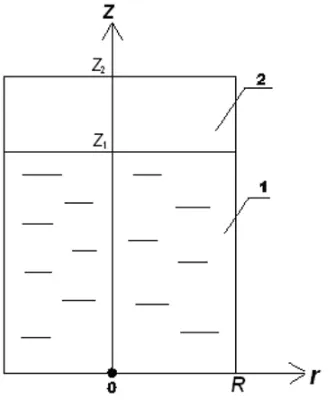
Figure 1. Area of solving the problem: 1 – liquefied gas; 2 – a pair of liquefied gas.
the displacement of the phase boundary may not be significant. Besides the reduced estimates assumed that the thermophysical characteristics of the gas in the liquid and gaseous state do not depend on temperature. The latter assumption is justified by the fact that in the LNG storage can not be a large temperature gradients. At high gradients, there is a risk of pressure increase above the maximum allowable. In this case, a lot of energy is expended to the “cooling down”.
Under such a physical model of the problem of heat transfer in the “liquid-gas” is reduced to solving a system of differential equations of heat conduction for a two-layer hollow cylinder filled with natural gas (Fig.1). It was assumed that the side and the lower end surface of the cylinder insulated, and on the upper borders by the “cooling down”. At the phase boundary LNG must use the boundary conditions of the fourth kind (equality of heat flows and temperatures). The evaporation rate was calculated by the formula Hertz-Knudsen-Langmuir (for evaporation in vacuum). This formula is often used when solving problems of heat and mass transfer under conditions of intensive evaporation of different liquids (e.g., [2]) in an environment with a pressure above atmospheric.
The system of differential equations in a cylindrical coordinate system with the appropriate boundary conditions has the form:
C11*T1
*t =1
1 r * *r
r*T1
*r
+*2T1
*Z2
·
C22*T2
*t =2
1 r * *r
r*T2
*r
+*2T2
*Z2
·
Here T – temperature; C – heat capacity; – thermal conductivity; – density; r,Z – cylindrical coordinate system; index 1 corresponds to liquefied gas, 2 - the gaseous state.
T1 =T0,T2=T0 t=0;
*T1
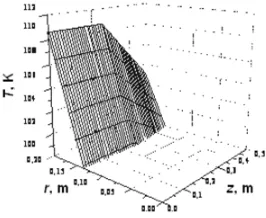
Figure 2. The temperature distributionT(r,z) at timet=100 s.
*T1
*Z =0 Z=0, 0< r < R;
*T2
*r =0 r=0,Z1< Z < Z2; T2=Tk r=R,Z1< Z < Z2;
T2 =TH Z=Z2, 0< r < R;
T2=T1 −1*T1
*Z = −2**TZ2 +Q·W
Z=Z1, 0< r < R.
W =
1−k·
(PE−P)
√
2RT /M;P = R2T
M ·
HereTk– the temperature of the outer border;TH – temperature cooling source;Q,W– thermal effect and the mass rate of condensation LNG respectively;– dimensionless coefficient of evaporation;k– constant;pH – saturation vapor pressure of the gas;P – the vapor pressure of the gas near the border condensation;M– the molecular weight of natural gas;R2– gas constant;R,Z2– the coordinates of the external borders of the region;Z1– coordinate boundary “liquid - gas”.
The boundary value problem (1) – (1) is solved by finite difference method using an iterative algorithm [3]. Control over the reliability of the results of numerical simulations carried out verification conservative difference scheme similar to [4]. To fulfill the conditions of conservativeness applied steps of the difference grid in time from 10−2s to 10−6s.
By condensation of the vapor on the surface of the section “liquid - vapor” there is a large temperature gradient in thin surface layers of the liquid and vapor phases of natural gas.
In accordance with [3–5] used the uneven and irregular difference grid.
Figures2,3illustrates the typical results of numerical studies of the considered process. Temperature distribution (Figs.1,2) illustrate a rather large variations in the z coordinate in the initial period of time (up to 30 K). In the future, with increasing t the temperature field becomes more and more homogeneous.
After 300 seconds (Fig.2), the temperature at the height of the container is aligned. Based on the results it can be concluded sufficiently fast (within minutes) to eliminate the conditions of evaporation of the main product by cooling the LNG only one boundary.
Figure 3. The temperature distribution onzwhenr=0, 14 m(t=100 s).
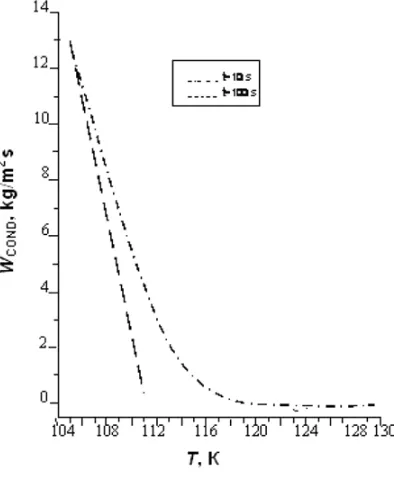
Figure 4. Dependence of the speed of condensation on temperature for two specific points in time.
Such is the nature of the dependenceW(T) allows to make a conclusion about the possibility of regulation of the process of “cooling down” LNG in terms of its partial evaporation of low cost energy in small time intervals.
As shown by the results of numerical studies, it is possible to localize the source of cooling on one surface of the storage tanks for LNG using technologies [6,7].
[6] B.S. Rachevsky, Liquefied petroleum gases (2009) [7] V.V. Remizov, V.A. Parfenov, J. Gas industry 2, 17 (1997)