AVAILABILITY AND UTILISATION OF TEACHING-LEARNING MATERIALS AND BASIC INFRASTRUCTURE IN PRIMARY SCHOOLS OF CONTAI MUNICIPALITY: A FIELD STUDY
Dipak Bhattacharya*1, Dr. Ramakanta Mohalik**
* M. Phil. Scholar, Regional Institute of Education, Bhubaneswar, India. ** Assistant Professor, Regional Institute of Education, Bhubaneswar, India.
Abstract
Teaching-learning materials and basic infrastructure are the primary requirements in every primary school to promote quality education, without these Teaching-learning materials and basic infrastructure good teaching-learning processes can not be established. This study intended to find out the availability and utilization of teaching-learning materials and basic infrastructure in primary schools. The study was conducted in 10 primary schools of Contai Municipality by using descriptive survey method. To find out the availability of teaching-learning materials and basic infrastructure in primary schools self made checklist and interview schedule for head-teacher, teacher, and pupils were used in this study. To find out the utilization of teaching-learning materials and basic infrastructure in primary schools self made observation schedule and interview schedule for head-teacher, teacher, and pupils were used in this study. The study found that majority of primary schools did not have sufficient teaching-learning materials and basic infrastructure. The study also found that teaching-learning materials and basic infrastructure were not utilized in very effective manner in these primary schools.
Introduction:
“Learning and teaching should not stand on opposite banks and just watch the river flow by; instead they should embark together on a journey down the water. Through an active, reciprocal exchange, teaching can strengthen learning how to learn.”
– Loris Malaguzzi.
Primary education is the initial stage of education and has its basic aim to create, establish and offer opportunities to all children, regardless of age, gender or country of origin, to achieve a balanced cognitive, emotional and psychomotor development. A basic responsibility of primary education is to help pupils become acquainted with their civilization and tradition and to develop respect and love for their national heritage, become aware of their national identity.
Teaching-learning materials and basic infrastructure are the primary requirements in every primary school to promote quality education, without these Teaching-learning materials and basic infrastructure good teaching-learning processes can not be established. There are different types of Teaching-learning materials and basic infrastructure like blackboard, teaching aids, science kits, playground, boundary wall, drinking water, girls toilet, etc. which are essential to create an effective positive learning environment in primary school. With this, constructive and creative learning atmosphere can be established in every classroom and entire primary school.
"Teaching-learning materials" is a generic term used to describe the resources teachers use to deliver instruction. Teaching-learning materials can support student learning and increase student success. Ideally, the teaching-learning materials will be tailored to the content in which they're being used, to the students in whose class they are being used, and the teacher. Teaching-learning materials come in many shapes and sizes, but they all have in common the ability to support student learning.
dominated by the Lecture Method of teacher. Except some essential aids like chalk, duster, blackboard, Teaching learning materials are hardly used in the classroom. When used it may not be context-specific. One of the major aims of NCERT is designing, providing for, and enabling appropriate teaching-learning systems that could realise the identified goals. Learning has shifted from Response Strengthening to Knowledge Acquisition to Construction of Knowledge. In this context, the duty of the teacher is to provide appropriate environment where the child will construct his knowledge by interacting with his physical and social environment. In this context, there is a need to orient teachers and develop appropriate context specific teaching learning materials useful to enhance the quality of teaching-learning process.
There are some needs of teaching-learning materials and basic infrastructures in primary school, like
1. To assist pupils to enhance their memories. Usually, pupils can remember concrete materials in a longer periods rather than abstract facts.
2. To make it easier for teachers to present their lessons. With the help of teaching aids, teachers do not need much to explain a certain concept by using many words.
3. Using teaching aids such as prepared charts with important information, teachers can save a lot of time because it is no longer required to write notes on the boards for the pupils to copy.
4. To stimulate the pupils interest so that they will concentrate on their lesson. 5. To help teachers to present their lesson precisely.
6. To enable pupils to relate concrete things with abstract facts. 7. To assists pupils to carry out enrichment or remedial activities.
8. To enable pupils to do research by using project or inquiry-discovery method, and to draw conclusion with the help of learning aids; and
9. To help pupils to solve problems themselves with learning aids.
Some norms were mentioned in ‘Operation Blackboard Scheme’ about requirement of teaching- learning materials and basic infrastructures in primary schools. Like, Operation Blackboard is designed to provide minimum essential infrastructure in the primary schools. Launched in 1987, in pursuance of the National Policy on Education, 1986, it had three objectives-(a) to provide at least two teachers in all primary schools: (b) to ensure that every school has essential teaching learning material' and (c) to provide each school at least a two roomed all weather building. As of 31st August. 1995, 522,902 primary schools have been sanctioned teaching learning material. 150,000 posts of teachers have been sanctioned, out of which 125,000 posts have been filled up. Approximately half the posts have been filled by women. 150,000 school rooms have been constructed. An amount of Rs. 1.280 million has been spent on the scheme till now. It is proposed to cover all the remaining primary schools under the scheme of Operation Blackboard during the remaining period of the Eighth Five Year Plan. This would mean that all the primary schools located in SC/ST habitations will be covered under Operation Blackboard. The scheme is being expanded to provide 3 teachers and 3 rooms to primary schools and also to cover the upper primary stage. The State Governments have been instructed to accord priority to areas of concentration of Scheduled Castes and Scheduled Tribes while implementing the expended scheme of Operation Blackboard.
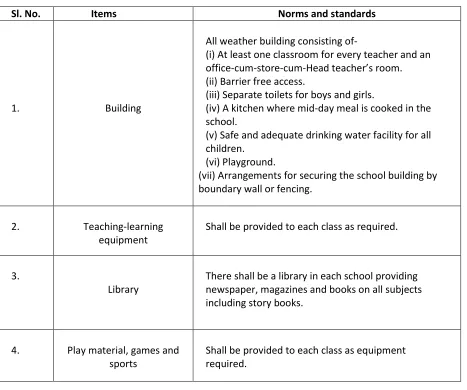
Table no. 1: Norms and Standard about Teaching-Learning Materials and Basic Infrastructures of A Primary School in the RTE Act, 2009.
Sl. No. Items Norms and standards
1. Building
All weather building consisting of-
(i) At least one classroom for every teacher and an office-cum-store-cum-Head teacher’s room. (ii) Barrier free access.
(iii) Separate toilets for boys and girls.
(iv) A kitchen where mid-day meal is cooked in the school.
(v) Safe and adequate drinking water facility for all children.
(vi) Playground.
(vii) Arrangements for securing the school building by boundary wall or fencing.
2. Teaching-learning equipment
Shall be provided to each class as required.
3.
Library
There shall be a library in each school providing newspaper, magazines and books on all subjects including story books.
4. Play material, games and sports
Shall be provided to each class as equipment required.
Rationale of the Study:
The goal of teaching-learning materials and basic infrastructure development in primary education is to increase school attendance motivation and to improve academic performance of students. To establish universalization in primary education, it is essential to improve the quality of teaching learning materials and basic infrastructures of primary schools. This study was focused on whether primary schools of Contai municipality have efficient teaching-learning materials and basic infrastructure to promote quality education. With the help of this study, we can know about the awareness of teachers and other school members regarding the utilisation of teaching-learning materials and basic infrastructure. This study gives a clear picture about the recent condition of primary schools of Contai municipality. This study was also attempted to find out the effectiveness of teaching-learning materials and basic infrastructure in establishing quality teaching-learning process.
assessed library as poor or average; 26.4 and21.6% of small and medium sized secondary schools respectively assessed the laboratory resource as poorer average; 21.6 and 15.6% small and medium sized secondary schools respectively assessed classrooms poor or average; 27.6 and 14.4% of small and medium sized secondary schools respectively assessed furniture as poor or average; 27.6 and 19.2% of small and medium sized schools respectively assessed staffing level as poor or average and 27.6 and 18% of small and medium sized secondary schools respectively assessed workshops as poor or average. Other resources assessed as poor or average include playgrounds and sports facility. Ayeni, Adeolu
Joshua and Adelabu, Modupe A. (2012) found that teachers’ perception of the quality of learning
infrastructure and environment ranges from 41 to 60.5%, while the schools with inadequate quality range from 19 to 59%. Bhunia, G. S., Shit, P.K. and Duary, S. (2012) found that the block covered by very good elementary educational infrastructure facility was Daspur-I and Dantan-II at primary level and Keshiary block at upper primary level in Paschim Medinipur district. Owoeye, J. S. and Yara, P.O. (2011) found that there were no significant differences in the performance of students between rural and urban secondary schools in term of availability of library facilities, availability of textbooks and availability of laboratory facilities.
From the above discussion it is clear that there are some researchers who believed that there were some schools where adequate teaching-learning materials and infrastructure were available, and these materials were helping in student’s learning achievement, Where as, there are also some researchers who believed that there were some schools where adequate teaching-learning materials and infrastructure were not available. This agreement and disagreement motivate the researcher to study about availability and utilization of teaching learning materials and basic infrastructure in primary schools of Contai Municipality.
Objectives of the Study:
1. To find out the availability of teaching-learning materials and basic infrastructure in primary schools of Contai municipality, West Bengal.
2. To find out the utilisation of teaching-learning materials and basic infrastructure in primary schools of Contai municipality, West Bengal.
Methodology:
Analysis and Findings:
A. Availability of Teaching-Learning Materials and Basic Infrastructure in Primary Schools of Contai
Municipality:
The first objective was to find out the availability of teaching-learning materials and basic infrastructure in primary schools of Contai municipality, West Bengal. In order to study this objective Checklist and Interview schedule for Head-teachers, teachers and pupils were used.
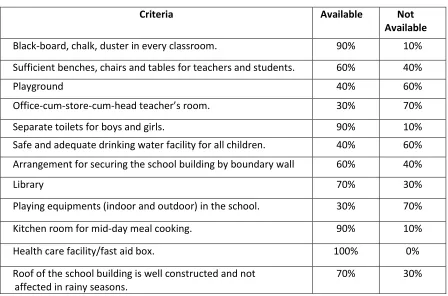
Table no. 1: Availability of teaching-learning materials and basic infrastructure in primary schools of Contai municipality, West Bengal.
Table no. 1 indicates that 10% primary schools of Contai Municipality did not have sufficient black-board, chalk, and duster in every classroom. 40% primary schools of Contai municipality did not have sufficient benches, chairs, and tables for students and teachers. 60% primary schools of Contai municipality did not have their own play ground and 70% Contai municipality primary schools did not have sufficient playing equipments. 70% primary schools of Contai municipality did not have an office-cum-store-cum-head teacher’s room. 10% primary schools of Contai municipality did not have separate toilets for boys and girls. 60% primary schools of Contai municipality did not have safe and adequate drinking water facility for all children. 40% primary schools of Contai municipality did not have any arrangement for securing the school building by boundary wall. 30% primary schools of Contai municipality did not have a library. 10% primary schools of Contai Municipality did not have sufficient Kitchen room for mid-day meal cooking. Almost all of the primary schools of Contai municipality had primary health care facility. The roof of the school building was not well constructed and affected in rainy seasons in 30% primary schools of Contai municipality.
Criteria Available Not
Available
Black-board, chalk, duster in every classroom. 90% 10%
Sufficient benches, chairs and tables for teachers and students. 60% 40%
Playground 40% 60%
Office-cum-store-cum-head teacher’s room. 30% 70%
Separate toilets for boys and girls. 90% 10%
Safe and adequate drinking water facility for all children. 40% 60% Arrangement for securing the school building by boundary wall 60% 40%
Library 70% 30%
Playing equipments (indoor and outdoor) in the school. 30% 70%
Kitchen room for mid-day meal cooking. 90% 10%
Health care facility/fast aid box. 100% 0%
Roof of the school building is well constructed and not affected in rainy seasons.
Table no. 2: Availability of teaching-learning materials and basic infrastructure in primary schools of Contai municipality, West Bengal.
Table no. 2 reveals that 20% primary schools of Contai Municipality did not have proper Student-teacher ratio of the school is as per RTE Act, 2009 (30:1). Computer learning facility was totally unavailable in the primary schools of Contai municipality. 30% primary schools of Contai municipality did not have fan and light (electricity) facility in every classroom. Almost all of the primary schools of Contai municipality had proper ventilation facility in the classroom.
B. Utilisation of Teaching-Learning Materials and Basic Infrastructure in Primary Schools of Contai
Municipality:
The second objective was to find out the utilisation of teaching-learning materials and basic infrastructure in primary schools of Contai municipality, West Bengal. In order to study this objective Observation schedule and Interview schedule for Head-teachers, teachers and pupils were used.
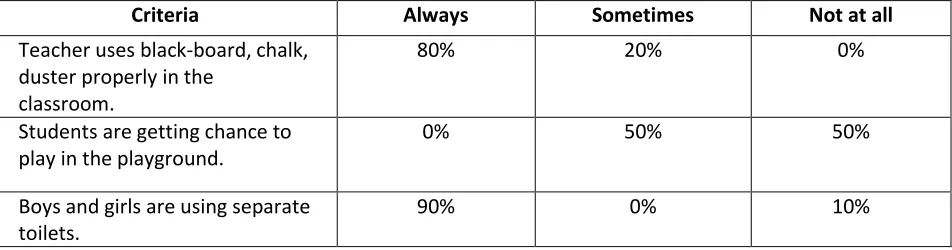
Table no. 3: Utilisation of teaching-learning materials and basic infrastructure in primary schools of Contai municipality, West Bengal.
Criteria Always Sometimes Not at all
Teacher uses black-board, chalk, duster properly in the
classroom.
80% 20% 0%
Students are getting chance to play in the playground.
0% 50% 50%
Boys and girls are using separate toilets.
90% 0% 10%
Table no. 3 points out that 80% primary school’s teachers of Contai Municipality were using black-board, chalk, duster regularly in the classroom. 50% primary school’s students of Contai Municipality were not getting chance to play in the playground. 90% primary school’s students of Contai Municipality were regularly using separate toilets.
Criteria Available Not
Available Student-teacher ratio of the school is as per RTE Act, 2009 (30:1). 80% 20%
Computer learning facility 0% 100%
Fan and light (electricity) facility in every classroom. 70% 30%
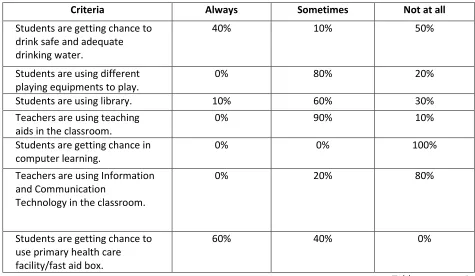
Table no. 4: Utilisation of teaching-learning materials and basic infrastructure in primary schools of Contai municipality, West Bengal
Criteria Always Sometimes Not at all
Students are getting chance to drink safe and adequate drinking water.
40% 10% 50%
Students are using different playing equipments to play.
0% 80% 20%
Students are using library. 10% 60% 30%
Teachers are using teaching aids in the classroom.
0% 90% 10%
Students are getting chance in computer learning.
0% 0% 100%
Teachers are using Information and Communication
Technology in the classroom.
0% 20% 80%
Students are getting chance to use primary health care facility/fast aid box.
60% 40% 0%
Table no. 4 reveals that 50% primary school’s students of Contai Municipality were not getting chance to drink safe and adequate drinking water. 20% primary school’s students of Contai Municipality were not using different playing equipments to play. Only 10% primary school’s students of Contai Municipality were using library. 90% primary school’s teachers of Contai Municipality were using teaching aids in the classroom sometimes. 100% primary school’s students of Contai Municipality were not getting chance in computer learning. 80% primary school’s teachers of Contai Municipality were never using Information and Communication Technology in the classroom. 60% primary school’s students of Contai Municipality were always getting chance to use primary health care facility.
Major Findings:
During field work the researcher had observed following findings-
1. There were some primary schools of Contai municipality (Dhandighi primary school, Contai Harisava primary school, Contai Harijanpalli primary school, Kumarepore K.M. primary school) where school did not have their own play ground and students were getting less chance to play out door games. Some teachers of these primary schools did not have any consciousness regarding this matter.
2. There were some primary schools of Contai municipality (Dhandighi primary school, Contai Model primary school) where Mid-day meal kitchen room was situated in a very dirty place. The quality of food was not also very good. Some teachers of these schools were also not aware about this matter.
Pic-2: Dirty Mid-day meal Kitchen room of Contai Model Primary School.
3. The teaching-learning process of these primary schools was not also well structured. Some teachers gave physical punishment in the classroom. They also believed that some extent of punishment is required to maintain discipline in the classroom.
Pic-3: Availability of stick for physical Punishment in Contai Muslim girls school.
Pic-4: Poor enrolment status in Dhandighi Primary school
5. There were some primary schools of Contai municipality (Contai National Primary School, Central Darua Primary School) where students were sitting in mat. School did not have of sufficient benches for children. Head-teachers of that schools told that due to lack of fund they were unable to provide sufficient benches for all children.
Pic-5: Non-availability of benches in Contai National Primary school.
6. There were a primary school of Contai municipality (Contai Harisava primary school) where local priests were protesting against construction of the school. They believed that the primary school is situated in the place of god’s land of Hari and there should have to establish a temple of Hari. The Head-teacher of the school told that he was legally protesting against it.
Pic.6: Joyful learning environment in Rahamania Primary School
8. Computer learning facility was totally unavailable in the primary schools of Contai municipality. 9. Around 60% primary schools of Contai municipality did not have their own play ground and 70% Contai municipality primary schools did not have sufficient playing equipments.
10. Around 60% primary schools of Contai municipality did not have safe and adequate drinking water facility for all children.
Pic-7: Unsafe drinking water facility in Dhandighi Primary School.
11. Around 70% primary schools of Contai municipality did not have an office-cum-store-cum-head teacher’s room.
12. Around 30% primary schools of Contai municipality did not have fan and light (electricity) facility in every classroom.
13. The roof of the school building was not well constructed and affected in rainy seasons in 30% primary schools of Contai municipality.
14. In 80% primary schools of Contai municipality teachers were not using Information and Communication Technology in the classroom.
Critical Reflections:
From the above analysis and findings it can be reflected that,
1. In most of the primary schools of Contai municipality did not have sufficient teaching-learning materials and basic infrastructure. There were some Head-teachers, teachers told that due to lack of fund and governmental unawareness they could not provide effective teaching-learning materials and basic infrastructure to the children of their primary schools. Where as, some Head-teachers and teachers were totally unaware about the availability and utilisation of teaching-learning materials and basic infrastructure. They were happy with whatever facilities they had. These peoples were taking causality about this serious matter. They were not playing their effective role in providing quality primary education to all children of their locality.
2. Due to lack of learning materials and basic infrastructure, the process of teaching-learning was done in a very primitive manner. Very few percentages of teachers were using ICT (Information and Communication Technology) in their classroom.
3. There were some primary schools of Contai municipality where the primary requirements like, drinking water facility, electricity, sufficient benches were not available.
4. There were some primary schools of Contai municipality where library, play ground, playing equipments were totally unavailable. Small children were not getting any chance to play.
5. In most of the primary schools of Contai municipality teachers were not conscious about the all round development of children. Co-curricular activities were not giving priority in these primary schools.
6. In most of the primary schools of Contai municipality teachers were giving less concentration in enhancement of creativity among children. Children were getting less scope to nourish their creativity.
7. In most of the primary schools of Contai municipality, teachers were giving less scope to develop curiosity and personality among children. There were very few teachers who encouraged and motivated their children to learn innovatively. Some teachers believed that due non-availability of teaching-learning materials and basic infrastructure they were unable to provide effective learning environment to the children.
8. There were very few teachers who were using playway method, activity based method of teaching in their classroom. They were implementing autocratic teaching strategies in their classroom. 9. In most of the primary schools of Contai municipality had sufficient chalk, duster, and black-board in every classroom. But few teachers were not using black-board in their classroom regularly. They were using lecture method in their classroom. There are very few teachers who were using story telling method in their classroom.
10. The availability and utilisation of library was not very effective in most of the primary schools of Contai municipality. There were very few schools where library facilities were available and there are very few children who were able utilise these library facilities. There were some primary schools where story book, daily newspaper, magazines were totally unavailable.
influence on the academic standard which is an index of quality assurance in the school. An effective physical environment can only transmit the educational values among students in the school.
References:
Ayeni, Adeolu Joshua and Adelabu, Modupe A.(2012) Improving learning infrastructure and environment for sustainable quality assurance practice in secondary schools in Ondo State, South-West, Nigeria. International Journal of Research Studies in Education. Vol- 1(1), PP.61-68.
Bhunia, G. S., Shit, P.K. and Duary, S. (2012). Assessment of School Infrastructure at Primary and Upper Primary Level: A Geospatial Analysis. Journal of Geographic Information System, Vol.- 4, PP. 412-424.
NCF. (2005), National Curriculum Framework, 2005. National Council of Educational Research and Training, New Delhi.
Onderi, H. and Makori, A. (2014) Examining the teaching and learning resources related challenges facing small and medium-sized public secondary schools in Kenya: A comparative analysis. African Educational Research Journal. Vol. 2(2), PP. 72-84.
Owoeye, J. S. and Yara, P.O. (2011) School Facilities and Academic Achievement of Secondary School Agricultural Science in Ekiti State, Nigeria. Asian Social Science. Vol.-7(7), PP.64-74.