Grid-based Simulation of a Lateral Move Irrigation System
Sven GRASHEY-JANSEN
Institute of Geography (Physical Geography & Quantitative Methods), University of Augsburg, Augsburg, Germany
Abstract
Grashey-Jansen S. (2013): Grid-based simulation of a lateral move irrigation system. Soil & Water Res., 8: 165–171.
A central objective in irrigation science is the improvement of the water use efficiency (WUE). Mostly the focus is laid on improvements and innovations in irrigation technology. The characteristics of soils are often con-sidered to be of secondary importance or totally disregarded. This paper reports on the simulation of a sensor network based irrigation system. The simulation was designed for a lateral move irrigation system with a notional irrigated area of 100 × 200 m. A grid-based network with soil specific calibrated and wireless moisture sensors (SMSN) captures the actual soil water content and calculates the corresponding water tensions simultaneously. The simulation in this paper is presented with two different modes of irrigation: the undifferentiated and evenly distributed irrigation (UDI-mode) and the differentiated precision irrigation (DPI-mode) which is adapted to the soil properties. The UDI-mode has been the most frequently applied practice so far and connected with an uncontrolled application of irrigation water. A supply under or over the real water demand of the plants is the consequence. In the DPI-mode the amount of given water is controlled by the soil water tensions (SWTs) calcu-lated by pedotransfer functions (PTFs).
Keywords: irrigation technology; pedotransfer functions; precision irrigation; soil moisture sensors; soil water tensions; water use efficiency
The consequences of climate change require a more responsible and efficient handling of water resources – particularly in regions with freshwater scarcities. This demand is especially addressed to those involved in irrigated agriculture as the largest water-use sector. Approximately 70% of the global water withdrawal and 85% of the consump-tive water use is for irrigation (Döll & Siebert 1999; Siebert et al. 2005; Goodwin & O’Conell 2008). Unfortunately, water use efficiency (WUE) in the agricultural sector is very poor with more than 50% water losses (Hezarjaribi & Sourell 2007). A major goal in most irrigation manage-ment is to optimize irrigation water use efficiency (IWUE) not only to produce high quality, high yielding crops, but also to ensure that runoff and leaching are minimized (Sadler et al. 2000; Al-Karadsheh et al. 2002; Chávez et al. 2010; Dur-sun & Ozden 2011).
Worldwide, overall IWUE is about 40%. So there is no doubt that introducing advanced technology such as innovative systems designed for precision irrigation (PI) can enhance efficiency from the cur-rent levels up to 80% (Schultz & De Wrachien 2002). PI is an important part of the concept of precision agriculture (PA) which was proposed by US agriculturalists in the 1990s. The traditional meaning of PI is to apply precise amounts of water to plants at precise locations (e.g. within the soil profile) and at specific times – but evenly distrib-uted across the field (Smith & Baillie 2009). PI-techniques are still in the development stages and require a lot of experimental work to determine their feasibility and applicability (Al-Karadsheh
densi-ties or contents of organic matter. Precision site-specific irrigation management requires precise knowledge of these soil properties and efficient methods to consider them by variable rates of ir-rigation. Consequently PI-systems need adjusted irrigation levels for effective action. Techniques of variable rate irrigation are a relatively new con-cept in agriculture (Sourell et al. 2004) and they require detailed knowledge of the physical and hydraulic properties of the soil horizons and their spatial-temporal variations. In principle, variable rate irrigation and the consideration of soil proper-ties help providing economic and environmental benefits as well as providing spatial variation in yield and quality of irrigated crops (Buss et al.
2004). Gains in water use efficiency can only be achieved if water application is precisely matched to the spatially distributed crop water requirements and the different properties of soils (Chávez et al.
2010; Grashey-Jansen 2010, 2012). Due to the fact that mobile irrigation systems often traverse highly variable soils, dynamic and precision irriga-tion is an important and soil-based strategy for an improved use of global water and soil resources.
Detailed spatial temporal information is very expensive and time consuming to obtain and spa-tially detailed measurement of soil properties is still not practical (Starks et al. 2003). The best one can obtain (e.g. from existing soil survey da-tabases) is the spatial distribution of soil textural classes. After all, the IWUE will benefit from it. Soil textural heterogeneity generally leads to vari-able water retention and yield within a field as crop productivity largely depends on the plant-available water (Mann et al. 2011). Hedley and Yule (2009) and Hedley et al. (2010) describe the potential benefits of modifying irrigation accord-ing to soil differences by comparaccord-ing uniform rate irrigation with variable rate irrigation scheduling. For instance, it is possible to save water by using different watering times with variable intensities based on soil physical values. Basically, the de-lineation of irrigation management zones is the primary problem in PI-management. A promising approach of soil physical based zoning of irrigation management using (geo-)statistical methods has recently been published by Jiang et al. (2011).
With the availability of soil moisture sensors and stem water potential devices, it has become possible to irrigate at the exact time when water is needed by the plant (Leib et al. 2003; Morais
et al. 2004b; Cardell-Oliver et al. 2005;
Sha-tanawi 2005). But also only by the use of soil moisture sensors a PI can be achieved – on con-dition that the soil properties are well known. There also exist novel micro-electro-mechanical systems like micro-tensiometers for plants and soils but they are very expensive compared with microtechnical soil moisture sensors. The wireless communication of sensors has improved markedly in recent years (Morais et al. 2004a; Wang et al.
2006; Kim & Evans 2009; Rundel et al. 2009). New technologies made it possible to measure the soil moisture with very small sensors – even with wireless sensors and wireless networks (Morais
et al. 2004a, b; Bogena et al. 2007; Dursun & Ozden 2011; Jansen 2011). Grashey-Jansen and Timpf (2010) created an agent-based simulation of a soil dependent precision irrigation system. The model calculates an irrigation plan to ensure that water application is both efficient and meets the demands. Thereby, the irrigation does not happen intermittently but in a continuous and dynamic way. This means that the amount of water applied during the irrigation process is subject to controlled dynamic fluctuations.
Soil moisture sensors and wireless sensor net-works will become still more cheaper and smaller in the future (Mittelbach et al. 2011). Dursun and Ozden (2011) and Li et al. (2011) have lately presented an autonomous variable drip irrigation control system with an in-field soil property moni-toring wireless sensor network. The non-invasive installation of a sensor system is very advanta-geous because of less maintenance and it provides measurement data in a high spatial and temporal resolution without an interruption or disturbance of the running agricultural operations in the field.
MATERIAL AND METHODS
According to Zacharias and Wessolek (2007) the multi regression based parameter estimation method was used for deriving the WRCs. The PTFs used therefore describe the relationship between the water content θ as a dependent variable and the pF-value as an independent variable by nonlinear regressions of the third degrees (Grashey-Jansen & Timpf 2010; Grashey-Jansen 2011). Based on these values it is possible to specify the point in time as well as the duration of irrigation on the plant specific threshold value in the respective phenological stage.
Figure 1 shows the virtual simulation field (100 × 200 m) with a wireless installed soil moisture sensor network (SMSN) at the soil depth of 0.3 m (grid size 5 × 5 m). The grid lines mark the borderlines between the calculation fields. The heterogeneity of the soil is limited to horizontal direction in this model (areas A–D). For simplification, it is assumed that these conditions are consistent downward in vertical direction. The computing of the irrigation
model was performed using the free programming language and software environment of R.
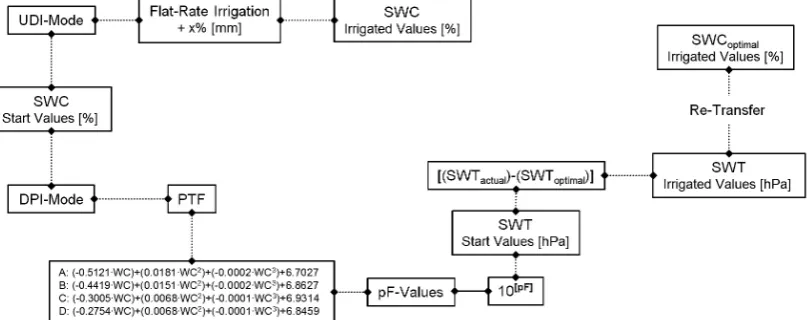
The simulation runs in two different modes: the UDI-mode (undifferentiated irrigation) with a flat rate of irrigation in the field and irrigation start-ing by a predefined time schedule or by subjective evaluation, and the DPI-mode (differentiated pre-cision irrigation) when irrigation is controlled by the values of soil moisture and their corresponding water tensions in the root zone. The soil water tensions are calculated by the soil specific PTFs mentioned above (Figure 2). Each grid will be ir-rigated until the target value is reached.
RESULTS
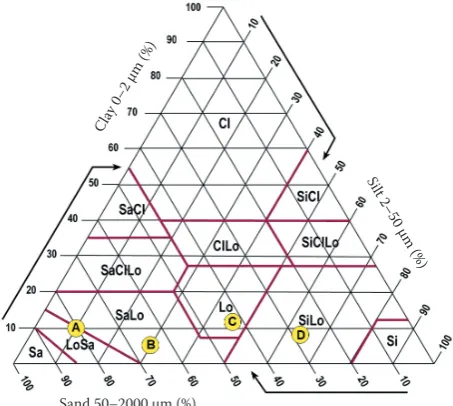
The respective particle-size distributions of the simulated soils on areas A–D are depicted in the particle-size grading curve in Figure 3. The corresponding soil textures and water retention curves are shown in the soil-texture triangle in Figures 4 and 5.
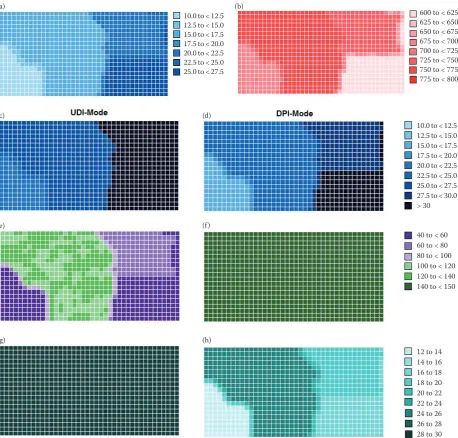
[image:3.595.65.293.84.232.2]Figure 6 shows the simulation process in both modes. The simulated soil water contents (SWC) in the root zone (soil depth 0.3 m) are unevenly distributed (Figure 6a) according to heterogeneous distribution of different soil textures (Figure 1) which is also reflected in the differentiated distri-bution pattern of soil water tensions (Figure 6b). The initial values of soil water tension range be-tween 600–800 hPa (Figure 6b). The nonlinear and pedospecific relations between the measured soil water contents and the corresponding soil water tensions are obvious: surface areas with higher values of SWC may nevertheless show high soil water tension (SWT)-values (e.g. discernible in Figure 1. Virtual test field with areas of different soil
[image:3.595.98.502.564.724.2]types and sensor nodes on corner points of the grid fields
Figure 2. Simplified procedure of the grid-based simulation in the undifferentiated irrigartion (UDI)- and diffe-rentiated precision irrigation (DPI)-mode; SWC – soil water contents; SWT – soil water tension
100 m
Area A
Area B Area CArea D
the lower left part of Figure 6b). The patterns of SWCs and SWTs are not congruent, but they are subjected to pedo-specificmodification.
The irrigation simulation in the UDI-mode (Fig-ure 6c) runs with a flat rate of 30 mm (10% for the replenishment of soil) and without any pedological differentiation. In the DPI-mode (Figure 6d) the volume of irrigation water corresponds to the soil specific water tensions in the root zone. This means that each grid is only irrigated until the target value of soil water tension (in this simulation 150 hPa) has been reached. Thus the water supply of soil and plants is controlled by the simultaneous values of soil water tensions, so that an over-irrigation
[image:4.595.62.289.80.227.2]in the DPI-mode is prevented. As a consequence the total area in the DPI-mode (Figure 6d) shows a much lower content of soil water than that in the UDI-mode (Figure 6c). Regarding the corre-sponding values of soil water tension, it is obvious that in the UDI-mode (Figure 6e) a major part of the area has been over-irrigated (values partially < 100 hPa). This oversupply of water (particularly in areas A and D) is not only a waste of water, but it also may have negative influence on plant growth. Only area B ranges in the defined optimum with an average soil water tension of 150 hPa. In the DPI-mode (Figure 6f ) the target level of 150 hPa was achieved for all grids by precision irrigation. For the crops this means equal conditions of water tension in the whole irrigated area. This is a big advantage in the water supply of the crops over the UDI-mode. Moreover, this aim was achieved with less water consumption than in the UDI-mode. Figure 6g shows that for each grid the same amount of water was used for irrigation. In comparison to the DPI-mode (Figure 6h), much more water was used for the irrigation process. Based on a virtual cropland of 2 ha, the DPI-mode saves a water amount of 177 m3 compared to the UDI-mode.
DISCUSSION
For precision irrigation it is indispensable to mark out irrigation management zones. Soil variability is therefore the most important key factor. The knowl-edge of only the spatial distribution of soil water content is insufficient because the soil-depending water tension decides about the availability of water for plants. The presented irrigation model makes it possible to apply irrigation water to a given soil Figure 3. Particle-size grading curve of the respective
par-ticle-size distributions of the simulated soils on areas A–D
Figure 4. Soil-texture triangle of corresponding soil
tex-tures; A, B, C, D – areas
Cl – clay; SiCl – silty clay; SaCl – sand clay; ClLo –
clay loam; SiClLo – silty clay loam; SaClLo – sand clay
[image:4.595.306.533.84.237.2]loam; Lo – loam; SiLo – silty loam; SaLo – sand loam; Si – silty; LoSa – loam sand; Sa – sand
Figure 5. Corresponding water retention curves of the different soil textures
Effective particle diameter (μm) 100
80
60
40
20
0
0.2 2 20 200 2000
Area A Area B Area C Area D
Area A Area B Area C Area D
pF v
alue (lo
g hP
a)
Water content θ (vol. %) 7
6
5
4
3
2
1
0
0 5 10 15 20 25 30 35 40 45 50
Clay 0–2 μm (%)
Sand 50–2000 μm (%)
[image:4.595.63.290.469.672.2]site in a volume and at a time needed for optimum soil water supply for the crops.
The use of soil moisture sensors has many advan-tages like the possibility to read soil volumetric water content directly and the possibility of continuous measurement at the same location in a high tempo-ral and spatial resolution. Water saving irrigation can be achieved by the use of simple soil moisture sensors in combination with the given knowledge of soil conditions. Compared with tensiometric sensors, the use of soil moisture sensors is less expensive. The efficiency of a sensor-controlled irrigation system can be optimized significantly by a grid-based distribution in the soil. The presented simulation approach is also compatible with special
irrigation scheduling decisions and the use of ir-rigation management strategies such as regulated deficit irrigation or partial root zone drying.
Sensor-based irrigation using wired sensors with pedohydrological calibration is considered to be a suitable method even if the sensor-technology is still in development. In addition to the usage of wired sensors, the application of wireless micro sensors, which are installed in the pedosphere for measuring the soil moisture at different depths, is a promising new approach.
[image:5.595.67.526.82.520.2]The exact positioning (GPS-supported) and non-destructive installation of micro sensors is no more a problem. Thereby the construction of a wireless network is a desirable objective in agriculture. Figure 6. Simulation output of UDI- and DPI-mode; (a, c, d): water content (%); (b, e, f): soil water tension (hPa), (g, h): irigated water (mm)
(b) (a)
10.0 to < 12.5 12.5 to < 15.0 15.0 to < 17.5 17.5 to < 20.0 20.0 to < 22.5 22.5 to < 25.0 25.0 to < 27.5
10.0 to < 12.5 12.5 to < 15.0 15.0 to < 17.5 17.5 to < 20.0 20.0 to < 22.5 22.5 to < 25.0 25.0 to < 27.5 27.5 to < 30.0 > 30
600 to < 625 625 to < 650 650 to < 675 675 to < 700 700 to < 725 725 to < 750 750 to < 775 775 to < 800
40 to < 60 60 to < 80 80 to < 100 100 to < 120 120 to < 140 140 to < 150
12 to 14 14 to 16 16 to 18 18 to 20 20 to 22 22 to 24 24 to 26 26 to 28 28 to 30
(c) (d)
(e) (f)
However the possibilities of implementing have been associated with many restrictions as yet. An error-free communication between the wireless sensor-nodes and the control unit is still more dif-ficult with the increasing soil depth. Furthermore, a stabilized electrical power supply of the wireless sensors is still a problem concerning sensor tech-nology. Solar powering is not possible because of the subsoil installation of the sensor nodes and small celled batteries have limited lifetimes.
References
Al-Karadsheh E., Sourell H., Krause R. (2002): Pre-cision irrigation: New strategy irrigation waterman-agement. In: Conf. Int. Research on Food Security, Natural Resource Management and Rural Development. Deutscher Tropentag. Witzenhausen, 9–11.
Almarshadi M.H., Ismail S.M. (2011): Effects of preci-sion irrigation on productivity and water use efficiency of alfalfa under different irrigation methods in arid climates. Journal of Applied Sciences Research, 7: 299–308. Bogena H.R., Huisman J.A., Oberdöster C., Vereecken H.
(2007): Evaluation of a low-cost soil water content sensor for wireless network applications. Journal of Hydrology, 344: 32–42.
Buss P., Dalton M., Olden S., Guy R. (2004): Precision management in viticulture – an overview of an Australian integrated approach. Integrated soil and water manage-ment for orchard developmanage-ment. FAO Land and Water Bulletin, 10: 51–59.
Cardell-Oliver R., Kranz M., Smetten K., Mayer K. (2005): A reactive soil moisture sensor network: Design and field evaluation. International Journal of Distributed Sensor Networks, 1: 149–162.
Chávez J.L., Pierce F.J., Elliott T.V., Evans R.G. (2010): A remote irrigation monitoring and control system for continuous move systems. Part A: description and devel-opment. Precision Agriculture, 11: 1–10.
Döll P., Siebert S. (1999): A Digital Global Map of Irri-gated Areas. [Report A9901.] Center for Environmental Systems Research, University of Kassel, Kassel.
Dursun M., Ozden S. (2011): A wireless application of drip irrigation automation supported by soil moisture sensors. Scientific Research and Essays, 6: 1573–1582. Goodwin I., O’Connell M.G. (2008): The future of
ir-rigated production horticulture – world and Australian perspective. Acta Horticulturae (ISHS) 792: 449–458. Grashey-Jansen S. (2010): Pedo-hydrological case study
of two apple-growing locations in South Tyrol (Italy). Agricultural Water Management, 98: 234–240.
Grashey-Jansen S. (2011): Simulation einer sensorg-estützten Präzisionsbewässerung von Standorten im
Südtiroler Obstanbau. Hallesches Jahrbuch für Geowis-senschaften, 32/33: 49–56.
Grashey-Jansen S. (2012): The influence of physical soil properties on the water supply of irrigated orchards – some examples from Val Venosta (South Tyrol/Northern Italy). Journal of Environmental Biology, 33: 417–424. Grashey-Jansen S., Timpf S. (2010): Soil hydrology of
irrigated orchards and agent-based simulation of a soil dependent precision irrigation system. Advanced Science Letters, 3: 259–272.
Hedley C.B., Yule I.J. (2009): Soil water status mapping and two variable-rate irrigation scenarios. Precision Ag-riculture, 10: 342–355.
Hedley C.B., Yule I.J., Bradbury S. (2010): Analysis of potential benefits of precision irrigation for variable soils at five pastoral and arable production sites in New Zealand. In: 19th World Congr. Soil Science. Brisbane. (published on DVD)
Hezarjaribi A., Sourell, H. (2007): Feasibility study of monitoring the total available water content using non-invasive electromagnetic induction-based and electrode-based soil electrical conductivity measurement. Irrigation and Drainage, 56: 53–65.
Jiang Q., Fu Q., Wang Z. (2011): Delineating site-specific irrigation management zones. Irrigation and Drainage, 60: 464–472.
Kim Y., Evans R.G. (2009): Software design for wireless sensor-based site-specific irrigation. Computers and Electronic in Agriculture, 66: 159–165.
Leib B.G., Jabro J.D., Matthews G.R. (2003): Field evalu-ation and performance comparison of soil moisture sen-sors. Soil Science, 168: 396–408.
Li Z., Wang N., Hong T.S., Franze A., Li J. (2011): Closed-loop drip irrigation control using a hybrid wireless sensor and actuator network. Science China, 54: 577–588. Mann K., Schumann A., Obreza T., Sartain J.,
Har-ris W., Shukla S. (2011): Analyzing the efficiency of soil amendments and irrigation for plant production on heterogeneous sandy soils under greenhouse conditions. Plant Nutrition and Soil Science, 174: 925–932.
Mittelbach H.F., Casini I., Lehner A., Teuling J., Seneviratne S.I. (2011): Soil moisture monitoring for climate research: Evaluation of a low-cost sensor in the framework of the Swiss Soil Moisture Experiment cam-paign. Journal of Geophysical Research, 116: 11. Morais R., Valente A., Couto C., Correia J.H. (2004a):
A wireless RF CMOS mixed-signal interface for soil mois-ture measurements. Sensors and Actuators A (Physical), 115: 376–384.
Rundel P.W., Graham E.A., Allen M.F., Fisher J.C., Harmon T.C. (2009): Environmental sensor networks in ecological research. New Phytologist, 182: 589–607. Sadler E.J., Evans R., Buchleiter G., King B., Camp C.
(2000): Venturing into precision agriculture. Irrigation Journal, 50: 15–17.
Schultz B., De Wrachien D. (2002): Irrigation and drain-age systems research and development in the 21st century. Irrigation and Drainage, 51: 311–327.
Shatanawi M. R. (2005): Future options and research needs of water uses for sustainable agriculture. In: Wa-ter Use Efficiency and WaWa-ter Productivity. Proc. 4th WASAMED Workshop. Options méditerranéennes, Se-ries B, No. 57, 21–29.
Siebert S., Feick S., Hoogeveen J. (2005): A Digital Global Map of Irrigated Areas. An Update for Asia. Frankfurt Hy-drology Paper 1. Institute of Physical Geography, Goethe University Frankfurt, Frankfurt am Main.
Smith R., Baillie J. (2009): Defining precision irrigation: A new approach to irrigation management. In: Irrigation and Drainage Conf. Swan Hill.
Sourell H., Spreer W., Müller J. (2004): Irrigation and sprinkling. Agrartechnik, 16: 111–116.
Starks P., Heathman G., Ahuja L., Ma L. (2003): Use of limited soil property data and modeling estimate root zone soil water content. Journal of Hydrology, 272: 131–147.
Wang N., Zhang N., Wang M. (2006): Wireless sensors in agriculture and food industry – Recent development and future perspective. Computers and Electronics in Agriculture, 50: 1–14.
Zacharias S., Wessolek G. (2007): Excluding organic matter content from pedotransfer predictors of soil wa-ter retention. Soil Science Society of America Journal, 71: 43–50.
Received for publication January 22, 2013 Accepted after corrections April 19, 2013
Corresponding author:
Dr. Sven Grashey-Jansen, University of Augsburg, Institute of Geography, Physical Geography & Quantitative Methods, Universitätsstraße 10, 86135 Augsburg, Germany