Towards Effective E-voting System for Refugees:
Lessons from the Case of Palestine
Fouad JF Shat [email protected]
Department of Computer Science, Brunel,
London, United Kingdom University
Pamela Abbott [email protected]
Department of Computer Science, Brunel University
London, United Kingdom
Elias Pimenidis [email protected] Department of Computer Science and Creative Technologies
University of the West of England
Bristol, United Kingdom
Paper Category: Research Paper
ABSTRACT
Significant global challenges related to persistent economic crises, local conflicts and continuous waves
of refugees being displaced from their countries of origin are affecting secure access to and completion of
people’s voting rights. The relevant technological solutions appear to have matured and have successfully
responded to rigorous testing, however, there are still doubts as to the success of these e-democracy
solutions in complex political environments. Since the late 1940s, Palestinians have been scattered across
the world thus creating particular challenges relating to the democratic process for this diaspora
community. In an effort to address this issue, the Palestinian Authority has started its e-government
project since 2001 but at the current time, the project has failed to deliver its objectives. This study is
using a mixed method research methodology for the purpose of obtaining rich interpretive insights to
understand the above-mentioned particular phenomenon, by conceptualising it as a socio-political issue.
Analysis of the contextual factors affecting e-government implementation in Palestine will enhance our
understanding of the underlying forces that promote or hinder e-government projects in general. In this
regard, although previous studies have examined some factors related to e-government as a tool for the
e-government service) and the challenges of introducing e-democracy into the unique contextual
circumstances such as those represented by the Palestinian situation. The results of this research would
clarify the policy-making processes influencing e-government implementation projects in other complex
contextual circumstances such as other refugee communities seeking participation in their political
processes.
Keywords: E-government, E-voting, Implementation, Complex political environment
1. INTRODUCTION
Recent years have witnessed increasing debates about the implementation of e-government, and
these discussions often include critical evaluations of various factors that contribute to e-
government’s success or failure. E-government uses information and communication technology
(ICT) to facilitate interactions between the government and individuals served by the government.
As ICT refers to any communication that requires technology, such as television, cell phones, and
computer networks, and thus, is an umbrella term for technology based communication services,
e-government is just one form of ICT. It can be argued that the success of e-e-government
implementation requires a consideration not only of technological change, but also of the various
shifts in social, political, and cultural contexts, and the wide range of actors and institutions involved
in development efforts (McGrath and Maiye 2010). Any research on the implementation of
e-government in developing countries will need to consider a variety of fields such as organizational,
socio-political, cultural etc. and their relevance to the application of e-government. In other words,
e-government is not only about technology issues, but involves several political, economic, social
and organisational issues (Alshawi and Alalwany 2009; Luo 2009; McGrath and Maiye 2010).
The implementation of e-government in developing countries can be more complex than in
developed countries, therefore, different strategies may be called for that take into consideration
cultural factors as well as technological ones (Chen et al. 2006; Dada 2006; Heeks 2003). In China,
e-government services are still not widely accepted and various challenges obstruct their use (Tan
2013). Scientists maintain that when advancing ICT in the developing world, it is necessary to
address each of the fundamental components, rather than present an elaborate, grand-scale approach
(Tan 2013). Researchers of e-government confirm that in developing countries in Asia, Africa,
Europe and Latin America they are multiple problems regarding the development and
implementation of e-government (Rodríguez Bolívar et al. 2014). These problems include structural
problems and system implementation issues such as determining who will manage the system,
aversion to using the services on the part of the constituents, the reluctance of public employees to
between generations impacting acceptance of and know how relating to technology. Researchers in
the area of e-government claims that there are certain aspects that should be investigated more
thoroughly such as the barriers and restrictions citizens have in accessing e-government, hindering
their full participation, and how different strategies adopted by government agencies can facilitat e
this participation (Rodríguez Bolívar et al. 2014).
2. THE FAILURE OF E-GOVERNMENT PROJECTS
Stories about the success of e-government implementation abound; however, the truth is that most of
e-government projects in developing countries fail (Dada 2006). What constitutes failure can vary
significantly according to context, time, and viewpoint, but e-government failure can be defined as
the inability of such a system to achieve predefined goals or other, previously unanticipated benefits
(Dada 2006).
In developing countries there is a large gap in the physical, cultural, economic, and various other
contexts between the software designers and the place in which the system is being implemented,
and this leads to incompatibilities between the system that is already in place and that which is being
introduced (Heeks 2005).
It is clear that even though e-government brings many economic and social benefits, real challenges
can hinder its establishment. Some of these challenges come from technological perspectives and
others come from social perspectives (Gilbert et al. 2004; Irani et al. 2010; Ndou 2004). One
example of these challenges is that e-government is expensive to implement, it requires highly
skilled technicians and a solid technical infrastructure (Stoltzfus 2005). Scholars of e-government
suggest the following risk factors that should also be taken into account when implementing an e-
government system: political stability, an adequate legal framework, trust in government, importance
of government identity, the economic structure, the government structure (centralised or not), levels
of maturity within the government and citizen demand (Basu 2004; Shafi and Weerakkody 2009).
The difference that exists between less-developed countries and developed countries, in terms of
e-government development, is highlighted in the literature. The factors that create and maintain this
difference have been discussed in many studies, and a great deal of attention is actually paid to it by
many researchers (Chen et al. 2006; Gil-García and Pardo 2005). Sometimes the failure of
e-government implementation in developing countries has to do with the fact that guidelines based on
experiments in developed countries have been followed. To alleviate for this situation, a
multi-disciplinary investigation should be conducted in order to attain a better understanding of these
necessary to recognise and understand the challenges that are faced by developing countries in their
attempts to implement e-government projects.
3. E-VOTING SERVICE IMPLEMENTATION:
E-voting, as a means for allowing electronic voting in a democracy, is just one example of e-
government platforms. Thus, contextual issues affecting the implementation of an e-voting system
will also be part of the issues affected e-government more broadly as e-voting is one component of
e-government and environmental barriers and/or enablers of e-government implementation
(Rodríguez Bolívar et al. 2014), will also likely be present in e-voting. According to the UK
government “E-Government is not an end in itself. It is at the heart of the drive to modernise
government and meet the needs of an increasingly electronic based society. Modernising local
government is about enhancing the quality of local services and effectiveness of local democracy”.
The UN model of e-government implementations includes e-voting as service of e-government for
enhancing democracy and increase the direct participation of citizens and accountability (Yildiz
2007). Researchers describe e-voting as e-government specialty (Rössler et al. 2005). Amongst the
various approaches and models that contribute to the theory and practice of e-democracy, one widely
discussed component is e-voting. This is generally defined as any type of voting that involves the use
of electronic means.
4. THE NEED FOR E-GOVERNMENT FOR PALESTINE
Palestine is a geographical region in Western Asia between the Mediterranean Sea and the Jordan River,
situated at a strategic location between Egypt and Jordan; the boundaries of the region have changed
throughout history. Previously Palestine was under the rule of the Ottoman (Turkish) Empire. During the
First World War, Britain promised to support “complete and final liberation” for the people of the wider
region in return for them rebelling against the Ottomans (PSC 2014).
However in 1948 Israel was established unilaterally with the Jewish population forming a minority of the
local population. By 1949 Palestinians had started spreading into different countries across the world
included in those societies as refugees. After this spread Israel became the ruler of more than 78% of the
land. The remaining land (22%) called West Bank, Gaza Strip and East Jerusalem have been under an
illegal Israeli military rule since they were occupied in the 1967 war, and today are referred to as the
“Occupied Palestinian Territories”(PSC 2014). The Arab League Summit had created an organization
called Palestinian liberation organization (PLO) in 1964 for the purpose of liberating Palestine and
creating a state for its people. Later PLO was recognized as sole legitimate representative of the
This agreement had offered Palestinian self-determination which had resulted to form a government for
Palestinians called Palestinian authority(PA) (BBC 2008) and since that time PA became responsible to
serve Palestinian citizen in west bank and Gaza strip mainly and particularly across the world. Recently
General Assembly of the UN has granted Palestine non-member observer State statue which has resulted
to a first real recognition for Palestine as state (Nation 2012).
Many Palestinians are currently denied from entering Palestine because of the occupation control. At the
present Palestinians are living in different areas around the world where there are differences in terms of
ICT infrastructure, Internet availability and IT literacy. This situation has resulted to significant problem
in terms of accessing public services, communication with government agencies and participating in the
general election. The Palestinian government has started an e-government initiative to cope with this
problem in 2001.
Implementation of e-government in Palestine may solve most the problems for accessing public services
and communication with government agencies. Considering the exceptional dispersion of the Palestinian
population and Israel’s control of the area, implementing of real electronic government may enable the
government to perform their responsibilities and provide public services electronically to Palestinians and
other stakeholders. Moreover, it will facilitate democracy by removing the need for physical voting
stations which is one of the main barriers to holding conventional elections.
The Palestinian Government’s policy over the past few years has included e-government as one of the top
national priorities. President Abbas has assigned a Ministerial Committee for E-Government. This
committee has prepared the first comprehensive E-government Strategic Plan in 2005, and this document
was part of the PA vision “to provide a better life for our citizens by being a Government that: Empowers
citizens to participate in government; Connects citizens, the private sector and institutions to drive
economic growth and meet community challenges; and Delivers real public value through citizen-centric
government services” (OECD 2011).
According to the Organization for Economic Co-operation and Development (OECD), e-government
vision and policies in Palestine at 2010 was including “a public sector that provides citizens with high quality services and value for money”. This plan states that the e-government National strategy should,
over time, work to increase efficiency and effectiveness of public service delivery; it also states that the
Ministry of Telecommunications and Information Technology (MTIT) is main key players in terms of
move this initiatives forward, moreover, the 13th government program (Ending the Occupation,
Establishing the State and Homestretch to Freedom) has clearly mention that the use of ICT and
e-government particular should help public sector reform and this is the most important national priorities.
administrative complexities, interior complexities, problems of cooperation and data exchange between
government institutions and in data accessibility (WAFA 2012).
4.1. An e-voting system for Palestinians
The forced diaspora of Palestinians has created challenges for the Palestinian Authority (PA) as it
continues to gain international recognition as an emerging state. With the possibility of the requirement
for democratic elections and a fully recognized Palestinian state in the horizon, it is a pressing need for
the officials within the existing Palestinian Authority find new and innovative ways to engage a scattered
constituency in the democratic process (Shat et al. 2014).
Due to the spread of Palestinians in different countries, Palestine has experienced a huge difficulty in
enabling its citizens to elect their representatives. Using a democratic way to elect people representatives
will be an ideal to solving the Palestinian leadership crisis. According to government officials many
countries who are hosting Palestinian as refugees do not allow them to hold election activities in their
territories; hence e-voting systems could offer a solution to overcome this problem (Kiayias et al. 2015;
Ntaliani et al. 2015).
Palestinian activists across the world have started an initiative for general election for Palestinians across
the world. Leaders from the main Palestinian parties and factions, in addition to independents and
intellectuals, have also encouraged Palestinians around the world to register to vote in this civic campaign
in the National Call for Registration for PNC elections.
In June 2011, A Palestinian organization called the Facilitation Office (FO) of the civic registration
announced that they have finalized a secure electronic voter registration machine for PNC elections. The
registration mechanism was built to provide Palestinians in a variety of different locations and
circumstances with the opportunity to register to vote, whilst maintaining the highest international
standards of safety and security in the creation of this primary register. The procedures of the registration
process are simple: Palestinian civic associations wishing to run a voter registration drive can do so
through a secure low-cost process, as part of a popularly-driven, national initiative.
The above office claimed that the procedures applied reflect international best practice and standards, and
have been developed with the relevant national and international institutions to ensure equality of
principles and practice across the Palestinian communities, mindful of the obstacles and challenges faced
by each Months later the central election commission in Palestine announced that e-voting system is not
applicable for the case of Palestine, stating that the majority of Palestinian will not trust e-democracy.
There is concern though within the Palestinian Authority relating to the skepticism that e-Democracy will
Based on this review of the extant literature relating to the phenomenon under consideration coupled with
the outcomes of the pilot survey, the question addressed here is “What are The Main Factors Affecting
E-government Implementation within Complex Political Environments: The case of E-voting System
Implementation in Palestine” As previously demonstrated, the academics have empirically observed the
need to assess this question, and they noted its paucity in extant literature.
The first motivation of this research is to provide an in-depth qualitative analysis of the main issues relating to the Palestinian implementation of e-voting, through investigating the factors which have affected the implementation of e-voting. The Palestinian political context is unique
and stands to democratically advance from an e-voting system that would allow millions of
Palestinian diaspora to participate in the democratic process through voting. The UN model of
e-government implementations includes e-voting as a service of e- e-government for enhancing
democracy and increasing the direct participation of citizens and accountability. This is particularly
true in the case of Palestine, but to date, there has not been any in-depth qualitative studies that seek
to understand the Palestinian contextual environment and perceptions among the Palestinian elite in
regards to factors of implementation. The interactive democratic potential of the technology is yet to
be fully utilized in the case of Palestine; the true potential for e-democracy lies in the exploitation of
the internet for interactivity between government and citizens (Heeks and Bailur 2007; Musso et al.
2000; Watson and Mundy 2001).
The second motivation of this research is to use the case of Palestine to advance the current state of knowledge on the impact of complex political environments. Despite a growing interest in the application of Information and Communication Technology (ICT) to re-structure democracy,
there is a lack of research that studies the different challenges that are faced when trying to
implement e-government in complex political environments (MAAN 2013; Rodríguez Bolívar et al.
2014). Using the case of Palestine, this research seeks to advance the state of knowledge on
perceptions of the role of the complex political environments on implementation possibilities and
outcomes. To understand the contextual environment of implementing e-democracy, one must
consider the complex political situation in the democracy potentially implementing such a system
and the more systems that can examined, the greater our understanding of contextual impact will be.
In fulfilling the first and second motivations of this research, it is responding to charges to narrow the knowledge gaps on contextual factors of e-voting implementation cited in the literature (Al-amer 2009; Graham and Witschge 2003). As this research seeks to both advance the
well as advance the broader state of literature that addresses to role of complex political
environments as barriers and/or enables in e-voting, it is filling a void in the extant literature. The
qualitative approach employed herein is needed to advance the state of knowledge on perceptions of
e-voting. There is a line of argument stating that the empirical studies conducted on online
deliberation in an e-democracy context do not provide enough grounds from which to draw solid
conclusions (Graham and Witschge 2003). This emphasizes the need for qualitative studies to
provide greater contextual understanding. There is a need to look beyond what is found in the
Internet through more quantitative content analysis or through more qualitative discourse analysis
and ethnographic approaches, so that the democratic potential of the internet can be fully grasped
(Graham and Witschge 2003). This points to the need for further research to advance the theory and
practice of e- democracy.
5. METHODOLOGY
A mixed-methods approach for data collection and analysis was used in two stages; the first stage was the
quantitative stage, in this stage A survey to gauge the citizen’s acceptance level of using technology in
participating in democratic processes has been conducted by the authors in 2015; the survey was setup
using the popular survey tool http://www.questionpro.com/. This offers data capture and data analysis
facilities. This survey also aimed to establish whether Palestinian people will be happy to use technology
to elect their representatives. The survey has targeted Palestinians in Palestine and in different countries
and locations across the world over social media websites and applications for the purpose of gauging the
level of e-trust in digital government services and processes. The key objective was to capture views and
measure the different means through which access to the survey was achieved. This last input would
demonstrate an ability to utilize and trust a wide range of technologies and thus provide a foundation for
the development of trust on e-voting processes (Sideridis et al. 2012, 2015).
The response rate for this survey was quite high as this questionnaire was available for a short period of
time in the early days of 2015. The statistics show a very high return rate of 320 completed responses out
of the 860 views and a 73% completion rate among those who have started responding to the
questionnaire. The actual rates could be much higher as a person that has completed the survey might
have done so after 2 or more views, or someone that has eventually completed the survey might have had
to abandon it and come back at a second time. Overall the result was very good as this survey was not
sent to specific individuals but links to it were posted on social media and websites that are of interest to
Palestinians. Thus the completion numbers and rates show that there is interest in e-voting systems among
Palestinians who are keen to express their approval or not of such systems. Naturally nearly 37% reside in
to Palestine and as far as the USA. A further element of information is that showing the diversity of
devices used to access the survey, which could potentially indicate the level of familiarity with
technology and possibly a likelihood of trusting e-voting systems.
In the second stage a grounded qualitative study underpinned by interviews was used to determine the
factors, herein contextual issues, that impact the success, likelihood, and outcome of the implementation
of e-voting services in Palestine, Authors have used qualitative research methodology for the purpose
of obtaining rich interpretive insights for the above-mentioned phenomena (Musso et al. 2000; Myers
1997; Silverman 2010; Urquhart 2012). During the interviews the outcomes of the quantitative study were
presented and examined by all interviewees.
To solicit the qualitative data needed to address this research question, the authors conducted 19
in-depth one-on-one semi-structured interviews with individuals identified as stakeholders in the
implementation of e-voting in Palestine. Interviewees included senior engineers, state political
leaders, and private sector representatives responsible or aware of the development and
implementation of e-government projects in Palestine. Interviewees were selected based on positions of
leadership (i.e., level of policy influence, administrative level, or private sector leader) and were invited to
participate by phone and/or email. Of the thirty- one individuals from whom an interview was requested,
nineteen (61.2%) agreed to participate. Interviews occurred between October 2015 and December 2015
and lasted an average of one hour, but ranged from forty-five to seventy-five minutes in length. All
interviews were conducted in Arabic by the authors. The semi-structured interview instrument was
developed to meet the needs of the research question, as well as adapted to be individualized to the
role of the interviewee. Moreover, the instrument was semi-structured as to allow concerns and
perceptions to emerge based on the issues perceived as important to the interviewee, so as not to bias
the data. The interviews solicited information of the technical, procedural, and political components
of implementing e-government in Palestine. For analysis purposes, the interviews were audio
recorded, transcribed verbatim, and then translated into English using qualitative research
back-translation reliability methods.
The interview data produced through the 19 interviews were then analysed using Nvivo10. The
analysis of interviews presented within this paper seeks to address the research question through
analysing the data to provide meaning to perceptions of the contextual issues affecting the
implementation of e-voting in Palestine. To this effect, Nvivo10, qualitative data analysis software,
was used to analyse the interview data. The remainder of the section is outlined as follows: 1)
introduction to the methods used to analyse the interviews, 2) provision of Nvivo outputs and
emergent themes. Moreover, the results are supported by examples of interview responses to
demonstrate how the emergent themes and concepts are grounded in the data.
Following grounded theory methods (GTM), this analysis aligns with the first two stages of coding:
open coding and selective coding (Glaser 2002; Urquhart 2012). In the open coding stage, the
nineteen interviews were constantly compared and annotated to develop themes, sub-themes, and
core categories. In this stage, each interview was first analysed separately and the results were
compared across the interviews to assess similarities and differences using the constant
comparative method. Memos were used in the coding process to elaborate on the data at a conceptual
level, providing context to the emergent themes, to begin to develop an understanding of the
relationships among the themes. Following the open coding, selective coding was used to further
develop these themes into dense core categories.
5.1. GTM Open Coding
In the open coding process, each line, sentence, and paragraph of each of the transcripts was
examined to label data that relates to the interviewee’s perception of the possibility of the
implementation of e-voting service in Palestine. These labels were applied to identify the general
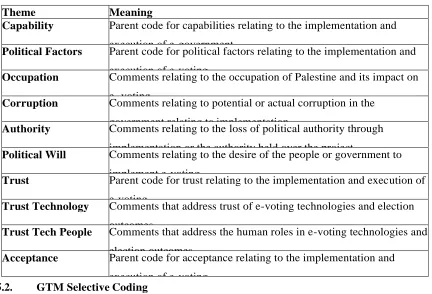
trends in the data and to after completion, generate a general theory of the trends. Table 1 provides
the themes that emerged from the data in the first column. After all nineteen transcripts were coded,
the second “meaning” column was added to document the purpose of the code and its meaning to the
researchers following the coding process. This codebook was thus a living document and adjusted as
themes emerged in alignment with the open coding stage of GTM. Analysis memos (commonly
referred to as annotations) were used to align the themes with the data being applied to them. Within
the codebook, yellow themes are used to provide context (i.e., background on the interviewee that
would improve the researchers’ ability to understand the context in which the interviewees
perceptions have developed), blue themes are parent nodes (i.e., broad/ major themes), purple
themes are child nodes (i.e., sub- themes to the parent nodes), which were not aggregated to parent
nodes, and green themes are general themes (i.e., general concepts that did not apply to other
categories for was still relevant for understanding the interviewees’ perceptions of the possibility of
e-voting in Palestine). Almost all data were found to be relevant to these categories with a few
Table 1: Codebook for Nvivo Analysis.
Theme Meaning
Capability Parent code for capabilities relating to the implementation and execution of e-government
Political Factors Parent code for political factors relating to the implementation and execution of e-voting
Occupation Comments relating to the occupation of Palestine and its impact on e- voting
Corruption Comments relating to potential or actual corruption in the government relating to implementation
Authority Comments relating to the loss of political authority through implementation or the authority held over the project
Political Will Comments relating to the desire of the people or government to implement e-voting
Trust Parent code for trust relating to the implementation and execution of e-voting
Trust Technology Comments that address trust of e-voting technologies and election
outcomes
Trust Tech People Comments that address the human roles in e-voting technologies and election outcomes
Acceptance Parent code for acceptance relating to the implementation and execution of e-voting
5.2. GTM Selective Coding
In the second step of grounded theory methodology, selective coding is used to identify and present
the core concepts needed to understand the relationship between the themes as presented in
the Figure 1. Specifically, selective coding was used to further develop these themes into dense core
categories. The concept map in Figure 1 has been colour coded to demonstrate the selective coding
themes. The colours are used in the figure to demonstrate the groupings of sub-themes from the open
coding stage. Specifically, the teal boxes are sub- themes of Political Factors, the orange boxes are
sub-themes of capability, and the pink boxes are sub-themes of trust. The yellow boxes are core
themes from the open coding phase. Finally, Political Factors is also a core theme, but this one is
marked in green as it emerged as the dominant theme of the interview data. Thus, the yellow and
green boxes are treated as dense code themes. These dense core themes, which will be used to
organize the remainder of the interview findings, are as follows: Political Will, Capability, Trust, and
Acceptance. In terms of understanding the contextual factors affecting the implementation of
e-voting in Palestine, these codes present a hierarchy in which political will is the primary contextual
issues affecting the implementation of an e-voting service in Palestine, followed by capability, trust,
and acceptance. Essentially, if the political will is there, then all factors can be put in place, but if the
political will is not there, then it is moot to determine capabilities, trust, or acceptance. Although
relationships between them (demonstrated in Figure 1) and that they cannot be clearly separated in
theory. For instance, capability, trust, and acceptance are all both impacted by and a factor in political
[image:12.612.72.527.138.333.2]will.
Fig. 1. Concept Map of Open Code Themes (NVIVO).
The above mentioned concept map can be summarized as a diagrammatical depiction of the core
themes in addressing e-voting in Palestine
Fig. 2. Diagrammatical Depiction of Four Core Themes.
6. PRESENTATION AND ANALYSIS OF SURVEY RESULTS:
The completed responses have been 320 across the world, with nearly 37% of respondents coming from
territories associated with the Palestinian Authority (Gaza, West Bank, East Jerusalem) and nearly 80% of
Capability Acceptance
Political
Factors Trust
[image:12.612.128.437.429.594.2]respondents being male. A key finding of the survey had been that over 68% of respondents indicated that
[image:13.612.167.444.121.276.2]they have used internet interfaces to connect with the Palestinian Authority and its governmental services.
Fig. 1. Internet Access of Governmental Services
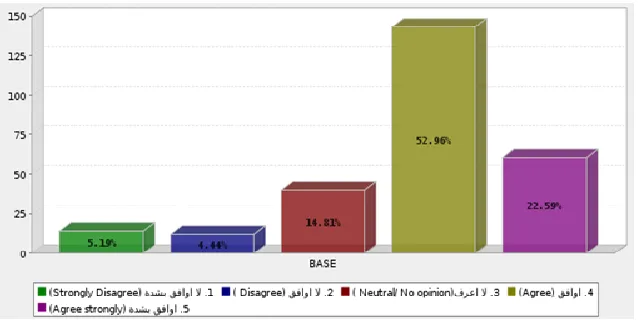
In exploring the respondent’s willingness to participate in future E-Government/E-Democracy initiatives,
almost 53% of respondents agreed. Further bolstering affirmative responses, over 22% of respondents
strongly agreed that they would willingly use the government’s online services in the future. Less than 10% expressed a negative response when asked about potential use of the government’s online services,
while the remaining respondents, less than 15% of the survey group, offered a neutral opinion or no
opinion at all.
Fig. 2. Willingness in using e-government services in the future
When asked about the potential of using the E-Voting System in the next election, nearly 2/3 of
[image:13.612.148.467.453.618.2]indicated a strong disagreement with the potential use of E-Voting, while 10.74% simply disagreed.
9.26% of respondents indicated a neutral response or did not respond.
What was more encouraging from the outcome of the survey was that nearly 14% of respondents strongly
agreed in trusting the outcome of an online election and over 38% agreeing to it, yielding affirmative a
majority of positive responses. That said, a significant minority of the survey group – 20.74% of
respondents – strongly disagreed with the statement. Another 9.63% of respondents fell in the “disagree”
segment of the survey group. Somewhat surprisingly, 17.41% of respondents offered no opinion or a
neutral opinion.
While no survey can provide an exhaustive gauge on public opinion, it appears that a majority of
Palestinians may feel comfortable engaging in E-Democracy initiatives as they come online. It would
appear that a potential Palestinian state would have a hearty base of support in place upon which future
E-Democracy initiatives could flourish and grow. For the parts of constituency in diaspora, the future state’s
use of a variety of online services and democratic opportunities (general elections, referenda), would
afford expatriates opportunities to stay connected and engaged with the homeland. The survey indicates
that the Palestinian Authority must work to cultivate trust among its constituents. Expanded delivery of
efficient, low cost services would certainly garner the trust of the people. Furthermore, the government’s
enhanced partnership with the technological industry could cultivate additional trust. Calling on the
expertise of technology firms to insure that online experiences are safe and private will do wonders for
[image:14.612.140.474.443.627.2]the “trust gap.”
Fig. 4. Trust in the outcome of e-Voting
There is reasonable evidence to prompt the Palestinian government to start a real initiative to gauge and
test out if e-voting can work this might be throw start using technology in small elections such as student
unions elections at universities, Unions election, local elections and Palestinian community committees
etc. this will provide further evidence about the political will towards enabling people elect their
representatives genuinely and regularly.
Furthermore e-voting and the capturing of the trust of its people could present the perfect opportunity for
the Palestinian Government to engage in further e-government activities. These could introduce new
levels of transparency, efficiency of processes and answer calls for government accountability, allowing
for better management of expectations and requirements of such a vastly dispersed peoples [1]. The
experience of more organized and integrated countries where smaller populations are dispersed in larger
geographical areas has provided enough evidence to support such initiatives. The European initiatives for
e-identification and cross-border e-government applications could provide an excellent instrument for
developing and supporting e-voting and other cross-border systems for a fragmented population such as
the Palestinians [26]. Grasping the trust and cultivating e-trust would be the biggest obstacle to overcome
on the road of effective e-government and real e-democracy [10, 28]. Any success in the above could
have a resonant effect on the handling of the present day humanitarian and at the same time governance
and identification crisis with the huge influx of refugees in to the European Union. In addition the
outcomes of such work will benefit all societies with isolated communities, serving the need of people
with special needs that are otherwise capable and willing to engage with digital democratic processes but
7. PRESENTATION AND ANALYSIS OF INTERVIEW FINDINGS 7.1. Political Will
Themes and sub-themes that contributed to the conceptualization of the core theme of political will
for e-voting include current government usage of e-technology, cooperation with the private sector,
authority, occupation, external countries, diaspora, and political corruption. There are essentially
four actors to consider within those core theme in the implementation of e-voting in Palestine: the
government, the citizens, the private sector, and external countries. In terms of political will, support
must be received from the citizens, but it must first come from the government. Political will is thus
the foremost issue of consideration in the establishment of e-voting. It is seen by interviews as both
what is needed to implement the project and what threatens the project. Political will must have
parameters. Such will must be enough to establish the need and support for the project, but not so
much that it influences the project.
Authority posed further concern, but also presented itself as a multi-faceted concept. Authority, in
the context of this research, can refer to 1) the disinterest of politicians in losing their authority
which yields a lack of political will, 2) current authority relating to decision making, and 3) proposed
authority relating to implementation and control over e-voting. The most frequent reason for the lack
of political will was that political will must come from those in authority, but that in supporting such
a system of e-voting, these officials would actually lose authority. Simply put, even if politicians had
the political will to implement e-voting, interviewees were concerned about the great possibly of
corruption. “The thing is that the entire election process is dysfunctional even if the system were
there. You know the political situation… Why will they have doubts? It is because we doubt the
voting process or that the person who will take out the results will cheat.” - The Manager of Mada Internet Services Company in Gaza.
While there were examples of e-governance used in Palestine, most interviewees were not
knowledgeable about these technologies and services unless directly related to their implementation.
Most examples of e-services were related to banking or other private sector services. Interviewees
were asked about the current state of an electronic signature in Palestine and most believed that it has
not yet been developed, but that there is the ability to develop such a system. A private sector
contractor working on government projects, argued that it was impossible to have electronic
signatures in Palestine because “signature could only come after the stage of building
e-governance and giving it trust.” This point will be further discussed in the final section of this report.
Much of the political will that does exist is driven by the desire and need to include the Palestinian
live within the country. E-voting is a proposed solution for including these individuals in the
democratic process. When discussed benefits and the impact of e-voting, the inclusion of these
external populations was a common theme. For instance, An IT specialist working at a non-profit
organization, stated, “the pros are that it will encompass all Palestinians and enable them to vote
and resolve the borders and geographical issues in general and would result in every Palestinian
exercising their right to vote.” Many interviewees noted that in the current environment many
Palestinians are unable to reaching polling stations and e-voting would address this barrier. While
some noted this barrier was related to the spread of the population, others noted that it also applies to
sick and handicapped people. In fact, most interviewees saw the inclusion of the diaspora as the
main benefit of e-voting. The former head of IT department of Al-azhar University, for instance,
stated that “the benefit is that it’s the only available political solution for holding elections that
include the whole Palestinian population.” The former ICT minster adds that “e-voting would be more democratic people of this greater inclusion. The Director of E-Government adds that “e-voting
would give voters more privacy as they would not have to vote under pressure and they could even cast their vote at night and from the comfort of their home, while the polling station atmosphere
would be more stressful”.
7.2. Capability
Capability was considered in terms of infrastructure, personnel, finances, and the ability to protect
the systems against fraud and corruption. Interviewees overwhelmingly agreed that Palestine has the
infrastructure and human resources capability to implement an e-voting system. While a few
interviewees felt that there are financial barriers, some stated that such a system would actually be
less costly than traditional ballot methods. Interviewees almost unanimously agreed that political
will trumps capability in terms of barriers to an e-voting system. The only concern that was
consistently raised was related to a generational divide in the IT literacy of citizens. While
interviewees agreed that Palestinians are extremely technology literature, there was a general
concern for the elder population and their ability to use technologies. The interviewees
overwhelmingly agreed that Palestine has the infrastructure to support e-voting. The Manager of
Mada Internet Services Company in Gaza, for instance, stated, “the Internet reaches over 90% of the Palestinian areas and we have no problems. The average speed is 2 megabytes and is to become 4
megabytes as the least speed. The people are developing along.” Similarly, the Director of
E-Government described Palestine as having complete maturity in this matter. Interviewees also
acknowledge that e- signatures would need to be in place in addition to the infrastructure and this has
terms of individuals qualified to design and implement the system from a technical standpoint. One
interviewee, a constitutional Judge, felt that the infrastructure nor the HR capability were, in fact, not
in place to implement e-voting— “In Palestine, there is a need to upgrade our equipment and requalify public sector workers with specific educational course in handling technology as many employees in the government sector do not have a good background in dealing with technology and
the requirements of an electronic government.” However, constitutional Judge noted that there are
individuals that are well qualified and many study abroad and then return. Interviewees expressed
mixed feelings on the capability to protect the data produced through e-voting. Sentiments fell into
four categories: Yes, this is a problem and it will prevent e-voting for effectively occurring; Yes,
this is a problem, but it exists will all e-services; Yes, this is a problem, but it exists will all elections;
and No, this is not a problem. Regarding the ability to protect e-voting data, comparisons were often
made to the ability of banks to protect sensitive data and to interact with customers electronically.
Banks are able to verify identification and therefore, serve as an example of how individuals are
already using and trusting e-services.
7.3. Trust
There are, in fact, many issues raised within the interviews regarding trust. There are concerns over
hacking, fraud by citizens, and corruption by political leaders. The general consensus among
interviewees was that trust can accomplished through efforts such as gradual implementation,
education and social awareness, the support of respected leaders, and a generational shift. Further
efforts to improve trust issues include proper oversight and assessment. While some interviewees
feel this should occur by a neutral third party in the private sector, others felt that it should occur
through a government commission. Interviewees noted that finding a neutral assessor could prove
problematic given the state of Palestinian politics. There was also a fear that there would be a
conflict over management of the project that could limit its implementation. Relating back to
political will, many interviewees felt that politicians are simply not comfortable with e-voting,
because as a Private Sector Contractor for Government stated, “its transparency will expose them.”
This indicates that there is a lack of track for politicians and the political system.
The interviewees broadly felt that full trust of the system could not be established. Rather, it was a
factor creating more trust in an e-voting system that exists for comparable or traditional systems.
Much of the limitation in trust stems from the human aspects of the technology. For instance, an
interviewed lecturer in Information Systems at the University of Greenwich exclaimed that “a
system that is 100% protected does not exist because anything that is made by humans is also
as identity fraud, hacking into the system both domestically and by foreign entities, and by party
corruption. If the voters do not perceive that their vote will be counted democratically and reliably,
they will not trust the system as a whole. The Director General of Information Technology stated,
“The matter [of trust] depends on whether we trust those who oversee it and their integrity. If there
are signs of corruption in their daily lives, how would you expect to have faith in them handling the
system.” Trust, therefore, must occur at multiple stages (design, implementation, reporting,
assessment) and across many actors to be effective.
7.4. Acceptance
For e-governance to be accepted, all of the factors have to be in place. There has to be the political
will, the capability, and the trust. If Palestine is lacking any of these factors, the project will not be
accepted by the citizens or the leaders.
“Issues of development do not usually come about because of a single need, but due to many different needs.” -A Private Sector Contractor for Government
The interviewees discussed methods for promoting acceptance of the system, such as campaigns to
promote IT literacy, educate the citizens on services available, and to implement systems gradually.
“In my opinion, e-voting should be offered as a complementary alternative to traditional ways of
voting; not as a replacement. If the parties and the candidates do not support the idea, they will also encourage their constituents not to use it. They could tell them this could cause a manipulation of the
results, and therefore they would reject its use and convince their supporters not to use it either. This would prevent reaching the required results.” - Senior Lecturer in Information Systems at the
University at Greenwich.
As previously addressed, a key component to promoting acceptance is establishing trust through
oversight. The Director General of Information Technology stated, “if those overseeing elections
presented themselves to the public and were people of integrity, the people will trust.” Interviewees
had mixed interpretations of the impact of an e-voting system. Nearly all interviewees believed that
electronic voting would result in increased participation in elections because it would enable people
vote without pressure and even encourage many individuals who have not previously voted and
handicapped individuals who were previously unable to get to polling stations. Moreover, the ability
to allow the diaspora to vote was an essential component of support in the overall system, but also
the belief that e- voting would increase voter turnout. Regarding the ability of e-voting to increase
youth in Gaza will particularly encourage the idea.” Another interviewee noted that the increase in
participation would come about eventually, but not immediately unless political will changes. Only
one interviewee—Unit Head of Networks and Security at Palestinian Telecom Company— predicted
poor participation: “I foresee poor participation… because they are used to the classical voting method by writing down his vote and inserting the vote in a box. That is the Palestinians’ ideal on
voting and is yet to change.”
8. DISCUSSION
Findings on the contextual issues affecting the implementation of an e-voting service in Palestine
have herein been presented. GTM revealed four core themes of factors surrounding perceptions of
e-voting implementation in Palestine as expressed by nineteen elites: political will, capability, trust,
and acceptance. The data reveal that implementation is a complex phenomenon and is both impacted
by political, cultural, and organization factors (Luo 2009; McGrath and Maiye 2010). The interview
data reveal that Palestine is, indeed, a complex political environment and that this complexity is
barrier to the implementation for e-voting, but the complexity also creates a greater need for
implementation of voting. Given this great need and the perception of most respondents that
e-voting would increase participation, e-e-voting would improve democracy in Palestine. Perhaps one
approach to implementation is start with other areas of e-democracy. “There are massive
opportunities for the enhancement of democratic processes via electronic interaction. It is perceived
as an enabler for the enhancement of existing democratic practices as well being a catalyst for democratic transformation” (FCO, 2001). It can be argued that the ICT can not only enhance
existing democratic practices but also can pave the way for democratic transformation by means of
the direct participation of all citizens. Thus two ideas emerge with respect to the application of ICT
to democracy. One is based on the “presumption that any political use of new technologies takes
place within existing institutional frameworks of parliaments, executive branches and political
parties” (Gibson et al. 2004), and the other advocates the transformation of representative forms of
democracy into more direct forms (Westen 2000). Furthermore, most research shows that various
government initiatives employ the Internet and ICT to provide services and information. In the case
of Palestine, therefore, e- government can start in other sectors. This will likely increase trust and
participation. However, it will not be as easy to address issues of trust as they relate to corruption
and control of the process.
Trust emerged within this research as a core theme and issue of concern. This finding aligns with
the literature and has proved to have a particular significance in developing countries. Several
a great deal of evidence that the e-voting system was widely used and appreciated, and that the
election results it produced were, with few exceptions, accepted to be the correct aggregate of
individual citizens’ actual votes. However, the formation of plausible cause-and-effect relationships
between a technical/ institutional arrangement and trust, as expressed in citizens’ opinion surveys
and demonstrated by their actions, posed a theoretical challenge (Avgerou 2008).
The case that is likely the closest to Palestine in regards to the implementation of e-voting is Iran.
Comparison can be drawn from the findings presented herein on Palestine to the Iranian case,
particularly in discussing the role of trust. It is important to note therefore, that in Iran, there have
been some cases where electronic voting was used and achieved a good level of success, and there
are other times where ‘trust’ issues prevented further implementation of electronic voting. The main
reason relates to the lack of trust in the accuracy and correctness of software (Kahani 2005).
CONCLUSION
The findings presented herein are both supported by the extant literature and ground-breaking in the
depth they present. As the findings align with research conducted in other countries and regions
regarding the challenges of implementation and their relation to factors such as the complex political
factors (Alshawi and Alalwany 2009; Alvarez et al. 2011; McGrath and Maiye 2010; Rodríguez
Bolívar et al. 2014; Walsham 2010; Yildiz 2007), the research has also advanced the literature in its
focus on the unique environment of Palestine. Not only is Palestine unique in its need for e- voting
for incorporating the mass diaspora into e-democracy, but it is also unique is the details of the
challenges that are faced in implementation, as the data have revealed. However, the challenges
more broadly are represented of those that have been presented in case studies of other countries. For
instance, while technological capabilities and trust of both citizenry and officials are known factors
associated with e-government and more specifically e-voting (Gilbert et al. 2004; Irani et al. 2010),
this research has provided greater depth to these issues in the specific context of Palestine, such as
the impact of the occupation, political will, political history, and diaspora as both a need for e-voting
and an obstacle to implementing e-voting. In doing so, this research has achieved the three purpose
areas outlined as motivations for the study. This research concludes with the charge for future
research to saturate the above-mentioned categories by gathering more in-depth qualitative data
which will drive this research to form grounded theory related to the research question.
REFERENCES:
(OECD), O. F. O. R. E. C.-O. A. N. D. D. 2011. “THE CASE OF E-GOVERNMENT IN THE
PALESTINIAN AUTHORITY,” ICOMM, (available at
=http%3A%2F%2Fwww.oecd.org%2Fmena%2Fgovernance%2F50402812.pdf&ei=pA9mVPXALJ PraOuRgegO&usg=AFQjCNGcKbO_f5m4r2jCfZAsqtdzSfiDLw).
Al-amer, M. A. 2009. “Electronic democracy strategy for Bahrain,” JOUR, De Montfort University. Alshawi, S., and Alalwany, H. 2009. “E‐government evaluation: Citizen’s perspective in developing
countries,” Information Technology for Development (15:3), JOUR, Wiley Online Library, pp. 193– 208.
Alvarez, R. M., Katz, G., and Pomares, J. 2011. “The Impact of New Technologies on Voter Confidence in Latin America: Evidence from E-Voting Experiments in Argentina and Colombia,” Journal of Information Technology & Politics (8:2), JOUR, Taylor & Francis, pp. 199–217.
Avgerou, C. 2008. “Information systems in developing countries: a critical research review,” Journal of Information Technology (23:3), JOUR, Nature Publishing Group, pp. 133–146.
Basu, S. 2004. “E‐government and developing countries: an overview,” International Review of Law, Computers & Technology (18:1), JOUR, Taylor & Francis, pp. 109–132.
BBC. 2008. “1993 Oslo agreement,” ICOMM, (available at
http://news.bbc.co.uk/1/hi/world/middle_east/7385301.stm).
Chen, Y. N., Chen, H. M., Huang, W., and Ching, R. K. H. 2006. “E-government strategies in developed and developing countries: An implementation framework and case study,” Journal of Global Information Management (JGIM) (14:1), JOUR, IGI Global, pp. 23–46.
Dada, D. 2006. “The failure of e-government in developing countries: A literature review,” The Electronic Journal of Information Systems in Developing Countries (26), JOUR, .
Gibson, R., Römmele, A., and Ward, S. 2004. Electronic democracy: mobilisation, organisation and participation via new ICTs, BOOK, Routledge.
Gilbert, D., Balestrini, P., and Littleboy, D. 2004. “Barriers and benefits in the adoption of e-government,” International Journal of Public Sector Management (17:4), JOUR, Emerald Group Publishing Limited, pp. 286–301.
Gil-García, J. R., and Pardo, T. A. 2005. “E-government success factors: Mapping practical tools to theoretical foundations,” Government Information Quarterly (22:2), JOUR, Elsevier, pp. 187–216. Glaser, B. G. 2002. “Conceptualization: On theory and theorizing using grounded theory,” International
Journal of Qualitative Methods (1:2), JOUR, SAGE Publications, pp. 23–38.
Graham, T., and Witschge, T. 2003. “In search of online deliberation: Towards a new method for examining the quality of online discussions,” COMMUNICATIONS-SANKT AUGUSTIN THEN BERLIN- (28:2), JOUR, MOUTON DE GRUYTER, pp. 173–204.
Heeks, R. 2003. Most eGovernment-for-development projects fail: how can risks be reduced?, BOOK, Institute for Development Policy and Management, University of Manchester Manchester.
Heeks, R. 2005. “e-Government as a Carrier of Context,” Journal of Public Policy (25:1), JOUR, Cambridge Univ Press, pp. 51–74.
Heeks, R., and Bailur, S. 2007. “Analyzing e-government research: Perspectives, philosophies, theories, methods, and practice,” Government information quarterly (24:2), JOUR, Elsevier, pp. 243–265.
Irani, Z., Kamal, M., Al-Sobhi, F., Weerakkody, V., and Mustafa Kamal, M. 2010. “An exploratory study on the role of intermediaries in delivering public services in Madinah City: Case of Saudi Arabia,”
Kahani, M. 2005. “Experiencing small-scale E-Democracy in Iran,” The Electronic Journal of Information Systems in Developing Countries (22), JOUR, .
Kiayias, A., Zacharias, T., and Zhang, B. 2015. “End-to-end verifiable elections in the standard model,” in Advances in Cryptology-EUROCRYPT 2015, CHAP, Springer, pp. 468–498.
Luo, G. 2009. “E-government, people and social change: A case study in China,” The Electronic Journal of Information Systems in Developing Countries (38), JOUR, .
MAAN. 2013. “ينورتكللاا تيوصتلاو ليجستلا لوح تاباختنلاا ةنجل بيقعت,” ICOMM, (available at http://www.maannews.net/Content.aspx?id=632707).
McGrath, K., and Maiye, A. 2010. “The role of institutions in ICT innovation: learning from interventions in a Nigerian e-government initiative,” Information Technology for Development (16:4), JOUR, Taylor & Francis, pp. 260–278.
Musso, J., Weare, C., and Hale, M. 2000. “Designing Web technologies for local governance reform: Good management or good democracy?,” Political Communication (17:1), JOUR, Taylor & Francis, pp. 1–19.
Myers, M. D. 1997. “Qualitative research in information systems,” Management Information Systems Quarterly (21:2), JOUR, MIS RESEARCH CENTER-SCHOOL OF MANAGEMENT, pp. 241– 242.
Nation, U. 2012. “General Assembly Votes Overwhelmingly to Accord Palestine ‘Non-Member Observer
State’ Status in United Nations,” ICOMM, (available at
http://www.un.org/press/en/2012/ga11317.doc.htm).
Nation, U. 2014. “PLO,” ICOMM, .
Ndou, V. 2004. “E-government for developing countries: opportunities and challenges,” The electronic journal of information systems in developing countries (18), JOUR, .
Ntaliani, M., Costopoulou, C., Karetsos, S., and Molhanec, M. 2015. “Citizen e-Empowerment in Greek and Czech Municipalities,” in E-Democracy–Citizen Rights in the World of the New Computing Paradigms, CHAP, Springer, pp. 124–133.
PSC. 2014. “No Title,” ICOMM, (available at http://www.palestinecampaign.org/information/).
Rodríguez Bolívar, M. P., Alcaide Muñoz, L., and López Hernández, A. M. 2014. “Scientometric Study of the Progress and Development of e-Government Research During the Period 2000–2012,”
Information Technology for Development (ahead-of-print), JOUR, Taylor & Francis, pp. 1–39. Rössler, T., Leitold, H., and Posch, R. 2005. “E-voting: a scalable approach using XML and hardware
security modules,” in e-Technology, e-Commerce and e-Service, 2005. EEE’05. Proceedings. The 2005 IEEE International Conference on, CONF, IEEE, pp. 480–485.
Shafi, A.-S., and Weerakkody, V. 2009. “Understanding citizens’ behavioural intention in the adoption of e-government services in the state of Qatar.,” in ECIS, CONF, , pp. 1618–1629.
Shat, F. J. F., Mousavi, A., and Pimenidis, E. 2014. “Electronic government enactment in a small developing country ??? the Palestinian authority???s policy and practice,” Communications in Computer and Information Science (441), Springer Verlag, pp. 83–92.
Sideridis, A., Protopappas, L., and Tsiafoulis, S. 2015. “Smart cross-border e-Gov systems and applications,” Conference on e- … (available at http://link.springer.com/chapter/10.1007/978-3-319-27164-4_11).
Silverman, D. 2010. Qualitative research, BOOK, Sage.
Stoltzfus, K. 2005. “Motivations for implementing e-government: an investigation of the global phenomenon,” in Proceedings of the 2005 national conference on Digital government research, CONF, Digital Government Society of North America, pp. 333–338.
Tan, M. 2013. “An Investigation of e-Government Services in China,” The Electronic Journal of Information Systems in Developing Countries (57), JOUR, .
Urquhart, C. 2012. Grounded theory for qualitative research: A practical guide, BOOK, Sage.
WAFA. 2012. “نيينيطسلفلا لقنت تاقيعم لحي ةينورتكللإا ةموكحلا قيبطت :يناطيرب روسيفورب,” ICOMM, WAFA (available at http://www.wafa.ps/arabic/index.php?action=detail&id=133955).
Walsham, G. 2010. “ICTs for the broader development of India: an analysis of the literature,” The Electronic Journal of Information Systems in Developing Countries (41), JOUR, .
Watson, R. T., and Mundy, B. 2001. “A strategic perspective of electronic democracy,” Communications of the ACM (44:1), JOUR, ACM, pp. 27–30.
Westen, T. 2000. “E‐Democracy: Ready or Not, Here It Comes,” National Civic Review (89:3), JOUR, Wiley Online Library, pp. 217–228.
Yildiz, M. 2007. “E-government research: Reviewing the literature, limitations, and ways forward,”