E-voting versus E-trust: A case study for e-democracy in Palestine
Fouad Shat1, Elias Pimenidis2
1
Department of Computer Science, Brunel University, London, United Kingdom [email protected]
2
Department of Computer Science and Creative Technologies, University of the West of England, Bristol, United Kingdom
Abstract
The world at present is facing a number of real challenges in the face of persistent economic crisis, local conflicts and huge waves of refugees. All of the above are affecting secure access to and completion of peoples voting rights. The relevant technological solutions appear to have matured and have successfully responded to rigorous testing. The need for digital access to election events is probably higher than ever in digital age. The question that remains to be answered is whether all this enough to inspire people to trust the systems and participate amass in e-voting particularly in areas where the political climate might be volatile. Palestinian have been scattered across the world since the late 1940s. This forced diaspora creates particular challenges as the Palestinian Authority (PA) continues to gain international recognition as an emerging state. The PA is experiencing a huge difficulty in enabling its citizens to elect their representative. According to PA officials many countries who are hosting Palestinians as refugees don’t accept the facilitation of elections for representatives to the PA government. Using e-voting systems could offer a solution to overcoming this problem and the PA has been evaluating such systems since 2011. The inspiration for this paper is taken from the results of an extensive survey conducted by the authors to evaluate the response amongst Palestinians around the world to the Palestinian Authority’s decision to fully embrace e-Voting
Keywords: E-government, E-voting, E-trust, Political will.
1 Introduction
The term “e-democracy” has emerged in discussions by scholars and politicians since the 1960s as part of the rhetoric about various technological Utopias which rely on the use of the internet or other networks to maintain the access of political information and the participation of citizens in the political life (Tsagarousianou et al, 1998, Macintosh, 2003). Although e-democracy is widely associated with the participation of citizens in elections using electronic access platforms, it is not limited to the process of elections by any means. In this context, e-democracy could include the attempts of various stakeholders including governments, political parties, civil society organizations and activist groups to use information technologies as a means to communicate with citizens and to facilitate the exchange of information for meeting requirements for accountability and transparency in governance processes (Sideridis et al 2015). In this sense, e-democracy can refer to any political activities that involve the use of ICT as a means of enhancing a more effective democratic process. Thomas (2005) adds that it resembles traditional political behavior in the sense that it is an activity carried out by citizens who are interested in politics and government. While Tsagarousianou et al (1998) argue that the whole idea of having electronic networks for civic and political engagement is aligned with certain developments in the field of technology, socio-economics and infrastructure.
Whether talking about e-democracy in particular or even about e-government in general, there seems to be certain issues that have to be taken into consideration in order to understand the various implications of these processes. The idea of trust is undoubtedly one of these areas that have the potential to make the whole idea of e-democracy more effective or under mine the possibilities of having it as an alternative to traditional methods. Because e-democracy relies on the use of technology- or specifically, ICT- and it is aimed at engaging citizens in the political process; the trust of these citizens in the use of ICT in this context is of key importance (Mousavi et al, 2008). Here, the idea of e-trust comes to play a significant role, and hence it requires particular attention as it interacts with cultural and personal issues.
With the development of information technologies in governmental contexts, e-trust has emerged as an increasingly important concept pacifically referring to the trust of citizens in services offered by their governments through digital and online means. In this context, with the passage of time and the evolution of technological advancements, e-trust nowadays has become one of the most important aspects to be considered in all stages of planning, implementing or assessing e-government services (Savvas et al, 2014).
Certain countries have witnessed effective e-government and e-democracy facilities so as to access the public services and communications with prevalence to the government institutions. E-trust facilities have instigated a new opening for these countries since the last few decades to assess the problems and the hindrances affecting the governmental service structure through the application and adaptation of the d igital vibrancies. Besides, the incorporation of the e-trust and e-democratic services along with the e-governmental services has enriched the efficacy and viability of governments in upgrading their services in serving their citizens and the public institutions (Pimenidis and Georgiadis, 2014).
Further it can be manifested from the scholarly works and evident sources that e-trust activities are mostly endured with the assistance of the web services like mailing lists, blogs, chats, peer -to-peer programs etc. (Casati, 2009). Moreover, it can be amplified that the e-government activities to drive along the effectiveness and thus it connects the citizens. Furthermore, overall economic development of the country depends on the e-democracy and e-trust facilities prevailing in this country (Celeste, et al., 2006). The overall economic development witnessed in a country can be measured by the effectiveness E-government facilities as well as the synchronized e-democratic services and e-trust services through internet facilities and services.
This paper presents and discusses the results of a questionnaire survey on the potential use of e-voting systems by the Palestinian Authority or elections amongst Palestinians. The case of Palestine and Palestinians is taken as a well-known example of widely dispersed peoples that need to interact with democratic processes as these are represented by the Palestinian Authority.
2 E-voting systems
Over the period of the last decade ther e have been increasing debates about the use of ICTs in relation to practicing democracy and making it possible for citizens to participate in elections and voting using electronic means rather than traditional means. The term “e-voting” came to use referring to the electronic voting techniques and procedures that take place through the use of punched cards, optical scan voting systems and specialized electronic voting systems that would replace the use of ballot boxes and their accompanied tools (Choi, 2012).
This in particular has emerged as a result of attempts by governments to jeopardize the ill and the adverse effec ts of the traditional election systems. Here, e-voting has been seen as an effective solution that would improve the whole process of voting and help to avoid any miscellaneous taking place already.
Advantages of electronic voting systems:
To shed light on the advantages of the use of online voting systems, it can be emphasized that the online voting systems eradicate the need to arrange the elections from scratch and empiri cally saves the ballot templates. Moreover, e-voting systems can be considered as the source of the reduc ed costs structure of the governmental body of a country (Galam, 2000).
with the provisions of jeopardizing the existing and uncertain problems relating to the security and confidentiality of the voting and polling ballots. Political, societal, infrastructural facilities and economic conditions of governments wer e somehow enriched with the eff ectiveness due to the emergence of e-voting systems from home only. Citizens in these countries were simply able to withstand promising challenges due to the progression in the electoral voting rights.
(Gritzalis, 2002) argues that e-voting has the potential to enhance the democratic process by triggering an increase in voter turnout. He adds that this could be done for example by offering new potential by for instance providing ballots in multiple languages, accommodating lengthy ballots or facilitating early and absentee voting in addition to meeting the needs of those voters who have physical disabilities. Not to mention here some other benefits which could be achieved by e-voting such as opening new markets and opening a door for employment.
Challenges to electronic voting systems:
(Mercuri, 2002) does not seem to disagree with the above advantages or benefits of e-voting and he argues that by using e-voting, citizens might get enabled to vote even if they are unable to get to the polls. However, he points out some of the difficulties and implications implied in using e-voting systems which might pose more challenges.
It is argued that the use of electronic voting systems bears exposure to certain risks and this is mostly related to the challenges that might emerge when considering accountability, reliability and the risk of facing cases of fraud that might only emerge in the use of electronic voting (Mercuri, 2002).
In addition to the above outlined challenges, it is argued that the use of electronic v oting systems might also find some obstacles which might limit its application. Amongst these obstacles, one can think of the legal difficulties that might arise when changing national election laws is required. Further more, economic barriers might also be one the factors that could hinder the use of e-voting systems which could be costly and time consuming. At the same time, online security will definitely be a case in point when thinking of e-voting, and this could raise more risks in regards to the relia bility of these electronic voting systems. Moreover, other obstacles might include the difficulty in maintaining equal access to this voting when it comes to different socioeconomic groups. Logistical obstacles could include challenges related to the availability of qualified election judges as well as election experts (Gritzalis, 2002).
2.1 E-trust and e-voting systems:
The various promises as well as implications relating to the use of e-voting systems and e-democracy, it would be inevitable for governments and other stakeholders to try and work on developing the trust of citizens in these services. Here, the application of e-services including e-voting systems should be carried out while all factors are taken into consideration. Casati argues, for instance, that secrecy and accuracy are amongst the key things that must be preserved by voting systems if they aimed to gain the trust of citizens. However, he adds that this should be carried out in a transparent way that would make citizens able to access all required information. As for the issue of accuracy, he argues, it is something that e-voting systems usually have the ability to deal with but when it comes to secrecy then these systems may prove some kind of inefficiency, and at the same time their potential for transparency is considerably doubted (Casati, 2009). In addition to the above, (Schaupp et al., 2005) adds that it is indicated that perceptions of users have a big impact on their willingness to use e-voting systems. These perceptions are mostly related to compatibility, usefulness, and trust (Schaupp et al., 2005).
3 The case for e-democracy for Palestine
3.1 Palestine – background and brief history:
In 1947 Britain approached the newly founded and then Western-dominated UN to deter mine Palestine’s future. Despite the Jewish population only making up a third of residents, the repor t recommended creati ng a Jewish state on 56% of the land. The Palestinians refused to accept the division of their homeland, yet in 1948 Israel was established unilaterally. By 1949, the Nakba (“catastrophe”) had resulted geographical spread of Palestinian people. After this spread Israel became the ruler of more than 78% of the land. The remaining land (22%) called West Bank, Gaza Strip and East Jerusalem have been under an illegal Israeli military rule since they were occupied in the 1967 war, and today are referred to as the “Occupied Palestinian Territories”(PSC 2014).
Figure 1. Map of Palestine and the Palestinian Diaspora .
The Arab League Summit had created an organization called Palestinian liberation organization (PLO) i n 1964 for the purpose of liberating Palestine and creating a state for its people. Later PLO was recognized as sole legitimate representative of the Palestinian people by many countries (United Nation 2014). On 1993, Israel and PLO have signed Oslo accords. This agreement had offered Palestinian self-determination which had resulted to form a government for Palestinians called Pal estinian authority(PA)(BBC 2008) and since that time PA became responsible to serve Palestinian citizen in west bank and Gaza strip mainly and particularly across the world. Recently General Assembly of the UN has granted Palestine non-member observer State statue which has resulted to a first real recognition for Palestine as state (United Nation 2012).
3.2 The need for e-government for Palestine:
Many Palestinians are currently denied from entering Palestine because of the occupation control. At the present Palestinians are living in different areas around the world wher e there are differences in terms of ICT infrastructure, Internet availability and IT literacy. This situation has resulted to significant problem in terms of accessing public services, communication with government agencies and participating in the general election. Since 2001 Palestinian government has started e-government initiative to cope with this problem.
Nevertheless, implementing of e-government in Palestine may solve most the problems for accessing public services and communication with government agencies. Considering the exceptional dispersion of the Palestinian population and Israel’s control of area, implementing real electronic government may enables government to perform their responsibilities and provide public services electronically to Palestinians and other stakeholders. Moreover, it’s facilitates democracy by removing the need for physical voting stations which is one of the main barriers to holding conventional election.
According to the OECD (2011), e-government vision and policies in Palestine at 2010 was including “a public sector that provides citizens with high quality services and value for money”. This plan states that the e-government National strategy should, over time, work to increase efficiency and effectiveness of public service delivery; it also states that the Ministry of Telecommunications and Information Technology (MTIT) is main key players in terms of move this initiatives forward, moreover, the 13th government program (Ending the Occupation, Establishing the State and Homestretch to Freedom) has clearly mention that the use of ICT and e-government particular should help public sector reform and this is the most important national priorities.
Dr Sabri the Palestinian president adviser for ICT added that Palestine has achieved a good level of e-transformation in terms of the moral will and spirited desire, but is still in the very early stages of implementing a real e-government project due to several barriers such as geo-politics, legislation, decision-making, policies and even an awareness in terms of level of readiness to embrace and stimulate the digital transformation towards true digi tal government (Wafa, 2013). To this Dr Chadwick added that the implementation of e-government in Palestine will solve all the problems in terms of accessibility and communication obstacles for Palestinian citizens under Israeli occupation. Currently, the e-government project in Palestine is still suffering from various factors such as administrative complexities, interior complexities, problems of cooperation and data exchange between government institutions and in data accessibility (Wafa, 2013).
3.3 An e-voting system for Palestinians:
Since the events of 1948 termed as “nakba” (catastrophe) in Palestinian history, persons self-identified as “Palestinian” have been scattered to differ ent countries across the world. This forced diaspora creates particular challenges as the Palestinian Authority (PA) continues to seek international recognition as an emerging state. With the potential of democratic elections and a fully recognized Palestinian state in the horizon, it becomes imperative that officials within the existing Palestinian Authority find new and innovative ways to engage a scattered constituency in the democratic process. The route to e-Democracy, using internet based technologies to foster citizen participation in government, could afford a displaced constituency greater access to the workings of the emerging state (Tsagarousianou et al, 1998 and Shat et al, 2014)
Due to the spread of Palestinians in different countries, Palestine has experience a huge difficulty in enabling its citizens to elect their representatives. Using a democratic way to elect people repr esentatives will be an ideal to solving the Palestinian leadership crisis. According to government officials many countries who are hosting Palestinian as refugees do not allow them to hold election activities in their territories; hence e-voting systems could offer a solution to overcome this problem (Kiayias et al, 2015 and Ntaliani et al, 2015)
Palestinian activists across the world have started an initiative for general election for Palestinians across the world. This for initiative for direct elections to the PNC is based on years of campaigning and organizing amongst Palestinians across the world, seeking a representative national institution that reflects the demands and positions of its people. It is based on three components: (1) a popular demand around which Palestinian communities in the homeland and outside have mobilized, (2) the nationally expressed consensus and (3) the official policy of the PLO, and the National Reconciliation Committee comprised of all the parties. The basis for the demand lies in the PLO’s own fundamental laws; national positions such as the Prisoners Document of 2006, the various agreements of the Nationa l Reconciliation Committee in Cairo in 2010, 2011, and 2012; and the demands from hundreds of public meetings convened by Palestinians abroad, during earlier refugee mobilizations from 2003 to 2006. Leaders from the main Palestinian parties and factions, i n addition to independents and intellectuals, have also encouraged Palestinians around the world to register to vote in this civic campaign in the National Call for Registration for PNC elections.
In June 2011, A Palestinian organization called the Facilitation Office (FO) of the civic registration announced that they have finalized a secure electronic voter registration machine for PNC elections. In their statement they said ‘’The technical, procedural, and political work that has gone into creatin g this registration mechanism makes it possible for all Palestinians to now register to vote for their national parliament, the Palestinian National Council (PNC)”
“The procedures applied reflect international best practice and standards, and have been developed wi th the relevant national and international institutions to ensure equality of principle and practice across our exile and refugee communities, mindful of the obstacles and challenges faced by each”
Months later the central election commission in Palestine announced that e-voting system is not applicable for the case of Palestine. They stated that the majority of Palestinian will not trust e-democracy.
4 Testing the Palestinian e-trust context
President Abbas of the Palestinian Authority created a Ministerial Committee for E-Government in 2005 tasked with providing a strategic plan for the interface of technology and democratic processes. The Committee for E-Government is but one facet of the Palestinian Authority’s strategic vision to “provide a better life for our citizens by being a Government that: Empowers citizens to participate in government; Connects citizens, the private sector and institutions to drive economic growth and meet community challenges; and delivers real public value through citizen-centric government services.” (Organization for Economic Co-operation and Development (OECD) 2011) Nevertheless, some within the Palestinian Authority seem concerned that E-Democracy will not work for Palestinians because a majority of Palestine’s constituents do not trust technology.
It is clear that ther e is a conflict between the Palestinian government and other independent organizations about the effectiveness of using technology for democracy and whether Palestinian will trust technology or not. In this research we conducted a survey to gauge the acceptance level of using technology in democracy and whether the Palestinian people will be happy to use technology to elect their representatives or not. The survey has targeted Pal estinian in Palestine and in different countries and locations across the world. The main purpose of this survey is to start gaining knowledge of reality by getting some insights about e-trust in democracy in Palestine to find an answer about whether Palestinian will use and will trust technology in democracy. The key objective was to capture views and measure the different means through which access to the survey was achieved. This last input would demonstrate an ability to utilize and trust a wide range of technologies and thus provide a foundation for the development of trust on e-voting processes (Sideridis et al, 2015 and Sideridis et al, 2011).
5 Presentations and Analysis of Results
General Demographic Data
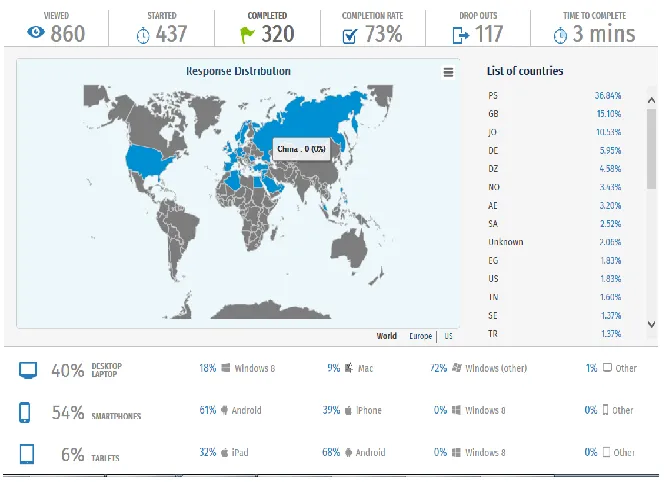
In a survey completed by 320 identified Palestinians, respondents were asked to rate their comfort with using technology in engaging with the democratic process by using internet platforms as a conduit for expanded democratic participation. The geographic distribution of respondents was diverse. Nearly 37% of respondents hailed from territories associated with the Palestinian Authority (Gaza, West Bank, East Jerusalem), a slight majority of respondents represented the diasporic element of Palestine, that is , those living outside of the aforementioned territories, while Just under 4% of “assumed” Palestinians did not self-identify as Palestinian. There was a heavy bias towards male respondents in this survey, c omprising nearly 80% of all respondents. Marital status did not appear to induce a specific bias as there was nearly equal numbers of respondents reporting being married or single, while fewer than 2% of the respondents were divorcees. When looking at age distribution, over 53% of respondents fell in the 18-30 age demographic. The age demographic with the second highest response rate was that of 31-40 years representing nearly 25% of all respondents. Thus there is a heavy bias on the younger generations being involved and responding to the questionnaire. This is not surprising though as there is an age related digital divide identified in most societies in the middle-east (Mousavi and Pimenidis, 2014 and Shat et al, 2014).
Figure 2. Survey demographics
Internet Usage
Participants in the survey group were asked to indicate how long they had used the internet, and then were asked to detail the frequency of their weekly internet usage. Over 93% of respondents reported internet use of three years or more. Of all respondents, over 97% indicated daily engagement with the internet. When the group was asked to reflect on their primary purpose for their engagement, responses were diverse. With results of 23.85%, 21.51%, and 20% respectively, social media networking was listed as the most common
reason for internet engagement, followed by general information searches, and then email use.
[image:7.596.342.520.452.577.2]Figure 4. The average time of Internet Usage 2
Figure 5. The main purpose of Internet Usage.
Government Engagement
At the core of the survey, respondents reflected on their e-based interaction with government agencies and/or their e-requests for government services. Pointedly, the survey asked respondents, “Ha ve you ever used any of the E-Government services or ever visited or communicated with the government over the internet?” Over 68% of respondents indicated the use of internet interfaces to connect with the Palestinian Authority and its governmental services.
Figure 6. Percentage of internet usage.
Predictive Statements
[image:8.596.72.268.354.480.2]Figure 7. Willingness of using e-government services in the future.
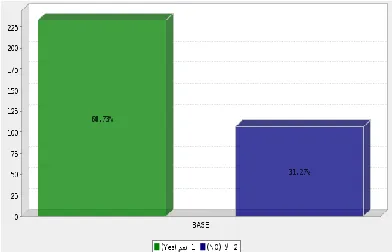
[image:9.596.76.312.312.464.2]When asked about the potential of using the E-Voting System in the next election, nearly 2/3 of respondents – just under 66% of the survey group – agreed or strongly agreed. 14.07% of respondents indicated a strong disagreement with the potential use of E-Voting, while 10.74% simply disagreed. 9.26% of r espondents indicated a neutral response or did not respond.
Figure 8. Willngness of using e-democracy system in the future.
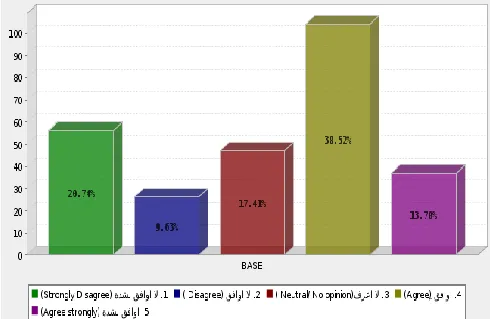
In what could be viewed as the crux statement of the survey, respondents were asked to rate their opinion of the statement, “I will trust the outcome of an election conducted via e-voting.” With nearly 14% of respondents strongly agreeing with the statement, and over 38% agreeing, affirmative responses compr omise the majority of all responses. That said, a significant minority of the survey group – 20.74% of respondents – strongly disagreed with the statement. Another 9.63% of respondents fell in the “disagree” segment of the survey group. Somewhat surprisingly, 17.41% of respondents offered no opinion or a neutral opinion.
[image:9.596.72.317.575.735.2]5.2 Is there enough evidence that e-voting can work in Palestine?
While no survey can provide an exhaustive gauge on public opinion, it appears that a majority of Palestinians may feel comfortable engaging in E-Democracy initiatives as they come online. It would appear that a potential Palestinian state would have a hearty base of support in place upon which future E-Democracy initiatives could flourish and grow. For the parts of constituency in diaspora, the futur e state’s use of a variety of online services and opportunities for engaging with democratic processes online (general elections, referenda), would afford Palestinian expatriates across the world opportunities to stay connected and engaged with the homeland.
The survey indicates that the Palestinian Authority must work to cultivate trust among its constituents. Expanded delivery of efficient, low cost services would certainly garner the trust of the people. Further more, the government’s enhanced partnership with the technological industry could cultivate additional trust. Calling on the expertise of technology firms to insure that online experiences are safe and private will do wonders for the “trust gap.”
There is reasonable evidence to prompt the Palestinian government to start a real initiative to gauge and test out if e-voting can work this might be throw start using technology in small elections such as student unions elections at universities, Unions election, local elections and Palestinian community committees etc. this will provide further evidence about the political will towards enabling people elect thei r representatives genuinely and regularly.
Furthermor e e-voting and the capturing of the trust of its people could present the perfect oppor tunity for the Palestinian Government to engage in further e-government activities. These could introduce new levels of transparency, efficiency of processes and answer calls for government accountability, allowing for better management of expectations and requirements of such a vastly dispersed peoples (Pimenidis and Georgiadis, 2014). The experience of more organized and integrated countries where smaller populations are dispersed in larger geographical areas has provided enough evidence to support such initiatives. The European initiatives for e-identification and cross-border e-government applications could provide a n excellent instrument for developing and supporting e-voting and other cross-border systems for a fragmented population such as the Palestinians (Sideridis et al, 2015). Grasping the trust and cultivating e-trust would be the biggest obstacle to overcome on the road of effective e-government and real e-democracy (Mousavi et al, 2008, Pimenidis et al, 2011).
This survey is only a starting block for exploring and verifying a realistic positive impact that e-voting systems could offer displaced peoples. Any practical application of e-voting in Palestine and its potential success could have a resonant effect on the handling of the present day humanitarian and at the same time governance and identification crisis with the huge influx of refugees in to the Europ ean Union. E-voting and other online systems can help displaced refuges to stay in touch, engage with the democratic process and help their homelands return to a full a restored democracy.
Conclusion
Being able to offer effective and trusted access to services that support government processes as well the participation in the election of the people that exert governance over a country, a nation or a dispersed group of people is one of the main challenges in the world of e-democracy nowadays.
To do so the governing body has to ensure that processes and systems are in place that allows the building of trust through the empowerment of the individuals. If this achieved processes can be simplified, become more effective and efficient and better integration of individuals into the democratic process can be attained. Driven by the need to overcome exclusion from such fundamental democratic rights and processes as voting, Palestinians appear to be favouring the use of e-voting technologies in electoral process es. This could offer the Palestinian government with a unique opportunity of embracing e-government related technologies to deliver trust, efficiency, effectiveness and transparent accountability on the road to an enhanced democracy. The benefits of a successful adoption of e-voting in Palestine can be extended to all organized displaced ethnic groups in the future.
References:
Casati, R. (2009). Trust, secrecy and accuracy in voting systems: the case for transparency. Mind & Society, 9(1), pp.19-23.
Celeste, R., Thornburgh, D. and Lin, H. (2006). Asking the right questions about elec tronic voting. Washington, D.C.: National Academies Press.
Choi, D. (2012). Supply chain governance mechanisms, green supply chain management, and organizational performance.
Galam, S. (2000). Democratic Voting in Hierarchical Structures or How to Build a Dictatorship. Advs. Complex Syst., 03(01n04), pp.171-180.
Gritzalis, D. (Ed.) (2002). Secure Electronic Voting, Kluwer Academic Publishers, USA.
Kiayias, A., Zacharias, T. and Zhang, B. (2015) On the Necessity of Auditing for Election Privacy in e-Voting Systems, In S.K. Katsikas and A.B. Sideridis (Eds.): E-Democracy 2015, CCIS 570, pp. 3–17, 2015. DOI: 10.1007/978-3-319-27164-4_1
Macintosh, A. (2003) Using Information and Communication, Technologies to Enhance Citizen Engagement in the Policy Process, in Promise and Problems of E-Democracy: Challenges of Online Citizen Engagement, OECD, pp. 59-91.
Mercuri, R. (2002) A better ballot box?. Spectrum, IEEE, vol.39, no.10, pp.46 – 50.
Mousavi S.A.A., Pimenidis E, Jahankhani H. (2008) Cultivating Trust – An e-Government Development model for addressing the needs of developing countries, International Journal of Electronic Security and Digital Forensics (IJESDF), Vol. 1, No. 3, pp. 233-248.
Ntaliani, M., Costopoulou, C., Karetsos, S. and Molhanec, M. (2015) Citizen e-Empowerment in Greek and Czech Municipalities in S.K. Katsikas and A.B. Sideridis (Eds.): E-Democracy 2015, CCIS 570, pp. 124–133, 2015. DOI: 10.1007/978-3-319-27164-4_9
Pimenidis, E. and Georgiadis C.K. (2014) Can e-Government Applications Contribute to Performance Improvement in Public Administration?, International Journal of Operations Research and Information Systems, 5(1), 48-57, January-March 2014 – DOI: 10.4018/ijoris.2014010104
Pimenidis, E., Iliadis L.S. and Georgiadis C.K. (2011) Can e-Government Systems Bridge the Digital Divide?, In Proceedings of the 5th European Conference on Information Management and Evaluation (ECIME 2011), Dipartimento di Informatica e Comunicazione, Università dell'Insubria, Como, Italy, 8 -9 September 2011, pp. 403 – 411.
Schaupp, C., Carter, L. (2005). E‐voting: from apathy to adoption. Journal of Enterprise Information Management 2005 18:5 , 586-601.
Shat, F., Mousavi, S.,A.,A and Pimenidis, E. (2014) Electronic Government Enactment in a Small Development Country – The Palestinian Authority’s Policy and Practice, in A.B. Sideridis et al. (Eds.): E-Democracy 2013, CCIS 441, pp. 83–92, 2014. DOI: 10.1007/978-3-319-11710-2_8.
Sideridis, A., Protopappas, L., Tsiafoulis, S. and Pimenidis, E. (2015) Smart cross -border e-Gov systems and applications, In: S.K. Katsikas and A.B. Sideridis (Eds.): E-Democracy 2015, CCIS 570, pp. 151–165, 2015. DOI: 10.1007/978-3-319-27164-4_11.
Sideridis, A.B., Pimenidis, E., Protopappas, L. and Koukouli, M. (2011) An evaluation of the initiatives and the progress made on Government services in the EU, Global Security, Safety and Sustainability & e-Democracy, Lecture Notes of the Institute for Computer Sciences, Social Informatics and Telecommunications Engineering Volume 99, 2012, pp 263-270.
Tsagarousianou, Roza, Tambini, D., Bryan, C. (1998). Cyberdemocracy: Technology, Cities and Civic Networks. Routledge. London.
BBC, 2008-last update, 1993 Oslo agreement. Available:
http://news.bbc.co.uk/1/hi/world/middle_east/7385301.stm [01/10, 2016].
ORGANIZATION FOR ECONOMIC CO-OPERATION AND DEVELOPMENT (OECD), 2011-last update, THE CASE OF E-GOVERNMENT IN THE PALESTINIAN AUTHORITY. Available:
http://www.google.co.uk/url?sa=t&rct=j&q=&esrc=s&source=web&cd=1&ved=0CCYQFjAA&url=http%3A %2F%2Fwww.oecd.org%2Fmena%2Fgovernance%2F50402812.pdf&ei=pA9mVPXALJPraOuRgegO&usg=AF QjCNGcKbO_f5m4r2jCfZAsqtdzSfiDLw [11/12, 2014].
PSC, 2014-last update. Available: http://www.palestinecampaign.org/information/ [12/15, 2014]. UNITED NATIONS, 2014-last update, PLO [11/11, 2014].
UNITED NATIONS, 2012-last update, General Assembly Votes Overwhelmingly to Accord Palestine ‘Non-Member Observer State’ Status in United Nations. Available: