warwick.ac.uk/lib-publications
Original citation:
Dehornoy, Patrick, Holt, Derek F. and Rees, Sarah (2018) Multifraction reduction IV : padding
and Artin–Tits monoids of sufficiently large type. Journal of Pure and Applied Algebra
. doi:10.1016/j.jpaa.2018.02.021
Permanent WRAP URL:
http://wrap.warwick.ac.uk/98262
Copyright and reuse:
The Warwick Research Archive Portal (WRAP) makes this work by researchers of the
University of Warwick available open access under the following conditions. Copyright ©
and all moral rights to the version of the paper presented here belong to the individual
author(s) and/or other copyright owners. To the extent reasonable and practicable the
material made available in WRAP has been checked for eligibility before being made
available.
Copies of full items can be used for personal research or study, educational, or not-for-profit
purposes without prior permission or charge. Provided that the authors, title and full
bibliographic details are credited, a hyperlink and/or URL is given for the original metadata
page and the content is not changed in any way.
Publisher’s statement:
© 2018, Elsevier. Licensed under the Creative Commons
Attribution-NonCommercial-NoDerivatives 4.0 International http://creativecommons.org/licenses/by-nc-nd/4.0/
A note on versions:
The version presented here may differ from the published version or, version of record, if
you wish to cite this item you are advised to consult the publisher’s version. Please see the
‘permanent WRAP URL’ above for details on accessing the published version and note that
access may require a subscription.
ARTIN–TITS MONOIDS OF SUFFICIENTLY LARGE TYPE
PATRICK DEHORNOY, DEREK F. HOLT, AND SARAH REES
Abstract. We investigate the padded version of reduction, an extension of multifraction reduction as defined inarXiv:1606.08991, and connect it both with ordinary reduction and with the so-called Property H. As an applica-tion, we show that all Artin–Tits groups of sufficiently large type satisfy some weakened version ConjectureApaddedof ConjectureA, thus showing that the reduction approach is relevant for these groups.
Reduction of multifractions, which was introduced in [2] and [3], is a new ap-proach to the word problem for Artin–Tits groups and, more generally, for groups that are enveloping groups of monoids in which the divisibility relations have weak lattice properties (“gcd-monoids”). It is based on a rewrite system (“R-reduction”) that extends the usual free reduction for free groups, as well as the rewrite systems known for Artin–Tits groups of spherical type, and more generally Garside groups. It was proved in [2] that R-reduction is convergent for all Artin–Tits groups of type FC, and in [3] that a certain condition called semi-convergence, weaker than convergence, is sufficient to obtain the decidability of the word problem, leading to the main conjecture (“ConjectureA”) that R-reduction is semi-convergent for every Artin–Tits monoid.
The aim of the current paper is to exploit the observation that semi-convergence up to Turing-computable padding, a weakening of semi-convergence, is again suf-ficient to solve the word problem. By padding, we mean the insertion of an even number of trivial components at the beginning of a multifraction.
The main results we prove are as follows. First, we have a simple criterion for the word problem:
Proposition 1.6. If M is a strongly noetherian gcd-monoid with finitely many basic elements, for whichR-reduction is semi-convergent up tof-padding for some Turing-computable mapf, then the word problem of U(M) is decidable.
Next, we establish a simple connection between the padded version of semi-convergence, the semi-convergence of a variant ofR-reduction (“split reduction” or “S-reduction”) and Property H of [1, 4, 8]. When we say below that (S, R) is an lcm presentation for M, we mean that every relations... = t...in R specifies the least common multiple ofsandt, and similarly on the right; see Definition 1.14.
Proposition 1.14. IfM is a gcd-monoid and(S, R)is an lcm presentation forM, then the following are equivalent:
2000Mathematics Subject Classification. 20F36, 20F10, 20M05, 68Q42, 18B40, 16S15.
Key words and phrases. Artin–Tits monoid; Artin–Tits group; large type; sufficiently large type; gcd-monoid; enveloping group; word problem; Property H; multifraction; reduction; subword reversing.
(i)R-reduction is semi-convergent forM up to padding; (ii) S-reduction is semi-convergent forM;
(iii) Property His true for (S, R).
Finally, we consider the specific case of Artin–Tits groups. In view of Proposi-tion 1.6, we propose
Conjecture Apadded. For every Artin–Tits monoid,R-reduction is semi-convergent
up tof-padding for some Turing-computable mapf.
By the results of [2], Conjecture Apadded is true for every Artin–Tits monoid of
type FC. Here we prove:
Theorem 1. Conjecture Apadded is true for all Artin–Tits monoids of sufficiently
large type.
We recall from [10] that an Artin–Tits group is said to be of sufficiently large typeif, in any triangle in the associated Coxeter diagram, either no edge has label 2, or all three edges have label 2, or at least one edge has label∞. The result follows directly from the more precise result stated as Proposition 2.1 below, which gives an explicit quadratic upper bound on the padding that is needed. The proof relies on a careful analysis of the techniques of [10] and [8]. With this result, the family of Artin–Tits for which multifraction reduction is relevant is greatly enlarged.
The paper is organised in two sections. The first one is devoted to padded reduction and its variants in a general context of gcd-monoids, and contains a proof of Propositions 1.6 and 1.15. The second section is devoted to the specific case of Artin–Tits monoids of sufficiently large type, with a proof of Theorem 1.
1. Padded multifraction reduction
After recalling in Subsection 1.1 the definitions that we need for multifraction reduction and the rewrite systemR, we introduce in Subsection 1.2 padded versions of semi-convergence and use them to solve the word problem of the enveloping group. Next, we introduce in Subsection 1.3 a new rewrite system SM, a variant
of Rcalled split reduction, and we connect its semi-convergence with the padded semi-convergence ofR. Finally, we establish the connection with subword reversing and Property H in Subsection 1.4.
1.1. Multifraction reduction. If M is a monoid, we denote by U(M) the
en-veloping group of M, and byι the canonical (not necessarily injective) morphism fromM to U(M). We say that a finite sequencea= (a1, ..., an) of elements ofM,
also called amultifractiononM and denoted bya1/···/an,represents an elementg
ofU(M) if
(1.1) g=ι(a1)ι(a2)−1ι(a3)···ι(an)(−1)
n−1
holds inU(M). In this context, the parameternis called thedepth ofa, denoted bykak, and the right hand side of (1.1) is denoted byι(a). We useFM for the family
of all multifractions on M, and 1n for the depth n multifraction with all entries
equal to 1, skippingnwhen no ambiguity is possible. Our aim is to recognise which multifractions represent 1 inU(M).
Definition 1.2. A monoid M is called a gcd-monoid if it is cancellative, 1 is its only invertible element, and any two elements ofM admit a left- and a right-gcd, where, for a, bin M, we say thataleft-divides b, writtena6b, if we haveb=ax for some xin M, and that dis a left-gcd ofa and b ifd left-divides a and b and every common left-divisor of aand b left-divides d. Right-division and right-gcd are defined symmetrically, withb=xareplacing b=ax.
Anatom inM is an element that is not expressible asabwitha, b6= 1. A right-(resp. left-)basic element is one that is obtained from atoms using the operation\ (resp./) defined bya(a\b) =a∨b(resp. (a/b)b=a∨eb), where∨(resp.∨e) stands for the right-lcm (resp. left-lcm).
The monoid M is called noetherian if there is no infinite descending sequence with respect to proper left- or right-division, andstrongly noetherian if there exists a mapλfrom M\ {1}to the positive integers satisfying λ(ab)>λ(a) +λ(b).
Throughout the paper, we restrict our attention to gcd-monoids: Artin–Tits monoids are typical examples. In a gcd-monoid, any two elementsa, bthat admit a common right-multiple (resp. left-multiple) admit a least one, the right-lcm (resp. left-lcm) ofaandb, denoted bya∨b(resp.a∨eb).
If M is a gcd-monoid, a family R of rewrite rules on FM is defined in [2]: for
a, b in FM, and for i>1 and x∈M, we write a•Ri,x=b if we havekbk=kak,
bk=ak fork6=i−1, i, i+ 1, and there existsx′ satisfying
forieven: bi−1=ai−1x′, xbi =aix′=x∨ai, xbi+1=ai+1, fori>3 odd: bi−1=x′ai−1, bix=x′ai=xe∨ai, bi+1x=ai+1, fori= 1: bix=ai, bi+1x=ai+1. We say that areduces tob in one step, and writea⇒b, if a•Ri,x =b holds for
someiand somex6= 1. We use⇒∗ for the reflexive–transitive closure of⇒.
By [2, Lemma 3.8 and Cor. 3.20],a⇒∗bimplies thataandbrepresent the same
element inU(M), and, conversely, the relationι(a) =ι(b) is essentially the equiv-alence relation generated by ⇒(up to deleting trivial final entries). Furthermore, whenever the monoidM is noetherian,R-reduction is terminating forM.
By [2, Prop. 4.16] and [3, Prop. 3.2],R-reduction is locally confluent forM if and only ifM satisfies the 3-Ore condition, meaning that any three elements ofM that pairwise admit a common right- (resp. left-) multiple admit a global one. In this case, R-reduction is convergent, implying that a multifraction arepresents 1 in U(M) if and only if a⇒∗1 is satisfied. In the case of Artin–Tits monoids, this
exactly corresponds to type FC.
When M does not satisfy the 3-Ore condition, R-reduction is not confluent for M, and no convergence result can be expected. However, a condition weaker than convergence can be used to solve the word problem:
Definition 1.3([3]). We say thatR-reduction issemi-convergent forM ifa⇒∗ 1
holds for every multifractionathat represents 1 inU(M).
Convergence implies semi-convergence, but explicit examples of gcd-monoidsM for whichR-reduction is semi-convergent but not convergent are known [6]. How-ever:
Conjecture A([3]). R-reduction is semi-convergent for every Artin–Tits monoid.
ConjectureAis true for every Artin–Tits monoid of FC type, but other cases re-main open. Every Artin–Tits monoid satisfies the finiteness assumptions of Propo-sition 1.4 and, therefore, the word problem of the enveloping group of every Artin– Tits monoid satisfying ConjectureAis decidable.
1.2. Padded semi-convergence. We now introduce a weakening of
semi-conver-gence, in which trivial initial entries may be added to multifractions. For p a non-negative integer and a a multifraction, we write 12p/a for the multifraction
obtained fromaby adding 2ptrivial entries on the left ofa. Note that the number of 1s that are added must be even in order to preserve the image of the multifraction in the group.
Definition 1.5. If f is a map from FM to N, we say that R-reduction is
semi-convergent forM up tof-padding if 12f(a)/a⇒∗ 1 holds for every multifractiona that represents 1 inU(M).
By definition, semi-convergence is semi-convergence up to 0-padding. Because a⇒∗btrivially implies 1
2p/a⇒∗ 12p/bfor everyp, semi-convergence ofR-reduction
up to f-padding implies its semi-convergence up to f′-padding forf′ >f
(mean-ing∀a∈FM(f′(a)>f(a))): appending trivial initial entries preserves the existing
reductions and possibly adds new ones.
Proposition 1.6. If M is a strongly noetherian gcd-monoid with finitely many basic elements for whichR-reduction is semi-convergent up tof-padding for some Turing-computable mapf on FM, then the word problem of U(M)is decidable.
Speaking of a Turing-computable map defined onFM makes sense because, under
the assumptions of Proposition 1.6,M admits a finite presentation in terms of the finite atom family S of M, and every element of the monoidM is represented by finitely many words inS only, which implies the decidability of the word problem ofM with respect toS. Then a Turing-computable map onM means one that is induced by a Turing-computable map on words in S that is compatible with the relations definingM.
If (S, R) is a monoid presentation, that is, Ris a family of pairs of words in S, we denote by ≡+
R, or simply ≡
+, the congruence on S∗ generated by R, implying
hS |Ri+=S∗/≡+. Forw a word inS, we denote by [w]+ the element of hS |Ri+
represented by w, that is, the ≡+-class of w. Let S be a disjoint copy of S that
consists of a new element s for each element s of S. For w a word in S∪S, we denote by w the word obtained from w by exchanging s and s everywhere and reversing the order of letters. In this context, the element ofS (resp.S) are called positive (resp. negative), and we denote by [w] the element of the grouphS | Ri represented bywwhensrepresentss−1.
Proof of Proposition 1.6. The argument is the same as the one in [3] for Proposi-tion 1.4. LetSbe the atom set ofM, and letwbe a word inS∪S. To decide whether w represents 1 in U(M), we first express it asw1w−21w3··· with w1, w2, ... in S∗ (no negative letters). Then, writing w= (w1, w2, ...) and [w]+ for [w1]+/[w2]+/···, we append 2f([w]+) trivial entries on the left, and exhaustively enumerate all
se-quences w′ satisfying 1
2f([w]+)/[w]+ ⇒∗ [w′]+: this is possible because, under the
the relation ⇒∗ are decidable. Indeed, call a word basic if it represents a basic
element ofM. Then, if a wordw(resp.w′) can be expressed as the concatenation
of ℓ(resp. ℓ′) basic words, which is the case if w (resp.w′) has lengthℓ (resp. ℓ′)
since all letters ofSare basic, and [w]+,[w′]+admit a common right multiple, hence
a right lcm, the latter can be expressed as the concatenation ofℓ+ℓ′ basic words,
namely any diagonal path in a rectangularℓ×ℓ′-grid all edges of which correspond
to basic words: this directly follows from the definition of basic elements and the rules for an iterated lcm (equivalently, the element [w]+\[w′]+ is a product of at
most ℓ′ basic elements). Thus, if [w]+ and [w′]+ admit a common right multiple,
they admit one represented by a word of length at most (ℓ+ℓ′)L, where Lis an
upper bound for the lengths of basic words. Then w represents 1 in U(M) if and only if a trivial sequenceε/···/εappears in the list, whereεis the empty word.
We are thus led to the new conjecture, Conjecture Apadded, stated in the
intro-duction. Conjecture Apadded isa priori weaker than Conjecture A but, by
Propo-sition 1.6, it nevertheless implies the decidability of the word problem of every Artin–Tits group for which it is true.
1.3. Split reduction. We now connect the padded version of semi-convergence of R-reduction with the ordinary semi-convergence of a new rewrite system, a variant ofR-reduction that can naturally be calledsplit reduction.
In the definition of multifraction reduction used in [2, 3, 6] and repeated in Section 1.2, in order fora•Ri,x to be defined, xand ai have to admit a common
multiple, a left- or right-multiple depending on the parity ofi. In order to define a variant of this reduction, we now relax the assumption and only require thatxand some divisor ofai admit a common multiple; then, we again remove xfrom ai+1 and push it to the left or right side using the lcm operation, this time through the divisor ofai that is involved and not necessarily through the whole ofai.
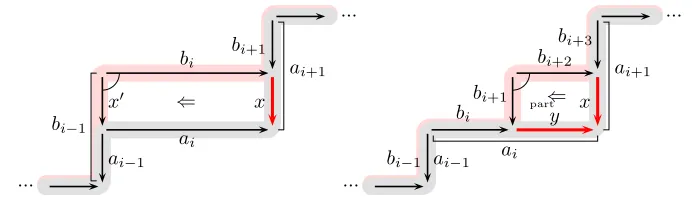
Definition 1.7. (See Figure 1 right.) Assume that M is a gcd-monoid. Fora, b in FM, and for i>1 even (resp. odd) and x, y in M such thatx∨y (resp. xe∨y)
exists, we writea•Ri,x,ybreak =bif we havekbk=kak+ 2,bk =ak fork < i,bk =ak−2 fork > i+ 3, and
forieven: ybi=ai, ybi+1=xbi+2=x∨y, xbi+3=ai+1, foriodd: biy=ai, bi+1y=bi+2x=x∨ey, bi+3x=ai+1.
In addition we define “trimming” rules Rtrim
i , such that a•Ritrim = b holds if we
have ai+1 = 1, kbk =kak −2, and bk = ak for k < i, bk = ak+2 for k > i+ 1, and bi =aiai+2 (resp.ai+2ai) if iis odd (resp. even). We write a⇒split bif either
a•Ri,x,ybreak =bholds for somei, x, ywithxy6= 1 ora•Ritrim=bholds for somei, and
denote by ⇒∗
split the reflexive–transitive closure of ⇒split. The rewrite systemSM so
obtained is calledsplit reduction onM.
Adding the trimming rulesRtrim
i is a technical artefact that will make statements
simpler. It directly follows from the definition that, ifa⇒∗
splitbis true, thenaandb
represent the same element in the group U(M). A major difference between R -andS-reductions is that, even if the monoidM is noetherian, no termination can be expected for the latter in general.
Example 1.8. LetM be the Artin–Tits monoid of typeAe2, that is,
...
ai−1 x′
bi−1
ai
bi
x bi+1
...
ai+1
⇐
...
ai−1 bi−1
bi+1
bi y
ai
bi+2
x bi+3
...
ai+1 ⇐
[image:7.595.131.477.110.211.2]part
Figure 1. Comparing the reduction Ri,x (left) and the split
reduc-tionRbreak
i,x,y (right), here foriodd: in both cases, we divide ai+1 byx and push x to the left using an lcm, but, for Ri,x, we demand that
x crosses the whole of ai, whereas, for Ri,x,ybreak, we only require thatx
crosses the possibly proper divisoryofai; as a consequence, we cannot
gather the elements at leveli−1 and the depth increases by 2.
and leta=ab/c. Then we finda•Rbreak
1,c,bR1break,c,a= 1/ac/ca/b/cb/1, whence
a•R break
1,c,bR break
1,c,aR break
3,b,aR break
3,b,cR break
5,a,cR break
5,a,b= 1/ac/1/cb/1/ba/ab/c/ac/1/ba/1/cb/1,
that is, with obvious notation,a⇒6
split 1/ac/1/cb/1/ba/a/ac/1/ba/1/cb/1, leading
to an infinite sequence of split reductions froma.
The following result directly follows from the definition; we state it both and as a useful example for practice and for future reference.
Lemma 1.9. IfM is a gcd-monoid, anda=···/a/1/bc/···is a multifraction onM with elementsa,1, and bcin positions i−1,i, andi+ 1, then we have
a•Ri,b =···/a/1/bc/···•Ri,b =···/ab/1/c/··· fori even,
a•Ri,c =···/a/1/bc/···•Ri,c =···/ca/1/b/··· fori odd.
In particular, fora= 1, we find
a•Ri,b =···/1/1/bc/···•Ri,b =···/b/1/c/··· fori even,
a•Ri,c =···/1/1/bc/···•Ri,c =···/c/1/b/··· fori odd.
Proof. The diagrams provide a proof.
ab
1 c
a 1 bc
b b
ca
1 b
a 1 bc
c c
Lemma 1.10. Assume thatM is a gcd-monoid anda, bbelong toFM.
(i)If a⇒∗b holds, then so does a⇒∗ splitb.
(ii) Ifa⇒∗
splitb holds, then12p/a⇒∗b/12q holds for somepandq.
Proof. (i) For an induction it is sufficient to prove thata⇒b impliesa⇒∗ splitb. So
assume thata•Ri,x=bwith, say,ieven. Writingx∨ai =xbi =aix′ and applying
the definition ofRbreak
i,x,y, we find
a•Ri,x,abreaki=a1/···/ai−1/1/x′/bi/···/bn=b1/···/bi−2/ai−1/1/x′/bi/···/bn.
The definition ofRi,xgivesbi−1=ai−1x′, so we deduce
a•Ri,x,abreakiR
trim
whencea⇒2
splitb. The argument is similar foriodd.
(ii) We prove using induction onmthata⇒m
splitbimplies the existence ofpandq
satisfying 12p/a ⇒∗ b/12q. Putn:=kak. The result is straightforward form= 0
withp=q= 0. Suppose thatm= 1. Suppose firsta•Ri,x,ybreak =b with, say,ieven.
By hypothesis,y left-divides ai, and we haveai=ybi. Starting from 12/a, we can first useireduction steps to splitai intobi andyby pushinga1, ..., ai−1, andbi to
the left using Lemma 1.9 repeatedly: precisely, we find
12/a•R2,a1R3,a2···Ri,ai−1Ri+1,bi=a1/···/ai−1/bi/1/y/ai+1/···/an,
whence 12/a ⇒i b1/···/bi/1/y/ai+1/bi+4/···/bn+2. Leta′ be the latter multifrac-tion. By hypothesis,xdividesai+1, which isa′i+3, and the lcm ofxandy, that is, ofxanda′
i+2, exists, soa′ is eligible forRi+2,x. Then we obtain
a′•Ri+2,x=b1/···/bi/bi+1/bi+2/bi+3/bi+4/···/bn+2=b,
whence 12/a⇒∗a′⇒b, the expected result withp= 1 and q= 0.
Suppose now a•Ritrim =b, still withi even. By hypothesis, we haveai+1 = 1, and we find
a•Ri+1,ai+2=a1/···/ai−1/aiai+2/1/1/ai+3/···/an
and from there, by the same argument as above with 12/a, we can pushai+3, ..., an
to the left, obtaining
a•Ri+1,ai+2Ri+2,ai+3···Rn−1,an=a1/···/ai−1/aiai+2/ai+3/···/an/1/1,
which impliesa⇒∗b/1
2, the expected result withp= 0 andq= 1. The verifications foriodd are similar.
Suppose finally m>2. Write a⇒m−1
split c⇒split b. The induction hypothesis
im-plies the existence ofpandqsatisfying 12p/a⇒∗c/12q, and that ofp′ andq′
satis-fying 12p′/c⇒∗b/12q′. AsR-reduction is compatible with left and right
multiplica-tion, 12p/a⇒∗c/12q implies 12p+2p′/a⇒∗12p′/c/12q, and 12p′/c⇒∗b/12q′ implies
12p′/c/12q ⇒∗b/12q+2q′. By transitivity of ⇒∗, we deduce 12p+2p′/a⇒∗ b/12q+2q′
and this is the expected result.
We deduce a simple connection betweenR- andS-reductions to 1:
Proposition 1.11. IfM is a gcd-monoid then, for every multifraction aonM,
(1.12) a⇒split∗ 1 is equivalent to ∃p(12p/a⇒ ∗1).
Proof. Assumea⇒split∗ 1, saya⇒ ∗
split1r. By Lemma 1.10, there exist p, qsatisfying
12p/a⇒∗1r+2q, whence 12p/a⇒∗1.
Conversely, assume 12p/a ⇒∗ 1. Suppose first kak 6 1. Then 12p/a ⇒∗ 1 is
possible only for a = 1, in which case a ⇒∗
split 1 is trivial. Now suppose kak > 2
with a not trivial, that is, at least one entry of a is not 1. Let i be minimal satisfying ai 6= 1. Then a is eligible for Ri,break1,a1, and we find a•R
break
i,1,ai = 12/a,
whence a⇒∗
split 12p/a in psteps. Next, by Lemma 1.10 again, 12p/a⇒
∗ 1 implies
12p/a⇒split∗ 1. We deducea⇒ ∗
split1 by transitivity of⇒ ∗
split.
We naturally say thatS-reduction is semi-convergent forM ifa⇒∗
split1 holds for
every multifractionathat represents 1 inU(M). Proposition 1.11 implies:
1.4. Connection with subword reversing and PropertyH. In the absence of a a solution of the word problem for general Artin–Tits groups, Property H (see Definition 1.16 below) was proposed [1] as a weaker statement in the direction of such a solution along the line of Dehn’s algorithm for hyperbolic groups, and it was proved that Property H is indeed satisfied for the standard presentation of all Artin–Tits groups of type FC [4] and of sufficiently large type [8]. We now establish a simple connection between Property H and multifraction reduction. To state the result, we first need the notion of an lcm presentation:
Definition 1.14. A presentation (S, R) of a monoidM is aright-lcm presentation ifR contains one relation for each pair (s, t) in S×S such that sand t admit a common right-multiple and this relation has the form sv=tuwhere both sv and tvrepresent the right-lcms∨t. A left-lcm presentation is defined symmetrically.
By [5, Thm. 4.1], every strongly noetherian gcd-monoid admits a right-lcm pre-sentation and a left-lcm prepre-sentation. For instance, the standard prepre-sentation of an Artin–Tits monoid is an lcm presentation on both sides.
Proposition 1.15. IfM is a gcd-monoid and(S, R)is an lcm presentation forM (on both sides), then the following are equivalent:
(i)R-reduction is semi-convergent forM up to padding; (ii) S-reduction is semi-convergent forM;
(iii) Property His true for (S, R).
By Corollary 1.13, (i) and (ii) in Proposition 1.15 are equivalent, and we are left with establishing the equivalence of (ii) and (iii), which will occupy the rest of the section.
We first recall a few definitions. If (S, R) is a monoid presentation, and w, w′
are words inS∪S, then we say thatw′ is obtained fromwby one step ofrightR
-reversingifw′is obtained by deleting some length 2 factorssofwor replacing some
length 2 factorstofwwithvusuch thatsv=tuis a relation ofR. Symmetrically, we say thatw′ is obtained fromw by one step ofleft R-reversing ifw′ is obtained
by deleting some length 2 factorssof wor replacing some length 2 factorst ofw withvusuch thatvs=utis a relation ofR.
Definition 1.16. Suppose that (S, R) is a monoid presentation. Ifw, w′ are words
inS∪S, we say thatw w′ is true if one can go fromwtow′ using finitely many
special transformations of the following types: (i) replacing a positive factoruofw byu′ withu′ ≡+u(“positive equivalence”), (ii) replacing a negative factoruofw
by u′ with u′ ≡+ u (“negative equivalence”), (iii) right R-reversing, (iv) left
R-reversing. We say that (S, R) satisfies Property H if [w] = 1 impliesw ε, where εis the empty word.
All special transformations map a word inS∪S to one that represents the same element in U(M), so w ε always implies [w] = 1: Property H says that this implication is an equivalence. Note that special transformations add no new trivial factorssorss, a situation reminiscent of Dehn’s algorithm for hyperbolic groups [4, Sec. 1.2].
The point here is that, if (S, R) is a right-lcm presentation, then right-reversing computes the right-lcm inhS|Ri+ in the following sense:
elements[u]+and[v]+ ofM admit a common right-multiple if and only if the right
R-reversing of uv leads to word v′u′ with u′, v′ in S∗ and, in this case, one has
[uv′]+= [vu′]+= [u]+∨[v]+.
Of course, if (S, R) is a left-lcm presentation of M, left R-reversing computes the left-lcm inM in a similar sense.
Our aim from now on is to connect the relation on words inS∪S with partial reduction of multifractions. The convenient bridge between words and multifrac-tions is as follows:
Definition 1.18. Suppose that M = hS | Ri+. A word w in S∪S is said to
represent a depth n multifraction a on M if there exist words w1, ..., wn in S∗
satisfying w = w1w2w3w4··· and [wi]+ = ai for every i. We say that w sharply
representsaif, in addition, wi is nonempty for 1< i < n.
A wordwinS∪Smay represent several multifractions, since the expression ofw as w1w2w3w4··· need not be unique if no maximality condition is required, but it sharply represents a unique multifraction not finishing with a trivial entry.
Lemma 1.19. Assume that M is a gcd-monoid with lcm presentation (S, R)and
wis a word inS∪S representing a multifractiona. Thena⇒splitb impliesw w ′
for some wordw′ inS∪S representingb.
Proof. Put n = kak, and let w1, ..., wn satisfy w = w1w2w3w4··· and [wi]+ = ai
for every i. Suppose first a•Ritrim =b with, say,i odd. By hypothesis, we have
ai+1= 1, which requireswi+1 =ε, because there is no nontrivial invertible element in M, so the empty word must be the only element of its ≡+-class. Then we
have bi = aiai+2, and w also represents b, as witnessed by the decomposition w1, ..., wi−1, wiwi+2, wi+3, ..., wn. The argument is similar for i even, replacing
wiwi+2with wi+2wi.
Suppose now a•Ri,x,ybreak =b with, say, ieven. The assumption that a•Ri,x,ybreak is
defined implies thaty left-divides ai, and xleft-divides ai+1. It follows that there exist wordsu, v, u′′, v′′in S satisfying
wi≡+uu′′ and wi+1≡+vv′′ with [u]+=y and [v]+=x. By Lemma 1.17, the assumption thatx∨y exists implies that the right-R-reversing ofuv leads to some -wordv′u′ with u′, v′ in S∗ such that uv′ andvu′ both
repre-sentx∨y. Putw′
k:=wkfork < i,w′i:=u′′,w′i+1:=v′,w′i+2:=u′,wi′+3 :=v′′, and w′
k+2:=wk fork > i+ 1, andw′:=w′1w2′w′3w4′···. By construction,w′ is obtained from w using special transformations (namely positive and negative equivalences and right-reversing) and, by the definition ofRbreak
i,x,y, it representsb. The argument
is similar foriodd, exchanging right- and left-reversings.
Some care is needed for the other direction, because positive and negative equiv-alences might cause trouble. This is where sharp representations are useful.
Lemma 1.20. Assume that M is a gcd-monoid with lcm presentation (S, R)and
wis a word in S∪S sharply representing a multifraction a. Thenw w′ implies
a⇒∗
splitbfor some multifraction bsharply represented byw ′.
Proof. Putn=kak, and letw1, ..., wn satisfyw=w1w2w3w4··· and [wi]+=ai for
everyi. Suppose first thatw′ is obtained fromwby positive equivalence. Because
only. Then we have w′
i ≡+wi, andwk′ =wk fork6=i, so w′ sharply representsa,
and the result is true withb=a. The case whenw′ is obtained fromwby negative
equivalence is similar.
Suppose now that w′ is obtained from w by one step of right-reversing. This
means that there exists an even integer i, generatorss, t in S, words u′, v′ in S∗,
and a relation sv = tu in R satisfying wi = tv′, wi+1 = su′, and such that w′ is obtained from w by replacing the factor wiwi+1, which is v′tsu′, with v′uvu′. Now, if we define w′
k :=wk fork < i, wi′ :=v′, w′i+1 :=u, w′i+2 :=v, wi′+3:=u′, and w′
k+2 := wk for k > i+ 1, then we have w′ = w1′w′2w′3w′4···, whereas, by very definition, the wordsw′
1, ..., w′n+2 witness thatw′ represents the multifraction a•Ri,s,tbreak. If all wordsu, v, u′, v′are nonempty, then the representation is sharp, and
takingb:=a•Ri,s,tbreakgives the result. Otherwise, we restore sharpness by inserting
trimming steps. Assume for instance thatuis empty, butu′ andvv′are not. Then
a•Ri,s,tbreak is eligible for Ritrim, and w′ sharply represents b := a•Ri,s,tbreakRitrim. The
other cases are treated similarly, possibly using several trimmings. Note that free reduction, which corresponds tos =t and u=v =ε, is not special. Finally, the argument for left-reversing is similar, withi now necessarily odd.
We can now complete the argument.
Proof of Proposition 1.15. As said above, it only remains to establish the equiv-alence of (ii) and (iii). Suppose first that SM is semi-convergent, and let w be a
word in S∪S representing 1 in U(M). Let w1, ..., wn be words in S∗ satisfying
w=w1w2w3···, and leta:= [w1]+/···/[wn]+. Then we find
(1.21) ι(a) =ι([w1]+)ι([w2]+)−1ι([w3]+)··· = [w1][w2]−1[w3]··· = [w],
so arepresents 1 inU(M). By hypothesis, this impliesa⇒split1. By Lemma 1.19,
we must havew w′ for some wordw′ inS∪S representing 1. The wordw′ must
be the empty word, so we havew ε. Thus (ii) implies (iii).
Suppose now that Property H is satisfied for (S, R), and letabe a multifraction satisfyingι(a) = 1. First, by applying as many trim steps Rtrim
i as possible to a,
we obtain a ⇒∗ split a
′ for some multifractiona′ satisfying a′
i 6= 1 for 1 < i <ka′k.
Now let w be a word in S∪S representinga′. The conditionsa′
i 6= 1 imply that
wsharply representsa′. By construction,ι(a′) = 1 holds in U(M), and, therefore,
by the computation of (1.21), w represents 1 inU(M). By Property H, we must have w ε. By Lemma 1.20, one has a′ ⇒
split b for a multifraction b sharply
represented by ε. The latter is necessarily of the form 1, whencea⇒split 1. Thus
(iii) implies (ii).
It was noted in [1] that Property H need not imply the decidability of the word problem in general; Proposition 1.15 precisely measures the gap between the two properties: by Proposition 1.6, the decidability of the word problem follows from the semi-convergence of R-reduction up to a Turing-computable padding, whereas Property H entails no effective upper bound on the padding that is needed.
Remark 1.22. As stated above, Property H makes sense only for those
Then Property H can be stated for the double presentation (S, R,R), usinge R for right-reversing andRefor left-reversing, and all results stated above extend without change to this general version.
2. Artin–Tits groups of sufficiently large type
We now investigate a special family of gcd-monoids, namely Artin–Tits monoids of sufficiently large type, for which we establish the padded semi-convergence result stated as Theorem 1.
A presentation (S, R) of a monoidM is an Artin–Tits presentation if, for each pair (s, t) in S×S withs 6=t, the setR contains at most one relation, and that relation has the formst··· =ts···, relating two alternating products of lengthmst,
for some integer mst ≥2. If mst = 2, then (s, t) is called acommuting pair, and
if there is no such relation between s and t, then (s, t) is called a free pair, and we define mst = ∞. The associated Coxeter diagram is a complete graph with
vertex setS, and a labelmst on the edge joiningsandt. A monoidM is called an
Artin–Tits monoid if it possesses an Artin–Tits presentation (S, R). We say that M and its enveloping groupU(M) are ofsufficiently large typeif, in any triangle in the associated Coxeter diagram, either no edge has label 2, or all three edges have label 2, or at least one edge has label∞.
Since all relations inRhave the formu=v, whereuandv are positive words of the same length, we see that the word-length mapλinduces a well-defined map on the presented monoid, verifying strong noetherianity. We use λalso to denote the induced map on the monoid and, fora∈M, we callλ(a) theword-length ofa. We extendλto multifractions byλ(a) :=Piλ(ai), and callλ(a) theword-length ofa.
2.1. The result. The main result that we shall prove is:
Proposition 2.1. If M is an Artin–Tits monoid of sufficiently large type andais a multifraction of word-lengthℓthat represents1inU(M), then we have12p/a⇒∗ 1
withp= 3ℓ(ℓ+ 2)/4.
Note that, since all of the defining relators of the Artin–Tits groups have even length, a word in S∪S that represents the identity must have even length, so ℓ must be even in the above proposition.
So, R-reduction is semi-convergent for every Artin–Tits monoid of sufficiently large type up to a quadratic padding. As the square of word-length is obviously Turing-computable, Proposition 2.1 verifies thatM satisfies ConjectureApadded, and
therefore that the word problem of the associated Artin–Tits group is decidable (as was known already). By Proposition 1.15, we also obtain an alternative proof to the main result of [8], namely that the standard presentation of Artin–Tits groups of sufficiently large type satisfies Property H.
Proposition 2.1 follows from directly the following technical result. We say that a multifraction a is geodesic if its word-length is minimal over all multifractions that represent the same group element.
Proposition 2.2. If M is an Artin–Tits monoid of sufficiently large type andais a multifraction of word-lengthℓthat is not geodesic, then 16ℓ/aisR-reducible to a
multifraction of word-length ℓ−2.
of whose rules involve two generators only. We show that appropriate sequences of rules from that system can be simulated within multifraction reduction to reduce 16ℓ/a as required.
The following subsection, Subsection 2.2, explains our strategy. Further technical results are established in Subsection 2.3, and then the proof given in Subsection 2.4.
2.2. Strategy for the proof of Proposition 2.2. For the rest of this section, we assume that M is an Artin–Tits monoid of sufficiently large type, and that (S, R) is the associated presentation.
We shall refer to the elements ofSasgeneratorsand to those ofS∪Sasletters. Fors∈S, we call sthenameof both of the letters sands. We use f[w] and l[w] to denote the first and last letter of a wordwinS∪S. Furthermore, in situations where an elementaofM is represented by a unique wordw inS, we use f[a] and l[a] also to denote the first and last letters of w.
The rewrite system described in [9, 10] is based on two kinds of length preserving rules relating words,τ-moves andκ-moves, together with free reduction. By defini-tion, aτ-move rewrites a certain type of 2-generator subwordwon non-commuting non-free generators to another wordτ(w) on the same two generators, wherewand τ(w) have the same length and represent the same group element. Aκ-move applies commutation relations to subwords on two or more generators. In this article, in order to simplify the exposition, we choose to break κ-moves down as sequences ofκ-moves on 2-generator subwords, and we introduce the termτ+-move to mean either aτ-move or aκ-move applied to a 2-generator subword.
Soτ+-moves can be applied only to certain geodesic 2-generator words, which we callcriticalwords. Whenvis critical, thenτ+(v) is also critical, on the same set of generators. In all cases, one can check from the list of rewrite rules that f[v] and f[τ+(v)] have distinct names, as do l[v] and l[τ+(v)]. Furthermore, if v is neither a positive nor a negative word, then exactly one of f[v] and f[τ+(v)] lies inS, and the same is true for l[v] and l[τ+(v)].
Suppose thatw is a freely reduced non-geodesic word in S∪S. Then, by [10, Proposition 3.2], w admits a so-called leftward length reducing critical sequence. This consists of a certain type of factorisation (see [10] for a precise definition)w= αw1w2···wkβ for some k>1, wherew1, ..., wk are geodesic 2-generator subwords
ofw, andwk is critical. We can locate such a decomposition, if it exists, by a finite
search.
To perform the length reduction, as described in [10], we first replace wk by
τ+(w
k). Then, ifk >1, we replacewk′−1byτ+(w′k−1), wherew′k−1:=wk−1f[τ+(wk)].
We continue in this manner, finally replacingw′
1byτ+(w′1), wherew′1:=w1f[τ+(w2)]. At that stage, we have l[α] = f[τ+(w′
1)], and we can freely cancel these two adjacent letters.
To mimic the length reduction summarised above, we need to simulate the re-placement of wk byτ+(wk). If wk is a positive or a negative word then, by
def-inition, τ+(w
k) is another such word representing the same group element, with
f[τ+(w
k)] 6= f[wk]. In that case, the only multifraction operations that we may
need to carry out are moves that ensure that the part of the multifraction that is represented bywk occupies a single component.
Whenwk is neither a positive nor a negative word, the simulation of the
part of the multifraction, which may be spread across several components, is rep-resented by the wordwk. We useR-reduction (if necessary) to adjust that part of
the multifraction so that it occupies exactly two adjacent components, numbered i andi+ 1 for somei, and is represented by a wordvk with [wk] = [vk].
Further-more, if f[wk]∈S (i.e. wk starts with a positive letter), theni is odd and vk is a
concatenation of nonempty positive and negative words, whereas if f[wk]∈S, then
i is even andvk is a concatenation of nonempty negative and positive words. We
then carry out a single R-reduction, after which the part of the multifraction in question occupies components i and i−1, and is represented by a wordu′
k with
[u′
k] = [vk], which is a concatenation of negative and positive words in the first case,
and of positive and negative words in the second.
Letukbe the maximal proper suffix ofu′k. We shall show later in Lemma 2.6 that
f[u′
k] = f[τ+(wk)], souk represents the same group element as f[τ+(wk)]−1τ+(wk).
Then, fork >1, we adjoin f[u′
k] towk−1to give the wordw′k−1defined above. We repeat the above procedure on w′
k−1 to define wordsu′k−1, uk−1 and then, provided that k > 2, to define w′
k−2, u′k−2, uk−2, ..., w′1, u′1, u1. Then the first letter f[u′
1] of u′1 freely reduces with the final letter l[α] ofα, and this cancellation can be effected by a singleR-reduction.
So the word has effectively been transformed to α′u
1···ukβ, where α′ is the
maximal prefix of α. Now we use R-reduction to simulate the replacement of each ui by a 2-generator geodesicvi. The resulting word v =α′v1···vkβ, where
|α′|=|α| −1,|v
k|=|wk| −1 and, for 16i < k,|vi|=|wi|, is the same as the word
resulting from the application of sequence ofτ+-moves tow followed by the free cancellation. So we have successfully used R-reduction to simulate the reduction resulting from the leftward critical sequence, and reduce the length of the word by 2.
2.3. Technical results for two-generator Artin–Tits monoids. In order to
simulate theτ+ transformations, we need a few preliminary results. By definition, the elements involved in the transformations belong to a non-free two-generator submonoid of the ambient monoid, and we establish here various technical state-ments involving the elestate-ments of such submonoids and their enveloping groups.
The first point is that every element in the group admits distinguished fractional decompositions.
Proposition 2.3. IfM0is a non-free two-generator Artin–Tits monoid, then every element ofU(M0)admits a unique expression ab−1 witha, b inM0 andae∧b= 1, and a unique expressionc−1dwithc, d inM
0 andc∧d= 1.
Proof. The lcm ∆ of the two generators is a Garside element in M0 and, as a consequence, any two elements ofM0admit a common right-multiple and a common left-multiple. By Ore’s classical theorem, this implies that every element ofU(M0) can be expressed as a right fraction ab−1 and as a left fraction c−1d. As any two elements ofM0 admit a left gcd and a right gcd, dividing the numerator and the denominator of a right (resp. left) fraction by their right gcd (resp. left gcd) yields irreducible fractions. Uniqueness follows from the fact that, if the right gcd of a andb is trivial, thenca is the right lcm ofc anddwhenever we haveca=db(see
for instance [7, Lemma 9.3.5]).
The next point is that, under mild assumptions, the numerator and the denom-inator of these fractional normal forms are represented by unique words in the generators:
Lemma 2.4. IfM0 is a non-free two-generator Artin–Tits monoid, andab−1 and c−1dare the fractional normal forms of an element g of U(M
0) and, moreover, a andb (orc andd) are both6= 1, then none ofa,b,cordis divisible by the Garside element∆, and there are unique positive words inM0representing each of them.
Proof. If, for example, awere divisible by ∆ then it would have a representative word with the same last letter as a representative word forb, which would violate the condition that aand b have no common right divisor. The uniqueness of the word representingais proved in [11, Proposition 4.3].
In this situation, we shall unambiguously write f[a] and l[a] for the first and last letters of the unique 2-generator word that representsa, and similarly forb,c, andd.
Next, the generators occurring at the ends of the numerators and denominators obey some constraints:
Lemma 2.5. IfM0 is a non-free two-generator Artin–Tits monoid, andab−1 and c−1dare the fractional normal forms of an element g of U(M
0) and, moreover, a andb (orc andd) are both6= 1, then we havef[a]6= l[c]andf[b]6= l[d].
Proof. We proved in Lemma 2.4 that none ofa, b, c, d is divisible by the Garside element ∆ of M0. Now, from the equalityca=dband the fact thatc andd have no nontrivial common left divisor, we have f[c]6= f[d], and so the element caofM0 is represented by more than one word in the generators. By [11, Proposition 4.3] again (or just because ca must be divisible by the two atoms of M0), any such word must admit ∆ as a subword. Since neithercnorais divisible by ∆, we have ∆ =c′a′, wherec′ anda′ are nontrivial right and left divisors ofcanda. But the
two words representing ∆ consist of alternating letters, and so we have f[a]6= l[c]
and similarly f[b]6= l[d].
Using the previous result, we obtain some control about the first (or the last) generator occurring in the fractional normal form of an arbitrary geodesic word.
Lemma 2.6. Assume thatM0is a non-free two-generator Artin–Tits monoid, and ab−1 and c−1d are the fractional normal forms of an element g of U(M
0) lying neither in M0 nor in M0−1. Then, ifw is a geodesic word representingg, we have f[a] = f[w] iff[w] is positive, andl[c] = f[w] iff[w]is negative.
Proof. The proof is by induction on the lengthnofw. In this proof, for a generator x∈S, we shall writex± to mean eitherxorx. Suppose thatw=x±
i1···x ± in.There
is nothing to prove forn61. Let us assume that that f[w] =xi1, that is, f[w] is
positive; the other case, when f[w] is negative, is similar. Letvbe the maximal prefix xi1x
± i2···x
±
in−1 ofw. If v is a positive word, then ab
−1 with a= [v] and b = [x
in]
is a fractional normal form of [w], so f[a] = xi1. Otherwise, leta
′b′−1 be the right fractional normal form of [v]. Then by induction we have f[a′] = f[v] = f[w].
Suppose first l[w] = xin. Now [a
′] and [x inb
′] may have a nontrivial greatest
common right divisor a′′ but, since [w] is not a negative element, this cannot be
the whole ofa′. By Lemma 2.4,a′ is represented by a unique positive word. Hence
Otherwise we have l[w] = xin. If xin = f[b
′] then x
in simply cancels with
l[b′−1] and we are done. Otherwise the left fractional normal form of [b′−1x
in] is
[b′]−1[x
in] and it follows from Lemma 2.5 that the right fractional normal form
a′′b′′−1 of [b′−1x
in] has f[a
′′]6= l[b′] and hence, since l[a′]6= l[b′], that f[a′′] = l[a′].
Soa′a′′is not divisible by ∆. Hencea′a′′ has a unique geodesic representative and
so, ifa′a′′ andb′′ had a nontrivial common right divisor, then so woulda′′ andb′′,
which is not the case. Soa′a′′b′′−1 is the right fractional normal form of [w], with
f[a′] = f[w], and we are done.
We now establish a series of results involving reduction of multifractions, still in the non-free two-generator case. Although very easy, the following result will be crucial.
Lemma 2.7. IfM0 is a non-free two-generator Artin–Tits monoid, andab−1 and c−1dare the fractional normal forms of an element ofU(M
0), then we have ···/s/c/dt/··· ⇒Ri,d ···/sa/b/t/··· when iis even
···/s/a/tb/··· ⇒Ri,b ···/cs/d/t/··· wheniis odd,
where the multifractions are of depth at least 3, and the entries shown are in posi-tionsi−1, i, i+ 1.In particular, for s= 1, we have
···/1/c/dt/··· ⇒Ri,d ···/a/b/t/··· wheni is even
···/1/a/tb/··· ⇒Ri,b ···/c/d/t/··· wheniis odd,
Proof. The diagrams provide a proof.
sa
b u
s c du
a d
cs
d u
s a ub
c b
Using Lemma 2.7 repeatedly, we deduce thatR-reduction can be used to go from a fractional normal form to a geodesic expression.
In the sequel, 1m stands for 1/···/1, m terms. Note that, for a, b in M, the
multifraction 1m/a/b represents the element ab−1 of U(M) when m is even, and
the elementa−1bwhenmis odd.
Lemma 2.8. Assume thatM0is a non-free two-generator Artin–Tits monoid, and ab−1 and c−1d are the fractional normal forms of an element g of U(M
0) lying neither in M0 nor in M0−1. Let v be a geodesic word representingg. Then, using R-reduction, we can transform each of the multifractions14|v|/a/band14|v|−1/c/d to a multifraction that is represented byv.
Proof. The proof is by induction on|v|. Since we are assuming thatvis not positive or negative, there is nothing to prove when|v|61.
Let x = f[v] and let v′ be the maximal proper suffix of v (of geodesic length
containing 1). We apply Lemma 1.9 to move the letterxleft to the first or second entry of the multifraction.
In the first case we have identified reductions
14|v|/a/b⇒∗[x]/14|v|−1/a′/b, 14|v|−1/c/d⇒∗[x]/14|v|−3/a′/b/1,
and in the second case we have identified reductions
14|v|/a/b⇒∗ 1/[x]/14|v|−3/c′/d/1, 14|v|−1/c/d⇒∗1/[x]/14|v|−3/c′/d.
If a′ or c′ is equal to the identity, then b ord is a negative or positive element
ofG′ and hence by Lemma 2.4 is represented by the unique geodesic wordv′, and
we are done. Otherwise, by induction, we can apply sequences ofR-reductions to transform each of 14|v|−4/a′/band 14|v|−5/c′/dto multifractions represented byv′. Hence there are sequences of R-reductions that transform each of 14|v|/a/b and
14|v|−1/c/dto multifractions represented byv.
2.4. Proof of Proposition 2.2. Using the results of Section 2.3, we now describe how the steps outlined in Subsection 2.2 can be executed usingR-reduction. As in Subsection 2.2 and for the rest of this section, M is a fixed Artin–Tits monoid of sufficiently large type.
Letw be a non-geodesic word representing the multifraction a=a1/a2/···/an
onM. Thenwhas a leftward length reducing critical factorisationw=αw1···wkβ.
Suppose that the subwordwistarts within the entryajiof the multifractiona, that
is, that we have
aji =
[yizi] forji odd
[ziyi] forji even
for positive wordszi, yi, wherewi shares a prefix withzi orzi. Specifically, unless
wi is a negative or positive word, one ofzi orzi is a proper prefix ofwi, but ifwi
is positive or negative, thenwi might instead be a prefix ofzi or zi.
It follows from Lemma 1.9 that, via an application of the sequence of moves R2k,a1R2k+1,a2···R2k+j1−2,aj1−1, we have
12k/a1/···/an ⇒∗12k−2/a1/a2/···/aj1−1/1/1/aj1/aj1+1/···/an
and then application ofR2k+j1,[y1] transforms this to
12k−2/a1/a2/···/aj1−1/[y1]/1/[z1]/aj1+1/···/an.
Hence we see that a sequence of such reductions transforms the multifraction 12k/a1/···/an to a multifraction
a′ :=a
1/a2/···/aj1−1/[y1]/1/[z1]/aj1+1/···/1/[z2]/··· ···/1/[zk]/···/an
for which [zi] is an entry of a′ for each of the subwordszi. Let us redefine ji to
denote the index of the entry ofa′ in which [z
i] now lies.
Let us assume thatjk is odd, and hence thatwk has a positive prefix - the other
case is similar.
Suppose first thatwkis a positive word. Thenwkmight be distributed over more
than one entry of a′ as a prefix of a multifraction b := [z
k]/1/ajk+2/1/···/ajk+2s.
But then a sequence of reductionsRjk+2s−1,ajk+2s···Rjk+1,ajk+2···ajk+2swould
trans-formbtob′ := [zk]ajk+2···ajk+2s/12s. So we can assume thatwklies within a single
multifraction entry, as a prefix of zk. The required τ+-move on wk can then be
executed just by choosing a different representative word for wk, which does not
Otherwise,wk is distributed over more than one entry ofa′, and has a positive
prefix. Suppose that wk occupies s >2 such entries. So it has a suffixxk (orxk)
which defines a left (resp. right) divisor of the (jk+s−1)-th entry of a′. Then,
by Lemma 2.7, we can apply a reduction Rjk+s−2,[xk], which effectively replaces
wk by a word representing the same group element that occupies at most s−1
multifraction entries. A sequence of at most s−2 such reductions transformswk
into a word occupying two entries, which represents the fractional normal formab−1 of [wk], withathejk-th entry andba right divisor of the (jk+ 1)-th entry of the
new multifractiona′′. (Sincew
k is not a positive or negative element of the group,
it could not be transformed to a word that occupies fewer than two multifraction entries.) By Lemma 2.6 we have f[a] = f[zk]. Now we apply Lemma 2.7, withi=jk
andt= 1, to transforma′′ into a multifraction in whichab−1 is represented by its other fractional normal form,c−1d, where nowcis the (j
k−1)-th entry anddthe
jk-th entry.
Let u′
k be a product of geodesic words representing c−1 and d. Then, from
Lemma 2.5, we have l[c]6= f[a] = f[wk], and soc−1 and hence alsou′k begins with
the first letter that we wish to append towk−1 to givewk′−1. We can repeat this process on w′
k−1, wk′−2, ..., w′1 in turn. Then we can carry out the free reduction between the first letter ofu′
1and the final letter ofαusing a singleR-reduction. Denote the multifraction after the free reduction byb. Then a word representingbcontains each of the wordsu1, ..., uk as a subword, where each
uiis either a positive or negative word within a single entry ofb, or else it is a word
in fractional normal formab−1orc−1d, where the entries ofbin positionj
i−1 and
ji areaandb, orcandd, respectively.
We complete the proof by describingR-reductions that transform the multifrac-tion 1N/binto one that is represented by the wordα′v1···vkβ, for an appropriately
chosen integerN. In the case whereui is a positive or a negative word, ui andvi
are geodesic words with [ui]+= [vi]+, so no change is needed to the multifraction.
We can apply Lemma 2.8 to deal with thoseuithat are neither positive nor
nega-tive words. We deduce that we can find a sequence ofR-reductions that transform 1N+2k/a via 1N/b to a multifraction that is represented by the wordα′v1···vkβ
provided that N > 4Pki=1|vi|. Since clearly both k and P k
i=1|vi| are bounded
above by|w|, the proof of the Proposition 2.2 is completed using Lemma 2.8. This
completes also the proof of Proposition 2.1.
The results of the current paper leave the question of whether Artin–Tits monoids of sufficiently large type satisfy ConjectureAopen, but, at least, we know now that R-reduction is relevant for them. In view of this result, and those of [2], which settle the case of type FC, the “first” case for which nothing is known in terms of reduction (nor of the word problem) is the Artin–Tits monoid with exponents 3,3,3,3,3,2, that is, the monoid
ha,b,c,d|aba=bab,aca=cac,bcb=cbc,ada=dad,bdb=dbd,cd=dci+.
We hope that further progress will arise soon
References
[1] P. Dehornoy, The subword reversing method.Intern. J. Alg. and Comput., 21:71–118, 2011. [2] P. Dehornoy, Multifraction reduction I: the 3-Ore case and Artin–Tits groups of type FC,J.
[3] P. Dehornoy, Multifraction reduction II: conjectures for Artin–Tits, J. Comb. Algebra, 1-3 (2017) 229–287.
[4] P. Dehornoy and E. Godelle. A conjecture about Artin–Tits groups J.Pure Appl. Algebra, 217:741–756, 2013.
[5] P. Dehornoy and L. Paris. Garside groups, two generalisations of Artin groups.Proc. London Math. Soc., 73:569–604, 1999.
[6] P. Dehornoy and F. Wehrung, Multifraction reduction III: the case of interval monoids, J. Comb. Algebra, 1-4 (2017) 341–370.
[7] D. B. A. Epstein, J.W. Cannon, D. F. Holt, S. Levy, M. S. Patterson and W. Thurston.Word processing in groups, Jones and Bartlett, 1992.
[8] E. Godelle and S. Rees. Rewriting systems in sufficiently large Artin-Tits groups.J. Algebra, 466:284–307, 2016.
[9] D.F. Holt and S. Rees, Artin groups of large type are shortlex automatic with regular geodesics
Proc. London Math. Soc., 104:486–512, 2012.
[10] D.F. Holt and S. Rees, Shortlex automaticity and geodesic regularity in Artin groups,Groups, Complex. Cryptol., 5:1–23, 2013.
[11] J. Mairesse and F. Math´eus. Growth series for Artin for Artin groups of dihedral type.Int. J. Algebra Comput., 16:1087–1107, 2006.
P.D., Laboratoire de Math´ematiques Nicolas Oresme, CNRS UMR 6139, Universit´e de Caen, 14032 Caen cedex, France, and Institut Universitaire de France
E-mail address: [email protected]
URL:dehornoy.users.lmno.cnrs.fr
D.H., Mathematics Institute, University of Warwick, Coventry CV4 7AL, UK
E-mail address: [email protected]
S.R., School of Mathematics and Statistics, University of Newcastle, Newcastle NE3 1ED, UK