sustainability
Review
SuDS & Sponge Cities: A Comparative Analysis of
the Implementation of Pluvial Flood Management in
the UK and China
Craig Lashford1,*, Matteo Rubinato2 , Yanpeng Cai3, Jingming Hou4, Soroush Abolfathi1, Stephen Coupe1, Susanne Charlesworth1and Simon Tait2
1 Centre for Agroecology, Water & Resilience, Coventry University, Priory Street, Coventry CV1 5FB, West Midlands, UK; [email protected] (S.A.); [email protected] (S.C.); [email protected] (S.C.)
2 Civil and Structural Engineering Department, University of Sheffield, Sir Frederick Mappin Building, Mappin Street, Sheffield S1 3JD, South Yorkshire, UK; [email protected] (M.R.);
[email protected] (S.T.)
3 School of Environment, Beijing Normal University, 19 Xinjiekou Outer St, Bei Tai Ping Zhuang, Haidian Qu, Beijing 100875, China; [email protected]
4 School of Environmental and Municipal Engineering, Xi’an University of Architecture & Technology, Yanta IT Shangquan, Beilin, Xi’an 710055, China; [email protected]
* Correspondence: [email protected] or [email protected]
Received: 31 October 2018; Accepted: 27 December 2018; Published: 4 January 2019
Abstract: In recent decades, rapid urbanization has resulted in a growing urban population, transformed into regions of exceptional socio-economic value. By removing vegetation and soil, grading the land surface and saturating soil air content, urban developments are more likely to be flooded, which will be further exacerbated by an anticipated increase in the number of intense rainfall events, due to climate change. To date, data collected show that urban pluvial flood events are on the rise for both the UK and China. This paper presents a critical review of existing sustainable approaches to urban flood management, by comparing UK practice with that in China and critically assessing whether lessons can be learnt from the Sponge City initiative. The authors have identified a strategic research plan to ensure that the sponge city initiative can successfully respond to extreme climatic events and tackle pluvial flooding. Hence, this review suggests that future research should focus on (1) the development of a more localized rainfall model for the Chinese climate; (2) the role of retrofit SuDS (Sustainable Drainage Systems) in challenging water environments; (3) the development of a robust SuDS selection tool, ensuring that the most effective devices are installed, based on local factors; and (4) dissemination of current information, and increased understanding of maintenance and whole life-costing, alongside monitoring the success of sponge cities to increase the confidence of decision makers (5) the community engagement and education about sponge cities.
Keywords:flood management; urban flooding; Sustainable Drainage Systems; sponge cities; lessons to be learnt; future opportunities
1. Introduction
Flooding impacted approximately 78 million people globally in 2016 [1]. In China, between June and July an estimated 32 million people were affected by flooding [2], whilst flooding in the UK caused damage in excess of £1.6 billion over the winter of 2015–2016 [3]. Climate change projections show that even for a moderate climate change scenario, an increase in the intensity and frequency of global flood events is likely [4]. With a worldwide anticipated increase in the urban population from 55%
to 68% by 2050 [5], and the impact of climate change, a sustainable solution to flood management is essential for the socio-economic growth of nations.
Urban developments across the globe are regularly built in close proximity to rivers, and near or on floodplains, with natural drainage replaced by hard engineering solutions, such as piped sub-surface drainage [6], maintaining the protection from rivers via engineered flood protection systems [7]. This, alongside catchments that change characteristics from permeable to impermeable surfaces, results in a reduction in infiltration and an increased hydrological response, ultimately increasing flood risk for even low-intensity events [8–10].
Traditional pipe-based drainage has largely been implemented globally, particularly in urban areas. However, with the UK population increasing by nearly 14% over the last 20 years [11], and a shift to more people living in urban areas, the existing drainage systems are not sufficient, and require enhancement. Consequently, a number of major UK cities have been exposed to pluvial flooding since 2011 (e.g., Birmingham in 2016, London in 2012 and Edinburgh in 2011) [12,13]. In China, Zheng et al. [14] show that the increased rate of urbanization since the economic reform in 1978 has coincided with a steady increase in large flood events. The 2016 floods impacted 26 southern provinces in China, with estimated losses in excess of USD 500 billion [15]. In July 2012, the Fangshan District of Beijing experienced 460 mm of rainfall in 24 hours, three times the daily average, which caused over USD 1.86 billion of damage and impacted 1.6 million people [16].
In order to address these impacts, China has adopted a top-down policy whereby cities are directed to become “sponges” and manage 70% of incident rainfall using sustainable drainage techniques. They are funded to do so, but if they are not successful, funding is withdrawn. In contrast, in the UK, implementation of SuDS is not supported by legislation, and is a piecemeal, bottom-up approach essentially relying on local “SuDS Champions” to support the concept.
Due to an increasing flood risk, climate change, urbanization and the change in flooding patterns in the UK and China, a critical review of sustainable approaches to flood management is necessary to improve existing flood management practice and tools to deliver new solutions [17]. The purpose of this paper is to present a review of sustainable flood management in the UK and the move to create “sponge cities” in China, determining the lessons that can be learnt from both approaches.
2. Methodology
Sustainability2019,11, 213 3 of 14
[image:3.842.110.742.80.461.2]Sustainability 2019, 11, x FOR PEER REVIEW 3 of 15
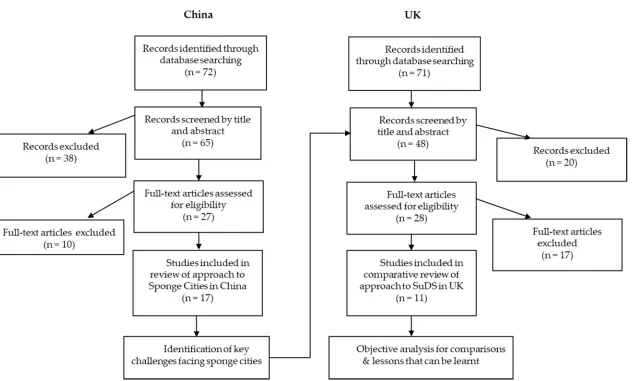
The literature analysis identified a number of key underlying themes, which were consistently highlighted as challenges for sponge cities (Section4.1). With this in mind, UK literature was sifted to identify future research projects that would reduce the anticipated challenges. SCOPUS was again used to search for literature, using the terms “SuDS” and “UK” in the title, abstract or keywords. As was the case with the literature for China, only journal articles were used, which had to be eitherin Press or published at the time of the search. The literature had to be published post-2010, when schedule 3 of the UK Flood and Water Management Act 2010 [19] highlighted the need to incorporate more SuDS into design in the UK. Both screening phases were based on the suitability of the literature to provide answers for the challenges presented in the literature on sponge cities. This therefore enabled the identification of key similarities and differences between the Chinese and UK approaches to flood management and mitigation, the challenges that are faced in China, and approaches to the challenges faced in the UK.
3. Historical Pluvial Flood Management
Post-Industrial Revolution, flood management in the UK has taken the approach of efficiently moving water from an urban area to a downstream location, typically a nearby watercourse, using a network of pipes [20]. The London main drainage project was built in the mid-19th Century to manage both sewage and runoff, using piped methods [21]. Similarly in China, conventional pluvial flood management is achieved using pipes and sewage treatment plants. Due to rapid socioeconomic development, capacities of existing drainage systems proved inefficient, and the conventional mode of flood management has become insufficient [22]. However, with limited expansion space, many cities around the world and particularly China, rely on old drainage pipe networks [23], leading to frequent large-scale pluvial flooding and considerable loss of property and life.
In the context of a changing climate however, it is unlikely that existing conventional drainage will manage events within their designed capacity [24,25]. For this reason, more sustainable approaches are beginning to be used to manage pluvial flooding.
4. Flood Management in China & UK
4.1. Sponge Cities: Pluvial Flood Management in China
Due to pluvial flooding in high rainfall season and the lack of water in the dry season, the sponge city concept was proposed as an alternative solution for better urban water management in China [26]. The term “sponge cities” was first proposed in the early 2000s, however, it was not widely adopted with reference to an integrated approach to urban water management in China until 2013, with technical guidance published in 2014 [27–29]. A top down approach to the implementation of sponge cities is largely applied by the Ministry of Housing and Rural-Urban Development (MHURD), Ministry of Finance (MOF) and the Ministry of Water Resources (MWR), who created the Sponge City Construction national guidelines in 2014 [30]. The initiatives are implemented at the city-scale, with some test-cities creating local guidance which is heavily informed by guidelines from the USA, and rarely consider variability in local climate, soil or topography, and often have a preference for grey infrastructure [30,31]. Following the development of guidelines and the desire of the government to implement sustainable urban flood management infrastructure, the aim is that 20% of Chinese cities will use modern drainage techniques, integrating green infrastructure, by 2020, and 80% by 2030, indicating a reliance on retrofit [32].
Sustainability2019,11, 213 5 of 14
[image:5.595.119.479.88.288.2]Sustainability 2019, 11, x FOR PEER REVIEW 6 of 15
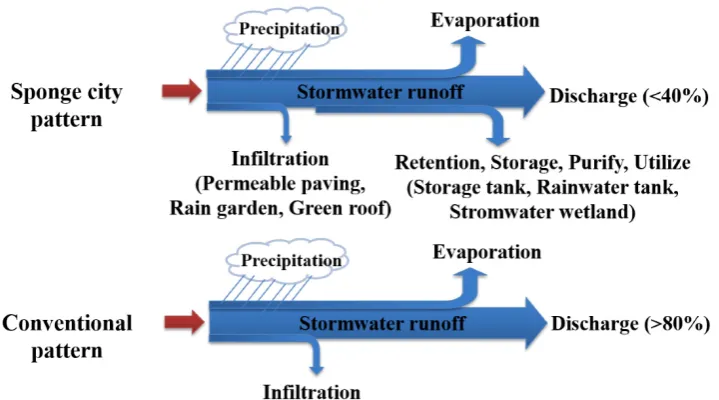
Figure 2. Overview of conventional urban pluvial flood management pattern and sponge city pattern.
Thirty cities, including Beijing and Shanghai, were designated sponge cities across two selection periods in 2014 and 2016 [18]. Most pilot cities are located in central and southern parts of China, with annual precipitation varying from 410 to 1830 mm and annual average temperatures from 4.6 to 25.5 °C. However, regardless of the spatial climatic variability of China, a national approach to standards are taken for sponge cities, with more general guidelines typically outweighing local needs. Li et al. [30] studied two sponge cities, each with a differing climate. Baicheng City, Jilin Province, suffers from water shortages, as annual evaporation outweighs annual rainfall, whereas Shenzen, a low-lying coastal city impacted by seasonal tropical storms, utilized largely consistent SuDS designs and devices, independent of their location. A similar approach has previously been adopted in China for conventional drainage, with cities configured to manage a rainstorm of 187 mm/24 h; a 100% Annual Exceedance Probability (AEP) scenario [35].
To ensure the initiative has the best possibility to succeed, designated sponge city sites should cover more than 20% of the city. The sponge City guideline document stipulates that provision has to be made to drain runoff from up to 3% AEP 24-h rainfall, as opposed to traditional drainage, which is designed to manage runoff from the 100% AEP 24-h event [34].
The development of both retrofit and new build infrastructure is driven by initial central government funding, alongside public-private-partnership (PPP) funds and local subsidies [30]. The amount of funds received is entirely dependent on the administrative levels of candidate cities, for example USD 88 million is given to those guided by State Council, with USD 73 million to provincial capitals, and USD 59 million to other cities [36]. However, due to the scale and need for development as part of the sponge city plan, it is estimated that governmental funding account for just 33% of the total costs, which are expected to be at least USD 22 millions of investment per square kilometer [36]. Additional PPP funds are therefore required to ensure continued growth and maintenance, particularly post the three-year initial funding [30]. Nonetheless, the arrangements for the adoption of SuDS, and ultimately continued maintenance upon completion is unclear.
Beijing was selected in the second phase in 2016, with the primary aim of reducing the impacts of large pluvial flood events, such as the 2012 floods [37]. The sponge city construction in Beijing is expected to control 85% of annual runoff, and manage flooding up to the 2% AEP scenario, through green and grey infrastructure, such as permeable pavements, bio-retention ditches and rain gardens [30]. The plan includes 55 projects over 19.36 km2, however as of 2017, only eight had been completed, with a further seven under way [18]. Zhang et al. [38] suggest that more needs to be done before the plan can be considered a success, with more emphasis needed on increasing water scarcity issues in Beijing. There are therefore a number of challenges that have arisen as part of the sponge city process which are mainly associated with the differences in natural conditions, financial uncertainty, complexity of the legislation and regulations as well as the degree of public acceptance [27,30].
Figure 2.Overview of conventional urban pluvial flood management pattern and sponge city pattern.
Thirty cities, including Beijing and Shanghai, were designated sponge cities across two selection periods in 2014 and 2016 [18]. Most pilot cities are located in central and southern parts of China, with annual precipitation varying from 410 to 1830 mm and annual average temperatures from 4.6 to 25.5◦C. However, regardless of the spatial climatic variability of China, a national approach to standards are taken for sponge cities, with more general guidelines typically outweighing local needs. Li et al. [30] studied two sponge cities, each with a differing climate. Baicheng City, Jilin Province, suffers from water shortages, as annual evaporation outweighs annual rainfall, whereas Shenzen, a low-lying coastal city impacted by seasonal tropical storms, utilized largely consistent SuDS designs and devices, independent of their location. A similar approach has previously been adopted in China for conventional drainage, with cities configured to manage a rainstorm of 187 mm/24 h; a 100% Annual Exceedance Probability (AEP) scenario [35].
To ensure the initiative has the best possibility to succeed, designated sponge city sites should cover more than 20% of the city. The sponge City guideline document stipulates that provision has to be made to drain runoff from up to 3% AEP 24-h rainfall, as opposed to traditional drainage, which is designed to manage runoff from the 100% AEP 24-h event [34].
The development of both retrofit and new build infrastructure is driven by initial central government funding, alongside public-private-partnership (PPP) funds and local subsidies [30]. The amount of funds received is entirely dependent on the administrative levels of candidate cities, for example USD 88 million is given to those guided by State Council, with USD 73 million to provincial capitals, and USD 59 million to other cities [36]. However, due to the scale and need for development as part of the sponge city plan, it is estimated that governmental funding account for just 33% of the total costs, which are expected to be at least USD 22 millions of investment per square kilometer [36]. Additional PPP funds are therefore required to ensure continued growth and maintenance, particularly post the three-year initial funding [30]. Nonetheless, the arrangements for the adoption of SuDS, and ultimately continued maintenance upon completion is unclear.
of the sponge city process which are mainly associated with the differences in natural conditions, financial uncertainty, complexity of the legislation and regulations as well as the degree of public acceptance [27,30].
4.2. Sustainable Drainage Systems: Pluvial Flooding and Management in the UK
Returning drainage to natural processes is one of the chief aims of sustainable drainage (SuDS), increasing infiltration by reducing the amount of impermeable surface. The concept of SuDS arose during the late-1980s due to a philosophy shift favoring sustainable management over hard engineered solutions [39], with Butler and Parkinson [40] questioning the sustainability of traditional piped drainage in urban environments, highlighting the need for an alternative approach. Whilst the main purpose of SuDS is to provide a nature-based drainage system capable of managing large volumes of runoff, they also have wider benefits; improving water quality, enhancing amenity, aesthetics and biodiversity [41].
SuDS installation in the UK has typically centered on single, standalone disconnected devices. However, combining devices to make a “management train”, provides a cumulative approach to runoff management, focusing on swales as opposed to pipes for conveyance, increasing opportunities for infiltration [42]. Hamilton in Leicester, UK, (Figure3) is a 26 ha new development site built in 2003, with 1500 houses built on land previously used for farming, and located in the Environment Agency ‘Flood Zone 1’; 0.1% AEP. Pipes are used at the site to transport runoff from the impermeable surfaces to a network of swales, vegetated ponds, filter strips and detention basins, offering a greener, more natural approach to drainage.
Sustainability 2019, 11, x FOR PEER REVIEW 7 of 15
4.2. Sustainable Drainage Systems: Pluvial Flooding and Management in the UK
Returning drainage to natural processes is one of the chief aims of sustainable drainage (SuDS), increasing infiltration by reducing the amount of impermeable surface. The concept of SuDS arose during the late-1980s due to a philosophy shift favoring sustainable management over hard engineered solutions [39], with Butler and Parkinson [40] questioning the sustainability of traditional piped drainage in urban environments, highlighting the need for an alternative approach. Whilst the main purpose of SuDS is to provide a nature-based drainage system capable of managing large volumes of runoff, they also have wider benefits; improving water quality, enhancing amenity, aesthetics and biodiversity [41].
[image:6.595.118.478.394.601.2]SuDS installation in the UK has typically centered on single, standalone disconnected devices. However, combining devices to make a “management train”, provides a cumulative approach to runoff management, focusing on swales as opposed to pipes for conveyance, increasing opportunities for infiltration [42]. Hamilton in Leicester, UK, (Figure 3) is a 26 ha new development site built in 2003, with 1500 houses built on land previously used for farming, and located in the Environment Agency ‘Flood Zone 1’; 0.1% AEP. Pipes are used at the site to transport runoff from the impermeable surfaces to a network of swales, vegetated ponds, filter strips and detention basins, offering a greener, more natural approach to drainage.
Figure 3. The SuDs management train in Hamilton, Leicester, UK—runoff is conveyed between a series of linked vegetated ponds by small swales, to the nearby watercourse.
SuDS installation is often focused on new build sites, however, only 1% of all buildings in the UK are new builds [43]. The focus therefore should be shifted to retrofitting SuDS; disconnecting stormwater from the existing conventional drainage network into a SuDS device [44]. Consequently, a combined strategy for dealing with both new and old builds is essential to effectively manage pluvial flooding. There are however limited examples of SuDS retrofit across the UK. Lamond et al. [45] highlight this in the UK, attributing it to high initial costs, demands on space in urban environments, the disturbance associated with disconnection from the conventional system and access for maintenance. For this reason, the current focus is on creating an integrated SuDS and conventional drainage approach. Although evidence supports the benefits of SuDS [24,31,44,46,47], there remains an issue in the UK regarding its ownership and ultimately who should be maintaining the systems [48,49].
SuDS require regular maintenance to ensure their continued success, whether that be trimming vegetation, or removing pollutants and de-clogging [50]. Failure to regularly maintain measures, reduces the impact of SuDS and increases the risk of flooding. From a technical perspective, successful maintenance is feasible for all UK SuDS, as the operation of single SuDS devices is
Figure 3.The SuDs management train in Hamilton, Leicester, UK—runoff is conveyed between a series of linked vegetated ponds by small swales, to the nearby watercourse.
Sustainability2019,11, 213 7 of 14
drainage approach. Although evidence supports the benefits of SuDS [24,31,44,46,47], there remains an issue in the UK regarding its ownership and ultimately who should be maintaining the systems [48,49].
SuDS require regular maintenance to ensure their continued success, whether that be trimming vegetation, or removing pollutants and de-clogging [50]. Failure to regularly maintain measures, reduces the impact of SuDS and increases the risk of flooding. From a technical perspective, successful maintenance is feasible for all UK SuDS, as the operation of single SuDS devices is sufficiently well understood [41]. In the UK, the barriers to successful SuDS maintenance, including possible retrofit SuDS, are due to difficulties with ownership for the long-term responsibilities and costs of maintenance activity [48,49]. Where ownership of liabilities is uncertain, this inhibits the production of an acceptable site drainage plan, and may well prevent a SuDS scheme from being installed. Incentives in place to produce a plan that facilitates SuDS, include involvement of internal drainage boards (IDB) that charge a commuted sum to help underpin longer-term operations [51]. This can assist in meeting the upfront costs, as the developer contributes to construction, and the asset may be eligible for local authority adoption. Water and Sewerage companies can adopt SuDS assets from a developer, taking on the responsibility of long-term operation and maintenance; both of these options are considered to be low risk as IDB have wide powers locally to intervene on drainage matters and receive reliable local authority and private funding [41,52].
In England and Wales, by default, landowners are the responsible party for maintaining SuDS, but there are options that may be taken to pass responsibility for SuDS assets to a third party. These include adoption by a local authority, a water company or another private company [53]. In Scotland, maintenance is significantly different from the rest of the UK, in that the Scottish Environmental Protection Agency explicitly prefer Scottish Water to adopt the SuDS assets where they are not part of a privately-owned development. In addition, Section7of the Sewerage (Scotland) Act 1968 and the 2010 SuDS for Roads guidance are part of a strategy to integrate roads, sewers and surface drainage infrastructure, including SuDS, more effectively [54].
Policy developments in the UK have attempted to highlight the importance of SuDS, particularly in response to recent large flood events. The Non-statutory SuDS standards [55] suggest that all new developments should manage runoff for events up to and including the 1% AEP scenario, with infiltration being the priority destination for runoff, followed by disposal to a nearby watercourse. SuDS design is typically advised by the Construction Industry Research and Information Association (CIRIA), through design guidance [41], the National Planning Policy Framework [56] and opportunity maps which support decision making, created by the British Geological Society [57]. These guidance documents, alongside the Environment Agency and Lead Local Flood Authorities (LLFAs) minimize the impact of new developments on flood risk. However, due to the non-statutory nature of SuDS standards and guidance, many developers continue with conventional piped drainage methods. To ensure the local climate is considered during the site development stage, the Flood Estimation Handbook (FEH) is used to manage the spatial variation of rainfall [58] and the design of rainfall events. The FEH uses depth-duration-frequency models to predict rainfall at the catchment scale for a given storm duration and return period [58].
5. Objective Analysis for Comparisons
A crucial difference between China and the UK is in terms of climate, since in China it is extremely varied, with annual rainfall ranging from as low as 100 mm in the north-west to upwards of 7000 mm in the south-east [18,30]. This is in comparison to a range of 450 mm to 3000 mm in the UK. The Tibetan Plateau to the southwest of China reults in alpine conditions, with sub-arctic conditions possible in the far north, and warmer cities to the south-east, with average temperatures ranging from 4–25◦C [30], compared to 5.5–13◦C average annual temperature range in the UK. This creates a series of challenges across China when attempting to ensure that standards are in place to manage runoff locally under diverse climate conditions. However, although the UK has a much less-varied climate, it has adopted a design methodology to ensure that flood management infrastructure is fit for local purpose; the Flood Estimation Handbook [58]. Comparing this approach for understanding local climate conditions is key to guaranteeing the long-term sustainability of urban pluvial flood management projects in China.
The lack of UK regulations for SuDS has resulted in limited SuDS retrofit examples [45]. Integrating retrofit SuDS is a key aspect of sponge cities, therefore a comparison with the UK can ensure that process and regulations are stringent enough to guarantee the same mistakes are not replicated in China. A strict maintenance and adoption regime is also necessary to ensure the long-term success of different techniques. As highlighted in Section4.2, current UK practice has resulted in less ownership and maintenance plans of SuDS, reducing their effectiveness, particularly regarding flood management [49]. It is crucial that this is also provided in the context of sponge cities, for the initiative to be successful, and devices to provide the best possible solution to urban pluvial flooding.
As highlighted previously (Section4.1), consistent funding is necessary to ensure the requirements of flood management of sponge cities are met. However, initial funding is only due to last for three years [59], with a requirement for further funding to be sourced from PPP funds. Comparing this to how SuDS are funded in the UK, and methods for increasing the awareness of SuDS, to generate funding, will ensure that money is available to continue the initiative post-Government funding.
6. Lessons to be Learnt
6.1. Climate
The design process for sponge cities fundamentally relies on design criteria based on nationwide standards, regardless of the local climate [30]. This can result in either an over, or under-engineered solution, depending on the location, however more importantly can further exacerbate issues regarding water availability and/or flooding.
Research is therefore needed to better understand the spatial distribution of rainfall across China, which can inform future sponge city design. An increased network of rain gauges, particularly in major cities, will assist depth-duration-frequency modelling to analyze how the design standard storms vary between regions, similar to the FEH process used in the UK. Implementing such strategies at the city scale will ensure that SuDS are designed to manage local needs, whether that is water scarcity or water excess. Integrating local site and climatic characteristics, such as geology and evaporation rates, alongside rainfall data, will further ensure that the most appropriate SuDS are installed, therefore providing the best possible solution for pluvial flood management.
However, due to the size of China, adopting a similar method to the FEH used in the UK may prove unfeasible in the short term, as the process analyses all catchments across the UK. Nevertheless, a more robust city-scale method of defining rainfall return periods is required to ensure a more transparent process across the country. This can then be adopted by the MWR, and implemented more widely as part of the regulatory process to ensure that local needs are met.
6.2. Regulations
Sustainability2019,11, 213 9 of 14
effective framework is required to offer more opportunities for sustainable pluvial flood management. As part of the regulation process in China, more feasibility and opportunity mapping would assist in highlighting locations where retrofit SuDS would have the greatest impact, as has been undertaken in the UK by the British Geological Society [57]. Opportunity mapping ensures that the most suitable sites are developed, and therefore have the maximum impact on runoff reduction. Although mapping has not yet resulted in the widespread implementation of retrofit SuDS in the UK, if it were to be enforced through regulations in China, which are more rigorously applied than in the UK, it is likely to be more readily adopted as part of the wider sponge city initiative.
Nonetheless, many sponge city applications are on a case by case site basis, with a limited view of the impacts of the wider drainage system [30]. Whilst Mei et al. [60] underlined the extent to which different SuDS can work in Liangshuihe, south of Beijing, more research is needed at the city scale by demonstrating the role of disconnection from the central drainage through retrofit SuDS. Disconnection from the existing stormwater system is becoming a more common new build process in the UK, by integrating management trains. Although SuDS management trains typically require large open space, combining SuDS in sponge cities with the existing stormwater drainage network has the potential to reduce total flows by detaining and storing runoff, therefore possibly achieving the desired 80% disconnections discussed above. This approach would offer wider pluvial flood management, as opposed to a series of non-linked or disconnected devices, which could have a limited impact on runoff volumes. However, existing codes of practice do not indicate how SuDS methods can be integrated into existing drainage design [35].
In principle, UK retrofit SuDS should not should be more problematic than new-build schemes from a planning and financial feasibility view. As discussed above, many of the incentives that facilitate SuDS installation, such as commuted sums and underwriting by local authorities and sewage or water companies, are equally applicable to retrofit. In practice, the association between retrofit and high value urbanized locations, particularly in the case of sponge city type initiatives, may make the upfront cost of retrofit prohibitive. It is also well established that urban environments exclude certain types of SuDS such as ponds, wetlands and extensive green infrastructure [41]. A possible option for successful urban SuDS in the UK and China, particularly with retrofit, may be to encourage more disconnection of individual properties from the drainage network by using inexpensive rainwater harvesting systems, raingardens and permeable pavements. This would avoid high upfront costs, be achievable during refurbishment and be a feasible proposition for a householder to maintain.
As is also necessary for the UK, research regarding maintenance is required to directly inform guidance and regulation for SuDS. To better understand what the necessary design requirements are for retrofit SuDS as part of the sponge city process, a robust site-selection tool is required, accounting for localized factors. A series of vulnerability assessments are also essential to identify those areas susceptible to pluvial flooding. This will ensure that the most suitable SuDS are installed for different environments, ensuring the best value for money, and the future success of devices.
6.3. Funding for Development
of the sponge city process to better engage the public with sustainable pluvial flood management techniques, but importantly, also engage potential future funders through the PPP approach.
As the Chinese investment model for sponge cities relies heavily on external funding sources, funders expect a return on their investment, but this is unlikely [36]. For this reason, it is possible that sponge city construction will slow down, and achieving the government target of 80% of all cities to utilize more modern, green infrastructure drainage techniques by 2030 will be challenging. The UK has had similar problems, particularly in the context of retrofit SuDS, with a lack of ownership, resulting in reduced maintenance of devices, and an overall lack of desire to integrate SuDS into drainage schemes [31,62]. Undertaking an assessment of the whole life cost of sponge city developments is therefore essential in order to ensure that PPP funding can support the initiatives, post-government funding support.
Funding support can be further reinforced by educating key stakeholders on the benefits of SuDS in urbanized environments, regarding flood risk management. To do this, field monitoring of before and after construction of SuDS in sponge cities will provide evidence of the likely reduction in runoff and ultimately, reduction in urban flood extents. Assessments of the success of sponge cities are often calculated through modelling the after impacts of SuDS [63–65], with monitoring practices undertaken sporadically [32,64,66] and no formal approach to monitoring available [18]. Creating a robust monitoring approach will provide evidence of the success of devices, therefore, understanding the impact of SuDS in sponge cities will increase the confidence of key decision makers in the initiative, and their likely engagement in the process.
7. Summary: Identifying Opportunities for Future Research
This review paper has outlined how both the UK and China manage pluvial flooding, with a view to examining the strengths and weaknesses of SuDS and the sponge cities approach. The paper presents novel research topics that are required to ensure the long-term success of the sponge city project in China, based on lessons learnt from the UK. The Chinese Government have spent approximately USD 25 billion on the 30 sponge city projects, therefore they need to be sustainable, whilst also working efficiently and effectively [30]. Sponge cities are not solely focused on managing flooding, but must also achieve all facets of sustainable drainage; infiltrate, detain, store, cleanse, use, and drain. With this in mind, the following areas have been identified, based on the challenges posed, as priority research topics to generate future research:
1. Develop a more localized rainfall model for China, to ensure that local climate characteristics are accounted for in the design of sponge cities and therefore the most appropriate SuDS are integrated dependent on the population needs.
2. Understand the role and cost benefits of retrofit SuDS in challenging water environments at the city scale.
3. Mapping vulnerability, undertaking feasibility assessments and the potential of disconnections to provide sustainable pluvial flood management, and create a robust SuDS selection tool, ensuring that the most effective devices are installed, based on local factors.
4. Bring maintenance, whole life costing approaches and before-after implementation monitoring to SuDS and sponge City developments to increase and disseminate current information and increase the confidence of decision makers when choosing unfamiliar drainage solutions. 5. Assess how community engagement and education of sponge cities can be better developed to
foster potential funding and develop more local partnerships.
Sustainability2019,11, 213 11 of 14
Author Contributions: Conceptualization, C.L., M.R. and S.T.; Methodology, C.L.; Investigation, C.L., M.R., Y.C., J.H., S.A., S.C. (Stephen Coupe), S.C. (Susanne Charlesworth); Formal Analysis C.L., M.R., Y.C., J.H., S.C. (Stephen Coupe), S.C. (Susanne Charlesworth), S.T.; Data Curation, C.L., M.R., Y.C., J.H., S.A., S.C. (Stephen Coupe); Writing—Original Draft, C.L., M.R., Y.C., J.H.; Writing—Reviewing and Editing M.R., S.A., S.C. (Stephen Coupe), S.C. (Susanne Charlesworth); Visualization, C.L., Y.C., J.H. and S.A.; Supervision, S.C. (Susanne Charlesworth), S.T.; Funding Acquisition, M.R., S.T.
Funding:This work was completed under the EPSRC grant—EP/K040405/1.
Acknowledgments:Particular thanks to: Dragan Savi´c, Guangtao Fu, Albert Chen, Fanlin Meng (University of Exeter), Yuntao Guan and Haifeng Jia (Tsinghua University) and Huapeng Qin (Peking University), for organizing the workshop “Urban Flooding and Sponge cities”, held on 3–5 July 2017, at Shenzhen, China, facilitating discussion between the participants and enabling new collaboration between early career researchers; David Butler, Guangtao Fu, Fanlin Meng (University of Exeter), Xiaochang Wang (Xi’an University of Architecture and Technology) Nanqi Ren (Harbin Institute of Technology) and Qiang He (Chongqing University) for organizing the workshop “Water-Wise Cities and Smart Water Systems”, held on 11–13 September 2018, at Xi’an, China, facilitating discussion between the participants and enabling new collaboration between early career researchers.
Conflicts of Interest:The authors declare no conflict of interest. The funders had no role in the design of the study; in the collection, analyses, or interpretation of data; in the writing of the manuscript, or in the decision to publish the results.
References
1. Guha-Sapir, D.; Hoyois, P.; Wallemacq, P.; Below, R. Annual Disaster Statistical Review 2016: The Numbers and Trends. 2017. Available online:https://reliefweb.int/sites/reliefweb.int/files/resources/adsr_2016.pdf (accessed on 18 August 2018).
2. Tang, G.; Zeng, Z.; Ma, M.; Liu, R.; Wen, Y.; Hong, Y. Can near-real-time satellite precipitation products capture rainstorms and guide flood warning for the 2016 summer in South China? IEEE Geosci. Remote Sens. Lett.2017,14, 1208–1212. [CrossRef]
3. Environment Agency. Estimating the Economic Costs of the Winter Floods 2015 to 2016. 2018. Available online:https://assets.publishing.service.gov.uk/government/uploads/system/uploads/attachment_data/ file/672087/Estimating_the_economic_costs_of_the_winter_floods_2015_to_2016.pdf (accessed on 18 August 2018).
4. Intergovernmental Panel on Climate Change. Climate Change 2013: Physical Science Basis (AR5). 2013. Available online:https://www.ipcc.ch/report/ar5/wg1/(accessed on 18 August 2018).
5. United Nations. World Urbanization Prospects: The 2018 Revision. 2018. Available online: https:// population.un.org/wup/Publications/Files/WUP2018-KeyFacts.pdf(accessed on 18 August 2018). 6. Miller, J.D.; Hutchins, M. The impacts of urbanisation and climate change on urban flooding and urban
water quality: A review of the evidence concerning the United Kingdom. J. Hydrol. Reg. Stud. 2017,12, 345–362. [CrossRef]
7. Kuriqi, A.; Ardiçlioglu, M.; Muceku, Y. Investigation of seepage effect on river dike’s stability under steady state and transient conditions.Pollack Period.2016,11, 87–104. [CrossRef]
8. Leopold, L.B. Hydrology for urban planning—A guidebook on the hydrological effects of urban land use.
Geol. Surv. Circ.1968,554, 1–18.
9. Miller, J.D.; Kim, H.; Kjeldsen, T.R.; Packman, J.; Grebby, S.; Dearden, R. Assessing the impact of urbanization on storm runoff in a peri-urban catchment using historical change in impervious cover.J. Hydrol.2014,515, 59–70. [CrossRef]
10. Ahilan, S.; Guan, M.; Sleigh, A.; Wright, N.; Chang, H. The influence of floodplain restoration on flow and sediment dynamics in an urban river.J. Flood Risk Manag.2018,11, 986–1001. [CrossRef]
11. Office for National Statistics. Population estimates for the UK, England and Wales, Scotland and Northern Ireland: Mid 2017. 2018. Available online:https://www.ons.gov.uk/peoplepopulationandcommunity/ populationandmigration/populationestimates/bulletins/annualmidyearpopulationestimates/mid2017/ pdf(accessed on 8 September 2018).
12. Golding, B.; Roberts, N.; Leoncini, G.; Mylne, K.; Swinbank, R. MOGREPS-UK Convection-Permitting Ensemble Products for Surface Water Flood Forecasting: Rationale and First Results.J. Hydrometeorol.2016,
13. Soetanto, R.; Mullins, A.; Achour, N. The perceptions of social responsibility for community resilience to flooding: The impact of past experience, age, gender and ethnicity. Nat. Hazards2017,86, 1105–1126. [CrossRef]
14. Zheng, Z.; Qi, S.; Xu, Y. Questionable frequent occurrence of urban flood hazards in modern cities of China.
Nat. Hazards2013,65, 1009–1010. [CrossRef]
15. Lyu, H.-M.; Xu, Y.-S.; Cheng, W.-C.; Arulrajah, A. Flooding Hazards across Southern China and Prospective Sustainability Measures.Sustainability2018,10, 1682. [CrossRef]
16. Jiang, X.; Yuan, H.; Xue, M.; Xue, M.; Chen, X.; Tan, X. Analysis of a heavy rainfall event over Beijing during 21–22 July 2012 based on high resolution model analyses and forecasts.J. Meteorol. Res.2014,28, 199–212. [CrossRef]
17. García-Feal, O.; González-Cao, J.; Gómez-Gesteira, M.; Cea, L.; Domínguez, J.; Formella, A. An Accelerated Tool for Flood Modelling Based on Iber.Water2018,10, 1459. [CrossRef]
18. Jiang, Y.; Zevenbergen, C.; Ma, Y. Urban pluvial flooding and stormwater management: A contemporary review of China’s challenges and “sponge cities” strategy.Environ. Sci. Policy2018,80, 132–143. [CrossRef] 19. Flood and Water Management Act. Chapter 29. 2010. Available online:http://www.legislation.gov.uk/
ukpga/2010/29/contents(accessed on 8 September 2018).
20. Wheater, H.; Evans, E. Land use, water management and future flood risk. Land Use Policy 2009, 26, S251–S264. [CrossRef]
21. Hughes, M. The Victorian London sanitation projects and the sanitation of projects.Int. J. Proj. Manag.2013,
31, 682–691. [CrossRef]
22. Qiu, B.X. The connotation, approach and perspective of Sponge city and LID.Water Wastewater Eng.2015,41, 1–7. (In Chinese)
23. Zhou, Z.; Qu, L.; Zou, T. Quantitative Analysis of Urban Pluvial Flood Alleviation by Open Surface Water Systems in New Towns: Comparing Almere and Tianjin Eco-City. Sustainability2015, 7, 13378–13398. [CrossRef]
24. Semadeni-Davies, A.; Hernebring, C.; Svensson, G.; Gustafsson, L.-G. The impacts of climate change and urbanisation on drainage in Helsingborg, Sweden: Suburban stormwater. J. Hydrol. 2008,350, 114–125. [CrossRef]
25. Bell, V.A.; Kay, A.L.; Cole, S.J.; Jones, R.G.; Moore, R.J.; Reynard, N.S. How might climate change affect river flows across the Thames Basin? An area-wide analysis using the UKCP09 Regional Climate Model ensemble.
J. Hydrol.2012,442–443, 89–104. [CrossRef]
26. Zhang, P.; Cai, Y.; Wang, J. A simulation-based real-time control system for reducing urban runoff pollution through a stormwater storage tank.J. Clean. Prod.2018,183, 641–652. [CrossRef]
27. Wang, H.; Chao, M.; Liu, J.H.; Shao, W.W. A new strategy for integrated urban water management in China: Sponge city.Sci. China Technol. Sci.2018,3, 1–13. [CrossRef]
28. Rooijen, D.J.V.; Turral, H.; Biggs, T.W. Sponge city: Water balance of mega-city water use and wastewater use in Hyderabad, India.Irrig. Drain.2010,54, S81–S91. [CrossRef]
29. Zhang, J.Y.; Wang, Y.T.; Hu, Q.F. Discussion and views on some issues of the sponge city construction in China.Adv. Water Sci.2016,27, 793–799. (In Chinese)
30. Li, H.; Ding, L.; Ren, M.; Li, C.; Wang, H. Sponge city construction in China: A survey of the challenges and opportunities.Water2017,9, 594. [CrossRef]
31. Hoang, L.; Fenner, R.A. System interactions of stormwater management using sustainable urban drainage systems and green infrastructure.Urban Water J.2015, 1–20. [CrossRef]
32. Nguyen, T.T.; Ngo, H.H.; Guo, W.; Wang, X.C.; Ren, N.; Li, G.; Ding, J.; Liang, H. Implementation of a specific urban water management—Sponge City.Sci. Total Environ.2019,652, 147–162. [CrossRef] [PubMed] 33. Hu, C.W. Reconstruction of urban water ecology by “Sponge city”.Ecol. Econ.2015,31, 10–13. (In Chinese) 34. Ministry of Housing and Urban-Rural Development. Technical Guide for Sponge Cities-Water System Construction of Low Impact Development. 2014. Available online:http://www.mohurd.gov.cn/zcfg/jsbwj_ 0/jsbwjcsjs/201411/W020141102041225.pdf(accessed on 16 September 2018).
Sustainability2019,11, 213 13 of 14
36. Dai, L.; van Rijswick, H.F.M.W.; Driessen, P.P.J.; Keessen, A.M. Governance of the Sponge City Programme in China with Wuhan as a case study.Int. J. Water Resour. Dev.2017,34, 1–19. [CrossRef]
37. Li, N.; Qin, C.; Du, P. Optimization of China Sponge City Design: The Case of Lincang Technology Innovation Park.Water2018,10, 1189. [CrossRef]
38. Zhang, S.; Yongkun, L.; Ma, M.; Song, T.; Ruining, S. Storm Water Management and Flood Control in Sponge City Construction of Beijing.Water2018,10, 1040. [CrossRef]
39. Pompêo, C. Development of a state policy for sustainable urban drainage.Urban Water1999,1, 155–160. [CrossRef]
40. Butler, D.; Parkinson, J. Towards sustainable urban drainage.Water Sci. Technol.1997,35, 53–63. [CrossRef] 41. Woods Ballard, B.; Wilson, S.; Udale-Clarke, H.; Illman, S.; Scott, T.; Ashley, R.; Kellagher, R.The SuDS Manual (C753); Construction Industry Research and Information Association (CIRIA): London, UK, 2015. 42. Lashford, C.; Charlesworth, S.; Warwick, F.; Blackett, M. Deconstructing the Sustainable Drainage
Management Train in Terms of Water Quantity—Preliminary Results for Coventry, UK.Clean2014, 42, 187–192. [CrossRef]
43. Committee on Climate Change. Climate change—Is the UK Preparing for Flooding and Water Scarcity? 2012. Available online:https://www.theccc.org.uk/archive/aws/ASC/CCC_ASC_2012_bookmarked_2. pdf(accessed on 6 October 2018).
44. Stovin, V. The potential of green roofs to manage Urban Stormwater.Water Environ. J.2010,24, 192–199. [CrossRef]
45. Lamond, J.E.; Rose, C.; Booth, C.A. Evidence for improved urban flood resilience by sustainable drainage retrofit.Proc. Inst. Civ. Eng. Urban Des. Plan.2015,168, 101–111. [CrossRef]
46. Ellis, J.B. Sustainable surface water management and green infrastructure in UK urban catchment planning.
J. Environ. Plan. Manag.2016,56, 24–41. [CrossRef]
47. Ellis, J.B.; Viavattene, C. Sustainable urban drainage system modeling for managing urban surface water flood risk.Clean2014,42, 153–159. [CrossRef]
48. Everett, G.; Lamond, J.; Morzillo, A.; Chan, F.K.S.; Matsler, A.M. Sustainable drainage systems: Helping people live with water.Proc. Inst. Civ. Eng.2016,169, 94–104. [CrossRef]
49. Melville-Shreeve, P.; Cotterill, S.; Grant, L.; Arahuetes, A.; Stovin, V.; Farmani, R.; Butler, D. State of SuDS delivery in the United Kingdom.Water Environ. J.2018,32, 9–16. [CrossRef]
50. Scholz, M. Case study: Design, operation, maintenance and water quality management of sustainable storm water ponds for roof runoff.Bioresour. Technol.2004,95, 269–279. [CrossRef] [PubMed]
51. Ellis, J.B.; Lundy, L. Implementing sustainable drainage systems for urban surface water management within the regulatory framework in England and Wales.J. Environ. Manag.2016,183, 630–636. [CrossRef] [PubMed] 52. Association of Drainage Authorities. An introduction to Internal Drainage Boards. 2017. Available online:https://www.ada.org.uk/wp-content/uploads/2017/12/IDBs_An_Introduction_A5_2017_web.pdf (accessed on 24 November 2018).
53. Susdrain. Sustainable Drainage Systems (SuDS) Maintenance and Adoption Options (England). 2015. Available online: https://www.susdrain.org/files/resources/fact_sheets/09_15_fact_sheet_suds_ maintenance_and_adoption_options_england_.pdf(accessed on 24 November 2018).
54. Susdrain. SuDS Adoption in Scotland. Available online: https://www.susdrain.org/delivering-suds/ using-suds/adoption-and-maintenance-of-suds/adoption/SuDS-adoption-in-Scotland.html(accessed on 24 November 2018).
55. Department for Environment, Food and Rural Affairs. Non-Statutory Technical Standards for Sustainable Drainage Systems. 2015. Available online:https://www.gov.uk/government/uploads/system/uploads/ attachment_data/file/415773/sustainable-drainage-technical-standards.pdf(accessed on 24 November 2018).
56. Department for Communities and Local Government. National Planning Policy Framework. 2012. Available online:https://www.gov.uk/government/uploads/system/uploads/attachment_data/file/6077/2116950. pdf(accessed on 24 November 2018).
57. Dearden, R.; Marchant, A.; Royse, K. Development of a suitability map for infiltration sustainable drainage systems (SuDS).Environ. Earth Sci.2013,70, 2587–2602. [CrossRef]
59. Liang, X. Integrated Economic and Financial Analysis of China’s Sponge City Program for Water-resilient Urban Development.Sustainability2018,10, 669. [CrossRef]
60. Mei, C.; Liu, J.; Wang, H.; Yang, Z.; Ding, X.; Shao, W. Integrated assessments of green infrastructure for flood mitigation to support robust decision-making for sponge city construction in an urbanized watershed.
Sci. Total Environ.2018,639, 1394–1407. [CrossRef] [PubMed]
61. Wang, Y.; Sun, M.; Song, B. Public perceptions of and willingness to pay for sponge city initiatives in China.
Resour. Conserv. Recycl.2017,122, 11–20. [CrossRef]
62. Wright, G.B.; Jack, L.B. Property-level stormwater drainage systems: Integrated flow simulation and whole-life costs.Build. Res. Inf.2013,41, 223–236. [CrossRef]
63. Luan, Q.; Fu, X.; Song, C.; Wang, H.; Liu, J.; Wang, Y. Runoff Effect Evaluation of LID through SWMM in Typical Mountainous, Low-Lying Urban Areas: A Case Study in China.Water2017,9, 439. [CrossRef] 64. Yuan, Y.; Xu, Y.-S.; Arulrajah, A. Sustainable Measures for Mitigation of Flooding Hazards: A Case Study in
Shanghai, China.Water2017,9, 310. [CrossRef]
65. Li, Q.; Wang, F.; Yu, Y.; Huang, Z.; Li, M.; Guan, Y. Comprehensive performance evaluation of LID practices for the sponge city construction: A case study in Guangxi, China. J. Environ. Manag. 2019,231, 10–20. [CrossRef]
66. Jiang, Y.; Zevenbergen, C.; Fu, D. Understanding the challenges for the governance of China’s “sponge cities” initiative to sustainably manage urban stormwater and flooding.Nat. Hazards2017,89, 521–529. [CrossRef]