International Research Journal of Engineering and Technology
(IRJET)
e-ISSN: 2395-0056 Volume: 06 Issue: 04 | Apr 2019 www.irjet.net p-ISSN: 2395-0072Detection and Analysis of Crime Patterns Using Apriori Algorithm
Arvind Venkatesh
1, Hemanth S
2, Juyin Shafaq Imtiaz Inamdar
3, Lokesh S
41,2,3
Department of Computer Science and Engineering, The National Institute Of Engineering, Mysore
4
Associate Professor, Department of Computer Science and Engineering, The National Institute Of Engineering,
Mysore
---***---Abstract -
Data mining is a very powerful tool that iswidely used in many industries. In this paper we use data mining technique to analyze and predict the crime patterns using apriori algorithm. This paper also reviews the literatures on various data mining applications, especially applications that can solve crime using data mining techniques.
Key words: Crime patterns detection, Data Mining,
Apriori Algorithm, Association Rule Mining1. INTRODUCTION
Statistics on Crime Records Bureau shows that the crime rate has significantly increased in the last few years. Due the increase in the crimes it is more necessary to have a automated crime detection and prevention system. Several studies have been conducted in the past to design an efficient system that can speed up the crime investigations. However due the changing crime pattern and growing crime data it has become more important to upgrade the crime pattern detection and prevention system using latest data mining technologies. Data mining algorithms can be used to extract hidden knowledge from huge volume of data.
Even though we cannot predict who all may be the victims of crime but can predict the place that has probability for its occurrence.The predicted results cannot be assured of 100% accuracy but the results shows that our application helps in reducing crime rate to a certain extent by providing security in crime sensitive areas. So for building such a powerful crime analytics tool we have to collect crime records and evaluate it. Unfortunately due the classification of crime files by the law enforcement officials we can access the data that is publically available on blogs, social media, RSS feeds etc.
The main challenges we are facing are:
Since the data we collect is huge it needs to be stored and analyzed.
The data may be incomplete and inconsistent so analysis could be very difficult.
Limitation of getting more crime data due to classification of crime files by law enforcement authorities.The Knowledge Discovery is a very tedious process and consists of the following steps, to convert from raw data to some form on new knowledge:
1.
Data cleaning: In this step we remove noise andunnecessary data from the dataset. This step is also referred to as data cleansing.
2.
Data integration: In this step we combine variousdata sources to form one single dataset.
3.
Data selection: In this step we analyze and carefully select the relevant data from the dataset.4.
Data transformation: In this step we transform the selected data into appropriate forms for the mining procedure. This step is also referred to as data consolidation5.
Data mining: It is the most important step in which we use advanced algorithms to extract patterns that are useful for our application.6.
Pattern evaluation:In this step we identify important patterns representing knowledges.7.
Knowledge representation: In this step we,visualize the knowledge data for the user.
2. RELATED WORK
International Research Journal of Engineering and Technology
(IRJET)
e-ISSN: 2395-0056 Volume: 06 Issue: 04 | Apr 2019 www.irjet.net p-ISSN: 2395-0072techniques. The review of literature will involve efficient and usable techniques such as fuzzy system and weka tool.
Some of the research paper that were reviewed during survey were: “Z-crime: A data mining tool for the detection of suspicious criminal activities based on decision tree” [1], “Association bundle- a new pattern for association analysis [2]”, ”Enhancing k-means algorithm for solving classification problems“ [10], ”Mining crime data by using new similarity measure.” [4], “Crime Analysis and Prediction Using Data Mining” [6], “Improved Apriori algorithm based on Selection Criterion” [11] , “An Improvement Apriori Arithmetic based on Rough set Theory“ [12].
Some of the limitations of other systems that were explored during the survey were:
1.
Stores crime data and retrieves the same2.
No extraction of useful information3.
No extraction of crime patterns4.
Lack of user satisfaction5.
Less Efficient3. PROPOSED SYSTEM
Proposed system includes modeling of crimes for finding suitable algorithms to detect the crime, precise detection, data preparation and transformation, and processing time. Proposed system identifies crime behavior, crime predicting, precise detection, and managing large volumes of data obtained from various sources. Proposed system is an automation for complaints registration, crime pattern prediction based on the previous crime details collected from various sources.
3.1 Scope and Objectives
Proposed system is a web enabled application.
1.
Proposed system is an innovative crime detection system.2.
Proposed system major objective is to predict the crimes and their patterns.3.
Proposed system makes use of data mining technique called as “Association Rules” for crime pattern discovery.4.
Proposed system is an automation for early crimes5.
Proposed system makes use of previous crime details , date and location for the prediction of crime patterns.6.
Proposed system is an real time application where complaints are registers and crime details.The main module is Crime Trendz Prediction Module. In this module, system predicts crime patterns based on the past crime details collected from various sources. Here system uses “Association Rule Mining” to analyze previous crime data and to extract the crime trends.
3.2 Apriori Algorithm
STEP 1: Scan the opinion data set and determine the support(s) of each item.
STEP 2: Generate L1 (Frequent one item set).
STEP 3: Use Lk-1, join Lk-1 to generate the set of candidate k - item set.
STEP 4: Scan the candidate k item set and generate the support of each candidate k – item set.
STEP 5: Add to frequent item set, until C=Null Set.
STEP 6: For each item in the frequent item set generate all non empty subsets.
STEP 7: For each non empty subset determine the confidence. If confidence is greater than or equal to this specified confidence .Then add to Strong Association Rule.
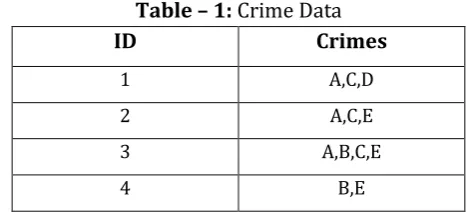
[image:2.595.312.546.612.718.2]For example let’s consider crime types A, B, C, D and E. We represent the crime in the table 1.
Table – 1:
Crime Data
ID
Crimes
1 A,C,D
2 A,C,E
3 A,B,C,E
4 B,E
International Research Journal of Engineering and Technology
(IRJET)
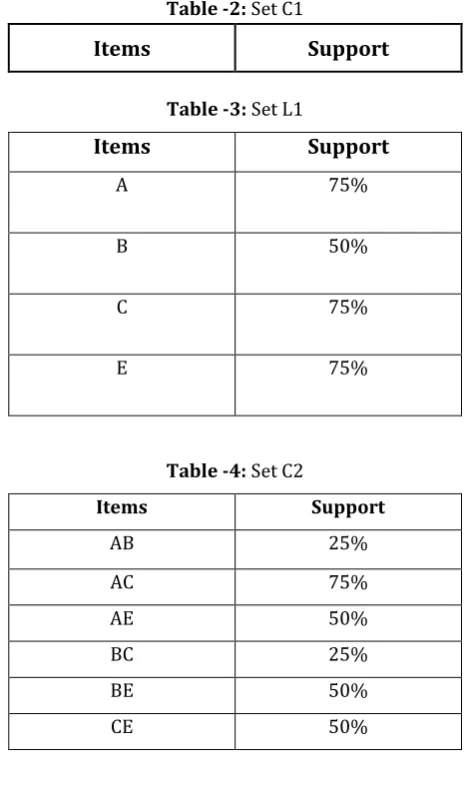
e-ISSN: 2395-0056 Volume: 06 Issue: 04 | Apr 2019 www.irjet.net p-ISSN: 2395-0072 [image:3.595.43.554.45.842.2]above tables the association rule is calculated.
Table -2: Set C1
Items
Support
Table -3: Set L1
Items
Support
A 75%
B 50%
C 75%
E 75%
Table -4: Set C2
Items Support
AB 25%
AC 75%
AE 50%
BC 25%
BE 50%
CE 50%
Table -5: Set L2
Items Support
AC 75%
AE 50%
BE 50%
[image:3.595.46.281.136.530.2]CE 50%
Table -6: Set C3
Items Support
ACE 50%
ABC 25%
ABE 25%
BCE 25%
Table -7: Set L3
Items Support
ACE 50%
Table -8: Frequent Item Set (L)
Items Support
A 75%
B 50%
C 75%
E 75%
AC 75%
AE 50%
BE 50%
CE 50%
ACE 50%
Table -9: Generate Confidence
RULE X RULE Y CONFIDENCE
{A} ⇨ {C} 100%
{C} ⇨ {A} 100%
{A} ⇨ {E} 66%
{E} ⇨ {A} 66%
{B} ⇨ {E} 100%
{E} ⇨ {B} 66%
{C} ⇨ {E} 66%
{E} ⇨ {C} 66%
{A} ⇨ {CE} 66%
{C} ⇨ {AE} 66%
{E} ⇨ {AC} 66%
{CE} ⇨ {A} 100%
{AE} ⇨ {C} 100%
{AC} ⇨ {E} 66%
STRONG ASSOCIATION RULE
[image:3.595.313.544.433.711.2]International Research Journal of Engineering and Technology
(IRJET)
e-ISSN: 2395-0056 Volume: 06 Issue: 04 | Apr 2019 www.irjet.net p-ISSN: 2395-0072{CE} ⇨ {A}
{AE} ⇨ {C}
{A} ⇨ {C}
{C} ⇨ {A}
4. IMPLEMENTATION AND RESULT
The entire project was implemented using the following configuration:
1. Frame work: DOTNET (suitable technology as it requires less time for implementation of this project)
2. IDE: Visual Studio 2010 (tool used for the development of .NET applications)
3. Front end: ASP.NET 4.0 (technology which is used for the development of internet-working applications)
4. Programming Language :
C#.NET (programming language which is used for processing purpose)
5. Back End – MS SQL Server (used to store the crime data)
[image:4.595.102.233.547.674.2]Several data sources were used to gather the required data and uploaded into the database. After testing each module of the software the results were noted down. The sample data and results are shown below in the figure 1.1