(will be inserted by the editor)
How to extract weak values from a mesoscopic
electronic system
Iliya Esin
·
Alessandro Romito
·
Yuval
Gefen
Received: date / Accepted: date
Abstract
Weak value (WV) protocols may lead to extreme expectation values
that are larger than the corresponding orthodox expectation values. Recent works
have proposed to implement this concept in nano-scale electronic systems. Here
we address the issue of how one calibrates the setup in question, maximizes the
measurement’s sensitivity, and extracts distinctly large WVs. Our concrete setup
consists of two Mach-Zehnder interferometers (MZIs): the “system” and the
“de-tector”. Such setups have already been implemented in experiment.
Keywords
weak value
·
weak measurement
·
Mach-Zehnder interferometer
1 Introduction and motivation
Strong measurement in quantum mechanics leads to the collapse of the measured
system’s wave function [16]. The challenge of performing a non-invasive
measure-ment is interesting both from the view point of foundations of quantum mechanics,
and for concrete applications (e.g. quantum computation). Weakly measuring an
observable, while weakly disturbing the system, provides only partial information
on the state of the latter. Weak measurements, due to their backaction, can be
ex-ploited for quantum feedback schemes [28, 24, 26] and conditional measurements.
The latter entail WV protocols [1] and derivatives thereof.
A standard two-step WV protocol consists of a weak measurement step (of the
observable
A
), followed by a strong one (of
B
), [
A, B
]
6
= 0. The outcome of the
first is conditional on the result of the second (postselection),
i.e., one admits the
I.Esin
Department of Condensed Matter Physics, The Weizmann Institute of Science, Rehovot 76100, Israel
A. Romito
Department of Physics, Lancaster University, Lancaster, LA1 4YB, United Kingdom
Y. Gefen
Department of Condensed Matter Physics, The Weizmann Institute of Science, Rehovot 76100, Israel
Φ
sysQPC A
QPC B
S2
S1
D2
D1
λ
𝑽
𝑺𝟏𝑰
𝑫𝟏arm 1 arm 2
Detector
𝛀
𝐿2
𝐿1
Fig. 1 (Color online) A weakly detected MZI. The average reading of the detector,Ω, is linearly proportional (to leading order in system–detector coupling,λ) to the total electric charge on arm 2 of the interferometer at the time of the measurement. (If the detector is a
current–carrying quantum point contact (QPC), thenΩ(t) is equal toΩ(t)∼Rt+τf l/2
t−τf l/2 I(t
0)dt0,
where I(t) is the current through the QPC and τf l = L2/v, with L2 being the length of
arm 2 andvthe velocity of the chiral edge mode). The strong follow-up measurement detects the charge (current pulse) arriving at the drain D1. Registering the outcome of the first measurement is subsequently conditioned on detecting a ‘click’ inD1. This is the WV of the charge in arm 2.
outcome of the weak measurement of
A
provided the result of the (strong)
measure-ment of
B
coincides with a prescribed value,
h
A
i
W V=
Tr{A·ΠB}Tr{ΠB}
, with
Π
Bbeing
the projection operator on the postselected subspace. WVs have been observed in
experiments [18, 17, 11, 9]. Their unusual expectation values [1] may be utilized for
various purposes, including weak signal amplification [5, 22, 3, 23, 7, 29], quantum
state discrimination [14, 30], and non-collapsing observation of virtual states [19].
There have been recent proposals to implement WV protocols in the context of
solid state systems [21, 20, 6]. Apart from the realization with superconducting
qubits in resonant cavity[9], setups made up of two (electrostatic interaction
cou-pled) MZIs, operating in the quantum Hall regime, are of particular importance,
given their immediate experimental availability [12, 25] and their versatile and
controllable nature. In such setups one MZI plays the role of “the system”, the
other being “the detector”.
Shpitalnik
et al.[21] have implemented, in principle, a WV protocol in this
setup, and have shown that the outcome of such measurement may produce a
complete tomography of the WV measured in the system’s MZI. An exhaustive
analysis of the correlated signal in this system has been reported in the single
particle regime[6], and the many body effects on the weak to strong measurement
crossover have been classified [8]. The fact that such a protocol is amenable to
ex-perimental verification [25] has been undermined by the lack of a concrete manual
on how to implement it.
[image:2.595.72.416.74.201.2]2 The system: a MZI
Our system consists of a MZI depicted schematically in Fig. 1. Electrons are
in-jected from the source contact
S
1, kept at a finite voltage bias
V
S1, and arecol-lected at drain
D
1. The other terminals of the interferometers are grounded. The
Quantum Point Contacts (QPCs) A and B allow tunnelling of the electrons
be-tween arms 1 and 2 of the system; the electrons collected at
D
1 are the result of
the interference of different electron trajectories, and are sensitive to the magnetic
flux
Φ
sys. A detector is electrostatically coupled to the charge in arm 2 of theinterferometer. At this stage we refer to a general detector, weakly coupled to the
system.
We consider explicitly the case where the bias current fed into the MZI is
di-luted (for example, one modifies the setup depicted in Fig. 1 such that most
elec-trons emitted from the source
S
1 are backscattered before arriving in the MZI). In
that case, the width of an electron’s wave packet is much smaller than the distance
between two consecutive electrons. Moreover, we require that the time
separa-tion between successive injecsepara-tions of non-equilibrium electrons (
τ
VS1,2
π
~
/eV
S1is
much larger than the electron’s time-of-flight through the interferometer’s arm[27]:
τ
VS1τ
f l. To reduce adverse decoherence effects one may consider the limit of low
temperature, low voltage bias, and nearly symmetric interferometers (i.e., nearly
equal arm lengths). The conditions are met in actual experiments [12, 25].
The first step of our protocol consists of weakly measuring the electric charge
Q
2, flowing through arm 2 of the interferometer. This (weak) measurement isperformed as a snapshot at time
t
Wof the electric charge along arm 2. The
follow-up (strong) measurement detects the charge arriving at the drain
D
1 with a delay,
t
delay, due to the finite propagation time of the charge from the weak detector to
D
1. The measurement itself consists of integrating the current pulse over a window
of time, [
t
W+
t
delay, t
W+
t
delay+
τ
f l], which corresponds to the time of flight of
an electron through arm 2 (the latter is of length
L
2;τ
f l=
L
2/v
, where
v
is the
Fermi velocity of the non-equilibrium electrons). We denote this integrated current
by
τ
f lI
D1. Under the conditions of diluted injected current specified above, thepostselection signal,
I
D1, can reveal the detection of one or no electrons collectedat
D
1, we then condition the acceptance of the first measurement of
Q
2on a ‘click’
in
D
1. Therefore the weak value of the charge on arm 2 is
h
Q
2i
W V=
Q
2(t
W)
·
I
D1(t
W+
t
delay+
12τ
f l)
h
I
D1i
.
(1)
We now relate the abstract WV defined above to a measurable quantity. We
as-sume that (to leading order in system–detector coupling) the average signal of the
detector is linearly proportional to measured charge,
i.e.,
h
δΩ
i
=
S h
Q
2i
, where
Ω
is the signal of the detector with
δΩ
,
Ω
−
Ω
hQ2i=0
and
S
is the sensitivity of the
detector defined as
S
,
∂
h
Ω
i
∂
h
Q
2i
.
(2)
We define the measured
h
Q
2i
MW Vas
h
Q
2i
MW V,
1
S
h
δΩ
·
I
D1i
h
I
D1i
S4
S3
D4
D3
Φ
detQPC C
QPC D
Φ
sysQPC A
QPC B
S2
S1
D2
D1
λ
𝑽
𝑺𝟒𝑽
𝑺𝟏𝑰
𝑫𝟒𝑰
𝑫𝟏MZI
detMZI
sys arm 1 arm 2 arm 3 arm 4 𝐿4𝐿3
𝐿2
𝐿1
(a)
𝑉𝑆1
𝐼𝐷4
𝑉𝑆4
𝐼𝐷1
𝑉𝑄𝑃𝐶 𝐵
𝑉𝑄𝑃𝐶 𝐴
𝑉𝑀𝐺𝑠𝑦𝑠
𝑉𝑀𝐺𝑑𝑒𝑡
𝑉𝑄𝑃𝐶 𝐷
𝑉𝑄𝑃𝐶 𝐶
(b)
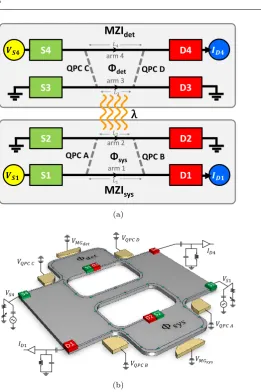
Fig. 2 (Color online) A concrete realization of the setup. (a) A schematic layout. (b) A realistic design. The system and the detector are realized by MZIsysand MZIdet, which are weakly (with
strengthλ) electrostatically coupled through arms 2 and 3. The sourcesS1 andS4 are biased with the voltagesVS1andVS4respectively, while the signals are measured inD1 andD4. The
contactsS2,D2,S3 andD3 are connected to the ground. The gate voltagesVQPC A-Dcontrol
the inter-arm tunneling amplitudes of electrons near the respective QPC. The modulation gate biasesVM Gsys (VM Gdet) control the effective magnetic fluxesΦsys (Φdet) by modifying the
areas encircled by electronic trajectories along the device.
We expect the latter to be proportional to the WV
h
Q
2i
W V(c.f Eq. (1)).
3 The detector: a MZI
[image:4.595.75.337.71.464.2]S4
S3
D4
D3
Φ
detΦ
sysS2
S1
D2
D1
λ
|
𝜓
1𝑠𝑦𝑠|
𝜓
2𝑠𝑦𝑠|
𝜓
3𝑠𝑦𝑠|
𝜓
4𝑠𝑦𝑠|
𝜓
1𝑑𝑒𝑡|
𝜓
2𝑑𝑒𝑡|
𝜓
3𝑑𝑒𝑡|
𝜓
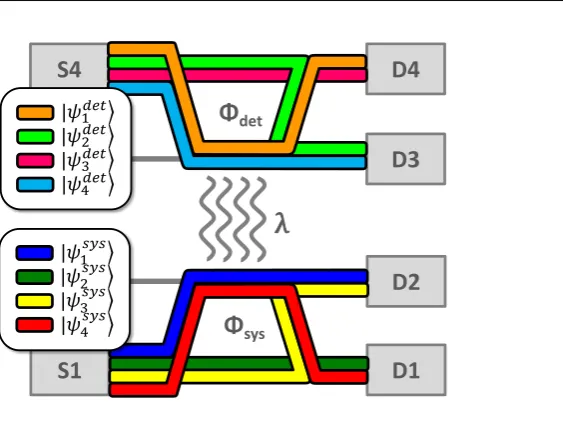
4𝑑𝑒𝑡Fig. 3 (Color online) Electronic trajectories along MZIs. The underlying scattering elec-tronic wavefunction can be constructed as an entangled product of elecelec-tronic trajectories in MZIsysand in MZIdet. Those are depicted schematically by different colors. cf. Appendix A for
explicit expressions for the electronic trajectories.
MZI is tuned, analogously with the system MZI, to have a diluted incident current
and a time-separation between incident electrons larger than the time-of-flight
across the interferometer. The current of the detector integrated over
τ
f l,
τ
f lI
D4,is sensitive to a charge on arm 2, and serves as a
pointer variable
— It plays the role
of
Ω
in the general formulation of the previos section. The (weak) signature of the
system–detector interaction is a small additional phase gain of the wavefunction
when a pair of electrons flow simultaneously along the arms 2 and 3 respectively[6,
15].
Therefore, the definition of
h
Q
2i
MW V(Eq. (3)) in the case of MZI as a detector
(cf. Fig. 2) reads
h
Q
2i
MW V=
1
S
h
I
D4I
D1i
h
I
D1i
− h
I
D4i
00.
(4)
It requires the measurement of the current–current correlator
h
I
D4I
D1i
, the
aver-age current in
D
1,
h
I
D1i
, and the average current in
D
4 when the transmission
of QPC A is set to zero,
h
I
D4i
00
. The value of
[image:5.595.77.359.80.296.2]4 The system-detector coupling
To gain physical insight on the detector’s response and determine its proper
cali-bration we resort to a two-particle picture (one electron passing through MZIsysand
another in MZIdet). The model is a valid description of the interaction between
the system and detector electrons in the regime of diluted electron currents we are
considering.
The two-particle scattering state,
|
Ψ
sys,deti
, near the drains (after the QPCs
B and D) can be expressed in terms of partial electronic trajectories (cf. Fig. 3)
as,
|
Ψ
sys,deti
=
X
ij
e
iλijc
sysi
|
ψ
sys
i
i
c
det j
ψ
det j
E
,
(5)
where
c
sysi(
c
deti) are amplitudes of the trajectories through MZIsys(MZIdet)
omit-ting the coupling between the interferometers (cf. Appendix A), and
λ
ij=
λ,
(
i
= 1
∨
4)
∧
(
j
= 1
∨
4)
0
,
o.w.
is the weak coupling term (
λ
1). The WV of
Q
2(cf. Eq. (1)) may be expressed
in terms of the amplitudes
c
ias
h
Q
2i
W V=
h
Q
2i
0c
sys4c
sys4+
c
sys2.
(6)
where
h
Q
2i
0≈
e2V
S1L2
2π~v
is the average excess charge on the segment
L
2. Similarly,we define
h
Q
3i
W V=
h
Q
3i
0c
det1c
det1
+
c
det3,
(7)
with
h
Q
3i
0≈
e2
VS4L3
2π~v
, as the weak value of the charge on arm 3 conditioned on a
signal in
D
4. With these definitions the signal in
D
4 to first order in
λ
is given by
(cf. Appendix B)
h
I
D4i
=
h
I
D4i
01 + 2˜
λ
Im
n
h
Q
3i
W Vh
h
Q
2i
+
D
Q
bg2Eio
,
(8)
where ˜
λ
=
λ/
h
Q
2i
0h
Q
3i
0and
h
Q
2i
=
h
Q
2i
0|
c
sys1|
2+
|
c
sys4|
2is the
out-of-equilibrium and
D
Q
bg2E
is the background charge on arm 2,
h
I
D4i
0=
h
Q
3i
0/τ
f lc
det1+
c
det3 2is the current measured at
D
4 in the absence of interaction (
λ
= 0). We obtain
also the explicit expression for Eq. (4) (cf. Apeendix B), given by
h
Q
2i
MW V=
2˜
λ
h
I
D4i
0S
Im
h
Q
2i
W Vh
Q
3i
W V− h
Q
3i
.
(9)
From the analysis it also follows that the sensitivity of the MZI detector (cf.
Eq. (2)) is
S
= 2˜
λ
h
I
D4i
0Im
h
Q
3i
W V,
(10)
with the explicit expression
S
= 2
h
Q
3i
20λ/τ
˜
f lc
det1c
det3sin ˜
φ
. Here ˜
φ
is the total
phase difference between the trajectories
ψ
1detand
ψ
3det0.0 0.5 1.0 1.5 2.0 0.0
0.5 1.0
𝐼
𝐷4 00𝐼
𝐷411
Δ 𝐼
𝐷4Φ
𝑑𝑒𝑡/Φ
0Current through the detector
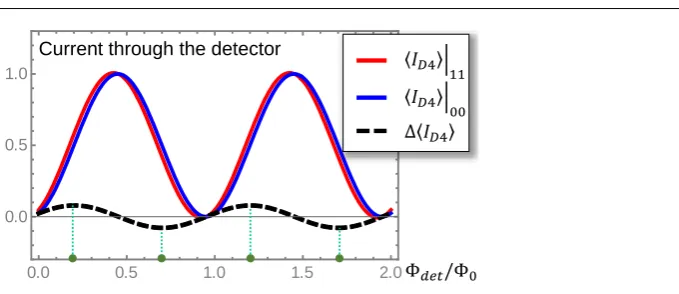
Fig. 4 (Color online) Calibration of the detector. The QPCs C and D are set to half trans-mission (|tC| = |tD| = 1/
√
2), ˜λ = 0.05π. The currents are measured in units of hQ3i0.
The red (blue) curve corresponds to the signal in D4 when both QPC A and QPC B are fully transmitting (reflecting),hID4i
11(hID4i
00). The black dashed curve is their difference:
∆hID4i,hID4i
11 −hID4i
00. The detector is maximally sensitive at the extremas of∆ hID4i.
Those points are highlighted by green dots.
The first requirement may be achieved by individually adjusting the gate voltages
of the QPCs. To set the phase ˜
φ
of the detector to the maximal sensitivity point
we employ a calibration protocol discussed below.
5 Calibration of the detector and extraction of weak values
Let us assume the QPCs are already tuned to the half transmission point. Here
we present a calibration protocol for the phase ˜
φ
governing the interference signal
registered in the detector. In the first step of this protocol, one sets QPC A of
the system(!) (by tuning the gate voltage
V
QPC A) to ‘full reflection’ (no currentthrough both QPC A and QPC B
1, cf. Fig. 2), and measures the current
h
I
D4i
00as function of the detector’s flux
Φ
det/Φ
0, whereΦ
0=
h/e
is the magnetic flux
quantum. Evidently the signal is independent of the system’s flux
Φ
sys, and of
the transmission of QPC B. In this configuration the amplitudes for trajectories
|
ψ
sys1i
and
|
ψ
4sysi
vanish and consequently
h
Q
2i
= 0. In the second step both
QPC A and QPC B are tuned to the opposite limit of ‘full transmission’ (a charge
arriving from
S
1 is deflected, with probability 1, to arm 2 (cf. Fig. 2)), setting
the weight of the trajectories
|
ψ
2sysi
and
|
ψ
3sysi
to zero. In this configuration the
current in MZIsysflows through arm 2 and the charge
h
Q
2i
reaches its maximal
value,
h
Q
2i
max. In this limit, the current measured in the detector is denoted
h
I
D4i
11
.
A representative plot of
h
I
D4i
for the two tunings:
h
I
D4i
00
and
h
I
D4i
11respectively, and their difference
∆
h
I
D4i
,
h
I
D4i
11− h
I
D4i
[image:7.595.76.416.76.223.2]as a function of magnetic flux
Φ
det. The maximal sensitivity of the detector is
achieved when one sets the magnetic flux to extremal points of
∆
h
I
D4i
. Values of
the latter are depicted in the figure.
The calibration process prescribes the values of the sensitivity
S
(cf. Eq. (10)),
h
Q
3i
W V(cf. Eq. (7),
h
I
D4i
0and
h
Q
3i
=
h
Q
3i
0c
det1 2+
c
det42
(cf. equations
following Eq.(8)). It turns out that the calibration at maximal sensitivity yields
Re
h
Q
3i
W V=
h
Q
3i
. Using the latter equality and Eq. (10) we rewrite Eq. (9)
as
h
Q
2i
MW V=
Re
h
Q
2i
W V(at maximal sensitivity)
,
(11)
which sets the relation between the measured (real) quantity and the abstract
definition of (complex) weak values. Consulting Eq. (4) we conclude that we can
conveniently get rid of the factor 1
/
S
by defining the normalized WV,
h
Q
2i
M
W V
,
h
Q
2i
MW Vh
Q
2i
MW V 11.
(12)
Here
h
Q
2i
MW V11
is the measured
h
Q
2i
W V, when both QPCs A and B are set to full
transmission. For this tuning, it follows that
h
Q
2i
MW V11
=
h
Q
2i
W V=
h
Q
2i
max.
Eq. (12) involves only measurable quantities and serves to operatively identify
weak values beyond the range allowed by unconditioned measurements.
6 Results and discussion
The present analysis is aimed at implementing the general framework of WV
protocol [1] to a representative electronic system. The latter is experimentally
ac-cessible [25], rendering the present protocol amenable to experimental verification.
We have focused on one central aspect of WV, namely the possibility to obtain
expectation values (a.k.a.
weak values) that lie beyond the range of possible
out-comes of strong measurement [16] (the latter implies the collapse of the system’s
wave function). Specifically, our setup consists of a “system” and a “detector”
(MZIsysand MZIdet, cf. Fig. 2) which are electrostatically weakly coupled. The
detector is tuned to measure the charge transmitted through one of the system
interferometer’s arms (a weak “which path” measurement [2, 13, 10, 4]).
Intuition based on strong measurement procedure would suggest that when
one electron is injected into the system’s MZI, the normalized charge that can
be measured on one of the interferometer arms is anything between 0 and 1.
By contrast, WV protocol allows us to obtain values which are above this value
(“charge larger than 1” or even
negative). The results shown in Fig. 5 make it
clear that as far as weak values are concerned, both conventional values (that
conform to “allowed values” of strong measurement)
and
exceptional values which
lie beyond the interval [0
,
1] are possible.
Specifically consider Figures 5a and 5b. We show that
h
Q
2i
M
W V
may grow
beyond the range of values allowed by a strong measurement of
Q
2, which involvesthe collapse of the system’s wavefunction. This is highlighted by a different (gray)
color of the 3D plot. Figures 5c and 5d show
h
Q
2i
M
|𝑡𝐵|
(b)
(c) (d)
Φ𝑠𝑦𝑠/Φ0 |𝑡𝐵|
𝑄2 𝑊𝑉𝑀
(a)
𝑄2 𝑊𝑉𝑀
𝑄2 𝑊𝑉𝑀 𝑡𝐵 = 0.79 𝑄2 𝑊𝑉𝑀
𝑡𝐵 = 0.62
Φsys= 0.94Φ0
Φsys= 0. 4Φ0
Fig. 5 (Color online) The normalized WV,hQ2i
M
W V, as a function of transmission amplitude
of QPC B,|tB|, and the flux,Φsys/Φ0. The transmission of QPC A is set to|tA|= √12, and
˜
λ= 0.05π. An overall phaseδ= 0.1π, representing the asymmetry of the interferometer’s arms is included, implying that the interference pattern is not symmetric aroundΦ0/2. (a). A 3D
plot ofhQ2i
M
W V as a function oftB andΦsys/Φ0. (b).hQ2i
M
W V as a function of the real and
the imaginary parts oftBexp (Φsys/Φ0). The yellow colored region corresponds to values that
fall within the conventional range, [0,1], while the gray regions underline the observability of “exceptional values” that lie beyond this range. The dashed lines correspond to specific cuts along|tB|= 0.62 (red),|tB|= 0.79 (blue),Φsys= 0.94Φ0(orange), andΦsys= 0.4Φ0(black).
Those are depicted in (c) vs.Φsys/Φ0and in (d) vs.|tB|, with the same respective colors.
plot, for
|
t
B|
= 0
.
62 and
|
t
B|
= 0
.
79 as a function of
Φ
sys/Φ
0, andΦ
sys= 0
.
94
·
Φ
0and
Φ
sys= 0
.
4
·
Φ
0as a function of
|
t
B|
. We note that the WV may become
exceedingly large (positive or negative) for a proper choice of the parameters.
In the procedure outlined above, we have put special emphasis on how the
measured values of current and current correlations should be calibrated to fit
with the weak value formalism. It would be interesting to repeat this analysis
having in mind variations of our setup (e.g., replacing the MZI detector by a QPC
or a current carrying quantum dot).
[image:9.595.74.415.75.309.2]A Appendix 1: Explicit expressions for electronic trajectories
A.1 Solution to the single particle Hamiltonian
Here we solve the single-particle problem for a single MZI (suppose MZIsysfrom figure 2) and
expand the solution in partial electronic trajectories (cf. Fig. 3). We begin with the single particle Schr¨odinger equation
i~ ∂ ∂t− ˆ H
Ψ= 0 (13)
whereΨ=
ψ1(x, t)
ψ2(x, t)
, and ˆ HΨ=
iv∂xψ1(x, t) +Pα=A,B
hΓ∗
α 2 δ(x−x
+
1α)ψ2(x−1α, t) + Γα∗
2 δ(x−x
−
1α)ψ2(x+1α, t)
i
iv∂xψ2(x, t) +Pα=A,B
h
Γα 2 δ(x−x
+ 2α)ψ1(x
−
2α, t) + Γα
2 δ(x−x
−
2α)ψ1(x
+ 2α, t)
i
.
(14) Hereψ1(x, t) andψ2(x, t) denote the wavefunctions in the corresponding arms 1 and 2, Γα
represents the tunneling term associated with theα-th QPC, connecting pointsx1αandx2α,
α=A, B(cf. Fig. 6));x±= lim
ε→0x±ε.Γα may be related to the scattering amplitudes
through Eqs. (16).
This problem is diagonal in the scattering basis
Ψk,l(x, t) =
1
√
Le
ik(x−vt)
νl , x∈I
˘
SAνl , x∈II
˘
SBνl, x∈III
. (15)
Here the Latin numerals denote the various sectors of the MZI: I - left to QPC A, II - between
QPC A and B, III- right of QPC B, ˘Sα=
rα−t∗α
tα rα
is the scattering matrix at QPCαand
the scattering amplitudes are
rα=
(2v2)− |Γ
α|2
(2v2) +|Γ
α|2
(16a)
tα= 4ivΓα
(2v2) +|Γα|2, (16b)
for the symmetric MZI case (x1B−x1A = x2B−x2A). The index l = 1,2 denotes two
orthogonal solutionsν1=
1 0
andν2=
0 1
that correspond to the scattering state incident
fromS1 orS2.
A.2 Explicit expressions for the coefficients
c
iThe probability of the particle incident fromS1 to be detected inD1 can be presented using the path integral formalism as
PS1→D1=
Z C
DΨ eiS{Ψ}/~
2 , (17)
where C represents all the trajectories from S1 to D1, and ci,eiS{Ψi}/~ is the weight of
the corresponding trajectory. The same argument may be repeated for probabilitiesPS1→D2,
PS2→D1, andPS2→D2to include all the trajectories depicted in Fig. 3. The explicit
Φ
S2
S1
D2
D1
arm 1 arm 2
𝑥1𝐴
𝑥2𝐴 𝑥2𝐵
𝑥1𝐵
I II III
L
Fig. 6 (Color online) A schematics of a MZI. The pointsx1α and x2α,α=A, B at QPCs
A and B are connected by the tunneling terms Γα. The Latin numerals denote the various
sectors of the MZI: I - left to QPC A, II - between QPC A and B, III- right of QPC B.
summarize the results. Up to unimportant orbital phases
csys1 =−t∗ArB (18a)
csys2 =rArB (18b)
csys3 =−rAt∗B (18c)
csys4 =−t∗AtB (18d)
cdet1 =−tCt∗D (18e)
cdet2 =rCtD (18f)
cdet3 =rCrD (18g)
cdet4 =tCrD. (18h)
B Appendix 2: Derivation of expectation values and correlators
Here we derive explicit expressions for expectation values of operators that appear throughout the manuscript. For simplicity we assume a symmetric MZI (L1 =L2,L3 =L4) operating
in the low frequency, zero temperature regime, where the quantum state does not vary much over the time of the experiment, hence is almost steady. Thus, in this regime, all quantities are essentially time independent. We evaluate the expectation values by computing a trace of the operator with respect to the initial density matrix,ρi = |S1, S4i hS1, S4|describing
two particles, which are taken fom out-of equilibrium distribution,and which are incident from the biased sourcesS1 andS4 (cf. Fig. 2). At the end of this appendix (cf. Section B.4) we add a contribution from the equilibrium, background sea of electrons below the Fermi level. Throughout this section, the charge operators associated with each MZI are normalized to have no physical units. The latter may be recovered at the end, multiplying the normalized charge byhQii0 (i= 2,3) (those are defined following Eqs. (6) and (7)).
B.1 Derivation of equations (6) and (7)
Writing explicitly the expectation values appearing in eq. (1), we come up with the expression
hQ2iW V =
hS1, S4|Q2ID1|S1, S4i hS1, S4|ID1|S1, S4i
, (19)
whereID1 =|D1i hD1|. To leading order in the coupling,λ(cf. eq. (5)), the two MZIs may
be considered as decoupled, and the trace over MZIdetstates (|S4i hS4|) is trivial. Hence the
expression reads
hQ2iW V =
hS1|Q2|D1i
[image:11.595.74.422.76.184.2]The operatorQ2is proportional to a projection operator that selects only partial wavepackets
ψ1sys
andψ4sys
(cf. Fig. 3). Onlyψ1sys
has support atD1 and contributes to the numerator. The denominator includes two contributions,
ψsys2
and ψsys4
. It follows that
hQ2iW V =
csys4
csys4 +csys2 . (21)
The derivation of an expression forhQ3iW V,
hQ3·ID4i
hID4i (eq. (7)) is similar.
B.2 Expression for the system–detector current correlator
Here we derive the expression forhID1ID4ito leading order in the couplingλ. The expression
for the non-equilibrium currents correlator reads
hID1ID4i=hS1, S4|ID1ID4|S1, S4i. (22)
We plug in the explicit expressions for the currents,ID1=|D1i hD1|andID4=|D4i hD4|to
obtain,
hID1ID4i=|hS1, S4|D1, D4i|2. (23)
We note that due to charge conservation and the assumption of a steady state, the sum of the currents on the two arms (between the QPCs) of any MZI, is equal to the total current that flows into the MZI. For example, for MZIsys,
IS1=I1+I2, (24)
where IS1 denotes an operator that measures current flow through S1, and I1(2) measure
currents at arbitrary points on arm 1 (2) (cf. Fig 2). Next, we integrate Eq. (24) over the time-of flight time-of electron in the MZI. Integration time-ofIS1over this time yields the total charge that
flows into the MZI during the time-of-flight. The latter is noiseless according to our assumptions and therefore is proportional to the identity (exactly one electron has been injected fromS1). The integration ofI1(2)yields the fraction of charge that when to arm 1(2),Q1(2). It follows
from the above that
Q1+Q2=1, (25)
where we have usedτf lIS1=1in dimensionless units. A similar identity may be obtained for
MZIdet,
Q3+Q4=1. (26)
Next, we insert those unit operators into Eq. (23), which yields the expression
hID1ID4i=
hS1, S4|Q1Q3+Q1Q4+
+Q2Q3+Q2Q4|D1, D4i
2 . (27)
Each element in the sum is diagonal in the basis of trajectories, and can be evaluated employing the wavefunction (5). It follows that
hID1ID4i=
hQ1iS1;D1hQ3iS4;D4+hQ1iS1;D1hQ4iS4;D4+
+eiλhQ2iS1;D1hQ3iS4;D4+hQ2iS1;D1hQ4iS4;D4
2 , (28)
where we have introduced the notationhQiS;D=hS|Q|Di. Using the identities (25) and (26), and expanding to leading order inλ, we arrive at the expression
hID1ID4i=
h1iS1;D1h1iS4;D4+iλhQ2iS1;D1hQ3iS4;D4
2
. (29)
Simplifying it, employing the relationshID1i0≡
h1iS1;D1
2
,hID4i0≡
h1iS4;D4
2
(see for ex-ample Eq. (23) and eq. (20)), we obtain
hID1ID4i=hID1i0hID4i0 1 + 2λIm
B.3 Expressions for the current expectation values
Here we compute the expressions for the current expectation values. To do so, we employ the charge conservation in a steady state regime. We repeat the discussion following Eq. (25) that led to the identities
ID1+ID2=1 (31a)
ID3+ID4=1. (31b)
The latter may be employed to write
hID1i=hID1ID3i+hID1ID4i (32a) hID4i=hID2ID4i+hID1ID4i. (32b)
SincehID1ID4iwas found in eq. (30), one may follow the derivation in appendix B.2 to obtain
an expression forhID1ID3iandhID2ID4i. Plugging those results into Eq. (32) one ends up
with the equalities
hID1i=hID1i0 1 + 2λIm
hQ2iW V hQ3i (33a)
hID4i=hID4i0 1 + 2λIm
hQ3iW V hQ2i . (33b)
B.4 The contribution of the background charge
Above we have derived expressions for the average currents and current-current correlator in the presence of single particle taken from out-of-equilibrium distribution. In real life, there is background charge. The latter may interact with the incoming electrons, producing a shift in the measured signal. We consider the background charge as a noiseless constant that shifts the charge operator on each arm (Q2→Q2+
D
Qbg2 E,Q3→Q3+
D
Qbg3 E). We may now rewrite now eqs. (30) and (33) with the contribution of the background charge,
hID1i=hID1i0
1 + 2λImnhQ2iW V
h
hQ3i+
D
Qbg3 Eio (34a)
hID4i=hID4i0
1 + 2λIm
n
hQ3iW V
h
hQ2i+
D Qbg2
Eio
(34b)
hID4ID1i=hID4i0hID1i0
h
1 + 2λImnhhQ2iW V +
D
Qbg2 Ei hhQ3iW V +
D
Qbg3 Eioi (35)
(cf. Eq. (8)).
References
1. Y. Aharonov, D.Z. Albert, L. Vaidman, How the result of a measurement of a component of the spin of a spin- 1/2 particle can turn out to be 100. Phys. Rev. Lett.60(14) (1988). doi:10.1103/PhysRevLett.60.1351
2. I.L. Aleiner, N.S. Wingreen, Y. Meir, Dephasing and the Orthogonality Catastrophe in Tunneling through a Quantum Dot: The Which Path? Interferometer. Phys. Rev. Lett. 79(19) (1997). doi:10.1103/PhysRevLett.79.3740
3. N. Brunner, C. Simon, Measuring Small Longitudinal Phase Shifts: Weak Mea-surements or Standard Interferometry? Phys. Rev. Lett. 105(1), 010405 (2010). doi:10.1103/PhysRevLett.105.010405
5. P.B. Dixon, D.J. Starling, A.N. Jordan, J.C. Howell, Ultrasensitive Beam Deflection Mea-surement via Interferometric Weak Value Amplification. Phys. Rev. Lett.102(17), 173601 (2009). doi:10.1103/PhysRevLett.102.173601
6. J. Dressel, Y. Choi, A.N. Jordan, Measuring which-path information with cou-pled electronic Mach-Zehnder interferometers. Phys. Rev. B 85(4), 045320 (2012). doi:10.1103/PhysRevB.85.045320
7. J. Dressel, M. Malik, F.M. Miatto, A.N. Jordan, R.W. Boyd, Colloquium : Understanding quantum weak values: Basics and applications. Rev. Mod. Phys.86(1), 307–316 (2014). doi:10.1103/RevModPhys.86.307
8. I. Esin, A. Romito, Y.M. Blanter, Y. Gefen, Crossover between strong and weak measurement in interacting many-body systems. New. J. Phys. 18(1), 013016 (2016). doi:10.1088/1367-2630/18/1/013016
9. J.P. Groen, D. Rist`e, L. Tornberg, J. Cramer, P.C. de Groot, T. Picot, G. Johansson, L. Di-Carlo, Partial-Measurement Backaction and Nonclassical Weak Values in a Superconduct-ing Circuit. Phys. Rev. Lett.111(9), 090506 (2013). doi:10.1103/PhysRevLett.111.090506 10. S.A. Gurvitz, Measurements with a noninvasive detector and dephasing mechanism. Phys.
Rev. B56(23), 15215–15223 (1997). doi:10.1103/PhysRevB.56.15215
11. O. Hosten, P. Kwiat, Observation of the spin hall effect of light via weak measurements. Science319, 787–90 (2008). doi:10.1126/science.1152697
12. Y. Ji, Y. Chung, D. Sprinzak, M. Heiblum, D. Mahalu, H. Shtrikman, An electronic MachZehnder interferometer. Nature422, 415–418 (2003). doi:10.1038/nature01503 13. Y. Levinson, Dephasing in a quantum dot due to coupling with a quantum point contact.
Eur. Phys. Lett.39(3), 299–304 (1997). doi:10.1209/epl/i1997-00351-x
14. J.S. Lundeen, B. Sutherland, A. Patel, C. Stewart, C. Bamber, Direct measurement of the quantum wavefunction. Nature474, 188–91 (2011). doi:10.1038/nature10120
15. I. Neder, M. Heiblum, D. Mahalu, V. Umansky, Entanglement, Dephasing, and Phase Recovery via Cross-Correlation Measurements of Electrons. Phys. Rev. Lett.98(3), 036803 (2007). doi:10.1103/PhysRevLett.98.036803
16. J.V. Neumann, Mathematical Foundations of Quantum Mechanics (Investigations in physics (Princeton University Press), Princeton). 0691028931
17. G.J. Pryde, J.L. OBrien, A.G. White, T.C. Ralph, H.M. Wiseman, Measurement of Quantum Weak Values of Photon Polarization. Phys. Rev. Lett.94(22), 220405 (2005). doi:10.1103/PhysRevLett.94.220405
18. N.W.M. Ritchie, J.G. Story, R.G. Hulet, Realization of a measurement of a “weak value”. Phys. Rev. Lett.66(9), 1107–1110 (1991). doi:10.1103/PhysRevLett.66.1107
19. A. Romito, Y. Gefen, Weak measurement of cotunneling time. Phys. Rev. B90(8), 085417 (2014). doi:10.1103/PhysRevB.90.085417
20. A. Romito, Y. Gefen, Y.M. Blanter, Weak Values of Electron Spin in a Double Quantum Dot. Phys. Rev. Lett.100(5), 056801 (2008). doi:10.1103/PhysRevLett.100.056801 21. V. Shpitalnik, Y. Gefen, A. Romito, Tomography of Many-Body Weak
Val-ues: Mach-Zehnder Interferometry. Phys. Rev. Lett. 101(22), 226802 (2008). doi:10.1103/PhysRevLett.101.226802
22. D.J. Starling, P.B. Dixon, A.N. Jordan, J.C. Howell, Optimizing the signal-to-noise ratio of a beam-deflection measurement with interferometric weak values. Phys. Rev. A80(4), 041803 (2009). doi:10.1103/PhysRevA.80.041803
23. D.J. Starling, P.B. Dixon, N.S. Williams, A.N. Jordan, J.C. Howell, Continuous phase amplification with a Sagnac interferometer. Phys. Rev. A 82(1), 011802 (2010). doi:10.1103/PhysRevA.82.011802
24. R. Vijay, C. Macklin, D.H. Slichter, S.J. Weber, K.W. Murch, R. Naik, A.N. Korotkov, I. Siddiqi, Stabilizing Rabi oscillations in a superconducting qubit using quantum feedback. Nature490, 77–80 (2012). doi:10.1038/nature11505
25. E. Weisz, H.K. Choi, I. Sivan, M. Heiblum, Y. Gefen, D. Mahalu, V. Umansky, An elec-tronic quantum eraser. Science344(6190), 1363–6 (2014). doi:10.1126/science.1248459 26. H.M. Wiseman, G.J. Milburn,Quantum Measurement and Control(Cambridge University
Press, Cambridge, 2010). ISBN 0521804426
27. S.-C. Youn, H.-W. Lee, H.-S. Sim, Nonequilibrium Dephasing in an Elec-tronic Mach-Zehnder Interferometer. Phys. Rev. Lett. 100(19), 196807 (2008). doi:10.1103/PhysRevLett.100.196807
doi:10.1103/PhysRevB.72.245322
29. O. Zilberberg, A. Romito, Y. Gefen, Charge Sensing Amplification via Weak Values Mea-surement. Phys. Rev. Lett.106(8), 080405 (2011). doi:10.1103/PhysRevLett.106.080405 30. O. Zilberberg, A. Romito, D.J. Starling, G.A. Howland, C.J. Broadbent, J.C. Howell, Y.