warwick.ac.uk/lib-publications
Manuscript version: Author’s Accepted Manuscript
The version presented in WRAP is the author’s accepted manuscript and may differ from the
published version or Version of Record.
Persistent WRAP URL:
http://wrap.warwick.ac.uk/114412
How to cite:
Please refer to published version for the most recent bibliographic citation information.
If a published version is known of, the repository item page linked to above, will contain
details on accessing it.
Copyright and reuse:
The Warwick Research Archive Portal (WRAP) makes this work by researchers of the
University of Warwick available open access under the following conditions.
Copyright © and all moral rights to the version of the paper presented here belong to the
individual author(s) and/or other copyright owners. To the extent reasonable and
practicable the material made available in WRAP has been checked for eligibility before
being made available.
Copies of full items can be used for personal research or study, educational, or not-for-profit
purposes without prior permission or charge. Provided that the authors, title and full
bibliographic details are credited, a hyperlink and/or URL is given for the original metadata
page and the content is not changed in any way.
Publisher’s statement:
Please refer to the repository item page, publisher’s statement section, for further
information.
TAPAS: Tricks to Accelerate (encrypted) Prediction As a Service
Amartya Sanyal
∗1,2, Matt J. Kusner
†2,3, Adri`
a Gasc´
on
‡2,3, and Varun Kanade
§1,21
University of Oxford, Oxford, UK
2
The Alan Turing Institute, London, UK
3
University of Warwick, Coventry, UK
Abstract
Machine learning methods are widely used for a variety of prediction problems. Prediction as a serviceis a paradigm in which service providers with technological expertise and computational resources may perform predictions for clients. However, data privacy severely restricts the applicability of such services, unless measures to keep client data private (even from the service provider) are designed. Equally important is to minimize the amount of computation and communication required between client and server. Fully homomorphic encryption offers a possible way out, whereby clients may encrypt their data, and on which the server may perform arithmetic computations. The main drawback of using fully homomorphic encryption is the amount of time required to evaluate large machine learning models on encrypted data. We combine ideas from the machine learning literature, particularly work on binarization and sparsification of neural networks, together with algorithmic tools to speed-up and parallelize computation using encrypted data.
1
Introduction
Applications using machine learning techniques have exploded during the recent years, with “deep learning” techniques being applied on a wide variety of tasks that had hitherto proved challenging. Training highly accurate machine learning models requires large quantities of (high quality) data, technical expertise and computational resources. An important recent paradigm isprediction as a service, whereby a service provider with expertise and resources can make predictions for clients. However, this approach requires trust between service provider and client; there are several instances where clients may be unwilling or unable to provide data to service providers due to privacy concerns. Examples include assisting in medical diagnoses (Kononenko, 2001; Bleckeret al., 2017), detecting fraud from personal finance data (Ghosh and Reilly, 1994), and detecting online communities from user data (Fortunato, 2010). The ability of a service provider to predict on encrypted data can alleviate concerns of data leakage.
The framework of fully homomorphic encryption (FHE) is ideal for this paradigm. Fully homomorphic encryption schemes support arbitrary computations to be performed directly on encrypted data without prior decryption. The first fully homomorphic encryption system was developed just 10 years ago by Gentry (2009), after being an open question for 30 years (Rivest et al., 1978). Since then several other schemes have been proposed Gentryet al.(2012, 2013); Brakerski and Vaikuntanathan (2014); Ducas and Micciancio (2015); Chillottiet al.(2016). However, without significant changes to machine learning models and improved
algorithmic tools, homomorphic encryption does not scale to real-world machine learning applications.
∗[email protected] †[email protected] ‡[email protected] §[email protected]
Indeed, already there have been several recent works trying to accelerate predictions of machine learning models on fully homomorphic encrypted data. In general, the approach has been to approximate all or parts of a machine learning model to accommodate the restrictions of an FHE framework. Often, certain kind of FHE schemes are preferred because they allow for “batched” parallel encrypted computations, called SIMD operations Smart and Vercauteren (2014). This technique is exemplified by the CryptoNets model (Gilad-Bachrach et al., 2016). While these models allow for high-throughput (via SIMD), they are not particularly suited for the prediction as a service framework for individual users, as single predictions are slow. Further, because they employ a leveled homomorphic encryption scheme, they are unable to perform many nested multiplications, a requirement for state-of-the-art deep learning models Heet al.(2016); Huang et al.(2017).
Our solution demonstrates that existing work on Binary Neural Networks (BNNs) (Kim and Smaragdis, 2015; Courbariauxet al., 2016) can be adapted to produce efficient and highly accurate predictions on encrypted data. We show that a recent FHE encryption scheme Chillottiet al.(2016) which only supports operations on binary data can be leveraged to compute all of the operations of BNNs. To do so, we develop specialized circuits for fully-connected, convolutional, and batch normalization layers Ioffe and Szegedy (2015). Additionally we design tricks to sparsify encrypted computation that reduce computation time even further. Most similar to our work is Bourseet al. (2017) who use neural networks with signed integer weights and binary activations to perform encrypted prediction. However, this model is only evaluated on MNIST, with modest accuracy results, and the encryption scheme parameters depend on the structure of the model, potentially requiring clients to re-encrypt their data if the service provider updates their model. Our framework allows the service provider to update their model at anytime, and allows one to use binary neural networks of Courbariauxet al.(2016) which, in particular, achieve high accuracy on MNIST (99.04%). Another closely related work is Meehanet al.(2018) who design encrypted adder and multiplier circuits so that they can implement machine learning models on integers. This can be seen as complementary to our work on binary networks: while they achieve improved accuracy because of greater precision, they are less efficient than our methods (however on MNIST we achieve the same accuracy with a 29×speedup, via our sparsification and parallelization tricks).
Private training. In this work, we do not address the question of training machine learning models with encrypted data. There has been some recent work in this area (Hardyet al., 2017; Aonoet al., 2017). However, as of now it appears possible only to train very small models using fully homomorphic encryption. We leave this for future work.
1.1
Our contributions
In this work, our focus is on achieving speed-ups when using complex models on fully homomorphic encrypted data. In order to achieve these speed-ups, we propose several methods to modify the training and design of neural networks, as well as algorithmic tricks to parallelize and accelerate computation on encrypted data:
• We propose two types of circuits for performing inner products between unencrypted and encrypted data: reduce tree circuits and sorting networks. We give a runtime comparison of each method.
• We introduce an easy trick, which we call the+1 trick to sparsify encrypted computations.
• We demonstrate that our techniques are easily parallelizable and we report timing for a variety of computation settings on real world datasets, alongside classification accuracies.
2
Encrypted Prediction as a Service
clients
C
i
C
1
C
n
server
[
f
(
x
i
)]
prediction on
sensitive data
sensitive data
[
x
i]
S
f
?
[image:4.612.190.423.70.296.2]x
i
?
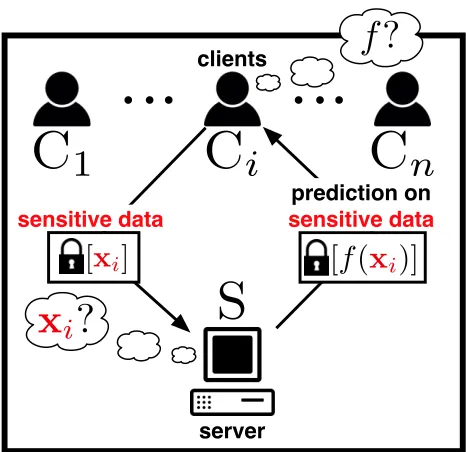
Figure 1: Encrypted prediction as a service.
In the EPAAS setting we have any number of clients, say C1, . . . , Cn that have data x1, . . . ,xn. The
clients would like to use a highly-accurate modelf provided by a serverS to predict some outcome. In cases where dataxis not sensitive there are already many solutions for this such as BigML, Wise.io, Google Cloud AI, Amazon Machine Learning, among others. However, if the data is sensitive so that the clients would be uncomfortable giving the raw data to the server, none of these systems can offer the client a prediction.
2.1
Privacy and computational guarantees
If dataxis sensitive (e.g.,xmay be the health record of client C, andf(x) may be the likelihood of heart disease), then we would like to have the following privacy guarantees:
P1. Neither the serverS, or any other party, learn anything about client datax, other than its size(privacy of the data).
P2. Neither the clientC, or any other party, learn anything about modelf, other than the predictionf(x) given client data x(and whatever can be deduced from it)(privacy of the model).
Further, the main attraction of EPAAS is that the client is involved as little as possible. More concretely, we wish to have the following computational guarantees:
C1. No external party is involved in the computation.
C2. The rounds of communication between client and server should be limited to 2 (send data & receive prediction).
C3. Communication and computation at the client side should be independent of model f. In particular, (i) the server should be able to updatef without communicating with any client, and (ii) clients should not need to be online during the computation of f(x).
well as the public key to the server. (2) The server evaluatesf on ˜xleveraging the homomorphic properties of the encryption, to obtain an encryption ˜f(x) without learning anything whatsoever about x, and sends
˜
[image:5.612.70.582.153.252.2]f(x) to the client. (3) Finally, the client decrypts and recovers the predictionf(x) in the clear. A high level depiction of these steps is shown in Figure 1.
Table 1: Privacy and computational guarantees of existing methods for sensitive data classification. Privacy Computation Prior Work P1 P2 C1 C2 C3(i) C3(ii) CryptoNets Gilad-Bachrachet al. (2016) -
-Chabanneet al. (2017) -
-Bourseet al.(2017)
-MPC Mohassel and Zhang (2017); Liuet al.(2017); Rouhaniet al.(2017)
Riazi et al.(2017); Chaseet al.(2017); Juvekaret al.(2018) - - - -Meehanet al.(2018), Ours
2.2
Existing approaches
Table 1 describes whether prior work satisfy the above privacy and computational guarantees. First, note that Cryptonets Gilad-Bachrachet al.(2016) violates C3(i) and P2. This is because the clients would have to generate parameters for the encryption according to the structure off, so we are able to make inferences about the model (violating P2) and the client is not allowed to change the modelf without telling the client (violating C3(i)). The same holds for the work of Chabanne et al. (2017). The approach of Bourseet al. (2017) requires the server to calibrate the parameters of the encryption scheme according to the magnitude of intermediate values, thus C3(i) is not necessarily satisfied. Closely related to our work is that of Meehan et al.(2018) which satisfies our privacy and computational requirements. We will show that our method is significantly faster than this method, with very little sacrifice in accuracy.
Multi-Party Computation (MPC). It is important to distinguish between approaches purely based on homomorphic encryption (described above), and those involving Multi-Party Computation (MPC) techniques, such as Mohassel and Zhang (2017); Liu et al. (2017); Rouhani et al.(2017); Riazi et al. (2017); Chase et al.(2017); Juvekaret al.(2018). While generally MPC approaches are faster, they crucially rely on all parties being involved in the whole computation, which is in conflict with requirement C3(ii). Additionally, in MPC the structure of the computation is public to both parties, which means that the server would have to communicate basic information such as the number of layers off. This is conflict with requirements P1, C2, and C3(i).
In this work, we propose to use a very tailored homomorphic encryption technique to guarantee all privacy and computational requirements. In the next section we give background on homomorphic encryption. Further, we motivate the encryption protocol and the machine learning model class we use to satisfy all guarantees.
3
Background
All cryptosystems define two functions: 1. an encryption functionE(·) that maps data (often calledplaintexts) to encrypted data (ciphertexts); 2. a decryption functionD(·) that maps ciphertexts back to plaintexts. In public-key cryptosystems, to evaluate the encryption functionE, one needs to hold a public keykpub, so the encryption of dataxisE(x, kpub). Similarly, to compute the decryption functionD(·) one needs to hold a secret keyksec which allows us to recover: D(E(x, kpub), ksec) =x.
half adder half adder half adder half adder half adder half adder half adder half adder 2-bit RC adder 2-bit RC adder 2-bit RC adder 2-bit RC adder
3-bit RC adder 3-bit RC adder 4-bit RC adder
N-BIT REDUCE TREE ADDITION SORTING NETWORK
[image:6.612.132.482.71.225.2]SWAP 1 0 0 1 SWAP SWAP SWAP SWAP 0 0 1 1
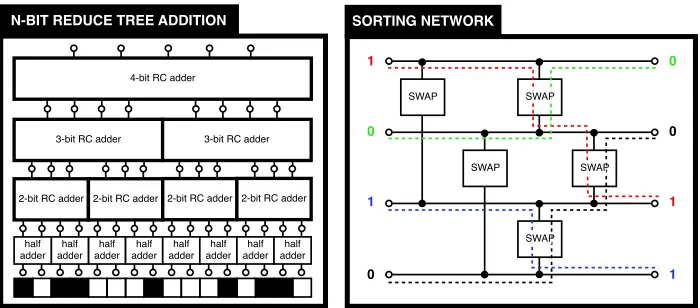
Figure 2: Binary circuits used for inner product: reduce tree (Left) and sorting network (Right). RC is short for ripple-carry.
be binary∈ {0,1}. For more detailed background on FHE beyond what is described below, see the excellent tutorial of Halevi (2017).
3.1
Fully Homomorphic Encryption
In 1978, cryptographers posed the question: Does an encryption scheme exist that allows one to perform arbitrary computations on encrypted data? The implications of this, called aFully homomorphic encryption (FHE) scheme, would enable clients to send computations to the cloud while retaining control over the secrecy of their data. This was still an open problem however 30 years later. Then, in 2009, a cryptosystem (Gentry, 2009) was devised that could, in principle, perform such computations on encrypted data. Similar to previous approaches, in each computation, noise is introduced into the encrypted data. And after a certain number of computations, the noise grows too large so that the encryptions can no longer be decrypted. The key innovation was a technique called bootstrapping, which allows one to reduce the noise to its original level without decrypting. That result constituted a massive breakthrough, as it established, for the first time, a fully homomorphic encryption scheme (Gentry, 2009). Unfortunately, the original bootstrapping procedure was highly impractical. Consequently, much of the research since the first FHE scheme has been devoted to reducing the growth of noise so that the scheme never has to perform bootstrapping. Indeed, even in recent FHE schemes bootstrapping is slow (roughly six minutes in a highly-optimized implementation of a recent popular scheme (Halevi and Shoup, 2015)) and bootstrapping many times increases the memory requirements of encrypted data.
3.1.1 Encrypted Prediction with leveled HE
Thus, one common technique to implement encrypted prediction was to take an existing ML algorithm and approximate it with as few operations as possible, in order to never have to bootstrap. This involved careful parameter tuning to ensure that the security of the encryption scheme was sufficient, that it didn’t require too much memory, and that it ran in a reasonable amount of time. One prominent example of this is Cryptonets (Gilad-Bachrachet al., 2016).
3.1.2 Encrypted Prediction with FHE
designing encrypted machine learning algorithms. Specifically, encrypted computation is now modular: the cost of adding a few layers to an encrypted neural network is simply the added cost of each layer in isolation. This is particularly important as recent developments in deep learning such as Residual Networks (Heet al., 2016) and Dense Networks (Huanget al., 2017) have shown that networks with many layers are crucial to achieve state-of-the-art accuracy.
3.2
Binary Neural Networks
The cryptosystem that we will use in this paper, TFHE, is however restricted to computing binary operations. We note that, concurrent to the work that led to TFHE, was the development of neural network models that perform binary operations between binary weights and binary activations. These models, called Binary Neural Networks (BNNs), were first devised by Kim and Smaragdis (2015); Courbariauxet al. (2016), and were motivated by the prospect of training and testing deep models on limited memory and limited compute devices, such as mobile phones.
Technical details. We now describe the technical details of binary networks that we will aim to replicate on encrypted data. In aBinary Neural Network (BNN) every layer maps a binary inputx∈ {−1,1}d to a
binary outputz∈ {−1,1}p using a set of binary weightsW∈ {−1,1}(p,d)and a binary activation function sign(·) that is 1 if x≥0 and−1 otherwise. Although binary nets don’t typically use a bias term, applying batch-normalization (Ioffe and Szegedy, 2015) when evaluating the model it means that a bias termb∈Zp
may need to be added before applying the activation function (cf. Sec. 4.1.2). Thus, when evaluating the model, a fully connected layer in a BNN implements the following transformationz:=sign(Wx+b). From now on we will call all data represented as{−1,1}non-standard binary and data represented as{0,1}as binary. Kim and Smaragdis (2015); Courbariauxet al. (2016) were the first to note that the above inner product nonlinearity in BNNs could be implemented using the following steps:
1. Transform data and weights from non-standard binary to binary: w,x→w,xby replacing−1 with 0. n
2. Element-wise multiply by applying the logical operator XNOR(w,x) for each element ofwandx.
3. Sum result of previous step by usingpopcountoperation (which counts the number of 1s), call thisS.
4. If the bias term isb, check if 2S≥d−b, if so the activation is positive and return 1, otherwise return
−1.
Thus we have that,
zi=sign(2·popcount(XNOR(wi,x))−d+b)
Related binary models. Since the initial work on BNNs there has been a wealth of work on binarizing, ternarizing, and quantizing neural networks Chenet al.(2015); Courbariauxet al.(2015); Hanet al.(2016); Hubaraet al. (2016); Zhuet al. (2016); Chabanneet al.(2017); Chenet al.(2017). Our approach is currently tailored to methods that have binary activations and we leave the implementation of these methods on encrypted data for future work.
4
Methods
We then show how a simple trick allows us to sparsify our computations. Our techniques can be easily parallelized. During the evaluation of a circuit, gates at the same level in the tree representation of the circuit can be evaluated in parallel. Hence, when implementing a function, “shallow” circuits are preferred in terms of parallelization. While parallel computation was often used to justify employing second generation FHE techniques—where parallelization comes from ciphertext packing—we show in the following section that our techniques create dramatic speedups for a state-of-the-art FHE technique. We emphasize that a key challenge is that we need to usedata oblivious algorithms (circuits) when dealing with encrypted data as the algorithm never discovers the actual value of any query made on the data.
4.1
Binary OPs
The three primary circuits we need are for the following tasks: 1. computing the inner product; 2. computing the binary activation function (described in the previous section) and; 3. dealing with the bias.
Algorithm 1Comparator
Inputs: EncryptedB[ ˜S], unencrypted B[(d−b)/2], sizedofB[(d−b)/2],B[ ˜S]
Output: Result of 2 ˜S≥d−b
1: o= 0
2: fori= 1, . . . , ddo
3: if B[(d−b)/2]i= 0 then
4: o=MUX(B[ ˜S]i,˜1, o)
5: else
6: o=MUX(B[ ˜S]i, o,˜0)
7: end if 8: end for 9: Return: o
4.1.1 Encrypted inner product
As described in the previous section, BNNs can speed up an inner product by computingXNORs (for element-wise multiplication) followed by apopcount (for summing). In our case, we compute an inner product of sizedby computingXNORs element-wise betweendbits of encrypted data anddbits of unencrypted data, which results in an encrypted dbit output. To sum this output, thepopcount operation is useful when weights and data are unencrypted becausepopcountis implemented in the instruction set of Intel and AMD processors, but when dealing with encrypted data we simply resort to using shallow circuits. We consider two circuits for summation, both with sublinear depth: a reduce tree adder and a sorting network.
Reduce tree adder. We implement the sum using a binary tree of half and ripple-carry (RC) adders organized into a reduction tree, as shown in Figure 2 (Left). All these structures can be implemented to run on encrypted data because TFHE allows us to computeXNOR,AND, and ORon encrypted data. The final number returned by the reduction tree ˜S is the binary representation of the number of 1s resulting from theXNOR, just likepopcount. Thus, to compute the BNN activation functionsign(·) we need to check whether 2 ˜S≥d−b, where dis the number of bits in ˜S andb is the bias. Note that if the bias is zero we simply need to check if ˜S≥d/2. To do so we can simply return the second-to-last bit of ˜S. If it is 1 then ˜S
is at leastd/2. If the biasbis non-zero (because of batch-normalization, described in Section 4.1.2), we can implement a circuit to perform the check 2 ˜S≥d−b. The biasb(which is available in the clear) may be an integer as large as ˜S. LetB[(d−b)/2],B[ ˜S] be the binary representations ofband ˜S. Algorithm 1 describes
gates. This gate has a dedicated implementation in TFHE, which results in a very efficient comparator in our setting.
Sorting network. We do not technically care about the sum of the result of the element-wise XNOR between ¯w and ¯x. In fact, all we care about is if the result of the comparison: 2 ˜S≥d−b. Thus, another idea is to take the output of the (bitwise)XNORand sort it. Although this sorting needs to be performed over encrypted data, the rest of the computation does not require any homomorphic operations; after sorting we hold a sequence of encrypted 1s, followed by encrypted 0s. To output the correct value, we only need to select one the (encrypted) bit in the correct position and return it. Ifb = 0 we can simply return the encryption of the central bit in the sequence; indeed, if the central bit is 1, then there are more 1s than 0s and thus 2 ˜S ≥ d and we return 1. If b 6= 0 we need to offset the returned index by b in the correct direction depending on the sign of b. In order to sort the initial array we implement a sorting network, shown in Figure 2 (Right). The sorting network is a sequence of swap gates between individuals bits, where SWAP(a, b) = (OR(a, b),AND(a, b)). Note that ifa≥bthenSWAP(a, b) = (a, b), and otherwise is (b, a). More specifically, we implement Batcher’s sorting network Batcher (1968), which consists of O(nlog2(n)) swap gates, and has depthO(log2(n)).
0 250 500 750 1000 1250 1500 1750 2000
Number of elements 101
102
103
Time in seconds
Time comparison of sorting network and reduce tree
[image:9.612.199.412.290.442.2]Reduce Tree Sorting Network Non-parallel reduce tree Non-parallel sorting net
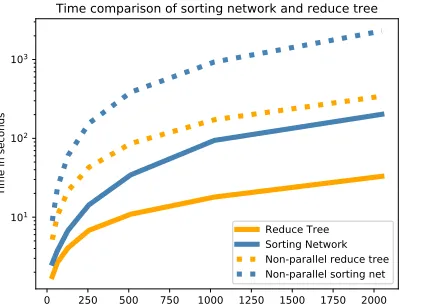
Figure 3: Timing of sorting network and reduce tree addition for different sized vectors, with and without parallelization.
4.1.2 Batch normalization
Batch normalization is mainly used during training; however during evaluating a model this requires us scale and translate and scale the input (which is the output of the previous layer). In practice, when our activation function is thesign function, this only means that we need to update the bias term (the actual change to the bias term is an elementary calculation). As our circuits are designed to work with a bias term, and the scaling and translation factors are available as plaintext (as they are part of the model), this operation is easily implemented during test time.
4.2
Sparsification via “+1”-trick
Since we have access toW∈ {−1,1}p×d and the bias term b∈
Zp in the clear (only data xand subsequent
activations are encrypted), we can exploit the fact thatWalways has values±1 to roughly halve the cost computation. We considerw∈ {−1,1}d which is a single row ofWand observe that:
w>x= (1+w)>(1+x)−X
i
where 1 denotes the vector in which every entry is 1. Further note that (1+w)∈ {0,2}d which means
that the product (1+w)>(1+x) is simply the quantity 4P
i:wi=1x¯i, where ¯x refers to the standard binary representation of the non-standard binaryx. Assuming at most half of thewis were originally +1, if
w∈ {−1,1}d, onlyd/2 encrypted values need be added. We also need to compute the encrypted sumP
ixi;
however, this latter sum need only be computed once, no matter how many output units the layer has. Thus, this small bit of extra overhead roughlyhalvesthe amount of computation required. We note that ifwhas more−1s than +1s,w>xcan be computed using (1−w) and (1−x) instead. This guarantees that we never
need to sum more than half the inputs for any output unit. The sums of encrypted binary values can be calculated as described in Sec. 4.1. The overheads are two additions required to compute (1+x)>1and
(1−x)>1, and then a subtraction of two log(d)-bit long encrypted numbers. (The multiplication by 2 or
4 as may be sometimes required is essentially free, as bit shifts correspond to dropping bits, and hence do not require homomorphic operations). As our experimental results show this simple trick roughly halves the computation time of one layer; the actual savings appear to be even more than half as in many instances the number of elements we need to sum over is significantly smaller than half.
It is worth emphasizing the advantage for binarizing and then using the above approach to making the sums sparse. By default, units in a neural network compute an affine function to which an activation function is subsequently applied. The affine map involves an inner product which involvesdmultiplications. Multiplication under fully homomorphic encryption schemes is however significantly more expensive than addition. By binarizing and applying the above calculation, we’ve replaced the inner product operation by selection (which is done in the clear asWis available in plaintext) and (encrypted) addition.
4.3
Ternarization (Weight Dropping)
Ternary neural networks use weights in {−1,0,1}rather than{−1,1}; this can alternatively be viewed as dropping connections from a BNN. Using ternary neural networks rather than binary reduces the computation time as encrypted inputs for which the correspondingwi is 0 can be safely dropped from the computation,
before the method explained in section 4.2 is applied to the remaining elements. Our experimental results show that a binary network can be ternarized to maintain the same level of test accuracy with roughly a quarter of the weights being 0 (cf. Sec. 5.4).
5
Experimental Results
In this section we report encrypted binary neural network prediction experiments on a number of real-world datasets. We begin by comparing the efficiency of the two circuits used for inner product, the reduce tree and the sorting network. We then describe the datasets and the architecture of the BNNs used for classification. We report the classification timings of these BNNs for each dataset, for different computational settings. Finally, we give accuracies of the BNNs compared to floating point networks. Our code is freely available at tap (2018).
5.1
Reduce tree vs. sorting network
We show timings of reduce tree and sorting network for different number of input bits, with and without parallelization in Figure 3 (parallelization is over 16 CPUs). We notice that the reduce tree is strictly better when comparing parallel or non-parallel timings of the circuits. As such, from now on we use the reduce tree circuit for inner product.
Another factor that may slow down sorting networks is that is that our implementation of sorting networks is recursive, whereas the reduce tree is iterative.
5.2
Datasets
We evaluate on four datasets, three of which have privacy implications due to health care information (datasets Cancer and Diabetes) or applications in surveillance (dataset Faces). We also evaluate on the standard benchmark MNIST dataset.
Cancer. The Cancer dataset1 contains 569 data points where each point has 30 real-valued features. The
task is to predict whether a tumor is malignant (cancerous) or benign. Similar to Meehanet al.(2018) we divide the dataset into a training set and a test in a 70 : 30 ratio. For every real-valued feature, we divide the range of each feature into three equal-spaced bins and one-hot encode each feature by its bin-membership. This creates a 90-dimensional binary vector for each example. We use a single fully connected layer 90→1 followed by a batch normalization layer, as is common practice for BNNs Courbariauxet al.(2016).
Diabetes. This dataset2 contains data on 100000 patients with diabetes. The task is to predict one of
three possible labels regarding hospital readmission after release. We divide patients into a 80/20 train/test split. As this dataset contains real and categorical features, we bin them as in the Cancer dataset. We obtain a 1704 dimensional binary data point for each entry. Our network (selected by cross validation) consists of a fully connected layer 1704→10, a batch normalization layer, asignactivation function, followed by another fully connected layer 10→3, and a batch normalization layer.
Faces. TheLabeled Faces in the Wild-a dataset contains 13233 gray-scale face images. We use the binary classification task of gender identification from the images. We resize the images to size 50×50. Our network architecture (selected by cross-validation) contains 5 convolutional layers, each of which is followed by a batch normalization layer and a sign activation function (except the last which has no activation). All convolutional layers have unit stride and filter dimensions 10×10. All layers except the last layer have 32 output channels (the last has a single output channel). The output is flattened and passed through a fully connected layer 25→1 and a batch normalization layer.
MNIST. The images in MNIST are 28×28 binary images. The training set and testing sets in this case are already available in a standard split and that is what we use. The training split contains 50000 images and the test split contains 10000 images. There are 10 classes, each corresponding to a different mathematical digit. We use the model (torch7) described in Courbariauxet al.(2016).
5.3
Timing
We give timing results for classification of an instance in different computational settings. All of the strategies use the parallel implementations of the reduce tree circuit computed across 16 CPUs (the solid line orange line in Figure 3). TheOut Seq strategy computes each operation of a BNN sequentially (using the parallel reduce tree circuit). Notice that for any layer of a BNN mappingdinputs topoutputs, the computation over each of thepoutputs can be parallelized. TheOut 16-P strategy estimates parallelizing the computation of thepoutputs across a cluster of 16 machines (each with 16 CPUs). TheOut Full-P strategy estimates complete parallelization, in which each layer output can be computed independently on a separate machine. We note that for companies that already offer prediction as a service, both of these parallel strategies are not unreasonable requirements. Indeed it is not uncommon for such companies to run hundreds of CPUs/GPUs over multiple days to tune hyperparameters for deep learning models3. Additionally we report how timings
change with the introduction of the+1-trick is described in Section 4.2. These timings are given in Table 2
Parallelism Cancer Diabetes Faces MNIST Out Seq 3.5s 283s 763.5h 65.1h +1-trick 3.5s 250s 564h 37.22 h Out 16-P.
[image:12.612.174.436.98.176.2]+1 trick 3.5s 31.5 s 33.1h 2.41 h Out Full-P 3.5s 29s 1.3h 147s
Table 2: Neural Network timings on various datasets using different forms of parallelism.
(computed with Intel Xeon CPUs @ 2.40GHz, processor number E5-2673V3). We notice that without parallelization over BNN outputs, the predictions on datasets which use fully connected layers: Cancer and Diabetes, finish within seconds or minutes. While the for the datasets that use convolutional layers: Faces and MNIST, predictions require multiple days. The+1-trick cuts the time of MNIST prediction by half and reduces the time of Faces prediction by 200 hours. With only a bit of parallelism over outputs (Out 16-Parallel) prediction on the Faces dataset now requires less than 1.5 days and MNIST can be done in 2
hours. With complete parallelism (Out N-Parallel) all methods reduce to under 2 hours.
5.4
Accuracy
We wanted to ensure that BNNs can still achieve similar test set accuracies to floating point networks. To do so, for each dataset we construct similar floating point networks. For the Cancer dataset we use the same network except we use the original 30 real-valued features, so the fully connected layer is 30→1, as was used in Meehanet al.(2018). For Diabetes and Faces, just like for our BNNs we cross validate to find the best networks (for Faces: 4 convolutional layers, with filter sizes of 5×5 and 64 output channels; for Diabetes the best network is the same as used in the BNN). For MNIST we report the accuracy of the best performing method Wanet al.(2013) as reported4. Additionally, we report the accuracy of the weight-dropping method
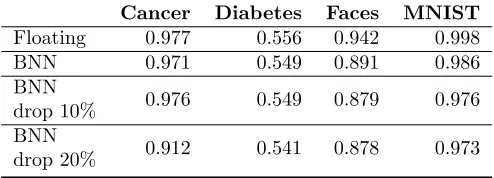
described in Section 4. The results are shown in Table 3. We notice that apart from the Faces dataset, the
Cancer Diabetes Faces MNIST Floating 0.977 0.556 0.942 0.998 BNN 0.971 0.549 0.891 0.986 BNN
drop 10% 0.976 0.549 0.879 0.976 BNN
drop 20% 0.912 0.541 0.878 0.973
Table 3: The accuracy of floating point networks compared with BNNs, with and without weight dropping. The Cancer dataset floating point accuracy is given by Meehan et al. (2018), the MNIST floating point accuracy is given by Wan et al. (2013), and the MNIST BNN accuracy (without dropping) is given by Courbariauxet al.(2016).
accuracies differ between the floating point networks and BNNs by at most 1.2% (on MNIST). The face dataset uses a different network in floating point which seems to be able to exploit the increased precision to increase accuracy by 5.1%. We also observe that weight dropping by 10% reduces the accuracy by at most 1.2% (on Faces). Dropping 20% of the weights seem to have small effect on all datasets except Cancer, which has only a single layer and so likely relies more on every individual weight.
[image:12.612.181.428.435.524.2]6
Conclusion
In this work, we devised a set of techniques that allow for practical Encrypted Prediction as a Service. In future work, we aim to develop techniques for encrypting non-binary quantized neural networks, and well as design methods for encrypted model training.
Acknowledgments
The authors would like to thank Nick Barlow and Oliver Strickson for their support in using the SHEEP platform. AS acknowledges support from The Alan Turing Institute under the Turing Doctoral Studentship grant TU/C/000023. AG, MK, and VK were supported by The Alan Turing Institute under the EPSRC grant EP/N510129/1.
References
(2018). TAPAS – tricks for accelerating (encrypted) prediction as a service. https://github.com/ amartya18x/tapas.
Aono, Y., Hayashi, T., Wang, L., Moriai, S.,et al.(2017). Privacy-preserving deep learning via additively homomorphic encryption. IEEE Transactions on Information Forensics and Security.
Batcher, K. E. (1968). Sorting Networks and Their Applications. In AFIPS Spring Joint Computing Conference, volume 32 of AFIPS Conference Proceedings, pages 307–314. Thomson Book Company, Washington D.C.
Blecker, S., Sontag, D., Horwitz, L. I., Kuperman, G., Park, H., Reyentovich, A., and Katz, S. D. (2017). Early identification of patients with acute decompensated heart failure. Journal of cardiac failure.
Bourse, F., Minelli, M., Minihold, M., and Paillier, P. (2017). Fast homomorphic evaluation of deep discretized neural networks. Cryptology ePrint Archive, Report 2017/1114.
Brakerski, Z. and Vaikuntanathan, V. (2014). Efficient fully homomorphic encryption from (standard) lwe. SIAM Journal on Computing,43(2), 831–871.
Chabanne, H., de Wargny, A., Milgram, J., Morel, C., and Prouff, E. (2017). Privacy-preserving classification on deep neural network. IACR Cryptology ePrint Archive,2017, 35.
Chase, M., Gilad-Bachrach, R., Laine, K., Lauter, K., and Rindal, P. (2017). Private collaborative neural network learning. Technical report, IACR Cryptology ePrint Archive, 2017: 762, 2017. 4324.
Chen, W., Wilson, J., Tyree, S., Weinberger, K., and Chen, Y. (2015). Compressing neural networks with the hashing trick. InInternational Conference on Machine Learning, pages 2285–2294.
Chen, X., Hu, X., Zhou, H., and Xu, N. (2017). Fxpnet: Training a deep convolutional neural network in fixed-point representation. InNeural Networks (IJCNN), 2017 International Joint Conference on, pages 2494–2501. IEEE.
Chillotti, I., Gama, N., Georgieva, M., and Izabachene, M. (2016). Faster fully homomorphic encryption: Bootstrapping in less than 0.1 seconds. In International Conference on the Theory and Application of Cryptology and Information Security, pages 3–33. Springer.
Courbariaux, M., Hubara, I., Soudry, D., El-Yaniv, R., and Bengio, Y. (2016). Binarized neural networks: Training deep neural networks with weights and activations constrained to+ 1 or-1. InAdvances in Neural Information Processing Systems.
Ducas, L. and Micciancio, D. (2015). Fhew: bootstrapping homomorphic encryption in less than a second. InAnnual International Conference on the Theory and Applications of Cryptographic Techniques, pages 617–640. Springer.
Fortunato, S. (2010). Community detection in graphs. Physics reports, 486(3-5), 75–174.
Gentry, C. (2009). Fully homomorphic encryption using ideal lattices. InProceedings of the Forty-first Annual ACM Symposium on Theory of Computing, pages 169–178. ACM.
Gentry, C., Halevi, S., and Smart, N. P. (2012). Fully homomorphic encryption with polylog overhead. InAnnual International Conference on the Theory and Applications of Cryptographic Techniques, pages 465–482. Springer.
Gentry, C., Sahai, A., and Waters, B. (2013). Homomorphic encryption from learning with errors: Conceptually-simpler, asymptotically-faster, attribute-based. InAdvances in Cryptology–CRYPTO 2013, pages 75–92. Springer.
Ghosh, S. and Reilly, D. L. (1994). Credit card fraud detection with a neural-network. InSystem Sciences, 1994. Proceedings of the Twenty-Seventh Hawaii International Conference on, volume 3, pages 621–630.
IEEE.
Gilad-Bachrach, R., Dowlin, N., Laine, K., Lauter, K., Naehrig, M., and Wernsing, J. (2016). Cryptonets: Applying neural networks to encrypted data with high throughput and accuracy. InProceedings of The 33rd International Conference on Machine Learning, volume 48 ofProceedings of Machine Learning Research, pages 201–210, New York, New York, USA. PMLR.
Halevi, S. (2017). Homomorphic encryption. InTutorials on the Foundations of Cryptography, pages 219–276. Springer.
Halevi, S. and Shoup, V. (2015). Bootstrapping for helib. InAnnual International Conference on the Theory and Applications of Cryptographic Techniques, pages 641–670. Springer.
Han, S., Mao, H., and Dally, W. J. (2016). Deep compression: Compressing deep neural network with pruning, trained quantization and huffman coding. InProceedings of the 6th International Conference on Learning Representations.
Hardy, S., Henecka, W., Ivey-Law, H., Nock, R., Patrini, G., Smith, G., and Thorne, B. (2017). Private federated learning on vertically partitioned data via entity resolution and additively homomorphic encryption. arXiv preprint arXiv:1711.10677.
He, K., Zhang, X., Ren, S., and Sun, J. (2016). Deep residual learning for image recognition. InComputer vision and pattern recognition, pages 770–778.
Huang, G., Liu, Z., Weinberger, K. Q., and van der Maaten, L. (2017). Densely connected convolutional networks. InProceedings of the IEEE conference on computer vision and pattern recognition, volume 1, page 3.
Hubara, I., Courbariaux, M., Soudry, D., El-Yaniv, R., and Bengio, Y. (2016). Quantized neural networks: Training neural networks with low precision weights and activations. arXiv preprint arXiv:1609.07061.
Juvekar, C., Vaikuntanathan, V., and Chandrakasan, A. (2018). Gazelle: A low latency framework for secure neural network inference.
Kim, M. and Smaragdis, P. (2015). Bitwise neural networks. In ICML Workshop on Resource-Efficient Machine Learning.
Kononenko, I. (2001). Machine learning for medical diagnosis: history, state of the art and perspective. Artificial Intelligence in medicine,23(1), 89–109.
Liu, J., Juuti, M., Lu, Y., and Asokan, N. (2017). Oblivious neural network predictions via minionn transformations. Cryptology ePrint Archive, Report 2017/452.
Meehan, A., Ko, R. K. L., and Holmes, G. (2018). Deep learning inferences with hybrid homomorphic encryption.
Mohassel, P. and Zhang, Y. (2017). Secureml: A system for scalable privacy-preserving machine learning. In Security and Privacy (SP), 2017 IEEE Symposium on, pages 19–38. IEEE.
Riazi, M. S., Weinert, C., Tkachenko, O., Songhori, E. M., Schneider, T., and Koushanfar, F. (2017). Chameleon: A hybrid secure computation framework for machine learning applications. Cryptology ePrint Archive, Report 2017/1164. http://ia.cr/2017/1164.
Rivest, R. L., Adleman, L., and Dertouzos, M. L. (1978). On data banks and privacy homomorphisms. Foundations of Secure Computation.
Rouhani, B. D., Riazi, M. S., and Koushanfar, F. (2017). Deepsecure: Scalable provably-secure deep learning.
Smart, N. P. and Vercauteren, F. (2014). Fully homomorphic simd operations.Designs, codes and cryptography, 71(1), 57–81.
Wan, L., Zeiler, M., Zhang, S., Cun, Y. L., and Fergus, R. (2013). Regularization of neural networks using dropconnect. InProceedings of the 30th International Conference on Machine Learning, volume 28, pages 1058–1066.