Current Opinion in Supportive & Palliative Care
Peer support for people with advanced cancer: a systematically constructed scoping
review of quantitative and qualitative evidence
--Manuscript
Draft--Manuscript Number: SPC120308
Full Title: Peer support for people with advanced cancer: a systematically constructed scoping review of quantitative and qualitative evidence
Article Type: Review Article
Corresponding Author: Catherine Walshe Lancaster University
Lancaster, UNITED KINGDOM Corresponding Author Secondary
Information:
Corresponding Author's Institution: Lancaster University Corresponding Author's Secondary
Institution:
First Author: Catherine Walshe
First Author Secondary Information:
Order of Authors: Catherine Walshe Diane Roberts Order of Authors Secondary Information:
1 Peer support for people with advanced cancer: a systematically constructed scoping review of quantitative and qualitative evidence
Catherine Walshe, Professor of Palliative Care, International Observatory on End of Life Care, Lancaster University.
Diane Roberts, Research Associate, Division of Nursing, Midwifery and Social Work, University of Manchester.
Corresponding author:
Professor Catherine Walshe
International Observatory on End of Life Care Division of Health Research
Lancaster University Bailrigg
Lancaster, LA1 4YX
+44 1524 510124
2 Abstract
Purpose of review: The number of people living with advanced cancer is increasing, and appropriate
support to this population is essential. Peer support is increasingly advocated as a component of care,
but little is known about how to provide this in the context of advanced cancer. This review describes
the experience and impact of different forms of peer support for people with advanced cancer.
Recent findings: Data from 22 papers were reviewed, primarily descriptive studies. They describe
three forms of peer support (one-to-one, group and online), reaching primarily those who are female,
middle aged and well educated. Only two studies focused on support to people with advanced cancer,
but those with advanced cancer were frequent users of all forms of peer support. Benefits of peer
support were described, but no data were presented to allow a determination of the best form of
support for people with advanced cancer.
Summary: Practitioners can be assured that peer support is likely to be beneficial, and provide care
that complements that of clinicians. However there is a need for a comprehensive programme of high
quality evaluative research of peer support for people with advanced cancer.
3 Introduction
The number of people living with and beyond cancer increases by 3.2% each year (1). Whilst some
remain disease free, a proportion are living with, and dying from, advanced cancer. One model
estimates that there are around 3-4 metastatic breast cancer cases for every breast cancer death(2).
It is therefore critically important that services not only support excellence in diagnosis and treatment,
but also provide effective and appropriate support for a prolonged period of time, designed to meet
the needs of those with advanced cancer (3).
Clinical services are unlikely to meet all the needs of those with advanced cancer. This may be because
of their capacity to provide care, or because needs may be best met outside formal healthcare
systems. Compassionate support cannot be the responsibility only of health and social care
professionals, and wider support, including from peers and the community, may be important (4, 5).
Social networks and social capital are important contributors to health (6, 7), buffering the effects of
crisis, providing a framework that may prevent burn out, and demonstrating the importance of
supportive social contexts (8-10).
One form of support that may have merit is that provided by peers. Peer support involves people
drawing on shared personal experience to provide knowledge, social interaction, emotional assistance
or practical help, often in a way that is mutually beneficial (11). Peer support is different because the
source of support is a similar person with relevant experience, and health policy recognizes the
importance of such support (12).
Peer support, within a health care context is:
‘The provision of emotional, appraisal, and informational assistance by a created social
network member who possesses experiential knowledge of a specific behaviour or
stressor and similar characteristics as the target population, to address a health-related
4 Peer support is a specific form of supportive relationship, distinctive from ‘embedded’ social networks
(such as family members, friends, co-workers or neighbours). Peer support is a ‘created’ social
network, provided with a range of professional support and involvement ranging from self-help groups
with little outside involvement to ‘paraprofessionals’ who may have extensive training for their peer
support role (13). Figure 1 presents conceptual distinctions of different forms of peer support and the
effect models and proposed outcomes of peer support.
<Insert Figure 1 around here>
The mechanisms of effect of peer support are theorised to be either direct (direct effect on health
outcomes through e.g. decreasing feelings of isolation), buffered (e.g. through reframing threat
appraisals and improving coping responses (14), or through mediating (e.g. indirectly influencing
health through emotions, cognitions, and behaviours (15).
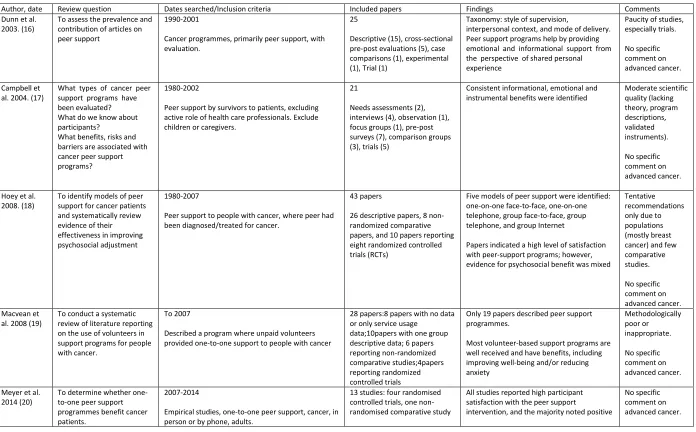
Previous reviews of peer support for people with cancer are summarised in table 1.
< Insert table 1 around here>
Some focus on describing peer support, providing taxonomies or models of types of support (16, 18),
others on outcomes generally (17), or of the effect of specific forms of peer support such as
one-to-one support (19, 20) or social media/online support (21, 22). All identify satisfaction with models of
peer support from those who receive it, but with criticisms of the descriptive focus of some studies,
5 What none of these reviews offer is an appraisal of peer support for people with advanced cancer.
The needs of those with advanced cancer are distinct (3), and there may be differences in their desire
for, experience, and impact of different forms of peer support. There is a need for an up to date review
that addresses the experience and impact of different forms of peer support for people with advanced
cancer.
Methods
This is a scoping review which enables literature to be mapped whilst addressing a broad question.
This approach allows overview, identification and mapping of key concepts rather than synthesis of
evidence. A formal assessment of methodological quality of included studies is usually not performed
(23, 24).
Review question
What is the experience and impact of different forms of peer support for people with advanced
cancer?
Inclusion and exclusion criteria
The key concept is the provision of any form of peer support (13), for people with a diagnosis of
advanced cancer. This can be in any setting or geographical location. This concept and context guided
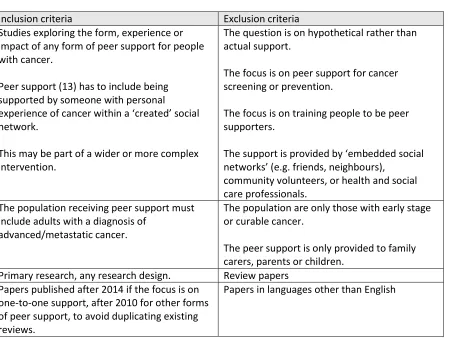
our inclusion and exclusion criteria (table 2):
6 Search strategy
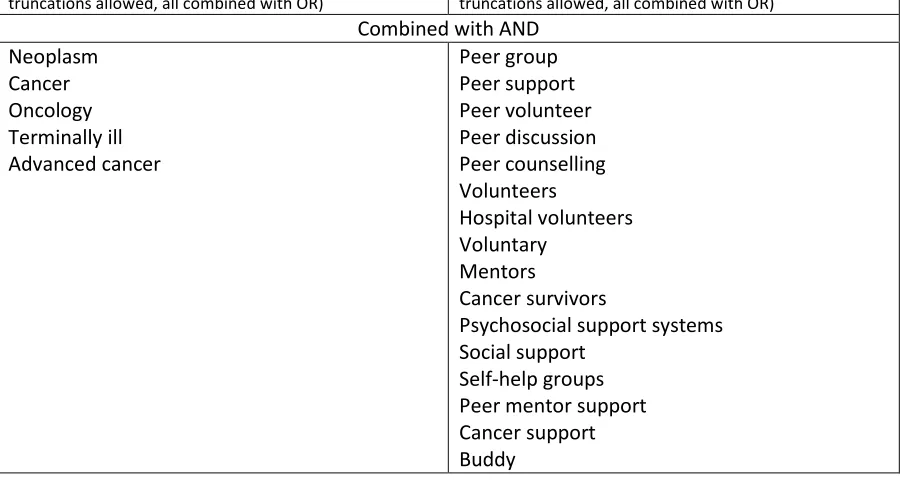
Key terms from existing reviews of peer support were used to combine terms for ‘peer support’ with
terms for ‘cancer’ (Table 3). Citation tracking of key papers in existing reviews was also used, and from
a recent broad report on peer support across a number of disease areas (11). Databases searched
include PubMed and Cochrane Databases(11).
<Insert table 3 around here>
The process of searching for papers and determining exclusion and inclusion is detailed in figure 2.
<Insert figure 2 around here>
Data extraction
Data were extracted and charted to describe and summarise information relevant to the question,
concept and context of the scoping review.
Findings
Twenty two papers were included in this review, two were from the same project. The studies are
summarised in table 4.
<Insert table 4 around here>
Studies came from the US (n=8), Canada (n=2), Australia (n=2), Netherlands (n=2) and one each from
Norway, Denmark, Finland, Germany, Hungary, Ireland and the UK. Study designs included qualitative
(n=8), cross-sectional surveys (n=8), pre-post surveys (n=1), comparative design (n=1) and different
forms of trial design (n=4). Only two studies exclusively explored peer support for people with
advanced cancer (35, 45), others included people with advanced cancer alongside those at other
stages of disease. Themes presented here include the type of peer support, who participates in peer
support, and the benefits or risks of peer support.
7 Studies investigated three types of peer support: one-to-one support (n=5), group support (n=6), and
online support (n=9). One paper compared group support offered either face-to-face or online. No
studies compared different types of peer support, so it is not possible to conclude if one form of
support is more effective.
Who participates in peer support programmes?
Peer support programmes typically report reaching out to people in middle age, female, and who are
well educated. The mean ages of those receiving support, where reported, ranged from 48-62. Some
studies only investigated peer support for those with specific diagnoses, often a gendered diagnosis,
typically breast cancer (n=11), but also gynaecological cancer (n=1), or prostate cancer (n=1). Two
studies only included those with lung cancer; five studies included those with any cancer diagnosis. Of
the studies that included those with any diagnosis, most participants were nevertheless female. A
study of a Peer Connect programme found that of their ‘guides’ 66% were female, and their ‘partners’
were 84% female (28). A similar pattern was found in a social network intervention with 77% female
participants (38), and 78% of users of an online lung cancer support community were female (39).
Study participants were typically well educated. One study of online social support found that most
had a polytechnic or college degree (39%), and nearly one in four (24%) had a university degree (43),
while a study of one-to-one peer support found that 51% had a college degree(29).
All studies reviewed have some participants with advanced cancer, but not exclusively so. Only two
studies solely examined support for those with advanced cancer (35, 45), but others identified that
people with advanced cancer were frequent users of all forms of peer support. A study of a Patient
Survivor Advocacy programme found that over 90% of both advocates and patients had invasive
cancer (26), the Woman to Woman programme had 19% of women with stage IV ovarian cancer(29),
a belly dancing support group had 31% with metastatic disease(31), and 25% of participants in a trial
of the Health-Space online intervention had late stage cancer(38).
8 Most studies were descriptive cross-sectional studies, typically using a qualitative interview or survey
design. Satisfaction with peer support was high (26), no risks were identified. Multiple benefits are
described, mostly characterised as emotional or informational support.
Emotional support included conveying hope and ways of coping(25, 29), reducing loneliness(27), and
improving self-esteem(34). Peer support helps people communicate with partners and family
members(29). Depressive symptoms and distress were reduced through group support (30, 33), but
a trial of online support found no difference in depressive symptoms(44). A trial of an online support
group for women with metastatic breast cancer showed a trend to distress reduction(45). How people
interacted was important, with humour important to conveying trust(37). Those who were highly
active online, but who managed their emotions less actively, had increased emotional wellbeing (40).
Informational support was also important (31), including health information and navigation(34).
Informational needs were particularly noted by users of online support groups (39, 42, 43). However
one study comparing online and face to face groups concluded that face to face groups were better
for exchanging information and caring for others (46).
Socially, peer support was seen as providing a framework for social comparisons (25), where
exchanging thoughts was easier with a peer(27), and with a need for mutual identification(36). Being
a peer supporter was felt to be positive and important, giving people a sense of achievement (25, 26).
Studies with a specific intervention (such as motivational interviewing), found that peers developed
proficiency in the intervention (28).
Discussion
Summary
This review describes a range of studies that investigate different forms of peer support used by
people with advanced cancer. Three main forms of peer support are one-to-one support, group
9 typically female, younger, and well educated. Peer support is well received, with people reporting a
range of benefits centred on emotional and informational support, however there are few robust trials
or other experimental studies. No risks from peer support were identified. Few studies specifically
study peer support for those with advanced cancer, but people with advanced cancer are frequent
users of peer support.
Comparison with previous reviews
Past reviews of peer support have been critical of this field of research, identifying issues with a focus
on breast cancer, lack of theory, poor or absent specification of peer support interventions, and the
lack of robust, high quality comparative studies such as trials (18-20). These issues, broadly, remain.
A large proportion of studies reviewed focus attention on those with breast cancer (26, 30, 32-34, 36,
37, 42). Whilst people with breast cancer require support, especially those with advanced cancer (47),
so too do people with other diagnoses. Studies reviewed are mostly not underpinned by any form of
theory, a trend also identified in a recent review of behavioural theories in end-of-life care
research(48). Peer support intervention descriptions were often poor, it was challenging to extract
details from many included papers, such as understanding the intervention at ‘Cairn Centres’ (25), the
use of former patients(27), or the form and function of some groups(34). This is an issue both for
practice implementation and for study replication.
Research included was typically descriptive, with few trials or other evaluative or comparative studies.
Many studies did not use validated measures of outcome e.g.(26, 28, 29). Studies of the perception of
peer support are, and have been, overwhelmingly supportive of the benefits of peers. This is no longer
the research that is needed. Questions that remain focus on who might benefit most from peer
support and what sort of peer support might be most effective. This is particularly true for those with
advanced cancer, who were frequent users of peer support programmes, but where the programmes
were rarely specifically designed to meet their needs. It is not possible on the basis of this review to
10 needed to investigate this. Peer support for those with (or by) advanced cancer is likely to have
specific issues associated with sensitive appreciation of the disease status, fluctuating health, and
likely death of those involved in the programmes. This was rarely acknowledged in the included
papers, but is important, with important methodological issues(49). Street (35) found two dominant
but separate narratives – those who wished to discuss death, and those deferring such discussions.
Any peer support programme needs to acknowledge and accept these different approaches.
Recommendations for policy, practice and future research
Peer support has a sufficient evidence base for policymakers and practitioners to be confident in
recommending it in policy and putting schemes in to practice. Whilst care is required in thoughtful use
of peer support it is likely to be positively perceived. However, the caveat to this is that there are
major unanswered questions and issues that require attention:
a) Peer support interventions should be clearly specified, such that they can be reported using
the TIDieR guidelines (50). This does not mean that programmes cannot be responsive and
flexible, as this is likely a hallmark of peer support. Rather, care should be taken in planning
and describing what is meant by a peer, and how support was given such that practice can be
carefully implemented and studies replicated.
b) Robust, adequately powered, theoretically underpinned, comparative and evaluative studies
are required. These should compare different forms of peer support, using appropriate
validated measures, in controlled conditions such that a clear understanding of what form of
peer support may benefit particular people is known. Designs such as wait-list or stepped
wedge trials may offer possibilities where it is felt that the intervention should not be withheld
from participants(51-53). Embedded qualitative process evaluations are likely to be required
to facilitate understanding of programme implementation and response(54).
c) Studies which focus on the peer support of those with advanced cancer are urgently needed.
11 cancer are studied within a larger project. Nevertheless, attention must be paid to the type of
support mechanism required and how to sensitively and methodologically manage issues of
deterioration and death.
Conclusion
Peer support appears important to those with advanced cancer, but has little evidence base. Attention
must be paid both in service and project design to incorporating the needs of people with advanced
12 Key points:
Peer support complements, but is distinctive from, health and social care services.
People with advanced cancer are frequent users of peer support services, but little is known
about how best to provide these services, nor their effect.
A high quality programme of evaluative research is required to understand what forms of peer
support are most effective for people with advanced cancer.
Acknowledgements:
1. Acknowledgements. No others assisted in the preparation of this review.
2. Financial support and sponsorship. No financial support specifically supported the preparation of this review. Catherine Walshe and Diane Roberts are both supported by a National Institute for Health Research (NIHR) Research for Patient Benefit grant for a feasibility study to investigate peer mentoring for people with advanced cancer.
13 1. Maddams J, Utley M, Moller H. Projections of cancer prevalence in the United Kingdom, 2010-2040. Br J Cancer. 2012;107(7):1195-202.
2. Clements MS, Roder DM, Yu XQ, Egger S, O'Connell DL. Estimating prevalence of distant metastatic breast cancer: a means of filling a data gap. Cancer Causes Control. 2012;23(10):1625-34. 3. Beernaert K, Pardon K, Van den Block L, Devroey D, De Laat M, Geboes K, et al. Palliative care needs at different phases in the illness trajectory: a survey study in patients with cancer. Eur J Cancer Care (Engl). 2016;25(4):534-43.
4. Dempers C, Gott M. Which public health approach to palliative care? An integrative literature review. Progress in Palliative Care. 2016:1-10.
5. Sallnow L, Richardson H, Murray SA, Kellehear A. The impact of a new public health approach to end-of-life care: A systematic review. Palliative Medicine. 2016;30(3):200-11.
6. Abel J, Walter T, Carey LB, Rosenberg J, Noonan K, Horsfall D, et al. Circles of care: should community development redefine the practice of palliative care? BMJ supportive & palliative care. 2013;3(4):383-8.
7. Holt-Lunstad J, Smith TB, Baker M, Harris T, Stephenson D. Loneliness and social isolation as risk factors for mortality: a meta-analytic review. Perspectives on psychological science : a journal of the Association for Psychological Science. 2015;10(2):227-37.
8. Lewis J, DiGiacomo M, Currow D, Davidson P. Social capital in a lower socioeconomic palliative care population: a qualitative investigation of individual, community and civic networks and relations. BMC Palliative Care. 2014;13(1):30.
9. Lewis JM, DiGiacomo M, Currow D, Davidson P. Dying in the margins: understanding palliative care and socioeconomic deprivation in the developed world. J Pain Symptom Manage. 2011;42(1):105-18.
10. Lewis JM, DiGiacomo M, Currow D, Davidson P. A social capital framework for palliative care: supporting health and well-being for people with life-limiting illness and their carers through social relations and networks. J Pain Symptom Manag. 2013;45(1):92-103.
11. Nesta. Peer support: What is it and does it work? . London: Nesta. 12. NHS. Five year forward view. 2014.
13. Dennis CL. Peer support within a health care context: a concept analysis. Int J Nurs Stud. 2003;40(3):321-32.
14. Lazarus RS, Folkman S. Stress, appraisal and coping. New York: Springer; 1984 1984. 15. Bandura A. Self-efficacy: toward a unifying theory of behavioral change. Psychological review. 1977;84(2):191.
16. Dunn J, Steginga SK, Rosoman N, Millichap D. A review of peer support in the context of cancer. J Psychosoc Oncol. 2003;21(2):55-67.
17. Campbell HS, Phaneuf MR, Deane K. Cancer peer support programs - do they work? Patient Educ Couns. 2004;55:3-15.
18. Hoey LM, Ieropoli SC, White VM, Jefford M. Systematic review of peer-support programs for people with cancer. Patient Educ Couns. 2008;70(3):315-37.
19. Macvean ML, White VM, Sanson-Fisher R. One-to-one volunteer support programs for people with cancer: A review of the literature. Patient Educ Couns. 2008;70(1):10-24.
20. Meyer A, Coroiu A, Korner A. One-to-one peer support in cancer care: a review of scholarship published between 2007 and 2014. Eur J Cancer Care (Engl). 2015;24(3):299-312. 21. Kim AR, Park HA. Web-based Self-management Support Interventions for Cancer Survivors: A Systematic Review and Meta-analyses. Studies in health technology and informatics.
2015;216:142-7.
14 24. Arksey H, O'Malley L. Scoping studies: towards a methodological framework. International journal of social research methodology. 2005;8(1):19-32.
25. Skirbekk H, Korsvold L, Finset A. To support and to be supported. A qualitative study of peer support centres in cancer care in Norway. Patient Educ Couns. 2017.
26. Mirrielees JA, Breckheimer KR, White TA, Denure DA, Schroeder MM, Gaines ME, et al**. Breast Cancer Survivor Advocacy at a University Hospital: Development of a Peer Support Program with Evaluation by Patients, Advocates, and Clinicians. Journal of cancer education : the official journal of the American Association for Cancer Education. 2017;32(1):97-104.Whilst not explicitly for those with advanced cancer, most of those who accessed this progrramme did have advanced cancer.
27. Borregaard B, Ludvigsen MS. Exchanging narratives-A qualitative study of peer support among surgical lung cancer patients. J Clin Nurs. 2018;27(1-2):328-36.
28. Allicock M, Carr C, Johnson LS, Smith R, Lawrence M, Kaye L, et al. Implementing a one-on-one peer support program for cancer survivors using a motivational interviewing approach: results and lessons learned. Journal of cancer education : the official journal of the American Association for Cancer Education. 2014;29(1):91-8.
29. Moulton A, Balbierz A, Eisenman S, Neustein E, Walther V, Epstein I. Woman to woman: a peer to peer support program for women with gynecologic cancer. Soc Work Health Care.
2013;52(10):913-29.
30. Mens MG, Helgeson VS, Lembersky BC, Baum A, Scheier MF. Randomized psychosocial interventions for breast cancer: impact on life purpose. Psychooncology. 2016;25(6):618-25. 31. Szalai M, Szirmai A, Fuge K, Makai A, Erdelyi G, Premusz V, et al. Special aspects of social support: Qualitative analysis of oncologic rehabilitation through a belly dancing peer support group. Eur J Cancer Care (Engl). 2017;26(6).
32. Morris BA, Chambers SK, Campbell M, Dwyer M, Dunn J. Motorcycles and breast cancer: the influence of peer support and challenge on distress and posttraumatic growth. Support Care Cancer. 2012;20(8):1849-58.
33. Morris BA, Campbell M, Dwyer M, Dunn J, Chambers SK. Survivor identity and post-traumatic growth after participating in challenge-based peer-support programmes. Br J Health Psychol. 2011;16(3):660-74.
34. Ashing-Giwa K, Tapp C, Rosales M, McDowell K, Martin V, Santifer RH, et al. Peer-based models of supportive care: the impact of peer support groups in African American breast cancer survivors. Oncol Nurs Forum. 2012;39(6):585-91.
35. Street AF, Wakelin K, Hordern A, Bruce N, Horey D. Dignity and deferral narratives as strategies in facilitated technology-based support groups for people with advanced cancer. Nursing research and practice. 2012;2012:647836.
36. Power S, Hegarty J. Facilitated peer support in breast cancer: a pre- and post-program evaluation of women's expectations and experiences of a facilitated peer support program. Cancer Nurs. 2010;33(2):E9-16.
37. Lovatt M, Bath PA, Ellis J. Development of Trust in an Online Breast Cancer Forum: A Qualitative Study. J Med Internet Res. 2017;19(5):e175.
38. Owen JE, Curran M, Bantum EO, Hanneman R.** Characterizing Social Networks and
Communication Channels in a Web-Based Peer Support Intervention. Cyberpsychology, behavior and social networking. 2016;19(6):388-96. An example of a trial design (wait-list trial) for investigating peer support.
39. Lobchuk M, McClement S, Rigney M, Copeland A, Bayrampour H. A Qualitative Analysis of "Naturalistic" Conversations in a Peer-Led Online Support Community for Lung Cancer. Cancer Nurs. 2015;38(5):E21-31.
15 41. Batenburg A, Das E. Emotional coping differences among breast cancer patients from an online support group: a cross-sectional study. J Med Internet Res. 2014;16(2):e28.
42. Bender JL, Katz J, Ferris LE, Jadad AR. What is the role of online support from the perspective of facilitators of face-to-face support groups? A multi-method study of the use of breast cancer online communities. Patient Educ Couns. 2013;93(3):472-9.
43. Yli-Uotila T, Rantanen A, Suominen T. Motives of cancer patients for using the Internet to seek social support. Eur J Cancer Care (Engl). 2013;22(2):261-71.
44. Klemm P. Effects of online support group format (moderated vs peer-led) on depressive symptoms and extent of participation in women with breast cancer. Computers, informatics, nursing : CIN. 2012;30(1):9-18.
45. Vilhauer RP, McClintock MK, Matthews AK. Online support groups for women with metastatic breast cancer: a feasibility pilot study. J Psychosoc Oncol. 2010;28(5):560-86.
46. Huber J, Muck T, Maatz P, Keck B, Enders P, Maatouk I, et al. Face-to-face vs. online peer support groups for prostate cancer: A cross-sectional comparison study. Journal of cancer survivorship : research and practice. 2017.
47. Lam WW, Soong I, Yau TK, Wong KY, Tsang J, Yeo W, et al. The evolution of psychological distress trajectories in women diagnosed with advanced breast cancer: a longitudinal study. Psychooncology. 2013;22(12):2831-9.
48. Scherrens A-L, Beernaert K, Robijn L, Deliens L, Pauwels NS, Cohen J, et al. The use of behavioural theories in end-of-life care research: A systematic review. Palliative
Medicine.0(0):0269216318758212.
49. Higginson I, Evans C, Grande G, Preston N, Morgan M, McCrone P, et al. Evaluating complex interventions in End of Life Care: the MORECare Statement on good practice generated by a
synthesis of transparent expert consultations and systematic reviews. BMC Medicine. 2013;11(1):111.
50. Hoffmann TC, Glasziou PP, Boutron I, Milne R, Perera R, Moher D, et al. Better reporting of interventions: template for intervention description and replication (TIDieR) checklist and guide. BMJ : British Medical Journal. 2014;348.
51. Walshe C, Dodd S, Hill M, Ockenden N, Payne S, Preston N, et al. How effective are volunteers at supporting people in their last year of life? A pragmatic randomised wait-list trial in palliative care (ELSA). BMC Medicine. 2016;14(1):203.
52. Higginson IJ, Booth S. The randomized fast-track trial in palliative care: Role, utility and ethics in the evaluation of interventions in palliative care? Palliative Medicine. 2011;25(8):741-7. 53. Aoun S, Grande G, Howting D, Deas K, Toye C, Troeung L, et al. The impact of the Carer Support Needs Assessment Tool (CSNAT) in community palliative care using a stepped wedge cluster trial. PLoS ONE. 2015;10(4).
54. Grant A, Treweek S, Dreischulte T, Foy R, Guthrie B. Process evaluations for
Consequences Personal
Characteristics
Selection Process
Training Provider Category
Defining Attributes
Effect Model Potential Health Outcomes
Lay individuals eligible to participate in supportive interventions due to similar characteristics with the target population
Lay individuals selected by community members
Lay individuals selected by health professionals/pro gram developers or self selected
Minimal
Extensive
Natural Lay Helpers
PEERS
Paraprofessionals
Emotional support Appraisal support Informational support
Direct Buffering Mediating
Augmenting social network Preventing health concerns Reinforcing help-seeking behaviours Decreasing barriers to care Encouraging effective coping Promoting social comparisons Increasing self-efficacy Aiding self-esteem
Figure 1. Conceptual distinctions of peer support. Reprinted with permission from (13)
Figure 2. Flow diagram of review process
Records identified through database searching
(Pubmed n = 816)
Scr
ee
n
in
g
In
cl
u
d
e
d
El
ig
ib
ili
ty
Id
en
ti
fi
cat
ion
Additional records identifiedthrough other sources (n = 24)
Records after duplicates removed (n = 832 )
Records screened (ab) (n = 832)
Records excluded (against criteria n = 790
Unobtainable n = 3)
Full-text articles assessed for eligibility
(n = 39)
Full-text articles excluded (n = 17)
Not peer support n = 6 Not advanced cancer n = 5 Insufficiently explicit n = 1 About group not support n = 3 About training not support n = 1 Concept/theory n = 1
Articles included in scoping review (n = 22, representing 21
[image:18.612.47.561.128.589.2]Table 1. Existing reviews of peer support for people with cancer
Author, date Review question Dates searched/Inclusion criteria Included papers Findings Comments Dunn et al.
2003. (16)
To assess the prevalence and contribution of articles on peer support
1990-2001
Cancer programmes, primarily peer support, with evaluation.
25
Descriptive (15), cross-sectional pre-post evaluations (5), case comparisons (1), experimental (1), Trial (1)
Taxonomy: style of supervision,
interpersonal context, and mode of delivery. Peer support programs help by providing emotional and informational support from the perspective of shared personal experience
Paucity of studies, especially trials.
No specific comment on advanced cancer.
Campbell et al. 2004. (17)
What types of cancer peer support programs have been evaluated? What do we know about participants?
What benefits, risks and barriers are associated with cancer peer support programs?
1980-2002
Peer support by survivors to patients, excluding active role of health care professionals. Exclude children or caregivers.
21
Needs assessments (2), interviews (4), observation (1), focus groups (1), pre-post surveys (7), comparison groups (3), trials (5)
Consistent informational, emotional and instrumental benefits were identified
Moderate scientific quality (lacking theory, program descriptions, validated instruments). No specific comment on advanced cancer.
Hoey et al. 2008. (18)
To identify models of peer support for cancer patients and systematically review evidence of their effectiveness in improving psychosocial adjustment
1980-2007
Peer support to people with cancer, where peer had been diagnosed/treated for cancer.
43 papers
26 descriptive papers, 8 non-randomized comparative papers, and 10 papers reporting eight randomized controlled trials (RCTs)
Five models of peer support were identified: one-on-one face-to-face, one-on-one telephone, group face-to-face, group telephone, and group Internet
Papers indicated a high level of satisfaction with peer-support programs; however, evidence for psychosocial benefit was mixed
Tentative recommendations only due to populations (mostly breast cancer) and few comparative studies. No specific comment on advanced cancer. Macvean et
al. 2008 (19)
To conduct a systematic review of literature reporting on the use of volunteers in support programs for people with cancer.
To 2007
Described a program where unpaid volunteers provided one-to-one support to people with cancer
28 papers:8 papers with no data or only service usage
data;10papers with one group descriptive data; 6 papers reporting non-randomized comparative studies;4papers reporting randomized controlled trials
Only 19 papers described peer support programmes.
Most volunteer-based support programs are well received and have benefits, including improving well-being and/or reducing anxiety Methodologically poor or inappropriate. No specific comment on advanced cancer.
Meyer et al. 2014 (20)
To determine whether one-to-one peer support programmes benefit cancer patients.
2007-2014
Empirical studies, one-to-one peer support, cancer, in person or by phone, adults.
13 studies: four randomised controlled trials, one non-randomised comparative study
All studies reported high participant satisfaction with the peer support
intervention, and the majority noted positive
and eight one-group descriptive studies.
outcomes regarding psychological adjustment
Kim and Park, 2015. (21)
1.What are the characteristics of the current web-based self-management support interventions for cancer survivors? 2.What modes of intervention delivery are used for cancer survivors on the Web? 3.Were the web-based interventions for cancer survivors more effective than the standard interventions
2000-2014
People with cancer, or carers, interventions include Web-based self-management support interventions. Only experimental designs.
37 articles were selected for the systematic review, and the meta-analysis included 5 articles for fatigue, 7 for depression, 5 for anxiety, and 5 for overall quality of life
The most popular mode of intervention delivery was “peer-to-peer access” in the communicative functions category, followed by “the use of an enriched information environment” in the
automated functions category. The effects across all outcome measures were small to moderate compared to standard care.
Not all included papers were on peer support.
No specific comment on advanced cancer.
Falisi et al. 2017 (22)
To provide a systematic synthesis of the current literature on social media in order to inform (breast) cancer health
communication practice and cancer survivorship research
2005-2015
Has online or web component that is participatory, breast cancer survivors.
98 publications
13 commentaries and reviews, 47 descriptive studies, and 38 intervention studies
Online support groups were the most commonly studied platform, followed by interactive message boards and web forums. Limited research focuses on non-Caucasian populations. Psychosocial well-being was the most commonly measured outcome of interest
Few assessed impact on people with breast cancer.
Table 2. Inclusion and exclusion criteria
Inclusion criteria Exclusion criteria
Studies exploring the form, experience or impact of any form of peer support for people with cancer.
Peer support (13) has to include being supported by someone with personal
experience of cancer within a ‘created’ social network.
This may be part of a wider or more complex intervention.
The question is on hypothetical rather than actual support.
The focus is on peer support for cancer screening or prevention.
The focus is on training people to be peer supporters.
The support is provided by ‘embedded social networks’ (e.g. friends, neighbours),
community volunteers, or health and social care professionals.
The population receiving peer support must include adults with a diagnosis of
advanced/metastatic cancer.
The population are only those with early stage or curable cancer.
The peer support is only provided to family carers, parents or children.
Primary research, any research design. Review papers Papers published after 2014 if the focus is on
one-to-one support, after 2010 for other forms of peer support, to avoid duplicating existing reviews.
Table 3. Search terms used
Terms for cancer
(MeSH heading or keywords used where possible, truncations allowed, all combined with OR)
Terms for peer support
(MeSH heading or keywords used where possible, truncations allowed, all combined with OR)
Combined with AND Neoplasm
Cancer Oncology Terminally ill Advanced cancer
Peer group Peer support Peer volunteer Peer discussion Peer counselling Volunteers
Hospital volunteers Voluntary
Mentors
Cancer survivors
Psychosocial support systems Social support
Author, Date, Country
Research question
Design Data collection Participants ( Peer Mentor intervention type Peer Mentor characteristics Mentee Characteristics. Findings 1:1 support Skirbekk et al. 2018. Norway (25) To explore what peer supporters, patients and their relatives want and gain from peer support in cancer care.
Qualitative. Focus group and in-depth interviews and observation of daily activities. Systematic text condensation. 38 people interviewed in focus groups or individually. Five FGs (19 peer supporters), 12 interviews (10 patients, 2 spouses), 7 peer supporters.
‘Cairn Centres’, within hospital settings, provide settings for peer support programmes. Peer supporters available every weekday in common spaces. Patients rarely see the same peer supporter. Peer supporter’s patient association provides training. No information, other than recruited and trained by national cancer association, have had experience of cancer.
Mean age 52. Age and gender typical of Cairn Centre users.
Peer support conveyed hope and ways of coping, protecting against stress. Provided a framework for social comparisons. Were an important supplement to family and health care providers. Being a peer supporter is positive and important.
Mirrielees et al. 2017. US (26) To evaluate patient, advocate and clinician experience with a Patient Survivor Advocacy (PSA) program
Survey. Survey created to explore experience, impacts and quality of life topics, experience of program. 14 advocates trained, 40 newly diagnosed breast cancer patients referred. 25 matched to an advocate. 14 surveys received.
Patient Survivor Advocate (PSA) program facilitates peer-to-peer support between those who have completed breast cancer treatment and newly diagnosed patients. Advocates who have completed treatment 1+ years ago were recruited if endorsed by a clinician. 2 day training. Matched to patients on basis of age, type of breast cancer and life factors identified by patients. Contact logs maintained (53% email, 36% telephone, 8% text, 2% face to face)
Advocates: Mean age 50, 93% with invasive cancer.
Patients. Mean age 49. 93% with invasive cancer.
Satisfaction with
Borregaard et al. 2018. Denmark (27) To examine how hospitalised surgical lung cancer patients experience talking to a former patient.
Qualitative, based on text interpretation theory.
Phenomenological qualitative interviews with a narrative structure. 9 Patients, 18+, having surgical lung cancer treatment.
Weekly availability of a trained former patient within the hospital ward setting. Current patients advised of opportunity to talk with him.
Male former patient. Recruited, interviewed, with contract to provide support. 2 years + following own admission. Aged 65.
3 women, 6 men between ages of 22-80.
Four themes: exchanging emotional thoughts easier with a peer, talking to a peer reduces loneliness, being ambiguous about a relationship with fellow patients, being the main person in the conversation with a peer.
Allicock et. al, 2014. US (28)
What is the role of guides, perceived program efficacy, program satisfaction and partner’s perceptions about support? Longitudinal Survey and telephone interviews Telephone survey, Likert scale exploring perceived efficacy, matching, benefits. Qualitative telephone interviews. 15 trained ‘volunteer guides’ (3 carers) and 19 ‘partners’ (4 carers). 4 ‘partners’ had been diagnosed for 6+ months. Data not collected on disease status of guides. Motivational
Interviewing based ‘Peer Connect’ programme. Primarily 1:1 telephone support. 2 day DVD training on MI, with 6 supplemental sessions. Coordinator managed recruitment, matching. Six month follow up.
‘Guides’ were 18+, either cancer survivor 1 year + post treatment, or caregiver.
Females 66% Mean age 56 Breast cancer 46%
‘Partners’ had a cancer diagnosis or caregiver, 18+. Self-referred to programme. Matched mostly on diagnosis. Females 84% Mean age 60.7 Breast cancer 32%
Guides were proficient at MI. Mean of 5 calls to partner discussing fears, support needs, coping and care issues. Partners valued listening, support, and non-judgemental attitude. Diagnosis matching not necessary.
Moulton et al. 2013. US (29)
To understand experiences of Woman-to-Woman programme, and perceptions of how met psychosocial needs.
Telephone survey
Telephone survey with 17 questions about perceptions of effectiveness (7 point Likert), plus open ended questions on program. 57 women (58% response rate) with gynaecological cancer. Mean age 58. 72% White. 51% college degree. 56% stage III ovarian cancer, and 19% stage IV ovarian cancer.
Woman to Woman provides 1:1 peer support to women in treatment of
gynaecological cancers. Matched on patient characteristics. Collaborates with multidisciplinary team at cancer centre. Follow people through treatment, visiting them in hospital settings, typically 10 – 20 minutes long. 15 survivor volunteers, some with recurrent disease. 8 hours of training. Monthly volunteer meetings. Referred by oncology team, seen by social worker coordinator.
Group support Mens et al. 2016. US (30)
To identify mediators underlying the effects of an education and peer support intervention for women with breast cancer. Randomised design comparing early stage vs late stage cancer randomised to education, peer support or a control condition.
Baseline, two weeks, 6 months. Interview or mailed survey. SF36, Center for Epidemiological Studies Depression Scale (CES-D). Life Engagement Test (LET), Confidence scale. 245 women with either first time diagnosis stage I or II breast cancer (180) OR initial diagnosis of stage IV or distant recurrence breast cancer (65).
Education: weekly group meetings to provide information about disease.
Peer support: focused on fostering purpose on life by providing opportunity to support and care for each other. Group facilitator present.
1-hour meetings for 8 weeks. Low attendance noted.
NA NA Peer support intervention reduced depressive symptoms increased life purpose at 2 weeks for both early and late stage cancer for those who attended a meeting. ITT showed no effect.
Szalai et al. 2016. Hungary. (31) To clarify channels of social support through a belly dancing peer support group. Comparative, non-randomised quantitative study comparing belly-dancing support and aged matched controls. Health related quality of life and overall life satisfaction. EORTC QLQ C30, F-SozU social support questionnaire. Baseline and 1 year follow up.
Semi-structured interviews.
51 people interviewed. Mean age 48, educated, 31.4% had metastatic disease. Belly dance rehabilitation programme, held outside the hospital setting. 3 hours weekly, 90 minutes physical activity, 90 minutes group discussion, without a facilitator.
NA NA Belly dancing group scored better at both baseline and follow up.
a) Morris et al. 2012. Australia (32)
b) Morris et al. 2010 Australia (33)
a) The role of social comparison and social identity based on group membership on posttraumatic growth and distress. b) To understand the lived experience of Breast cancer survivors participating in a peer-support programme a)Pre-and post peer intervention survey. b) Qualitative
a) Social identity measure, Identification – Contrast Scale for social comparison, Impact of event Scale – Revised (IES-R) to measure distress, Posttraumatic Growth Inventory (PTGI). b) Phenomenological interviews and written narratives. 51 women with breast cancer, mean age 49, average 6.39 years since diagnosis. 14% had recurrent breast cancer.
b) 37 women. Demography as above.
A shared 1000 mile motorcycle ride (2 rides in US and Australia), preceded by a 6 month online discussion group.
NA NA a) Cancer related distress significantly reduced, but no difference to post-traumatic growth. Challenge based activities may provide a positive peer support environment.
b) Peer support is a safe network, providing understanding and acceptance. Overcoming challenge enables bondinig and affirmed a survivor identity.
Ashing-Giwa et al. 2012. US (34)
To examine the impact of support groups among African American breast cancer survivors
Qualitative Focus groups and questionnaires.
62 African American breast cancer survivors. Mean age 62. 8 stage III, 3 stage IV cancer.
Five different peer support groups.
Street et al. 2012. Australia (35) To investigate motivations for involvement in technology-based support groups for people with advanced cancer
Qualitative Telephone interviews, qualitative content analysis.
20 people (10 online group, 10 telephone group). Mean age 49. 14 females. Diagnosis of advanced cancer.
Telephone and online groups facilitated by cancer information and support service. Those for people with advanced cancer are facilitated by nurses who make check-calls to assess availability and see if any issues. Six facilitated sessions fortnightly for each online group (60-90 minutes), with 6-8 participants and 2 palliative care nurses. Online meet in a password protected chat room. Telephone groups meet as a teleconference.
NA NA Two dominant narratives: a focus on dying with dignity, or an interests in deferring discussion of death to focus on the present. Groups were accessible and safe environments in which to discuss difficult topics.
Power & Hegarty, 2010, Ireland (36)
To evaluate a facilitated breast cancer peer support program
Qualitative Pre and post program focus groups. Content analysis.
8 women with breast cancer. Aged 30 – 60, completed treatment.
7 week facilitated peer support programme. Run in a cancer support house. Led by nurse counsellor, with a Reach to Recovery volunteer, trained as a peer supporter. Groups lasted 2.5 hours.
NA NA Themes: The need for
mutual identification, post-treatment isolation, help with moving on, the impact of hair loss, consolidation of information,
Lovatt et al. 2017. UK (37)
To examine how trust develops and influences sharing among users of an online breast cancer forum. Interpretive, qualitative approach. Sample from threaded forum posts from a UK based breast cancer charity.
Semi structured interviews face to face, skype or telephone. 135 threads across 9 boards. Includes a board called ‘end of life’.
Interviews with 14 forum users, no information on disease status.
Online forum, moderated by the staff of a cancer charity.
NA NA Three dimensions to trust: structural, relational and temporal, which are intersecting. Aspects such as not ranting and using humour were key to assessing and conveying trust.
Owen et al. 2016. US (38)
To evaluate social network characteristics of different forms of social networking interventions, determine who participates, and evaluate whether community membership impacts engagement. Wait-list trial. Randomised allocation to immediate or 12 week wait intervention. Reported here are data on all those who accessed intervention, regardless of randomised condition.
Baseline and 12 week measures. Depression (CES-D), trauma (IES-R), social support (Yale Social Support survey, YSS), and social constraints (Social Constraints Inventory SCI).
Network attributes such as density, clustering, connectedness. 299 participants from larger wait-list study. 77% female, mean age 53.8, well educated. 24.7% had late stage cancer. 45% breast cancer, 14% prostate cancer. Health-Space intervention included access to confidential community of cancer survivors (asynchronous discussion, personal pages, blogs, mail, and real-time 90 minute weekly chat) and professional facilitators and a structured, 12 week coping skills training intervention.
Lobchuk et al. 2015. Canada (39)
To describe the content of messages in an online support community for lung cancer. Descriptive exploratory qualitative case study approach to analyse a sample of online pages. Convenience sample of archived online threaded messages within an online lung cancer support community over a two month period.
Registered users were 36-65 years old, 78% female. Around 50% were support persons (e.g. family, the others diagnosed with lung cancer. Secured, monitored online support community. Monitors respond to some postings to correct erroneous information, remove spam, abuse etc. Volunteer peer monitors guided on how to respond to posts and report concerns.
NA NA Themes: disease, test,
treatment information; symptoms, marked deterioration, advocacy, experiencing healthcare providers, survivorship, making sense of emotions. Predominant focus on symptoms and meeting instrumental and emotional needs.
Batenburg and Das. 2014. Netherlands (40) Hypothesised an interaction between emotional coping style and intensity of online participation. Longitudinal cohort study Survey. Demographic information. Social support (FACT-B), Depression (CESD-10), Emotional coping scale, Profile of concerns about breast cancer, intensity of use of online communities. . 133 people with breast cancer, 109 visited online communities. Mean age 48. Educated. 32.5% had ‘cancer cells’ currently.
Dutch online
communities for people with breast cancer.
NA NA Increased emotional
Batenburg and Das. 2014. Netherlands (41) Hypothesized relationship between active online support group participation and emotional wellbeing, depression, and concerns. Cross-sectional survey design. Survey. Demographic information. Intensity of use of online communities. Cognitive avoidance (Dutch mini-MAC), Emotional Approach Coping scale, Depression (CES-D10), Functional Assessment of Chronic Illness Therapy questionnaire (FACIT-B) 175 women with breast cancer. Mean age 48. 12% degree educated. 14.3% stage III, 9.1% stage IV.
Dutch online communities.
NA NA Breast cancer patients’ ability to cope with emotions and thoughts regarding the illness influence the relationship between online support group participation and psychological well-being
Bender et al. 2013. Canada (42)
To explore the role of online communities from the perspective of breast cancer survivors who are facilitators of face-to-face support groups. Cross-sectional survey followed by qualitative interviews. Postal survey exploring use of online
communities. Telephone interviews exploring how became aware of online communities, motivations, comparisons to other support forms. 73 survey respondents (16.4% with recurrent disease), 12 interview respondents (8.3% with recurrent disease). Recruited from those attending support group facilitator training.
Any form of online community reported.
NA. Peers who accessed any form of online cancer support community. Often tested or accessed more than one community.
Yli-Uotila et al. 2013. Finland (43) To identify the initial stimuli and motives of patients with cancer to seek social support on the internet.
Survey Online questionnaire, demographic details, experience of cancer, use of the internet.
74 adults. Mean age 53. 87% female. Educated. One forum was particularly for people with chronic cancer or palliative care treatment.
Use of discussion forums hosted on a cancer society website.
NA NA Initial stimuli to use internet was ease of communication, access to information, need for emotional and
informational support. Seeking peer support was important, especially when fearful of expressing self to family. Healthcare systems cannot meet needs.
Klemm. 2012. US (44)
To evaluate the effects of different formats of online group support (moderated vs. peer led) on depressive symptoms and extent of participation in women with breast cancer. Randomised longitudinal design comparing two forms of online groups. Random allocation to moderated or peer-led online support group. Depressive symptoms (CES-D), demographic information. Baseline, 6 weeks, 12 weeks. 50 women with breast cancer recruited from breast cancer organisation. Mean age 53 (moderated), 52 (peer led. 16 had metastatic disease.
Moderated or peer-led 12 week online support groups. 15 women recruited in to each group in waves. Four groups in total. Moderated groups included social work trained moderators, trained in online support.
Vilhauer et al. 2010. US (45)
To evaluate the feasibility and
acceptability of an online peer support intervention for women with metastatic breast cancer. Pilot randomised wait-list trial (2 months wait).
Baseline and 6 monthly assessments. Satisfaction questionnaires. ECOG performance scales. FACT-B, Perceived social support (MSPSS), Positive and Negative Affect Schedule (PANAS), Depression (CES-D).
Logbooks of time taken online, and activities. Post-intervention telephone interviews. 30 women with metastatic breast cancer. 16 immediate, 14 waitlist.
Three online support group for 6 months, or 4 months for waitlist condition. Some groups mixed immediate and waitlist condition participants.
Size of study precluded definitive conclusions about intervention effectiveness. Recruitment was lengthy, but other study procedures feasible.
Trends indicate effect on reducing distress and increasing activity.
Comparing forms of support Huber et al.
2017. Germany (46) To identify differences and similarities in anamnestic, medical and psychological characteristics of users of face-to-face and online support groups for prostate cancer. Cross sectional comparison study.
Quality of life (EORTC QLQ C30), Patient Health Questionnaire (PHQ-2), Generalised Anxiety Disorder Scale (GAD-2), distress thermometer, Control Preferences Scale. 955 patients visiting face-to-face support groups, and 686 using online support groups. F:F 12% metastatic disease, OSG 17%.
Face to face (230 groups) and online groups (with 3357 registered users) organised by the Prostate Cancer Patient Support Organization of Germany. Face to face groups have a trained group leader who organises meetings.
NA NA Online used by younger
people, more educated, higher income, more likely to have metastatic disease (17 vs. 12% p<0.001). OSG report more distress. Face to face better for