Contract-Based Resource Allocation for
Low-Latency Vehicular Fog Computing
Yahui Wang
∗, Chen Xu
∗, Zhenyu Zhou
∗, Haris Pervaiz
†, and Shahid Mumtaz
‡ ∗The State Key Laboratory of Alternate Electrical Power System with Renewable Energy Sources, School of Electrical and Electronic Engineering, North China Electric Power University, Beijing, China.(e-mail:[email protected], [email protected], zhenyu [email protected])
† Nstitute of Communication Systems, Home of 5GIC, University of Surrey, UK. (e-mail:[email protected]) ‡ Instituto de Telecomunicac¸˜oes, Aveiro, Portugal. (e-mail: [email protected])
Abstract—Low-latency communication is crucial to sat-isfy the strict requirements on latency and reliability in 5G communications. In this paper, we firstly consider a contract-based vehicular fog computing resource allocation framework to minimize the intolerable delay caused by the numerous tasks on the base station during peak time. In the vehicular fog computing framework, the users tend to select nearby vehicles to process their heavy tasks to minimize delay, which relies on the participation of vehicles. Thus, it is critical to design an effective incentive mechanism to encourage vehicles to participate in resource allocation. Next, the simulation results demonstrate that the contract-based resource allocation can achieve better performance.
I. INTRODUCTION
Low-latency communication is crucial for diverse emerging 5G applications such as self driving, collision warning, and environment monitoring [1], [2]. The huge amount of data traffic caused by these applications poses a great challenge on the base station (BS) during peak time, which cannot guarantee the stringent quality of service (QoS) on low-latency and quality of experience (QoE) requirements due to the long distance between user equipments (UEs) and remote data centers.
An alternative choice is to exploit the under-utilized resources of nearby vehicles to alleviate the pressure on the BS and reduce delay. Particularly, future vehicles are more likely to be equipped with powerful onboard com-puters and large-capacity data storage units for the sake of improving driving safety, convenience, and satisfac-tion [3]. Hence, the tremendous computasatisfac-tion resources provided by vehicles can be utilized to alleviate network congestion during the peak time. Moreover, compared to the BS, vehicles which are more close to pedestrial UEs can provide line-of-sight links to further reduce the transmission delay. This novel idea is known as vehicular fog computing (VFC), which is able to provide more computing resources and less processing delay.
However, despite the above-mentioned advantages, the wide area deployment of VFC still confronts the problem of lack of an effective incentive mechanism for vehicles to share their resources. Most of previous studies assume that vehicles will follow the resource
allocation decision and act as fog nodes unconditionally [4]–[7]. This assumption is too optimistic in practical implementation. Due to the cost incurred by resource sharing, self-interested vehicles are reluctant to serve as fog nodes unless they are well compensated.
In [8], Luong et al. proposed a comprehensive liter-ature survey of pricing-based incentive mechanisms for resource allocation in cloud-enabled wireless networks. Liu et al. provided a Stakckelberg game-based pricing scheme to stimulate edge server owners to participate in computation offloading [9]. As we can observe, most of current works have assumed that the information of the potential fog nodes is perfectly known by the BS. However, the preference of each vehicle towards the total amount of available resources belongs to the vehicle’s private information, i.e., the information is only known by the vehicle itself, which is a typical paradigm of information asymmetry [10]. Therefore, it is necessary to design an incentive mechanism, which can improve the utilization of resources and reduce delay under information asymmetry.
In this paper, the BS designs a contract to motivate vehicles to share their resources, which specifies the rela-tionship between the performance and the reward. In the contract, each distinct performance-reward association is defined as a contract item, and a contract generally contains a great variety of contract items. Then, the BS broadcasts the contract, and each vehicle chooses its desired contract item to maximize its payoff.
The remaining chapters of this paper are summarized as follows. The system model is described in section II. Section III introduces the incentive mechanism in VFC and section IV shows the simulation results. The conclusion is given in section V.
II. SYSTEMMODEL
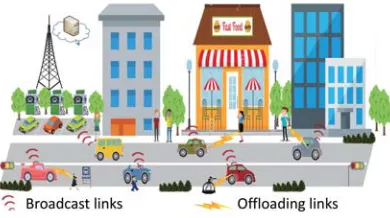
Fig. 1. The VFC resource allocation framework.
demand offloading. With a proper incentive mechanism designed by the BS, each vehicle can actively adjust the amount of sharing resources according to the reward in order to maximize its individual payoff.
For the sake of simplicity, we adopt a time-slot model [11]. The set of vehicles and the set of UEs within the coverage of the BS remain fixed within each slot, and vary across different slots. During slot t, we assume that there exist M vehicles and N UEs. The set of vehicles and the set of UEs are de-noted as VM = {V1,· · ·, Vm,· · · , VM} and UN =
{U1,· · ·, Um,· · · , UM}, respectively. Denote a triplet
{Dn, Cn, τn} as the attributes of each UE, where Dn represents the task data size,Cn is the required compu-tation resource for processing the task, andτnrepresents the delay constraint.
III. A CONTRACT-BASEDINCENTIVEMECHANISM FORRESOURCESHARING
In this section, we propose a contract-based resource allocation strategy for UEs to employ the shared re-sources to offload their tasks.
A. Vehicle Type Modeling
The preference of a vehicle towards resource sharing is quantified as its vehicle type. Due to the different configuration of each vehicle, the type of vehicles are generally different. A vehicle with a higher type is more willing to share its resources and serve as a fog node compared to a vehicle with a lower type. Thus, it is intuitive for the BS to employ higher-type vehicles. Since the number of vehicles in a cell is usually limited, the set of vehicle types is assumed as a discrete and finite space. Vehicle type is defined as
Definition 1: (Vehicle Type): Considering the set of vehicles VM, these M vehicles can be sorted in an ascending order based on their preferences and classi-fied into M types. Denote the set of vehicle types as
Θ ={θ1,· · · , θm,· · · , θM}, which is given by
θ1<· · ·< θm<· · ·< θM, m= 1,· · · , M. (1)
Definition 1 is also applicable when there are multiple vehicles belong to the same type. The computational complexity decreases with the vehicle types, but at the expense of the effectiveness of resource allocation.
In the scenario of information asymmetry, we assume that the BS only knows that there are a total ofM types of vehicles and each vehicleVm∈ VM belongs to type θm with a probabilityλm, i.e.,Mm=1λm= 1.
B. Contract Formulation
In this paper, the BS can design up to M con-tract items for vehicles with M types. The contract items describe the employment relationships between the employer, i.e., the BS, who designs a series of incentive contract items, and the employees, i.e., the vehicles, who receive rewards by providing idle re-sources. For instance, the contract item dedicated for type θm vehicle is denoted as (δm, πm), where δm denotes the required computation resources, and πm is the corresponding reward. The whole contract is denoted as C = {(δm, πm),∀m ∈ M}, where M =
{1,· · ·, m,· · · , M}.
Assuming the total amount of computation tasks that can be processed by the BS during a time interval T is CBS, we have CBS = δBST. Here, δBS is the unit computation capability of the BS per second. With the assistance from vehicles, the computation capability of the BS can be enlarged and the corresponding task processing delay can be reduced. We model the benefit of the BS as a linear function of the reduced delay. By signing the contract item(δm, πm)with typeθmvehicle, the benefit of the BS is given by
RBS(δm) =rBS(CBSδ BS −
CBS δm+δBS)
=rBSTδBSδm+δm.
(2)
where rBS is the unit benefit brought by the reduced delay.
With theM types of vehicles, the expected utility of the BS is calculated as
UBS({δm},{πm}) =
M
m=1
λm(RBS(δm)−πm). (3)
The utility function of typeθmvehicle which accepts the contract item (δm, πm)is given by
UV
m(δm, πm) =θmπm−δm. (4)
adjustment of each contract item. The corresponding optimization problem is formulated as
P1: max
({δm},{πm})UBS({δm},{πm})
s.t. C1:θmπm−δm≥0,∀m∈ M,
C2:θmπm−δm≥θmπm−δm,∀m, m∈ M, C3: 0≤δ1<· · ·< δm<· · ·< δM,∀m∈ M,
C4:δm≤θm,∀m∈ M. (5)
whereC1,C2, andC3 represent the IR, IC, and mono-tonicity constraints, respectively.C4represents the upper bound ofδm.
Definition 2:The IR, IC, and monotonicity constraints are defined as follows:
• Individual rationality (IR) constraint: Type θm vehicle,∀m∈ M, will get a nonnegative payoff if it selects the contract item(δm, πm).
• Incentive compatibility (IC) constraint: The IC constraint ensures that type θm vehicle,∀m∈ M, will get the maximum payoff if and only if it selects the contract item (δm, πm) designed for its own type.
• Monotonicity constraint: The reward of type θm vehicle, ∀m ∈ M, should be higher than that of type θm−1 vehicle, and lower than that of type θm+1 vehicle.
Based on the IR, IC, and monotonicity constraints, we conclude that for any m, m ∈ M, if θm > θm, then δm> δm andπm> πm.πm=πm andδm=δm if and only ifθm=θm.
C. Optimal Contract Design under Information Asym-metry
The corresponding optimization problemP1involves M IR constraints and M(M −1) IC constraints. To provide a tractable solution, the following procedures are carried out to simplify the problem.
Step 1:IR Constraints Elimination
For type θmvehicle,m∈ M, m= 1, we can derive UV
m≥UmV−1≥U1V ≥0. (6)
The IR constraints ofθmvehicle holds automatically as long as the IR constraint of typeθ1vehicle is guaranteed.
Step 2:IC Constraints Elimination
We define the IC constraints between type θm and typeθm,m∈ {1,· · ·, m−1}, as downward incentive constraints (DICs). Similarly, the IC constraints between type θm and type θm, m ∈ {m+ 1,· · ·, M}, are defined as upward incentive constraints (UICs). In the following, we show that both the DICs and UICs can be reduced.
We consider three adjacent vehicle types, i.e.,θm−1< θm< θm+1, which satisfy
θm+1πm+1−δm+1≥θm+1πm−δm, (7) θmπm−δm≥θmπm−1−δm−1. (8)
where (7) denotes the DIC between typeθm+1 and type θm, and (8) denotes the DIC between typeθmandθm−1.
By combiningπm+1≥πm≥πm−1, we have θm+1πm+1−δm+1≥θm+1πm−1−δm−1. (9)
Therefore, if the DIC between typeθm+1 andθmholds, then the DIC between θm+1 andθm−1 also holds. The DIC constraints can be extended downward from type θm−1 to typeθ1, which are given by
θm+1πm+1−δm+1≥θm+1πm−1−δm−1,
≥ · · ·
≥θm+1π1−δ1.
(10)
Thus, we demonstrate that if the DICs between ad-jacent types hold, then all the DICs hold automatically. Similarly, we can demonstrate that if the UICs between adjacent types hold, then all the UICs hold automatically. Based on the above analysis, the M IR constraints andM(M−1) IC constraints can be reduced to 1and M−1, respectively. Furthermore, in order to maximize the utility of the base station, the optimal contract item for type θ1 vehicle, i.e.,(δ1∗, π∗1), must enforce
UV
1 (δ∗1, π1∗) =θ1π∗1−δ1∗= 0. (11)
The optimal contract item for any type θm vehicle
(δ∗
m, π∗m),m= 2,· · ·, M, satisfies the following equal-ity condition:
δ∗
m=δ∗m−1+θm(πm∗ −πm∗−1), m= 2,· · ·, M. (12)
Based on the above description,P1 is rewritten as P2: max
({δm},{πm})UBS({δm},{πm})
s.t. C1:θ1π1−δ1= 0,
C2:δm=δm−1+θm(πm−πm−1),2≤m≤M,
C3, C4,∀m∈ M. (13)
We can easily prove that P2 is a convex program-ming problem by checking the Hessian matrix, which can be solved by applying Karush-Kuhn-Tucker (KKT) conditions. The Lagrangian associated withP2 is given by
L({δm},{πm},{μm},{ρm},{βm}) =UBS({δm},{πm}) +μ1(θ1π1−δ1)
+M
m=2
μm
θm(πm−πm−1) +δm−1−δm
+ρ1δ1+
M
m=2
ρm(δm−δm−1) +
M
m=1
βm(δm−θm).
(14)
TABLE I PARAMETERS.
Parameter Value
Number of vehicles 5−20
Number of UEs 15−25
Radius of BS coverage 1000m VFC communication radius 200m Data size of UE’s task 100−200Mb Computing resources of BS 5GHz Transmission power of UEs 30dBm
Noise power −114dBm
Bandwidth of UEs 20MHz
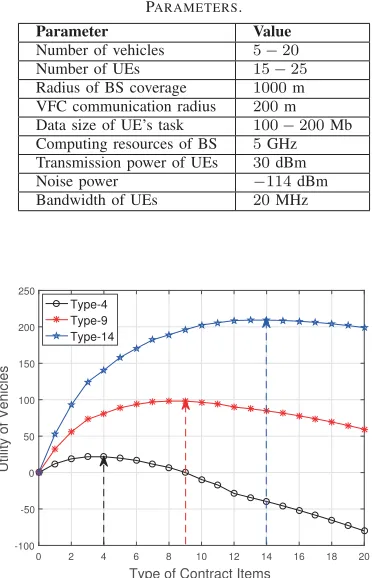
0 2 4 6 8 10 12 14 16 18 20 Type of Contract Items
-100 -50 0 50 100 150 200 250
Utility of Vehicles
[image:4.612.89.275.69.358.2]Type-4 Type-9 Type-14
Fig. 2. The utility of vehicle versus the different type of vehicles.
constraintsC2,C3, andC4, respectively. KKT conditions are summarized as follows:
• Primal constraints: 0 ≤ δ∗1; δm∗−1 ≤ δm∗,∀m ∈
M, m = 1; δ1∗ =θ1π∗1; δm∗ = δ∗m−1+θm(πm∗ − π∗
m−1),∀m∈ M, m= 1; δm∗ ≤θm,∀m∈ M;
• Dual constraints: μ∗m ≥ 0, ρ∗m ≥ 0 and βm∗ ≥
0,∀m∈ M;
• Complementary slackness: ρ∗1δ1∗ = 0; ρ∗m(δ∗m− δ∗
m−1) = 0,∀m ∈ M, m = 1; βm∗(δ∗m−θm) =
0,∀m∈ M;
• The first-order conditions of this Lagrangian func-tion is
⎧ ⎪ ⎪ ⎪ ⎪ ⎪ ⎪ ⎪ ⎪ ⎪ ⎪ ⎪ ⎪ ⎪ ⎪ ⎪ ⎨ ⎪ ⎪ ⎪ ⎪ ⎪ ⎪ ⎪ ⎪ ⎪ ⎪ ⎪ ⎪ ⎪ ⎪ ⎪ ⎩
∂L
∂δm =
∂RBS(δm)
∂δm −μm+μm+1+ρm−ρm+1
+βm= 0,∀m∈ M, m=M, ∂L
∂δM =
∂RBS(δM)
∂δM −μM +ρM+βM = 0, ∂L
∂πm =−λm+μmθm−μm+1θm+1= 0,
∀m∈ M, m=M, ∂L
∂πM =−λM+μMθM = 0.
(15)
0 2 4 6 8 10 12 14 16 18 20 Type of Contract Items
0 0.2 0.4 0.6 0.8 1 1.2 1.4 1.6 1.8
Utility of the Base Station
Information Asymmetry No Information Asymmetry Take-it-or-leave Contract
Fig. 3. The utility of BS versus the number of vehicles.
IV. SIMULATION
In the paper, we have proposed a contract-based resource allocation strategy in VFC networks for low-latency. To verify whether the proposed algorithm can effectively deal with the resources allocation under infor-mation asymmetric and reduce delay, a series of numer-ical results are conducted in this section. Assuming that the possibility of type θm obeys Gaussian distribution, and the simulation parameters are presented in Table I.
[image:4.612.90.303.506.713.2]Fig. 2 shows the utilities of 4, 9 and type-14 vehicles when selecting all the types of contract items provided by the BS, which illustrates that the de-signed contract is incentive compatible. Each vehicle can achieve the maximum utility if and only if it selects the contract specifically designed for its type. Additionally, it is observed that the vehicles with higher types are able to obtain higher utilities compared to the lower types, that is the BS offers rewards to the vehicles according to their contributions.
Fig. 3 shows the utility of BS versus the vehicle type. It can be observed that the asymmetric information actually protects the vehicles from being overexploited by the base station. With complete information, the base station is able to design a contract such that its utility is much larger compared to the utility achieved under the information asymmetry scenario. The performance gap increases monotonically with the vehicle type.Therefore, information asymmetry is actually beneficial to the vehi-cles because the base station cannot overexploit a vehicle without knowing the complete information of its type.
V. CONCLUSION
of the payoff on them. The simulation results shows that the proposed mechanism can greatly facilitate the partici-pation of vehicles in resource allocation and reduce delay after offloading tasks to appropriate vehicles. In future works, we will study how to combine resource allocation and task assignment in more complicated scenarios.
ACKNOWLEDGMENT
This work was partially supported by the National Natural Science Foundation of China (NSFC) under Grant Numbers 61601181, the Fundamental Research Funds for the Central Universities under Grant Num-bers 2017MS001; supported by Beijing Natural Science Foundation (4174104); Beijing Outstanding Young Tal-ent under Grant Number 2016000020124G081.
REFERENCES
[1] Z. Zhou, C. Gao, C. Xu, Y. Zhang, S. Mumtaz, and J. Rodriguez, “Social big-data-based content dissemination in internet of vehi-cles,”IEEE Trans. Ind. Informat., vol. 14, no. 2, pp. 768–777, Feb. 2018.
[2] Z. Zhou, H. Yu, C. Xu, Y. Zhang, S. Mumtaz, and J. Rodriguez, “Dependable content distribution in D2D-based cooperative ve-hicular networks: A big data-integrated coalition game approach,”
IEEE Transactions on Intelligent Transportation Systems, vol. 19, no. 3, pp. 953–964, Jan. 2018.
[3] Y. Lai, F. Yang, L. Zhang, and Z. Lin, “Distributed public vehicle system based on fog nodes and vehicular sensing,”IEEE Access, vol. 6, pp. 22 011–22 024, Apr. 2018.
[4] Z. Zhou, K. Ota, M. Dong, and C. Xu, “Energy-efficient matching for resource allocation in D2D enabled cellular networks,”IEEE Trans. Veh. Technol., vol. 66, no. 6, pp. 5256–5268, Jun. 2017. [5] X. Hou, Y. Li, M. Chen, D. Wu, D. Jin, and S. Chen, “Vehicular
fog computing: A viewpoint of vehicles as the infrastructures,”
IEEE Trans. Veh. Technol., vol. 65, no. 6, pp. 3860–3873, Jun. 2016.
[6] K. Xue, J. Hong, Y. Ma, D. S. L. Wei, P. Hong, and N. Yu, “Fog-aided verifiable privacy preserving access control for latency-sensitive data sharing in vehicular cloud computing,”IEEE Netw., vol. 32, no. 3, pp. 7–13, Jun. 2018.
[7] Z. Zhou, M. Dong, K. Ota, G. Wang, and L. T. Yang, “Energy-efficient resource allocation for D2D communications underlay-ing cloud-RAN-based LTE-A networks,”IEEE Internet Things J., vol. 3, no. 3, pp. 428–438, Jun. 2016.
[8] N. C. Luong, P. Wang, D. Niyato, Y. Wen, and Z. Han, “Resource management in cloud networking using economic analysis and pricing models: A survey,”IEEE Commun. Surv. Tut., vol. 19, no. 2, pp. 954–1001, Secondquarter 2017.
[9] Y. Liu, C. Xu, Y. Zhan, Z. Liu, J. Guan, and H. Zhang, “Incentive mechanism for computation offloading using edge computing: A stackelberg game approach,,”Comput. Netw., vol. 129, no. 2, pp. 745–748, Mar. 2017.
[10] Y. Zhang, L. Song, W. Saad, Z. Dawy, and Z. Han, “Contract-based incentive mechanisms for device-to-device communica-tions in cellular networks,”IEEE J. Sel. Areas Commun., vol. 33, no. 10, pp. 2144–2155, May 2015.