Finding non-local dependencies: beyond pattern matching
Valentin Jijkoun
Language and Inference Technology Group, ILLC, University of Amsterdam
Abstract
We describe an algorithm for recover-ing non-local dependencies in syntac-tic dependency structures. The pattern-matching approach proposed by John-son (2002) for a similar task for phrase structure trees is extended with machine learning techniques. The algorithm is es-sentially a classifier that predicts a non-local dependency given a connected frag-ment of a dependency structure and a set of structural features for this frag-ment. Evaluating the algorithm on the Penn Treebank shows an improvement of both precision and recall, compared to the results presented in (Johnson, 2002).
1 Introduction
Non-local dependencies (also called long-distance, long-range or unbounded) appear in many fre-quent linguistic phenomena, such as passive, WH-movement, control and raising etc. Although much current research in natural language parsing focuses on extracting local syntactic relations from text, non-local dependencies have recently started to attract more attention. In (Clark et al., 2002) long-range dependencies are included in parser’s probabilistic model, while Johnson (2002) presents a method for recovering non-local dependencies after parsing has been performed.
More specifically, Johnson (2002) describes a pattern-matching algorithm for inserting empty nodes and identifying their antecedents in phrase structure trees or, to put it differently, for recover-ing non-local dependencies. From a trainrecover-ing corpus
with annotated empty nodes Johnson’s algorithm first extracts those local fragments of phrase trees which connect empty nodes with their antecedents, thus “licensing” corresponding non-local dependen-cies. Next, the extracted tree fragments are used as patterns to match against previously unseen phrase structure trees: when a pattern is matched, the algo-rithm introduces a corresponding non-local depen-dency, inserting an empty node and (possibly) co-indexing it with a suitable antecedent.
In (Johnson, 2002) the author notes that the biggest weakness of the algorithm seems to be that it fails to robustly distinguish co-indexed and free empty nodes and it is lexicalization that may be needed to solve this problem. Moreover, the author suggests that the algorithm may suffer from over-learning, and using more abstract “skeletal” patterns may be helpful to avoid this.
In an attempt to overcome these problems we de-veloped a similar approach using dependency struc-tures rather than phrase structure trees, which, more-over, extends bare pattern matching with machine learning techniques. A different definition of
pat-tern allows us to significantly reduce the number
classifi-NP
NP
the asbestos
VP
found NP
* PP
in NP
schools
(a) The Penn Treebank format
asbestos
the
MOD
found
S-OBJ
in
PP
schools
NP-OBJ
NP-OBJ
(b) Derived dependency structure
Figure 1: Past participle (reduced relative clause).
cation methods on top of pattern matching.
The evaluation of our algorithm on data automat-ically derived from the Penn Treebank shows an in-crease in both precision and recall in recovery of non-local dependencies by approximately 10% over the results reported in (Johnson, 2002). However, additional work remains to be done for our algorithm to perform well on the output of a parser.
2 From the Penn Treebank to a dependency treebank
This section describes the corpus of dependency structures that we used to evaluate our algorithm. The corpus was automatically derived from the Penn Treebank II corpus (Marcus et al., 1993), by means of the script chunklink.pl (Buchholz, 2002) that we modified to fit our purposes. The script uses a sort of head percolation table to identify heads of constituents, and then converts the result to a de-pendency format. We refer to (Buchholz, 2002) for a thorough description of the conversion algorithm, and will only emphasize the two most important modifications that we made.
One modification of the conversion algorithm concerns participles and reduced relative clauses modifying NPs. Regular participles in the Penn Treebank II are simply annotated as VPs adjoined to the modified NPs (see Figure 1(a)). These par-ticiples (also called reduced relative clauses, as they lack auxiliary verbs and complementizers) are both syntactically and semantically similar to full rela-tive clauses, but the Penn annotation does not
in-troduce empty complementizers, thus preventing co-indexing of a trace with any antecedent. We perform a simple heuristic modification while converting the Treebank to the dependency format: when we en-counter an NP modified by a VP headed by a past participle, an object dependency is introduced be-tween the head of the VP and the head of the NP. Figure 1(b) shows an example, with solid arrows de-noting local and dotted arrows dede-noting non-local dependencies. Arrows are marked with dependency labels and go from dependents to heads.
This simple heuristics does not allow us to handle all reduced relative clauses, because some of them correspond to PPs or NPs rather than VPs, but the latter are quite rare in the Treebank.
The second important change to Buchholz’ script concerns the structure of VPs. For every verb ter, we choose the main verb as the head of the clus-ter, and leave modal and auxiliary verbs as depen-dents of the main verb. A similar modification was used by Eisner (1996) for the study of dependency parsing models. As will be described below, this al-lows us to “factor out” tense and modality of finite clauses from our patterns, making the patterns more general.
3 Pattern extraction and matching
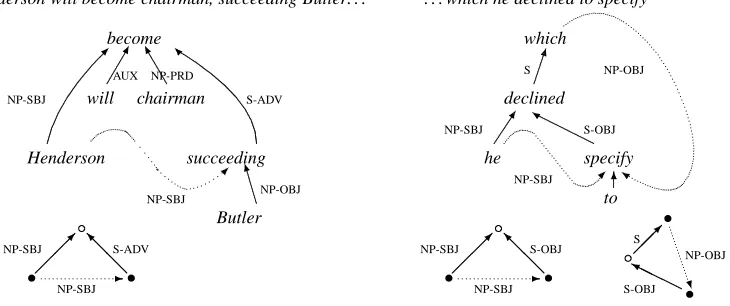
[image:2.612.345.451.45.193.2]Henderson will become chairman, succeeding Butler. . . become will AUX chairman NP-PRD Henderson NP-SBJ succeeding S-ADV NP-SBJ Butler NP-OBJ ... ... ... ... ...... ...... ... ... ... ... ... ... ... ... ... ... ... ... ... ... ...... ...... ...... ...... ...... ... ...... ...... NP-SBJ S-ADV NP-SBJ
. . . which he declined to specify
which declined he specify to ... ... ... ... ... ... .... .... .... .... .... .... .... .... .... .... .... .... .... .... .... .... .... .... .... .... .... .... .... .... ... ... ... S NP-SBJ S-OBJ NP-SBJ NP-OBJ NP-SBJ S-OBJ NP-SBJ S S-OBJ NP-OBJ
Figure 2: Dependency graphs and extracted patterns.
case these fragments are not connected sets of local trees, but shortest paths in local dependency graphs, leading from heads to non-local dependents. Pat-terns do not include POS tags of the involved words, but only labels of the dependencies. Thus, a
pat-tern is a directed graph with labeled edges, and two
distinguished nodes: the head and the dependent of a corresponding non-local dependency. When sev-eral patterns intersect, as may be the case, for exam-ple, when a word participates in more than one non-local dependency, these patterns are handled inde-pendently. Figure 2 shows examples of dependency graphs (above) and extracted patterns (below, with filled bullets corresponding to the nodes of a non-local dependency). As before, dotted lines denote non-local dependencies.
The definition of a structure matching a pattern, and the algorithms for pattern matching and pat-tern extraction from a corpus are straightforward and similar to those described in (Johnson, 2002).
The total number of non-local dependencies found in the Penn WSJ is 57325. The number of different extracted patterns is 987. The 80 most fre-quent patterns (those that we used for the evaluation of our algorithm) cover 53700 out of all 57325 non-local dependencies (93,7%). These patterns were further cleaned up manually, e.g., most Penn func-tional tags (-TMP, -CLR etc., but not -OBJ, -SBJ, -PRD) were removed. Thus, we ended up with 16 structural patterns (covering the same 93,7% of the Penn Treebank).
Table 1 shows some of the patterns found in the Penn Treebank. The column Count gives the number
of times a pattern introduces non-local dependen-cies in the corpus. The Match column is the num-ber of times a pattern actually occurs in the corpus (whether it introduces a non-local dependency or not). The patterns are shown as dependency graphs with labeled arrows from dependents to heads. The column Dependency shows labels and directions of introduced non-local dependencies.
Clearly, an occurrence of a pattern alone is not enough for inserting a non-local dependency and de-termining its label, as for many patterns Match is significantly greater than Count. For this reason we introduce a set of other structural features, associ-ated with patterns. For every occurrence of a pattern and for every word of this occurrence, we extract the following features:
pos, the POS tag of the word;
class, the simplified word class (similar to
(Eis-ner, 1996));
fin, whether the word is a verb and a head of
a finite verb cluster (as opposed to infinitives, gerunds or participles);
subj, whether the word has a dependent
(prob-ably not included in the pattern) with a depen-dency label NP-SBJ; and
obj, the same for NP-OBJ label.
Id Count Match Pattern Dependency Dep. count P R f
1
NP-SBJ
7481 1.00 1.00 1.00
2
ADVP
1945 0.82 0.90 0.86
3
10527 12716
S
NP-OBJ
727 0.60 0.71 0.65
4
NP-SBJ
8562 0.84 0.95 0.89
5 8789 17911
S-*
NP-SBJ
NP-OBJ
227 0.83 0.71 0.77
6 8120 8446
VP-OBJ
NP-SBJ
NP-OBJ
8120 0.99 1.00 1.00
7
NP-OBJ
1013 0.73 0.84 0.79
8
NP-SBJ
836 0.60 0.96 0.74
9
2518 34808
SBAR
ADVP
669 0.56 0.16 0.25
10 1424 1442
S-OBJ VP-OBJ NP-SBJ
NP-SBJ
1424 0.99 1.00 0.99
11
NP-SBJ
1047 0.86 0.83 0.85
12 1265 28170
S*
S*
NP-OBJ
218 0.77 0.71 0.74
13 880 1699
S-NOM PP
NP-SBJ
NP-SBJ
[image:4.612.77.534.83.379.2]
880 0.85 0.87 0.86
Table 1: Several non-local dependency patterns, frequencies of patterns and pattern-dependency pairs in Penn Treebank, and evaluation results. The best scores are in boldface.
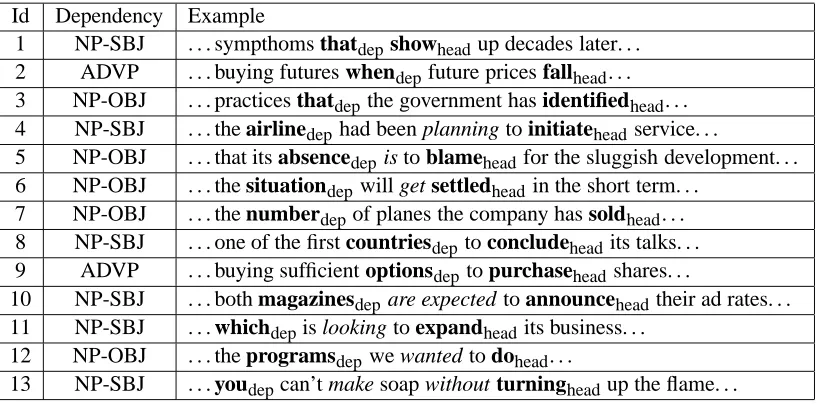
Id Dependency Example
1 NP-SBJ . . . sympthoms thatdepshowhead up decades later. . . 2 ADVP . . . buying futures whendepfuture prices fallhead. . . 3 NP-OBJ . . . practices thatdep the government has identifiedhead. . .
4 NP-SBJ . . . the airlinedep had been planning to initiateheadservice. . .
5 NP-OBJ . . . that its absencedepis to blameheadfor the sluggish development. . . 6 NP-OBJ . . . the situationdepwill get settledhead in the short term. . .
7 NP-OBJ . . . the numberdepof planes the company has soldhead. . .
8 NP-SBJ . . . one of the first countriesdep to concludeheadits talks. . . 9 ADVP . . . buying sufficient optionsdepto purchasehead shares. . .
10 NP-SBJ . . . both magazinesdepare expected to announceheadtheir ad rates. . .
11 NP-SBJ . . . whichdepis looking to expandheadits business. . .
12 NP-OBJ . . . the programsdepwe wanted to dohead. . .
13 NP-SBJ . . . youdepcan’t make soap without turningheadup the flame. . .
[image:4.612.103.517.453.655.2]4 Classification of pattern instances
Given a pattern instance and its feature vector, our task now is to determine whether the pattern intro-duces a non-local dependency and, if so, what the label of this dependency is. In many cases this is not a binary decision, since one pattern may introduce several possible labeled dependencies (e.g., the pat-tern S
in Table 1). Our task is a classification
task: an instance of a pattern must be assigned to two or more classes, corresponding to several possi-ble dependency labels (or absence of a dependency). We train a classifier on instances extracted from a corpus, and then apply it to previously unseen in-stances.
The procedure for finding non-local dependencies now consists of the two steps:
1. given a local dependency structure, find match-ing patterns and their feature vectors;
2. for each pattern instance found, use the clas-sifier to identify a possible non-local depen-dency.
5 Experiments and evaluation
In our experiments we used sections 02-22 of the Penn Treebank as the training corpus and section 23 as the test corpus. First, we extracted all non-local patterns from the Penn Treebank, which resulted in 987 different (pattern, non-local dependency) pairs. As described in Section 3, after cleaning up we took 16 of the most common patterns.
For each of these 16 patterns, instances of the pat-tern, pattern features, and a non-local dependency label (or the special label “no” if no dependency was introduced by the instance) were extracted from the training and test corpora.
We performed experiments with two statistical classifiers: the decision tree induction system C4.5 (Quinlan, 1993) and the Tilburg Memory-Based Learner (TiMBL) (Daelemans et al., 2002). In most cases TiBML performed slightly better. The re-sults described in this section were obtained using TiMBL.
For each of the 16 structural patterns, a separate classifier was trained on the set of (feature-vector, label) pairs extracted from the training corpus, and then evaluated on the pairs from the test corpus. Ta-ble 1 shows the results for some of the most
fre-quent patterns, using conventional metrics: preci-sion (the fraction of the correctly labeled dependen-cies among all the dependendependen-cies found), recall (the fraction of the correctly found dependencies among all the dependencies with a given label) and f-score (harmonic mean of precision and recall). The table also shows the number of times a pattern (together with a specific non-local dependency label) actually occurs in the whole Penn Treebank corpus (the col-umn Dependency count).
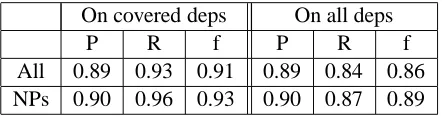
In order to compare our results to the results pre-sented in (Johnson, 2002), we measured the over-all performance of the algorithm across patterns and non-local dependency labels. This corresponds to the row “Overall” of Table 4 in (Johnson, 2002), re-peated here in Table 4. We also evaluated the pro-cedure on NP traces across all patterns, i.e., on non-local dependencies with SBJ, OBJ or NP-PRD labels. This corresponds to rows 2, 3 and 4 of Table 4 in (Johnson, 2002). Our results are pre-sented in Table 3. The first three columns show the results for those non-local dependencies that are ac-tually covered by our 16 patterns (i.e., for 93.7% of all non-local dependencies). The last three columns present the evaluation with respect to all non-local dependencies, thus the precision is the same, but re-call drops accordingly. These last columns give the results that can be compared to Johnson’s results for section 23 (Table 4).
On covered deps On all deps
P R f P R f
All 0.89 0.93 0.91 0.89 0.84 0.86 NPs 0.90 0.96 0.93 0.90 0.87 0.89
Table 3: Overall performance of our algorithm.
On section 23 On parser output
P R f P R f
[image:5.612.317.538.477.536.2]Overall 0.80 0.70 0.75 0.73 0.63 0.68
Table 4: Results from (Johnson, 2002).
empty nodes (without antecedents), we look for non-local dependencies, which corresponds to identifica-tion of co-indexed empty nodes (note, however, the modifications we describe in Section 2, when we ac-tually transform free empty nodes into co-indexed empty nodes).
6 Discussion
The results presented in the previous section show that it is possible to improve over the simple pattern matching algorithm of (Johnson, 2002), using de-pendency rather than phrase structure information, more skeletal patterns, as was suggested by John-son, and a set of features associated with instances of patterns.
One of the reasons for this improvement is that our approach allows us to discriminate between dif-ferent syntactic phenomena involving non-local de-pendencies. In most cases our patterns correspond to linguistic phenomena. That helps to understand why a particular construction is easy or difficult for our approach, and in many cases to make the nec-essary modifications to the algorithm (e.g., adding other features to instances of patterns). For example, for patterns 11 and 12 (see Tables 1 and 2) our classi-fier distinguishes subject and object reasonably well, apparently, because the feature has a local object is explicitly present for all instances (for the examples 11 and 12 in Table 2, expand has a local object, but
do doesn’t).
Another reason is that the patterns are general enough to factor out minor syntactic differences in linguistic phenomena (e.g., see example 4 in Ta-ble 2). Indeed, the most frequent 16 patterns cover 93.7% of all non-local dependencies in the corpus. This is mainly due to our choices in the dependency representation, such as making the main verb a head of a verb phrase. During the conversion to a de-pendency treebank and extraction of patterns some important information may have been lost (e.g., the finiteness of a verb cluster, or presence of subject and object); for that reason we had to associate pat-terns with additional features, encoding this infor-mation and providing it to the classifier. In other words, we first take an “oversimplified” representa-tion of the data, and then try to find what other data features can be useful. This strategy appears to be
successful, because it allows us to identify which in-formation is important for the recovery of non-local dependencies.
More generally, the reasonable overall perfor-mance of the algorithm is due to the fact that for the most common non-local dependencies (extrac-tion in relative clauses and reduced relative clauses, passivization, control and raising) the structural in-formation we extract is enough to robustly identify non-local dependencies in a local dependency graph: the most frequent patterns in Table 1 are also those with best scores. However, many less frequent phe-nomena appear to be much harder. For example, per-formance for relative clauses with extracted objects or adverbs is much worse than for subject relative clauses (e.g., patterns 2 and 3 vs. 1 in Table 1). Ap-parently, in most cases this is not due to the lack of training data, but because structural information alone is not enough and lexical preferences, subcat-egorization information, or even semantic properties should be considered. We think that the aproach al-lows us to identify those “hard” cases.
The natural next step in evaluating our algorithm is to work with the output of a parser instead of the original local structures from the Penn Tree-bank. Obviously, because of parsing errors the per-formance drops significantly: e.g., in the experi-ments reported in (Johnson, 2002) the overall f-score decreases from 0.75 to 0.68 when evaluating on parser output (see Table 4). While experimenting with Collins’ parser (Collins, 1999), we found that for our algorithm the accuracy drops even more dra-matically, when we train the classifier on Penn Tree-bank data and test it on parser output. One of the reasons is that, since we run our algorithm not on the parser’s output itself but on the output automat-ically converted to dependency structures, conver-sion errors also contribute to the performance drop. Moreover, the conversion script is highly tailored to the Penn Treebank annotation (with functional tags and empty nodes) and, when run on the parser’s out-put, produces structures with somewhat different de-pendency labels. Since our algorithm is sensitive to the exact labels of the dependencies, it suffers from these systematic errors.
the parser output for it. This would allow us to train and test our algorithm on data of the same nature.
7 Conclusions and future work
We have presented an algorithm for recovering long-distance dependencies in local dependency struc-tures. We extend the pattern matching approach of Johnson (2002) with machine learning tech-niques, and use dependency structures instead of constituency trees. Evaluation on the Penn Treebank shows an increase in accuracy.
However, we do not have yet satisfactory results when working on a parser output. The conversion algorithm and the dependency labels we use are largely based on the Penn Treebank annotation, and it seems difficult to use them with the output of a parser.
A parsing accuracy evaluation scheme based on grammatical relations (GR), presented in (Briscoe et al., 2002), provides a set of dependency labels (grammatical relations) and a manually annotated dependency corpus. Non-local dependencies are also annotated there, although no explicit difference is made between local and non-local dependencies. Since our classification algorithm does not depend on a particular set of dependency labels, we can also use the set of labels described by Briscoe et al, if we convert Penn Treebank to a GR-based dependency treebank and use it as the training corpus. This will allow us to make the patterns independent of the Penn Treebank annotation details and simplify test-ing the algorithm with a parser’u output. We will also be able to use the flexible and parameterizable scoring schemes discussed in (Briscoe et al., 2002).
We also plan to develop the approach by using iteration of our non-local relations extraction algo-rithm, i.e., by running the algoalgo-rithm, inserting the found non-local dependencies, running it again etc., until no new dependencies are found. While rais-ing an important and interestrais-ing issue of the order in which we examine our patterns, we believe that this will allow us to handle very long extraction chains, like the one in sentence “Aichi revised its tax
calcu-lations after being challenged for allegedly failing to report. . . ”, where Aichi is a (non-local)
depen-dent of five verbs. Iteration of the algorithm will also help to increase the coverage (which is 93,7%
with our 16 non-iterated patterns).
Acknowledgements
This research was supported by the Netherlands Organization for Scientific Research (NWO), un-der project number 220-80-001. We would like to thank Maarten de Rijke, Detlef Prescher and Khalil Sima’an for many fruitful discussions and useful suggestions and comments.
References
Mark Johnson. 2002. A simple pattern-matching al-gorithm for recovering empty nodes and their an-tecedents. In Proceedings of the 40th Meeting of the ACL.
Jason M. Eisner. 1996. Three new probabilistic models for dependency parsing: An exploration. In Proceed-ings of the 16th International Conference on Compu-tational Linguistics (COLING), pages 340–345.
Michael Collins. 1999. Head-Driven Statistical Models For Natural Language Parsing. Ph.D. thesis, Univer-sity of Pennsylvania.
Sabine Buchholz. 2002. Memory-based grammatical re-lation finding. Ph.D. thesis, Tilburg University.
Walter Daelemans, Jakub Zavrel, Ko van der Sloot, and Antal van den Bosch. 2002. TiMBL: Tilburg Memory Based Learner, version 4.3, Refer-ence Guide. ILK Technical Report 02-10, Available from http://ilk.kub.nl/downloads/pub/ papers/ilk0210.ps.gz
J. Ross Quinlan. 1993. C4.5: Programs for machine learning. Morgan Kaufmann Publishers.
Michael P. Marcus, Beatrice Santorini, and Mary Ann Marcinkiewicz. 1993. Building a large annotated cor-pus of English: The Penn Treebank. Computational Linguistics, 19(2):313–330.
Ted Briscoe, John Carroll, Jonathan Graham and Ann Copestake. 2002. Relational evaluation schemes. In Proceedings of the Beyond PARSEVAL Workshop at LREC 2002, pages 4–8.