Constructing a Turkish-English Parallel TreeBank
Olcay Taner Yıldız†, Ercan Solak†, Onur G¨org¨un†,†† and Razieh Ehsani† †Is¸ık University, Istanbul, Turkey
†† Alcatel Lucent Teletas¸ Telekom¨unikasyon A.S¸., Istanbul, Turkey {olcaytaner,ercan,razieh.ehsani}@isikun.edu.tr
Abstract
In this paper, we report our preliminary ef-forts in building an English-Turkish paral-lel treebank corpus for statistical machine translation. In the corpus, we manually generated parallel trees for about 5,000 sentences from Penn Treebank. English sentences in our set have a maximum of 15 tokens, including punctuation. We con-strained the translated trees to the reorder-ing of the children and the replacement of the leaf nodes with appropriate glosses. We also report the tools that we built and used in our tree translation task.
1 Introduction
Turkish is an agglutinative and morphologically rich language with a free constituent order. Al-though statistical NLP research on Turkish has taken significant steps in recent years, much re-mains to be done. Especially for the annotated cor-pora, Turkish is still behind similar languages such as Czech, Finnish, or Hungarian. For example, EuroParl corpus (Koehn, 2002), one of the biggest parallel corpora in statistical machine translation, contains 22 languages (but not Turkish). Although there exist some recent works to produce paral-lel corpora for Turkish-English pair, the produced corpus is only applicable for phrase-based training (Yeniterzi and Oflazer, 2010; El-Kahlout, 2009).
In recent years, many efforts have been made to annotate parallel corpora with syntactic structure to build parallel treebanks. A parallel treebank is a parallel corpus where the sentences in each language are syntactically (if necessary morpho-logically) annotated, and the sentences and words are aligned. In the parallel treebanks, the syntactic annotation usually follows constituent and/or de-pendency structure. Well-known parallel treebank efforts are
• Prague Czech-English dependency treebank annotated with dependency structure (Cme-jrek et al., 2004)
• English-German parallel treebank, annotated with POS, constituent structures, functional relations, and predicate-argument structures (Cyrus et al., 2003)
• Link¨oping English-Swedish parallel treebank that contains 1,200 sentences annotated with POS and dependency structures (Ahrenberg, 2007)
• Stockholm multilingual treebank that con-tains 1,000 sentences in English, German and Swedish annotated with constituent structure (Gustafson-Capkova et al., 2007)
In this study, we report our preliminary efforts in constructing an English-Turkish parallel tree-bank corpus for statistical machine translation. Our approach converts English parse trees into equivalent Turkish parse trees by applying several transformation heuristics. The main components of our strategy are (i) tree permutation, where we permute the children of a node; and (ii) leaf re-placement, where we replace English word token at a leaf node.
This paper is organized as follows: In Section 2, we give the literature review for parallel treebank construction efforts in Turkish. In Section 3, we give a very brief overview on Turkish syntax. We give the details of our corpus construction strategy in Section 4 and explain our transformation heuris-tics in Section 5. Finally, we conclude in Section 6.
2 Literature Review
Turkish Treebank creation efforts started with the Sabancı dependency Treebank. METU-Sabancı Treebank explicitly represents the head-dependent relations and functional categories. In
order to adapt the corpus written in 1990’s Turk-ish to further studies, a subset of 7.262 sentences of the corpus was manually annotated morpho-logically and syntactically (Atalay et al., 2003). METU-Sabancı Treebank is then used in many Turkish NLP studies (Eryigit and Oflazer, 2006; Yuret, 2006; Riedel et al., 2006; Ruket and Baldridge, 2006; Eryigit et al., 2006; Eryigit et al., 2008).
METU-Sabancı Treebank is also subject to transformation efforts from dependency-structure to constituency-structure. Combinatory Categori-cal Grammar (CCG) is extracted from the METU-Sabancı Treebank with annotation of lexical cat-egories (Cakici, 2005). Sub-lexical units reveal-ing the internal structure of the words are used to generate a Lexical Grammar Formalism (LGF) for Turkish with the help of finite state ma-chines (Cetinoglu and Oflazer, 2006; Cetinoglu and Oflazer, 2009).
Swedish-Turkish parallel treebank is the first parallel Treebank effort for Turkish (Megyesi et al., 2008). The treebank is a balanced syntactically annotated corpus containing both fiction and tech-nical documents. In total, it consists of approxi-mately 160,000 tokens in Swedish and 145,000 in Turkish. Parallel texts are linguistically annotated using different layers from part of speech tags and morphological features to dependency annotation. English-Swedish-Turkish parallel treebank (Megyesi et al., 2010), mainly the successor of the Swedish-Turkish parallel treebank, consists of approximately 300,000 tokens in Swedish, 160,000 in Turkish and 150,000 in English. The majority of the original text is written in Swedish and translated to Turkish and/or English. For the syntactic description, dependency structure is chosen instead of the constituent structure. All data is automatically annotated with syntactic tags using MaltParser (Nivre et al., 2006a). MaltParser is trained on the Penn Treebank for English, on the Swedish treebank Talbanken05 (Nivre et al., 2006b), and on the METU-Sabancı Turkish Treebank (Atalay et al., 2003), respectively.
ParGram parallel treebank (Sulger et al., 2013) is a joint effort for the construction of a par-allel treebank involving ten languages (English, Georgian, German, Hungarian, Indonesian, Nor-wegian, Polish, Turkish, Urdu, Wolof) from six language families. The treebank is based on deep Lexical-Functional Grammars that were
devel-oped within the framework of the Parallel Gram-mar effort. ParGram treebank allows for the align-ment of sentences at several levels: dependency structures, constituency structures and POS infor-mation.
3 Turkish syntax
Turkish is an agglutinative language with rich derivational and inflectional morphology through suffixes. Word forms usually have a complex yet fairly regular morphotactics.
Turkish sentences have an unmarked SOV or-der. However, depending on the discourse, con-stituents can be scrambled to emphasize, topical-ize and focus certain elements. Case markings identify the syntactic functions of the constituents, (Kornfilt, 1997).
4 Corpus construction strategy
In order to constrain the syntactic complexity of the sentences in the corpus, we selected from the Penn Treebank II 9560 trees which contain a maxi-mum of 15 tokens. These include 8660 trees from the training set of the Penn Treebank, 360 trees from its development set and 540 trees from its test set. In the first phase of our work, we trans-lated 4247 trees of the training set and all of those in the development and the test sets.
4.1 Tools
Manual annotation is an error prone task. From simple typos to disagreements among annotators, the range of errors is fairly large. An annotation tool needs to help reduce these errors and help the annotator locate them when they occur. Moreover, the tool needs to present the annotator with a vi-sual tree that is both easy to understand and ma-nipulate for the translation task.
We built a range of custom tools to display, ma-nipulate and save annotated trees in the treebank. The underlying data structure is still textual and uses the standard Treebank II style of syntactic bracketing.
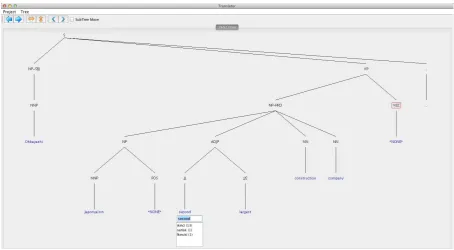
Figure 1: A screenshot of the tree translation tool
Figure 1 shows a screenshot of our tree transla-tion tool.
4.2 Tree permutation
In translating an English syntactic tree, we confine ourselves to two operations. We can permute the children of a node and we can replace the English word token at a leaf node. No other modification of the tree is allowed. In particular, we use the same set of tags and predicate labels in the non-leaf nodes and do not use new tags for the Turkish trees. Adding or deleting nodes are not allowed either.
This might seem like a rather restrictive view of translation. Indeed, it is very easy to construct pairs of translated sentences which involve opera-tions outside our restricted set when transformed into each other.
However, we use the following method to alle-viate the restrictions of the small set of operations. We use the *NONE* tag when we can not use any direct gloss for an English token. In itself, this operation corresponds to effectively mapping an English token to a null token. However, when we use the *NONE* tag, permute the nodes and choose the full inflected forms of the glosses in the Turkish tree, we have a powerful method to convert subtrees to an inflected word. The tree in Figure 2. illustrates this. Note that the POS tag se-quence VP-RB-MD-PRP in the Turkish sentence
corresponds to the morphological analysis “gec¸-NEG-FUT-2SG” of the verb “gec¸meyeceksin”. In general, we try to permute the nodes so as to cor-respond to the order of inflectional morphemes in the chosen gloss.
S VP
VP VB pass RB not MD will NP-SBJ PRP You
S
NP-SBJ PRP *NONE* VP
MD *NONE* RB *NONE*
VP VB gec¸meyeceksin
Figure 2: The permutation of the nodes and the replacement of the leaves by the glosses or *NONE*.
5 Transformation heuristics
5.1 Constituent and morpheme order
Majority of unmarked Turkish sentences have the SOV order. When translating English trees, we permute its shallow subtrees to reflect the change of constituent order in Turkish.
Also, the agglutinative suffixes of Turkish words dictate the order when permuting the con-stituents which correspond to prepositions and particles.
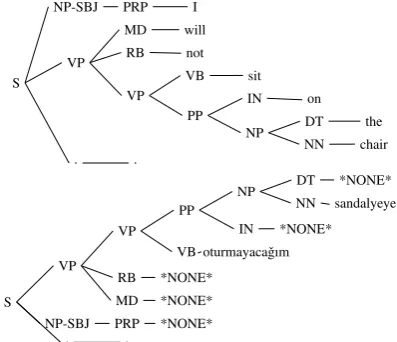
The semantic aspects expressed by preposi-tions, modals, particles and verb tenses in En-glish in general correspond to specific morphemes attached to the corresponding word stem. For example, “Ali/NNP will/MD sit/VB on/IN a/DT chair/NN” is literally translated as
Ali bir sandalye-ye otur-acak. Ali a chair-DAT sit-FUT.
If we embed a constituent in the morphemes of a Turkish stem, we replace the English constituent leaf with *NONE*.
In some cases, the personal pronouns acting as subjects are naturally embedded in the verb inflec-tion. In those cases, pronoun in the original tree is replaced with *NONE* and its subtree is moved to after the verb phrase. See Figure 3.
S
. .
VP
VP PP
NP
NN chair DT the IN on VB sit RB not MD will NP-SBJ PRP I
S
. .
NP-SBJ PRP *NONE* VP
MD *NONE* RB *NONE* VP
VB oturmayacaˇgım PP
IN *NONE* NP
[image:4.595.333.495.238.374.2]NN sandalyeye DT *NONE*
Figure 3: Original and translated trees, sandalye-ye otur-ma-yacaˇg-ım
chair-DAT sit-NEG-FUT-1SG
5.2 The determiner “the”
There is no definite article in Turkish correspond-ing to “the”. Dependcorrespond-ing on the context, “the” is translated either as *NONE* or one of the demon-strative adjectives in Turkish, corresponding to “this” and “that” in English. See Figure 3 .
5.3 Case markers
Turkish, being a fairly scrambling language, uses case markers to denote the syntactic functions of nouns and noun groups. For example, accusative case may be used to mark the direct object of a transitive verb and locative case may be used to mark the head of a prepositional phrase. In trans-lation from English to Turkish, the prepositions are usually replaced with *NONE* and their cor-responding case is attached to the nominal head of the phrase. See Figure 4.
S VP
PP
NP PRP me IN at NP
NN ball DT the VBD threw NP NNP Ali
S
VP
VBD attı PP
IN *NONE* NP PRP bana NP
[image:4.595.81.280.428.599.2]NN topu DT *NONE* NP NNP Ali
Figure 4: Original and translated trees, Ali top-u ban-a at-tı
Ali ball-ACC me-DAT throw-PAST-3SG
5.4 Plural in nouns and verb inflection
Number agreement between the verb in the pred-icate and the subject is somewhat loose in Turk-ish. We preserved this freedom in translation and chose the number inflection that sounds more nat-ural. Also, plural nouns under NNS tag in the En-glish tree are sometimes translated as singular. In those cases, we kept the original POS tag NNS in-tact but used the singular gloss. See Figure 5.
5.5 Tense ambiguity
S VP
VP NP
NNS apples CD three VBN eaten VBP have NP
NNS children DT The
S
VP
VBP *NONE* VP
VBN yedi NP
NNS elma CD ¨uc¸ NP
[image:5.595.100.262.63.200.2]NNS c¸ocuklar DT *NONE*
Figure 5: Original and translated trees, C¸ocuk-lar ¨uc¸ elma ye-di
Child-PL three apple eat-PAST-3SG
5.6 WH- Questions
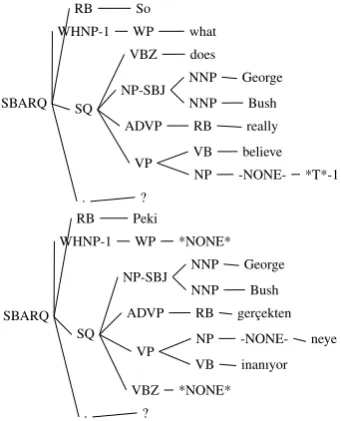
Question sentences require special attention dur-ing transformation. As opposed to movement in English question sentences, any constituent in Turkish can be questioned by replacing it with an inflected question word. In the Penn Treebank II annotation, the movement leaves a trace and is associated with wh- constituent with a numeric marker. For example, “WHNP-17” and “*T*-17” are associated.
When we translate the tree for a question sentence, we replace the wh- constituent with *NONE* and replace its trace with the appropri-ate question pronoun in Turkish. See Figure 6.
SBARQ
. ?
SQ
VP
NP -NONE- *T*-1 VB believe ADVP RB really NP-SBJ
NNP Bush NNP George VBZ does
WHNP-1 WP what RB So
SBARQ
. ?
SQ
VBZ *NONE* VP
VB inanıyor NP -NONE- neye ADVP RB gerc¸ekten NP-SBJ
NNP Bush NNP George WHNP-1 WP *NONE*
RB Peki
Figure 6: Original and translated trees, Peki George Bush gerc¸ekten ne-ye inan-ıyor? So George Bush really what-DAT
believe-PRES-3SG?
5.7 Miscellany
In the translation of nominal clauses, the copula marker “-dIr” corresponding to verb “be” is often dropped.
The proper nouns are translated with their com-mon Turkish gloss if there is one. So, “London” becomes “Londra”.
Subordinating conjunctions, marked as “IN” in English sentences, are transformed to *NONE* and the appropriate participle morpheme is ap-pended to the stem in the Turkish translation.
A multiword expression may correspond to a single English word. Conversely, more than one words in English may correspond to a single word in Turkish. In the first case, we use the multiword expression as the gloss. In the latter case, we re-place some English words with *NONE*.
6 Conclusion
Parallel treebank construction efforts increased significantly in the recent years. Many parallel treebanks are produced to build statistically strong language models for different languages. In this study, we report our preliminary efforts to build such a parallel corpus for Turkish-English pair. We translated and transformed a subset of parse trees of Penn Treebank to Turkish. We cover more than 50% of all sentences with a maximum length of 15-words including punctuation.
This work constitutes the preliminary step of parallel treebank generation. As a next step, we will focus on morphological analysis and disam-biguation of Turkish words. After determining the correct morphological analysis of Turkish words, we will use the parts of these analyses to re-place the leaf nodes that we intentionally left as “*NONE*”. As a future work, we plan to expand the dataset to include all Penn Treebank sentences.
References
Lars Ahrenberg. 2007. Lines: An english-swedish par-allel treebank.
Nart B. Atalay, Kemal Oflazer, and Bilge Say. 2003. The annotation process in the Turkish treebank. In 4th International Workshop on Linguistically Inter-preted Corpora.
Ruken Cakici. 2005. Automatic induction of a ccg
grammar for Turkish. In ACL Student Research
[image:5.595.96.267.487.698.2]Ozlem Cetinoglu and Kemal Oflazer. 2006. Morphology-syntax interface for Turkish lfg. In Computational Linguistics and Annual Meeting of the Association.
Ozlem Cetinoglu and Kemal Oflazer. 2009.
Integrat-ing derivational morphology into syntax. InRecent
Advances in Natural Language Processing V.
Martin Cmejrek, Jan Haji, and Vladislav Kubo. 2004. Prague czech-english dependency treebank: Syntac-tically annotated resources for machine translation. In In Proceedings of EAMT 10th Annual Confer-ence, page 04.
Lea Cyrus, Hendrik Feddes, and Frank Schumacher. 2003. FuSe – a multi-layered parallel treebank.
In Joakim Nivre and Erhard Hinrichs, editors,
Pro-ceedings of the Second Workshop on Treebanks and Linguistic Theories, 14–15 November 2003, V¨axj¨o, Sweden (TLT 2003), volume 9 of Mathematical Modelling in Physics, Engineering and Cognitive Sciences, pages 213–216, V¨axj¨o. V¨axj¨o University Press.
Ilknur D. El-Kahlout. 2009. Statistical machine trans-lation from english to turkish (ph.d. thesis).
Gulsen Eryigit and Kemal Oflazer. 2006. Statistical
dependency parsing for Turkish. In11th Conference
of the European Chapter of the Association for Com-putational Linguistics.
Gulsen Eryigit, Esref Adali, and Kemal Oflazer. 2006. T¨urkc¸e c¨umlelerin kural tabanlı ba˘glılık analizi. In 15th Turkish Symposium on Artificial Intelligence and Neural Networks.
Gulsen Eryigit, Joakim Nivre, and Kemal Oflazer.
2008. Dependency parsing of Turkish.
Computa-tional Linguistics.
Sofia Gustafson-Capkova, Yvonne Samuelsson, and
Martin Volk. 2007. Smultron (version 1.0)
-the stockholm multilingual parallel treebank. an english-german-swedish parallel treebank with sub-sentential alignments.
Philipp Koehn. 2002. Europarl: A multilingual corpus for evaluation of machine translation.
J. Kornfilt. 1997.Turkish. Routledge.
Be´ata Megyesi, Bengt Dahlqvist, Eva Pettersson, and Joakim Nivre. 2008. Swedish-turkish parallel tree-bank. InLREC.
Be´ata Megyesi, Bengt Dahlqvist, ´Eva ´A. Csat´o, and Joakim Nivre. 2010. The english-swedish-turkish parallel treebank. InLREC.
Joakim Nivre, Johan Hall, and Jens Nilsson. 2006a. Maltparser: A data-driven parser-generator for
de-pendency parsing. InIn Proc. of LREC-2006, pages
2216–2219.
Joakim Nivre, Jens Nilsson, and Johan Hall. 2006b. Talbanken05: A swedish treebank with phrase
struc-ture and dependency annotation. InIn Proceedings
of the fifth international conference on Language Resources and Evaluation (LREC2006, pages 24– 26.
S. Riedel, Ruket Cakici, and I. Meza-Ruiz. 2006. Multi-lingual dependency parsing with incremental integer linear programming.
Ruket and Jason Baldridge. 2006. Projective and
non-projective Turkish parsing. In Fifth International
Workshop on Treebanks and Linguistic Theories. Sebastian Sulger, Miriam Butt, Tracy Holloway King,
Paul Meurer, Tibor Laczk´o, Gy¨orgy R´akosi, Cheikh M. Bamba Dione, Helge Dyvik, Victoria Ros´en, Koenraad De Smedt, Agnieszka Patejuk, ¨Ozlem C¸etinoglu, I Wayan Arka, and Meladel Mistica. 2013. Pargrambank: The pargram parallel treebank. InACL (1), pages 550–560.
Reyyan Yeniterzi and Kemal Oflazer. 2010. Syntax-to-morphology mapping in factored phrase-based sta-tistical machine translation from english to turkish. InProceedings of the 48th Annual Meeting of the As-sociation for Computational Linguistics, ACL ’10, pages 454–464, Stroudsburg, PA, USA. Association for Computational Linguistics.