Speech Acts and Rationality
Philip R. Cohen
Artificial Intelligence Center
SRI International
and
Center for the Study of Language and Information
Stanford University
Hector J. Levesque
Department of Computer Science
University of Toronto"
1
A b s t r a c t
This pallet derives the ha.sis of a theory, of communication from a formal theov,.' of rational interaction. The major result is a <h, mon~t fallen t hat. ilh,c,tionary acts need not I)e primitive, and .ee, I uot he reco~'nized..\s a t,'st case. we derive Searle's con- dit ions on reqt,est in~ from pri,ciples of ralionality coupled with a ~;ric~,an theory of iml~erativ,.s. The theory is shown to dis- tingui.~h insincere or nonserious imperatives from tr~le requests. ['~xlensions to indirect .~peech acts. and ramifications for natural language ~ystcms are also brieily discussed.
2
I n t r o d u c t i o n
']'he tlnifyin~ tilt'me of m,wh c-trent pragmatics antl discourse re~earrh is that the c.herence . f dialogue is to he folnnd in tile iuleraclinn of the cottver~alll'~' 1~61rI.I. T h a l is, a speaker is re- garded a~s planning his ,lllcrance,~ re achieve his goals, which n,ay involve in{h..lwing a hean'r by the ,,se of comm,micative or "speech" acts. (-)u receiving an lltler~tnce realizing such an action, the hearer altempls Io infer the ~peaker's goal(s) anti to qndeffland how the 11llerat|rv fnrthcrs them. The hearer then adopts new goals (e.~.. to re-pond to a reqllest, to clarify the pre- vious ~peaker'~ lllll'r~ince o r ~.:f,al) and plan~ his r~wn utterances to acl,ie:'e those. :\ cotl,cel'?~alion e n s l l e ~ , I
This view of language a.~ p.rposefid art ion has pervaded ('om- putational I,inzui-~ics re~carch, and ha.~ re~,lted in numerous protoCyl~e systems [I, 2, 3..',. 9. 25, 27]. llowever, the formal foundations underlying 01n... %v~l.ems haw" heen unspecified or .nder~peril'ied. In this ,.late ,~[' affairs, one cannot characterize what a ~,y.',tem .~llould ih~ independently from what it does.
This paper hl,gins to rectify this sit-ation by presenting a fl~rmalizalinn of rational interaction. ~pon which is erected tile he~itmin~'- r,f a
theory
of rein m~miralion attd ~peech acts. Inter- ;wtion is d~.riv~,d fr~,m prmcil~h,.~ of rational action for indivi,h,al a~enas. ~.. well as lwinciph's - [ helief and goal adoption among a~enls. The h~sis of a theory nf purposefi,l communication t h u s" F , ll~,w ,,I' th~ C a n a d i a n lr, sti~,~t~- f~)r A,'.wanc~d R-search.
~This re~,.areh was m a d - W,~sdde ;n part hy a gilt from ~he S y s t e m s Dew.l- opm~.n~ ["~.md:~ti,,n. and in part t,y suFport f r - m ti~e r)efens~ Advanced R~.se~rrh ['roje.rts .Ag,ncy un.h'r C,~n~ra.ct Nf~I)t)3D.8.I-K-0078 wilh the .N~v:~| ['~lec~ronic Systems C,,mm~nd. The views and om¢lusions eon- tain~'d in thls document ~re ~hos~" of the ~uthor~ and should not be inter- preted ;~ representa, tive of the. omci~.| policies, ~ither expre~ed or implied, oi" the Defense ~ d v a n c e d Research Projects Agency or the United States (Jovernment. Mu~h nf this rrsearrh was done when the second a.uthor wa~ employed at the Falrehild ( ' ~ m , r ~ and I n s t r u m e n t Corp.
emerges as a consequence of principles of action.
2.1
S p e e c h A c t T h e o r y
Speech act theory was originally conceived a~s part of action
the-
ory.
Many of Austin's [.l] insights about the nature of ~peech acts, felicity conditions, anti modes of lath,re apply equally well to non-communicative actions. Searle [2G] repeatedly mentions lhat many of the conditions he attributes to variol,s illocution- ary acls (such as requests anti qm,stions) apply more ~e:.,rally to non-communicative action. ]lowever, re~earcher~ have ~rad- ually lost ~ight of their roots. In recent work [3~ I illoc,ltior,a~" acts are formalized, antl a logic is proposed, in which propertie~ of IA's (e.g., "preparatory conditions" and "mode~ of achieve- m e n t ' ) are primitively s t i p . l a l e d , rather than derived front more h ~ i c principles of action. We helieve this approach misses sig- nificant generalities. "['hm paper ~hows how to derive properties of illocutionary acts from principh,s of rationality, . p d a t i n g the formalism of [10J.Work in Artificial Intelligence provided the first forntal g r o . n d i n g of speech act theory in terms of plannin~ and plan rerog~nitmn, cldminalin~ in P e r r a . h and \lh.n'~ [:2:~ I I I . . . r y of indirect speech acts. Xhwh ~,I" o~0r re~earch i~. in.~lfir~'d I,~ l h r i r analyses, llowe~er, one major ingredien! ~I" their t h e . r y r:m be shown to he redundant
in01
illocutionary acts. All do. in- ferential power nf the recolfnition of their dloc~itionary acts wa.s already available in other "operators'. Nevertheless, the natu- ral langlnage systems based on this approach [I. ,-3] always had to recognize which illocutionary act was performed in order to respond to a tnser's utterance. Since the illocutionary acts were unnecessary for achieving their ell'errs, so too wa.~ their re~'n~ni- tion.The stance that illocutionary arts are not primitive, and need not he re;og'nize(l, is a lih..ratmg one. ()nee taken, it l)ecomes apparent that many of the (lifl~cuhies in applying ~l),,ech act theory to discourse, or to computer systems, stem from taking these acts too seriously - i.e., too primitively.
3
Form of the argument
propositional a t t i t u d e expressing the speaker's goal. This atti- tude becomes true as a result of u t t e r i n g a sentence with t h a t feature. Because of certain general principles governing beliefs and goals, o t h e r causal consequences of the speaker's h a v i n g the expressed goal can be derived. Such derivations will be " s u m m a - rized" as lemmas of t h e form "If (conditions) are true, t h e n any action making ( a n t e c e d e n t ) true also makes (consequent) t r u e ] T h e s e lemmas will be used to characterize illocutionary acts. t h o u g h they are not t h e m s e l v e s acts. For example, t h e l e m m a called R E Q U E S T will characterize a derivation t h a t shows how a heater's knowing t h a t the speaker has certain goals can cause the hearer to act. T h e conditions licensing t h a t chain will be col- lected in the R E Q U E S T lemma, and will be s h o w n to s u b s u m e those s t i p u l a t e d by Searle [261 as felicity conditions. However, they have been derived here from first principles, and without the need for a primitive action of requesting.
T h e benefits of this a p p r o a c h become clearer as o t h e r illocu- tionary arts are derived. We have derived a characterization of the speech act of informing, and have used it in deriving the speech act of questioning. T h e latter derivation also allows us to disting~tish real questions from t e a c h e r / s t u d e n t questions, and rhetorical questions. However. for brevity, t h e discussion of the.,e speech acts has been o m i t t e d .
Indirect speech acts can be handled within the framework. although, again, we c a n n o t present the analyses here. Briefly, axioms similar to those of P e r r a u h and Allen {22] can be sup- plied enabling one to reason t h a t an agent has a goal that q, ~iven that he also has a goal p. W h e n the p's and q's are them- selves goals of the hearer (i.e.. the speaker is trying to get the hearer to do s o m e t h i n g ) , then we can derive a set of lemmas for i,,lirect requests. Many of these indirect request lemmas corre- s p o n d to w h a t have been called %herr-circuited" implicatures. which, it was suggested [211 underlie t h e processing of u t t e r a n c e s of the form "Can you do X ? ' . "Do you know y?", etc. l , e m m a formation and l e m m a application thus provide a familiar model o f - h e r r - c i r c u i t i n g . Furthermore. this a p p r o a c h shows how one ran use general purpose reasoning in concert with convention- alized b~rms (e.g., how one can reason that "Can you reach the salt" is a request to pass the salt), a problem t h a t has plagnwd most theories of speech acts.
T h e plan for the p a p e r is to construct a formalism based on a theory of action t h a t is sufficient for characterizing a request. Most of the work is in the theory of action, as it should be.
4
T h e F o r m a l i s m
To achieve these goals we need a carefl:lly worked out (though perhaps, incomplete) theory of rational action and interaction. "!'he theory wil~ be expressed in a logic whose mndet theory is ba.,ed (loosely) on a possible-worlds semantics. We shall propose a logic with four primary modal operators - - BELief, B M B , ~,f)AL. and A F T E R . W~th these, we shall characterize what agents need to know to perform actions that art, intended to achieve their ~oals. T h e .zgents do so with Ihe knowledge that o t h e r agents o p e r a t e similarly. Thus, agents have beliefs about . ' h e r ' ~ gcals, and they have goals to influence o t h e r s ' beliefs and goals. T h e integration of these operators follows that of Moore {20l, who analyzes how an a g e n t ' s knowledge affects and is affected by his actions, by meshing a possible-worlds model of knowledge with a situation calculus model of action [18]. By adding G O A L , we can begin to talk about an agent's plans,
which can include his plans to influence t h e beliefs and goals of others.
Intuitively, a model for these operators includes courses of events (i.e., sequences of primitive acts) " that characterize what has happened. Courses of events
(O.B.e.'s)
are paths through a tree of possible future primitive acts, and after any primitive act has occurred, one can recover the course of events that led up to it. C.o.e.'s can also be related to one another via accessiblity relations that partake in the semantics of B E L and G O A L . Fur- ther details of this semantics must await our forthcoming paper[17].
As a general strategy, the formalism will be too strong. First, we have the usual consequential closure problems that plague possible-worlds models for belief. These, however, will be ac- cepted for the time being. Second, the formalism will describe agents as satisfying certain p r o p e r t i e s that might generally he true, but for which there might be exceptions. P e r h a p s a process of n o n - m o n o t o n i c reasoning could s m o o t h over the exceptions, b u t we will not a t t e m p t to specify such reasoning here. Instead, we assemble a set of basic principles and e x a m i n e their conse- quences for speech act use. T h i r d , we are willing to live with the difficulties of the situation calculus model of action - e.g., the lack of a way to c a p t u r e tnse parallelism, and the frame prob- lem. Finally. the formalism should be regarded as a de,~eription or specification Bran agent, r a t h e r t h a n one t h a t any agent could or should use.
O u r approach will be to ground a theory of c o m m u n i c a t i o n in a theory of rational interaction, itself s u p p o r t e d by a theory, of rational action, which is finally grounded in mental states. Ac- cordingly, we first need to d e s c r i b e the_behavior of BEL, B M B . G O A L and A F T E R . T h e n , these o p e r a t o r s will be combined to describe how agents' goals and plans influence their actions. Then. we characterize how h a v i n g beliefs a b o u t the beliefs and goals of o t h e ~ can affect one's own beliefs and goals. Finally, we characterize a request.
To be more spe~iflc, here are the primitives t h a t will be used, with a minimal explanation.
4 , 1 P r i m i t i v e s
Assume p, q, . . . are schema variables ranging over wffs, and a, b • • are schematic variables ranging over acts. T h e n the following are wlfs.
4.1.1 t V f f s
~ p { p v q}
(AFTEI'~. a p} - p is true in all courses of events that obt,-,in from act a's happening';, (if a denotes a halting act).
(DONI:'. a) - The event denoted by a has just happened. ( A G T a x) - Agent x i s t h e o n l y agent of act a
a ~ b -- Art a I)r~cedes act b in the current course of events. 3 z p ,~here p contains a free occurrence of variable z. x - ~ . y
True. False
( B E L x p) - p foUows from X'S beliefs. { ~ O A L x p) -- p fotlotps from x's goals.
{ B M B x y p} .- p/~llows from x's beliefs about what is mutually believed by x and y.
:P'w chls paper, the only events that will be considered &re primitive acts. 3Th&t is. p is true in ~.11 c.o e.'s resulting from concatenating the current
4 . 1 . 2 A c t i o n F o r m a t i o n
If a , b , c , d range over sequences of primitive acts, a n d p is a wff. then the following are complex act descriptions:
a : b - - sequential action
a [ b - - non-deterministic choice (a or b) action p? - - action of positively testing p.
def
(IF p a b ) - - conditional action = ( p ? : a ) 1 ( ~ p T ; b ) , as in dy- namic logic.
( U N T I L p a) - - iterative action d*~ ( ~ p : a ) ' ; ~ p ? (again, as in d y n a m i c logic).
T h e recta-symbol "1-' will prefix formulas t h a t are theorems, i.e.. that are derivable. Properties of the formal s y s t e m t h a t will be assumed to hold will be t e r m e d Propositions. Propositions will be both formulas that should always be valid, for our forth- coming ~emantics, and rules of inference that should be sound. No a t t e m p t to prove or validate these propositions here, but we do so in It 7].
4 . 2 P r o p e r t i e s o f A c t s
We adop! ,In' ,Isual axioms characterizing how complex actions behave . m h ' r A F T E R , a.s t r e a t e d in a dynamic logic (e.g., [20])
namely,
P r o p o s i t i o n t Propert*es o / c o m p l e z aet~ --~
( A F T E R ( A F T E R ( A F T E R
A F T E R atttl ties: P r o p o s i t i o n
P r o p o s i t i o n
P r o p o s i t i o n
P r o p o s i t l o n
P r o p o s i t i o n
a:b p) --- ( A F T E R a ( A F T E R b p)). a]b p) -= ( A F T E R a p) ^ ( A F T E R b p). p't q) -= p ^ q.
D O N E will have ~he f o l l o w i n g a d d i t i o n a l p r o p e r .
2 V a c t ( A F T E R act ( D O N E x act)) 4
$ Va [ { D O N E ( A F T E R a p)?:a) ~ p]
4 [lb. ~D,q then
( D O N E ~?:a) :~ ( D O N E ,')?;a) ,5 p -= { D O N E p?}
6 ( D O N E [(p 3 q) ^ p]?} .~ ( D O N E q?) Our t r e a t m e n t of acts requires t h a t we deal somehow with the "frame problem" [18]. T h a t is, we must characterize not only what changes as a resuh of doing an action, but also what does not change. To approach this problem, the following notation will he convenient:
D e f i n i t i o n t ( P R E S E R V E S a p) d.f P ~ ( A F T E R a p)
Of co.rse, all theorems are preserved.
Temporal concepts are introduced w i l l D O N E (for past hap- penings) and <> (read "eventually'}. To say that p was true at ~(,me point in the past, we use 3a ( D O N E p?:a). <> is to he regarded in the "branching time* sense [I
1],
and will be defined more rigorously in !17]. Essentially, O P is true iff for all infinite extensions of any course of events there is a finite prefix satis- fying p. O P and O ~ p are jointly satisfiable. Since O P starts "now ", the following property is also true,* ( A F T E R t ( D O N E t ) ) , where t is t e r m denoting a primitive act (or a sequence of primitive actsl, is ant always true since aft ;~t '~ay change the values of terms (e.g., an election changes t h e value of the term (PRESIDENT U.S.))
P r o p o s i t i o n 7 t- p 3 0 P
Also, we have the following rule of inference:
P r o p o s i t i o n 8 I / I - a ~ fl then O ( a v p) ~ O ( 3 v p)
4 . 3 T h e A t t i t u d e s
Neither B E L , B M B . nor G O A L characterize what an agent actively believes, mutually believes (with someone else), or has as a goal, but r a t h e r w h a t is imph'cit in his beliefs, mutual be- liefs, and goals, s T h a t is, these o p e r a t o r s characterize what the world would be like if the agent's beliefs and mutlml beliefs were true, and if his goals were made true. Importantly. we do not inch,de an o p e r a t o r for wanting, since desire~ m,ed not he consistent. We ass.me t h a t once an agent has sorted o~lt his possibly inconsistent desires in deciding what he wishes to achieve, the worhls he will he s t r i v i n g for are consisteal. ~'on- v e r s e l y recognition of an agent's plans n,'ed not, com, ider that agent's possibly inconsistent desires. F,zrthermore. there is al~o no explicit o p e r a t o r for intending. If an agent intends to bring a b o u t p, the agent is usually regarded as also being able to bring about p. By using G O A L , we will be able to reason about the end state the agent is aiming at separately from our reasoning about Iris ability to achieve t h a t state.
For simplicity, we assume the usual Hintikka axiom s c h e m a t a for B E L [I,SI, and we introduce K N O W by definition:
D e f i n i t i o n 2 ( K N O W x p) ~ f p ^ ( B E L x p)
4 . 3 . 1 M u t u a l B e l i e f
H u m a n c o m m u n i c a t i o n depends crucially on w h a t is m u t u a l l y believed [I, 6, 7, 9, 22, 23, 2.1]. We do not use the s t a n d a r d definitions, but employ ( n M B y x p), which s t a n d s for y's belief t h a t it is mutually believed between y and x that p. ( B M B y x p} is true iff ( B E L y [p A ( B M D x y p)]). ~ B M B has the f o l l o w i n g properties:
P r o p o s i t i o n 9 ( B M B y x p A q ) =- ( B M B y x p) A
( D M B y x q)
P r o p o s i t i o n 10 ( B M B y x pDq) 3
( ( B M D y x p) 3 ( B M B y x q ) )
P r o p o s i t i o n 11 1/I-,~ 3 # then
~-(BMB y x ~) :3 ( B M B y x J)
Also, we characterize mutual knowledge as:
D e f i n i t i o n 3 ( M K x y p)d.=f P ^ ( B M B x y p) ^ ( B M D y x p ) r
5For an exploration of the issues involved in explicit vs. implicit belief, see
ilel.
SNotice that ( B M B y x p) $ ( B M B x y p).
4 . 3 . 2 G o a l s
For G O A L , we have t h e following properties:
P r o p o s i t i o n 12 { G O A L x { G O A L x p)) ~ ( G O A L x p)
If an agent thinks he has a goal, then he does.
P r o p o s i t i o n 13 {BEL x { G O A L x p}} - { G O A L x p}
P r o p o s i t i o n 14 { G O A L x p} ^ { G O A L x p ~ q )
{ G O A L x q)8
T h e following two derived rules are also useful:
P r o p o s i t i o n 15 I f i" o D ~ then
~ ' ( G O A L x a) D ( G O A L x ~)
P r o p o s i t i o n t 0 Ilk- a A ;1 D "7 then
I-{BMB y x ( G O A L x ~)) ^ ( B M B y x { G O A L x ~)} :~ ( B M B y x { G O A L x "~))
More p r o p e r t i e s of G O A L follow.
4 . 4 A t t i t u d e s a n d R a t i o n a l A c t i o n
Next. we must characterize how beliefs, goals, and actions are related. "the interaction of B E L anti A F T E R will be p a t t e r n e d after Moore's analysis
['20l.
In particular, we have:P r o p o s i t i o n IT v x. a c t ( A G T a x) D
( A F T E R a c t ( K N O W x ( D O N E a c t ) ) )
Agents know what they have done. Moreover, they think certain effects of their own actions are achieved:
P r o p o s i t i o n 18 ( B E L x { R E S U L T x a p)) 3
( R E S U L T x a ( B E L x p ) ) . tvhere
def
D e f i n i t i o n 4 ( R E S U L T x a p) = ( A F T E R a p) ^ ( A G T a x)
T h e major addition we have made is G O A L . which interacts tightly with the o t h e r operators.
We will say a rational agent only a d o p t s goals t h a t are achiev- able, and accepts as "desirable" those states of t h e world t h a t are inevitable. To characterize inevitabiJities, we have
D e f i n i t i o n 5 ( A L W A Y S p) 4.~ Va ( A F T E R a p)
This says t h a t no m a t t e r what h a p p e n s , p is true. Clearly, we want
P r o p o s i t i o n 19 lf~-r~ then ~- ( B E L x ( A L W A Y S ,~))
That is, t h e o r e m s are believed to be always true.
A n o t h e r p r o p e r t y we want is t h a t no sequence of primitive acts is forever ruled out from h a p p e n i n g .
P r o p o s i t i o n 20 ~" Va ( A C T a) ~ ~ ( A L W A Y S ~ ( D O N E a)), w h e r e ( A C T a) ~ f ~ ( A F T E R a - - ( D O N E a))
O n e i m p o r t a n t variant of A L W A Y S is ( A L W A Y S x p) (rel- ative to an agent), which indicates t h a t no m a t t e r w h a t that aqent does, p is true. T h e definition of this version is:
d~f
D e f i n i t i o n 6 ( A L W A Y S x p) = Va { R E S U L T x a p)
A u:~eful instance of A L W A Y S Is (ALWAYS pDq) ill which no m a t t e r what h a p p e n s , p still implies q. We can now distinguish between p :~ q ' s being logically valid, its being true in all courses of events, and its merely being true after some event h a p p e n s .
SNotice t h a t it pDq is true (or even believed} b u t ( G O A L x pDq) is not
true, we should not reach this conclusion since some act could make it laise.
4 . 4 . 1 G o a l s a n d I n e v i t a b i l i t i e s
W h a t an agent believes to be inevitable is a goal (he accepts w h a t he c a n n o t change).
P r o p o s i t i o n 21 ( B E L x {ALWAYS p ) ) ~ ( G O A L x p)
a n d conversely (almost), agents do n o t a d o p t goals t h a t they believe to be impossible to achieve - -
P r o p o s i t i o n 22 N o f u t i l i t y - - ( G O A L x p)
~ ( B E L x ( A L W A Y S ~ p ) )
This gives t h e following useful lemma:
L e m m a I Inevitable Consequences
( G O A L x p) A ( B E L x ( A L W A Y S p ~ q )) D ( G O A L x q)
Proof: By P r o p o s i t i o n 21, if an agent believes p D q is always true, he has it as a goal. Hence by P r o p o s i t i o n 14, q follows from his goals,
This l e m m a s t a t e s t h a t if one's goal is ac.o.e, in which p holds, and if one thinks t h a t no m a t t e r w h a t h a p p e n s , pDq, then one's goal is a c.o.e, in which q holds. T w o a s p e c t s of this p r o p e r t y are crucially i m p o r t a n t to its plausibility. First, one must keep in mind the "follows from* i n t e r p r e t a t i o n of our propositional attitudes. Second, t h e key aspect of the connection between p and q is t h a t no one can achieve p w i t h o u t achieving q. If someone could do so, then q need not be true in a c.o.e, that satisfies the a g e n t ' s goals.
Now, we have t h e following as a l e m m a t h a t will be used in the speech act derivations:
L e m m a 2 Shared Recoqnition
( B M B y x { G O A L x p)} A
( B M B y x ( B E L x ( A L W A Y S p ~ q ) ) ) 3 ( B M B y x ( G O A L x q))
T h e proof is a s t r a i g h t f o r w a r d application of L e m m a I and P r o p o s i t i o n s 9 and 10.
4 . 4 . 2 P e r s i s t e n t g o a l s
In this formalism, we are a t t e m p t i n g to c a p t u r e a n u m b e r of properties of w h a t might be called "intention" without postu- lating a primitive concept for "intend". Instead, we will combine acts, beqiefs, goals, and a notion of c o m m i t m e n t built out of more primitive notions.
To capture ,me grade of c o m m i t m e n t t h a n an agent might have towards his goals, we define a persistent goal. P - G O A L , to be one that the agent will not give up until he thinks it has been an:(stied, or until he thinks he c a n n o t achieve it.
Now, in order to s t a t e c o n s t r a i n t s on c.o.e.'s we define:
d * f
D e f i n i t i o n T ( P R E R E Q x p q) =
Vc ( R E S U L T x ¢ q) ~ 3 a (a ~ c) A ( R E S U L T x a p}
dlt D e f i n i t i o n 8 ( P - G O A L x p) =
( G O A L x p) ^
[ P R E R E Q x ( ( B E L x p) v
{ B E L x ( A L W A Y S x ~ p ) ) )
~ ( G O A L x p)l
Persistent goals are ones the agent will replan to achieve if his earlier attempts to achieve it fail to do so. Our definition does not say that an agent must give up his goal when he thinks it is satisfied, since goals of m a i n t e n a n c e are allowed. All this says is that somewhere along the way to giving up the persistent goal, the agent had to think it was true (or belie~,e it was impossible for him to achieve).
T h o u g h an agent may be persistent, he may be foolishly so b e c a , s e he ha.~ no c o m p e t e n c e to achieve his goals. We charac- terize competence below.
4.4.3 C o m p e t e n c e
I'e.ple are ~omet imes e x p e r l s in certain fiehts, as well as in their own bodily movements. For example, a c o m p e t e n t electrician will form correct plans to achieve world states in which "elec- trical" .-tares of affairs obtain. Most a d u h s are c o m p e t e n t in achievimz worhl states in which their teeth are brushed, etc. We will say an agent is C O M P E T E N T with respect to p if,
whenever he thinks p will tnJe after some action h a p p e n s , he is correct:
def D e f i n i t i o n 9 ( C O M P E T E N T x p} =
Va ( B E L x ( A F T E R x p)) 2) ( A F T E R a p} One property of c o m p e t e n c e we will want is: Proposition 23 Vx. a ( A G T x a)
( A L W A Y S ( C O M P E T E N T x ( D O N E x a))), where
Definltlon I0 ( D O N E x a) a---'f ( D O N E a) .'~ ( A G T a x)
That is. any person is always competent to do the acts of which he is the agent. ~ Of course, he is not always competent
to achieve any particular effect.
Finally. ~iven all these properties we are ready to describe rational agents.
4 . 5 R a t i o n a l A g e n t s
i~elow are properties of ideally rational agents who adopt per- ~i.~tent gnals.
First. a~ents are carefuh they do not knowingly and deliber- ately make their persistent goals impossible for them achieve.
P r o p o s i t i o n 24 ( D O N E x act) 2) { D O N E x p ? ; a c t ) , where p %'J ( P - G O A L x q) ~ ~ ( D E L x ( A F T E R a c t
(ALWAYS x ~ p ) ) ) v
~ ( C O A L x ( D O N E x act)) l0 in other words, no deliberately shooting onessetf in the foot.
Now, agents are cautious in adopting" persistent goats, since they must eventually come to some decision about their feasi- bility. We require an agent to either come up with a "plan ~ to
Sl}ecause of Proposition 2. all Proposition 23 says is that if a competent agen,, believes his own p r i m i t i w act halts, it will.
~nNotice *hat tt is eruciad that p be true in ~he sane world in which the agent does act, hence the use ,if "p?;aet*.
achieve t h e m - - a belief of some act (or act sequence) that it achieves the p e r s i s t e n t goal - - or to believe he c a n n o t bring the goal a b o u t . T h a t is, agents do not adopt persistent goals they could never give up. T h e next Proposition will characterize this
property of P - G O A L .
But, even with a correct plan and a p e r s i s t e n t goal. there is still the possibility t h a t the c o m p e t e n t agent never executes the plan in the right circumstances - - some o t h e r agent has changed the circumstances, thereby making the plan incorrect. [f the agent is c o m p e t e n t , then if he formulates a n o t h e r plan. it will be correct for the new circumstances. But again, the world could change out from under him. Now, just as with o p e r a t i n g systems, we want to say that the world is "fair" - the agent will eventually get a chance to execl,te his plans. This property is also characterized in the following Proposition:
P r o p o s i t i o n 25 f a , r EzecuHon - - The agent u,dl prentually f o r m a plan and ezeeute *t. believing it achieves his persistent goal in e,rcumstanees he believes to be appropriate for its sucees.~.
V x ( P - G O A L x q) 2)
0 [ 3 a c t ' ( D O N E x p ? ; a c t ' ) ] v
[BEL x ( A L W A Y S x ~ql[}, where p 4=*¢ ( n E L x ( R E S U L T x a c t ' q))
We now give a crucial theorem:
T h e o r e m I Consequences o f a pers,stent goal -- If .~omeone has a pers*stent goal of bringing about p , and brmgm 9 ~ l ~ u t p is usffhin his area o f competence, then eventually either p becomes true or he wall believe there is nothing that can be done to achiet, e P
¥ y ( P . G O A L y p) A ( A L W A Y S ( C O M P E T E N T y p)) D
(> (p v ( B E L y ( A L W A Y S y ~p}))
Proof sketch:
Since the agent has a persistent goal. he eventually will either find and execute a plan. or will believe there is nothing he can do to achieve the goal. Since he is competent with respect to p,
the plans he forms will be correct. Since his plan act' is correct, and since any other plans he forms for bringing about p are also correct, and since the world is "fair', eventually either the agt,nt executes his correct plan, making p true, or the agent comes to believe he cannot achieve p. A more rigorous proof can be found
in the Appendix.
This theorem is a major cornerstone of the formalism, telling us when we can conclude • p , given a plan and a ~oal. and is used throughout the speech act analyses. [f an agent who is not C O M P E T E N T with respect to p adopts p a.s a persistent goal, we cannot conclude that eventually either p will be true (or the agent will think he cannot bring it a b o u t ) , since the agent could forever create incorrect plans. [f the goal is not persistent, we also c a n n o t conclude O P since the agent could give it up without achieving it.
T h e use of ~ opens the formalism to M c D e r m o t t ' s "Little Nell* p a r a d o x [19l. tt In our context, the problem arises as follows: First, since an agent has a persistent goal to achieve p,
~lLittle Nell is tied to the railroad tracks, and will be m u h e d by the neXt train. Dudley Doright is planning to save her. McDermott claims that,
and we assume here he is always competent with respect to p, ~ p is true. But, when p is of the form O q (eg., <>(SAVED LITTLE-NELL)), <><>q is true, so <>q is true ~ well. Let us assume the agent knows all this. Hence, by the definition of P - G O A L , one might expect the agent to give up his persistent goal that <>q, since it is already satisfied!
On the other hand, it would appear t h a t Proposition 25 is sufficient to prevent the agent from giving up his goal too soon, since it states t h a t the agent with a persistent goal must act on
it, and, moreover, the definition of P - G O A L does not require the agent to give up his goal immediately. For persistent goals to achieve <>q. within someone's scope of competence, one might think the agent need "only"
maintain
<>q as a goal, and then the other properties of rationality force the agent to perform a primitive act.Unfortunately, the properties given so far do not yet rule out Little Nell's being mashed, and for two reasons. First, NIL denotes a primitive act - - the empty sequence, llence, doing it would satisfy Proposition 25, but the agent never does anything substantive. Second, doing anything t h a t does not affect q also satisfies Proposition 25, since after doing the unrelated act, <>q is still true. We need to say t h a t the agent eventually acts on q! To do so, we have the following property:
P r o p o s i t i o n 26 ( P - G O A L y O q ) 3 O [ ( P - G O A L y q) v
( r t g L y (ALWAYS y ~ q ) ) ] ,
T h a t is. eventually the agent will have the persistent goal that q, and by Proposif ion 25. will act on it. If he eventually comes to believe he cannot bring about q, he eventually comes to believe he cannot bring about eventually q as well, allowing him to give up his persistent goal that eventually q.
4 . 6 R a t i o n a l I n t e r a c t i o n
This ends our discussion of single agents. We now need to char- acterize rational interaction sufficiently to handle a simple re- qt,?st. First, we ,.liscuss cooperative agents, and then the effects of uttering sentences.
4.6.1 P r o p e r t i e s o f C o o p e r a t i v e A g e n t s
We describe agents as sincere, helpful, and more knowledgeable than others about the t ~ l t h of some ~tate of affairs. Essentially,
O.,,~e
concepts capture (quite ~iml)li,qic) constraints on influegc-ing ~omeone clse's beliefs and goals, and on adopting the beliefs and goal~ of someone else ~ one'~ own. More refined versions are certainly desirable. Ultimately. we expect such properties of cooperative agents, a.s embedded in a theory of rational inter- action, to provide a formal description of the kinds of conver- sational behavior ~rice [1-t[ describes with his "conversational m;Lxims".
First, we will say an agcnt i~ S I N C E R E with respect to p if whenever his goal is to get someone else to
belietpe
p, his goal is in fact to get t h a t person toknom
p .dec D e f i n i t i o n t l ( S I N C E R E x p) =
( G O A L x (laEL y p)) D ( G O A L x ( K N O W y p))
An agent is H E L P F U L to another if he adopts as his own persistent goal another agent's goal t h a t he eventually do some- thing (provided t h a t potential goal does not conflict with his o w n I.
D e f i n i t i o n 12 ( H E L P F U L x y) a,¢=
'Ca (BEL x ( G O A L y ( } ( D O N E y a))) ^
~ ( G O A L x ~ ( D O N E x a)) D ( P - G O A L x ( D O N E x a))
Agent x thinks agent y is more E X P E R T a b o u t the true of p t h a n x if he always adopts x's beliefs about p as his own.
d e f D e f i n i t i o n 13 ( E X P E R T y x p) :
(BEL x (BEL y p ) ) :3 (BEL x p)
4 . 0 . 2 U t t e r i n g S e n t e n c e s w i t h C e r t a i n a F e a t u r e s "
Finally, we need to describe the effects of uttering sentences with certain "features" [141, such an mood. In particular, we need to characterize the results of uttering imperative, interrogative, and declarative sentences t: Our descriptions of these effects will be similar to Grices's [131 and to P e r r a u h and Allen's
{22]
%urface speech a c t s ' . Many times, these sentence forms are not
used literally to perform the corresponding speech acts (requests,
questions, and assertions).
The following is used to characterize uttering a n imperative:
P r o p o s i t i o n 27
Imperatives:
V x y ( M K x y ( A T T E N D y x}) 3
( R E S U L T x [IN4PER x y "do y a c t " 1 (laMB y x
( G O A L x
(BEL y
( G O A L x
( P - G O A L y ( D O N E y act)
)))))))
The ac: ! I M P E R speaker h e a r e r 'p] stands for "make p t r~w" Proposition 27 states t h a t if it is mutually known that y is at- tending to x, is then tile result of uttering an imperative to y to make it the case t h a t y has done action act is t h a t y thinks it is mutitally believed t h a t the speaker*s goal is that y should think his goal is foe y to form the persistent goal of doing act.
We also need to a~sert t h a t I M P E R preserves sincerity about the speak,'r's coals and helpfulness. These restrictions c,~uld be loosened, but maintaining them is simpler.
P r o p o s i t i o n 28 { P R E S E R V E S [ I M P E R x y "do y a c t ' ]
( B M B y x ( S I N C E R E y ( G O A L y p))))
P r o p o s i t i o n 29 ( P R E S E R V E S [ I M P E R x y "rio y ;Jet'] ( H E L P F U L y xt)
All t ',ricean "feature'-based theories of communication need to acco,mt for cases in which a speaker uses an utterance with a feat'tre, but does not have the attitudes (e.g.. beliefs, and goals)
'2llowever, #e can only present the analysis of imperatives here. tall it is not mutually known that y is attending, for example, if the speaker
usually a t t r i b u t e d to s o m e o n e u t t e r i n g sentences with that fea- ture. Thus, the a t t r i b u t i o n of the a t t i t u d e s needs to be context- d e p e n d e n t . Specifically, proposition 28 needs to be weak enough to prevent nonserious u t t e r a n c e s such as "go j u m p in the lake ~ from being automatically i n t e r p r e t e d as requests even t h o u g h the u t t e r a n c e is an imperative. On the o t h e r hand, the formula must be s t r o n g enough t h a t requests are derivable.
5
D e r i v i n g a S i m p l e R e q u e s t
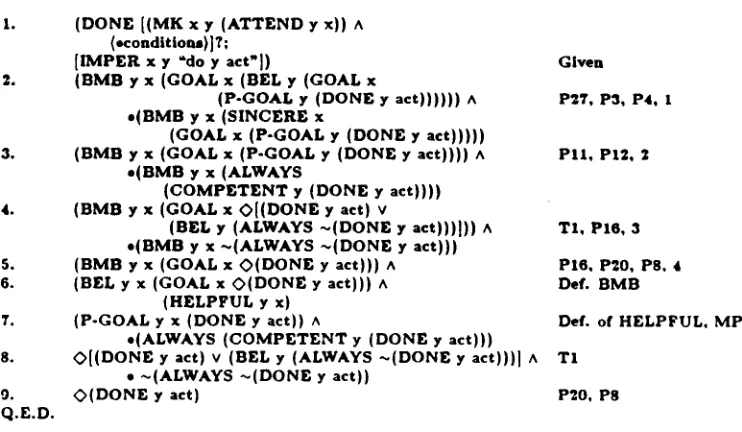
In making a request, the speaker is trying to get the hearer to do an act. We will show how the speaker's u t t e r i n g an i m p e r a t i v e to do the act leads to its eventually being done. W h a t we need to prove is this:
T h e o r e m 2 Result o[ an Imperative -- ( D O N E [ ( M K x y ( A T T E N D y x)) ^
( B M B y x ( S I N C E R E x
( G O A L x
( P - G O A L y ( D O N E y a c t ) ) ) ) ) ^ ( H E L P F U L y x)l?;
l I M P E R x y " d o y a c t ' ] ) :3 O ( D O N E y act)
We will give the major steps of the proof in F i ~ l r e I, and point In their justifications. T h e full-fled~'ed proofs are h'ft to Ihe ,,nergetic reader. All formula.s preceded by a * are supposed
t,, be Irue just prior to performing the I M P E R , are preserved by
il. an,I thus are implicitly conjoined to formulas 2 - 9. By their placement in the proof, we indicate where they are necessary for
making t he deductions.
E~entially. the proof proceeds as follows:
If it is mutually known that y is a t t e n d i n g to x. and y thinks it i~ mutually believed Ihat Ihe e-conditions hohl. then x's ,lltering an imlwrative to y to do some action results in formula (2). Since h i~ mutually believed x is sincere about his goals, then (:~) it is miltually believed his goal t n d y is that y form a persistent goal to ,Io the act. Since everyone is always c o m p e t e n t to do acts of which they are the agent. (.1) it is mutltally believed that the act will eventually be done, or y will think it is forever impossible to do. But since no halting act is forever impossible to do, it is (.3) mutually believed that x's goal is that y eventually do it. Ih, nee, 16) y thinks x's ~oa] is that y eventually do the act. Now, ~ince y is helpfillly disposed towards x, and has no objections Io doing the act. 17) y takes it on as a persistent goal. Since he is alwa.w c o m p e t e n t about doing his own arts, 18) eventually it ~ill I , . , I o n e or he will think it impossible to do. Again. since it is n(,I f~)rever impossible. (3) he v, ill eventually do it.
W,. have shown how the p,.rforming of an i m p e r a t i v e to do an act leads to the act's evemually being done. We wish to create a n u m b e r of l e m m a s from this proof (and others like it) to characterize iilocutionary acts.
8
P l a n s a n d S u m m a r i e s
6. t
Plans
A plan for agent "x" to achieve some goal "q" is an action term ~a" and two sequences of wits ".no', ~ P l " . . . . "pt," and "q0", "qz", . . . ~qk" where "qk" is ~q" and satisfying
I. I- ( B E L x ( p o A p t A . . . A p ~ }
( R E S U L T x a q o a p t A . . . A P k )))
2. h ( B E L x ( A L W A Y S (p~a Ch-t) D q,))) i = l , e . . . . k
In o t h e r words, given a s t a t e where "x" believes t h e "pi ~, he will believe t h a t if he does ~a" then "q0" will hold and moreover. given t h a t t h e act preserves pi, and he believes his making "qi-i ~ true in t h e presence o f p i will also make "qi* tale. Consequently, a plan is a special kind of proof t h a t
I- ( B E L x ((Po^.-. A Pk) ~ ( R E S U L T x a q)))
and therefore, since
( B E L x p) D ( B E L x ( B E L x p))
and
( B E L x (p ~ q)) D ( ( B E L x p) D ( B E L x q)). are axioms of
belief, a plan is a proof that
h ( B E L x (p. A . . . ^ p~)) ~ ( B E L x ( R E S U L T x a 'l))
Among tile corollaries to a plan are
}- ( B E L x ( (Po a . . . ^ p,) ~ ( R E S U L T x a q , ) ) ) i = [ . . . . k
and
}- ( B E L x ( (p," a . . . a Pi) ~ ( A L W A Y S q~-i D q i ) ) ) i : 1 . . . . k ]=l" . . . . k
T h e r e are two main points to be made about the~e corollaries. First of all, since they are theorems, the implications can be taken to be believed by the agent "x" in every, state. In this sense, these wits express general m e t h o d s believed to achieve certain effects provided the a s s u m p t i o n s are satisfied. T h e sec- ond point is that these corollaries are in precisely the form that is required in a plan and therefore can be used as justification for a step in a filture plan in much the s a m e way a lemma becomes a single step in the proof of a theorem.
6 . 2 S u m m a r i e s
We therefore propose a notation for describing many ~t,.p~ of a plan as a single s u m m a r i z i n g operator. A 3 u m m a r y consists of a name, a list of free variables, a distingafished free variable called the agent of the s u m m a r y (who will always be list,,d tirst), an Effect which is a wff, a optional Body which is either an action or a wff and finally, an optional Gate which is a wff. T h e u n d e r s t a n d i n g here is that s u m m a r i e s are associated with agent and for an agent "x" to have s u m m a r y "u". then there are three cases d e p e n d i n g on the b o d y of " u ' :
I. If the B o d y o f "u" is a wff, then
( B E L x ( A L W A Y S (Gate ^ Bod~) ~ {Gate ^ Effect})) Is
2. If the Body of "u" is an action term, then
I- ( B E L x ( G a t e ~ ( R E S U L T a g e n t Bod~ (Gate A Effect})))
I.
2.
G i v e n
P27, P3, P4, I
3. P l l , P 1 2 , 2
( D O N E [ ( M K x y ( A T T E N D y x)) A
( . c o n d i t i o n s ) ] ? ;
l I M P E R x y "do y a c t * ] )
( B M B y x ( G O A L x (BEL y ( G O A L x
( P - G O A L y ( D O N E y a c t ) ) ) ) ) ) A * ( B M B y x ( S I N C E R E x
( G O A L x ( P - G O A L y ( D O N E y a c t ) ) ) ) ) ( B M B y x ( G O A L x ( P - G O A L y ( D O N E y a c t ) ) ) ) ^
* ( B M B y x (ALWAYS
( C O M P E T E N T y ( D O N E y act)))} ( B M B y x ( G O A L x O [ ( D O N E y act) v
4.
( B E L y (ALWAYS ~ ( D O N E y a e t ) ) ) l ) ) ^ TX, P l f , 3 , ( B M B y x ~ ( A L W A Y S ~ ( D O N E y a c t ) ) )
5. ( B M B y x ( G O A L x O ( D O N E y a c t ) ) ) A P160 P20, P8, 4 6. (BEL y x ( G O A L x O ( D O N E y a c t ) ) ) ^ Def. B M B
( H E L P F U L y x)
T. ( P - G O A L y x ( D O N E y a c t ) ) ^ Def. of H E L P F U L , M P • (ALWAYS ( C O M P E T E N T y ( D O N E y a c t ) ) )
8. <>[(DONE y act) v (BEL y (ALWAYS ~ ( D O N E y act)})l ^ T1 • ~ ( A L W A Y S ~ ( D O N E y a c t ) )
9. <>(DONE y act} P20, P8
Q.E.D.
Figure 1: Proof o f Theorem 2 -- A n imperative to do an act result~ in its eventually bein 9 done. 14
One thing worth noting about summaries is t h a t normally the wiTs used above
~" (BEL x (Ga:e D . . . ) )
will follow from the m o r e general wff
I- (;ate D . . .
llowever, this need not be the ca,~e and different agents could
have different summaries (even with the same name). Saying
that an agent has a summary is no more than a convenient way of saying t h a t the agent always believes an implication of a certain kind.
7
S u m m a r i z a t i o n o f a R e q u e s t
The following is a summary named R E Q U E S T that captures steps 2 through steps 5 of the proof of Theorem 2.
[ R E Q U E S T x y act]:
Gate: i t ) ( B M B y x ( S I N C E R E x ( G O A L x ( P - G O A L y ( D O N E y a c t ) ) ) ) ) ^ (2) ( B M B y x (ALWAYS
( C O M P E T E N T y ( D O N E y a c t ) ) ) ) (3) ( B M B y x ~ ( A L W A Y S ~ ( D O N E y a c t ) ) )
Bo~i~.
( B M B y x( G O A L x
(BEL y
( G O A L x ( P - G O A L y {DONE y act))))})
Effect: ( B M B y x ( G O A L x O ( D O N E y a c t ) ) )
This summary allows us to conclude that any action preserv- ing the Gate and making the Bod!/true makes the Effect true.
Conditions (2) and (3) are theorems and hence are always pre- served. Condition (1) was preserved by assumption.
Searle's conditions for requesting are captured by the above. Specifically, his "propositional content" condition, which states t h a t one requests a future act, is present as the Effect because of Theorem 2. Searle's first "preparatory" condition - - that the hearer be able to do the requested act, and t h a t the speaker think so is satisfied by condition (2). Searle's second prepara* tory condition - - t h a t it not be obvious t h a t the hearer was going to do the act anyway - - is captured by our conditions on persistence, which state when an agent can give up a persistent goal, t h a t is not one of maintenance, when it has been satisfied. Grice's "recognition of intent* condition [12, 13] is satisfied since the endpoint in the chain (step 9) is a goal. Hence, the speaker's goal is to get the hearer to do the act hy means, in part, of the (mutual) recognition t h a t the speaker's goal is to get the hearer to do it. Thus, according to Grice, the speaker has meant,,,, t h a t the hearer should do the act. Searle's revised Gricean condition, t h a t the hearer should "understand" the lit- eral meaning of the utterance, a n d what illocutionary act the utterance "counts as* are also satisfied, provided the summary is mutually known, le
T. 1 N o n s e r i o u s R e q u e s t s
Two questions now arise. First, is this not overly complicated? The answer, perhaps surprisingly, is "No'. By applying this R E Q U E S T theorem, we can prove t h a t the utterance of an im- perative in the circumstances specified by the Gate results in the Effect, which is as simple a propositional attitude as anyone would propose for the effect of uttering an imperative - - namely t h a t it is mutually believed t h a t the speaker's goal is t h a t the hearer eventually do the act. The Bod V need never be considered
[image:8.612.120.491.73.289.2]unless one of the gating conditions fails.
Then, if the
Body
is rarely needed, when is the "extra" em- bedding (GOAL speaker (BEL h e a r e r ...)} attitude of use? The answer is that these embeddings are essential to preventing nonserious or insincere imperatives from being interpreted un-conditionally as
requests. In demonstrating this, we will showhow Searle's "Sincerity ~ condition is captured by our S I N C E R E predicate.
The formula ( S I N C E R E speaker p) is false when the speaker does something to get the hearer to believe he, the speaker, has the goal of the bearer's believing p, when he in fact does not have the goal of the heater's knowing that p Let us see see how this would he applied for "Go jump in the lake', uttered idiomati- cally. Notice that it could be uttered and meant as a request, and we should be able to capture the distinction between serious and nonserious uses. In the case of uttering this imperative, the content of S I N C E R E . p p = ( ( : O A L speaker ( P - G O A L h e a r e r ( D O N E h e a r e r / J U M P - I N T O Laker]))).
Assume that it is mutually known/believed that the lake is frigidly cold (any other conditions leading to -,.{GOAL x p) would do as well. e.g., that the hearer is wearing his best suit, or that there is no lake around). So, by a reasonable axiom of goal formation, no one has goals to achieve states of affairs that are objectionable (assume what is "objectionable" involves a weighing of alternatives). ~o, it is mutually known/believed that ~ ( G O A L speaker ( D O N E h e a r e r [ J U M P - I N T O Laket])), and so the speaker does not believe he has such a goal. l'l The consequent to the implication defining S I N C E R E is false, and because tile result of tile imperative is a mutual belief that the speaker's goal is that the hearer think he has the goal of the bearer's jumping into the lake, the antecedent of the implica- tion is true. Hence, the speaker is insincere or not serious, and a request interpretation is blocked, is
In the case of there not being a lake around, the speaker's goal cannot be that the hearer form the persistent goal of jumping in some non-existent lake. since by the 3/0
Futility
property, the hearer will not adopt a goal if it is unachievable, and hence the speaker will not form his g~al to achieve the unachievable state of affairs (that the hearer adopt a goal he cannot achieve). }tence, since all this is mutually believed, using the same argument, the speaker must be insincere.8
Nonspecific requests
The ability conditions for requests are particularly simple, since as long as the hearer knows what action the speaker is referring to. he can always do it. He cannot, however, always bring about some goal world. An important variation of requesting is one in which the speaker does not specify the act to be performed; he merely expresses his goal that some p be made true. This will be captured by the action l I M P E R y 'p] for ~make p true*. Here,
tTThe speaker's expressed goat is that the hearer form t persistent gold to jump in the lake. But. by the
/neeitails Coassqasaees
lemma, given that a c.o.e, satisfying the speaker's goal also h u the heater's eventually jumping in (since the hearer knows what to do), the speaker's goal is also • c.o.e, in which the hearer eventually jumps in. In the same way, the speaker's goal would also be that the hearer eventually gets wet. I*11owever, we do not say what else might be derivable. The speaker's truegoals may have more to do with the manner of his action (e.g., tone of voice), than with the content. All we have done is demoasnurata formally how • hearer could determine the utterance is not to be talteo ~r, face value.
in planning this act, the speaker need only believe the hearer thinks it is mutually believed that it is always the case that the hearer will eventually find a plan to bring about p. Ahhough we cannot present the proof that performing an [ I M P E R x y "p] will make O p true, the following is the illocutionary summary of that proof: [ N O N S P E C I F I C - R E Q U E S T x y p]:
Gate: ( B M B y x ( S I N C E R E x ( G O A L x ( B E L y
(GOAL x ( P - G O A L y p ) ) ) ) ) ) A ( B M B y x (ALWAYS ( C O M P E T E N T y p))) ( B M B y x (ALWAYS
~-7 a c t ' ( D O N E y q?;act'), w h e r e q ~( (BEL y ( R E S U L T y a c t ' p))))
Body:. (IJMB y x
(GOAL x (BEL y
(GOAL x ( P - G O A L y p)))))
Effect:
( n M B y x( G O A L x O P t )
Since the speaker only asks the hearer to make p true. the ability conditions are that the hearer think it is mutually be- lieved that it is always true that eventually there will be some act such that the hearer believes of it that it achieves p (or he will believe it is impossible for him to achieve). The speaker need not know what act the hearer might choose.
9
On s u m m a r i z a t i o n
Just as mathematicians have the leeway t o decide which proofs are useful enough to be named a.s lemmas or theorems, so too does the language user. linguist, computer system, and speech act theoretician have great leeway in deciding which summaries to name and form. Grounds for making such decisions range from the existence of ilfocutionary verbs in a particular lan- guage, to efficiency. However. summaries are flexible - - they allow for different languages and different agents to carve up the same plans differently. ,o Furthermore, a summary formed for efficiency may not correspond to a verb in the language.
Philosophical considerations may enter into how much of a plan to summarize for an illocutionary verb. For example, most illocutionary acts are considered successful when the speaker has communicated his intentions, not when the intended effect has taken hold, This acgues for labelling as
Effects
of summaries in- tended to capture illocutionary acts only formulas that are of the form (BMI3 h e a r e r speaker (GOAL s p e a k e r p)), rather than those of the form (BMB h e a r e r speaker p) or (BEL hearer p), where p is not a GOAL-dominated formula. Finally, summaries may be formed as conversations progress.The same ability to capture varying amounts of a chain of inference will allow us to deal with muhi-utterance or muhi- agent acts, such as, betting, complying, answering, etc., in which there either needs to be more than one act (a successful bet r.quires an offer and an acceptance), or one act is defined to require the presence of another (complying makes sense only in the presence of a previous directive). For example, where R E Q U E S T captured the chain of inference from step 2 to step 5, one called C O M P L Y could start at 5 and stop at step 9.
tSRemember, summaries are actually beliefs of agents, and those beliefs
Thus, the notion of characterizing illocutionary acts as lemma- like summaries, i.e., as chains of inference subject to certain conditions, buys us the ability to encapsulate distant inferences at "one-shot'.
9.1
Ramifications for Computational Models of
Language Use
The use of these summaries provides a way to prove t h a t various short-cuts t h a t a system might take in deriving a speaker's goals are correct. Furthermore, the ability to index summaries by their
Bodies
or from the utterance types t h a t could lead to their application (e.g., for utterances of the form "(.',an you do < X > ~) allows for fast retrieval of a lemma tlmt is likely to result in goal recognition. By an appropriate organization of summaries [5], a system can a t t e m p t to apply the most comprehensive sum- maries first, and if inapplicable, can fall back on less compre- hensive ones, eventuMly relying on first principles of reasoning about actions. Thus. the apparent difficulty of reasoning about speaker-intent can be tamed for tile "short-circuhed ~ cases, but more general-purpose reasoning can deployed when necessary. IIowever. the conil)lexities of rea.~oning about others' beliefs and goals remains.10
E x t e n s i o n s : I n d i r e c t i o n
Indireciion will be modeh'd ill tills framework a.s tile derivation of propositions (lUlling with the speaker's goals t h a t are not stated as such by tile initial propositional attitude. For example, if we can conchlde from I B M B y x ( G O A L x ( G O A L y N i l that
( B M B y x ( G O A L x ( G O A L y 0 q))), where p d o e s not entail q, then. "loosely', we will say an indirect request has been made by x.
(;iven the properties of O . ( G O A L x p) D ( G O A L x <C>P) is a dworcm. ( G O A L x p) an(l ( ( ; ( ) A t , x - l i ) ar~" mutually un- ~ati~[ial)le, hilt ( C O A L x OP) and ( G O A L x O ~ p ) are jointly ~ali~liahh'. ["(}r examllh ", ( ( ; O A L BILL O H A V E BILL H A M - M E R I ) ) ) and ( G O A L BILL <~(HAVE J O H N H A M M E R I ) ) could both be part of a description of Bill's plan for John to get a h a m m e r and give it to him. Such a plan could be triggered by Bill's merely saying "C, et tile ilammer" in the right circum- stances, such as when Bill is on a ladder plainly holding a nail. :0 A subsequent paper will demonstrate the conditions under which such reasoning is ~ound.
I1
C o n c l u d i n g R e m a r k s
r h i ~ i)alier tia.~ demonstrated tilat all illocutionary acts ne,'d ant t),' primitive. At least some can be derived from more basic priuciph.s of rational lotion, and an account of tile propositional attitudes affected by the uttering of sentences wittl decl.'u-ative, interrogative, and imperative moods. This account satisfies a number of criteria for a good theory of illocutionary acts.
* Most elements of :he theory are independently motivated. The ~heory of rational action is motivated independently from any notions of communication. Similarly, the proper- ties of cooperative agents are also independent of commu- nication.
l°Notice thllt molt theoritqt Ot Ipeech g t a would treat the above utterance
u Bed I I direct request. We do not.
The characterization of the result of uttering sentences with certain syntactic moods is justified by the results we derive for illocutionary acts. as well as the results we cannot de- rive (e.g.. we cannot derive a request under conditions of insincerity ).
Summaries need not correspond to illocutionary verbs in a language. Different languages could capture different parts of the same chain of reasoning, and an agent might have formed a summary for purposes of efficiency, but t h a t sum- mary need not correspond to any other agent's summary.
The rules of combination of illocutionary acts (character- izing, for example, how mnltiple assertions could consti- tute the performance of a request) are now reduced to nlles for combining propositional contents and attitudes. Thus, multi-utterance illocutionary acts can be handled by accu- mulating the speaker's goals expressed in multiple titter- antes, to allow an illocutionary theorem to be applied.
Multi-act utterances are also a natural outgrowth of l|liS ap- proach. There is no rea.~on why one cannot apply mulliple illocutionary sunlniaries tO tile res0ill o f utlt, ring a S¢'lllen¢¢'. Those sllmmaries, however, need not ¢'orre~pond Io illoc0f tionary verbs.
The theory is naturally extensible to indirection (to lie ar- gued for hi another paper), to other i l l o c . t i o . a r y act, such u questions, commands, informs, a~sertions, and to tile act of referring [gl.
Finally. allllougti illocutionary act rerog'nition may h,, ~lricily unntwcssary, given the complexily of o01r proofs, it is likely to he loser011. I']~s,.nliallv. s01etl rec~l~nilhm would ;lillOlill~ to lh(. application (if ill,lc01tl*lnary Sllnlllllries llleort'nl.~ Io di.~cover the
speaker'~ I~(ml(s L
12
A c k n o w l e d g e m e n t s
We w o . l d like to thank Tom Blenko, Ih.rb (:lark, M i c h u l (,eorg,.lr, David I~r~el, Bob Moore, (;(,off .NUli|ierg', Fernan(|o [)ereira. flay Penault, .":,tan Rosenschein, Ivall ~ag, and ,~loshe Vacdi for valuable dise.ssions.
13
References
1. AIh'n..!. F. A llhin-lla-'~ed atll)roa~'h I(i Sll,,0.ch act rrc.~nh.ion. "r,.,ctinic:ll I~.,.port 17.1. Di'p;lrtnit'!it o f ('ornpill.('r ~cil'nce. llilivei~ity ()f 'r,)roiito, January. ll.)]'¢.).
2. Allen..I. [:., F r i t h . A. M.. <[" l,il,nan. I)..I. ARt ;(iT: The Rochester dialogue system.
Proceedings of the
.Vat,..,dConference on Artificial Intelligence,
P h t s h , r ~ h , I),'nn~yl-vanla, 1982. ¢I,-70.
3. Appelt, D.
Planning Natural Language
Utterancesto S(itisfy
Multiple Goals.
Ph.D. Th.. Stanford University, Stanford,California, December 1981.
5. Bracbman. R., Bobrow, R., Cohen, P., Klovatad, J.,
Wel>- bet, B. L., & Woods, W. A. Research in natural language understanding. Technical Report 4274, Bolt Beranek and Newman Inc., August, 1979.6. Bruce, B. C., & Newman, D. Interacting plans. CognRiee Science ~, 3, 1978, pp. 195-233.
T. Clark. H. H., & Marshall, C. Definite reference and mutual knowledge. In Elements of Discourse Understanding, Aca- demic Press, Joshi, A. K., Sag, !. A., & Webber, B., Eds.,
New York. 1981.
8. Cohen, P. R. The Pragmatics of Referring and the Modality of Communication. Computational LinquMtics lO, 2, 198,1, pp. 97-1.16.
9. Cohen, P. R. On Knowin 9 what to Say: Plannin 9 Speech Acts. Ph.D. Th., University of Toronto. Toronto, January 1978. Technical Report No. 118, Dept. of Computer Sci- ence.
lO, ( :ohen, P. R.. & Levesque, II. J. Speech Acts and the Rerog- nition of Shared Plans. Proe. , [ the Third Iliennial Con- ference, Canadian Society for (~omputa!ional Studies of In- telligence, Victoria. B. (;., May. 1980, 263-271.
I I . Emerson, E. A., and Ilalpern. J. Y. "Sometimes" and "Not Never" Revisited: On Branching versus [.inear Time. ACM Sympa.~ium on Prinr~ple.~ of t)rt~jrammin9 Lanquaqes, 1983.
12. (;rice. l{. I'..\|caning. Phdo,,ophiral Ret,ietp 66, 1957, pp. 377-3,g8.
13. Grice. II. 1'. Utterer'.~ Meaning anti Intentions. t'hilo.~ophi- cal Reriew 63, 2. 1969, pp. 1.17-177.
14. Grice, t|. P. Logic and conversation. In t:ole., P. and M a r
gan, J. [,., Eds.,Syntaz and Semantics: Speech Acts , Ace.
demic Press, New York,1975.
15. Halpern, J. Y., and Moses. Y. O. A tluide to the Modal Logics of Knowledge anti Belief. Pr~. a / t h e Ninth Inter. national Joint (;on[erenre on .4rtl]ir:al intelligence, J.J( :AI, Los Angeles, ('alif.. Augnst, 1985.
Levesque, tlector, J. A logic of implicit and explicit belief.
Proceedings of the National t,'ofl/erence a/ the American As- ~ciation for Artificial Intelligence, ~ustin, Texan, 198.1.
esque, H. J., & Cohen, P. R. A Simplified I,ogic of In- ~eraction. in preparation
18. McCarthy. J.. A: Ilayes. P..1. ~ome Philo~.phical ['rnhlems from the :-;tandpoint of ..\rtifi¢ial l.h'lli~,ehce, In 3t¢~rhl,e intelh'fence .i American El.~evier, B. Mehzer & D. Michh'. Eds., New York. 1~;9.
I 9 . McDermott, D. A temporal logic for reasoning about pro- cesses and plans. Cognitive Science ~, 2, 1982, pp. 101-|55. 20. Moore, R. C. Reasoning about Knowledge and Action. Technical Note 191, Artificial Intelligence Center, SR! In- ternational, October, 1980.
21. Morgan, J. L. Two types o[ convention in indirect speech acts. In Syntaz and Semantics, Volume 9: Pragmaties, Academic Press, P. Cole. Ed., N e w
York,
1978, 261-280.22. Perrault, C. R.. & Allen, J. F. A Plan-Based Analysis of Indirect Speech Acts. American Journal of Computational LinguiaticJ 6, 3, 1980, pp. 167-182.
25. Perrauit, C. R., & Cohen, P. R. It's for your own good: A note on inaccurate reference. In Elements of Discourse Understandin9, Cambridge University Press, Joshi, A., Sag, i., & Webber, B., Eds., Cambridge, Mass., 1981.
24. Schiffer, S. Mctmin 9. Oxford University Press, London. 1972.
25. Schmidt, D. F., Sridharaa, N.S., & Goodson, J. L. The plan recognition problem: An intersection of artificial intel- ligence ant| psychology. Artificial Intelligence 10, 1979. pp. 45-83.
26. Searle, J. R. Speech acts: ..In essay in the philosophy of language. (?ambridge University Pre~s, (:ambridge, 1969. 27. Sidner, (',. 1,., Bates, M., lgobrow. R. ,1., Brachman, R. J.,
Cohen, P. R.. Israel, D. J., Wehber. B. l,., & Woods, W. A. Research in knowledge representation for natural language undecstaz,liog. Annual R,'p~)rt .1785, Bolt, Beranek and Newman Inc., November, 1981.
13
A p p e n d i x
Proof of Theorem l: First, we need a lemma:
L e m m a $ Va (DONE x [(BEL x (AFTER & p)) ^ (COMPETENT x p)[?;a) :) p
Proo/:
L o
3, 4. 5.
Q.E.D.
Va { D O N E x [(BEL x { A F T E R & p)} A ( C O M P E T E N T x
p)l?;a)
Ass [ B E L x ( A F T E R x p)) A ( C O M P E T E N T x p) D { A F T E R a p) Def. ofC O M P E T E N T , M P
Ya (DONE x {AFTER & p)?;a} 2, P4
p 3, P3
Ya { D O N E x [(BEL x ( A F T E R a p)} A { C O M P E T E N T x pJl?;a) D p Impl. lntr.
T h e o r e m I.. Vy (P-COAL y p) A (ALWAYS (COMPETENT y p)) D O(p v {BEL y {ALWAYS ~p)))
Proo~
I,
2. 3.
4.
Q.E.D.
{P.GOAL y (DONE y act}} A {ALWAYS {COMPETENT y {DONE y actJ}} O{3a {DONE y [(BEL y (AFTER a p}}l?:a} v {BEL y (ALWAYS ~p}}} O{P v {BEL y (ALWAYS ~p}}}
[P-GOAL y (DONE y act}) ^ (ALWAYS (COMPETENT y {DONE y act}J} :) O(P v {BEL y (ALWAYS ~p)))
ASS.