Munich Personal RePEc Archive
An Insight to the Structure of the North
East Indian Retail Sector
Hazarika, Bhabesh
Indian Institute of Technology Kharagpur
28 April 2015
Online at
https://mpra.ub.uni-muenchen.de/63987/
An Insight to the Structure of the North East Indian Retail Sector
Bhabesh Hazarika
Research Scholar
Department of Humanities and Social Sciences Indian Institute of Technology Kharagpur
West Bengal India, 721 302 Email: [email protected]
Abstract
Retail trade plays a major role in all economies all over the world. The performance of the sector has important implications towards the economic development of a country. Towards the end of 2008-09, while the world economy got shrank, the Indian economy was not much hampered due to its strong consumer demand. Retail demand,, bar some exceptions, has proven to be more resilient than that was expected for many emerging countries during the economic downturn of 2008-09. In India, the concept and idea of shopping have been experiencing a considerable change in terms of format and consumer behavior, ushering a shopping revolution in India. Modern retailing has entered into the retail market in India and is observed in the form of busting shopping centers, multi-storied malls and huge complexes offering shopping, entertainment, and food under one roof. Apart from changing business environment and use of information technology, people are becoming more enthusiasts for brands, online shopping, etc., leading to a considerable growth of retail sector in India.
JEL Classification: L81
Keywords: Retail trade, Consumer behavior, India
1.
INTRODUCTION
Retail trade plays a major role in all economies of the world. The performance of the sector has its important implications towards the economic development of a nation. Towards the end of 2008, while the world economy got shrank, India did not get much affected due to a strong consumer demand. Retail demand proved more resilient than expected during the economic downturn of 2008-09 for many emerging economies. For example, many global retailers (food) continued to perform relatively stronger sales throughout the crisis.
The concept and idea of shopping has undergone a considerable change in terms of format and consumer buying behavior, ushering a revolution in the concept of shopping in India. Modern retailing has entered into the retail market in India and is observed in the form of bustling shopping centers, multi-storied malls, and the huge complexes that offer shopping, entertainment, and food all under one roof.
Consumers’ expectation, behavior etc., are sprouting motivated by the changing business environment and the use of information and technology. People are becoming more enthusiasts for brands, merchandise, etc., even if in many developing countries, consumers are adopting online purchase. This is leading to a considerable growth in e-commerce.
India presents a grand opportunity to the world at large, to use it as a business hub. As a ‘Vibrant Economy', India is an emerging market for global retailers. It is the 2nd fastest growing economy in the world, the 3rd largest economy in terms of GDP in the next 5 years and the 4th largest economy in Purchasing Power Parity (PPP) terms after USA, China & Japan. India is also rated among the top 10 FDI destinations. India is a very big market which has potential of growth for all fields (Vivek et al., 2011). In India, the vast middle class consumer group and its almost untapped retail industry are the key attractive factors for global retail giants towards integration of global retail markets, which in turn will help the Indian retail industry to grow faster. Indian retail industry is expected to grow by 25 percent annually. Modern retail in India could be worth of US$ 175-200 billion by 2016 (IMF, 2012). The Food retail industry in India dominates the shopping basket. The Mobile phone retail industry in India is already a 16.7 billion USD business, growing at over 20 per cent per year (Roy, 2011). With more favorable government policies regarding FDI and other instruments, the future of the Indian retail industry looks promising.
Growing urbanization, large young working population group, nuclear families along with increasing working-women population, emerging opportunities in the services sector, etc., are the critical factors in the growth of the retail industry specially the organized sector in India (Rohilla & Bansal, 2012). During the last couple of years, the growth pattern in organized retailing and in the consumption made by the Indian population shows an upward trend indicating more potentiality and opportunities in Indian retail industry.
2.
OBJECTIVES
Recently, the government of India has approved FDI reforms in retail sector after a long controversy regarding the adaptation of such policy that may have adverse impact on the unorganized domestic retail sector. However, it is argued that these kinds of impacts will be wreaked through the passage of time and the overall economy will be benefitted in the long run. Present paper aims at giving an insight to the structure and the current situation in the retail industry in India. The paper also focuses on the following objectives:
1. To assess the nature and trend of market size of the Indian retail sector 2. To assess the employment status in the Indian retail sector
3. To assess the performance of a few leading retail firms
2
3.
METHODOLOGY AND DATA SOURCE
The paper is descriptive in nature. Tables and graphs are used to explain the different aspects of the Indian retail sector. The work is based on secondary data and collected from various agencies like Department of Commerce and Industries, NSSO Govt. of India, Planning Commission, Press Bureau of Information, IMF, Internet, etc.
4.
RETAIL SECTOR IN INDIA
In 2014, India ranked 20th in Global Retail Development Index (GRDI) (14th in 2013) showing the high potential retail market growth which is expected to be 15-20 percent in the next 5 years. The sector is highly fragmented and unorganized having around 13 million retail outlets where unorganized retailing accounts for 95-96 percent of the total retail industry. It is one of the major pillars of Indian economy which contributes nearly 14-15 percent to GDP and is estimated to be USD 660 billion in market size by 2016 (Department of Commerce, 2014). This growth is highly realized by the macro-economic environment, including a 6-7 percent in GDP growth, rapid urbanization, a large youth population group, etc. Moreover, increase in consumer spending over the years by the young population (more than 31 percent of the country
is below 14 years) and sharp rise in disposable income are driving the Indian organized retail sector’s growth (Rohilla & Bansal, 2012). Even small towns and cities are witnessing a major shift in consumer lifestyle and preferences, and have thus emerged as attractive markets for retailers to expand their presence.
[image:3.612.73.543.317.588.2]India’s economy, demographics, and retail market are different as compared to other emerging economies. The approach towards foreign investment is far more welcome than in the past, but it remains a protectionist country and restrictions are high in some sectors, including the retail sector. Indian consumers have lower purchasing power. Moreover, the geographical locations and the poor infrastructures especially the transport facilities, makes the trade even more difficult since India is not having a single market. Again existence of different state’s legislation, with some preventing large scale retail development, hinders the growth of this sector. Still, India is an attractive market for retailers. As we can see from the Figure 1, in 2014, India is placed 12th in the aspect of market potential for retail sector (AT Kearney Report, 2014). It has a large, young and growing population. Incomes are rising, with more households entering the middle class. Less proportion of the population live in urban areas, but urbanization is increasing and there are several big cities with a large proportion of middle class population. All of these forecast well for consumer and retail demand in the years ahead, and should augur well for the development of a modern retail market.
Figure 1: Country attractiveness in retail sector trade for the foreigners
4.1. COMPOSITION OF INDIAN RETAIL INDUSTRY
Figure 1: Organized and unorganized retailing: A global comparison
Source: http://reurbanist.com
Unorganized retailing refers to the traditional formats of low-cost retailing, for example, the local corner shops, general stores managed by owners, paan/beedi shops, convenience stores, hand cart and pavement vendors, etc. The retail sector, in India, is yet to be allotted the status of an “industry”. The sector has more than 12 million retail outlets. It has the highest retail density in the world. In terms of ownership, it primarily consists of independent, owner managed shops.
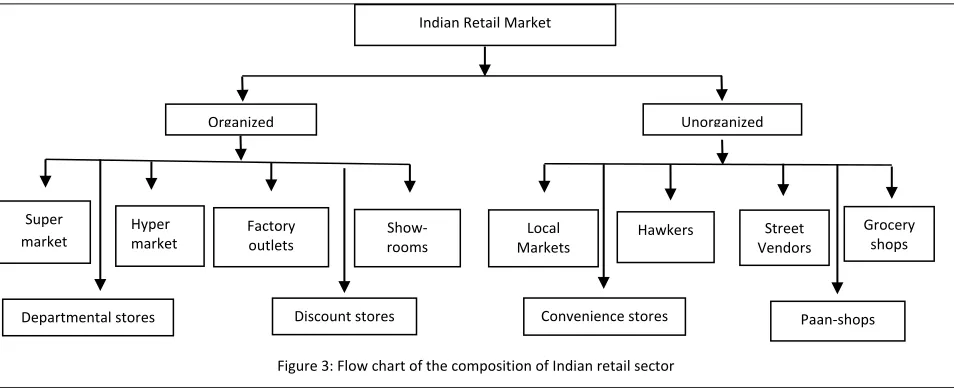
[image:4.612.68.545.288.482.2]On the other hand, organized retailing refers to trading activities undertaken by licensed retailers, that is, those who are registered for sales tax, income tax, etc. These include the corporate-backed hypermarkets and retail chains, and also the privately owned large retail businesses. Figure 3 presents the composition of Indian Retail sector.
Figure 3: Flow chart of the composition of Indian retail sector
A significant trend in the market is the development of a combination of retail and entertainment centers. Indian malls have a combination of high-value outlets, as well as mass brands. While the number of shopping malls has seen a spurt in the recent past, the future development is now increasingly being focused on providing for leisure activities as well. A considerable number of multiplexes are being developed as an integral part of retail malls along with facilities such as food courts, video game parlours, books stores, cinema and theatre.
Earlier retailing in India was mostly done through family-owned small stores with limited merchandise. In those times, food and grocery were shopped from clusters of open stalls. There were also occasional fairs and festivals where people went to shop. In the twentieth century, infusion of western concepts brought about changes in the structure of retailing. Some traditional retail chains were set up on the lines of western retail concepts of supermarkets. The government set up the Public Distribution System (PDS) outlets to sell subsidized food and started the Khadi Gram Udyog to sell clothes made of cotton fabric. The biggest advantage in this sector is the consumer familiarity that passes on from one generation to the next.
The transformation of Indian retail sector started with the implementation of new economic policy in 1991. Since then, many firms like Shoppers Stop, Pantaloon Retail India Ltd. (PRIL), Spencer Retail, etc., ventured into the organized retail sector and have grown by many folds. These were the pioneers of the organized Indian retail formats. With the opening up of Foreign Direct Investment (FDI) in single-brand retail and cash & carry formats, a new chapter unfolded in the retail space. There was an explosion of shopping malls and plazas where customers interacted with professionals and not with just one single person-the owner. An important point here is that customers' requirements are catered to by trained staff. Today, organized retailing has become an experience characterized by comfort, style and speed. It is something that offers a customer more control, convenience and choice along with an experience.
The FDI bill in 2011 has paved the way to several international giant retailers' entry and expansion plans. Allowing FDI up to 100 percent in single-brand retail and 51 percent in multi-brand, with an added constraint that sourcing must be 30 percent local, there will more dynamic changes in the sector. Companies such as Gap, IKEA, and Abercrombie & Fitch are stepping up inquiries to enter the market, while others are seeking local partners. For example, LVMH has linked with local player Genesis Luxury Fashion in multi-brand retail. Others, such as Amazon and eBay, are considering alternate business opportunities and platforms to overcome FDI restrictions. At the same time, the government is still working through the implementation plan for these regulatory changes.
0% 20% 40% 60% 80% 100%
USA UK Malaysia Thailand Brzail Russia Indonesia China India
Re
tai
l Trade
Country
Unorganized Retail Organized Retail
Indian Retail Market
Organized Unorganized
Super market
Factory outlets
Departmental stores
Local Markets
Hawkers Street Vendors
Grocery shops Hyper
market Show-rooms
4
In food and beverage segment, Starbucks partnered with Tata Group to own and operate cafes, and Dunkin' Donuts recently opened its first store in Delhi, in partnership with local franchisee Jubilant Food-works. Grocery remains India's largest source of retail sales. Hypermarkets and supermarkets continue to dominate, but cash-and-carry is growing fast, with significant expansion planned from Bharti Wal-Mart, Metro Group, and Carrefour. Companies like Zara, Marks & Spencer, and Mango are actively scouting locations to open more stores across the country in apparel industry.
4.2. SIZE OF THE INDIAN RETAIL INDUSTRY
The size of Indian retail industry is growing fast during the last decade especially in the organized sector. It has increased from USD 235.7 billion in 2004 to USD 461 billion in 2009 with an impressive growth rate of around 15-18 percent. It marked around USD 550 billion in 2010 and projected the size to be touching an USD 800 billion by 2014 (Goyel and Mukharjee, 2012). In the last decade, the retail trade in the country shows an upward trend indicating continuous expansion of the sector from USD 235.35 billion in 2004 to USD 545.40 billion in 2011 (Department of Commerce, 2014). This expansion has paved the way towards increase in significant infrastructure development. With diverse consumer demand and behavior, even the giant retailers have been diversifying their marketing strategy and retailing format to attract the more discerning and impulsive consumers who take time to explore, understand, and discuss before final consumption.
[image:5.612.70.544.246.366.2]As discussed earlier, different macro-economic variables are playing a major role in the expansion of retail industry. Some indicators related to the retail trade in India are shown in Table 1. Population size, per-capita GDP, and consumer spending have positive relation with retail trade.
Table 1: Some indicators related to Indian retail sector Year Population
(millions)
GDP growth rate Per capita GDP ( USD at current prices)
Consumer spending
Retail sales (USD billions) 2008 1182 6.4 2868.00 664.90 457.60 2009 1199 5.7 3015.00 679.30 461.80 2010 1216 9.7 3291.00 812.70 545.40 2011 1233 8.4 3563.00 895.10 610.00 2012 1249 8.0 3847.00 986.90 670.00 2013 1266 8.2 4168.00 1094.90 740.00 2014 1282 8.1 4524.00 1217.70 798.00 Source: IMF (2014)
4.3. EMPLOYMENT SCENARIO IN RETAIL SECTOR
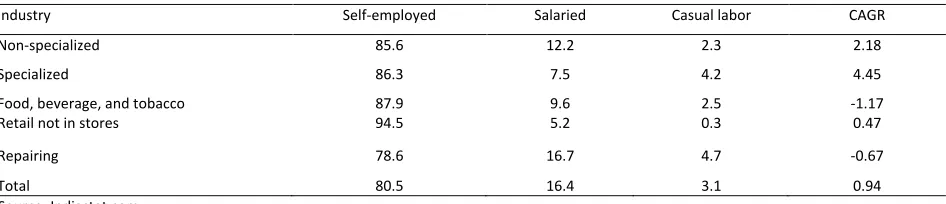
The retail sector employs nearly 40 million (4.4% of the total population) people. Within the retail sector, selling of food, beverage, tobacco, and clothing and apparels captures the major share in generating employment. The share and growth of the employment in the retail sector in India is shown in Table 2.
Table 2: Employment status (percentage distribution) in the retail sector in India during 2005-06
Industry Self-employed Salaried Casual labor CAGR Non-specialized 85.6 12.2 2.3 2.18 Specialized 86.3 7.5 4.2 4.45 Food, beverage, and tobacco 87.9 9.6 2.5 -1.17 Retail not in stores 94.5 5.2 0.3 0.47 Repairing 78.6 16.7 4.7 -0.67 Total 80.5 16.4 3.1 0.94 Source: Indiastat.com
The table reveals that within the retail industry sub-sectors, self-employed people dominated in all categories having a share nearly 80-90 percent while salaried or wage employment occupies nearly 10-15 percent and the share of the casual workforce is only about 2-4 percent. The compound annual growth rate (CGAR) during the period of 1999-2006 of workforce in the category of sale of new good in specialized stores is the maximum indicating sensitiveness of Indian firm toward technology adoption creating marketing strategy towards new product development to attract the market share. The growth of the organized retailing paves changes in the nature of retail employment showing demand for skilled and prospective labor force. However, in food and beverage industry has witnessed a negative CAGR over the period.
4.4. PERFORMANCE OF A FEW INDIAN RETAIL COMPANIES IN ORGANIZED RETAIL SECTOR
[image:5.612.73.546.427.529.2]Ltd., VRL Fashion Ltd., and VRL Infrastructure Ltd. It also set up 2 new manufacturing units with a capacity of 1.5 million pieces per annum. The annual sales turnover of these four Indian giant retailers is shown in the Figure 4.
Figure 4: Annual sales turnover of Pantaloons, Shoppers stop, Trent, and Vishal during 2006-11
Source: http://www.capitaline.com
5. Prospect of organized retail trade in North East India
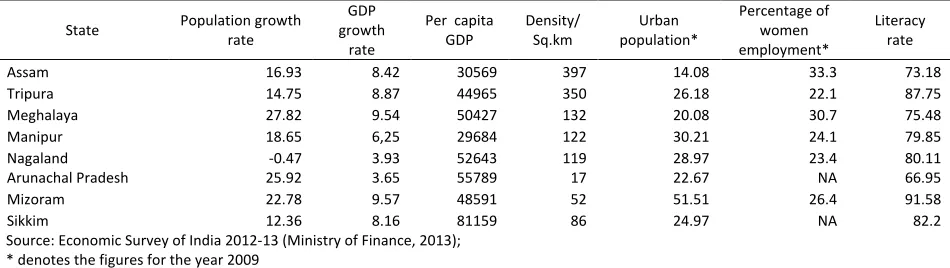
[image:6.612.73.538.109.204.2]The retail trade in North Eastern States is dominated by the unorganized sector. Especially due to the geographical location, it poses challenges for the organized sector in expanding the business. Poor growth in transport and infrastructure are the major concern in the region for the development of organized retailing in the region. The region is lagging behind in poor railway transport system causing a high transportation cost. There are ample opportunities for the organized sector to grow in the region. Steps towards a better and efficient supply chain management would bring down the down inventory cost, which can then be passed on to the consumer in the form of low pricing. Growth in the following socio-economic and other indicators may pave the way towards development of organized retailing in the region (Table 3). Investment from foreign sector has increased in the last couple of years but with a very slow rate (Table 4). State government needs to look forward towards attracting foreign investment in overall development programs as well as in retail trade.
Table 3: Socio-economic and other indicators of the North Eastern States in 2001-11
State Population growth rate
GDP growth
rate
Per capita GDP
Density/ Sq.km
Urban population*
Percentage of women employment*
Literacy rate Assam 16.93 8.42 30569 397 14.08 33.3 73.18 Tripura 14.75 8.87 44965 350 26.18 22.1 87.75 Meghalaya 27.82 9.54 50427 132 20.08 30.7 75.48 Manipur 18.65 6,25 29684 122 30.21 24.1 79.85 Nagaland -0.47 3.93 52643 119 28.97 23.4 80.11 Arunachal Pradesh 25.92 3.65 55789 17 22.67 NA 66.95 Mizoram 22.78 9.57 48591 52 51.51 26.4 91.58 Sikkim 12.36 8.16 81159 86 24.97 NA 82.2 Source: Economic Survey of India 2012-13 (Ministry of Finance, 2013);
* denotes the figures for the year 2009
Table 4: FDI inflow the North Eastern States (in crores)
Source: Indiastat.com (2013) NA: Data Not Available
With the market set to grow strongly in the years ahead, domestic retailers are looking to expand fast. Initial expansion plans of major retailers proved too ambitious and regulation prevented them in some cases from rolling out large-scale developments. Nevertheless, these investments have started to change in the retail environment. Reliance, Pantaloon and Bharti in particular, who have emerged as major players in many market segments, plough on with expansion plans across a wide range of formats. While there has been considerable expansion, retailers argue that there is still a lack of quality sites in urban locations. Boosted by growing demand, the retail sector should continue to grow rapidly, with the share of organized retail expected to double in the four years ahead, as a growing middle class demands higher-quality shopping environment. The major retail companies operating in the North East India with different format are shown in Table 5.
0 2000 4000 6000 8000
2006 2007 2008 2009 2010 2011
Annu
al
sat
es (
i
n
Cror
e)
Pantaloons Shopper stop Vishal Trent
Year 2000-05 2006 2007 2008 2009 2010 2010-11* 2011-12 * North East 417.43 0 110 1764.66 334.13 176.16 NA NA
[image:6.612.69.544.323.457.2]6
Table 5: Major forms of organized retailing in North East India
Type Assortments Services Prices Major players Departmental
stores
Extensive width and depth of assortments; average to good quality
Good to excellent
Average to high
Sohum shoppe, shoppers’ stop,
pantaloons, etc. Discount stores Extensive width and depth of assortments;
average to good quality
Below average
Low Spencer’s Subhiksha, Bombey dying, Reliance fresh, etc.
Factory outlets Moderate width of assortments and poor depth of assortments;
Low continuity
Very low Low Nike, Adidas, Reebok, Wrangler,
Levi’s, etc.
Showrooms Average width and depth of assortments; Average High Nike, Adidas, Reebok, Wrangler, etc. Hyper market Average width and depth of assortments; Low Every day
low
Big Bazar, Vishar Mega Mart, Metro Bazar, etc.
Super Market Moderate width and depth of assortments; Average Average Nanz, Soprite, etc. E-commerce Average width and depth of assortments; Good Average Flipkart, goibibo, etc.
6. STATE POLICY ON FDI FOR RETAIL SECTOR IN INDIA
Following the suggestions of IMF and World Bank, government of India initiated new economic policy in 1991. As a part of liberalization and globalization, India opened up door for Foreign Investment but with certain conditions. In 1997, 100 percent FDI was allowed in cash and carry wholesale trading under the government approval route, subsequently brought under the automatic route in 2006. FDI in single brand retail was permitted to the extent of 51 percent in 2006, while FDI in multi-brand retail remained prohibited till recently. The proposal to allow up to 51 percent FDI in multi-brand retail has been approved by the Union Cabinet in November 2011. The Union Cabinet has also approved increasing the FDI limit in single brand retail to 100 percent with government approval (Table 6).
Table 6: Key parameters related to FDI policy in retail:
Parameter Single brand Multi-brand
FDI Limit Up to 51 percent Up to 100 percent Ownership/investment
details
The foreign investor should be an owner of the brand Minimum investment of US$ 100 million by the foreign investor
Location of stores
Stores to be restricted to cities with a population of one million or more (53 cities as per 2011 Census); given constraints around real estate, retailers are allowed to set up stores within 10 km of such cities
Investment towards back-end infrastructure
At least 50 percent of the investment by the foreign company to be in back-end infrastructure
Sourcing In respect of proposals involving FDI beyond 51 percent, 30 percent sourcing would mandatorily have to be done from domestic SMEs and cottage industries artisans and craftsmen
At least 30 percent of manufactured items procured should be through domestic small and medium enterprises (SMEs)
Approval of State Governments required
While the proposals on FDI will be sanctioned by the Centre, approvals from each State Government would be required Source: Press Information Bureau, 2012
The mandated capital requirement of US$ 100 million may a matter of concerns for the foreign investors regarding entering into Indian retail industry in special/departmental retailing such as music, mobile, electronics goods, etc., as these kinds of segments requires lower investment. Again the requirement of approval of state government and fulfillment criteria for eligible cities may also pose a roadblock in making an entry which results in inefficient supply chain management. Also, some structural reforms will be needed for the domestic retailers for partnering with the foreign companies towards the inflow of FDI.
Opening up the retail sector to the FDI will have negative impact on the indigenous small retailers’ businesses; however, this adverse impact is expected to be short-lived and will weaken over time. In the long run, the economy is expected to reap benefits through improving the balance sheet and liquidity profile of cash-starved retailers with aggressive expansion plans, supply chain and back-end infrastructure development. Improvement in productivity and realizations for farmers through direct connection with these large organized players, there will be reduction
in middlemen’s share who has been dominating the value chain.
7. CONCLUSION AND POLICY ISSUES
Indian retail sector is one of the most potential in the world and is expanding over the years with an impressive organized retail trade growth. With a large youth consumer group with a median age of 24 years, India is one of the favorite destinations for foreign retailers and they are trying to target the untapped Indian retail sector with diversifying their business strategies and practices. Retailing in India is still evolving and the sector is witnessing a series of experiments across the country with new formats being tested out. Example: quasi-mall, sub-urban discount stores, cash and carry, etc. Opening up the industry with recent FDI policy reforms can bring ample opportunities for the unorganized retailing through supply chain improvement, investment in technology, manpower and skill development. Creating better linkages between demand and supply also has the potential to improve the price levels that primary producers receive and by eliminating both wastage and middlemen, it also increases the fraction of the final sales prices that is paid to primary producers.
India emerged as one of the most potential destination for the foreign investors over the last couple of years. With a vast and untapped retail sector the North East India is also capable of attracting the foreign investment. A few policy issues need to be addressed are:
[image:7.612.68.574.310.475.2]2. There should be a developed supply chain and integrated IT management. 3. Taxation, which favors small retail businesses, should also be eased out.
4. FDI seems to be one of the critical factors towards economic growth. State government should take initiative towards attracting foreign investors.
References:
ATKearney Report (2014). 2014 Global Retail Development Index. Available at:
http://www.atkearney.com/consumer-products-retail/global-retail-development-index (Accessed on 12-Mar-2015)
Capitalline Plus Database. Available at:http://www.capitaline.com (Accessed on 23-Nov-2014)
Chandrasekhar, N. (2012). Entry Strategy for Organized European Retailers into India, with a Special Focus on German Retailers. International
Journal of Sales, Retailing and Marketing, Special Issue: Selected papers from the 9th CIRCLE Conference, 18, 78-95.
Deloitte (2013). Indian Retail Market: Opening more doors. Available at: www.deloitte.com/in (Accessed on 20-Oct-2013) Deloitte (2013). Indian Retail Market: Opening more doors. Available at www.deloitte.com/in
Department of Commerce (2014). India on Move. Annual Report 2013-14. Available at:
http://commerce.nic.in/MOC/pdf_download/E%20book%20of%20Commerce%20Annual%20Report%202013-14%20(English)/index.html (Accessed on 05-Nov-2014)
Goyal, T. M., & Mukherjee, A. (2012). Indian Investment in Eastern Europe: Prospects, issues and the way forward. Migration Policy Centre; CARIM-India Research Report; 2012/18.
IMF (2015). World Economic Outlook. Available at: http://www.imf.org/external/pubs/ft/weo/2014/01/pdf/text.pdf (Accessed on 20-Nov-2014) Indiastat.com (2013). FDI inflow the North Eastern States. Available at: http://www.indiastat.com (Accessed on 26-Nov-2014)
Ministry of Finance (2013). Economic Survey of India 2012-13. Govt. of India
Press Information Bureau (2012). Press Release on FDI on Retail. Available at: http://pib.nic.in (Accessed on 22-Oct-2014)
Rohilla, A., & Bansal, M. (2012). Foreign Direct Investment in Retail in India: Good or Bad? National Conference on Foreign Direct Investment in
India: Response and Challenge. Shaheed Bhagat Singh College, Delhi Uinversity.
Roy, S. (2012). An Overview of Retail Industry in India: Its Growth, Challenges and Opportunities. Available at: 10.2139/ssrn.1750794 (Accessed on 01-Nov-2014)
Srivastava R. K. (2008). Changing Retail Scene in India. International Journal of Retail & Distribution Management, 36(9), 714-721. Vivek, K., Kumar, G. A., & Parul, K. (2011). A view on FDI in Indian Retailing. International Journal of Business Economics and Management