Proceedings of the 49th Annual Meeting of the Association for Computational Linguistics:shortpapers, pages 170–175,
Word Alignment via Submodular Maximization over Matroids
Hui Lin
Dept. of Electrical Engineering University of Washington
Seattle, WA 98195, USA
Jeff Bilmes
Dept. of Electrical Engineering University of Washington
Seattle, WA 98195, USA
Abstract
We cast the word alignment problem as max-imizing a submodular function under matroid constraints. Our framework is able to express complex interactions between alignment com-ponents while remaining computationally ef-ficient, thanks to the power and generality of submodular functions. We show that submod-ularity naturally arises when modeling word fertility. Experiments on the English-French Hansards alignment task show that our ap-proach achieves lower alignment error rates compared to conventional matching based ap-proaches.
1 Introduction
Word alignment is a key component in most statisti-cal machine translation systems. While classistatisti-cal ap-proaches for word alignment are based on generative models (e.g., IBM models (Brown et al., 1993) and HMM (Vogel et al., 1996)), word alignment can also be viewed as a matching problem, where each word pair is associated with a score reflecting the desirabil-ity of aligning that pair, and the alignment is then the highest scored matching under some constraints.
Several matching-based approaches have been proposed in the past. Melamed (2000) introduces the competitive linking algorithm which greedily constructs matchings under the one-to-one mapping assumption. In (Matusov et al., 2004), matchings are found using an algorithm for constructing a maximum weighted bipartite graph matching (Schrijver, 2003), where word pair scores come from alignment posteriors of generative models. Similarly, Taskar et al. (2005) cast word alignment as a maximum weighted matching problem and propose a
framework for learning word pair scores as a function of arbitrary features of that pair. These approaches, however, have two potentially substantial limitations: words have fertility of at most one, and interactions between alignment decisions are not representable.
Lacoste-Julien et al. (2006) address this issue by formulating the alignment problem as a quadratic assignment problem, and off-the-shelf integer linear programming (ILP) solvers are used to solve to op-timization problem. While efficient for some median scale problems, ILP-based approaches are limited since when modeling more sophisticated interactions, the number of variables (and/or constraints) required grows polynomially, or even exponentially, making the resultant optimization impractical to solve.
faster than an ILP-based approach.
2 Background
Matroids and submodularity both play important roles in combinatorial optimization. We briefly in-troduce them here, referring the reader to (Schrijver, 2003) for details.
Matroids are combinatorial structures that general-ize the notion of linear independence in matrices. A pair(V,I)is called amatroidifV is a finite ground set andI is a nonempty collection of subsets ofV
that areindependent. In particular,Imust satisfy (i) ifX ⊂Y andY ∈ IthenX ∈ I, (ii) ifX, Y ∈ I
and|X|<|Y|thenX∪{e} ∈ Ifor somee∈Y\X. We typically refer to a matroid by listing its ground set and its family of independent sets:M= (V,I). A set function f : 2V → Ris called submodu-lar (Edmonds, 1970) if it satisfies the property of diminishing returns: for anyX⊆Y ⊆V \v, a sub-modular functionfmust satisfyf(X+v)−f(X)≥
f(Y +v)−f(Y). That is, the incremental “value” ofvdecreases as the context in whichvis considered grows fromX toY. If this is satisfied everywhere with equality, then the function f is called modu-lar. A set functionf ismonotone nondecreasingif
∀X ⊆ Y,f(X) ≤f(Y). As shorthand, in this pa-per, monotone nondecreasing submodular functions will simply be referred to asmonotone submodular. Historically, submodular functions have their roots in economics, game theory, combinatorial optimiza-tion, and operations research. More recently, submod-ular functions have started receiving attention in the machine learning and computer vision community (Kempe et al., 2003; Narasimhan and Bilmes, 2004; Narasimhan and Bilmes, 2005; Krause and Guestrin, 2005; Narasimhan and Bilmes, 2007; Krause et al., 2008; Kolmogorov and Zabin, 2004; Jegelka and Bilmes, 2011) and have recently been introduced to natural language processing for the task of docu-ment summarization (Lin and Bilmes, 2010; Lin and Bilmes, 2011).
3 Approach
We are given a source language (English) stringeI1= e1,· · · , ei,· · ·, eI and a target language (French) string f1J = f1,· · · , fj,· · ·, fJ that have to be aligned. Define the word positions in the English
string as setE , {1,· · · , I}and positions in the French string as setF ,{1,· · ·, J}. An alignment
Abetween the two word strings can then be seen as a subset of the Cartesian product of the word posi-tions, i.e.,A ⊆ {(i, j) : i ∈ E, j ∈ F} , V,and
V =E×F is the ground set. For convenience, we refer to element(i, j)∈Aas anedgethat connectsi
andjin alignmentA.
Restricting the fertility of wordfj to be at mostkj is mathematically equivalent to having|A∩PjE| ≤
kj, whereA⊆V is an alignment andPjE =E×{j}. Intuitively,PjE is the set of all possible edges in the ground set that connect toj, and the cardinality of the intersection between Aand PjE indicates how many edges inAare connected toj. Similarly, we can impose constraints on the fertility of English words by constraining the alignment A to satisfy
|A∩PiF| ≤ ki for i ∈ E wherePiF = {i} ×F. Note that either of{PjE :j ∈F}or{PiF :i∈E}
constitute a partition ofV. Therefore, alignmentsA
that satisfy|A∩PjE| ≤kj,∀j∈F, are independent in thepartition matroidME = (V,IE)with
IE ={A⊆V :∀j ∈F,|A∩PjE| ≤kj},
and alignmentsAthat satisfy|A∩PiF| ≤ki,∀i∈E, are independent in matroidMF = (V,IF)with
IF ={A⊆V :∀i∈E,|A∩PiF| ≤ki}.
Suppose we have a set functionf : 2V →R+that measures quality (or scores) of an alignmentA⊆V, then when also considering fertility constraints, we can treat the word alignment problem as maximizing a set function subject to matroid constraint:
Problem 1. maxA⊆V f(A), subject to:A∈ I, whereIis the set of independent sets of a matroid (or it might be the set of independent sets simultaneously in two matroids, as we shall see later).
Independence in partition matroids generalizes the typical matching constraints for word alignment, where each word aligns to at most one word(kj =
1,∀j) in the other sentence (Matusov et al., 2004; Taskar et al., 2005). Our matroid generalizations pro-vide flexibility in modeling fertility, and also strate-gies for solving the word alignment problem effi-ciently and near-optimally. In particular, when f
For example, in (Fisher et al., 1978), a simple greedy algorithm for monotone submodular function maximization with a matroid constraint is shown to have a constant approximation factor. Precisely, the greedy algorithm finds a solution A such that
f(A)≥ m1+1f(A∗)whereA∗is the optimal solution andmis number of matroid constraints. When there is only one matroid constraint, we get an approxima-tion factor 12. Constant factor approximation algo-rithms are particularly attractive since the quality of the solution does not depend on the size of the prob-lem, so even very large size problems do well. It is also important to note that this is a worst case bound, and in most cases the quality of the solution obtained will be much better than this bound suggests.
Vondr´ak (2008) shows a continuous greedy al-gorithm followed by pipage rounding with approx-imation factor 1 −1/e (≈ 0.63) for maximizing a monotone submodular function subject to a ma-troid constraint. Lee et al. (2009) improve the m1+1 -approximation result in (Fisher et al., 1978) by show-ing a local-search algorithm has approximation guar-antee of m1+ for the problem of maximizing a mono-tone submodular function subject tommatroid con-straints (m ≥2and >0). In this paper, however, we use the simple greedy algorithm for the sake of efficiency. We outline our greedy algorithm for Prob-lem 1 in Algorithm 1, which is slightly different from the one in (Fisher et al., 1978) as in line 4 of Al-gorithm 1, we have an additional requirement ona
such that the increment of addingaisstrictlygreater than zero. This additional requirement is to main-tain a higher precision word alignment solution. The theoretical guarantee still holds asf is monotone — i.e., Algorithm 1 is a 12-approximation algorithm for Problem 1 (only one matroid constraint) whenf is monotone submodular.
Algorithm 1:A greedy algorithm for Problem 1.
input :A=∅, N =V.
begin
1
whileN6=∅do
2
a←argmaxe∈Nf(A∪ {e})−f(A);
3
ifA∪ {a} ∈ Iandf(A∪ {a})−f(A)>0
4
then
A→A∪ {a}
5
N→N\ {a}.
6
end
7
Algorithm 1 requiresO(|V|2)evaluations off. In
practice, theargmaxin Algorithm 1 can be efficient implemented with priority queue whenf is submod-ular (Minoux, 1978), which brings the complexity down toO(|V|log|V|)oracle function calls.
4 Submodular Fertility
We begin this section by demonstrating that submod-ularity arises naturally when modeling word fertility. To do so, we borrow an example of fertility from (Melamed, 2000). Suppose a trained model estimates
s(e1, f1) =.05, s(e1, f2) =.02ands(e2, f2) =.01, wheres(ei, fj)represents the score of aligningeiand
fj. To find the correct alignment(e1, f1)and(e2, f2),
the competitive linking algorithm in (Melamed, 2000) poses a one-to-one assumption to prevent choosing
(e1, f2) over (e2, f2). The one-to-one assumption,
however, limits the algorithm’s capability of handling models with fertility larger than one. Alternatively, we argue that the reason of choosing(e2, f2)rather
than(e1, f2)is that the benefit of aligninge1andf2
diminishesaftere1is already aligned withf1— this
is exactly the property of diminishing returns, and therefore, it is natural to use submodular functions to model alignment scores.
To illustrate this further, we use another real example taken from the trial set of English-French Hansards data. The scores estimated from the data for aligning word pairs (the, le), (the, de) and (of, de) are 0.68,0.60 and 0.44 respectively. Given an English-French sentence pair: “I have stressed the CDC as an example of creative, aggressive effective public ownership” and “je le ai cit´e comme exemple de propri´et´e publique cr´eatrice, dynamique et efficace”, an algorithm that allows word fertility larger than1might choose alignment (the, de) over (of, de) since0.68 + 0.60>0.68 + 0.44, regardless the fact thattheis already aligned withle. Now if we use a submodular function to model the score of aligning an English word to a set of French words, we might obtain the correct alignments (the, le) and (of, de) by incorporating the diminishing returns property (i.e., the score gain of (the, de), which is
0.60out of context, could diminish to something less than0.44when evaluated in the context of (the, le)).
δi : 2V →2F with
δi(A) ={j∈F|(i, j)∈A}, (1)
i.e.,δi(A)is the set of positions inFthat are aligned with positioniin alignmentA.
We use functionfi : 2F → R+ to represent the
benefit of aligning positioni∈Eto a set of positions inF. Given scoresi,j of aligningiandj, we could have, forS⊆F,
fi(S) =
X
j∈S
si,j
α
, (2)
where0< α≤1, i.e., we impose a concave function over a modular function, which produces a submod-ular function. The value of α determines the rate that the marginal benefit diminishes when aligning a word to more than one words in the other string.
Summing over alignment scores in all positions in
E, we obtain the total score of an alignmentA:
f(A) =X
i∈E
fi(δi(A)), (3)
which is again, monotone submodular. By diminish-ing the marginal benefits of aligndiminish-ing a word to more than one words in the other string,f(A)encourages the common case of low fertility while allowing fer-tility larger than one. For instance in the aforemen-tioned example, whenα= 12, the score for aligning bothleanddetotheis√0.68 + 0.60≈1.13, while the score of aligningthetoleandoftodeis√0.68 +
√
0.44≈1.49, leading to the correct alignment.
5 Experiments
We evaluated our approaches using the English-French Hansards data from the 2003 NAACL shared task (Mihalcea and Pedersen, 2003). This corpus con-sists of 1.1M automatically aligned sentences, and comes with a test set of 447 sentences, which have been hand-aligned and are marked with both “sure” and “possible” alignments (Och and Ney, 2003). Us-ing these alignments,alignment error rate(AER) is calculated as:
AER(A, S, P) = 1−|A∩S|+|A∩P| |A|+|S| (4)
whereS is the set of sure gold pairs, andP is the set of possible gold pairs. We followed the work in (Taskar et al., 2005) and split the original test set into 347 test examples, and 100 training examples for parameters tuning.
In general, the score of aligning i to j can be modeled as a function of arbitrary features. Although parameter learning in our framework would be another interesting topic to study, we focus herein on the inference problem. Therefore, only one feature (Eq. 5) was used in our experiments in order for no feature weight learning to be required. In particular, we estimated the score of aligningitojas
si,j =
p(fj|ei)·p(i|j, I)
P
j0∈Fp(fj0|ei)·p(i|j0, I), (5)
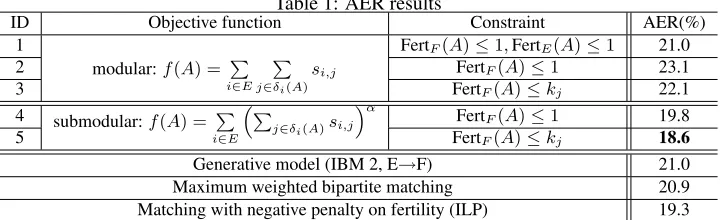
where the translation probability p(fj|ei) and alignment probabilityp(i|j, I)were obtained from IBM model 2 trained on the 1.1M sentences. The IBM 2 models gives an AER of 21.0% with French as the target, in line with the numbers reported in Och and Ney (2003) and Lacoste-Julien et al. (2006). We tested two types of partition matroid con-straints. The first is a global matroid constraint:
A∈ {A0 ⊆V :∀j ∈F,|A0∩PjE| ≤b}, (6)
which restricts fertility ofallwords onFside to be at most b. This constraint is denoted as FertF(A)≤b in Table 1 for simplicity. The second type, denoted as FertF(A)≤kj, is word-dependent:
A∈ {A0 ⊆V :∀j ∈F,|A0∩PjE| ≤kj}, (7)
where the fertility of word onj is restricted to be at most kj. Here kj = max{b : pb(f) ≤ θ, b ∈
{0,1, . . . ,5}}, whereθis a threshold and pb(f) is the probability that French wordf was aligned to at mostbEnglish words based on the IBM 2 alignment. As mentioned in Section 3, matroid constraints generalize the matching constraint. In particular, when using two matroid constraints, FertE(A)≤1
Table 1: AER results
ID Objective function Constraint AER(%)
1 FertF(A)≤1,FertE(A)≤1 21.0
2 FertF(A)≤1 23.1
3
modular:f(A) = P i∈E
P
j∈δi(A)
si,j
FertF(A)≤kj 22.1
4 FertF(A)≤1 19.8
5 submodular:f(A) =
P
i∈E “
P
j∈δi(A)si,j
”α
FertF(A)≤kj 18.6
Generative model (IBM 2, E→F) 21.0
Maximum weighted bipartite matching 20.9 Matching with negative penalty on fertility (ILP) 19.3
greedy algorithm to solve this problem, we get AER 21.0% (setup 1 in Table 1) – no significant difference compared to the AER (20.9%) achieved by the ex-act solution (maximum weighted bipartite matching approach), illustrating that greedy solutions are near-optimal. Note that the bipartite matching approach does not improve performance over IBM 2 model, presumably because only one feature was used here. When allowing fertility of English words to be more than one, we see a significant AER reduction using a submodular objective (setup 4 and 5) instead of a modular objective (setup 2 and 3), which verifies our claim that submodularity lends itself to modeling the marginal benefit of growing fertility. In setup 2 and 4, while allowing larger fertility for English words, we restrict the fertility of French words to be most one. To allow higher fertility for French words, one possible approach is to use constraint FertF(A) ≤ 2, in which all French words are allowed to have fertility up to 2. This approach, how-ever, results in a significant increase of false positive alignments since all French words tend to collect as many matches as permitted. This issue could be alleviated by introducing a symmetric version of the objective function in Eq. 3 such that marginal benefit of higher fertility of French words are also compressed. Alternatively, we use the second type of matroid constraint in which fertility upper bounds of French words are word-dependent instead of global. Withθ=.8, about 10 percent of the French words have kj equal to 2 or greater. By using the word-dependent matroid constraint (setup 3 and 5), AERs are reduced compared to those using global matroid constraints. In particular, 18.6% AER is achieved by setup 5, which significantly outperforms the maximum weighted bipartite matching approach. We also compare our method with model of Lacoste-Julien et al. (2006) which also allows
fer-tility larger than one by penalizing different levels of fertility. We usedsi,jas an edge feature andpb(f)as a node feature together with two additional features: a bias feature and the bucketed frequency of the word type. The same procedures for training and decoding as in (Lacoste-Julien et al., 2006) were performed where MOSEK was used as the ILP solver. As shown in Table 1, performance of setup 5 outperforms this model and moreover, our approach is at least 50 times faster: it took our approach only about half a second to align all the 347 test set sentence pairs whereas using the ILP-based approach took about 40 seconds.
6 Discussion
We have presented a novel framework where word alignment is framed as submodular maximization subject to matroid constraints. Our framework extends previous matching-based frameworks in two respects: submodular objective functions generalize modular (linear) objective functions, and matroid constraints generalize matching constraints. Moreover, such generalizations do not incur a prohibitive computational price since submodular maximization over matroids can be efficiently solved with performance guarantees. As it is possible to leverage richer forms of submodular functions that model higher order interactions, we believe that the full potential of our approach has yet to be explored. Our approach might lead to novel approaches for machine translation as well.
Acknowledgment
References
P.F. Brown, V.J.D. Pietra, S.A.D. Pietra, and R.L. Mercer. 1993. The mathematics of statistical machine transla-tion: Parameter estimation. Computational linguistics, 19(2):263–311.
J. Edmonds, 1970.Combinatorial Structures and their Ap-plications, chapter Submodular functions, matroids and certain polyhedra, pages 69–87. Gordon and Breach. ML Fisher, GL Nemhauser, and LA Wolsey. 1978. An
analysis of approximations for maximizing submodular set functions—II. Polyhedral combinatorics, pages 73–87.
S. Jegelka and J. A. Bilmes. 2011. Submodularity beyond submodular energies: coupling edges in graph cuts.
InComputer Vision and Pattern Recognition (CVPR),
Colorado Springs, CO, June.
D. Kempe, J. Kleinberg, and E. Tardos. 2003. Maximiz-ing the spread of influence through a social network.
InProceedings of the 9th Conference on SIGKDD
In-ternational Conference on Knowledge Discovery and
Data Mining (KDD).
V. Kolmogorov and R. Zabin. 2004. What energy func-tions can be minimized via graph cuts? IEEE Trans-actions on Pattern Analysis and Machine Intelligence, 26(2):147–159.
A. Krause and C. Guestrin. 2005. Near-optimal nonmy-opic value of information in graphical models. InProc. of Uncertainty in AI.
A. Krause, H.B. McMahan, C. Guestrin, and A. Gupta. 2008. Robust submodular observation selection.
Jour-nal of Machine Learning Research, 9:2761–2801.
S. Lacoste-Julien, B. Taskar, D. Klein, and M.I. Jordan. 2006. Word alignment via quadratic assignment. In
Proceedings of the main conference on Human Lan-guage Technology Conference of the North American Chapter of the Association of Computational Linguis-tics, pages 112–119. Association for Computational Linguistics.
J. Lee, M. Sviridenko, and J. Vondr´ak. 2009. Submodular maximization over multiple matroids via generalized exchange properties. Approximation, Randomization, and Combinatorial Optimization. Algorithms and Tech-niques, pages 244–257.
H. Lin and J. Bilmes. 2010. Multi-document summariza-tion via budgeted maximizasummariza-tion of submodular func-tions. InNorth American chapter of the Association for Computational Linguistics/Human Language
Tech-nology Conference (NAACL/HLT-2010), Los Angeles,
CA, June.
H. Lin and J. Bilmes. 2011. A class of submodular func-tions for document summarization. InThe 49th Annual Meeting of the Association for Computational
Linguis-tics: Human Language Technologies (ACL-HLT),
Port-land, OR, June.
E. Matusov, R. Zens, and H. Ney. 2004. Symmetric word alignments for statistical machine translation. In
Proceedings of the 20th international conference on Computational Linguistics, page 219. Association for Computational Linguistics.
I.D. Melamed. 2000. Models of translational equivalence among words. Computational Linguistics, 26(2):221– 249.
R. Mihalcea and T. Pedersen. 2003. An evaluation exer-cise for word alignment. InProceedings of the HLT-NAACL 2003 Workshop on Building and using parallel texts: data driven machine translation and
beyond-Volume 3, pages 1–10. Association for Computational
Linguistics.
M. Minoux. 1978. Accelerated greedy algorithms for maximizing submodular set functions. Optimization
Techniques, pages 234–243.
Mukund Narasimhan and Jeff Bilmes. 2004. PAC-learning bounded tree-width graphical models. In Un-certainty in Artificial Intelligence: Proceedings of the
Twentieth Conference (UAI-2004). Morgan Kaufmann
Publishers, July.
M. Narasimhan and J. Bilmes. 2005. A submodular-supermodular procedure with applications to discrimi-native structure learning. InProc. Conf. Uncertainty in Artifical Intelligence, Edinburgh, Scotland, July. Mor-gan Kaufmann Publishers.
M. Narasimhan and J. Bilmes. 2007. Local search for balanced submodular clusterings. InTwentieth Inter-national Joint Conference on Artificial Intelligence (IJ-CAI07), Hyderabad, India, January.
F.J. Och and H. Ney. 2003. A systematic comparison of various statistical alignment models. Computational linguistics, 29(1):19–51.
A. Schrijver. 2003. Combinatorial optimization: polyhe-dra and efficiency. Springer Verlag.
B. Taskar, S. Lacoste-Julien, and D. Klein. 2005. A dis-criminative matching approach to word alignment. In
Proceedings of the conference on Human Language Technology and Empirical Methods in Natural
Lan-guage Processing, pages 73–80. Association for
Com-putational Linguistics.
S. Vogel, H. Ney, and C. Tillmann. 1996. HMM-based word alignment in statistical translation. In
Proceedings of the 16th conference on Computational linguistics-Volume 2, pages 836–841. Association for Computational Linguistics.
J. Vondr´ak. 2008. Optimal approximation for the sub-modular welfare problem in the value oracle model. In
Proceedings of the 40th annual ACM symposium on