Labeling Documents with Timestamps:
Learning from their Time Expressions
Nathanael Chambers
Department of Computer Science United States Naval Academy
Abstract
Temporal reasoners for document understand-ing typically assume that a document’s cre-ation date is known. Algorithms to ground relative time expressions and order events of-ten rely on this timestamp to assist the learner. Unfortunately, the timestamp is not always known, particularly on the Web. This pa-per addresses the task of automatic document timestamping, presenting two new models that incorporate rich linguistic features about time. The first is a discriminative classifier with new features extracted from the text’s time expressions (e.g., ‘since 1999’). This model alone improves on previous generative mod-els by 77%. The second model learns prob-abilistic constraints between time expressions and the unknown document time. Imposing these learned constraints on the discriminative model further improves its accuracy. Finally, we present a new experiment design that facil-itates easier comparison by future work.
1 Introduction
This paper addresses a relatively new task in the NLP community: automatic document dating. Given a document with unknown origins, what char-acteristics of its text indicate the year in which the document was written? This paper proposes a learn-ing approach that builds constraints from a docu-ment’s use of time expressions, and combines them with a new discriminative classifier that greatly im-proves previous work.
The temporal reasoning community has long de-pended on document timestamps to ground
rela-tive time expressions and events (Mani and Wilson, 2000; Llid´o et al., 2001). For instance, consider the following passage from the TimeBank corpus (Pustejovsky et al., 2003):
And while there was no profitthis yearfrom discontinued operations, last year they con-tributed 34 million, before tax.
Reconstructing the timeline of events from this doc-ument requires extensive temporal knowledge, most notably, the document’s creation date to ground its relative expressions (e.g., this year = 2012). Not only did the latest TempEval competitions (Verha-gen et al., 2007; Verha(Verha-gen et al., 2009) include tasks to link events to the (known) document cre-ation time, but state-of-the-art event-event ordering algorithms also rely on these timestamps (Chambers and Jurafsky, 2008; Yoshikawa et al., 2009). This knowledge is assumed to be available, but unfortu-nately this is not often the case, particularly on the Web.
Document timestamps are growing in importance to the information retrieval (IR) and management communities as well. Several IR applications de-pend on knowledge of when documents were posted, such as computing document relevance (Li and Croft, 2003; Dakka et al., 2008) and labeling search queries with temporal profiles (Diaz and Jones, 2004; Zhang et al., 2009). Dating documents is sim-ilarly important to processing historical and heritage collections of text. Some of the early work that moti-vates this paper arose from the goal of automatically grounding documents in their historical contexts (de Jong et al., 2005; Kanhabua and Norvag, 2008; Ku-mar et al., 2011). This paper builds on their work
by incorporating more linguistic knowledge and ex-plicit reasoning into the learner.
The first part of this paper describes a novel learn-ing approach to document datlearn-ing, presentlearn-ing a dis-criminative model and rich linguistic features that have not been applied to document dating. Further, we introduce new features specific to absolute time expressions. Our model outperforms the generative models of previous work by 77%.
The second half of this paper describes a novel learning algorithm that orders time expressions against the unknown timestamp. For instance, the phrasethe second quarter of 1999might be labeled as beingbeforethe timestamp. These labels impose constraints on the possible timestamp and narrow down its range of valid dates. We combine these constraints with our discriminative learner and see another relative improvement in accuracy by 9%.
2 Previous Work
Most work on dating documents has come from the IR and knowledge management communities inter-ested in dating documents with unknown origins. de Jong et al. (2005) was among the first to auto-matically label documents with dates. They learned unigram language models (LMs) for specific time periods and scored articles with log-likelihood ra-tio scores. Kanhabua and Norvag (2008; 2009) tended this approach with the same model, but ex-panded its unigrams with POS tags, collocations, and tf-idf scores. They also integrated search engine results as features, but did not see an improvement. Both works evaluated on the news genre.
Recent work by Kumar et al. (2011) focused on dating Gutenberg short stories. As above, they learned unigram LMs, but instead measured the KL-divergence between a document and a time period’s LM. Our proposed models differ from this work by applying rich linguistic features, discriminative models, and by focusing on how time expressions improve accuracy. We also study the news genre.
The only work we are aware of within the NLP community is that of Dalli and Wilks (2006). They computed probability distributions over different time periods (e.g., months and years) for each ob-served token. The work is similar to the above IR work in its bag of words approach to classification.
They focused on finding words that show periodic spikes (defined by the word’s standard deviation in its distribution over time), weighted with inverse document frequency scores. They evaluated on a subset of the Gigaword Corpus (Graff, 2002).
The experimental setup in the above work (except Kumar et al. who focus on fiction) all train on news articles from a particular time period, and test on ar-ticles in the same time period. This leads to possi-ble overlap of training and testing data, particularly since news is often reprinted across agencies the same day. In fact, one of the systems in Kanhabua and Norvag (2008) simply searches for one training document that best matches a test document, and as-signs its timestamp. We intentionally deviate from this experimental design and instead create tempo-rally disjoint train/test sets (see Section 5).
Finally, we extend this previous work by focusing on aspects of language not yet addressed for docu-ment dating: linguistic structure and absolute time expressions. The majority of articles in our dataset contain time expressions (e.g., the year 1998), yet these have not been incorporated into the models de-spite their obvious connection to the article’s times-tamp. This paper first describes how to include time expressions as traditional features, and then describes a more sophisticated temporal reasoning component that naturally fits into our classifier.
3 Timestamp Classifiers
Labeling documents with timestamps is similar to topic classification, but instead of choosing from topics, we choose the most likely year (or other granularity) in which it was written. We thus begin with a bag-of-words approach, reproducing the gen-erative model used by both de Jong (2005) and Kan-habua and Norvag (2008; 2009). The subsequent sections then introduce our novel classifiers and temporal reasoners to compare against this model.
3.1 Language Models
N LLR(D, Y) = X
w∈D
P(w|D)∗log(P(w|Y)
P(w|C)) (1)
whereD is the target document,Y is the time span (e.g., a year), andC is the distribution of words in the corpus across all years. A document is labeled with the year that satisfiesargmaxYN LLR(D, Y). They adapted this model from earlier work in the IR community (Kraaij, 2004). We apply Dirichlet-smoothing to the language models (as in de Jong et al.), although the exact choice ofαdid not signifi-cantly alter the results, most likely due to the large size of our training corpus. Kanhabua and Norvag added an entropy factor to the summation, but we did not see an improvement in our experiments.
The unigramsware lowercased tokens. We will refer to this de Jong et al. model as theUnigram NLLR. Follow-up work by Kanhabua and Norvag (2008) applied two filtering techniques to the uni-grams in the model:
1. Word Classes: include only nouns, verbs, and adjectives as labeled by a POS tagger
2. IDF Filter: include only the top-ranked terms by tf-idf score
We also tested with these filters, choosing a cut-off for the top-ranked terms that optimized perfor-mance on our development data. We also stemmed the words as Kanhabua and Norvag suggest. This model is theFiltered NLLR.
Kanhabua and Norvag also explored what they termed collocation features, but lacking details on how collocations were included (or learned), we could not reproduce this for comparison. How-ever, we instead propose using NER labels to ex-tract what may have counted as collocations in their data. Named entities are important to document dat-ing due to the nature of people and places comdat-ing in and out of the news at precise moments in time. We compare the NER features against the Unigram and Filtered NLLR models in our final experiments.
3.2 Discriminative Models
In addition to reproducing the models from previous work, we also trained a new discriminative version with the same features. We used a MaxEnt model and evaluated with the same filtering methods based
on POS tags and tf-idf scores. The model performed best on the development data without any filtering or stemming. The final results (Section 6) only use the lowercased unigrams. Ultimately, this MaxEnt model vastly outperforms these NLLR models.
3.3 Models with Time Expressions
The above language modeling and MaxEnt ap-proaches are token-based classifiers that one could apply to any topic classification domain. Barring other knowledge, the learners solely rely on the ob-served frequencies of unigrams in order to decide which class is most likely. However, document dat-ing is not just a simple topic classification applica-tion, but rather relates to temporal phenomena that is often explicitly described in the text itself. Lan-guage contains words and phrases that discuss the very time periods we aim to recover. These expres-sions should be better incorporated into the learner.
3.3.1 Motivation
Let the following snippet serve as a text example with an ambiguous creation time:
Then there’s the fund-raiser at the American Museum of Natural History, which plans to welcome about 1,500 guests paying $1,000 to $5,000. Their tickets will entitle them to a pre-view of...the new Hayden Planetarium.
Without extremely detailed knowledge about the American Museum of Natural History, the events discussed here are difficult to place in time, let alone when the author reported it. However, time expres-sions are sometimes included, and the last sentence in the original text contains a helpful relative clause:
Their tickets will entitle them to a preview of...the new Hayden Planetarium,which does not officially open until February 2000.
This paper discusses two complementary ways to learn and reason about this information. The first is to simply add richer time-based features into the model. The second is to build separate learners that can assign probabilities to entire ranges of dates, such as all years following 2000 in the example above. We begin with the feature-based model.
3.3.2 Time Features
To our knowledge, the following time features have not been used in a document dating setting. We use the freely available Stanford Parser and NER system1 to generate the syntactic interpretation for these features. We then train a MaxEnt classifier and compare against previous work.
Typed Dependency: The most basic time feature is including governors of year mentions and the rela-tion between them. This covers important contexts that determine the semantics of the time frame, like prepositions. For example, consider the following context for the mention1997:
Torre, who watched the Kansas City Royals beat the Yankees, 13-6, on Friday for the first time since 1997.
The resulting feature is ‘since pobj 1997’.
Typed Dependency POS: Similar to Typed Depen-dency, this feature uses POS tags of the dependency relation’s governor. The feature from the previous example is now‘PP pobj 1997’. This generalizes the features to capture time expressions with prepo-sitions, as noun modifiers, or other constructs.
Verb Tense: An important syntactic feature for tem-poral positioning is the tense of the verb that domi-nates the time expression. A past tense verb situates the phrasein 2003differently than one in the future. We traverse the sentence’s parse tree until a gover-nor with a VB* tag is found, and determine its tense through hand constructed rules based on the struc-ture of the parent VP. The verb tense feastruc-ture takes a value ofpast,present,future, orundetermined.
Verb Path: The verb path feature is the dependency path from the nearest verb to the year expression. The following snippet will include the feature, ‘ex-pected prep in pobj 2002’.
1
http://nlp.stanford.edu/software
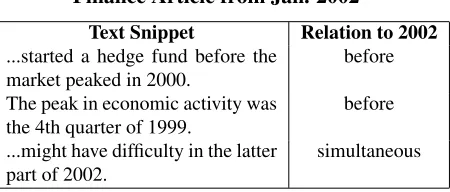
Finance Article from Jan. 2002
Text Snippet Relation to 2002
...started a hedge fund before the market peaked in 2000.
before
The peak in economic activity was the 4th quarter of 1999.
before
...might have difficulty in the latter part of 2002.
[image:4.612.316.541.67.163.2]simultaneous
Figure 1: Three year mentions and their relation to the document creation year. Relations can be correctly iden-tified for training using known document timestamps.
Supervising them is Vice President Hu Jintao, who appears to be Jiang’s favored successor if he retires from leadership as expected in 2002.
Named Entities: Although not directly related to time expressions, we also include n-grams of tokens that are labeled by an NER system using Person, Or-ganization, or Location. People and places are often discussed during specific time periods, particularly in the news genre. Collecting named entity mentions will differentiate between an article discussing abill and one discussing the US President, Bill Clinton. We extract NER features as sequences of uninter-rupted tokens labeled with the same NER tag, ignor-ing unigrams (since unigrams are already included in the base model). Using the Verb Path example above, the bigram featureHu Jintaois included.
4 Learning Time Constraints
This section departs from the abovedocument clas-sifiers and instead classifies individual emphyear mentions. The goal is to automatically learn tem-poral constraintson the document’s timestamp.
Instead of predicting a single year for a document, a temporal constraint predicts a range of years. Each time mention, such as ‘not since 2009’, is a con-straint representing its relation to the document’s timestamp. For example, the mentioned year ‘2009’ must occur before the year of document creation. This section builds a classifier to label time mentions with their relations (e.g., before, after, or simultane-ous with the document’s timestamp), enabling these mentions to constrain the document classifiers de-scribed above. Figure 1 gives an example of time mentions and the desired labels we wish to learn.
1995 1996 1997 1998 1999 2000 2001 2004 2005 0
0.05 0.1 0.15 0.2
Probability
[image:5.612.78.297.63.166.2]Year Class
Figure 2: Distribution over years for a single document as output by a MaxEnt classifier.
Figure 2 illustrate a typical distribution output by a document classifier for a training document. Two of the years appear likely (1999 and 2001), how-ever, the document contains a time expression that seems to impose a strict constraint that should elim-inate 2001 from consideration:
Their tickets will entitle them to a preview of...the new Hayden Planetarium, which does not officially open until February 2000.
The clauseuntil February 2000in a present tense context may not definitively identify the document’s timestamp (1999 is a good guess), but as discussed earlier, it should remove all future years beyond 2000 from consideration. We thus want to impose a constraint based on this phrase that says, loosely, ‘this document was likely written before 2000’.
The document classifiers described in previous sections cannot capture such ordering information. Our new time features in Section 3.3.2 add richer time information (such asuntil pobj 2000andopen prep until pobj 2000), but they compete with many other features that can mislead the final classifica-tion. An independent constraint learner may push the document classifier in the right direction.
4.1 Constraint Types
We learn several types of constraints between each year mention and the document’s timestamp. Year mentions are defined as tokens with exactly four digits, numerically between 1900 and 2100. LetT be the document timestamp’s year, andM the year mention. We define threecore relations:
1. BeforeTimestamp:M < T
2. AfterTimestamp:M > T
3. Sameas Timestamp:M ==T
We also experiment with 7fine-grained relations:
1. One year BeforeTimestamp:M ==T−1
2. Two years BeforeTimestamp:M ==T−2
3. Three+ years BeforeTimestamp:M < T−2
4. One year AfterTimestamp:M ==T+ 1
5. Two years AfterTimestamp:M ==T+ 2
6. Three+ years AfterTimestamp:M > T + 2
7. SameYear and Timestamp:M ==T
Obviously the more fine-grained a relation, the bet-ter it can inform a classifier. We experiment with these two granularities to compare performance.
The learning process is a typical training envi-ronment where year mentions are treated as labeled training examples. Labels for year mentions are automatically computed by comparing the actual timestamp of the training document (all documents in Gigaword have dates) with the integer value of the year token. For example, a document written in 1997 might contain the phrase, “in the year 2000”. The year token (2000) is thusthree+ years afterthe timestamp (1997). We use this relation for the year mention as a labeled training example.
Ultimately, we want to use similar syntactic con-structs in training so that “in the year 2000” and “in the year 2003” mutually inform each other. We thus compute the label for each time expression, and re-place the integer year with the genericYEARtoken to generalize mentions. The text for this example be-comes “in the year YEAR” (labeled asthree+ years after). We train a MaxEnt model on each year men-tion, to be described next. Table 2 gives the overall counts for the core relations in our training data. The vast majority of year mentions are references to the future (e.g. after the timestamp).
4.2 Constraint Learner
The features we use to classify year mentions are given in Table 1. The same time features in the docu-ment classifier of Section 3.3.2 are included, as well as several others specific to this constraint task.
Time Constraint Features
Typed Dep. Same as Section 3.3.2 Verb Tense Same as Section 3.3.2 Verb Path Same as Section 3.3.2
Decade The decade of the year mention Bag of Words Unigrams in the year’s sentence n-gram The 4-gram and 3-gram that end
with the year
[image:6.612.316.541.65.186.2]n-gram POS The 4-gram and 3-gram of POS tags that end with the year
Table 1: Features used to classify year expressions.
Constraint Count
After Timestamp 1,203,010 Before Timestamp 168,185 Same as Timestamp 141,201
Table 2: Training size of year mentions (and their relation to the document timestamp) in Gigaword’s NYT section.
year predictions. Let Td be the set of mentions in documentd. We represent a MaxEnt classifier by PY(R|t)for a time mentiont∈Tdand possible re-lationsR. We map this distribution over relations to a distribution over years by definingPyear(Y|d):
Pyear(y|d) =
1
Z(Td)
X
t∈Td
PY(rel(val(t)−y)|t) (2)
rel(x) =
bef ore ifx <0
af ter ifx >0
simultaneous otherwise
(3)
whereval(t)is the integer year of the year mention andZ(Td)is the partition function. Therel(val(t)− y)function simply determines if the year mentiont (e.g., 2003) is before, after, or overlaps the year we are predicting for the document’s unknown times-tampy. We use a similar function for the seven fine-grained relations. Figure 3 visually illustrates how Pyear(y|d)is constructed from three year mentions.
4.3 Joint Classifier
Finally, given the document classifiers of Section 3 and the constraint classifier just defined in Section 4, we create a joint model combining the two with the following linear interpolation:
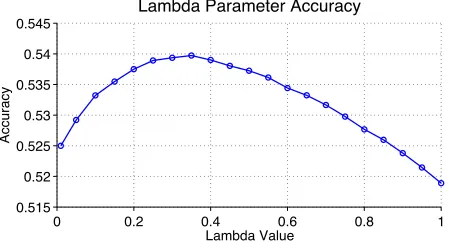
P(y|d) =λPdoc(y|d) + (1−λ)Pyear(y|d) (4)
whereyis a year, anddis the document. λwas set to0.35by maximizing accuracy on the dev set. See
0 0.2 0.4 0.6 0.8 1 0.515
0.52 0.525 0.53 0.535 0.54 0.545
Lambda Value
Accuracy
[image:6.612.78.298.69.183.2]Lambda Parameter Accuracy
Figure 4: Development set accuracy andλvalues.
Figure 4. This optimal λ = .35 weights the con-straint classifier higher than the document classifier.
5 Datasets
This paper uses the New York Times section of the Gigaword Corpus (Graff, 2002) for evaluation. Most previous work on document dating evaluates on the news genre, so we maintain the pattern for consis-tency. Unfortunately, we cannot compare to these previous experiments because of differing evalua-tion setups. Dalli and Wilks (2006) is most similar in their use of Gigaword, but they chose a random set of documents that cannot be reproduced. We instead define specific segments of the corpus for evaluation. The main goal for this experiment setup was to es-tablish specific training, development, and test sets. One of the potential difficulties in testing with news articles is that the same story is often reprinted with very minimal (or no) changes. Over 10% of the doc-uments in the New York Times section of the Giga-word Corpus are exact or approximate duplicates of another document in the corpus2. A training set for document dating must not include duplicates from the test set.
We adopt the intuition behind the experimen-tal setup used in other NLP domains, like parsing, where the entire test set is from a contiguous sec-tion of the corpus (as opposed to randomly selected examples across the corpus). As the parsing com-munity trains on sections 2-21 of the Penn Treebank (Marcus et al., 1993) and tests on section 23, we cre-ate Gigaword sections by isolating specific months.
2Approximate duplicateis defined as an article whose first
Year Distributions for Three Time Expressions
97 98 99 00 01 02 03 04 05 96
PY(y | "peaked in 2000")
PY(y | "was the quarter of 1999")
PY(y | "will have difficulty in part of 2003")
Final Distribution - Pyear(y|d)
0.2
0.0 0.2
0.0
0.2
0.0
0.2
[image:7.612.118.502.76.196.2]0.0
Figure 3: Three year mentions in a document and the distributions output by the learner. The document is from 2002. The dots indicate thebefore,same, andafterrelation probabilities. The combination of three constraints results in a final distribution that gives the years 2001 and 2002 the highest probability. This distribution can help a document classifier make a more informed final decision.
Training Jan-May and Sep-Dec Development July
Testing June and August
In other words, the development set includes docu-ments from July 1995, July 1996, July 1997, etc. We chose the dev/test sets to be in the middle of the year so that the training set includes documents on both temporal sides of the test articles. We include years 1995-2001 and 2004-2006, but skip 2002 and 2003 due to their abnormally small size compared to the other years.
Finally, we experiment in a balanced data set-ting, training and testing on the same number of documents from each year. The test set in-cludes 11,300 documents in each year (months June and August) for a total of 113,000 test doc-uments. The development set includes 7,300 from July of each year. Training includes ap-proximately 75,000 documents in each year with some years slightly less than 75,000 due to their smaller size in the corpus. The total number of training documents for the 10 evaluated years is 725,468. The full list of documents is online at www.usna.edu/Users/cs/nchamber/data/timestamp.
6 Experiments and Results
We experiment on the Gigaword corpus as described in Section 5. Documents are tokenized and parsed with the Stanford Parser. The year in the times-tamp is retrieved from the document’s Gigaword ID which contains the year and day the article was
re-trieved. Year mentions are extracted from docu-ments by matching all tokens with exactly four digits whose integer is in the range of 1900 and 2100.
The MaxEnt classifiers are also from the Stanford toolkit, and both the document and year mention classifiers use its default settings (quadratic prior). The λ factor in the joint classifier is optimized on the development set as described in Section 4.3. We also found that dev results improved when training ignores the border months of Jan, Feb, and Dec. The features described in this paper were selected solely by studying performance on the development set. The final reported results come from running on the test set once at the end of this study.
Table 3 shows the results on the Test set for all document classifiers. We measure accuracy to com-pare overall performance since the test set is a bal-anced set (each year has the same number of test documents). Unigram NLLRandFiltered NLLR are the language model implementations of previ-ous work as described in Section 3.1. MaxEnt Un-igramis our new discriminative model for this task. MaxEnt Timeis the discriminative model with rich time features (but not NER) as described in Section 3.3.2 (Time+NERincludes NER). Finally, theJoint model is the combined document and year mention classifiers as described in Section 4.3. Table 4 shows the F1 scores of the Joint model by year.
Model Overall Accuracy
Random Guess 10.0% Unigram NLLR 24.1% Filtered NLLR 29.1% MaxEnt Unigram 45.1% MaxEnt Time 48.3% MaxEnt Time+NER 51.4%
[image:8.612.96.275.59.162.2]Joint 53.4%
Table 3: Performance as measured by accuracy. The pre-dicted year must exactly match the actual year.
95 96 97 98 99 00 01 02
P .57 .49 .52 .48 .47 .51 .51 .59
R .54 .56 .62 .44 .48 .48 .46 .57
F1 .55 .52 .57 .46 .48 .49 .48 .58
Table 4: Yearly results for the Joint model. 2005/06 are omitted due to space, with F1 .56 and .63, respectively.
7%, and adding NER by another 6%. Total relative improvement in accuracy is thus almost 77% from the Time+NER model over Filtered NLLR. Further, the temporal constraint model increases this best classifier by another 3.9%. All improvements are statistically significant (p < 0.000001, McNemar’s test, 2-tailed). Table 6 shows that performance in-creased most on the documents that contain at least one year mention (60% of the corpus).
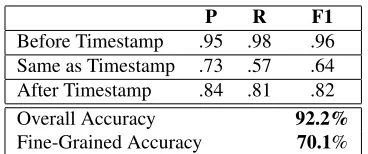
Finally, Table 5 shows the results of the tempo-ral constraint classifiers on year mentions. Not sur-prisingly, the fine-grained performance is quite a bit lower than the core relations. The full Joint results in Table 3 use the three core relations, but the seven fine-grained relations give approximately the same results. Its lower accuracy is mitigated by the finer granularity (i.e., the majority class basline is lower).
7 Discussion
The main contribution of this paper is the discrimi-native model (54% improvement) and a new set of
P R F1
Before Timestamp .95 .98 .96 Same as Timestamp .73 .57 .64 After Timestamp .84 .81 .82
Overall Accuracy 92.2%
Fine-Grained Accuracy 70.1%
Table 5: Precision, recall, and F1 for the core relations. Accuracy for both core and fine-grained.
All With Year Mentions
MaxEnt Unigram 45.1% 46.1% MaxEnt Time+NER 51.4% 54.3%
[image:8.612.78.294.204.251.2]Joint 53.4% 57.7%
Table 6: Accuracy on all documents and documents with at least one year mention (about 60% of the corpus).
features for document dating (14% improvement). Such a large performance boost makes clear that the log likelihood and entropy approaches from previ-ous work are not as effective as discriminative mod-els on a large training corpus. Further, token-based features do not capture the implicit references to time in language. Our richer syntax-based features only apply to year mentions, but this small textual phenomena leads to a surprising 13% relative im-provement in accuracy. Table 6 shows that a signif-icant chunk of this improvement comes from docu-ments containing year mentions, as expected.
The year constraint learner also improved perfor-mance. Although most of its features are in the doc-ument classifier, by learning constraints it captures a different picture of time that a traditional document classifier does not address. Combining this picture with the document classifier leads to another 3.9% relative improvement. Although we focused on year mentions here, there are several avenues for future study, including explorations of how other types of time expressions might inform the task. These con-straints might also have applications to the ordering tasks of recent TempEval competitions.
Finally, we presented a new evaluation setup for this task. Previous work depended on having train-ing documents in the same week and day of the test documents. We argued that this may not be an ap-propriate assumption in some domains, and particu-larly problematic for the news genre. Our proposed evaluation setup instead separates training and test-ing data across months. The results show that log-likelihood ratio scores do not work as well in this environment. We hope our explicit train/test envi-ronment encourages future comparison and progress on document dating.
Acknowledgments
[image:8.612.95.279.602.679.2]References
Nathanael Chambers and Dan Jurafsky. 2008. Jointly combining implicit constraints improves temporal or-dering. In Proceedings of the Conference on Em-pirical Methods on Natural Language Processing (EMNLP), Hawaii, USA.
W. Dakka, L. Gravano, and P. G. Ipeirotis. 2008. An-swering general time sensitive queries. InProceedings of the 17th International ACM Conference on Informa-tion and Knowledge Management, pages 1437–1438. Angelo Dalli and Yorick Wilks. 2006. Automatic
dat-ing of documents and temporal text classification. In
Proceedings of the Workshop on Annotating and Rea-soning about Time and Events, pages 17–22.
Franciska de Jong, Henning Rode, and Djoerd Hiemstra. 2005. Temporal language models for the disclosure of historical text. InHumanities, computers and cultural heritage: Proceedings of the XVIth International Con-ference of the Association for History and Computing (AHC 2005).
Fernando Diaz and Rosie Jones. 2004. Using temporal profiles of queries for precision prediction. In Pro-ceedings of the 27th Annual International ACM Spe-cial Interest Group on Information Retrieval Confer-ence.
David Graff. 2002. English Gigaword. Linguistic Data Consortium.
Nattiya Kanhabua and Kjetil Norvag. 2008. Improv-ing temporal language models for determinImprov-ing time of non-timestamped documents. In Proceedings of the 12th European conference on Research and Advanced Technology for Digital Libraries.
Nattiya Kanhabua and Kjetil Norvag. 2009. Using tem-poral language models for document dating. Lecture Notes in Computer Science: machine learning and knowledge discovery in databases, 5782.
W. Kraaij. 2004. Variations on language modeling for information retrieval. Ph.D. thesis, University of Twente.
Abhimanu Kumar, Matthew Lease, and Jason Baldridge. 2011. Supervised language modeling for temporal res-olution of texts. InProceedings of CIKM.
Xiaoyan Li and W. Bruce Croft. 2003. Time-based lan-guage models. InProceedings of the twelfth interna-tional conference on Information and knowledge man-agement.
Dolores M. Llid´o, Rafael Llavori, and Mari´a J. Aram-buru. 2001. Extracting temporal references to assign document event-time periods. InProceedings of the 12th International Conference on Database and Ex-pert Systems Applications.
Inderjeet Mani and George Wilson. 2000. Robust tempo-ral processing of news. InProceedings of the 38th An-nual Meeting on Association for Computational Lin-guistics.
Mitchell P. Marcus, Beatrice Santorini, and Mary Ann Marcinkiewicz. 1993. Building a large annotated cor-pus of english: The penn treebank. Computational Linguistics, 19.
James Pustejovsky, Patrick Hanks, Roser Sauri, Andrew See, David Day, Lisa Ferro, Robert Gaizauskas, Mar-cia Lazo, Andrea Setzer, and Beth Sundheim. 2003. The timebank corpus.Corpus Linguistics, pages 647– 656.
Marc Verhagen, Robert Gaizauskas, Frank Schilder, Mark Hepple, Graham Katz, and James Pustejovsky. 2007. Semeval-2007 task 15: Tempeval temporal re-lation identification. InWorkshop on Semantic Evalu-ations.
Marc Verhagen, Robert Gaizauskas, Frank Schilder, Mark Hepple, Jessica Moszkowicz, and James Puste-jovsky. 2009. The tempeval challenge: identifying temporal relations in text. Special Issue: Computa-tional Semantic Analysis of Language: SemEval-2007 and Beyond, 43(2):161–179.
Katsumasa Yoshikawa, Sebastian Riedel, Masayuki Asa-hara, and Yuji Matsumoto. 2009. Jointly identify-ing temporal relations with markov logic. In Proceed-ings of the Association for Computational Linguistics (ACL).