
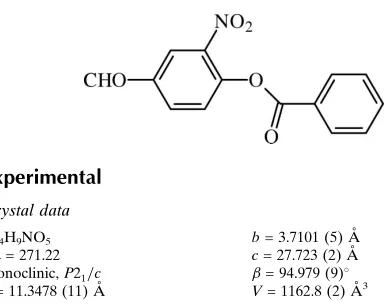
4-Formyl-2-nitrophenyl benzoate
Rodolfo Moreno-Fuquen,a* Geraldine Hernandezaand Alan R. Kennedyb
a
Departamento de Quı´mica, Facultad de Ciencias, Universidad del Valle, Apartado 25360, Santiago de Cali, Colombia, andbWestCHEM, Department of Pure and Applied Chemistry, University of Strathclyde, 295 Cathedral Street, Glasgow G1 1XL, Scotland
Correspondence e-mail: [email protected]
Received 4 February 2014; accepted 5 February 2014
Key indicators: single-crystal X-ray study;T= 123 K; mean(C–C) = 0.005 A˚; Rfactor = 0.065;wRfactor = 0.190; data-to-parameter ratio = 11.9.
In the title nitroaryl benzoate derivative, C14H9NO5, the
aromatic rings form a dihedral angle of 46.37 (8). The central ester moiety, —C—(C O)—O—, is essentially planar (r.m.s. deviation for all non-H atoms = 0.0283 A˚ ) and forms a dihedral angle of 54.06 (9) with the 4-formyl-2-nitrophenyl ring and 7.99 (19) with the benzoate ring. In the crystal, molecules are intertwined by weak C—H O interactions, forming helical chains along [100].
Related literature
For similar esters, see: Moreno-Fuquenet al.(2013a,b, 2014). For hydrogen bonding, see: Nardelli (1995) and for hydrogen-bond motifs, see: Etter (1990).
Experimental
Crystal data
C14H9NO5
Mr= 271.22 Monoclinic,P21=c
a= 11.3478 (11) A˚
b= 3.7101 (5) A˚ c= 27.723 (2) A˚
= 94.979 (9)
V= 1162.8 (2) A˚3
Z= 4
CuKradiation
= 1.02 mm1
T= 123 K
0.210.120.02 mm
Data collection
Oxford Diffraction Xcalibur E diffractometer
Absorption correction: multi-scan (CrysAlis PRO; Agilent, 2010) Tmin= 0.813,Tmax= 1.000
4231 measured reflections 2213 independent reflections 1403 reflections withI> 2(I) Rint= 0.049
Refinement
R[F2> 2(F2)] = 0.065
wR(F2) = 0.190
S= 0.99 2213 reflections 186 parameters
H atoms treated by a mixture of independent and constrained refinement
max= 0.37 e A˚ 3
[image:1.610.54.247.506.660.2]min=0.28 e A˚ 3
Table 1
Hydrogen-bond geometry (A˚ ,).
D—H A D—H H A D A D—H A
C10—H10 O4i
0.95 2.50 3.343 (4) 148
C12—H12 O5ii 0.95 2.62 3.346 (4) 134
Symmetry codes: (i)xþ1;yþ1
2;zþ12; (ii)xþ2;y12;zþ12.
Data collection: CrysAlis PRO(Agilent, 2010); cell refinement:
CrysAlis PRO; data reduction: CrysAlis PRO; program(s) used to solve structure: SHELXS97(Sheldrick, 2008); program(s) used to refine structure:SHELXL97(Sheldrick, 2008); molecular graphics:
ORTEP-3 for Windows(Farrugia, 2012) andMercury(Macraeet al., 2006); software used to prepare material for publication: WinGX
(Farrugia, 2012).
RMF thanks the Universidad del Valle, Colombia, for partial financial support.
Supporting information for this paper is available from the IUCr electronic archives (Reference: HG5380).
References
Agilent (2010).CrysAlis PRO. Oxford Diffraction Ltd, Yarnton, England. Etter, M. (1990).Acc. Chem. Res.23, 120–126.
Farrugia, L. J. (2012).J. Appl. Cryst.45, 849–854.
Macrae, C. F., Edgington, P. R., McCabe, P., Pidcock, E., Shields, G. P., Taylor, R., Towler, M. & van de Streek, J. (2006).J. Appl. Cryst.39, 453–457. Moreno-Fuquen, R., Hernandez, G., Ellena, J., De Simone, C. A. & Tenorio, J.
C. (2013a).Acta Cryst.E69, o793.
Moreno-Fuquen, R., Hernandez, G., Ellena, J., De Simone, C. A. & Tenorio, J. C. (2013b).Acta Cryst.E69, o1806.
Moreno-Fuquen, R., Herna´ndez, G. & Kennedy, A. R. (2014).Acta Cryst.E70, o17.
Nardelli, M. (1995).J. Appl. Cryst.28, 659. Sheldrick, G. M. (2008).Acta Cryst.A64, 112–122.
Acta Crystallographica Section E
Structure Reports Online
supporting information
Acta Cryst. (2014). E70, o268 [doi:10.1107/S1600536814002694]
4-Formyl-2-nitrophenyl benzoate
Rodolfo Moreno-Fuquen, Geraldine Hernandez and Alan R. Kennedy
S1. Comment
The title compound 4-formyl-2-nitrophenyl benzoate (I), is part of a series of studies on the structural properties of the
formyl nitro aryl benzoates developed by our research group. The molecular structure of (I) is shown in Fig. 1. Bond
lengths and bond angles show marked similarity with the 4-formyl-2-nitrophenyl 4-bromo benzoate (F4BrB)
(Moreno-Fuquen et al., 2013a), 4-formyl-2-nitrophenyl 4-cloro benzoate (F4ClB) (Moreno-Fuquen et al., 2013b) and
4-formyl-2-nitrophenyl 3-nitro-2-methyl benzoate (F3N2MB) (Moreno-Fuquen et al., 2014) reported earlier jobs. The benzene rings
of (I) form a dihedral angle of 46.36 (8)°. This value is quite different when compared to the systems F4BrB [62.90 (7)°],
F4ClB [19.55 (9)°] and F3N2MB [4.96 (3)°]. Substituents on the rings of each system are crucial in defining the values
of this angle. The central ester moiety, C1-(C7=O1)-O2-C8, is essentially planar (rms deviation for all non-H atoms =
0.0283 Å) and it forms dihedral angles of 54.06 (9)° with the formyl nitro aryl ring and 7.99 (19)° with the benzoate ring.
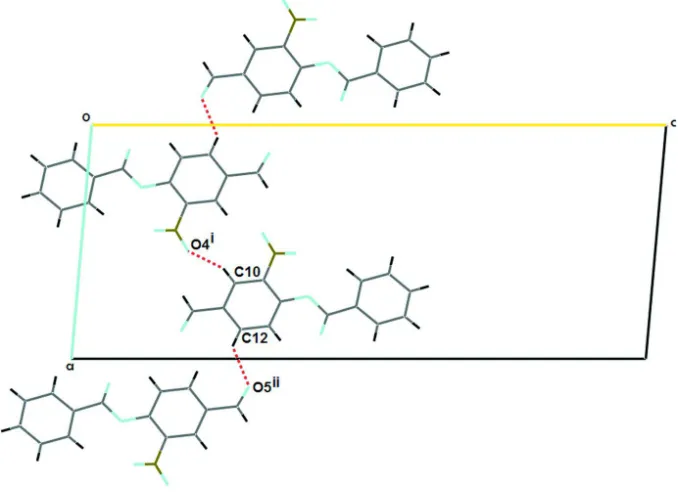
The nitro group forms a dihedral angle with the adjacent benzene ring of 39.66 (12)°. In the crystal, the C10 and C12
atoms of the formyl nitro aryl ring at (x, y, z) act as a hydrogen-bond donors to atom O4 at (-x+1,+y+1/2,-z+1/2) and to
atom O5 at (-x+2,+y-1/2,-z+1/2) forming C(5) and C(7) helical chains (Etter, 1990), along [100] (See Fig. 2). These
interactions are presented in Table 1. (Nardelli, 1995).
S2. Experimental
The reagents and solvents for the synthesis were obtained from the Aldrich-Sigma Chemical Co., and were used without
additional purification. In a 25 ml round bottom flask, 4-hydroxy-3-nitrobenzaldehyde (0.201 g, 0.571 mmol) and
benzoyl chloride in equimolar amounts, were dissolved in 20 mL of acetonitrile. After a short period of time, 0.03 ml of
pyridine were added. Then the mixture was left to reflux in constant stirring for about two hours. A colourless solid was
obtained after leaving the solvent to evaporate. m.p 384 (1)K.
S3. Refinement
All H-atoms were positioned at geometrically idealized positions with C—H distances of 0.95 Å and Uiso(H) = 1.2 times
Figure 1
Molecular conformation and atom numbering scheme for the title compound with displacement ellipsoids drawn at the
50% probability level. H atoms are shown as spheres of arbitrary radius.
Figure 2
Part of the crystal structure of (I), showing the formation of helical chains which running along [100]. Symmetry code: (i)
-x+1,+y+1/2,-z+1/2; (ii) -x+2,+y-1/2,-z+1/2.
4-Formyl-2-nitrophenyl benzoate
Crystal data
C14H9NO5
Mr = 271.22
Monoclinic, P21/c Hall symbol: -P 2ybc
a = 11.3478 (11) Å
c = 27.723 (2) Å
β = 94.979 (9)°
V = 1162.8 (2) Å3
Z = 4
[image:3.610.136.475.303.551.2]Melting point: 457(1) K Cu Kα radiation, λ = 1.54180 Å Cell parameters from 977 reflections
θ = 3.9–73.3°
µ = 1.02 mm−1
T = 123 K Plate, colourless 0.21 × 0.12 × 0.02 mm
Data collection
Oxford Diffraction Xcalibur E diffractometer
Radiation source: fine-focus sealed tube Graphite monochromator
ω scans
Absorption correction: multi-scan (CrysAlis PRO; Agilent, 2010)
Tmin = 0.813, Tmax = 1.000
4231 measured reflections 2213 independent reflections 1403 reflections with I > 2σ(I)
Rint = 0.049
θmax = 70.0°, θmin = 3.9°
h = −10→13
k = −4→4
l = −33→33
Refinement
Refinement on F2 Least-squares matrix: full
R[F2 > 2σ(F2)] = 0.065
wR(F2) = 0.190
S = 0.99 2213 reflections 186 parameters 0 restraints
Primary atom site location: structure-invariant direct methods
Secondary atom site location: difference Fourier map
Hydrogen site location: inferred from neighbouring sites
H atoms treated by a mixture of independent and constrained refinement
w = 1/[σ2(F
o2) + (0.0857P)2] where P = (Fo2 + 2Fc2)/3 (Δ/σ)max < 0.001
Δρmax = 0.37 e Å−3 Δρmin = −0.28 e Å−3
Extinction correction: SHELXL97 (Sheldrick, 2008), Fc*=kFc[1+0.001xFc2λ3/sin(2θ)]-1/4 Extinction coefficient: 0.0028 (7)
Special details
Geometry. All esds (except the esd in the dihedral angle between two l.s. planes) are estimated using the full covariance matrix. The cell esds are taken into account individually in the estimation of esds in distances, angles and torsion angles; correlations between esds in cell parameters are only used when they are defined by crystal symmetry. An approximate (isotropic) treatment of cell esds is used for estimating esds involving l.s. planes.
Refinement. Refinement of F2 against ALL reflections. The weighted R-factor wR and goodness of fit S are based on F2, conventional R-factors R are based on F, with F set to zero for negative F2. The threshold expression of F2 > σ(F2) is used only for calculating R-factors(gt) etc. and is not relevant to the choice of reflections for refinement. R-factors based on F2 are statistically about twice as large as those based on F, and R- factors based on ALL data will be even larger.
Fractional atomic coordinates and isotropic or equivalent isotropic displacement parameters (Å2)
x y z Uiso*/Ueq
O1 0.89645 (19) 0.3296 (7) 0.43051 (7) 0.0419 (7)
O2 0.73248 (18) 0.0150 (7) 0.40350 (7) 0.0398 (6)
O5 0.8819 (2) −0.0584 (8) 0.18661 (8) 0.0510 (8)
O3 0.5482 (2) 0.4580 (8) 0.37507 (8) 0.0457 (7)
O4 0.46029 (19) 0.1854 (8) 0.31290 (7) 0.0462 (7)
N1 0.5497 (2) 0.2761 (9) 0.33830 (9) 0.0374 (7)
C7 0.8124 (3) 0.1534 (10) 0.43947 (10) 0.0356 (8)
C1 0.7763 (3) 0.0601 (10) 0.48775 (11) 0.0363 (8)
C2 0.6678 (3) −0.1079 (9) 0.49328 (11) 0.0370 (8)
C3 0.6360 (3) −0.1820 (11) 0.53964 (11) 0.0404 (8)
H3 0.5626 −0.2956 0.5439 0.048*
C4 0.7118 (3) −0.0895 (10) 0.57954 (12) 0.0441 (9)
H4 0.6897 −0.1382 0.6112 0.053*
C5 0.8190 (3) 0.0722 (11) 0.57390 (11) 0.0436 (9)
H5 0.8708 0.1306 0.6016 0.052*
C6 0.8514 (3) 0.1497 (10) 0.52809 (11) 0.0393 (8)
H6 0.9249 0.2641 0.5243 0.047*
C8 0.7551 (3) 0.0466 (10) 0.35567 (11) 0.0353 (8)
C9 0.6635 (3) 0.1614 (10) 0.32282 (11) 0.0345 (8)
C10 0.6769 (3) 0.1666 (10) 0.27316 (11) 0.0364 (8)
H10 0.6138 0.2447 0.2508 0.044*
C11 0.7821 (3) 0.0577 (10) 0.25704 (11) 0.0369 (8)
C12 0.8741 (3) −0.0597 (10) 0.29011 (11) 0.0375 (8)
H12 0.9469 −0.1342 0.2788 0.045*
C13 0.8601 (3) −0.0684 (10) 0.33923 (11) 0.0380 (8)
H13 0.9224 −0.1530 0.3615 0.046*
C14 0.7966 (3) 0.0616 (11) 0.20439 (11) 0.0399 (9)
H14 0.731 (3) 0.180 (10) 0.1847 (11) 0.039 (9)*
Atomic displacement parameters (Å2)
U11 U22 U33 U12 U13 U23
O1 0.0400 (13) 0.0533 (16) 0.0313 (12) −0.0048 (12) −0.0026 (10) 0.0012 (11) O2 0.0384 (12) 0.0560 (16) 0.0233 (11) −0.0044 (11) −0.0075 (9) 0.0031 (11) O5 0.0475 (15) 0.072 (2) 0.0329 (12) 0.0034 (14) −0.0016 (11) −0.0037 (13) O3 0.0450 (14) 0.0584 (18) 0.0329 (12) −0.0017 (12) −0.0009 (10) −0.0091 (12) O4 0.0376 (13) 0.0667 (19) 0.0322 (12) 0.0026 (12) −0.0085 (10) −0.0034 (12) N1 0.0377 (15) 0.0472 (18) 0.0259 (12) 0.0007 (13) −0.0056 (11) 0.0023 (13) C7 0.0355 (17) 0.043 (2) 0.0264 (15) 0.0041 (15) −0.0074 (13) −0.0006 (15) C1 0.0355 (17) 0.045 (2) 0.0271 (16) 0.0055 (15) −0.0036 (13) 0.0026 (15) C2 0.0397 (18) 0.041 (2) 0.0283 (16) 0.0030 (15) −0.0070 (13) 0.0004 (15) C3 0.0380 (17) 0.047 (2) 0.0353 (17) 0.0033 (16) 0.0003 (14) 0.0018 (16) C4 0.047 (2) 0.054 (2) 0.0310 (16) 0.0024 (18) −0.0013 (14) 0.0038 (17) C5 0.0449 (19) 0.055 (2) 0.0281 (16) 0.0046 (17) −0.0122 (14) −0.0049 (16) C6 0.0365 (17) 0.048 (2) 0.0320 (16) 0.0003 (16) −0.0038 (13) 0.0022 (16) C8 0.0381 (17) 0.0407 (19) 0.0258 (15) −0.0061 (15) −0.0051 (13) 0.0036 (14) C9 0.0332 (16) 0.0404 (19) 0.0285 (15) −0.0025 (15) −0.0051 (12) −0.0003 (15) C10 0.0362 (17) 0.044 (2) 0.0266 (15) −0.0005 (16) −0.0091 (13) 0.0055 (15) C11 0.0383 (18) 0.044 (2) 0.0271 (15) −0.0036 (15) −0.0043 (13) −0.0019 (15) C12 0.0363 (17) 0.042 (2) 0.0333 (16) −0.0043 (15) −0.0043 (13) −0.0043 (15) C13 0.0384 (17) 0.044 (2) 0.0292 (16) −0.0008 (15) −0.0087 (13) 0.0034 (15) C14 0.0382 (18) 0.050 (2) 0.0301 (17) −0.0024 (16) −0.0064 (14) 0.0008 (16)
Geometric parameters (Å, º)
O1—C7 1.200 (4) C4—H4 0.9500
O2—C7 1.387 (3) C5—H5 0.9500
O5—C14 1.208 (4) C6—H6 0.9500
O3—N1 1.224 (3) C8—C13 1.380 (5)
O4—N1 1.231 (3) C8—C9 1.388 (4)
N1—C9 1.459 (4) C9—C10 1.398 (4)
C7—C1 1.475 (4) C10—C11 1.372 (4)
C1—C6 1.387 (4) C10—H10 0.9500
C1—C2 1.399 (5) C11—C12 1.398 (4)
C2—C3 1.392 (4) C11—C14 1.483 (4)
C2—H2 0.9500 C12—C13 1.385 (4)
C3—C4 1.384 (4) C12—H12 0.9500
C3—H3 0.9500 C13—H13 0.9500
C4—C5 1.377 (5) C14—H14 0.99 (3)
C8—O2—C7 119.7 (3) C5—C6—H6 120.1
O3—N1—O4 123.9 (3) C1—C6—H6 120.1
O3—N1—C9 118.8 (2) O2—C8—C13 122.0 (3)
O4—N1—C9 117.3 (3) O2—C8—C9 117.8 (3)
O1—C7—O2 122.3 (3) C13—C8—C9 119.8 (3)
O1—C7—C1 127.2 (3) C8—C9—C10 120.8 (3)
O2—C7—C1 110.5 (3) C8—C9—N1 121.9 (3)
C6—C1—C2 120.2 (3) C10—C9—N1 117.4 (3)
C6—C1—C7 118.4 (3) C11—C10—C9 119.3 (3)
C2—C1—C7 121.4 (3) C11—C10—H10 120.4
C3—C2—C1 119.3 (3) C9—C10—H10 120.4
C3—C2—H2 120.3 C10—C11—C12 120.0 (3)
C1—C2—H2 120.3 C10—C11—C14 119.5 (3)
C4—C3—C2 119.7 (3) C12—C11—C14 120.5 (3)
C4—C3—H3 120.1 C13—C12—C11 120.6 (3)
C2—C3—H3 120.1 C13—C12—H12 119.7
C5—C4—C3 120.7 (3) C11—C12—H12 119.7
C5—C4—H4 119.6 C8—C13—C12 119.6 (3)
C3—C4—H4 119.6 C8—C13—H13 120.2
C4—C5—C6 120.2 (3) C12—C13—H13 120.2
C4—C5—H5 119.9 O5—C14—C11 124.0 (3)
C6—C5—H5 119.9 O5—C14—H14 122.0 (19)
C5—C6—C1 119.8 (3) C11—C14—H14 114.0 (19)
C8—O2—C7—O1 6.7 (5) O2—C8—C9—N1 5.3 (5)
C8—O2—C7—C1 −174.7 (3) C13—C8—C9—N1 178.3 (3)
O1—C7—C1—C6 −7.0 (6) O3—N1—C9—C8 40.2 (5)
O2—C7—C1—C6 174.5 (3) O4—N1—C9—C8 −140.5 (3)
O1—C7—C1—C2 171.6 (4) O3—N1—C9—C10 −140.6 (3)
O2—C7—C1—C2 −6.9 (5) O4—N1—C9—C10 38.6 (5)
C6—C1—C2—C3 0.3 (5) C8—C9—C10—C11 −0.2 (5)
C7—C1—C2—C3 −178.2 (3) N1—C9—C10—C11 −179.4 (3)
C1—C2—C3—C4 −0.1 (5) C9—C10—C11—C12 0.5 (5)
C3—C4—C5—C6 1.1 (6) C10—C11—C12—C13 0.2 (5)
C4—C5—C6—C1 −0.8 (6) C14—C11—C12—C13 −179.1 (3)
C2—C1—C6—C5 0.1 (6) O2—C8—C13—C12 174.3 (3)
C7—C1—C6—C5 178.7 (3) C9—C8—C13—C12 1.6 (5)
C7—O2—C8—C13 53.3 (5) C11—C12—C13—C8 −1.3 (5)
C7—O2—C8—C9 −133.8 (3) C10—C11—C14—O5 −173.3 (4)
O2—C8—C9—C10 −173.9 (3) C12—C11—C14—O5 5.9 (6)
C13—C8—C9—C10 −0.8 (5)
Hydrogen-bond geometry (Å, º)
D—H···A D—H H···A D···A D—H···A
C10—H10···O4i 0.95 2.50 3.343 (4) 148
C12—H12···O5ii 0.95 2.62 3.346 (4) 134
![Crystal structures of (E) 4 [1 (2 carbamothioylhydrazinylidene)ethyl]phenyl acetate and (E) 4 [1 (2 carbamothioylhydrazinylidene)ethyl]phenyl benzoate](data:image/gif;base64,R0lGODlhAQABAIAAAP///wAAACH5BAEAAAAALAAAAAABAAEAAAICRAEAOw==)