Combination of Triboelectrostatic Separation and Air Tabling
for Sorting Plastics from a Multi-Component Plastic Mixture
Gjergj Dodbiba
1;*1, Atsushi Shibayama
1, Jun Sadaki
2and Toyohisa Fujita
3;*2 1Faculty of Engineering and Resources Sciences, Department of Materials-process Engineering & Applied Chemistry for Environments, Venture Business Laboratory (VBL), Akita University, Akita 010-8502, Japan
2Department of Geosystem Engineering, Graduate School of Engineering, The University of Tokyo, Tokyo 113-8656, Japan 3RACE, Department of Geosystem Engineering, Graduate School of Engineering, The University of Tokyo, Tokyo 113-8656, Japan
This paper examines separation of waste plastics obtained from automotive shredder operations. Thus, a mixture of three kinds of plastic components (i.e.acrylonitrile-butadiene-styrene (ABS), polypropylene (PP), and polyvinyl chloride (PVC)) is sorted by using dry techniquesi.e.
without using water and hazardous chemicals. The separation process is characterized by the utilization of properties of triboelectric charge and density. Considering the relative position in triboelectric series (TES) and density of the each plastic component of the ABS, PP and PVC mixture, it is concluded that a satisfactory separation could not be obtained by either triboelectrostatic separation or air tabling alone. Thus, a system utilizing a combination of the two processes is developed. The triboelectrostatic separator is initially used to collect the ABS flakes as positively charged fraction and to produce a negatively charged fraction of PP and PVC flakes for further treatment on air table. Hence, at the end of the process, products of ABS, PP and PVC with a grade of 94.3%, 92.5% and 93.7% respectively are collected with a percentage mass distribution higher than 76.7% for all of them.
(Received June 30, 2003; Accepted September 1, 2003)
Keywords: plastic separation, air table, triboelectrostatic separator, charge-to-mass ratio, particle size, superficial air velocity, height of
riffles
1. Introduction
Plastics are excellent and very useful materials to replace wood, metals,etc.Thus, socio-economic activities in the 20th century were based on mass production, mass consumption and mass disposal of plastics. According to Japan Plastics Industry Federation,1)total production of plastic products is increased every year and it amounted to more than 1:36
107tonnes in 2001. This in turn boosted the volume of waste
plastics. Hence, waste plastics represented 14.16 mass% of Japanese industrial waste in 2002.2) However, only about 36% of this amount is reused and recycled, a very low percentage when compared to the recovery percentages for metal, glass and waste paper.3) Therefore, an important subject in society is now to minimize the amount of waste plastics for environmental health or elongation of service life of disposal sites.
Let us consider an example: recently, steel companies in Japan have planned to utilize waste plastics instead of fine coals for charging into blast furnaces. This leads to the question of the long-term corrosion in furnace from increas-ing level of PVC (polyvinyl chloride) in waste plastics that can be used for that purpose. Furthermore, about two thirds of the chlorine produced from incineration of PVC appears as hydrochloric acid in flue gas with a reminder being retained by the ash harming the environment.4) Hence, removal of PVC from other plastics should be carried out in advance pointing out the importance of the processing of waste plastics in terms of sustainable recycling.
The processing of waste plastics is often faced with a variety of problems especially caused by the composition of the mixture of particles of different or similar densities.
Nevertheless, plastics separation technology has made good progress in developing different methods. Flotation5–9) and sink-float10,11) separation techniques are well-known wet methods for sorting plastics. On the other hand, many kinds of binary plastic mixtures are separated with high purity by dry methods such as pneumatic separation using air table,12) and electrostatic separation using tribo-cyclone,13) friction mixer with rotary blades,14) fluidized-bed triboelectrifica-tion,15)or vibrating feeder.16)Being dry methods, they have a clear advantage over wet ones, as they do not require treatment of water from the process for reuse or discharge, expensive wetting reagents, and most importantly, dewater-ing or drydewater-ing the mixture after separation.
Generally speaking, the past studies for separation of plastics are focused only on processing binary mixtures, even though the discharged wastes contained more than two different types of plastics. Hence, the objective of this study is to present a new flowsheet for dry separation of a multi-component plastic mixture.
There are three basic dry separation processes in use for separation of mixed plastics: (1) mechanical sorting devices, which automatically sort individual particles dependent on differences in one of their physical properties, be it color, luminescence, X-ray reflection,etc. Although sensing tech-nology offers high accuracy, it is not always suitable for current sorting system from the viewpoint of cost-efficiency and handling;17) (2) triboelectrostatic separation, which depends on the different surface property of materials and their relative position in triboelectric series; (3) dry gravity separation, which depends on density of materials to be separated and their relative movement in response to the force of gravity and one or more other forces. This type of separation uses air as suspension medium.
In this article dry separation of a three-component plastic mixture of ABS, PP, and PVC, which are used in the
*1Graduate Student, Akita University
*2Corresponding author, E-mail: [email protected]
manufacture of automotive interior and exterior trim, pack-aging, and medical electrical or electronic applications and obtained from automotive shredder operations, is investigat-ed. The separation is characterized by the utilization of plastic properties of triboelectric charge and density in order to achieve high separation results. Considering the relative position in triboelectric series (TES) and density of the each plastic component of the ABS, PP and PVC mixture, it was concluded that a satisfactory separation could not be obtained by either triboelectrostatic separation or air tabling alone. Thus, a system utilizing a combination of the two processes was developed. Prior to the separation process, an evaluation of the performance of each separator was carried out.
2. Materials
The separation process is investigated for three-component mixture of ABS, PP and PVC, which are used in the manufacture of automotive interior and exterior trim, pack-aging, and medical electrical or electronic applications. Each component of the artificial mixture amounted approximately 1/3 of total mass of the mixture. Table 1 tabulates plastic components with their physical properties. According to their charging behavior after frictional charging, the various plastic types are arranged in triboelectric series (TES).18) The size of flakes,D, ranges from2:38toþ1:63mm. It is determined by screen analysis, whereas density, s, is measured using pycnometer and ethanol (density of 790 kgm3) as relative substance.
No special treatment of the materials was done prior to the experiment. During each test approximately10103kg of
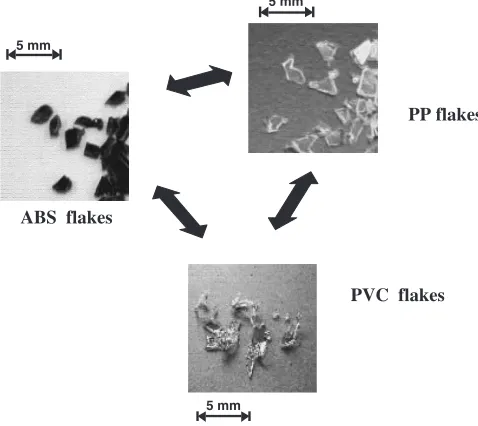
[image:2.595.142.455.83.282.2]plastic mixture is processed. The shape of the plastic components, which are of different colors, can be seen from Fig. 1.
3. Equipment
3.1 Shredder
Size-reduction of plastic mixture for producing flakes of suitable size is carried out in a shredder provided by Nissui
Kako Co. LTD of Japan (Nissui Scutter, type: SA - 22). The schematic design of the shredder representing its operational principle is depicted in Fig. 2. The shredder consists of two static cutters and a rotary one, and it primarily employs the shear actioni.e.the action of scissors. The rotary and static cutters are enclosed in a heavy-duty housing, an integral part of the shredder, and mounted on its side. The shredder has also a vertical shaft, thus the feed moves by gravity through the shaft down the sides of the housing. Underneath the rotary cutter is placed a container that collects the shredded product.
3.2 Triboelectrostatic separator
Triboelectrostatic separation is an effective method for sorting mixtures of dielectric particles of similar densities. A base for the triboelectrostatic separation of a binary plastic mixture can be created if constituents of the mixture acquire charges of opposite polarities. The measure of polarity is the triboelectric series (Table 1). When two non-successive plastics in this series are rubbed against a plastic positioned Table 1 Properties of the plastic.
Plastic type Size of flakes,
D (mm)
Density,
s
ρ (kg.m-3)
Triboelectrostatic series
(TES) 18)
ABS
(acrylonitrile-butadiene-styrene)
- 2.38 + 1.63 1060 Positive end ( + )
PC
(polycarbonate)
1200
PET
(polyethylene terephthalate)
1350
PS
(polystyrene)
1050
PE
(polyethylene)
- 960
PP
(polypropylene)
- 2.38 + 1.63 900
PVC
(polyvinyl chloride)
- 2.38 + 1.63 1400 Negative end ( - )
ABS flakes
PP flakes
PVC flakes
5 mm
5 mm
5 mm
[image:2.595.306.545.313.526.2]between them, the plastic on the left is charged positively and the one on the right is charged negatively. For instance, when ABS and PVC are rubbed against PET surface, ABS is charged positively and PVC negatively. Hence, for the triboelectrification of a mixture it will be preferable to use for rubbing surface, a material that in the triboelectric series is classified between the two materials in the mixture to be separated.18)
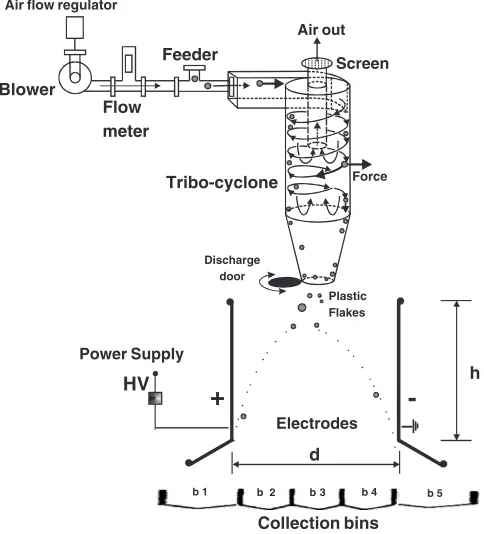
The triboelectrostatic separator consists of five compo-nents: a tribo-cyclone, a separation unit (i.e. electrodes), collection bins, a blower and a feeder (Fig. 3). The inner wall of tribo-cyclone is made of a plastic material that in the
triboelectric series is classified between the plastic materials in the mixture to be separated. The electric field is created by using two parallel plate electrodes made of Cu and a DC power supply. Though the processing is done with high voltage, the total power consumption is very low, because the current is limited to few milliamperes. The maximum electric field strength that our triboelectrostatic separator can create without causing electric breakdown is 400 kVm1.
In operation, the plastic feed is dispersed in a current of air provided by the blower and introduced into the tribo-cyclone through its tangential entry. The air is used to transport the mixture into tribo-cyclone and to frictionally charge the particles by rubbing them against the inner wall (namely rubbing surface). After a certain period of frictional charging inside the tribo-cyclone, the oppositely charged particles fall down freely between vertical-plate electrodes that are separated by a distance, d. Particles are drawn to either positive or negative electrode according to the polarity of the triboelectric charge and are separated by falling in different collection bins.
The surface potential (Vs) is used to quantify the tribo-electric charge of individual plastic components. Its polarity and magnitude are measured by using a non-contacting type electrostatic-voltmeter (TREK Model 523). The instrument can measure the surface potentials from 020kV. The amount of the triboelectric charge acquired by plastic flakes is controlled by regulating the inlet air velocity (v), and rubbing time (t).
3.3 Air table
Air tabling is suitable method to treat plastics with difference in density.12,19) It is indicated that air tabling is an effective method for separation of mixtures components with differences is their densities of about 450 kgm3 or
greater. Moreover, air tabling has the attraction of generally low capital and operational cost which together with the lack of water, chemical and drying requirements means it is environmentally friendly.20)
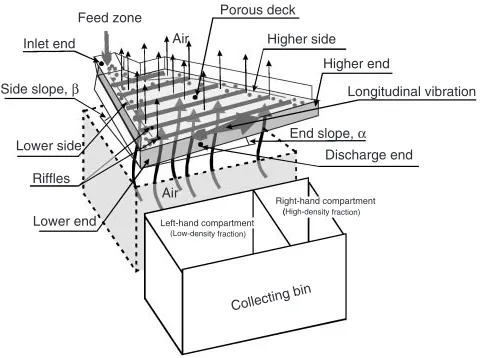
The air table (manufactured by Triple/S Dynamics, Inc.; model No. V-135E) is a dry gravity separator that is mainly comprised of a porous deck powered by an eccentric drive to impart the longitudinal vibration. The porous deck can be tilted from inlet end to discharge end creating so-called ‘‘side slope’’, and from side to side creating so-called ‘‘end slope’’. An electric fan is also located below the porous deck to generate the upward airflow at a controlled value of super-ficial velocity. A sketch of the experimental apparatus is shown in Fig. 4. A collecting bin is arranged alongside the discharge end of the porous deck. It consists of two compartments separated by a splitter, which can be posi-tioned by preliminary visual assessments. The left-hand compartment collected so called low-density fraction, whereas the right-hand compartment collected high-density fraction.
In operation, the moving bed of particles is fluidized by upward airflow being blown through a porous deck, which together with the longitudinal vibration causes high-density particles to settle on the deck and contact its surface, while low-density particles to float on top of the bed. Then, the high-density particles are vibrated up hill along the end slope Air out
Plastic Flakes
Force
Electrodes
d
h HV
-+
Collection bins Blower
Flow meter
Feeder
Tribo-cyclone
b 1 b 2 b 3 b 4 b 5 Discharge
door
Screen
Air flow regulator
Power Supply
Fig. 3 Diagrammatic arrangement of the triboelectrostatic separation system.
Feed
Static cutter Heavy-duty housing
Vertical shaft
Container Rotary cutter
[image:3.595.65.270.75.273.2] [image:3.595.49.291.491.758.2]towards the higher side (Fig. 4). At the end of each forward stroke of vibration, the motion of the porous deck is sharply reversed, but the high-density particles continue to move forward during most of the backward stroke due to their built-up momentum. The vibration proceeds until they overflow from the discharge end of the deck at its higher end before entering into the right-hand compartment of the collecting bin. On the other hand, the low-density particles, which remain fluidized, drift downhill in the direction of the deck inclination due to gravitational pull and flow into the left-hand compartment of collecting bin (Fig. 4).
4. Experimental Procedure
Initially, the components of artificial mixture are chopped into flakes with a shredder (Fig. 2). Subsequently, plastic flakes of the irregular shapes (Fig. 1) are classified by conventional screening and, considering the reasons that stem from the following results, only the2:38þ1:63mm size fraction was subject to further processing. This was carried out using screens in the closed shredding circuit to prevent further processing of any flakes below the preferred size and to ensure an appropriate classification prior to subsequent stages of separation. The triboelectrostatic sep-arator (Fig. 3) is used in the first stage of separation process. It is employed to produce a positively charged fraction of ABS and collect the rest of the feed (i.e.PP and PVC flakes) as negatively charged fraction for further treatment on air tabling. Next, the negatively charged fraction of PP and PVC flakes is introduced as feed to an air table (Fig. 4), which is used in the second stage of the process. At the end of the two-stage process, the separated fraction of ABS, PP and PVC are obtained.
5. Evaluation and Data Handling
The difference in color between plastic types allowed easy hand-sorting and analysis of the product streams. At the end of process, the individual separated fractions are collected to determine the mass, then, the evaluations of the separation performance are made by calculating grade, eq. (1), and percent mass distribution, eq. (2) of each product. These criteria are defined as follows:
Grade‘‘a’’¼
Mass of material ‘‘a’’ in the collected fraction
Total mass of the collected fraction 100% ð1Þ
Distribution‘‘a’’¼
Mass of material ‘‘a’’ in the collected fraction
Total mass of material ‘‘a’’ in input stream 100% ð2Þ
where ‘‘a’’ denotes one of the components of the mixture.
6. Performance of Triboelectrostatic Separation
Considering the forces acting on a charged particle of spherical shape falling due to the gravity in the area between the vertical-plate electrodes, it can be found that the electric field strength (E) to the electrodes is a function of the magnitude of the surface potential (Vs) acquired by the particle, its size (D), and density (s). A mathematical model for this specific triboelectrostatic separator has already been developed13)and expressed as follows:
E>k4:591010 sD
3
rVs
ð3Þ
where coefficient,k, found experimentally, is dimensionless and laid between 1.0-1.8. The empirical coefficientkin the function of electric field strength (eq. 3) is determined by comparing the calculated values of electric field strength with the electric field strength applied to deflect the tribocharged particles of known density and size (i.e. the experimental
data). Thus, it represents the error made during the measure-ments of the surface potential and, also, takes into account the assumption that the plastic flake are of spherical shape.
Subsequently, in order to quantify and investigate the influence of particle size various size fractions of the ABS, PP, and PVC mixture are charged separately by friction and the surface potential of each component of the mixture is measured. Prior to each measurement, the air entered the tribo-cyclone at velocity of 15.5 ms1 and rubbed the
particles against the inner wall, made of PET material, for 60 s. The apparatus is installed inside a chamber (ESPEC type TBL-3HAOGAC) at controlled temperature (T) of 30C
and relative humidity (H) of 50%.
The results depicted in Fig. 5 evidence that for all components of the mixture, there is an increase in the magnitude of surface potential with increasing flake size (Fig. 5). This was likely due to increasing contact area between the flakes and the inner wall of the cyclone during frictional charging. It is also observed that ABS flakes are charged positively after rubbed against PET inner lining, whereas PP and PVC flakes are charged negatively. This Feed zone
Side slope, β
End slope, α
Longitudinal vibration
Discharge end Lower side
Higher side Air
Porous deck
Riffles
(
Inlet end
Lower end
Higher end
Left-hand compartment
Right-hand compartment
Collecting bin
Air
(Low-density fraction)
(High-density fraction)
[image:4.595.49.290.72.251.2]charging behavior is in accordance with the TES (Table 1). Additionally, the charge-to-mass ratio and the electric field strength required for deflection of a tribocharged flake are calculated based on the measurements of the surface potential of each plastic component of known size (Fig. 5) and using eq. (3) respectively. Figure 6 shows the size of each plastic component of known density (Table 1) as function of the charge-to-mass ratio and the required electric field strength respectively. Referring to Fig. 6, it can be seen that a rise in the maximum size of the processed fraction caused a decrease in the charge-to-mass ratio of each plastic compo-nent, despite that surface potential increases (Fig. 5). In turn the electric field strength required for electrostatic deflection of the tribocharged flakes increases sharply (Fig. 6).
Considering the results depicted in Fig. 6, and knowing the maximum electric field strength that our triboelectrostatic separator can create without causing electric breakdown (E¼400kVm1), an upper limit of size fraction should be
set. Therefore, the maximum size of this particular plastic
mixture, that the laboratory-scale separator can effectively process, should be smaller than 2.38 mm.
7. Performance of Air Tabling
7.1 Effect of superficial air velocity
The air tabling is a density concentration technique whereby particles of mixed sizes, shapes, and densities are separated from each other due to the differential settling in an upward airflow with controllable velocity and under the influence of a vibrating action. Hence, the superficial air velocity is one of the most important operating parameter of air table. When the superficial air velocity is zero, the particle weight is entirely supported by the deck. However, when the air is forced through the porous deck and the bed of particles, the bed expansion eventually occurs when the superficial velocity of the air,u, reaches a so-called minimum fluidizing value. At this point the weight of the bed of particles is fully supported by the drag force produced by the air.21)With this in mind, the effect of superficial air velocity on separation results of PVC/PP mixture is investigated.
In this series of tests the superficial air velocity is the variable and ranges from 0.8 to 2.5 ms1. The other variables
of the operation are kept constant at the following values: longitudinal vibrating frequency of the deck, 10.12 s1; end
slope, 4.2; side slope, 2.4; and height of riffles, 4:5 103m. During each test a sample of10103kg of PVC/
PP mixture is processed. Particle size ranges from2:38to þ1:63mm. Only two products, namely low-density and high-density fractions, are discharged from the air table into collecting bin. Generally, the low-density fraction contains mainly PP flakes, whereas the high-density fraction contains mainly PVC ones.
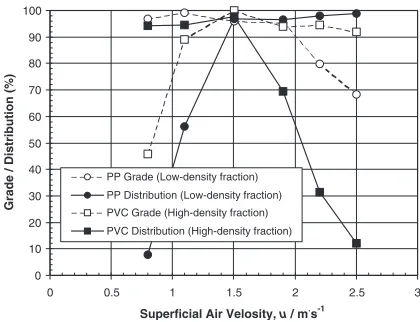
Data plotted in Fig. 7 demonstrate that variation of superficial velocity of air influences noticeably the grade and mass distribution of collected products. The higher is the velocity of air, the greater becomes the mass of PP flakes collected in left-hand compartment and the lower becomes the mass of PVC collected in right-hand compartment. This behavior is due to the fact that with increasing superficial air 0
50,000 100,000 150,000 200,000
1.63 2.38 3.36 4.76
Maximum Size of the Fraction, D / mm
Charge-to-Masss Ratio (kV/kg)
0 500 1000 1500 2000 2500 3000
Electric Field Stren
g
th,
E
/ kV
.m
-1
ABS
PP
PVC
Fig. 6 Plastic flake size as function of charge-to-mass ratio or the electric field strength needed for electrostatic deflection - triboelectrostatic separation, (Experimental conditions: rubbing surface: PET; t¼60s; v¼15:5ms1;T¼30C;H¼50%).
0 10 20 30 40 50 60 70 80 90 100
0 0.5 1 1.5 2 2.5 3
Superficial Air Velosity, u / m.s-1
Grade / Distribution (%)
PP Grade (Low-density fraction) PP Distribution (Low-density fraction) PVC Grade (High-density fraction) PVC Distribution (High-density fraction)
Fig. 7 Grade and distribution of each component of PVC/PP mixture (50%/50%), showing the effect of superficial air velocity - air tabling, (Experimental conditions: flake size =2:38þ1:63mm;f¼10:12s1; end slope = 4.2; side slope = 2.4;h
r¼4:5103m). -1.2
-1 -0.8 -0.6 -0.4 -0.2 0 0.2 0.4 0.6 0.8 1
-1.63 +1.19 -2.38 +1.63 -3.36 +2.38 -4.76 +3.36
Size of Processed Fraction, D / mm
Surface Potential,
Vs
/ kV
ABS PP PVC
[image:5.595.63.277.71.242.2] [image:5.595.49.287.309.483.2] [image:5.595.321.531.577.738.2]velocity more flakes (especially PP ones) are suspended above the deck and collected as low-density fraction into the left-hand compartment of collecting bin. Figure 7 shows that the mass of collected PP increased from about 8% to 99% in going from low (0.8 ms1) to high (2.5 ms1) superficial air
velocity. It is important to note that the velocity of air higher than 2.5 ms1 tends to raise all the flakes off the deck,
destroying any stratification effect and makes the separation of the mixture an extremely difficult task. On the contrary, the lower is the velocity of air, the greater becomes the mass of PVC collected as high-density fraction into the right-hand compartment increasing the grade of PP collected into the left-hand compartment (Fig. 7). Figure 7 shows that the mass of collected PVC increased from about 12 to 94% in going from high (2.5 ms1) to low (0.8 ms1) superficial air velocity. Additionally, superficial air velocity less than 0.8 ms1 caused the bed of plastic flakes to be sluggish
and to accumulate at the higher end of the deck destroying the separation process. Referring to the data illustrated in Fig. 7, the highest separation results are achieved at the superficial air velocity of 1.5 ms1.
7.2 Effect of height of riffles
The following studied variable was a constructive param-eter of the design, namely the height of riffles,hr. Hence, the performance of the deck without riffles (i.e. hr¼0:0m) is compared with two other types of deck fitted with riffles of
4:5103 or 7:0103m high respectively. The
experi-ments are carried out at superficial air velocity of 1.5 ms1; longitudinal vibrating frequency of 10.12 s1; end slope, 4.2; and side slope, 2.4. During each test a sample of 10103kg of PVC/PP mixture is processed. Particle size
of samples ranges from 2:38 to þ1:63mm. Only two products, namely low-density and high-density fractions, are discharged from the air table into collecting bin. Generally, the low-density fraction contains mainly PP flakes, whereas the high-density fraction contains mainly PVC ones.
The influence of the height of riffles on the separation results for PP from PVC is depicted in Fig. 8. From examination of Fig. 8 it is apparent that the deck fitted with riffles of4:5103m high ensures higher separation results
than the one without riffles. Figure 8 shows that the mass of
collected PVC increased from about 54% to 98% with increasing height of riffles from 0 to4:5103m high. This
was due to the fact that riffles of 4:5103m high were
suitable to hold back more high-density flakes (i.e.PVC) on the deck, preventing them from going down to the lower end of the deck and at the same time insuring their migration towards the higher side (Fig. 4). However, at the given experimental conditions, riffles higher than4:5103m (i.e. 7:0103m) hold back also low-density flakes (i.e.PP). In
turn, the grade of PVC decreases (Fig. 8). Considering the results, riffles of 4:5103m high are suitable to be
employed for the separation of this specific plastic mixture.
8. Separation Results
The flowsheet for processing a three-component plastic mixture considers the composition of the mixture and design features, which provide the best feed preparation for each unit device, (for instance adequate sizing and classification,
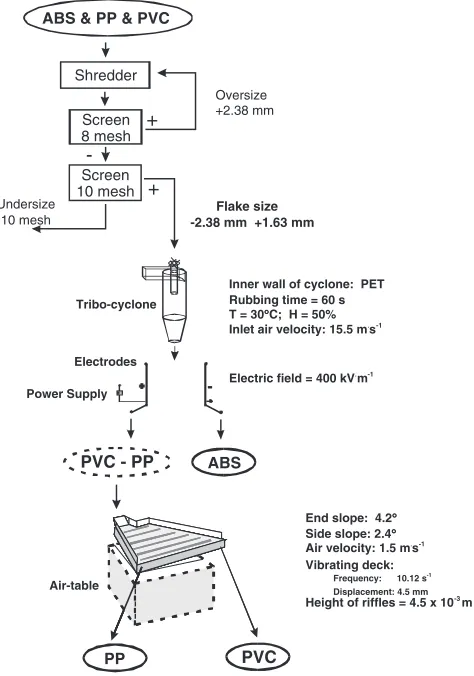
etc.). A general flowsheet of the process is developed and indicated in Fig. 9. It can be seen that only the 2:38þ
1:63mm size fraction was subject to further processing. Moreover, it is important to note that the2:38þ1:63mm size fraction that enters the first stage of separation process is considered as ‘‘input stream’’. Thus, calculations of the grade (eq. 1) and percent mass distribution (eq. 2) of the products are based on the mass of the2:38þ1:63mm size fraction.
0 10 20 30 40 50 60 70 80 90 100
0 1 2 3 4 5 6 7
Height of Riffles, hr / 10-3 m
Grade / Distribution (%)
PP Grade (Low-density fraction) PP Distribution (Low-density fraction) PVC Grade (High-density fraction) PVC Distribution (High-density fraction)
Fig. 8 Grade and distribution of each component of PVC/PP mixture (50%/50%), showing the effect of height of riffles - air tabling, (Experimental conditions: flake size =2:38þ1:63mm;u¼1:5ms1; f¼10:12s1; end slope = 4.2; side slope = 2.4).
ABS & PP & PVC
Tribo-cyclone
Electrodes
Electric field = 400 kV m. -1 Inner wall of cyclone: PET Rubbing time = 60 s T = 30°C; H = 50% Inlet air velocity: 15.5 m s. -1
End slope: 4.2°
Side slope: 2.4°
Vibrating deck: Air velocity: 1.5 m s. -1
Height of riffles = 4.5 x 10 m-3
Shredder
Screen 8 mesh
PP PVC
Air-table Frequency: 10.12 s
Displacement: 4.5 mm
-1
Screen 10 mesh
Flake size
Undersize -10 mesh
Oversize +2.38 mm
-2.38 mm +1.63 mm +
+
-Power Supply
PVC - PP ABS
[image:6.595.309.546.421.759.2] [image:6.595.62.280.605.737.2]8.1 Optimization
Optimization of flowsheet (Fig. 9) started with a detailed analysis of the operating performance of individual item of equipment. The efficiency of the triboelectrostatic separation is affected by various factors such as the property of the feed material (i.e. triboelectric charge, size, etc.) and operation conditions (i.e. material of the inner wall of tribo-cyclone,
etc.). On the other hand, the air table is provided with a
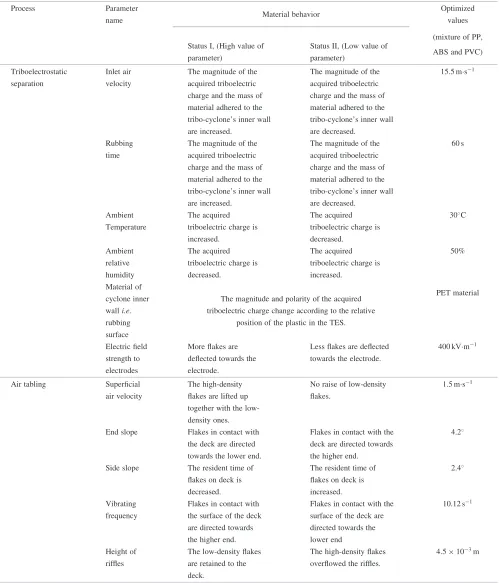
[image:7.595.51.550.203.786.2]number of parameters (such as superficial air velocity, height of riffles,etc), which should be optimized to obtain the best possible separation. Detailed experimental procedures and analyses of the performance of triboelectrostatic separator and air table respectively have been already reported and discussed separately in previous articles.12,13)Table 2 sum-marizes the influence of each operating parameters on the behavior of material processed by each separator showing the
Table 2 Influence of adjustable operational parameters on the material behavior during the process.
Process Parameter
Material behavior Optimized
name values
(mixture of PP, Status I, (High value of Status II, (Low value of
ABS and PVC)
parameter) parameter)
Triboelectrostatic Inlet air The magnitude of the The magnitude of the 15.5 ms1
separation velocity acquired triboelectric acquired triboelectric
charge and the mass of charge and the mass of material adhered to the material adhered to the tribo-cyclone’s inner wall tribo-cyclone’s inner wall
are increased. are decreased.
Rubbing The magnitude of the The magnitude of the 60 s
time acquired triboelectric acquired triboelectric
charge and the mass of charge and the mass of material adhered to the material adhered to the tribo-cyclone’s inner wall tribo-cyclone’s inner wall
are increased. are decreased.
Ambient The acquired The acquired 30C
Temperature triboelectric charge is triboelectric charge is
increased. decreased.
Ambient The acquired The acquired 50%
relative triboelectric charge is triboelectric charge is
humidity decreased. increased.
Material of
PET material cyclone inner The magnitude and polarity of the acquired
walli.e. triboelectric charge change according to the relative
rubbing position of the plastic in the TES.
surface
Electric field More flakes are Less flakes are deflected 400 kVm1
strength to deflected towards the towards the electrode.
electrodes electrode.
Air tabling Superficial The high-density No raise of low-density 1.5 ms1
air velocity flakes are lifted up flakes.
together with the low-density ones.
End slope Flakes in contact with Flakes in contact with the 4.2
the deck are directed deck are directed towards towards the lower end. the higher end.
Side slope The resident time of The resident time of 2.4
flakes on deck is flakes on deck is
decreased. increased.
Vibrating Flakes in contact with Flakes in contact with the 10.12 s1
frequency the surface of the deck surface of the deck are are directed towards directed towards the
the higher end. lower end
Height of The low-density flakes The high-density flakes 4:5103m
riffles are retained to the overflowed the riffles.
optimized value of the operating parameters.
8.2 First stage of separation process - triboelectrostatic separation
During the first stage of separation, the three-component plastic mixture is processed by the triboelectric separator (Fig. 9). The plastic mixture is tribocharged by air (v¼15:5ms1) that rubbed it against the inner wall of
tribo-cyclone made of PET. After 60 s of frictional charging inside the tribo-cyclone the flakes are allowed to drop in the area between electrodes (E¼400kVm1). The temperature
and air relative humidity are kept at 30C and 50%
respectively. At the end of this stage, the ABS flakes are charged positively and collected on the bin namely ‘‘b5’’ next to the negative electrode, whereas PP and PVC flakes are charged negatively and collected on the opposite side bins (i.e. ‘‘b1’’, ‘‘b2’’ and ‘‘b3’’) next to the positive electrode (Fig. 3).
A typical collection of the first stage of the separation is exemplified in Fig. 10. Considering the results graphed in Fig. 10, bin named ‘‘b5’’ collected ABS with a grade of 94.3%, whereas bin ‘‘b1’’, ‘‘b2’’ and ‘‘b3’’collected PVC and PP material of 100.0%, 98.9% and 96.8% grade respectively. Moreover, the fraction collected in the ‘‘b4’’ (i.e. ‘‘mid-dling’’), which does not have the necessary purity, may be reprocessed in one or more subsequent stages. It is expected that reprocessing the ‘‘middling’’ through the apparatus could substantially increase the grade and the mass of collected products. The effect of multi-stage processing on the separation efficiency of triboelectrostatic separation was already discussed in previous articles.13)
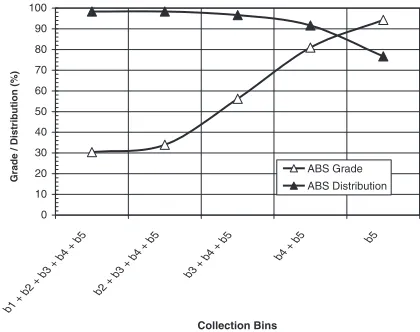
Purification curves for ABS constituent are derived from the experimental results presented in Fig. 10 and are plotted in Fig. 11. The cumulative percentage of ABS material collected in the bins is plotted against the grade and mass distribution of ABS. If the target of collected mass of ABS is higher than 90%, then materials fallen into bins ‘‘b5’’ and ‘‘b4’’ should be collected. However, the grade of ABS is approximately 80% (Fig. 11). Moreover, Fig. 11 shows that 76.7% of ABS material with a grade of 94.3% is fallen in bin ‘‘b5’’ alone indicating a satisfactory separation of ABS.
8.3 Second stage of separation process - air tabling Subsequently, the negatively charged fraction of PP and PVC, which is obtained from the previous stage of tribo-electrostatic separation (i.e.materials collected in bin ‘‘b1’’, ‘‘b2’’, and ‘‘b3’’), is further processed in a second stage using an air table (Fig. 9). The operating parameters of the air table are maintained at the following constant values: superficial air velocity, 1.5 ms1; end slope, 4.2; side slope, 2.4;
longitudinal vibrating frequency of 10.12 s1 with
corre-sponding stroke length of 4.5 mm; and height of riffles,
4:5103m. Only two products of different density are
discharged from the air table and fall into different compart-ments of the collecting bin. The left-hand compartment collected so called low-density fraction, whereas the right-hand compartment collected high-density fraction.
At the end of this stage, PP flakes are collected as low-density fraction, whereas PVC flakes are collected as high-density fraction. The collection of the second stage of separation is given in Fig. 12. It can be seen that some ABS flakes, which had been conveyed from the first stage of
0 10 20 30 40 50 60 70 80 90 100
PP&PVC ABS PP&PVC ABS PP&PVC ABS PP&PVC ABS PP&PVC ABS
( + ) b 1 b 2 b 3 b 4 b 5 ( - ) Collection Bins
Grade / Distribution (%)
[image:8.595.321.531.73.239.2]Grade Distribution
Fig. 10 Typical separation results for ABS-PP-PVC mixture at the end of first stage of process - triboelectrostatic separation, (Experimental conditions: size = 2:38þ1:63mm; rubbing surface: PET; v¼
15:5ms1;t¼60s;T¼30C;H¼50%;E¼400kVm1).
0 10 20 30 40 50 60 70 80 90 100
b1 + b2 + b3 + b4 + b5
b2 + b3 + b4 + b5
b3 + b4 + b5
b4 + b5
b5
Collection Bins
Grade / Distribution (%) ABS Grade
ABS Distribution
Fig. 11 ABS purification curves at the end of first stageof process -triboelectrostatic separation, (Experimental conditions: size =2:38þ
1:63mm; rubbing surface: PET; t¼60s; v¼15:5ms1; T¼30C; H¼50%;E¼400kVm1).
0 10 20 30 40 50 60 70 80 90 100
PP ABS PVC PP ABS PVC
Low-density High-density Collected Fractions
Grade / Distribution (%)
Grade
[image:8.595.322.531.577.737.2]Distribution
Fig. 12 Typical separation results for ABS-PP-PVC mixture at the end of second stageof process - air tabling, (Experimental conditions: size =
2:38þ1:63mm; end slope = 4.2; side slope = 2.4;u¼1:5ms1; f¼10:12s1;h
[image:8.595.53.287.604.736.2]separation process, contaminated the each of collected fraction. It can also be seen that 87.7% of PP and 89.0% of PVC flakes are collected with a grade of 92.5% and 93.7% respectively (Fig. 12). If middling,i.e. the third fraction, is collected and reprocessed, an improvement in separation results will be achieved.
9. Conclusions
A technology involving dry separation of ABS, PP and PVC mixture was developed and tested at a laboratory scale. The developed flowsheet enabled separation of a multi-component plastic mixture employing dry techniques only. The separation was characterized by the utilization of plastic properties of triboelectric charge and density in order to achieve high separation results. Considering the relative position in triboelectric series and density of the each plastic component of the ABS, PP and PVC mixture, it was concluded that a satisfactory separation could not be obtained by either triboelectrostatic separation or air tabling alone. Thus, a system utilizing a combination of the two processes was devised to effectively process this particular plastic mixture. Triboelectrostatic separator was initially employed to collect the ABS flakes as positively charged fraction and to produce a negatively charged fraction of PP and PVC flakes for further treatment on air table, which is an effective technique to separate materials of different densities.
Many factor affected the development and the layout of the flowsheet including feed composition and particle size. Primarily, the mixture to be processed should be carefully shredded and classified at an appropriate size suitable for the employed separators. Hence, at the end of the process, products of ABS, PP and PVC with a grade of 94.3%, 92.5% and 93.7% respectively have been collected with a percent-age mass distribution higher than 76.7% for all of them.
List of symbols
d Distance between vertical-plate
electrodes (m)
D Diameter (m)
E Electric field strength
to the electrodes ( kVm1)
f Longitudinal vibrating frequency
of the deck (s1)
H Relative humidity (%)
hr Height of riffles (m)
k Dimensionless coefficient (-)
r Distance between the detector of the electrostatic-voltmeter
and the surface of material (m)
t Rubbing time (s)
T Temperature (C)
u Superficial velocity of air (ms1)
v Velocity of air that enters the
tribo-cyclone namely inlet air velocity (ms1)
Vs Surface potential (kV)
Greek
s Density (kgm3)
REFERENCES
1) Japan Almanac 2003: the Asahi Shinbun, pp. 139. 2) Kankyou Hakusho (2002) pp. 174.
3) The Environmental Agency in Japan: (‘‘Kankyo Hakusho’’, The Finance Ministry Printing in Japan, 1999) pp. 148-149.
4) F. S. Jr. Kaufman:Resource Recovery and Utilization, ASTM STP 592, (American Society for Testing Materials, 1975) pp. 122-131. 5) J. Shimoiizaka A. Kounosu and Y. Hayashi: J. Min. Met. Inst. of Japan
90(1974) 775-779.
6) A. Kounosu, Y. Hayashi and K. Saito: J. Min. Met. Inst. of Japan94
(1978) 475-478.
7) J. Shibata, S. Matsumoto, H. Yamamoto, E. Kusaka and Pradip: Int. J. Min. Proc.48(1996) 127-134.
8) J. Drelich, T. Payne, J. H. Kim and J. D. Miller: Pol. Eng. Sci.38(1998) 1378-1386.
9) H. Shen, E. Forssberg and R. J. Pugh: Res. Cons. Rec.35(2002) 229-241.
10) J. Shimoiizaka, A. Kounosu, Y. Hayashi and K. Saito: J. Min. Met. Inst. of Japan,92(1976) 675-679.
11) G. Dodbiba, N. Haruki, A. Shibayama, T. Miyazaki and T. Fujita: Int. J. Min. Proc.65/1(2002) 11-29.
12) G. Dodbiba, A. Shibayama, T. Miyazaki and T. Fujita: Phys. Sep. Sci. Eng.12/2(2003) 71-86.
13) G. Dodbiba, A. Shibayama, T. Miyazaki and T. Fujita: Mag. Elec. Sep.
11/1-2(2002) 63-92.
14) Y. Matsushita, N. Mori and T. Sometani: Elec. Eng. in Japan127/3
(1999) 33-40.
15) I. I. Inculet and G. S. P. Castle:Inst. Phys. Conf. Ser. No. 118: Section 4, (paper presented at Electrostatics 1991) pp. 217-222.
16) T. Fujita, Y. Kamiya, N. Shimizu and T. Tanaka:Proceedings of the Third International Symposium on East Asian resources Recycling Technology(1995) pp. 155-164.
17) K. Inada, R. Matsuda, C. Fujiwara, M. Nomura, T. Tamon, I. Nishihara, T. Takao and T. Fujita: Res. Cons. Rec.33(2001) 131-146. 18) G. Dodbiba, A. Shibayama, T. Miyazaki and T. Fujita: Mater. Trans.44
(2003) 161-166.
19) D. Clifford: Mining Magazine180/3(1999) 136. 20) A. Falconer: Phys. Sep. Sci. Eng.12/1(2003) 31-48.