http://www.scirp.org/journal/jssm ISSN Online: 1940-9907
ISSN Print: 1940-9893
Emergency Coordination Decision-Makers
Evaluation and Selection Based on
Multi-Attribute Group Decision Model
Haixia Wang
1, Lin Wang
2, Yunxian Hou
11College of Economics and Management, China Agriculture University, Beijing, China 2School of Management, Henan University of Technology, Zhengzhou, China
Abstract
The sudden disasters often cause serious consequences; the research on emer- gency decision becomes a focus, and emergency collaborative decision-mak- ing is becoming a hot spot. Sudden disasters emergency behavior usually in-volves many departments, so it is necessary to evaluate and select the coopera-tive decision-makers in the process of collaboracoopera-tive decision-making, the ap-propriate cooperative decision-makers play an important role in the emer-gency rescue operation. Based on this, we analyze emeremer-gency collaborative decision-making subject influence factors under the sudden disaster, and de-sign the index system for the Evaluation and Selection of emergency collabor-ative decision-makers, and solve the evaluation model by the method of mul-ti-attribute group decision-making.
Keywords
Emergency Decision, Collaborative Decision, Decision-Makers, Multi-Attribute Group Decision Model
1. Introduction
Since the 21st century, the global human continuously suffered the invasion of earthquakes, floods, landslides, frozen, tsunamis and other natural disasters and all kinds of malignant disease and other kinds of public emergency, which pose a serious threat to people’s lives and property security. For example, in 2003 the SARS epidemic swept the country, the end of 2004 in the Indian Ocean earth-quake and tsunami, in August 2005 the United States in the south of the “Katri-na” hurricane, early 2008 occurred in southern China’s snowstorms and 2008 Sanlu milk powder incident and May 12 occurred in Wenchuan, Sichuan Prov-How to cite this paper: Wang, H.X., Wang,
L. and Hou, Y.X. (2017) Emergency Coor-dination Decision-Makers Evaluation and Selection Based on Multi-Attribute Group Decision Model. Journal of Service Science and Management, 10, 43-53.
https://doi.org/10.4236/jssm.2017.101004 Received: February 10, 2017
Accepted: February 21, 2017 Published: February 24, 2017
Copyright © 2017 by authors and Scientific Research Publishing Inc. This work is licensed under the Creative Commons Attribution International License (CC BY 4.0).
ince, China’s 8.0 magnitude earthquake. In 2009, the global spread of influenza A H1N1 influenza. 7.3 strong earthquake in Haiti. The 7.1 earthquake in Yushu, Qinghai and the large debris flow in Zhouqu, Gansu in 2010 as well as the 2011 motor vehicle crash in Wenzhou, “3.11” Richter 9.0 earthquake in Japan, and the resulting nuclear leakage events, etc. These massive sudden public emergencies to the affected areas of economy, people’s lives and property caused heavy losses.
Emergencies occur frequently makes the emergency management become a focus of global attention, how to make the most efficient emergency decision- making has been a common topic that countries around the world face. Emer-gency decision-making is a multi-decision-making decision-making body in-volved in the decision-making behavior, decision-making with a consistent deci-sion objective, each decideci-sion-making fully share information in decideci-sion, fully understand the emergency situation and restriction conditions, so as to make ef-fective decisions, to win more multilateral decision-making satisfactory results. Can be seen from this, emergency decision reflects the cooperative way of deci-sion, but compared with the general meaning of coordinated decideci-sion, more emphasis on time and resource constraints of punitive, the need to further im-prove the existing collaborative decision-making theory, in order to better guide the decision-making activities of emergency situation.
At present, foreign countries have a wide range of research subjects for deci-sion-making, involving many areas. Some from the method point of view of the decision-makers to study, and some studies focus on the impact of decision- makers of the frame effects, as well as from the perspective of the complexity of decision-making groups to study, and on the aspects of the decision-making body weight were studied. In terms of method, Elfithri R., Mokhtar M. B., by means of the characteristics of the Malay archipelago Langat basin, from the perspective of coordinated decision, studied the cross-regional integrated water resources management, points out that the integrated water resources manage-ment of coordinated decision participants including governmanage-ment agencies, non- governmental organizations, private structure, publics, universities, society, wa-ter resource users and other stakeholders, based on cooperation, communication, share information, exchange information, work together, widely participate in collaborative decision-making, such as the analysis of the key elements to achieve fast and efficient and reasonable comprehensive water resources [1]. Bernier J. used the Bayesian method to research the decision-making behavior in the hy-drological risk decision and policy makers [2]. Manassero G. in order to solve the equipment selection in the uncertainty of decision-making process involved in the decision-making problem, using the analytic hierarchy process to the de-cision-making management [3]. In addition, in terms of the complexity of the decision-making plan selection, F. Herrera, put forward that in the process of group decision choice, mainly reflected in three aspects: decision-making group preference statement and exchange group massing and scheme selection prefe-rences.
research the specific accident emergency coordination, focus on the research the coordination mechanism of emergency decision system, emergency department linkage mechanism and the study of emergency resource conflict coordination. Huang Dian-jian, Li Chuan-gui studied the major accident emergency coordina-tion mechanism, city major accident emergency coordinacoordina-tion model is estab-lished [4]. Tan Xiao-qun, Chen Guo-hua studied the mechanism of emergency coordination to cross-regional, and from the organization, laws, regulations, cross-regional emergency culture, resources and technical support five aspects discusses the realization ways of cross-regional emergency coordination me-chanism, the effect of emergency response [5]. Kang Kai, Chen Tao, Yuan Hong- yong proposed the concept of multilateral collaborative decision-making of emer-gency decision-making, studied the emeremer-gency resources cooperative decision- making and group decision-making of emergency rescue of coordinated decision in the process of emergency plan optimization, and various emergency collabor-ative decision-making is defined as the sudden incident, in the time urgent cir-cumstances, collect information processing, and emergency decision making problems with clear objective, negotiation and formulate alternatives set, to seek the best collaborative scheduling scheme, organize implementation and con-stantly track inspection, timely and correct the mistakes in the decision making process, until the problem solve a dynamic decision process [6]. Chen Xing, Wang Yong, Wu Ling-yun combined with dynamic department coordination and decision-making, define the synergy matrix, coordination coefficient and so on some new concepts about emergency coordinated decision, and build the multi-stage multi-objective multi-sectoral collaborative decision-making model in emergency [7]. Du Lei for multiple cooperating organization in the process of emergency disposal problems, the use of multiple cooperating Agent and Petri net model to define the problem, research the basic structure of Petri net model within the Agent and using the model of collaborative interaction relation adjustment Agent more work together [8]. Liu Yi, Zhou Qi, et al. by adopting the method of Multi-Agent in the snow disaster in 2008 typical multi-sectoral collaborative modeling and analysis together, the weak strong synergy and syn-ergy of three different coordination mechanism for emergency response to effect [9]. Liu Hong-qin, Sha Yong-zhong, Liu Qiang (2011) further analyzes the pub-lic emergency coordination mechanism, combining with the earthquake cases, life cycle from public crisis types, emergency disposal and emergency manage-ment organization structure three sides, this paper expounds the emergency disposal of coordination mechanism in the process of the formation of the way [10].
op-eration experience, some still not solve the fundamental problem, the efficiency of emergency management is not on the actual public emergency is able to fully embody. As in the emergency management decisions subject selection, partici-pate in power is mainly limited to government departments and the affected unit of emergency power, to use and guidance is of rich resources and power in so-ciety to participate in the emergency management research institute, see few; In terms of the rescue efficiency of emergency management, how to improve the rescue efficiency of emergency management, the coordination of emergency re-sources scheduling, strengthen the order rescue process, to coordinate the rescue participate in the collective action of main body, improve the ability to partici-pate in the joint collaboration between organizations or individuals, as well as the analysis of emergency situations emergency group negotiation process and scheme of quantitative or qualitative research also need to be further in-depth study.
Therefore, this article will research on the evaluation and selection of emer-gency coordination decision-makers. We first analyzes the factors affecting the decision-making body of emergency coordination, establish the evaluation index system, and then design the multiple attribute group decision making method for solving emergency collaborative decision-making selection model.
2. Model Formulation
2.1. Problem Description
Emergency coordinated decision suggests that in emergencies, there is always spontaneous decision-making aid consciousness, at the same time, more or less with other decision-making subject connection and the formation of a coordi-nated emergency practice. At the beginning of the emergency happened, the correlation of various decision-making subject is very small, and the whole res-cue practice can present a state of disorder. But as the core of decision-making to step in and rescue practice achieved fully mobilized, the correlation of various decision-making body is enhanced, and the independence of the various deci-sion-making body in subdued. When the whole rescue practice in a fully active, each decision-making relating to become dominant, emergency disaster loss no longer increases, constantly improve the emergency rescue efficiency, to enhance collaborative between decision-making. Therefore, in the process of the colla-borative continuously strengthen, needs to participate in the decision-making of the decision-making evaluation and selection, in order to realize the overall se-quential collaborative.
2.2. Emergency Collaborative Decision-Making Influence
Factors Analysis
2.2.1. Decision-Making Capacity
deci-sion-making capacity of the core components of the core of four, respectively, for the strategic sense of the capacity to judge and control, as well as operational significance of the action and organizational capacity.
1) Accurate judgment capacity based on comprehensive quality of decision- making subject
This judgment not only required in the process of decision-making can be ra-tional, objective and unbiased attitude direct judgment, but also requires the de-cision-making subject can carry on the risk assessment to the complicated situa-tion, make complex judgment based on limited information. No matter in which part of emergency response work, decision-making subject needs to be based on the limited information, first of all to event situation and development trend of overall comprehensive judgment. Specific indicators include the amount of in-formation, the time of judgment, accuracy, etc.
2) The specific content of the decision-making quickly put into action the ability to act
Good action capacity firstly includes a based on the response will determine the accurate judgment of the ideas into a feasible solution, and quickly imple-ment and promote the process. Different decision makers on the basis of similar isolation thinking of hazard specific measures taken by the often are quite dif-ferent. The specific indicators including: the time of reaction, the time of action, the effect of action.
3) The organizational capacity of effectively mobilize all aspects of social forces to participate to response
The organizational capacity is mainly embodied can make full use of a partic-ular time and space under the condition of limited resources in the decision- making process, and emergency decision making includes effective scheduling of all resources and power. Specific indicators include task assignment, persuasion guidance, and social participation.
4) For their psychological and rhythm of action until the whole situation of the control capacity
Control is mainly to supervise, comparing and correcting work process. Deci-sion-making subject is facing the more urgent and complicated things, once won’t be able to keep a clear mind and their own psychological and action has strong rhythm control, also won’t be able to achieve the ultimate control over the whole situation, thus the whole emergency response work might walk into trouble or directly result in failure. The decision makers control of the rhythm of the specific actions require both on the basis of subjective judgment and objec-tive events at the same time also need to deal with the working conditions and requirements as the guidance. Specific indicators include self-control, rhythm control and state control.
2.2.2. Participate Capacity
decision-making stability.
1) The decision environment factors, mainly including the ecological envi-ronment, natural envienvi-ronment, cultural environment factors, and legal policy factors, such as the strength of decision rules in the process of supervision, deci-sion-making environment on the influence of the decideci-sion-making behavior, etc. 2) Resource input, including can be used for emergency decision-making and rescue funds resources, facilities, information platform, etc.
3) The degree of recognition of the decision-making program, said the deci-sion ability of recognition and enforcement.
4) The cooperative decision-making stability, refers to a collaborative deci-sion-making between the coordinated decision will cause a huge wave.
2.2.3. Synergy Capacity
The decision-making of the collaborative relationship between collaborative re-lationships not only include the decision-making, but also includes the sion-making with a series of coordination of relationship between the deci-sion-making, these relations belong to indirect collaborative relationship. Affect the ability of the collaborative key attributes and indicators including decision information transparency, decision subject substitution, process synergy, the degree of mutual support among subjects.
1) Decision-making information transparency is used to represent the deci-sion-making information sharing between the level and quality.
2) The decision-making subject alternative when in collaborative decision- making, don’t have to back the desired synergy of decision-making, the need to replace by other decision-making ability, so as to ensure a smooth process of coordinated decision.
3) Collaborative process, collaborative decision-making process of interaction and integration, said the decision-making process in the degree of tacit coopera-tion between the subjects.
4) The degree of mutual support among subjects, the decision-making, the association rules between interaction and mutual influence relationship among decision-making subjects.
2.3. Emergency Decision-Making Evaluation Index System
to Build Together
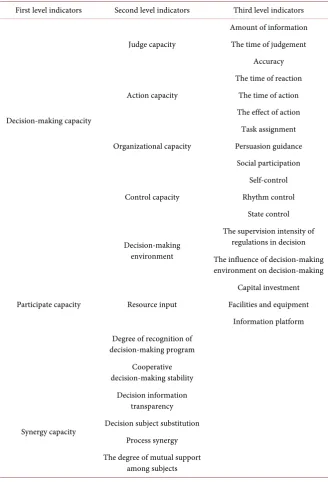
Through the above-mentioned emergency collaborative decision-making influ-ence factors analysis, sorting can draw emergency collaborative decision-making subject evaluation indicator system, which is shown in Table 1, at the same time also reflects the influence of emergency coordinated decision attribute characte-ristics of subject selection, provide framework for emergency collaborative deci-sion-making subject evaluation and selection.
3. Method
Table 1. Emergency collaborative decision subject evaluation indicator system.
First level indicators Second level indicators Third level indicators
Decision-making capacity
Judge capacity
Amount of information The time of judgement
Accuracy
Action capacity
The time of reaction The time of action The effect of action
Organizational capacity
Task assignment Persuasion guidance
Social participation
Control capacity
Self-control Rhythm control
State control
Participate capacity
Decision-making environment
The supervision intensity of regulations in decision The influence of decision-making environment on decision-making
Resource input
Capital investment Facilities and equipment
Information platform Degree of recognition of
decision-making program Cooperative decision-making stability
Synergy capacity
Decision information transparency Decision subject substitution
Process synergy The degree of mutual support
among subjects
coordination of decision-making subject, can more effectively to the decision- making subject evaluation and choice. Process is as follows: first of all, the emergency committee established evaluation team, each member hereby respec-tively to multiple emergency rescue in the subject of the various indicators to evaluate attributes; Then, gather each member of each participation subject of each attribute value, it is concluded that the emergency committee for each par-ticipation subject comprehensive evaluation; Finally, according to each partici-pation subject of the evaluation results to choose according to certain require-ments.
quantify, appropriate uses ordinal number method, namely the emergency com- mittee members first according to the attributes of each sort to choose subject, to gather various properties of the subject of the sorting result, and then according to the weight of each attribute the ranking, the general subject according to the situation to make decisions subject selection.
So, can adopt the following multiple attribute group decision making model: Set up emergency committee evaluation team has L members, to evaluate the M optional subject, evaluation criteria (attributes) has N, the weight of each attribute is ωn, meet the
1 1 N n n
ω
= =∑
, in which it is ωn >0(
n=1, 2,,N)
.Set used by each member of the evaluation criteria, the same power of each committee member of the same, they have the same importance to the evalua-tion of each subject. The decision-making subject evaluaevalua-tion and selecevalua-tion process is as follows:
Step 1: get the l member of the evaluation of each attribute optional subject
sort matrix l l mn M N
A = a ×
11 12 1 21 22 2
1 2
, 1, 2, ,
l l l
n
l l l
l n
l l l
m m mn
a a a
a a a
A l L
a a a
= =
Among them, amnl
(
almn∈{
1, 2,,M}
)
said the l l(
=1, 2,,L)
memberac-cording to the n n
(
=1, 2,,N)
attribute to evaluate all optional subject after,The m m
(
=1, 2,,M)
alternative ranking position. Sort the smaller almn, thatis, the more, said the property, the optimal.
Step 2: it is concluded that evaluation group according to the n attribute to all optional subject evaluation matrix after sorting n l
mn M L
B = a × .
1 2
1 1 1 1 2
2 22 2
1 2
, 1, 2, ,
L
n n n
L
n n n
L
Mn Mn Mn
a a a
a a a
B n N
a a a
= =
Step 3: calculate the emergency committee evaluation group according to the
n attribute optional subject Borda points after the evaluation matrix BnB.
, 1, 2, ,
B
n n
M L
M M M
M M M
B B n N
M M M ×
= − = B n
B line m m
(
=1, 2,,M)
of column l l(
=1, 2,,L)
element bmln re-presents the l assessment team to n in the m optional subject attribute
evaluation Borda points, its meaning is: from the l evaluation team, in the n
attribute of the first m alternative is better than that of other optional subject
number.
1 L n n m ml l b b =
=
∑
, compose matrix B n m M NB b
×
= . By bmn
(
m=1, 2,,M)
under thesize can be scheduled to start the n n
(
=1, 2,,N)
attribute of the pros andcons of each alternative subject order k k
(
=1, 2,,M)
, n mb is the optimal
de-cision-making body.
1 2
1 1 1 1 2
2 2 2
1 2
N N B
N
M M M
b b b
b b b
B
b b b
=
Step 5: define the n n
(
=1, 2,,N)
properties under the consistency of thematrix n n mk M N
C = c × , the elements of the n mk
c value according to the follow-
ing rules: when according to the n m
b will be the m alternative when the
sub-ject was ranked the k, cmkn is one, otherwise cmkn is 0, so the Cn elements of
each row (or column) to 1, the one and only one element in the rest are. Step 6: calculation of weighted consistency matrix of all attributes
1
N
jk M N n n
n
D d ×
ω
C=
= =
∑
× .Step 7: each candidate for the subject of final order. Since each optional sub-ject only in a certain position, also can row a decision-making subsub-ject in each position, available 0 - 1 programming to solve as follows:
{ }
1 1 1 1 max s.t.1, 1, 2, ,
1, 1, 2, ,
0,1 , , 1, 2, , M M jk jk j k M jk j M jk k jk d x
x k M
x j M
x j k M
= = = = = = = = ∈ =
∑∑
∑
∑
1 jkx = represents the first solution to the problem of j a subject should be
in k.
4. Conclusions
does not exclude the special situation needs two or more of the decision-making subject of public decision-making, this paper established the multiple attribute group decision making model can also solve the problem, that is, the result of the top two in the subject is the need to choose the two decision-making subject, and so on.
If the BB approximation as emergency committee evaluation team for all pos- sible subject all attributes of the quantitative evaluation of value, and then use generally weighted sum method to solve, also can come to the conclusion that the same as the above model, it also suggests that the validity of the model.
Acknowledgements
This article could not have been completed without the help and support of many people. We express our deepest gratitude to the reviewers and editors, whose able guidance helped in the publication of this article. This work is sup-ported by National Social Science Fund (Grant No. 14BGL062), National Science & Technology Pillar Program during the 12th Five-year Plan Period (Grant No. 2014BAL07B04, 2014BAL07B05) and Henan University of Technology High- level Personnel Funds (Grant No. 2015SBS014).
References
[1] Elfithri, R. and Mokhtar, M.B. (2002) Collaborative Decision Making Issues in Sus-tainable Water Resources Management: A Case Study on Langat Basin. Proceedings of the International Conference on Environmental Management: Ten Years after Rio, 10, 304-314.
[2] Bernier, J. (2003) Decisions and Attitude of Decision Makers Facing Hydrological Risk. Hydrological Science Journal, 6, 301-316.
https://doi.org/10.1623/hysj.48.3.301.45284
[3] Manassero, G., Semeraro, Q. and Tolio, T. (2004) A New Method to Cope with De-cision Makers’ Uncertainty Technology. Equipment Selection Prices. CIRP An-nals-Manufacturing, 1, 389-392.
[4] Huang, D.J. and Li, C.G. (2008) Research on the Coordination in City Major Acci-dent Emergency Management. Safety, 29, 18-20.
[5] Tan, X.Q. and Chen, G.H. (2009) The Ways to Achieve Coordination Mechanism in Cross-regional Emergencies. Journal of Institute of Disaster-Prevention Science and Technology, 11, 76-79.
[6] Kang, K., Chen, T. and Yuan, H.Y. (2016) Cooperative Scheduling Model for Multi- Level Emergency Response Teams. Journal of Tsinghua University (Sci & Tech), 56, 830-835.
[7] Chen, X., Wang, Y., Wu, L.Y., Yan, G.Y. and Zhu, W. (2010) Emergency Decision Model with Multiple Stages, Multiple Objectives and Multidivisional Cooperation. Systems Engineering Theory and Practice, 30, 1977-1985.
[8] Du, L., Wang, W.J., Dong, C.X., Li, L.X. and Gao, S. (2010) Emergency Collabora-tive Petri Net Modeling and CollaboraCollabora-tive Detection Based on Multi-Agent System. Journal of Computer Applications, 30, 2567-2571.
https://doi.org/10.3724/SP.J.1087.2010.02567
Mechanism in Emergency Response Based on Multi-Agent Method. Journal of Tsing- hua University (Sci & Tech), 50, 165-169.
[10] Liu, H.Q., Sha, Y.Z. and Liu, Q. (2011) The Construction of Multi-Agency and Co- Ordination Mechanism in Emergency Management: Three Perspectives. Journal of Intelligence, 4, 18-23.
Submit or recommend next manuscript to SCIRP and we will provide best service for you:
Accepting pre-submission inquiries through Email, Facebook, LinkedIn, Twitter, etc. A wide selection of journals (inclusive of 9 subjects, more than 200 journals)
Providing 24-hour high-quality service User-friendly online submission system Fair and swift peer-review system
Efficient typesetting and proofreading procedure
Display of the result of downloads and visits, as well as the number of cited articles Maximum dissemination of your research work