EXPORT INCENTIVES AND GLOBAL VALUE CHAINS
Svetlana Ledyaeva
Aalto University School of Business (formerly Helsinki School of Economics), Department of Economics P.O. Box 21240 FI-00076 AALTO; email: [email protected]
Key words: export, export policy, export subsidy, export incentive, global value chains, forward linkages, backward linkages, BRICs, Brazil, Russia, China, India
JEL codes: F13, F14, O10
Abstract: Nowadays global value chains (GVCs) play a central role in trade flows. This paper argues that GVCs can play an important role in transmission of national trade policy effects across borders. More specifically, this study examines how domestic export incentives can affect foreign countries` exporters in the presence of GVCs. Existing theoretical literature suggests that in addition to negative “competition for market share” effects, there can be positive effects, which propagate via backward and forward GVCs linkages. To the best of our knowledge, this paper is the first one that empirically tests these effects. In particular, using recent trade data for BRICs countries (Brazil, Russia, India and China) this study shows that in the GVCs world there can be both negative and positive effects of domestic export incentives for foreign exporters as theory predicts. According to our framework, positive effects propagate via GVCs linkages.
Acknowledgement: I am grateful to Elodie Douarin, Pertti Haaparanta, Mitri Kitti, Julia Korosteleva, Miriam Manchin, Andreas Moxnes, Philipp Poyntner, Slavo Radosevic, Caroline Schimanski, Roman Stöllinger, Otto Toivanen, John Whalley, Julia Woerz, and participants of seminars at University of Western Ontario, UNU-WIDER, ETLA, HECER, Turku School of Economics, Bank of Austria and UCL SSEES for very useful comments on earlier versions of this paper.
1. INTRODUCTION
The production of most goods is increasingly organized along global value chains (GVCs), in which different
stages of the production process are fragmented across countries. This worldwide phenomenon has attracted
a lot of attention among policy makers, business leaders, trade economists and academic researchers alike.
Consequently, a large academic literature has emerged to investigate how the possibility to fragment
production processes across borders may affect the volume, pattern and consequences of international trade
(see, e.g., Feenstra and Hanson 1996; Yi 2003; Grossman and Rossi-Hansberg 2008). However, GVCs are
undeservingly rarely considered in theoretical and empirical analysis of trade policy (for relevant discussion
see also Blanchard, Bown and Johnson 2016) though the question how should trade policy be designed in the
presence of global production networks is considered to be of first-order importance (Manova 2015). In this
paper, we take a step toward filling these voids by exploring effects of domestic export incentives on foreign
countries` export in the presence of GVCs linkages.
The main issue in both policy and academic discussion of export incentives and particularly export
subsidies is whether they have significant negative impacts on foreign (rival) countries. Earlier strategic trade
policy literature (Spencer and Brander 1983; Brander and Spenser 1985; To 1994) conclude that in the world
of imperfect competition and without trade in intermediates (i.e. without GVCs), export subsidies can help
domestic firms to capture market shares of foreign firms in international markets thereby pointing to negative
effects of domestic export incentives on foreign export. In this study we refer to such effects as to negative “competition for market share” effects.
However, as Hoekman (2015) notes, once the shift towards GVCs production is considered and
linkages within and across value chains must be taken into account, determining the net effects of
government export policies becomes more complicated. In particular, domestic sectoral or firm-specific
government policies in GVCs world can benefit GVC as a whole including foreign firms/plants, their
(MNCs) and their ability to lobby certain policy measures whether in their base country or in foreign
countries, which would benefit their activities worldwide via GVCs.
Several theoretical papers (Spencer and Jones 1991; Bernhofen 1997; Ishikawa and Spencer 1998;
Sheldon, Pick, and McCorriston 2001; Lee and Wong 2005) attempted to shed light on this issue by studying
external export incentives` effects in the presence of trade in intermediates (main attribute of GVCs). In
general, these studies conclude that under certain theoretical assumptions and in the presence of trade in
intermediates, domestic export incentives, particularly export subsidies, can lead to profit/rent-shifting to
foreign producers-exporters within common value chains. In this paper, based on the mentioned theoretical
studies, we distinguish between two main types of such effects. First one, we name it positive forward
linkages` effect, emerges as a result of domestic export incentive for intermediate-good producers. This
incentive leads to the cost reduction of produced abroad exportable final/higher-tier intermediate goods,
which uses subsidized imported intermediate good in its production. Second one, we name it positive
backward linkages` effect, emerges as a result of domestic export incentive for final-good/processed
intermediate-good producers. In particular, this incentive stimulates demand increase for imported foreign
intermediate goods, which are used in production of subsidized domestic final/higher-tier processed
intermediate good.
We provide empirical test of the presence of the outlined effects in the BRICs1 bloc`s trade in recent years (2009-2015). BRIC countries are very suitable for this project, first and utmost, due to their rather
aggressive export promotion policies in recent years, which in fact should harm significantly commercial
interests of each other. In particular, Evenett (2015) reports that BRICS (Evenett also includes South Africa
into his analysis) countries` commercial interests have been hit over 2700 times by trade policy measures of
other countries since the Global Crisis began and almost a third of the times a BRICS commercial interest is
harmed, it is due to actions taken by another member of the club. He suggests that “a straightforward way for
1The ‘BRIC’ is an acronym for the four largest and most dynamic emerging economies – Brazil, Russia, India and China. The four countries, Brazil, Russia, India and China (BRIC) held their first summit in 2009. At the end of 2010, South Africa was officially invited to join the group (henceforth called ‘BRICS’) and attended the third summit in 2011. I do not include South Africa in the analysis because its share in the BRICS export is very small – only 3% of the BRICS` cumulative export in 2010-2014 according to the data of International Trade Centre of WTO and UN (http://www.trademap.org/tradestat/Product_SelCountry_TS.aspx).
the BRICS to show greater solidarity would be to initiate a programme to unwind the 1196 measures that
they have taken that harm each other’s commercial interests”. Evenett (2015) further reports that since the
Global Crisis began three of the BRICS (Brazil, India, and China) have implemented additional incentives to
inflate exports. These incentives harm the interests of trading partners that compete in the same markets
abroad, including BRICS members itself. In this paper, we suggest that due to rather high interdependence of
BRIC countries via GVCs linkages there can be also significant positive effects of export incentives
implemented in one BRIC country for the export of other three BRIC countries. Indeed, according to our
analysis of relevant data, BRIC countries demonstrate growing GVCs linkages between each other in recent
years.
In our empirical analysis, we specifically study how export incentives implemented in one BRIC
country affect exports of the other three BRIC countries via GVCs linkages in period 2009-2015. To
accomplish this, in gravity equations for export by industry estimated for each BRIC country, we control for
export incentives implemented in each of the other three BRIC countries in respective industries. We further
construct specific weights for these “foreign” export incentives which reflect backward/forward GVCs
linkages between respective two BRIC countries for respective industries using bilateral data on origin of
value added in gross exports (by exporting and source country-industry) published by OECD-TiVA. Due to
high aggregation of the weights (two-digit and broader ISIC revision 3 sectors), the resultant indicators of
weighted foreign export incentives can exhibit both positive and negative relationship with export of the
examined country. Positive relationship would indicate the dominance of positive effects transmitting via
GVCs linkages for a respective BRICs country-pair while negative relationship would point to the
dominance of classical negative “competition for market share” effects of foreign export incentives.
Our empirical analysis provides rather convincing evidence that external effects of export incentives
can be positive which confirms that GVCs can play important role in transmission of trade policy effects
across borders. First, we find that Indian export incentives implemented for intermediate goods mostly
positively affect export of Brazil and China due to GVCs` forward linkages. These results mean that when
Brazil and China, positive effects emerge for competitiveness of respective Brazilian and Chinese export
products in the world market via, e.g., cost reduction as theory suggests. Furthermore, these positive effects
seem to outweigh possible negative “competition for market share” effects.
Second, strongest positive effects via GVCs backward linkages are coming from Russian export
incentives implemented for final and processed intermediate goods for Brazilian and Chinese export to
Russia and from Brazilian export incentives to Indian export to Brazil. These results suggest that when
Russia/Brazil implement export incentives for processed intermediates or final goods, Brazil and China/India
increase their export of inputs to Russia/Brazil, which are used in Russian/Brazilian exportable production of
exposed goods.
However, we should stress that overall our findings show that negative effects still seem to dominate.
This enables us to conclude that GVCs linkages between BRICs are not strong enough to significantly dampen negative “competition for market shares” effects coming from each other’s export incentives. Russian export seems to suffer most from negative effects of export incentives implemented in the other
three BRICs. On the one hand, this can be due to weak GVCs linkages between Russia and other three
BRICs, and, on the other hand, due to rather strong negative “competition for market share” effects coming
to Russia from export incentives implemented in the other three BRIC countries.
First and utmost, this paper contributes to a strand of theoretical literature that found
profit/rent-shifting effects from domestic export incentives to foreign producers in the presence of trade in intermediates
(Spencer and Jones 1991; Bernhofen 1997; Ishikawa and Spencer 1998; Sheldon, Pick, and McCorriston
2001; Lee and Wong 2005). Despite the prominence of this theory, to the best of our knowledge there is no
single study, which would empirically examine these effects. In this paper, we take a step toward bridging
this gap between theory and evidence.
This study further relates to recently emerging literature on trade policies in the age of global value
chains (Balwin and Venables 2013; Gawande, Hoekman, Cui 2015; Blanchard, Bown and Johnson 2016).
Finally, though in recent years BRIC countries have become salient players in the world trade, only few trade
analyze the BRICs in terms of their trade patterns, developing integration, and potential bloc-wide
cohesiveness. This study attempts to enrich this scant literature.
The paper is organized as follows. Section 2 discusses theoretical background of the study. Section 3
introduces our empirical case, in particular, it discusses recent data on BRICs export incentives and BRICs
current involvement in GVCs including their interdependence via GVCs. Section 4 describes empirical
strategy. Section 5 presents and discusses empirical results. Finally, section 6 offers conclusions.
2. THEORETICAL FRAMEWORK
Though the perfectly competitive model of international trade says that, in general, export subsidies reduce
home country welfare, in the world of imperfect competition by subsidizing/promoting export countries
might increase their domestic welfare if they win in competition for profitable international markets. In their
seminal paper Spencer and Brander (1983) has shown that in imperfectly competitive international markets, a
government, which has the objective of maximizing domestic welfare, may have an incentive to subsidize
research and development activities of domestic firms in industries in which they compete with foreign firms
for international markets. In particular, they conclude that in the case of subsidy domestic welfare is
improved by the capture of a greater share of the output of rent-earning industries, although the
subsidy-ridden non-cooperative international equilibrium is jointly suboptimal. In a companion paper Brander and
Spencer (1985) further present the analysis based on imperfect competition (in particular, they incorporate
Cournot duopoly into a one-period “third market” model) to explain why export subsidies might be attractive
policies from a domestic point of view. They found that governments` optimal policy is to subsidize exports
because export subsidy improves the relative position of the domestic firm in non-cooperative rivalries with
other firms, and allow it to expand its market share. To (1994) goes forward and examines export policy
using a two-period model of oligopolistic competition with switching costs. He concludes: “When
governments and firms are patient, consumers are impatient, and switching costs are significant, exporting
countries will subsidize exports in the first period. A subsidy helps capture market share which is valuable to
All these studies come to a general conclusion that in markets with imperfect competition export incentives
(subsidies, in particular) can benefit implemented countries and harm affected (rival) foreign countries if they
help subsidized domestic firms to capture market shares of foreign firms in international markets. In other
words domestic export promotion measures enhance domestic export (lead to the increase of domestic export
shares in the world markets in affected industries) but negatively affect export of foreign rivals (i.e. the
respective export shares of affected foreign countries fall). In the rest of the paper, we refer to the latter effect
(i.e. negative effect of export incentive targeted at domestic good for foreign export of the same good) as to
negative “competition for market share” effect.
In strategic trade policy models outlined above, only a final product is considered and only primary
factors are used in the production process. However, in the real world most industries use in production not
only primary factors but also intermediate inputs. Furthermore, the rising international trade in intermediate
inputs reflects the increasing importance of GVCs when production processes span multiple countries, with
each country specializing in particular stages of a good’s production sequence (Costinot, Vogel, and Wang 2013). These facts have been recognized in academic literature and a number of papers have emerged
analyzing various issues of interaction between trade in intermediate inputs and trade policies. In this study
we focus on the literature which examines effects of domestic export incentives on foreign countries` export
in the presence of trade in intermediates/GVCs. In order to make analysis more straightforward, we
distinguish between external effects of export incentives targeted at either final or intermediate goods.
The seminal paper for the case of external effects of export incentives aiming at domestic final-good
producers in the presence of intermediate trade is Ishikawa and Spencer (1998). Ishikawa and Spencer
(1998), under assumption of Cournot competition, conclude that in vertically related industry an export
subsidy aimed at shifting rents from foreign to domestic final-good producers may also shift rents to
oligopolistic foreign suppliers of intermediate inputs. Bernhofen (1997), assuming that intermediate good is
supplied by a foreign monopolist, similarly finds that export subsidy on domestic final-good producer can
cause a vertical rent-shifting from domestic downstream producer to foreign upstream supplier. In the
Proposition 1: Domestic export incentive (e.g. subsidy) implemented in country A for final/higher-tier intermediate product X can induce foreign export of intermediate input I from country B to country A used in production of subsidized final/higher-tier intermediate product X in country A if foreign suppliers of intermediate input I are oligopolistic or monopolistic. In the rest of the paper, we refer to this effect as to
positive backward linkages` effect.
Theoretical literature on external effects of export incentives aiming at intermediate-good producers also
allows us to make relevant conclusions. For example, in their influential paper Spencer and Jones (1991)
study the market structure where, in the home country A, there is a vertically integrated firm controlling
exports of both an intermediate and a final good. This firm competes in a foreign country B with a firm that
produces the final good and has the option of either importing the intermediate good or producing it at higher
cost. In the case of trade in intermediate and final goods, if in home country A profit margins are higher for
trade in the former, Spencer and Jones show that the optimal policy of country A government is a tax on
exports of the final good in order to shift toward trade in the intermediate good. Such a policy results in that
low-cost vertically integrated manufacturer in country A exports an intermediate product, lowering the costs
of a foreign rival producer of final goods in country B thereby stimulating country B export of respective
final goods. For the empirical context of our study, these conclusions imply that there can be circumstances
when a government can be interested in establishing export incentives targeting at intermediate-good
producers, which in turn will benefit producers in foreign countries who import these intermediate inputs for
their production of final/higher-tier intermediate goods.
Similarly, Lee and Wong (2005) examine the use of export subsidy to encourage domestic production
of an intermediate input or a final product in a model with international rivalry between firms in two
countries. Lee and Wong paper is a simple extension of a well-known international duopoly model
considered in the literature to study the use of export subsidies. They consider two countries, labeled home
intermediate input, which is used exclusively in the production of the final good. Trade between the two
countries in the intermediate product is allowed, while outputs of the final good are sold in the rest of the
world. Though Lee and Wong emphasize that they do not want to claim wide applicability of their results
because of some simplifying assumptions they made, in the context of our study some of their conclusions
are useful. In particular, according to their model, under certain theoretical assumptions, domestic subsidy for
intermediate-input producer leads to the increase of output and profit of foreign producer of final good,
which uses respective intermediate input in her production.
Sheldon, Pick, and McCorriston (2001) examine the interaction between export subsidies and
profit-shifting in a vertical production system, where each stage of production downstream from agriculture may be
characterized by imperfect competition. Their focus is on comparing the profit-shifting effect for the case
where an export subsidy can be targeted either at a foreign final processed good (i.e. foreign export subsidy
for final-good producers) or at domestic unprocessed agricultural commodity (i.e. domestic export subsidy
for unprocessed agricultural commodity producers), where the latter enters the production process for an
intermediate good subsequently used in production of the final processed good. According to their model,
domestic export subsidy to the unprocessed agricultural commodity may have greater profit-shifting effects
in the final goods` market than a downstream foreign export subsidy. In addition, both types of subsidy result
in profits being shifted from the home to the foreign upstream processing firm.
Summarizing the above theoretical studies, we arrive at our second proposition:
Proposition 2:Domestic export incentive (e.g. subsidy) implemented in country A for intermediate product I
can positively affect country B`s export of final/higher-tier intermediate good X which uses intermediate product I imported from country A in its production. In the rest of the paper we refer to this effect as to
positive forward linkages` effect.
3. BRIC COUNTRIES AS A CASE STUDY OF EFFECTS OF DOMESTIC EXPORT INCENTIVES
As was already noted in introduction, BRIC countries are very suitable for this project, firstly, due to their
rather aggressive export promotion policies in recent years (see, e.g., Evenett 2015) and, secondly, due to
their rather high inclusion into the word` GVCs and also their high and growing interdependence via GVCs.
Below we discuss these issues in more detail.
3.1. Export incentives in the BRIC countries in recent years
In a recent Global Trade Alert (GTA) report of the Centre for Economic Policy Research (CEPR) authored
by Evenett (2015), it has been shown that since the Global Crisis began three of the BRICS - Brazil, India,
and China - have introduced a large number of additional incentives to inflate exports (i.e. export incentives).
In this section, we briefly overview data on recent BRICs` export incentives according to GTA database.
This database includes trade measures implemented from 2006 to present but does not necessarily contain all
implemented measures. First, we report statistics on cumulative number of export incentives by industry (HS
2007 four-digit codes as reported in GTA database) and year of being in force. In particular, for each BRIC
country we sum up number of export incentives, which are in force by affected industry in a certain year. E.g.
if in a country X in a year t one export incentive has been in force and it affects 10 HS four-digit industries,
our indicator of export incentives for a year t and country X equals to 10. In this way we are able to count not
just for the number of implemented export incentives but also for their industrial coverage (some incentives
concern only one HS four-digit industry, some – hundreds) and duration (some measures last only few
months, some – five and even more years). If export incentive lasts only several months, i.e. less than one
year, we count for it as 1/12*X where X is duration of the export incentive in months. E.g. for the above
example if in a country X in a year t one export incentive which affects 10 HS four-digit industries has been
in force for six months, our indicator of export incentives for a year t and country X equals to 5. Results of
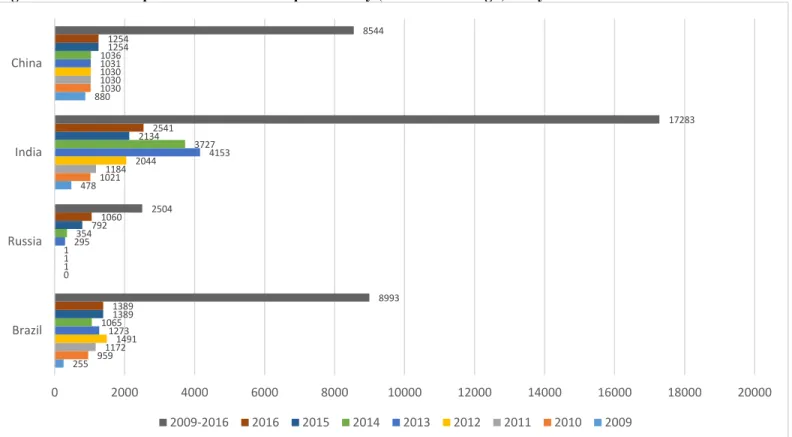
Figure 1 Number of export incentives in force per industry (HS 2007 four-digit) and year
Source: Author`s calculations based on GTA data.
As we can see India is an obvious leader here. During the period of 2009-2016 Indian cumulative number of
export incentives per industry-year was about 2 times higher than that of Brazil and China and 7 times higher
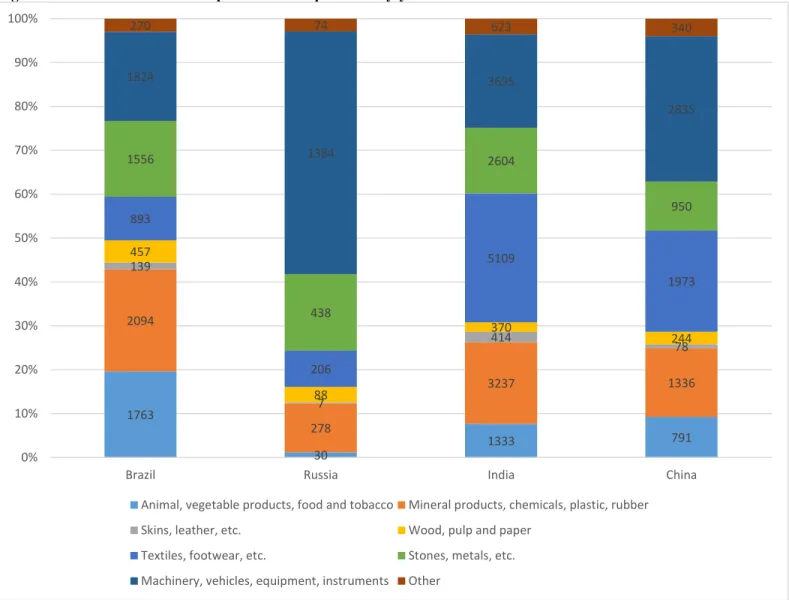
than that of Russia. We next report industrial structure of export incentives per industry-year for the period of
2009-2016 on Figure 2. 255 0 478 880 959 1 1021 1030 1172 1 1184 1030 1491 1 2044 1030 1273 295 4153 1031 1065 354 3727 1036 1389 792 2134 1254 1389 1060 2541 1254 8993 2504 17283 8544 0 2000 4000 6000 8000 10000 12000 14000 16000 18000 20000 Brazil Russia India China 2009-2016 2016 2015 2014 2013 2012 2011 2010 2009
Figure 2 Industrial structure of export incentives per industry-year in 2009-2016
Note: Based on HS chapter classification: Animal, vegetable products, food and tobacco (chapters 1-24); Mineral products, chemicals, plastic, rubber (chapters 25-40); Skins, leather, etc. (chapters 41-43); Wood, pulp and paper (chapters 44-49); Textiles, footwear, etc. (chapters 50-67); Stones, metals, etc. (chapters 68-83); machinery, vehicles, equipment, instruments (chapters 84-92); Other (chapters 92-99).
Source: Author`s calculations based on GTA data.
From the Figure 2 we can see that BRICs implemented most export incentives in machinery, vehicles,
equipment, instruments` sector (especially its share is high for Russia - about 50%; in China – about 30%; in
Brazil and India – about 20%). India and China implement significant amount of export incentives in
agricultural and food industries – about 30 and 20% in total numbers of export incentives, respectively.
1763 30 1333 791 2094 278 3237 1336 139 7 414 78 457 88 370 244 893 206 5109 1973 1556 438 2604 950 1824 1384 3695 2835 270 74 623 340 0% 10% 20% 30% 40% 50% 60% 70% 80% 90% 100%
Brazil Russia India China
Animal, vegetable products, food and tobacco Mineral products, chemicals, plastic, rubber
Skins, leather, etc. Wood, pulp and paper
Textiles, footwear, etc. Stones, metals, etc. Machinery, vehicles, equipment, instruments Other
Finally, BRICs stimulate export rather intensively in Mineral products, chemicals, plastic and rubber sector –
over 20% of all export incentives in Brazil, about 20% in India, about 15% in China and about 10% in
Russia.
After quantitative analysis of BRICs export incentives, we briefly turn to the qualitative side of the
problem. According to Evenett (2015) and our assessments India stands out for the number of measures taken
to boost exports through subsidized trade finance. Many of BRICs export incentives involve tax refunds or
reductions for firms engaged in exporting. China mostly implement Value Added Tax (VAT) rebates and
reductions: 17 out of 27 export incentives reported in GTA database concern VAT.
3.2. BRIC countries` participation in the world`s GVCs
When it comes to measurement of GVCs participation, the most known approach is the Hummels, Ishii, and
Yi (2001) indicator of “vertical specialization” and its refinement by Koopman, Powers, Wang, and Wei
(2011). Value chain participation is defined in terms of the origin of the value added embodied in exports
both looking backward and forward from a reference country: backward is represented by foreign value
added embodied in exports, and forward is represented by domestic value added which is used as inputs to
produce exports in the destination country (Kowalski, Gonzalez, Ragoussis, and Ugarte (2015)). On Figures
3 and 4 we present relevant indicators for BRIC countries which are readily available in OECD-TiVA
database.
Figure 3 Foreign value added share of gross exports (backward GVCs participation index) in the BRICs, %
Note: According to OECD-TiVA definition backward GVC participation index captures the extent to which domestic firms use foreign intermediate value added for exporting activities in a given country.
Source: OECD-TiVA data.
Figure 4 Domestic value added in exports of intermediate products as a share of total gross foreign exports (forward GVCs participation index) in the BRICs, %
7.83 11.46 11.71 12.54 9.99 10.34 10.77 33.38 37.28 37.43 31.77 30.82 32 32.16 9.36 11.28 17.47 22.66 20.97 22.31 24.1 13.26 18.31 12.78 13.89 12.7 13.1 13.72 0 10 20 30 40 1995 2000 2005 2008 2009 2010 2011
Note: According to OECD-TiVA definition forward GVC participation index captures the extent to which a given country’s exports are used by firms in partner countries as inputs into their own exports.
Source: OECD-TiVA data.
As we can see from the Figures, only India`s backward participation index has increased dramatically in the
period (from 9.36 to 24.1). Otherwise, both indices have been rather stable for the BRIC countries in
1995-2011. China has the highest participation in backward linkages of the world GVCs followed by India. Russia
and Brazil, on the other hand, participate significantly more than India and China in forward linkages of the
world GVCs. These are expectable trends, as, on the one hand, China and India are widely recognized as the
world`s manufacturing hubs, and, on the other hand, Brazil and Russia are among the world`s largest
suppliers of natural resources used as inputs in production of various goods and services worldwide.
On Figure 5 we depict backward against forward GVCs participation indices for all countries for
which data is available in OECD-TiVA database for the year 2011 (last available data point).
Figure 5 Backward versus forward GVCs participation indices by country in 2011, %
54.55 49.74 50.06 55.23 56.32 58.71 59.79 31.56 29.25 31.95 36.77 35.36 35.46 36.04 42.82 44.45 46.27 44.62 43.93 45.2 43.83 62.63 65.82 72.62 70.29 69.27 69.76 69.65 0 10 20 30 40 50 60 70 80 1995 2000 2005 2008 2009 2010 2011
Source: OECD-TiVA data.
As can be seen from Figure 4, Brazil and Russia are in the cluster of resource abundant countries with high
forward GVCs participation index and low backward GVCs participation index while China and India are in
the cluster of countries with more advanced industrial structure with relatively equal indices ranging between
30 and 40%.
Trends in intermediate goods` trade are also indicative of GVCs formation because fragmented
production processes require that parts, components, and partially manufactured subassemblies cross
borders—sometimes more than once—before final goods are produced and shipped to final markets
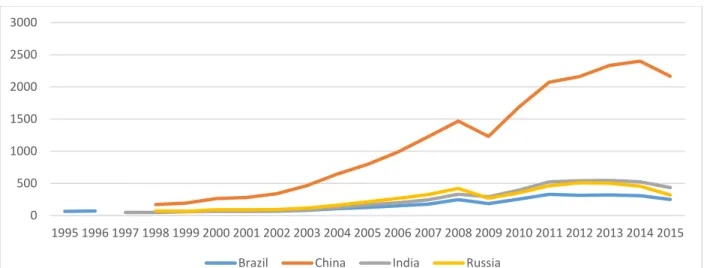
(Feenstra 1998; Arndt and Kierzkowski 2001; Sturgeon and Mevedovic 2011). On Figures 6 and 7 we
present intermediate goods` trade volumes (export plus import) of the BRICs and their annual growth rates,
respectively.
Figure 6 Trade volume (export plus import) of intermediate goods in the BRICs, billion USD, 1995-2015 Australia: 66.16; 14.1 Chile: 63.76; 20.18 Estonia: 38.61; 35.21 Germany: 45.84; 25.54 Iceland: 40.29; 33.19 Israel: 43.04; 25.27 Japan: 55.03; 14.68 Luxemburg: 25.8; 58.98 Norway: 68.89; 17.16 Portugal: 35.89; 32.78 USA: 50.85; 15.03 Brazil: 59.79; 10.77 China: 36.04; 32.16 Colombia: 75.54; 7.65 Croatia: 27.04; 20.17 India: 43.83; 24.1 Russia: 69.65; 13.72 South Africa: 58.2; 19.47 0 10 20 30 40 50 60 70 0 10 20 30 40 50 60 70 80 90 100 Backward p ar ticip at ion in d ex
Note: Intermediate goods have been identified according to Broad Economic Categories (BEC) classification. Source: Author`s calculations based on UN COMTRADE data.
Figure 7 Growth rates of trade volume (export plus import) of intermediate goods in the BRICs, %, 1995-2015
Note: 1) Intermediate goods have been identified according to BEC classification; 2) Growth rates have been computed as
% 100 1 1 t t t Y Y Y .
Source: Author`s calculations based on UN COMTRADE data.
As we can see from the Figures, though in recent decades BRICs` intermediate trade has been growing, the
growth rates have been decreasing and have become even negative in 2014-2015 for all the BRICs.
Figures 6 and 7 provide us with the picture of respective trade dynamics in absolute terms.
Nevertheless, it is interesting to look at these trends relative to total trade of the BRICs and to world trade in
intermediate goods. On Figures 8 and 9 we present these indicators.
Figure 8 Trade volume (export plus import) of intermediate goods as percentage of total trade volume of the BRICs, 1995-2015 0 500 1000 1500 2000 2500 3000 1995 1996 1997 1998 1999 2000 2001 2002 2003 2004 2005 2006 2007 2008 2009 2010 2011 2012 2013 2014 2015
Brazil China India Russia
-50 -40 -30 -20 -10 0 10 20 30 40 50 1999 2000 2001 2002 2003 2004 2005 2006 2007 2008 2009 2010 2011 2012 2013 2014 2015
Note: Intermediate goods have been identified according to BEC classification. Source: Author`s calculations based on UN COMTRADE data.
Figure 9 BRICs trade volume (export plus import) of intermediate goods as percentage of world trade volume of intermediate goods, 1995-2015
Note: Intermediate goods have been identified according to BEC classification. Source: Author`s calculations based on UN COMTRADE data.
From Figure 8 we can conclude that BRICs` trade structure with respect to intermediate versus final goods
have been rather stable in recent decades with highest share of intermediates in Brazilian and Indian trade
and lowest – in Chinese trade. On the other hand, from Figure 9 we can further see that China`s role in the
world trade of intermediate goods is rather significant with a strong growing tendency. Brazil, Russia and
India do not seem to be even close to China on that score.
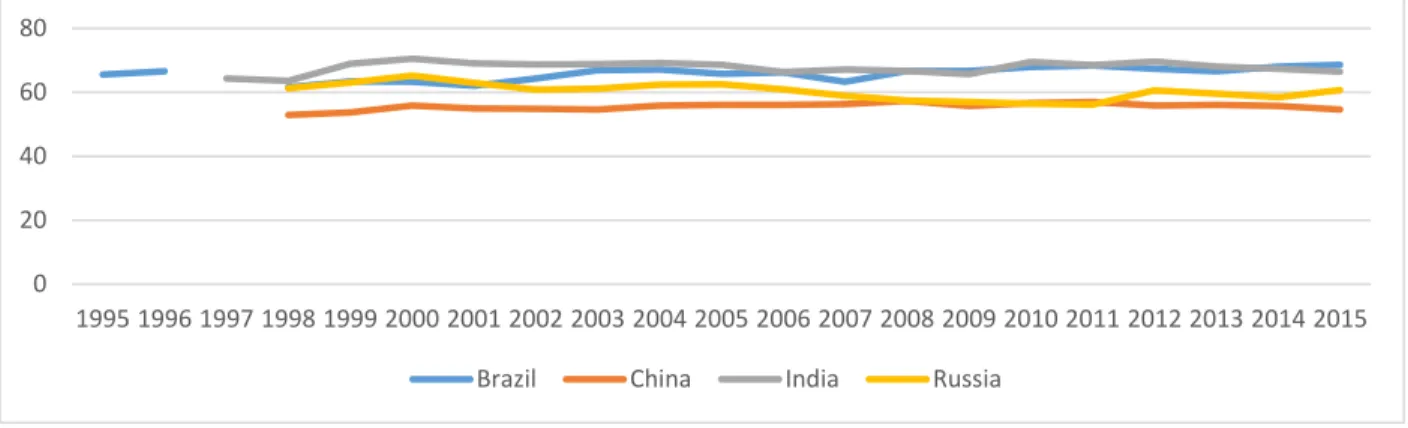
In Figure 10 we present shares of processed intermediates in total intermediate trade volumes of the
BRICs.
Figure 10 Share of processed intermediates in total intermediate trade volume (export plus import) in the BRICs, %, 1998-2015 0 20 40 60 80 1995 1996 1997 1998 1999 2000 2001 2002 2003 2004 2005 2006 2007 2008 2009 2010 2011 2012 2013 2014 2015
Brazil China India Russia
0.00 2.00 4.00 6.00 8.00 10.00 12.00 14.00 1998 1999 2000 2001 2002 2003 2004 2005 2006 2007 2008 2009 2010 2011 2012 2013 2014
Note: Intermediate goods have been identified according to BEC classification. Source: Author`s calculations based on UN COMTRADE data.
As we can see, China exhibits the highest share of processed intermediates in its intermediate trade among
the BRICs and Russia – the lowest.
Finally, on Figures A1.1-A1.4 in Appendix 1, we present the structure of intermediate goods` exports
of the BRICs according to BEC classification2. As we can see, Brazilian intermediate export has been rather diversified with dominance of processed and primary industrial supplies. Primary fuels and lubricants
dominate in Russian intermediate export. Processed industrial supplies strongly dominate in Indian
intermediate export. Finally, processed and primary industrial supplies prevail in Chinese intermediate
export.
Overall, this brief descriptive analysis enables us to conclude that BRIC countries` participation in the
world`s GVCs have been rather high and stable in recent years which is good in the context of this study.
Furthermore, BRIC countries seem to have differential roles in the world`s GVCs with Brazil and Russia
providing core inputs for global production and China and India serving as the world`s manufacturing hubs
(China also stands out for specializing in more processed goods compared to other BRICs). This makes
BRICs bloc a particularly interesting example for comparative analysis.
3.3. BRICs participation in each other`s global value chains
2 The purpose of the classification is to analyze international trade statistics by large economic classes of commodities, distinguishing food, industrial supplies, capital equipment, consumer durables and consumer non-durables.
78 78 79 77 75 74 72 72 70 68 66 66 64 61 63 63 63 67 89 89 85 86 88 87 85 84 84 83 79 80 78 75 75 76 78 83 75 67 62 65 64 66 65 64 62 63 61 65 65 64 59 59 60 70 57 52 47 45 45 43 44 40 41 44 41 42 43 41 44 44 45 49 0 20 40 60 80 100 1998 1999 2000 2001 2002 2003 2004 2005 2006 2007 2008 2009 2010 2011 2012 2013 2014 2015
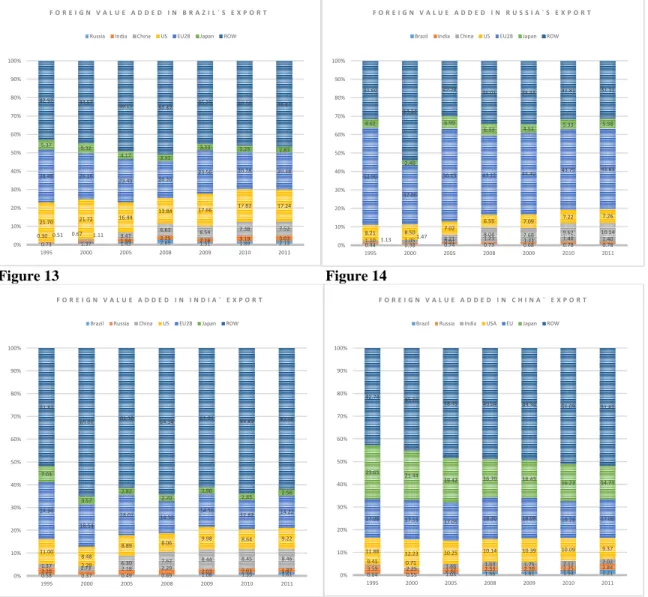
In recent years, BRIC countries` participation in each other’s GVCs has been on rise. From Figures 11-14 we
can see that between the years of 1995 and 2011 value added in export by the other three BRICs have
increased for Brazil from 1.53 to 12.68%, for Russia from 2.67 to 12.32%, for India from 5.23 to 11.94% and
for China from 4.65 to 7.08%. However, it should be noted that for Brazil, Russia and India most of this
increase comes from China`s value added. On the other hand, China has the lowest share of BRICs value
added in its export among the BRICs so it has also increased during the period by 1.5 times. We can also see
that the shares of US, EU and Japan value added in BRIC countries` export either have decreased or have not
changed in the period though they still remain high.
Figure 11 Figure 12
Figure 13 Figure 14
Source: Author`s calculations based on OECD-TiVA data.
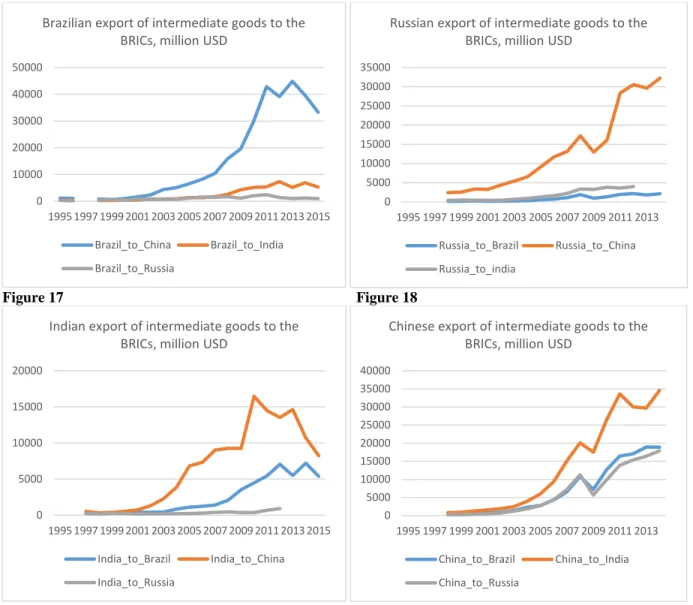
Next, we look at inter-BRICs trade in intermediate goods presented on Figures 15-18.
Figure 15 Figure 16 0.73 1.37 1.43 2.69 1.51 1.89 2.13 0.30 0.67 1.84 2.25 2.16 3.19 3.03 0.51 1.11 3.47 6.63 6.54 7.38 7.52 21.70 21.72 16.44 13.84 17.66 17.83 17.24 28.49 25.16 23.49 20.20 23.56 20.28 20.38 5.37 5.32 4.17 3.51 3.33 3.23 2.83 42.92 44.67 49.17 50.87 45.25 46.20 46.87 0% 10% 20% 30% 40% 50% 60% 70% 80% 90% 100% 1995 2000 2005 2008 2009 2010 2011 F O R E I G N V A L U E A D D E D I N B R A Z I L ` S E X P O R T
Russia India China US EU28 Japan ROW
0.44 0.38 0.74 0.73 0.68 0.78 0.78 1.101.13 1.051.47 0.914.21 1.238.04 7.681.21 1.48 1.40 9.62 10.14 8.21 8.50 7.02 6.55 7.09 7.22 7.26 52.90 32.06 50.15 43.12 44.40 43.75 43.63 4.62 2.40 6.99 6.33 4.51 5.33 5.58 31.60 54.13 29.98 34.01 34.44 31.81 31.21 0% 10% 20% 30% 40% 50% 60% 70% 80% 90% 100% 1995 2000 2005 2008 2009 2010 2011 F O R E I G N V A L U E A D D E D I N R U S S I A ` S E X P O R T
Brazil India China US EU28 Japan ROW
0.58 0.37 0.49 0.69 1.08 1.39 1.61 3.28 1.73 2.18 2.29 2.03 2.01 1.87 1.37 2.29 6.30 7.62 8.44 8.45 8.46 11.00 8.48 8.89 8.06 9.98 8.64 9.22 24.94 18.54 18.01 14.30 14.56 12.82 14.22 7.03 3.57 2.82 2.70 2.90 2.85 2.56 51.81 65.01 61.32 64.34 61.01 63.85 62.05 0% 10% 20% 30% 40% 50% 60% 70% 80% 90% 100% 1995 2000 2005 2008 2009 2010 2011 F O R E I G N V A L U E A D D E D I N I N D I A ` E X P O R T
Brazil Russia China US EU28 Japan ROW
0.64 0.55 1.03 1.66 1.81 1.94 2.21 3.59 2.25 2.32 2.53 2.20 2.25 2.84 0.41 0.71 1.48 1.63 1.75 2.11 2.02 11.88 12.23 10.25 10.14 10.39 10.09 9.37 17.08 17.53 17.05 18.30 18.08 16.28 17.00 23.65 21.44 19.42 16.70 16.43 16.23 14.73 42.74 45.28 48.45 49.04 49.34 51.09 51.82 0% 10% 20% 30% 40% 50% 60% 70% 80% 90% 100% 1995 2000 2005 2008 2009 2010 2011 F O R E I G N V A L U E A D D E D I N C H I N A ` E X P O R T
Figure 17 Figure 18
Note: Intermediate goods have been identified according to BEC classification. Source: Author`s calculations based on UN COMTRADE data.
As we can see from the Figures, bilateral trade in intermediates between China, on the one hand, and Brazil,
Russia and India, on the other hand, have been especially on rise in recent years.
Finally, on Figures A2.1-A2.12 in Appendix 2, we present the structure of intermediate goods`
exports in inter-BRICs trade according to BEC. It appears that Brazil largely exports intermediates of food
and fuel industries to other BRICs. Russian intermediate export to Brazil and India largely consists of
processed industrial supplies though Russian intermediate export to China is mainly primary fuels. Processed
industrial supplies dominate in Indian intermediate export in inter-BRICs trade. India also exports rather
significant amounts of parts and accessories of capital goods (including transport equipment) to Brazil and
Russia. China`s main export categories in inter-BRICs intermediate trade are processed industrial supplies,
parts and accessories of capital goods (including transport equipment).
0 10000 20000 30000 40000 50000 1995 1997 1999 2001 2003 2005 2007 2009 2011 2013 2015
Brazilian export of intermediate goods to the BRICs, million USD
Brazil_to_China Brazil_to_India Brazil_to_Russia 0 5000 10000 15000 20000 25000 30000 35000 1995 1997 1999 2001 2003 2005 2007 2009 2011 2013
Russian export of intermediate goods to the BRICs, million USD
Russia_to_Brazil Russia_to_China Russia_to_india 0 5000 10000 15000 20000 1995 1997 1999 2001 2003 2005 2007 2009 2011 2013 2015
Indian export of intermediate goods to the BRICs, million USD
India_to_Brazil India_to_China India_to_Russia 0 5000 10000 15000 20000 25000 30000 35000 40000 1995 1997 1999 2001 2003 2005 2007 2009 2011 2013
Chinese export of intermediate goods to the BRICs, million USD
China_to_Brazil China_to_India China_to_Russia
On the whole, it can be concluded that at present BRICs interdependence via GVCs is rather high
and, in general, has been growing in recent years. Individual roles of each BRIC country in common GVCs
seem to have its own unique characteristics.
4. ESTIMATION STRATEGY
Export incentives` effects on foreign export via GVCs forward linkages (Proposition 2)
Empirical test of the impact of export policy (whether it is foreign or domestic) on export must control for
other determinants of trade. We adopt a gravity approach to our data and augment it to include export policy
measures. Specifically, for each country of interest (denoted by X, which is one of the BRIC countries) we
estimate the following equation:
i it t t BRIC t i s BRIC t i s BRIC t i s BRIC t i s BRIC t i s BRIC t i s X t i X t X t X t i X t i u YD D FLI a OFFD FLI a D FLI a OFFD FLI a D FLI a OFFD FLI a EI a TF a SH WGDP a SH EX a a SH EX
3 , ), ( 10 3 , ), ( 9 2 , ), ( 8 2 , ), ( 7 1 , ), ( 6 1 , ), ( 5 , , 4 , 3 , 2 , 1 , 1 0 , , _ _ _ _ _ _ _ _ _ (1). X t iSH
EX
_
,, /EX
_
SH
i,t1,X is country X export share in the world export of an industry i (HS 2007,six-digit level)in a year t / t-1 (2008,…,2015).The data comes from UN COMTRADE. The use of export shares
in world markets and not export flows as dependent variable is reasonable in the context of this study, first
and utmost, because export incentives originally target at capturing market shares of foreign rivals in export
markets. In our case, we are then able to test if domestic export incentives actually can help foreign exporters
to capture additional market shares in the world markets taking into account the strength of their relevant
GVCs linkages with the country implementing these incentives. However, for robustness checking purposes
X t
SH
WGDP
_
, is the share of GDP of country X in the World GDP in a year t (2009-2015). Thedata comes from World Bank.
TF
t,X is Trade Freedom component of Index of Economic Freedom ofHeritage foundation of country X in a year t (2009-2015).
EI
i,t,Xis number of export incentives in industry i(HS 2007, four-digit level) which are in force in a year t (2009,…, 2015) in country X. If export incentive
lasts only several months, i.e. less than one year, we count for it as 1/12*X where X is duration of the export
incentive in months. Data comes from GTA database3.
Next six variables are variables of interest in this study.
FLI
_
OFFD
s(i),t,BRIC1/2/3 and3 / 2 / 1 , ), (
_
D
s i tBRICFLI
are indices which count for forward linkages across off-diagonal and diagonal elements, respectively, in respective bilateral input-output tables and are calculated as follows:X t i s World t i s s X t i s BRIC t i s s BRIC t i s s i s s BRIC t i s
inEXP
VA
inEXP
VA
NFEI
OFFD
FLI
n n n n (),, (),, , ), ( 3 / 2 / 1 , ), ( 3 / 2 / 1 , ), ( ) ( 3 / 2 / 1 , ), (_
(2); X t i s World t i s X t i s BRIC t i s BRIC t i s BRIC t i sinEXP
VA
inEXP
VA
NFEI
D
FLI
, ), ( , ), ( , ), ( 3 / 2 / 1 , ), ( 3 / 2 / 1 , ), ( 3 / 2 / 1 , ), (_
(3),where
s
(
i
)
is a broad sector (ISIC rev. 3 two-digit or broader sector as available in OECD-TiVA database on origin of value added in gross export by exporting and source country-sector and reported in Table 1) whichincludes industry i (HS 2007, six-digit level);
s
n
s
(
i
)
is a broad ISIC sector which is nots
(
i
)
.Table 1 ISIC rev. 3 broad sectors used in the study for construction of forward and backward linkages` indices
ISIC rev. 3 sectors Description
C01T05 Agriculture, hunting, forestry and fishing
C10T14 Mining and quarrying
3 This database includes trade measures implemented from 2006 but does not necessarily contain all implemented measures.
Originally, GTA data is reported for four-digit HS 2007 industries. We should also note that while constructing export incentives` variables we consider only those export incentives, which, by GTA definition, are “implemented and almost certainly discriminate against foreign commercial interests” (in GTA classification they are marked by red color).
C15T16 Food products, beverages and tobacco
C17T19 Textiles, textile products, leather and footwear
C20 Wood and products of wood and cork
C21T22 Pulp, paper, paper products, printing and
publishing
C23 Coke, refined petroleum products and nuclear
fuel
C24 Chemicals and chemical products
C25 Rubber and plastics products
C26 Other non-metallic mineral products
C27 Basic metals
C28 Fabricated metal products
C29 Machinery and equipment, nec
C30T33 Electrical and optical equipment
C34 Motor vehicles, trailers and semi-trailers
C35 Other transport equipment
C36T37 Manufacturing nec; recycling
Source: OECD-TiVA
BRIC1/2/3 is one of the BRIC countries which is not X; t denotes year (2009,…,2015); FLI denotes forward
linkages` index and OFFD/D – off-diagonal/diagonal elements of respective input-output table. NFEI
denotes export incentives, which are in force in denoted sector, year and country and which do not concern
final products (i.e. only export incentive for primary and processed intermediates are included). VAinEXP
denotes value added (VA) of denoted country, industry and year in export (EXP) of denoted country,
industry and year. Data on value added comes from OECD-TiVA database on origin of value added in gross
export by exporting and source country-sector. Data is available up to 2011 and, hence, for the years of
2012-2015 we use data of 2011.
The first indicator,
FLI
_
OFFD
s(i),t,BRIC1/2/3, defines the weighted sum of export incentives forintermediates which are in force in country BRIC1/2/3 in year t in sectors
s
n
s
(
i
)
with weights as ratios of value added of country BRIC1/2/3 sectors
n
s
(
i
)
in country X gross export of sectors
(
i
)
to respective value added of the world in year t (i.e. ratios have been computed for off-diagonal elements in respectivebilateral input-output tables from OECD_TiVA database). The second indicator,
FLI
_
D
s(i),t,BRIC1/2/3,weighted by ratio of value added of country BRIC1/2/3 sector
s
(
i
)
in country X gross export of sectors
(
i
)
to respective value added of the world in year t (i.e. ratios have been computed for diagonal elements inrespective bilateral input-output OECD-TiVA tables).
Finally, we control for time fixed effects, YD
t t
.As was mentioned above for robustness checking purposes we also estimate version of equation (1)
for export flows:
i it t t BRIC t i s BRIC t i s BRIC t i s BRIC t i s BRIC t i s BRIC t i s X t i X t X t X t i X t i u YD D BLI a ND BLI a D BLI a ND BLI a D BLI a ND BLI a EI a TF a LnGDP a LnEX a a LnEX
3 , ), ( 10 3 , ), ( 9 2 , ), ( 8 2 , ), ( 7 1 , ), ( 6 1 , ), ( 5 , , 4 , 3 , 2 , 1 , 1 0 , , _ _ _ _ _ _ (4),where
LnEX
i,t,X /LnEX
i,t1,Xis natural logarithm of country X export in industry i (HS 2007, six-digitlevel) in a year t / t-1 (2008,…,2015).
LnGDP
t,X is natural logarithm of country X GDP in year t (2009,…,2015). Both variables are in US dollars and have been transformed into real values using US GDP deflator. Data for export flows comes from UN COMTRADE. Data for GDP and US GDP deflator comefrom World Bank. The other variables have been defined above.
We suggest that if
FLI
_
OFFD
s(i),t,BRIC1/2/3 andFLI
_
D
s(i),t,BRIC1/2/3 are positively related toX t i
SH
EX
_
,, /LnEX
i,t,X , then we can conclude that export incentives for intermediates implemented inone country positively affect export of the other country via GVCs forward linkages. If the respective
relationship is negative for
FLI
_
D
s(i),t,BRIC1/2/3, it can be concluded that negative “competition for marketshare” effects within sector
s
(
i
)
dominate. If this relationship is negative forFLI
_
OFFD
s(i),t,BRIC1/2/3, theinterpretation is not that straightforward. In particular, this actually means that export incentives for
intermediates in one country in sectors other than
s
(
i
)
negatively affect export of the other country in sector)
(
i
the latter country. It can be suggested then that export incentives of the first country in sectors
s
n
s
(
i
)
also positively affect this country`s export in sectors
(
i
)
via spillovers which in turn cause significant negative “competition for market share” effects for the export in this sector of the second country. Similar effects can also exist within sectors
(
i
)
and, hence, this way of argumentation can be also used for explanation of negative relationship betweenFLI
_
D
s(i),t,BRIC1/2/3 andEX
_
SH
i,t,X/LnEX
i,t,X .Export incentives` effects on foreign export via GVCs backward linkages (Proposition 1)
To test for export incentives` effects on foreign export via GVCs backward linkages we estimate the
following equation: i it t t XY t i s XY t i s X t i Y t X t Y t X t XtoY t i XtoY t i u YD D BLI a OFFD BLI a EI a TF a TF a SH WGDP a SH WGDP a SH EX a a SH EX
, ), ( 6 , ), ( 5 , , 6 , 5 , 4 , 3 , 2 , 1 , 1 0 , , _ _ _ _ _ _ (5),where
EX
_
SH
i,t,XtoY is share of country X export to country Y in the world export to country Y of anindustry i (HS 2007, six-digit level)in a year t / t-1 (2008,…,2015). X and Y denote two BRIC countries.The
data comes from UN COMTRADE.
WGDP
_
SH
t,X /WGDP
_
SH
t,Y,TF
t,X /TF
t,Y andEI
i,t,X weredefined above.
Last two variables are variables of our interest. They are calculated as follows:
Y t i s s World t i s Y t i s s X t i s Y t i s s i s s XY t i s n n n n
VA
inEXP
inEXP
VA
NPIEI
OFFD
BLI
, ), ( , ), ( , ), ( , ), ( , ), ( ) ( , ), (_
(6); Y t i s World t i s Y t i s X t i s Y t i s XY t i sinEXP
VA
inEXP
VA
NPIEI
D
BLI
, ), ( , ), ( , ), ( , ), ( , ), ( , ), (_
(7),where BLI denotes backward linkages` index. NPIEI denotes export incentives, which are in force in denoted
sector, year and country and which do not concern primary intermediate products (i.e. only export incentives
for processed intermediates and final goods are included).
The first indicator,
BLI
_
OFFD
s(i),t,XY, defines the weighted sum of export incentives for final andprocessed intermediate goods which are in force in country Y in year t in sectors
s
n
s
(
i
)
with weights as ratios of value added of country X sectors
(
i
)
in country Y gross export of sectorss
n
s
(
i
)
to respective value added of the world in year t (i.e. ratios have been computed for off-diagonal elements in respectivebilateral input-output tables from OECD_TiVA database). The second indicator,
BLI
_
D
s(i),t,XY, definesexport incentives for final and processed intermediate goods which are in force in country Y in year t in
sector
s
(
i
)
weighted by ratio of value added of country X sectors
(
i
)
in country Y gross export of sectors
(
i
)
to respective value added of the world in year t (i.e. ratios have been computed for diagonal elements inrespective bilateral input-output tables from OECD_TiVA database).
For robustness checking purposes, we also estimate version of equation (5) for export flows:
i it t t XY t i s XY t i s X t i X t Y t X t XtoY t i XtoY t i u YD D FLI a ND FLI a EI a TF a LnGDP a LnGDP a LnEX a a LnEX
, ), ( 6 , ), ( 6 , , 5 , 4 , 3 , 2 , 1 , 1 0 , , _ _ (8),where
LnEX
i,t,XtoY /LnEX
i,t1,XtoYis natural logarithm of country X export to country Y in an industry i(HS 2007, six-digit level)in a year t / t-1 (2008,…,2015). It has been transformed into real values using US
GDP deflator. Other variables have been defined above.
We suggest that if
BLI
_
OFFD
s(i),t,XY andBLI
_
D
s(i),t,XY are positively related toXtoY t i
SH
EX
_
,, /LnEX
i,t,XtoYthen it can be concluded that export incentives for final and processedintermediate goods implemented in one country positively affect export of the other country to this country
negative competition effects dominate as increased local production in sector
s
(
i
)
in country Y due to export incentives means less import and, hence, less export from country X to country Y in this sector. Negativerelationship between
BLI
_
OFFD
s(i),t,XYandEX
_
SH
i,t,XtoY/LnEX
i,t,XtoY would support theoreticalpredictions of Baldwin and Venables (2015) who developed a model in which the interaction of forward and
backward linkages determines the range of goods and of parts that are produced in a developing economy.
Based on this model they show that support for final goods producers can increase the range of parts
produced, broadening the industrial base. In the context of our study this suggests that if export incentives for
final and processed intermediate goods in country Y in sector
s
(
i
)
have positive spillover effects for other sectorss
n
s
(
i
)
in country Y which produces inputs for sectors
(
i
)
, there can be less import in these sectors from country X.5. EMPIRICAL RESULTS
Export incentives` effects on foreign export via GVCs forward linkages
We estimate equations (1) and (4) using panel version of Tobit model with random effects because of
excessive number of zeros in our dependent variables. For robustness checking purposes we also report
results for ordinary panel model with fixed effects. Results are reported in Tables 2 and 3. Desriptive
Table 2 Export incentives` effects on foreign export via GVCs forward linkages: Dependent variable is export shares in world export by industry
Brazil Russia India China Tobit with RE Ordinary panel with FE Tobit with RE Ordinary panel with FE
Tobit with RE Ordinary panel with FE
Tobit with RE Ordinary panel with FE Constant -0,038 (0.035) 0,014 (0.033) -0,076 (0.017)*** -0,078 (0.029)*** -0,068 (0.045) 0,241 (0.046)*** 11,08 (1.505)*** 11,032 (1.907)*** EX_SH(i,t-1,X) 0,942 (0.002)*** 0,253 (0.005)*** 0,938 (0.002)*** 0,333 (0.005)*** 0,919 (0.003)*** 0,199 (0.007)*** 0,974 (0.002)*** 0,531 (0.005)*** WGDP_SH(t,X) -4,931 (2.294)** 2,724 (2.464) 1,425 (1.242) 3,149 (2.081) 29,249 (4.286)*** 30,979 (5.723)*** 0,00000001 (0.000000001)*** 0,00000002 (0.000000001)*** TF(t,X) 0,001 (0.001) -0,0002 (0.001) 0,001 (0.0002)*** 0,001 (0.0004)*** -0,0004 (0.001) -0,004 (0.001)*** -0,158 (0.021)*** -0,156 (0.027)*** EI(i,t,X) 0,001 (0.0001)*** 0,0002 (0.0002) 0,0004 (0.0002)* -0,00003 (0.0002) 0,001 (0.0001)*** 0,0002 (0.0002) 0,002 (0.0003)*** 0,008 (0.001)*** FLI_OFFD_BR (s(i),t) -0,0004 (0.0001)*** -0,0001 (0.0002) 0,001 (0.0003)** 0,0001 (0.001) -0,001 (0.0002)*** -0,002 (0.0003)*** FLI_D_BR (s(i),t) 0,011 (0.004)*** 0,0003 (0.006) -0,004 (0.008) 0,016 (0.017) -0,035 (0.006)*** -0,027 (0.009)*** FLI_OFFD_RU (s(i),t) -0,0003 (0.0001)*** 0,0002 (0.0001)*** -0,0004 (0.0003) -0,001 (0.0003)** 0,0003 (0.0002) 0,0003 (0.0002) FLI_D_RU (s(i),t) -0,0001 (0.002) -0,003 (0.002)* 0,002 (0.005) 0,009 (0.005)* -0,011 (0.005)** -0,008 (0.005)* FLI_OFFD_IN (s(i),t) 0,0002 (0.0001)*** 0,0001 (0.0001)** -0,0002 (0.0001)* -0,0004 (0.0002)** 0,001 (0.0002)*** 0,001 (0.0003)*** FLI_D_IN (s(i),t) 0,001 (0.001)** 0,001 (0.001) -0,001 (0.0004)*** -0,001 (0.001) 0,005 (0.001)*** 0,003 (0.001)** FLI_OFFD_CH (s(i),t) 0,0001 (0.00002)*** 0,00002 (0.00004) 0,000004 (0.00002) -0,00001 (0.00004) -0,0001 (0.00003)*** -0,0004 (0.0001)*** FLI_D_CH (s(i),t) -0,001 (0.0003)*** -0,002 (0.001)*** -0,001 (0.0001)*** -0,001 (0.0003)** 0,002 (0.0004)*** -0,001 (0.002) Log likelihood 80122.048 75774.151 47132.509 45930.295 Wald chi2 (Prob.) 186186.3 (0.0000) 190185.27 (0.0000) 84001.00 (0.0000) Not reported N. of left-censored (zero) obs. 4,584 4,189 1,367 1,671 N. obs. 31,776 31,776 31,776 31,776 27,224 27,224 31,776 31,776 R-sq. (overall) 0.918 0.869 0.676 0.914
Table 3 Export incentives` effects on foreign export via GVCs forward linkages: Dependent variable is natural logarithm of export flows by industry
Brazil Russia India China Tobit with RE Ordinary panel with
FE
Tobit with RE Ordinary panel with FE
Tobit with RE Ordinary panel with FE
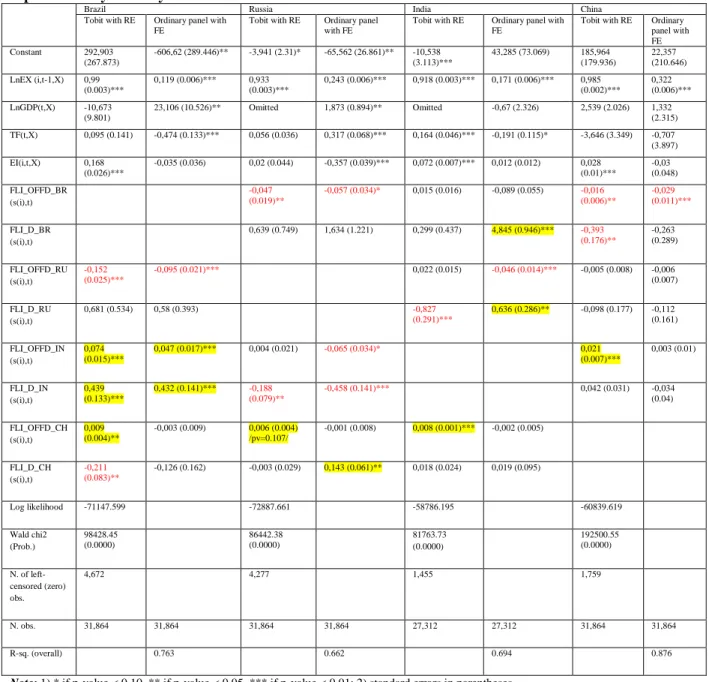
Tobit with RE Ordinary panel with FE Constant 292,903 (267.873) -606,62 (289.446)** -3,941 (2.31)* -65,562 (26.861)** -10,538 (3.113)*** 43,285 (73.069) 185,964 (179.936) 22,357 (210.646) LnEX (i,t-1,X) 0,99 (0.003)*** 0,119 (0.006)*** 0,933 (0.003)*** 0,243 (0.006)*** 0,918 (0.003)*** 0,171 (0.006)*** 0,985 (0.002)*** 0,322 (0.006)*** LnGDP(t,X) -10,673 (9.801) 23,106 (10.526)** Omitted 1,873 (0.894)** Omitted -0,67 (2.326) 2,539 (2.026) 1,332 (2.315) TF(t,X) 0,095 (0.141) -0,474 (0.133)*** 0,056 (0.036) 0,317 (0.068)*** 0,164 (0.046)*** -0,191 (0.115)* -3,646 (3.349) -0,707 (3.897) EI(i,t,X) 0,168 (0.026)*** -0,035 (0.036) 0,02 (0.044) -0,357 (0.039)*** 0,072 (0.007)*** 0,012 (0.012) 0,028 (0.01)*** -0,03 (0.048) FLI_OFFD_BR (s(i),t) -0,047 (0.019)** -0,057 (0.034)* 0,015 (0.016) -0,089 (0.055) -0,016 (0.006)** -0,029 (0.011)*** FLI_D_BR (s(i),t) 0,639 (0.749) 1,634 (1.221) 0,299 (0.437) 4,845 (0.946)*** -0,393 (0.176)** -0,263 (0.289) FLI_OFFD_RU (s(i),t) -0,152 (0.025)*** -0,095 (0.021)*** 0,022 (0.015) -0,046 (0.014)*** -0,005 (0.008) -0,006 (0.007) FLI_D_RU (s(i),t) 0,681 (0.534) 0,58 (0.393) -0,827 (0.291)*** 0,636 (0.286)** -0,098 (0.177) -0,112 (0.161) FLI_OFFD_IN (s(i),t) 0,074 (0.015)*** 0,047 (0.017)*** 0,004 (0.021) -0,065 (0.034)* 0,021 (0.007)*** 0,003 (0.01) FLI_D_IN (s(i),t) 0,439 (0.133)*** 0,432 (0.141)*** -0,188 (0.079)** -0,458 (0.141)*** 0,042 (0.031) -0,034 (0.04) FLI_OFFD_CH (s(i),t) 0,009 (0.004)** -0,003 (0.009) 0,006 (0.004) /pv=0.107/ -0,001 (0.008) 0,008 (0.001)*** -0,002 (0.005) FLI_D_CH (s(i),t) -0,211 (0.083)** -0,126 (0.162) -0,003 (0.029) 0,143 (0.061)** 0,018 (0.024) 0,019 (0.095) Log likelihood -71147.599 -72887.661 -58786.195 -60839.619 Wald chi2 (Prob.) 98428.45 (0.0000) 86442.38 (0.0000) 81763.73 (0.0000) 192500.55 (0.0000) N. of left-censored (zero) obs. 4,672 4,277 1,455 1,759 N. obs. 31,864 31,864 31,864 31,864 27,312 27,312 31,864 31,864 R-sq. (overall) 0.763 0.662 0.694 0.876
Note: 1) * if p-value < 0.10, ** if p-value < 0.05, *** if p-value < 0.01; 2) standard errors in parentheses.
First, we should note that interpretation of Tobit coefficients is not straightforward. In particular, Tobit
regression coefficients are interpreted in a similar manner to OLS regression coefficients; however, the linear
effect is on the uncensored latent variable, not the observed outcome. The expected export share changes by
coefficient for each unit increase in the corresponding predictor. E.g. if we take the coefficient of
CH t i s