ISSN Online: 2160-8806 ISSN Print: 2160-8792
Postmenopausal Bleeding and Changing
Bleeding Patterns after Parental Use of
Corticosteroids: A Prospective Cohort Study
Henny Anna Rie Klomp
1,
Johannes Maria Gulielmus Cobben
2, Paul Jan Quirien van der Linden
1*1Department of Obstetrics and Gynecology, Deventer Ziekenhuis, Deventer, The Netherlands 2Department of Anesthesiology, Deventer Ziekenhuis, Deventer, The Netherlands
Abstract
Objective: To study whether there is a relation between the application of cor-ticosteroids and occurrence of postmenopausal bleeding. Also we want to de-termine whether corticosteroids can cause an irregularity in a previously reg-ular menstruation cycle. Design and Setting: Prospective cohort study in the department of anesthesiology. Patients: 209 women who received a single do-sage of corticosteroids as treatment for pain. Interventions: None, observa-tional cohort study; all women received standard care. Main outcome meas-ures: Postmenopausal blood loss or disruption of menstruation cycle. Result: Postmenopausal blood loss or disruption of menstruation cycle were both more common 6 weeks after administration of corticosteroids, but were sometimes also reported 2 weeks after administration of corticosteroids. Con-clusion: After administration of corticosteroids in a postmenopausal woman an episode of menstruation like bleeding can be expected. This is probably due to a transient drop of androstenedione. In premenopausal women a tran-sient change in menstruation cycle can be observed.
Keywords
Postmenopausal Bleeding, Corticosteroids, Bleeding Patterns
1. Introduction
Postmenopausal blood loss is a very common problem in women. It can have multiple causes and endometrial carcinoma is the most serious [1]. In a large Scandinavian study a variation of age specific incidence of postmenopausal blood loss was shown. It ranges from 14.6 per 1000 (CI 10.1 - 20.3) in women younger than 50 years of age to 1.7 per 1000 (CI 1.1 - 2.6) in women over 80 How to cite this paper: Klomp, H.A.R.,
Cobben, J.M.G. and van der Linden, P.J.Q.
(2017) Postmenopausal Bleeding and Ch-
anging Bleeding Patterns after Parental Use of Corticosteroids: A Prospective Cohort
Study. Open Journal of Obstetrics and
Gynecology, 7, 326-333.
https://doi.org/10.4236/ojog.2017.73034
Received: February 13, 2017 Accepted: March 20, 2017 Published: March 23, 2017
Copyright © 2017 by authors and Scientific Research Publishing Inc. This work is licensed under the Creative Commons Attribution International License (CC BY 4.0).
http://creativecommons.org/licenses/by/4.0/
years. On the other hand, the risk that this blood loss is caused by endometrial carcinoma is less than 1% in women under 50 years of age, but increases to 24% in women over the age of 80 [2].
In a previous study, we showed that postmenopausal blood loss can occur af-ter prior administration of corticosaf-teroids, in particular when they are parentally administered [3]. It was also shown that corticosteroids can influence the men-strual cycle [4]. Because this medication is widely used by various doctors for all kinds of painful or inflammatory conditions such as in orthopedic surgery, oph-thalmology and anesthesiology we want to investigate this possible connection as a cause of a common gynecological complaint.
The primary aim of this study is to determine whether there is a relation be-tween the application of corticosteroids and occurrence of postmenopausal bleeding. Also we want to determine whether corticosteroids can cause an irre-gularity in a previously regular menstruation cycle. To this end we performed a prospective cohort study in women who received a single dosage of corticoste-roids in the department of anesthesiology as treatment for pain.
2. Material and Method
We performed a prospective cohort study. All female patients visiting the de-partment of anesthesiology, who met the inclusion criteria, were invited to par-ticipate in this study prior to their corticosteroids injection. They gave written informed consent for two questionnaires via email and permission to check their medical record if necessary.
Hereafter, we made two groups based on their pre- and postmenopausal sta-tus. The first questionnaire was sent two weeks after application of corticostero-ids. We collected baseline characteristics (for instance age, weight, smoking, co-morbidity) and data on vaginal blood loss. The second questionnaire was sent six weeks after application of corticosteroids. With that questionnaire we col-lected data regarding blood loss and changes in medication. From postmeno-pausal women who reported vaginal blood loss we checked their medical record on endometrial sampling and reports of histopathology.
Inclusion criteria were: premenopausal women with regular menstrual cycles, defined as cycles between 25 - 35 days during at least 6 previous months. Post-menopausal women were defined as at least one year of no menstrual bleeding before intervention with corticosteroids. Exclusion criteria were age under 18 years, not having access to a computer, irregular menstrual cycles, use of hor-monal therapy (oral contraceptive pill or HRT), known bleeding disorders, a history of hysterectomy or endometrial ablation, or known endocrinologic dis-eases (i.e. thyroid problem).
For statistical analysis we used student t-test, Mann-Whitney U test, Kruskall Wallis test and Wilcoxon signed rank test, when appropriate. We also performed a univariate and multivariate logistic regression analysis.
bleeding appeared. Therefore the approval of our Institutional Review Board was given. Since a non-interventional prospective observational study, i.e. a non WMO-study, was performed.
3. Results
Between November 2013 and December 2014, 209 women were selected and gave their written informed consent. They were initially referred to the anesthe-siology department for corticosteroid injection for treatment of joint and mus-culoskeletal pain problems. They all were treated with 40 mg or 80 mg Kenacort® (Triamcinolon). They all received an invitation via e-mail to complete a ques-tionnaire and if necessary up to 2 reminders; 152 (72.7%) women completed the first questionnaire, 145 (69.3%) women completed both questionnaires.
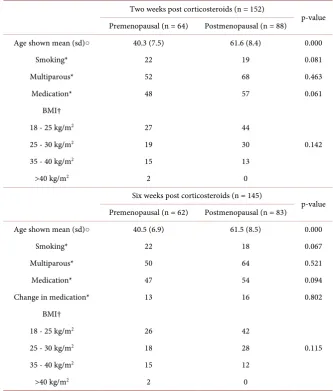
[image:3.595.205.539.331.723.2]The demographical features are presented in Table 1. There were no signifi-cant differences between both groups, except for mean age (pre-menopausal 40 years and post-menopausal 61 years).
Table 1. Demographical features in participants.
Two weeks post corticosteroids (n = 152)
p-value
Premenopausal (n = 64) Postmenopausal (n = 88)
Age shown mean (sd)○ 40.3 (7.5) 61.6 (8.4) 0.000
Smoking* 22 19 0.081
Multiparous* 52 68 0.463
Medication* 48 57 0.061
BMI†
0.142
18 - 25 kg/m2 27 44
25 - 30 kg/m2 19 30
35 - 40 kg/m2 15 13
>40 kg/m2 2 0
Six weeks post corticosteroids (n = 145)
p-value
Premenopausal (n = 62) Postmenopausal (n = 83)
Age shown mean (sd)○ 40.5 (6.9) 61.5 (8.5) 0.000
Smoking* 22 18 0.067
Multiparous* 50 64 0.521
Medication* 47 54 0.094
Change in medication* 13 16 0.802
BMI†
0.115
18 - 25 kg/m2 26 42
25 - 30 kg/m2 18 28
35 - 40 kg/m2 15 12
>40 kg/m2 2 0
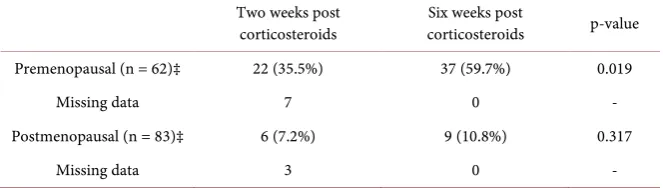
In Table 2 we present changes in bleeding pattern or presence of postmeno-pausal blood loss. Both events were more common 6 weeks after administration of corticosteroids, but were sometimes also reported 2 weeks after administra-tion of corticosteroids.
In premenopausal women group (n = 62), bleeding pattern was changed in 22 women (35.5%) after 2 weeks and in 37 women (59.7%) after 6 weeks (p < 0.05). In postmenopausal women (n = 83) vaginal blood loss was reported in 6 (7.2%) women after 2 weeks and in 9 (10.8%) women after 6 weeks (p = 0.31). However, when we performed regression analysis we did not find any significant differences in individual variables (smoking, BMI and parity).
The histopathological data of women with postmenopausal blood loss, within 6 week follow-up, were collected from their medical records and are shown in Table 3. In only one case an endometrial sample was reported. It did not show histopathological changes of endometrial tissue. In the other twelve women that had postmenopausal blood loss, no endometrial samples were taken. Mostly, because no abnormal endometrial thickness was noted and hence endometrial sampling was not found obligatory.
4. Discussion
Corticosteroids have an influence on both pre- and postmenopausal women with respect to vaginal blood loss. In premenopausal women we noted an in-crease of disturbance of the menstruation cycle. In post-menopausal women presence of postmenopausal vaginal blood loss was noted. This increase of inci-dence was more prominent in premenopausal women.
[image:4.595.208.540.499.593.2]In the group of premenopausal women we found a significant difference in the presence of bleeding irregularities, when we compared the number of events
Table 2. Bleeding differences in time (n = 145, information from both questionnaires).
Two weeks post
corticosteroids corticosteroids Six weeks post p-value
Premenopausal (n = 62)‡ 22 (35.5%) 37 (59.7%) 0.019
Missing data 7 0 -
Postmenopausal (n = 83)‡ 6 (7.2%) 9 (10.8%) 0.317
Missing data 3 0 -
[image:4.595.208.539.654.722.2]‡ = Wilcoxon signed rank.
Table 3. Follow-up in women with postmenopausal blood loss after corticosteroids (n = 83).
Percentage No follow up Pathohystological report
Only after 2 weeks (n = 4) 4.8% n = 3 No report of histopathology▪
After 2 & 6 weeks (n = 3) 3.6% n = 2 No histopathological changes
Only after 6 weeks (n = 6) 7.2% n = 5 No report of histopathology
after respectively two and six weeks post corticosteroids administration. Six weeks after administration 59.7% of premenopausal participants experienced a change in their menstrual cycle, whereas after two weeks only 35.5% had re-ported changes in their menstrual cycle. Glucocorticosteroids affect a menstrual cycle due to their effect on two organs. Both the pituitary gland and the ovary, producing estrogens and progesterone are directly inhibited [5]. This causes a temporary change in menstrual cycle, and after prolonged use of medication these effects might be more prominent.
In our previous study we hypothesized a pathophysiological pathway that might cause postmenopausal bleeding. Since there is a positive correlation be-tween the conversion of androgens to estrogen and bodyweight, we hypothe-sized that there would be more endogenous estrogen in over weighted postme-nopausal women. Therefore, they might have more endometrial proliferation. If a transient lower level of circulating estrogens occurs, caused by a drop of an-drostenedione after adrenal suppression by corticosteroids, a menstruation like withdrawal of endometrium will follow. This transient change in circulating hormones might explain the elapsed time between corticosteroid use and vaginal bleeding [6].
In our previous study no histopathological changes in endometrial tissue were found, hence we expected a similar finding in this cohort [3]. Surprisingly, in only one woman out of 14 we found a report on histopathology (no pathological changes in endometrial tissue). In the other 13 women collection of an endome-trial sample was not found necessary by their caretakers. The majority of these women were not referred to have an endometrial sample or hysteroscopy. This leaves us with the question on the findings on further histopathology due to the nature of our study that is based mainly on questionnaires.
We performed a prospective cohort study on the effects of corticosteroids in pre- and postmenopausal women, with a six-week follow-up. To our knowledge, this is the first prospective study published. Only one retrospective study is pub-lished before regarding this subject [7]. Possible corticosteroid effects are men-tioned a few times in recent literature by others in case series [7] [8] [9] [10] [11]. Most authors report case series with a similar problem as mentioned by us in our previous study [3]. All authors reported a comparable clinical pathway, namely corticosteroids give a transient increase of disrupted menstrual period or might cause postmenopausal vaginal blood loss. However, none of them per-formed a prospective study in which all patients were treated in the same anes-thesiology department and got two questionnaires afterwards.
Since postmenopausal blood loss and disrupted menstruation cycle are very common complaints in gynecological day to day practice, to study a possible cause is important. Our present study shows an increase in abnormal vaginal blood loss, both in pre- and postmenopausal women. We believe this is caused by a pathway as explained above. However, a limitation of this study is we were not able to ascertain our hypothesis. It would be necessary to take multiple serial blood samples to mark the moment of androstenedione drop and subsequent withdrawal bleeding. Ideally, blood samples should be taken in ovarian veins, since this would give an optimal representation of hormonal levels surrounding the ovaries [12]. Since serial ovarian vein blood samples are no option due to the nature of the sampling method, we do not expect it possible to realize. On the other hand, we found very few endometrial samples with respect to the number of women with postmenopausal blood loss. If we take daily practice in account we can explain this rather surprising feature. We wanted to see how it was done in daily practice in a furthermore healthy group of patients that got corticoste-roid treatment for other conditions, namely pain relief, while not having gyne-cological complaints before. If they were experiencing blood loss, they would probably seek help from their general practioner and some of them became re-ferred to us, thereafter. A second limitation in our study design is we did not take routinely endometrial samples from all women with postmenopausal bleeding. This is only indicated when there is an ultrasound measurement of endometrial thickness above 4 mm [13]. Because we performed a prospective cohort study on the presence of changes in menstruation or the presence of postmenopausal blood loss, routine endometrial sampling was no part of this study.
we also still recommend these women to seek help from their general practition-er or gynecologist when an abnormal bleeding pattpractition-ern has occurred. It remains of pivotal importance to rule out other etiologies of abnormal vaginal bleeding, regardless the woman’s age.
5. Conclusions
After administration of corticosteroids in a postmenopausal woman an episode of menstruation like bleeding can be expected. This is probably due to a tran-sient drop of androstenedione. In premenopausal women a trantran-sient change in menstruation cycle can be observed.
However, since postmenopausal blood loss is also an early sign of gynecologic malignancy, we believe all women with this complaint should be referred to or visit a gynecologist.
Acknowledgements
We thank all women who participated in our study and especially our nurses and office managers of the anesthesiology department.
References
[1] Emanuel, M.H., Verdel, M.J., Wamsteker, K. and Lammes, F.B. (1995) A Prospec-tive Comparison of Transvaginal Ultrasonography and Diagnostic Hysteroscopy in the Evaluation of Patients with Abnormal Uterine Bleeding: Clinical Implications.
American Journal of Obstetrics & Gynecology, 172, 547-552. https://doi.org/10.1016/0002-9378(95)90571-5
[2] Gredmark, T., Kvint, S., Havel, G. and Mattsson, L.A. (1995) Histopathological Findings in Women with Postmenopausal Bleeding. British Journal of Obstetrics and Gynaecology, 102, 133-136. https://doi.org/10.1111/j.1471-0528.1995.tb09066.x [3] Klomp, H.A. and van der Linden, P.J. (2013) Postmenopausal Bleeding and
Corti-costeroids. Gynecologic and Obstetric Investigation, 76, 260. https://doi.org/10.1159/000351105
[4] Mens, J.M., Nico de Wolf, A., Berkhout, B.J. and Stam, H.J. (1998) Disturbance of the Menstrual Pattern after Local Injection with Triamcinolone Acetonide. Annals of the Rheumatic Diseases, 57, 700. https://doi.org/10.1136/ard.57.11.700
[5] Petraglia, F., Musacchio, C., Luisi, S. and De Leo, V. (2008) Hormone-Dependent Gynaecological Disorders: A Pathophysiological Perspective for Appropriate Treat- ment. Best Practice & Research Clinical Obstetrics & Gynaecology, 22, 235-249. https://doi.org/10.1016/j.bpobgyn.2007.07.005
[6] Speroff, L., Glass, R.H. and Kase, N.G. (1999) Clinical Gynecologic Endocrinology and Infertility. 6th Edition, Lippincott Williams & Wilkins, Philadelphia.
[7] Suh-Burgmann, E., Hung, Y.Y. and Mura, J. (2013) Abnormal Vaginal Bleeding af-ter Epidural Saf-teroid Injection: A Paired Observation Cohort Study. American Jour-nal of Obstetrics & Gynecology, 209, 206.e1-206.e6.
https://doi.org/10.1016/j.ajog.2013.06.045
[8] Gowri, V. (2013) An Unusual Cause of Postmenopausal Bleeding. British Medical Journal Case Reports 2013.
Epidural Corticosteroid Injections and Facet Medial Branch Blocks in Both Pre- and Postmenopausal Women: A Case Series. Pain Medicine, 13, 1137-1140.
https://doi.org/10.1111/j.1526-4637.2012.01445.x
[10] James, L.M. and Carneiro, K. (2014) Abnormal Uterine Bleeding in a Postmeno-pausal Woman after an Intra-Articular Knee Injection with Triamcinolone: A Case Report. Physical Medicine and Rehabilitation, 6, 656-658.
https://doi.org/10.1016/j.pmrj.2013.11.015
[11] Kerner, J.A. (1986) Postmenopausal Bleeding Associated with Corticosteroid Ad-ministration. Journal of the American Medical Association, 255, 2897-2898. https://doi.org/10.1001/jama.1986.03370210065017
[12] Heineman, M.J., Sluijmer, A.V. and Evers, J.L. (1993) Utero-Ovarian Vein Blood Sampling in Postmenopausal Women. Fertility and Sterility, 60, 184-186.
[13] Dijkhuizen, F.P., Brolmann, H.A., Potters, A.E., Bongers, M.Y. and Heinz, A.P. (1996) The Accuracy of Transvaginal Ultrasonography in the Diagnosis of Endo-metrial Abnormalities. Obstetrics & Gynecology, 87, 345-349.
Submit or recommend next manuscript to SCIRP and we will provide best service for you:
Accepting pre-submission inquiries through Email, Facebook, LinkedIn, Twitter, etc. A wide selection of journals (inclusive of 9 subjects, more than 200 journals)
Providing 24-hour high-quality service User-friendly online submission system Fair and swift peer-review system
Efficient typesetting and proofreading procedure
Display of the result of downloads and visits, as well as the number of cited articles Maximum dissemination of your research work