doi: 10.1093/nar/gkw019
Phase variation of a Type IIG restriction-modification
enzyme alters site-specific methylation patterns and
gene expression in
Campylobacter jejuni
strain
NCTC11168
Awais Anjum
1, Kelly J. Brathwaite
2, Jack Aidley
1, Phillippa L. Connerton
2, Nicola
J. Cummings
2, Julian Parkhill
3, Ian Connerton
2and Christopher D. Bayliss
1,*1Department of Genetics, University of Leicester, Leicester LE1 7RH, UK,2Division of Food Sciences, School of
Biosciences, University of Nottingham, Sutton Bonington LE12 5RD, UK and3The Sanger Institute, Wellcome
Genome Campus, Hinxton, Cambridge CB10 1SA, UK
Received September 2, 2015; Revised December 22, 2015; Accepted December 26, 2015
ABSTRACT
Phase-variable restriction-modification systems are a feature of a diverse range of bacterial species. Stochastic, reversible switches in expression of the methyltransferase produces variation in methylation of specific sequences. Phase-variable methylation by both Type I and Type III methyltransferases is asso-ciated with altered gene expression and phenotypic variation. One phase-variable gene of Campylobac-ter jejuni encodes a homologue of an unusual Type IIG restriction-modification system in which the en-donuclease and methyltransferase are encoded by a single gene. Using both inhibition of restriction and PacBio-derived methylome analyses of mutants and phase-variants, the cj0031c allele in C. jejunistrain NCTC11168 was demonstrated to specifically methy-late adenine in 5CCCGA and 5CCTGA sequences. Alterations in the levels of specific transcripts were detected using RNA-Seq in phase-variants and mu-tants ofcj0031cbut these changes did not correlate with observed differences in phenotypic behaviour. Alterations in restriction of phage growth were also associated with phase variation (PV) of cj0031cand correlated with presence of sites in the genomes of these phages. We conclude that PV of a Type IIG restriction-modification system causes changes in site-specific methylation patterns and gene expres-sion patterns that may indirectly change adaptive traits.
INTRODUCTION
Campylobacter jejuni is a major cause of food-borne gas-troenteritis in humans with more than 400 million cases of Campylobacteriosis reported annually worldwide (1). Cur-rently, the disease burden exerted byCampylobactersin the UK is higher than for any other foodborne pathogen (2) with chickens being the main source of infection in over 80% of disease cases (3). Campylobactersare present in a very high fraction of farmed chickens with significant num-bers of bacteria in each colonized bird (4,5). Rapid micro-evolution may be a major mechanism that facilitates per-sistent colonization of and rapid transmission between in-dividual birds. One of the characteristic mechanisms for enabling rapid adaptation is phase variation (PV) medi-ated by hypermutable simple sequence repeats (6). Most of phase-variable genes of C. jejuniencode surface proteins or enzymes that modify host surface structures (7). How-ever one of these phase-variable genes encodes a restriction modification (RM) system that has the potential to act as a stochastically-regulated modifier of expression of other genes or mediate alternation between phage susceptible and resistant states (8).
PV is an adaptive process characterized by high fre-quency, reversible ON/OFF switching of gene expression that is stochastic in nature and gives rise to heterogeneous population (9). The main mechanism of PV inC. jejuni in-volves insertion or deletion of repeat units during genome replication in polyG or polyC repeat tracts located in the reading frames of genes. In a recent survey, each C. je-juni genome was found to contain between 12 and 29 polyG/polyC tracts capable of mediating PV (8). Most of these phase-variable loci encode enzymes that modify the glycan components of the flagella, capsule and lipooligosac-charide. One of the tracts was present in a putative Type IIG restriction-modification system. This is a general paradigm
*To whom correspondence should be addressed. Tel: +44 0 116 252 3465; Fax: +44 0 116 252 3378; Email: [email protected]
C
The Author(s) 2016. Published by Oxford University Press on behalf of Nucleic Acids Research.
This is an Open Access article distributed under the terms of the Creative Commons Attribution License (http://creativecommons.org/licenses/by-nc/4.0/), which permits non-commercial re-use, distribution, and reproduction in any medium, provided the original work is properly cited. For commercial re-use, please contact [email protected]
by guest on January 27, 2016
http://nar.oxfordjournals.org/
with phase-variable Type I and III RM systems being found in other host adapted bacterial pathogens including He-licobacter pylori, Neisseria meningitidis, Neisseria gonor-rhoeaeandHaemophilus influenzae(6).
The three major classes of RM systems (i.e. I, II and III) are distinguished by the composition and nature of the recognition sequences, position of cleavage, require-ments for co-factors and subunit composition (10). A Type IIG RM system is a subclass of the Type II RM systems in the majority of which the endonuclease (ENase) and methyltransferase (MTase) activities are fused into a sin-gle polypeptide chain rather than being present as sepa-rate enzymes. These Type IIG enzymes methylate only one strand within either a symmetric or asymmetric recogni-tion site while the endonuclease activity occurs 14–21 bp away from the recognition site in a 3direction (11). This biochemical property of Type IIG RM systems is simi-lar to that of Type IIS and Type III RM systems. Two of the most highly characterized prototypical Type IIG en-zymes are BpuSI and Eco57I (12,13). However, REBASE (rebase.neb.com/rebase/rebase.html;14) predicts the exis-tence of 6400+ putative Type IIG RM enzymes with 100+ recognition sites and a presence in a vast range of bacterial species.
RM systems are regarded as defensive weapons of pathogenic bacteria preventing infection by phages or in-vasion by foreign DNA (15). A putative role in epige-netic gene regulation through methylation-dependent con-trol of the interactions of DNA binding regulatory proteins with their cognate recognition sites was suggested by anal-ogy with the Dam methylase, a known epigenetic regula-tor of bacterial virulence gene expression (16–18). The role of RM-mediated epigenetic regulation was demonstrated by showing that ON/OFF PV of theH. influenzae modA
gene was correlated with altered expression of several genes (19). This gene encodes the methyltransferase component of a Type III RM system whose PV-dependent co-regulated genes were termed the phasevarion. Subsequently, Type III RM systems in three other human pathogens,H.pylori, N.
meningitidisandN.gonorrhoeae (20,21) and a Type I sys-tem inStreptococcus pneumoniaewere found to have pha-sevarion activities (22). The alterations in expression of a ‘regulon’ are predicted to be mediated through differential methylation of promoter elements or other regulatory se-quences. Critically, phasevarions include genes mediating resistance to stress and virulence phenotypes leading to the suggestion that phase-variable RM systems may be a com-mon mechanism for regulation of virulence and stress sur-vival in a wide range of bacterial pathogens.
MostC. jejunistrains contain one Type I RM and four Type II systems, one of which is a Type IIG enzyme (23,24). This Type IIG RM system exhibits significant sequence variation between strains in the domain presumed to en-code the target recognition domain (TRD). In agreement with this hypothesis, strains vary in the methylation site as-sociated with this gene. In strain NTCT11168, the homo-logue of this Type IIG gene,cj0031,contains a polyG tract and undergoes PV bothin vivoandin vitro(8). This obser-vation of major shifts in the bacterial population from the OFF to ON expression state ofcj0031,during passage ofC. jejuniin chickens, combined with similarities in the
mecha-nism of methylation to the phasevarion-associated Type III RM systems, suggested that PV ofcj0031 may confer fit-ness advantages on the bacterial population, due to alter-ations in expression of multiple genes mediated by changes in global methylation. To test this hypothesis, we investi-gated the functions, methylome, global expression patterns and phenotypic variation of mutants and phase-variants of
cj0031inC. jejuni strainNCTC11168.
MATERIALS AND METHODS
Bacterial strains and growth conditions
Two variants of C. jejuni strain NCTC11168 were used in the present study: a motile but non-swarming vari-ant (11168); and a chicken-adapted hypermotile varivari-ant (CH11168). TheC. jejuni strains were grown on Mueller-Hinton agar (MHA, Oxoid, UK) supplemented with van-comycin (10g/ml Sigma Aldrich, UK) and trimethoprim (5g/ml Sigma Aldrich) in a VA500 Variable Atmosphere Incubator (Don Whitley, UK) providing 4% oxygen (v/v), 10% carbon dioxide (v/v), 86% nitrogen (v/v) and a tem-perature of 42◦C.Esherichia colistrain DH5␣was used for cloning and was cultured at 37◦C on Luria agar plates or in Luria broth containing appropriate antibiotic as required; ampicillin, 50g/ml; kanamycin, 50g/ml; and chloram-phenicol, 10g/ml.
Phylogenetic analysis
Thecj0031gene sequence was downloaded from the NCBI database, and then used in a BLAST search to iden-tify homologues of this gene and of the allelic variant,
A911 00150,present inC. jejuniPT14 (25). These sequences were submitted to the Phylogeny.fr platform in order to con-struct a phylogenetic tree. This platform uses MUSCLE for the alignment of the submitted sequences, PhyML for tree building and TreeDyn for tree rendering (26). For building phylogenetic tree ofA911 00150, the default parameters set for MUSCLE, PhyML and TreeDyn were applied.
Isolation of ON and OFF phase-variants
Serial dilutions of a single colony ofC. jejuniNCTC11168 strain were plated onto MHA plates and incubated for 3 days under micro-aerobic conditions at 42◦C. A total of 110 colonies were randomly selected and sub-cultured. Boiled lysates were prepared in 100l of distilled water for DNA amplification. The repeat tract ofcj0031was amplified us-ing two primers, 0031F-Fam and 0031R and then analysed by GeneScan as described elsewhere (8). A total of 75 iso-lates had a tract length of G10 (an OFF-phenotype) and 13 had G9 (an ON phenotype). The tract lengths of three iso-lates of each type were confirmed by dideoxy sequencing.
Identification of the Cj0031 methylation site by inhibition of restriction
Changes in the restriction patterns of chromosomal DNA extracted from phase variants and mutants was identified as follows. Chromosomal DNA was prepared using either a phenol extraction/caesium chloride method or a DNeasy
by guest on January 27, 2016
http://nar.oxfordjournals.org/
extraction kit (Qiagen). Two micrograms of DNA was di-gested for 2 h at 37◦C with 20–40 units of a range of methy-lation sensitive restriction enzymes. The resulting fragments were resolved on 1% agarose gels at 80V for 2–3 h, and visu-alized under UV illumination. Southern blot and hybridiza-tion (27) were performed using DIG-labelled (Roche) poly-merase chain reaction (PCR) products as probes. These probes were generated using primers listed in Supplemen-tary Table SI and were designed to contain one or more of the relevant restriction sites within chromosomal fragments of 0.5–10 kb. Products were visualized using a DIG lumi-nescent detection kit (Sigma-Aldrich, UK) and autoradio-graphy.
Construction of deletion and complementation mutants of cj0031 inC. jejunivariants 11168 and CH11168
For the deletion mutant, the M0031-up fragment was am-plified from upstream ofcj0031using primers 0031–2108-F-pst1 and 0031–2832-R-2832-Bam (Supplementary Table SI). A second fragment (S0031-down) having a size of 621 bp was amplified from the downstream region ofcj0032 us-ing primers 0032-Bam-F and 0032-R (Supplementary Ta-ble SI). These PCR products were cloned separately into TEasy to create M0031-up and pGEM-S0031-down and then these recombinant plasmids were di-gested with PstI and BamHI to release the M0031-up frag-ment or BamHI and EcoRI to release the S0031-down frag-ment, respectively. These fragments were subcloned into pUC18, digested with PstI and EcoRI, in a three-way lig-ation reaction to obtain pUC18-M0031-up-S0032-down. This plasmid was linearized with BamHI and ligated to a 1.4 kb fragment containing a kanamycin resistance cassette and recovered from pJKM30 by BamHI digestion. The re-sulting plasmid, pUC18-cj0031::kan, was recombined into competent cells from 11168 and CH11168, and transfor-mants were verified by PCR amplification and sequencing. The pCfdxA complementation vector (28) enables re-combination into cj0046, a pseudogene of C. jejuni
NCTC11168. Thecj0031gene was amplified with primers N-cj0031-F and N-cj0031-R (Supplementary Table SI). The pCfdxA vector was cleaved with BsmBI (Esp3I), which generates Esp3I and NcoI overhangs and this was lig-ated to PCR products cut with Esp3I and NcoI. The re-sulting recombinant vector pCfdxA0031 was transformed into the C. jejuni mutant strains to generate the comple-mentation constructs NCTC111680031::kan::0031c and CH111680031::kan::0031c. PCR and sequencing reac-tions were performed to verify the integrity of cj0031
and the orientation relative to the CAT promoter in pCfdxA0031 using three pairs of primers: CAT-INV-F, 0031–2108-R; 0046-INVF, 0032-R; and CAT-INV-F, 0031– 2832-R.
Adhesion and invasion assays
Campylobacter strains CH11168-0031::kan,
CH11168-cj0031-ON (G9) and CH11168-cj0031-OFF (G10) were cul-tured for 3 days on MHA plates with antibiotics and then a sweep of cells was inoculated into MHB (without an-tibiotics). After overnight incubation under shaking condi-tions, the OD600 of the culture was adjusted to 0.5 (∼2×
109cells) prior to adding 10l (1×10⁷cells) into selected
wells of a 24-well tissue culture plate containing a confluent monolayer of Caco-2 cells. After 4 h incubation at 37◦C with 5% CO2, media was removed and wells were gently washed
twice with 2 ml of phosphate buffered saline (PBS). After washing, 1 ml of PBS/1% Triton X100 was added to each well and incubated for 10 min at room temperature to allow for lysis of the Caco-2 cells. Lysates were mixed and then subject to serial dilution in PBS in triplicate. A 50l aliquot of each dilution was plated onto an MHA plate and, after 2–3 d, CFUs were counted and the number of adherent bac-terial cells was calculated.
For the invasion assays, the Caco-2 monolayer were chal-lenged with 2×10⁷bacterial cells and incubated for 4 h at 37◦C. After washing the monolayers, fresh media contain-ing 200l gentamycin was added to each well and incuba-tion continued for a further 4 h. Each well was then pro-cessed as described above in and the numbers of invasive bacterial cells were determined from duplicate serial dilu-tions.
Measurement of biofilm formation
Biofilm formation (29) was performed using C. jejuni
strains, grown overnight in MHB under shaking conditions, which were then diluted in MHB broth to give a final OD600
of 0.025 (∼2.5×10⁷CFU). One ml of this suspension was added to each well of a 24-well polystyrene plates (Corn-ing). Plates were incubated for either 48 or 72 h. Following incubation, the media was discarded and wells were washed twice with distilled water. Plates were dried at 55◦C for 30 min and then 1 ml of 0.1% crystal violet (CV) was pipet-ted into each well followed by 10 min incubation at room temperature. The CV solution was removed and wells were washed twice with water followed by drying at 55◦C for 15 min. Bound CV was solubilized in 1 ml of 80%- ethanol-20% acetone. The absorbance at 570 nm of a 100l aliquot was determined using a micro-plate reader (BMG-Labtech) as a measure of the biofilm mass.
Motility assay
Bacterial cells harvested from MHA plates were suspended in MHB and the optical density at 600 nm was adjusted to 0.45 (∼1×10⁹ CFU/ml). A 2l aliquot of this bacterial
suspension was stabbed into a 0.4% MHA plate and incu-bated for 48–72 h.
Testing the efficacy of plaque formation of phages onC. jejuni host strains
Propagation of bacteriophages (Supplementary Table SII) was carried out using the following hostC. jejuni strains: PT14, HPC5 and 11168 (30) as previously described with slight modification (31). Briefly, theC. jejuni host strains were sub-cultured on MHA plates for 24 h under micro-aerobic conditions, bacterial cells were scrapped off and sus-pended in 10 ml of 10 mM MgSO4 and adjusted to a cell
density of∼1×10⁹CFU/ml. A 500l aliquot of cell
sus-pension was added into molten NZCYM top agar (0.6% agar w/v), and poured on to the basal NZCYM plates
by guest on January 27, 2016
http://nar.oxfordjournals.org/
(1.2% agar w/v). Serial 10-fold, dilutions of the phages were prepared in SM buffer and applied as 10 l droplets, in triplicate, on to the surface of the NZCYM overlay plates. Once the droplets had been absorbed, the plates were in-cubated for 24 h, under micro-aerobic conditions, at 42◦C. The plaques were counted and used to calculate the plaque forming units per ml (PFU/ml).
SMRT sequencing and detection of the methylome
Genomic DNA was prepared using a DNeasy extraction kit (Qiagen) and sequenced on the Pacific Biosciences RSII machine according to standard manufacturer’s con-ditions. Template preparation used kit version 3.0, poly-merase binding used version P4 and sequencing reagents were version C2. Data was captured using 3 h movies. Each sample was sequenced on two single molecule real time se-quencing (SMRT) cells, to give genome coverage of> 200-fold per sample. Data has been deposited in the European Nucleotide Archive, and accession numbers are given in Supplementary Table SIII. The genomic positions of each methylation site motif for Cj0031 were determined by a word search.
The relative positions of each 5CCYGA sequence in the genome sequence ofC. jejunistrain NCTC11168 were de-tected using a script to determine position relative to the nearest coding sequence.
Analysis of gene expression by RNASeq
Total RNAs were extracted from three independent log phase cultures of CH11168 cj0031-ON and the deletion mutant CH11168-cj0031::kan using the TRIzolR MaxTM
Bacterial Isolation kit with MaxTMBacterial Enhancement
Reagent (Invitrogen, Paisley, UK) according to the manu-facturer’s instructions, before ethanol-precipitation and pu-rification using the RNeasyR
Mini kit of Qiagen (Craw-ley, UK) according to the manufacturer’s instructions. On-column DNase treatment was included during the purifi-cation using the RNase-free DNase set (Qiagen). The pu-rified total RNAs were assessed for quality and rRNA de-pletion using an Agilent 2100 Bioanalyzer (Agilent Tech-nologies Inc., South Queensferry, UK) with Prokaryote Total RNA Nano series II software, Version 2.3. RNA samples with an RNA Integrity Number (RIN) of 7.0 and above were selected for cDNA library preparation. Total RNA yields were determined using an ND-1000 spectrophotometer (NanoDrop Technologies). Ribosomal RNAs were depleted using Ribo-ZeroTM rRNA removal kit for Gram-negative bacteria (Epicentre Biotechnologies, Madison, WI, USA), from which cDNA libraries were pre-pared with the TruSeqTMRNA sample preparation kit
(Il-lumina, San Diego, California). Each library was indexed with a unique identification adapter sequence before 15 cy-cles of PCR enrichment. The libraries were validated using the MultiNA analyzer (Shimadzu Corporation) and were normalized to∼10 nM. The indexed libraries were pooled and loaded onto a single lane of an Illumina HiSeq 2000 flowcell at a final concentration of 7 pM.
Raw sequence reads were imported into the CLC Ge-nomics Workbench 6.0 package where filtering removed low
quality reads, trimmed the TruSeqTMadapter index and
re-moved duplicate reads. Sequence reads were mapped to the
C. jejuniNCTC11168 genome sequence (accession number AL111168.1). Quality control of the sequences derived from replicate cDNA libraries were analysed by principal com-ponent analysis. Differential expression was determined us-ing normalized RPKM (reads per kilobase of transcript per million;32) in conjunction with Baggerly’s test statistic (33). To control the error rate,P-values were calculated using the False Discovery Rate (FDR;34). Genes with a fold change of 1.5 or more and a correctedP-value of<0.05 were con-sidered to exhibit differential expression, and represented using Circos diagrams (35).
Real time qRT-PCR
Total RNAs were converted to cDNA using the Omnis-cript cDNA synthesis kit (Qiagen) according to the man-ufacturer’s protocol. Specific primers for qRT PCR were designed with lengths of 18–24 nt with melting tempera-tures at 57◦C. Aliquots of cDNA were used as the tem-plate for qRT PCR. An optical 46 well microtiter tem-plate (Applied Biosystems) was used with a 20l reaction vol-ume consisting of Power SYBRR Green PCR master mix (Life Technologies), 50 nM gene specific primers and the template. An ABI Prism 7000 sequence detector (Applied Biosystems) was programmed for an initial set up of 30 s at 95◦C, followed by 40 cycles of 15 s at 95◦C and 1 min at 57–58◦C. SYBRR Green detects double stranded DNA. A melt curve was obtained from a first step starting from 50–95◦C to control specificities of quantitative PCR reac-tion for each primer pair. Cycle threshold (CT) values were determined using Step one software version 2.0 (Applied Biosystems). The comparative threshold cycle method was used to calculate change (n-fold) where samples were nor-malized to the internal control product of thesodB gene (36), which showed no change in expression levels between CH11168 cj0031-ON and CH11168-cj0031::kan. Reac-tions were performed in triplicate. The fold changes were calculated using the 2Ct method. The primer pairs uti-lized in the qRT PCR experiments to determine the change in expression for selected genes are given in Supplementary Table SIV.
RESULTS
Distribution and conservation of Cj0031 homologues
Thecj0031gene ofC. jejunistrain NCTC11168 is 3732 bp in length and contains a polyG tract of nine residues at po-sition 2573 bp. Deletions or insertions in this tract can sep-arate the gene into two reading frames (calledcj0031and
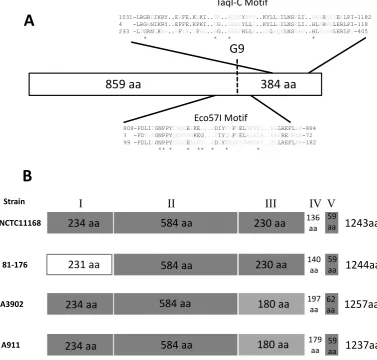
cj0032in the original annotation of the genome sequence). Thecj0031amino acid sequence (1243 amino acids) has ho-mology to known Type IIG RM enzymes with conserved domains present on either side of the polyG tract that in-cludes conservation of amino acids involved in specific and non-specific DNA interactions in the M.TaqI crystal struc-ture (Figure1). An unusual feature of these systems is that the methyltransferase and endonuclease activities are fused into a single reading frame. PV mediated by alterations in
by guest on January 27, 2016
http://nar.oxfordjournals.org/
Figure 1. Alignments and sequence conservation of Cj0031 homologues. (A) The positions and sequences of the conserved domains of the amino acid sequence of Cj0031 (top sequence) are shown in comparison to M.TaqI (2IBS A; GI:155126; bottom sequence) and the consensus sequences of the Eco57I (pfam07669; middle sequence) and TaqI C domains (pfam12950; middle sequence). The amino acids marked with an asterisk are involved in DNA interactions, specific and non-specific, as shown by Goedeckeet al. for M.TaqI (51). The position of the phase-variable G-tract in Cj0031 is marked as G9. (B) Representation of the conserved regions in Cj0031 and homologues fromCampylobacter jejunistrains whose methylomes have been characterized. The dark grey boxes indicate>90% homology between sequences. The light grey regions indicate>90% homology between the two sequences but divergence from the other two sequences.
the repeat tract are predicted to simultaneously abrogate both activities, i.e. methylation and restriction, reducing the toxic effects associated with inactivation of other Type II RM systems.
Orthologues of Cj0031 were found in several other species including a distant association with a putative RM system of the cyanobacteria,Microcystis aeruginosa(data not shown). Homologues fromCampylobacterandH. py-lori, the closest neighbour ofC. jejuni, fell into two groups, separated by homologues in more distant organisms, sug-gestive of the possibility of acquisition by horizontal trans-fer (Figure2). Homologues were present in other Campy-lobactersincluding all otherC. jejunistrains. A notable fea-ture was the lack of a repeat tract in many of the other strains indicating that PV only occurs in a limited number of alleles and is not a universal feature of this gene. For ex-ample, strain 81–176 had an interrupted repeat tract (4G-A-4G) that will effectively prevent PV in this allele. Align-ments were performed between the cj0031 nucleotide and
amino acid sequences and those of homologues from the fourC. jejunistrains whose methylomes have been deter-mined (37–39). Strain F38011 exhibited a ∼300 bp dele-tion in the central pordele-tion of the gene, expected to abrogate methylation activity and explaining the lack of methylation at sites recognized by this protein in the genome. The other three strains showed high levels of conservation in the N-terminal (regions I and II) and C-N-terminal regions (region V) with the exception of significant divergence in amino ter-minal region 1 of strain 81–176. The sequences diverged into two classes in region III and were all highly divergent in region IV suggesting the presence of a variable domain responsible for observed differences in site-specific methy-lation by each of these Cj0031 homologues.
Characterization of the recognition site of Cj0031 by inhibi-tion of restricinhibi-tion
A previous attempt to identify the methylation site of Cj0031 was compromised by use of a strain with an OFF
by guest on January 27, 2016
http://nar.oxfordjournals.org/
Figure 2. Phylogenetic tree showing relationship ofcj0031with orthologues in other species. The tree was generated by using Phylogeny.fr software. The alignment was of thecj0031amino acid sequence with homologues identified through a BLAST analysis. The sequences were aligned using MUSCLE and entered into PhyML for tree building followed by TreeDyn for tree rendering.
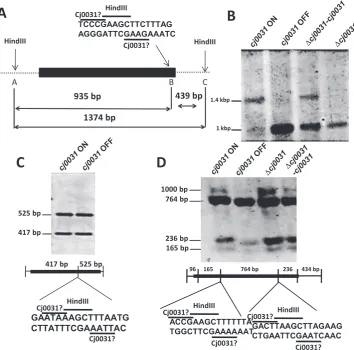
number of repeats in cj0031 (37). To overcome this diffi-culty, both ON and OFF phase-variants were isolated from a population of cells forC. jejuni strain NCTC11168 (see Methods). A fixed OFF strain (11168cj0031::kan) was generated by constructing a deletion in cj0031. Comple-mentation of this mutation (strain 11168-cj0031-cj0031c) was achieved by insertion of the wild-type, phase-variable gene into a pseudogene (with expression controlled by a heterologous promoter) and isolation of a variant with an ON number of repeats. Genomic DNA from these strains was digested with a range of methylation sensitive restric-tion enzymes and tested for differences in the restricrestric-tion patterns using probes from three different regions of the genome (Figure 3). An obvious difference in the restric-tion pattern of cj0031-ON versus 11168-cj0031-OFF and 11168cj0031::kan was detected using probe III with in-hibition of HindIII digestion in ON but not OFF phase variants or a deletion mutant (Figure3). Protection of this site was partially restored in the complementation strain, 11168-cj0031c, confirming that protection was due to Cj0031, with the incomplete level of protection being due to a sub-optimal expression from thefdxApromoter in the complementation vector (36). Additional phase-variants were tested with probe III and exhibited the same restric-tion pattern (data not shown). Critically, another HindIII site present in Probe I did not show any difference in restric-tion pattern (Figure3) suggesting that the putative Cj0031 MTase recognition site did not correspond to but over-lapped with one of the two end sequences of the HindIII 5-AAGCTT-3 recognition sequence in Probe III with in-hibition by methylation on the first adenine.
As Cj0031 shares 87% identity with CjeFV of C. jejuni
strain 81–176 whose recognition sequence was character-ized as 5-GGGCA or 5GGACA (37), we hypothesized that the Cj0031 recognition sequence was GC-rich and had one of three sequences:- 5-CCGAA-3; 5-CGAAG-3; or 5-CCCGA-3(Figure2). The alternative was that the site was AT-rich and had a recognition sequence of 5AAGAA or 5AGAAG. The PSR-HindIII-CCG probe was designed
to investigate if the recognition site was 5CCGAA or 5CGAAG. No inhibition of restriction was observed (Fig-ure3D). This result indicated that all three cytosine residues were required and that a Cj0031 recognition sites could be 5-CCCGA-3.
Detection of the methylation motif of Cj0031 by SMRT se-quencing
SMRT is a robust and reliable method for detecting methy-lation patterns in DNA sequences. The PacBio RS sequenc-ing platform was utilized to generate methylomes for an ON phase variant and deletion mutantof cj0031inC. je-junistrain NCTC11168 strain. Both genomes contained two degenerate motifs, a palindromic motif (RAATTY) and a non-palindromic motif (GKAAYG; Table 1) that had been previously identified (37) as the recognition sites of CjeNII (Cj1051c), M.CjeNIV (Cj1553c), CjeNIII (Cj0690c) and M.CjeNI (Cj0208). In contrast, a novel methylation motif––5CCYGA––was present in the genome sequences for the ON phase variant of Cj0031 but absent from the deletion mutant. This 5CCYGA motif, as also observed for 5GKAAYG, only exhibited methylation on the adenine of one of the DNA strands. A high level of methylation was observed with 1759 of 1777 sites being detected as having methylation with a mean modification QV of 75%. These results confirmed the modification of 5CCCGA in Cj0031 ON phase variants, as detected by Southern blotting, and additionally indicated modification of 5CCTGA sites by this enzyme.
Investigation of the impact of phase variation or mutation of cj0031 on adherence, invasion and biofilm formation byC. jejuni
Motility is a critical phenotype required for colonization and invasion by C. jejuni. As the laboratory strain uti-lized for the methylome studies is non-motile, phase vari-ants and mutvari-ants of cj0031 were obtained for a hyper-motile chicken-adapted variant (i.e. CH11168) of C.
by guest on January 27, 2016
http://nar.oxfordjournals.org/
A
B
C D
TCCCGAAGCTTCTTTAG AGGGATTCGAAGAAATC
HindIII Cj0031?
Cj0031?
GAATAAAGCTTTAATG CTTATTTCGAAATTAC
HindIII Cj0031?
Cj0031? 417 bp 525 bp
1000 bp
ACCGAAGCTTTTTTA TGGCTTCGAAAAAAT
HindIII Cj0031?
Cj0031?
GACTTAAGCTTAGAAG CTGAATTCGAATCAAC
HindIII Cj0031?
Cj0031? 525 bp
417 bp
HindIII HindIII
1374 bp
935 bp 439 bp
764 bp
236 764 bp
165
96 434 bp
236 bp 165 bp
1.4 kbp
[image:7.612.138.493.69.419.2]1 kbp
Figure 3. Identification of the methylation target site for Cj0031. Chromosomal DNA was extracted from ON and OFF phase variants (i.e. 11168-cj0031 -ON and 11168-cj0031-OFF, respectively), a deletion mutant (11168-cj0031::kan) and a complementation mutant (11168cj0031-cj0031) ofcj0031in
Campylobacter jejunistrain NCTC11168. DNA was subjected to restriction with HindIII followed by probing of Southern blots with region specific probes. (A) Schematic diagram of the HindIII recognition sites (A, B and C) and overlapping putative Cj0031 recognition site present in Probe III. The figure indicates the sizes of fragments generated by complete and partial HindIII digestion with the latter resulting from protection of site B by Cj0031. (B) Analysis of HindIII restriction fragments using probe III. Inhibition of restriction is observed in the ON phase variant and complementation strain but not the OFF variant or deletion mutant. (C) Analysis of HindIII restriction fragments using probe I. (D) Analysis of HindIII restriction fragments using probe PSR-HindIII-CCG. This probe covers a region in which the 5CCGAA and 5CGAAG sequences (present in Probe III) overlap with the HindIII sequence but are not protected against HindIII digestion. Black rectangles, position of probes; Cj0031?, putative Cj0031 recognition site; HindIII, recognition site for HindIII.
Table 1. Methylation motifs identified within the genomes of aC. jejuniNCTC11168cj0031ON phase-variant and acj0031mutant
Motifs
Modified
position Type
% Motifs detected
# Of motifs detected
# Of motifs in
genome Partner motif
C. jejuniNCTC11168cj0031ON
ACNNNNNCTC 1 m6A 99.91% 1065 1066 GAGNNNNNGT
GAGNNNNNGT 2 m6A 99.25% 1058 1066 ACNNNNNCTC
TAAYNNNNNTGC 3 m6A 99.79% 468 469 GCANNNNNRTTA
GCANNNNNRTTA 3 m6A 97.87% 459 469 TAAYNNNNNTGC
GKAAYG 4 m6A 99.68% 1255 1259
RAATTY 3 m6A 99.01% 27 011 27 280 RAATTY
CCYGA 5 m6A 98.99% 1759 1777
C. jejuniNCTC11168cj0031
ACNNNNNCTC 1 m6A 99.91% 1065 1066 GAGNNNNNGT
GAGNNNNNGT 2 m6A 99.25% 1058 1066 ACNNNNNCTC
TAAYNNNNNTGC 3 m6A 99.79% 468 469 GCANNNNNRTTA
GCANNNNNRTTA 3 m6A 97.87% 459 469 TAAYNNNNNTGC
GKAAYG 4 m6A 99.68% 1255 1259
RAATTY 3 m6A 99.01% 27 011 27 280 RAATTY
by guest on January 27, 2016
http://nar.oxfordjournals.org/
[image:7.612.56.569.543.736.2]cj0031
ON
cj0031
OFF
Δcj0031 Δcj0031 -cj0031
P
e
rc
en
ta
g
e
adher
ence
A
B
***
***
**
cj0031
ON
cj0031
OFF
Δcj0031 Δcj0031 -cj0031
P
e
rc
en
ta
g
e
in
v
asion
**
***
[image:8.612.325.540.71.402.2]***
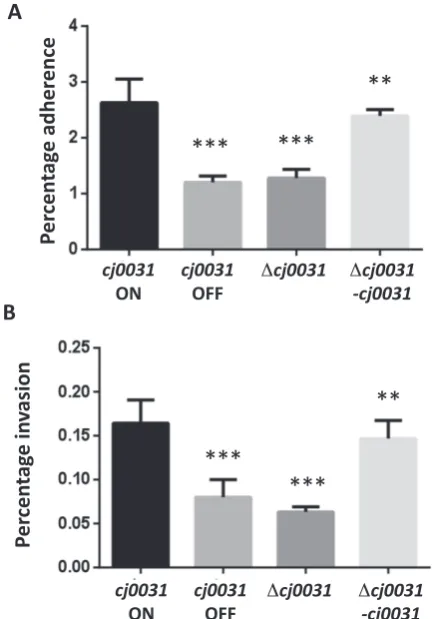
Figure 4. Influence ofcj0031on adherence and invasion of Campylobac-ter jejunistrain NCTC11168 to Caco-2 cells. Adhesion and invasion ex-periments were performed using an inoculum of 1×10⁷cells (adherence
assay) or 2×10⁷cells (invasion assay) for each bacterial strain and a
semi-confluent monolayer of Caco-2 cells. Adherence (panelA) was measured after a 4 h incubation as a combination of adherent and invaded bacteria. Invasion (panelB) was determined by performing an initial four hour ad-hesion assay followed by 4 h of gentamycin treatment. In both cases, serial dilutions of total cell lysates were utilized for calculation of the number of cfu/ml and expressed as percentage of the inoculum. Both experiments were performed with an ON and OFF phase-variant ofcj0031(cj0031ON andcj0031OFF, respectively), a deletion mutant ofcj0031(cj0031) and a complement of this mutant withcj0031inserted intocj0046, a pseudo-gene (cj0031–cj0031). All of these phase variants or mutants were in a chicken-adapted variant ofC. jejunistrain NCTC11168. Triplicate read-ings were utilized for calculation of an SEM (standard error of mean) and error bars. Unpaired Student’st-test was used to calculate theP-values as compared tocj0031ON (**P<0.01; ***P<0.001).
juni strain NCTC11168. The functional consequences of PV or inactivation of cj0031 on motility were examined using Mueller-Hinton-soft-agar plates. No obvious differ-ences in motilities of these strains were observed, indicat-ing that Cj0031 methyltransferase activity does not affect the motility of C. jejuni(Supplementary Figure S1). Hav-ing shown these strains to be motile, the adhesion and inva-sion phenotypes were investigated. In two separate experi-ments, both an OFF variant and the deletion mutant (i.e. CH11168cj0031::kan) exhibited significant 2-fold lower levels of adhesion to Caco-2 cells than an ON variant (Figure4). Complementation restored the adherent pheno-type to the same level as the ON variant. Invasion was as-sayed using Caco-2 cells and gentamycin-treatment. Both
cj0031
ON
cj0031
OFF
Δcj0031 Δcj0031 -cj0031
cj0031
ON
cj0031
OFF
Δcj0031 Δcj0031 -cj0031
A
B
****
****
****
****
**
[image:8.612.52.269.76.386.2]**
Figure 5. Influence ofcj0031on biofilm formation byCampylobacter jejuni
strain NCTC11168. An assessment of biofilm formation was performed using phase variants and mutants ofcj0031in a chicken-adapted variant ofC. jejunistrain 11168 (see Figure4). Biofilm formation was measured by crystal violet (CV) staining of standing cultures in 24-well polystyrene plates following either 48 (panelA) or 72 (panelB) h incubation at 37◦C under micro-aerobic conditions. Quantification of dissolved CV was made at 570 nm. Measurements represent six measurements determined from triplicate readings of two independent experiments. An unpaired Student’s
t-test was used to calculateP-values as compared tocj0031ON (****P<
0.0001; and **P<0.01).
the OFF variant and deletion mutant ofcj0031exhibited a significant reduction of 2–3-fold as compared to the wild-type cj0031 ON variant. Complementation of the cj0031
deletion mutant with an ON variant of the nativecj0031
gene partially restored the invasion phenotype (Figure4). Additionally, the contributions of Cj0031 to biofilm formation were examined using a CV staining method (29,40). Both OFF phase-variants and a cj0031 deletion mutant demonstrated 7- and 4-fold decreases, respectively, in biofilm formation as compared to an ON phase-variant after both 48 and 72 h of growth (Figure5). The comple-mentation strain (i.e. 11168-cj0031-cj0031) partially re-stored the phenotype to a level that was significantly (P<
0.001) different from the deletion mutant, indicating that absence ofcj0031is deleterious to biofilm formation byC. jejunistrain NCTC11168. A further biofilm experiment was performed to test whether PV ofcj0031or other genes oc-curred during the course of the biofilm assay. Differences
by guest on January 27, 2016
http://nar.oxfordjournals.org/
in PV state were assessed forcj0031and 26 other loci con-taining polyG tracts using a multiplex PCR/GeneScan as-say (Lango-Scholeyet al., in preparation). No differences in the PV state ofcj0031or any other locus were observed be-tween input and output populations for any of the strains whilst the biofilm phenotype was as observed in Figure 5
(data not shown). One gene,cj1342, was in an ON state (i.e. 9G) in the deletion mutant but OFF (i.e. 10G) in the wild-type and complement strains. Phase variants ofcj1342were isolated for the cj0031ON phase variant of the wild-type strain and shown to exhibit identical levels of biofilm for-mation (data not shown), indicating that the differences in biofilm formation observed in Figure5were due to changes incj0031expression and not other phase-variable genes.
Transcriptional profiling of Cj0031 phase variants and mu-tants
Alterations in methylation of Cj0031 recognition sites could impact on transcription of specific genes and produce dif-ferences in phenotypic behaviour. RNASeq profiles were generated for an ON variant in strain NCTC11168 and the deletion mutant of cj0031. Examination of sequences generated from the RNA-Seq data confirmed that cj0031
contained an ON number of repeats and that the mutant lacked the gene. Major differences in gene expression were observed with 89 and 130 genes exhibiting a statistically-significant reduction or increase, respectively, of>1.5-fold in the mutant (Figure 6). A subset of 20 genes exhibited changes of>5-fold (Figure6; with 14 having reduced and 6 increased expression). An qRT-PCR of nine genes con-firmed the observed changes in relative gene expression lev-els (Supplementary Figure S2). Major changes in gene ex-pression were observed in two tRNA genes and genes whose products contribute to metabolism (e.g. Uxa, altronate hy-drolase; Cj0073-Cj0075, iron-sulphur cluster proteins) or transport (e.g. PutP, a sodium-proline symporter; HydA2, NI-Fe hyrdrogenase; LctP, L-lactate permease). Only one of nine genes (i.e.capA,cadF,pldA,peb1A,flpA,ciaB,cipA,
cj0268candcj1349) with evidence of roles in adhesion and invasion, was altered in expression with a 3-fold increase in expression ofpeb1A.
Altered expression of genes in cj0031 may be due to differential methylation of 5CCYGA sequences. The NCTC11168 genome contains 1776 of these sequences with an average of 1.1 sites per kbp and∼1 site per gene. Only 69 sites are located in intergenic regions and these sites are associated with 38 genes. Significant>1.5-fold alterations in expression were only observed for three of these genes in
cj0031 (two upregulated and one downregulated). None of these genes had known roles in adhesion, invasion or biofilm formation. The loci that contained genes exhibiting large differences (>5-fold) in expression were examined for the presence of Cj0031 methylation sites. In some of these loci, 2–4 5CCYGA sequences were present within the read-ing frames of multiple genes but in other loci most of the genes contained 0–1 sequences (Supplementary Figure S3). As an alternative, loci with 4–6 genic 5CCYGA sequences were examined for alterations in gene expression and multi-ple exammulti-ples were observed with<1.5-fold changes in ex-pression. There was however an association between the
presence of multiple recognition sites and an increase in gene expression with 23% of genes containing four or more repeats (n=83) exhibiting a significant increase in expres-sion whereas only 7% and 10% of genes with 1–3 (n=1038) or 0 (706) sites, respectively, exhibited an increase in expres-sion. However the average increase in expression for genes containing four or more sites was 2-fold with no genes show-ing a>3.5-fold increase in expression. Overall these results indicated that there is only a weak association between al-terations in gene expression incj0031and the presence of 5CCYGA sequences.
Assessment of the phage restriction activity of Cj0031
The classic activity of RM enzymes is to prevent phage replication. Stocks ofCampylobacterbacteriophages prop-agated onC. jejunistrain PT14 were tested for plaque for-mation at the routine test dilution (log10 6 PFU) on
bac-terial lawns ofcj0031phase-variants and the deletion mu-tant. Some of these bacteriophages exhibited plaque forma-tion on thecj0031OFF variant or deletion mutant but not oncj0031ON. These phages were selected for further study in order to determine whether they were subject to restric-tion by the putative endonuclease activity of Cj0031. Phages were propagated oncj0031 to allow for methylation on sites for all of the NCTC11168 RM systems exceptcj0031
and then tested for growth on cj0031 phase-variants and mutants. The efficiency of plating (EOP) values of the dele-tion mutant andcj0031OFF variant were similar, whereas the EOPs recorded for thecj0031ON variant exhibited be-tween 5- and 1000-fold reductions in PFU (Table2). These data are consistent with the hypothesis thatcj0031encodes a functional endonuclease.
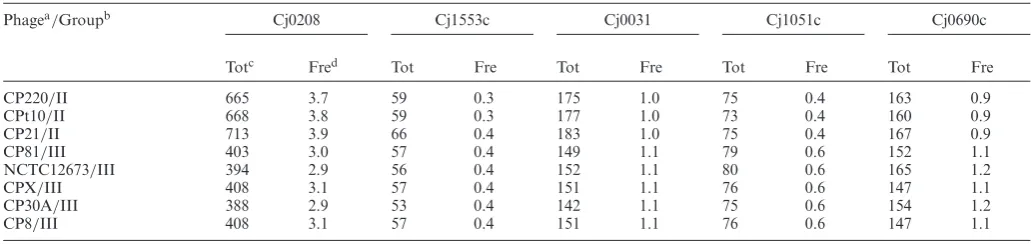
The potential of an RM system to restrict phage replica-tion is dependent on the presence and frequency of recogni-tion sites in phage genomes. The methylarecogni-tion site frequen-cies were determined for all of theC. jejuni RM systems of ten phages whose genome sequences were available and ranged in size from 132 to 178 kb (Table3). The Cj0031 site was present in all phage genomes at similar frequen-cies including phages with sensitivity (i.e. CP8 and CP30) to restriction on Cj0031 ON variants. A comparison be-tween enzymes indicated that the highest site prevalence was for the AT-rich recognition site of Cj0208 (3–4 -sites/kb for RAATTY) whilst both Cj0031 and Cj0690 exhibited frequencies of ∼1/kb whereas the more complex sites of Cj1051 and Cj1553 were present at<0.5 sites/kb.
DISCUSSION
Campylobacter jejunicontains several phase variable genes with known or potential roles in survival and adaptation of this species to various niches in hosts and the environ-ment. While phase-variable genes usually encode surface structures, a provocative association with non-surface cod-ing genes is widely reported and in particular a distinctive PV signal is found for RM systems of several pathogenic bacteria (19–22,41). PV of surface molecules is an tive strategy enabling escape of not only innate and adap-tive host immune responses but also a dynamic and evolv-ing phage population (8,9). The phase-variable RM systems
by guest on January 27, 2016
http://nar.oxfordjournals.org/
Figure 6. Circos diagram representing the genome ofCampylobacterjejuni11168. This diagram was drawn as described by Krzywinskiet al. (35).The outer ring represents genes transcribed in the forward direction, colour coded according to COG (Clusters of Orthologous Groups function; colour key bottom right). The second ring represents the positions of the CCYGA motif on this forward strand with intergenic sites represented in green and intragenic positions represented in black. The third ring represents genes transcribed on the reverse strand, colour coded according to COG. The fourth ring represents the positions of the CCYGA motif on this reverse strand with intergenic sites represented in red and intragenic positions represented in black. The fifth ring represents the positions of pseudogenes (pink), tRNA genes (blue), rRNA genes (green) on both strands. The histograms show the expression of genes increased in mutant relative to wild-type by more than 1.5-fold (black) or those decreased relative to wild-type by more than 1.5-fold (red). The outer ring of the scale for the histograms represents a 5-10-fold change in expression whilst the inner ring represents a 1.5-5-fold change.
provide another strategy to escape selection by phages. A more surprising finding was of a phasevarion whereby PV of the methyltransferase of a phase-variable RM system coor-dinates the expression of multiple genes through changes in genome methylation (19). We define herein the recognition sites of a novel, phase-variable Type IIG RM system and
investigated the contributions of this enzyme to a Campy-lobacterphasevarion and phage restriction.
Previous SMRT sequencing of C. jejuni strain NCTC11168 detected methylation sites for four of the putative RM systems but not for Cj0031 as this gene was in an OFF state in the analysed variant of this strain (37). We isolated an ON variant and constructed both a deletion
by guest on January 27, 2016
http://nar.oxfordjournals.org/
Table 2. Relative efficiency of plating of phages on phase variants and mutants of cj0031 inC. jejunistrain NCTC11168
Phagea Relative EOPb
cj0031ON cj0031OFF cj0031
CP8 0.05 1 1
CP25 0.04 1 1
CP30 0.01 1 1
A1b 0.2 1 1
X3 0.1 1 1
G3 0.01 0.8 1
G4 0.06 0.9 1
MC1a 0.008 0.8 1
11 0.009 0.9 1
19b 0.005 0.9 1
NCTC12671 0.001 1 1
NCTC12679 0.02 0.8 1
aPhages were propagated on 11168cj0031;
bEOP of the sensitive phages on the test host relative to a non-restricting host.
Table 3. Prevalence of recognition sites for the RM systems ofC.jejunistrain NCTC11168 in phage genomes
Phagea/Groupb Cj0208 Cj1553c Cj0031 Cj1051c Cj0690c
Totc Fred Tot Fre Tot Fre Tot Fre Tot Fre
CP220/II 665 3.7 59 0.3 175 1.0 75 0.4 163 0.9
CPt10/II 668 3.8 59 0.3 177 1.0 73 0.4 160 0.9
CP21/II 713 3.9 66 0.4 183 1.0 75 0.4 167 0.9
CP81/III 403 3.0 57 0.4 149 1.1 79 0.6 152 1.1
NCTC12673/III 394 2.9 56 0.4 152 1.1 80 0.6 165 1.2
CPX/III 408 3.1 57 0.4 151 1.1 76 0.6 147 1.1
CP30A/III 388 2.9 53 0.4 142 1.1 75 0.6 154 1.2
CP8/III 408 3.1 57 0.4 151 1.1 76 0.6 147 1.1
aAccession numbers: FN667788, FN667789, HE815464, FR823450, GU296433, JN132397, JX569801, JK148616;
bGroup, phages belonging to group II have genomes of 180–190 kb whilst those in group III have genome sizes of 130–140 kb (52,53) cTot, total number of sites per genome;
dFre, frequency of sites per kb.
mutant and complementation strain to facilitate charac-terization of this RM system. By examining inhibition of methylation activity, we detected a HindIII site that exhibited a differential pattern of digestion between ON and OFF variants ofcj0031. This suggested that the Cj0031 recognition site was either 5CCCGA with methylation on the adenine or an AT-rich sequence (e.g. 5AAGAA). SMRT sequencing identified the methylation site of this enzyme as either 5CCCGA or 5CCTGA as methylation of these sites was absent in a cj0031 deletion mutant but present in an ON phase variant of this gene.
The phylogenetic analysis ofcj0031showed that homo-logues ofcj0031 were present inH. pylori, a close relative to C. jejuni, as well as several other more diverse bacte-rial species. Homologues of cj0031 were present in other strains of C. jejuni and have a 90–99% sequence similar-ity with conservation of the motifs characteristic of restric-tion endonucleases. Despite this high overall level of con-servation, one region (IV; Figure 1) of the protein exhib-ited high levels of variation between all alleles of Cj0031 for which methylomes have been determined. This region is predicted to encode the TRD as has been predicted for the hypervariable regions of other RM-associated methyl-transferases. The methylation site of CfeFV, the homologue ofcj0031in strain 81–176, has been characterized by SMRT
sequencing as 5GGRCA (37) whereas that of Cj0031 was 5CCYGA. The putative TRD regions of these homologues differ by 87–91 amino acids in the 136–140 residues of re-gion IV suggesting that the amino acids responsible for site-specific DNA recognition are located therein. The IA3902 homologue, CjeIAORF32P, exhibits significant amino acid variation from Cj0031 in both regions III and IV (Figure1) and methylates at a 5GAAGAA sequence (38). A notable feature of these alignments is of the absence of the polyG tract in the other Cj0031 homologues suggesting that PV may be restricted to a sub-set of alleles.
Populations of C. jejuni strain NCTC11168 will con-tain phase-variants of Cj0031 with either methylated (ON) or non-methylated (OFF) 5CCYGA sequences, raising the potential for association of a phasevarion with PV of Cj0031. A phasevarion is a set of genes whose expression is regulated by ON-OFF switching of site-specific methyla-tion by a phase-variable methyltransferase. The observamethyla-tion of reductions in adhesion, invasion and biofilm formation incj0031deletion mutants was indicative of association of Cj0031 PV with a phasevarion. These alterations in host cell attachment were not due to differences in motility (Supple-mentary Figure S1) but were in general minor differences in phenotype. The degree of these effects could have been reduced by PV of the ON variants so that starting
by guest on January 27, 2016
http://nar.oxfordjournals.org/
[image:11.612.54.570.281.403.2]tions contained variable proportions of OFF variants. An alternative explanation of differences in phenotype is the impact of PV of other genes. The potential importance of this caveat was reduced by the observation of similar pheno-types for the ON variant of the wild-type and complementa-tion mutant and similarly for the OFF variant and delecomplementa-tion mutant. Furthermore, no influence on biofilm formation of PV ofcj0031during the experiment or of differences in ex-pression of other phase-variable genes between strains was observed in additional repetitions of the biofilm assay. Inac-tivation of another putative methyltransferase, Cj1461, re-duced both the motility and invasion byC. jejunistrain 81– 176 (42). Similarly, Fields and Thompson (43) reported that inactivation of CsrA, a global post-transcriptional regula-tor, reduced motility, biofilim formation and adherence of
C. jejunistrain 81–176 but enhanced invasion leading to the proposal that CsrA directly or indirectly represses invasion specific genes. The RNASeq analysis of cj0031detected an altered level of expression for Peb1A (cj0921c,−2.8-fold) but not for any other known adhesins or invasins. Peb1A is a periplasmic protein that mediates uptake of dicarboxylic amino acids (44). A variable association of this gene with reductions in adhesion has been reported (45). Thus, the Cj0031 methyltransferase might act as a phasevarion with alterations in expression of Peb1A resulting in reductions in host cell adhesion and invasion. Alternatively the alter-ations in metabolic pathways, also observed in thecj0031
RNASeq data, could be responsible for the observed phe-notypic variation. A final possibility is that observed differ-ences in gene expression may have impacted on other types of phenotypic variation.
The proposed mechanism of regulation of a phasevarion is through differential methylation of promoter elements leading to alterations in binding of regulatory proteins and/or RNA polymerase to promoter elements in an anal-ogous manner to Dam methylase-mediated regulation of bacterial gene expression (17and18). There was only weak evidence of a genome-wide association between presence of 5CCYGA sequences and alterations in transcription as de-tected in the RNASeq data. An alternate possibility is that variable methylation at only some of the 5CCYGA sites has any effect on transcription and that the differential tion is through perturbation of one or more global regula-tors of gene expression. However, there were no significant alterations in expression of known two-component regu-lators (i.e. RacRS, DccRS, cbrRS and FlgRS), sigma fac-tors (FliA and RpoN), CsrA or of Fur (a significant 2-fold change in flgR was observed but this was disregarded as there was no overall change in expression of theflagenes). Finally, the Peb1A gene contained a single 5CCYGA se-quence within the reading frame, which is the number ex-pected by chance for any gene of this genome. Thus, neither the overall nor specific distribution of Cj0031 methylation sites provides a clear insight into the mechanism for alter-ing gene expression as implied by differences in phenotypic variation or as detected in the RNASeq data.
An alternate putative function of all RM systems is striction of phage replication. Testing of a phage panel re-vealed that inactivation ofcj0031resulted in a higher EOP for 12 phages. This loss of inhibition of phage replication provides evidence that Cj0031 is an active restriction
en-donuclease with the ability to restrict phage DNA. The efficiency of restriction by RM systems is, for some sys-tems, directly proportional to the number of recognition sites located in the genome of the invading element (46– 48) with low numbers of restriction sites for a specific RM system correlating with a greater probability to escape re-striction. The high prevalence of sites for Cj0031 in two of the restricted phages, CP8 and CP30, supports the view that the restriction activity is correlated with the number of restriction sites. Intriguingly, thecj0031site has a higher prevalence (1.5- to 6-fold) in all phage genomes than that of the homologue present in strain PT14 (i.e. A911 00150; GAACAA). If the main function of Cj0031 is restriction of phage growth and the number of recognition sites is cor-related with higher restriction of phage growth, then the Cj0031 and CfeFV alleles may be more widely distributed inCampylobactergenomes than the alleles with 6 bp recog-nition sites. Evolution of PV of Cj0031 could then be driven by selection for phage resistance in the ON state and se-lection for expression of one state of the phasevarion in the alternate state. Alternatively selection for the OFF state may be driven by receptiveness to adaptive mutations as-sociated with natural transformation (assuming in-coming DNA can be restricted by Cj0031 endonuclease activity) or fluctuating levels of Cj0031-resistant methylated phage genomes as speculated elsewhere (49).
Our study provides evidence of a dual role for PV of the Type IIG enzyme, Cj0031, ofC. jejunistrain NCTC11168 as a limiter of phage spread and a regulator of a gene expres-sion. The underlying mechanism of action for the alteration in gene expression is not known and does not appear to in-volve differential methylation of specific recognition sites by Cj0031. Nevertheless PV of Cj0031, as detected during in-fections in chickens and mice (8,50), produces changes in ex-pression of multiple genes that may lead to phenotypic vari-ation and genervari-ation of highly differentiated variants with differing capabilities of adaptation to diverse niches.
SUPPLEMENTARY DATA
Supplementary Dataare available at NAR Online.
ACKNOWLEDGEMENT
The authors are grateful to Dr Richard Haigh for provision of the CH11168 strain and for his assitance with the adhe-sion and invaadhe-sion assay.
FUNDING
Wellcome Trust Grant [098051]. Funding for open access charge: University of Leicester [M38DF47].
Conflict of interest statement.None declared.
REFERENCES
1. Ruiz-Palacios,G.M. (2007) The health burden ofCampylobacter
infection and the impact of antimicrobial resistance: playing chicken.
Clin. Infect. Dis.,44, 701–703.
2. Tam,C.C., O’Brien,S.J., Tompkins,D.S., Bolton,F.J., Berry,L., Dodds,J., Choudhury,D., Halstead,F., Iturriza-G ´omara,M., Mather,K.et al.(2012) Changes in causes of acute gastroenteritis in
by guest on January 27, 2016
http://nar.oxfordjournals.org/
the United Kingdom over 15 years: Microbiologic findings from 2 prospective, population-based studies of infectious intestinal disease.
Clin. Infect. Dis.,54, 1275–1286.
3. Sheppard,S.K., Dallas,J.F., Strachan,N.J.C., MacRae,M.,
McCarthy,N.D., Wilson,D.J. and Gormley,F.J. (2009)Campylobacter
genotyping to determine the source of human infection.Clin. Infect. Dis.,48, 1072–1078.
4. Hermans,D., Pasmans,F., Messens,W., Martel,A., Van Immerseel,F., Rasschaert,G., Heyndrickx,M., Van Deun,K. and Haesebrouck,F. (2012) Poultry as a host for the zoonotic pathogenCampylobacter jejuni.Vector Borne Zoonotic Dis.,12, 89–98.
5. Newell,D.G., Elvers,K.T., Dopfer,D., Hansson,I., Jones,P., James,S., Gittins,J., Stern,N.J., Davies,R., Connerton,I.et al.(2011)
Biosecurity-based interventions and strategies to reduce
Campylobacterspp. on poultry farms.Appl. Environ. Microbiol.,77, 8605–8614.
6. Bayliss,C.D. (2009) Determinants of phase variation rate and the fitness implications of differing rates for bacterial pathogens and commensals.FEMS Microbiol. Rev.,33, 504–520.
7. Parkhill,J., Wren,B.W., Mungall,K., Ketley,J.M., Churcher,C., Basham,D., Chillingworth,T., Davies,R.M., Feltwell,T., Holroyd,S.
et al.(2000) The genome sequence of the food-borne pathogen
Campylobacter jejunireveals hypervariable sequences.Nature,403, 665–668.
8. Bayliss,C.D., Bidmos,F.A., Anjum,A., Manchev,V.T., Richards,R.L., Grossier,J.P., Wooldridge,K.G., Ketley,J.M., Barrow,P.A.,
Jones,M.A.et al.(2012) Phase variable genes ofCampylobacter jejuni
exhibit high mutation rates and specific mutational patterns but mutability is not the major determinant of population structure during host colonization.Nucleic Acids Res.,40, 5876–5889. 9. Moxon,R., Bayliss,C. and Hood,D.(2006) Bacterial contingency loci:
the role of simple sequence DNA repeats in bacterial adaptation.
Annu. Rev. Genet.,40, 307–333.
10. Boyer,H.W. (1971) DNA restriction and modification mechanisms in bacteria.Annu. Rev. Microbiol.,25, 153–176.
11. Bujnicki,J.M. (2001) Understanding the evolution of
restriction-modification systems: clues from sequence and structure comparisons.Acta Biochim.,48, 935–967.
12. Janulaitis,A., Vaisvila,R., Timinskas,A., Klimasauskas,S. and Butkus,V. (1992) Cloning and sequence analysis of the genes coding for Eco57I Type IV restriction-modification enzymes.Nucleic Acids Res.,20, 6051–6056.
13. Shen,B.W., Xu,D., Chan,S.H., Zheng,Y., Zhu,Z., SY,X. and Stoddard,B.L. (2011) Characterization and crystal structure of the Type IIG restriction endonuclease RM.BpuSI.Nucl. Acids Res.,39, 8223–8236.
14. Roberts,R.J., Vincze,T., Posfai,J. and Macelis,D., (2015) REBASE – a database for DNA restriction and modification: enzymes, genes and genomes.Nuc. Acids Res.,43, D298–D299.
15. Bickle,T.A. and Kruger,D.H. (1993) Biology of DNA restriction.
Microbiol. Rev.,57, 434–450.
16. Heusipp,G., F¨alker,S. and Schmidt,M.A. (2007) DNA adenine methylation and bacterial pathogenesis.Int. J. Med. Microbiol.,297, 1–7.
17. Casadesus,J. and Low,D. (2006) Epigenetic gene regulation in the bacterial world.Microbiol. Mol. Biol. Rev.,70, 830–856.
18. Wion,D. and Casadesus,J. (2006) N6-methyl-adenine: an epigenetic signal for DNA-protein interactions.Nat. Rev. Microbiol.,4, 183–192.
19. Srikhanta,Y.N., Maguire,T.L., Stacey,K.J., Grimmond,S.M. and Jennings,M.P. (2005) The phasevarion: a genetic system controlling coordinated, random switching of expression of multiple genes.Proc. Natl. Acad. Sci. U.S.A.,102, 5547–5551.
20. Srikhanta,Y.N., Dowideit,S.J., Edwards,J.L., Falsetta,M.L., Wu,H.J., Harrison,O.B., Fox,K.L., Seib,K.L., Maguire,T.L., Wang,A.H.et al.
(2009) Phasevarions mediate random switching of gene expression in pathogenicNeisseria.PLoS Pathog.,5, e1000400.
21. Srikhanta,Y.N., Gorrell,R.J., Steen,J.A., Gawthorne,J.A. and Kwok,T. (2011) Phasevarion mediated epigenetic gene regulation in
Helicobacter pylori.PLoS One.,6, e27569.
22. Manso,A.S., Chai,M.H., Atack,J.M., Furi,L., De Ste Croix,M., Haigh,R., Trappetti,C., Ogunniyi,A.D., Shewell,L.K., Boitano,M.
et al.(2014) A random six-phase switch regulates pneumococcal virulence via global epigenetic changes.Nat. Commun.,5, 5055.
23. Miller,W.G., Pearson,B.M., Wells,J.M., Parker,C.T., Kapitonov,V.V. and Mandrell,R.E. (2005) Diversity within theCampylobacter jejuni
Type I restriction-modification loci.Microbiology,151, 337–351. 24. Gardner,S.P. and Olson,J.W. (2012) Barriers to horizontal gene
transfer inCampylobacter jejuni.Adv. Appl. Microbiol.,79, 19–42. 25. Brathwaite,K.J., Siringan,P., Connerton,P.L. and Connerton,I.F.
(2015) Host adaption to the bacteriophage carrier state of
Campylobacter jejuni.Res. Microbiol.,166, 504–515.
26. Dereeper,A., Guignon,V., Blanc,G., Audic,S., Buffet,S., Chevenet,F., Dufayard,J.F., Guindon,S., Lefort,V., Lescot,M.et al.
(2008) Phylogeny.fr: robust phylogenetic analysis for the non-specialist.Nucleic Acids Res.,36, W465–W469. 27. Sambrook,J., Fritschi,E.F. and Maniatis,T. (1989)Molecular
Cloning: A Laboratory Manual, Cold Spring Harbor Laboratory Press, Cold Spring Harbor NY, USA.
28. Gaskin,D.J.H., Van Vliet,A.H.M. and Pearson,B.M. (2007) The
Campylobactergenetic toolbox: development of tractable and generally applicable genetic techniques forCampylobacter jejuni.
Zoon. Publ. Health.,54, 101.
29. Reeser,R.J., Medler,R.T., Billington,S.J., Jost,B.H. and Joens,L.A. (2007) Characterization of Campylobacter jejuni biofilms under defined growth conditions.Appl. Environ. Microbiol.,73, 1908–1913. 30. Siringan,P., Connerton,P.L., Cummings,N.J. and Connerton,I.F.
(2014) Alternative bacteriophage life cycles: the carrier state of
Campylobacter jejuni.Open Biol.,4, 130200.
31. Atterbury,R.J., Connerton,P.L., Dodd,C.E., Rees,C.E. and Connerton,I.F. (2003) Isolation and characterization of
Campylobacterbacteriophages from retail poultry.Appl. Environ. Microbiol.,69, 4511–4518.
32. Mortazavi,A., Williams,B.A., McCue,K., Schaeffer,L. and Wold,B. (2008) Mapping and quantifying mammalian transcriptomes by RNA-Seq.Nat. Methods,5, 621–628.
33. Baggerly,K., Deng,L., Morris,J. and Aldaz,C. (2003) Differential expression in SAGE: accounting for normal between-library variation.Bioinformatics,19, 1477–1483.
34. Benjamini,Y. and Hochberg,Y. (1995) Controlling the false discovery rate: a practical and powerful approach to multiple testing.J. Roy. Statist. Soc. B,57, 289–300.
35. Krzywinski,M., Schein,J., Birol,I., Connors,J., Gascoyne,R., Horsman,D., Jones,S.J. and Marra,M.A. (2009) Circos: an information aesthetic for comparative genomics.Genome Res.,19, 1639–1645.
36. Shaw,F.L., Mulholland,F., Le Gall,G., Porcelli,I., Hart,D.J., Pearson,B.M. and van Vliet,A.H. (2012) Selenium-dependent biogenesis of formate dehydrogenase inCampylobacter jejuniis controlled by the fdhTU accessory genes.J. Bacteriol.,194, 3814–3823.
37. Murray,I.A., Clark,T.A., Morgan,R.D., Boitano,M., Anton,B.P., Luong,K., Fomenkov,A., Turner,S.W., Korlach,J. and Roberts,R.J. (2012) The methylomes of six bacteria.Nucleic Acids Res.,40, 11450–11462.
38. Mou,K.T., Muppirala,U.K., Severin,A.J., Clark,T.A., Boitano,M. and Pummer,P.J. (2015) A comparative analysis of methylome profiles ofCampylobacter jejunisheep abortion isolate and gastroenteric strains using PacBio data.Font. Microbiol.,5, 1–15. 39. O’Loughlin,J.L., Eucker,T.P., Chavez,J.D., Samuelson,D.R.,
Neal-McKinney,J., Gourley,C.R., Bruce,J.E. and Konkel,M.E. (2015) Analysis of theCampylobacter jejunigenome by SMRT DNA sequencing identifies restriction-modification motifs.PLoS One, e0118533.
40. Joshua,G.W., Guthrie-Irons,C., Karlyshev,A.V. and Wren,B.W. (2006) Biofilm formation inCampylobacter jejuni.Microbiology,152, 387–396.
41. Srikhanta,Y.N., Fox,K.L. and Jennings,M.P. (2010) The phasevarion: phase variation of Type III DNA methyltransferases controls coordinated switching in multiple genes.Nat. Rev. Microbiol.,8, 196–206.
42. Kim,J.S., Li,J., Barnes,I.H., Baltzegar,D.A., Pajaniappan,M., Cullen,T.W., Trent,M.S., Burns,C.M. and Thompson,S.A. (2008) Role of theCampylobacter jejuniCj1461 DNA methyltransferase in regulating virulence characteristics.J. Bacteriol.,190, 6524–6529. 43. Fields,J.A. and Thompson,S.A. (2008)Campylobacter jejuniCsrA
mediates oxidative stress responses, biofilm formation, and host cell invasion.J. Bacteriol.,190, 3411–3416.
by guest on January 27, 2016
http://nar.oxfordjournals.org/
44. Leon-Kempis Mdel,R., Guccione,E., Mulholland,F.,
Williamson,M.P. and Kelly,D.J. (2006) The Campylobacter jejuni PEB1a adhesin is an aspartate/glutamate-binding protein of an ABC transporter essential for microaerobic growth on dicarboxylic amino acids.Mol. Microbiol.,60, 1262–1275.
45. Pei,Z., Burucoa,C., Grignon,B., Baqar,S., Huang,X.-Z.,
Kopecko,D.J., Bourgeois,A.L., Fauchere,J.-L. and Blaser,M.J. (1998) Mutation in the peb1A locus ofCampylobacter jejunireduces interactions with epithelial cells and intestinal colonization of mice.
Infect. Immun.,66, 938–943.
46. Wilson,G.G. and Murray,N.E. (1991) Restriction and modification systems.Ann. Rev. Genet.,25, 585–627.
47. Franklin,N.C. and Dove,W.F. (1969) Genetic evidence for restriction targets in the DNA of phages lambda and phi 80.Genet. Res.,14, 151–157
48. Murray,N.E., Manduca De Ritis,P. and Foster,L. (1973) DNA targets for theEscherichia coliK restriction system analyzed genetically in recombinants between phages phi80 and lambda.Mol. Gen. Genet.,120, 261–281.
49. Bayliss,C.D., Callaghan,M.J. and Moxon,E.R. (2006) High sequence diversity in the mod gene of a phase variable putative type III restriction-modification ofHaemophilus influenzae.Nucliec Acids Res.,34, 4046–4059.
50. Jerome,J.P., Bell,J.A., Plovanich-Jones,A.E., Barrick,J.E., Brown,C.T. and Mansfield,L.S. (2011) Standing genetic variation in contingency loci drives the rapid host adaptation ofCampylobacter jejunito a novel host.PLoS One,6, e16399.
51. Goedecke,K., Pignot,M., Goody,R.S., Scheidig,A.J. and Weinhold,E. (2001) Structure of the N6-adenine DNA methyltransferase M.TaqI in complex with DNA and a cofactor analog.Nat. Struct. Biol.,8, 121–125.
52. Sails,A.D., Wareing,D.R., Bolton,F.J., Fox,A.J. and Curry,A (1998) Characterisation of 16 Campylobacter jejuni and C. coli typing bacteriophages.J. Med. Microbiol., 47, 123–128.
53. Javed,M.A., Ackermann,H.W., Azeredo,J., Carvalho,C.M., Connerton,I., Evoy,S., Hammerl,J.A., Hertwig,S., Lavigne,R., Singh,A.et al.(2014) A suggested classification for two groups of Campylobacter myoviruses.Arch. Virol.,159, 181–190.
by guest on January 27, 2016
http://nar.oxfordjournals.org/