ISSN(Online): 2320-9801
ISSN (Print): 2320-9798
International Journal of Innovative Research in Computer
and Communication Engineering
(An ISO 3297: 2007 Certified Organization)
Vol. 3, Issue 8, August 2015
Privacy Authentication by User Identity for
Secure Networks Using Matching Protocol
Valapala Divyasree, Bullarao Domathoti, Nageswara Rao Putta
Pursuing M. Tech, Dept. of CSE., SITS, JNT University, Aanthapur, Tirupati, AP, India
Assistant Professor, Dept. of CSE., SITS, JNT University, Aanthapur, Tirupati, AP, India
Associate Professor, Dept. of CSE., SITS, JNT University, Aanthapur, Tirupati, AP, India
ABSTRACT: Session management in disbursed internet offerings is generally situated on username and password, explicit logouts and mechanisms of user session expiration utilizing classic timeouts. Emerging biometric options enable substituting username and password with biometric knowledge during session establishment, but in such an process still a single verification is deemed enough, and the identification of a consumer is viewed immutable throughout the whole session. Moreover, the length of the session timeout may affect on the usability of the service and consequent purchaser pride. This paper explores promising alternatives supplied via applying biometrics in the management of periods. A relaxed protocol is defined for perpetual authentication by means of continuous person verification. The protocol determines adaptive timeouts centered on the exceptional, frequency and form of biometric information transparently received from the consumer. The useful habits of the protocol is illustrated by means of java simulations, even as model-situated quantitative evaluation is applied to examine the potential of the protocol to contrast security attacks exercised by means of special kinds of attackers. Subsequently, the current prototype for PCs and Android smartphones is discussed.
KEYWORDS: protection; internet Servers; cellular Environments; Authentication;
I. INTRODUCTION
ECURE user authentication is most important in most of brand new ICT techniques. Consumer authentication techniques are more commonly situated on pairs of username and go- phrase and verify the identification of the user handiest at login phase. No assessments are carried out throughout working classes, which are terminated by way of an specific logout or expire after an idle pastime interval of the consumer. Protection of web-headquartered purposes is a significant con- cern, due to the recent expand in the frequency and complexity of cyber-attacks; biometric procedures [10] of- fer rising resolution for relaxed and relied on authentication, the place username and password are replaced with the aid of bio- metric knowledge. However, parallel to the spreading usage of biometric methods, the incentive of their misuse is also developing, principally in view that their feasible software in the fiscal and banking sectors [20], [11]. Such observations result in arguing that a single authentication point and a single biometric data can't guarantee a enough measure of security [5], [7]. Actually, in a similar way to common authentication procedures which rely on username and password, biometric consumer authentication is quite often formulated as a “single shot” [8], providing consumer verification best for the period of login section when a number of biometric characteristics could also be required. Once the user’s identification has been proven, the procedure assets are available for a fixed interval of time or unless specific logout from the person. This approach assumes that a single verification (on the commencing of the session) is ample, and that the identity of the consumer is consistent for the duration of the whole session. For illustration, we keep in mind this easy situation: a consumer has al- equipped logged into a security-significant service, after which the consumer leaves the laptop unattended within the work area for a even as.
ISSN(Online): 2320-9801
ISSN (Print): 2320-9798
International Journal of Innovative Research in Computer
and Communication Engineering
(An ISO 3297: 2007 Certified Organization)
Vol. 3, Issue 8, August 2015
timeouts and periodically request the person to input his/her credentials time and again, however this isn't a definitive answer and closely penalizes the carrier usability and finally the pride of users. To well timed detect misuses of computer resources and avoid that an unauthorized user maliciously replaces a licensed one, solutions founded on multi-modal bio- metric steady authentication [5] are proposed, turning consumer verification right into a continuous approach as an alternative than a onetime incidence [8]. To hinder that a single biometric trait is cast, biometrics authentication can rely on multiple biometrics traits. Finally, the usage of biometric authentication allows credentials to be bought obviously, i.E. Without explicitly notifying the consumer or requiring his/her interplay, which is foremost to assurance better carrier usability. We gift some examples of transparent acquisition of biometric knowledge. Face can also be acquired at the same time the consumer is placed in front of the digital camera, but now not purposely for the acquisition of the biometric knowledge; e.G., the user is also studying a textual SMS or gazing a movie on the cell phone. Voice will also be acquired when the user speaks on the cell, or with other humans nearby if the microphone constantly captures historical past. Key- stroke data may also be obtained each time the person varieties on the keyboard, for example when writing an SMS, chat- ting, or searching on the web. This procedure differentiates from traditional authentication processes, where username/password are requested most effective once at login time or explicitly required at confirmation steps; such common authentication systems impair usability for more desirable security, and present no solutions against forgery or stealing of passwords.
This paper presents a new technique for person verification and session management that's utilized within the CASHMA (Context mindful security via Hierar- chical Multilevel Architectures [1]) process for relaxed bi- ometric authentication on the net. CASHMA is in a position to operate securely with any type of net provider, includ- ing offerings with excessive protection demands as on-line financial institution- ing services, and it's intended to be used from unique purchaser instruments e.G., smartphones, laptop PCs and even bi- ometric kiosks positioned on the entrance of comfortable areas. De- pending on the preferences and standards of the own- er of the net provider, the CASHMA authentication ser- vice can complement a usual authentication carrier, or can substitute it. The method we introduced in CASHMA for usable and highly relaxed person sessions is a continuous sequential (a single biometric modality at once is provided to the method [22]) multi-modal biometric authentication proto- col, which adaptively computes and refreshes session timeouts on the foundation of the believe put within the client.
II. PRELIMINARIES
Steady Authentication:
A significant predicament that steady authentication goals to sort out is the likelihood that the user gadget (smartphone, table, computing device, and many others.) is used, stolen or forcibly taken after the consumer has already logged into a safety- valuable service, or that the communication channels or the biometric sensors are hacked. In [7] a multi-modal biometric verification method is designed and developed to observe the bodily presence of the consumer logged in a laptop. The proposed technique assumes that first the consumer logs in using a powerful authentication approach, then a steady verification method is started established on multi-modal biometric. Verification failure along side a conservative estimate of the time required to subvert the pc can automatically lock it up. Similarly, in [5] a multi-modal biometric verification system is awarded, which continually verifies the presence of a consumer working with a computer. If the verification fails, the system reacts by way of locking the laptop and with the aid of delaying or freezing the consumer’s methods. The work in [8] proposes a multi-modal biometric continuous authentication solution for regional entry to excessive- protection methods as ATMs, the place the raw information acquired are weighted within the person verification system, centered on i) kind of the biometric traits and ii) time, in view that extraordinary sensors are equipped to provide raw knowledge with unique timings. Factor ii) introduces the necessity of a temporal integration system which depends on the availability of previous observations: founded on the idea that as time passes, the arrogance within the acquired (aging) values decreases. The paper applies a degeneracy perform that measures the uncertainty of the rating computed through the verification perform. In [22], despite the point of interest isn't on continuous authentication, an automatic tuning of determination parameters (thresholds) for sequential multi-biometric score fusion is awarded: the principle to achive multimodality is to bear in mind monomodal biometric subsystems sequentially. In [3] a wearable authentication gadget (a wristband) is awarded for a steady consumer authentication and trans- guardian login process in applications where users are nomadic.
ISSN(Online): 2320-9801
ISSN (Print): 2320-9798
International Journal of Innovative Research in Computer
and Communication Engineering
(An ISO 3297: 2007 Certified Organization)
Vol. 3, Issue 8, August 2015
CASHMA is calculated in line with the trust in the users and the biometric subsystems, and tailor-made on the safety requisites of the provider. This supplies a trade-off between usability and safety. Even though there are similarities with the overall pursuits of the decay perform in [8] and the approach for sequential multi-modal approach in [22], the ref- erence methods are enormously one of a kind. Therefore, specific requisites in phrases of information availability, fre- quency, high-quality, and protection threats result in distinctive solutions. 2. Three normal Definitions in this part we introduce the elemental definitions which are adopted in this paper. Given n unimodal biometric sub- programs Sk, with ok= 1, 2, …, n which can be competent to come to a decision independently on the authenticity of a consumer, the False Non- match rate, FNMRk, is the share of exact comparisons that effect in false non-suits. False non-match is the determination of non-in shape when evaluating biometric samples which are from same biometric supply (i.E., specific comparison) [10]. It is the likelihood that the unimodal system Sk wrongly rejects a respectable consumer. Conversely, the False healthy fee, FMRk, is the likelihood that the unimodal subsystem Sk makes a false fit error [10] i.E., it wrongly decides that a non legit consumer is as an alternative a legit one (assuming a fault-free and attack-free op- eration). Most likely, a false healthy error in a unimodal sys- tem would result in authenticate a non authentic consumer. To simplify the discussion however without loosing the general applicability of the method, hereafter we don't forget that every sensor permits obtaining just one biometric trait; e.G., having n sensors signifies that at most n biometric traits are used in our sequential multimodal biometric process. The subsystem trust level m(Sk, t) is the likelihood that the unimodal subsystem Sk at time t does no longer authenticate an impostor (a non-legitimate consumer) in view that both the fine of the sensor (i.E., FMRk) and the chance that the sub- approach is intruded. The user trust degree g(u, t) indicates the believe positioned by way of the CASHMA authentication service within the consumer u at time t, i.E., the likelihood that the user u is a reliable user simply when you consider that his habits in terms of gadget utilization (e.G., time due to the fact final keystroke or other motion) and the time due to the fact that last acquisition of biometric knowledge. The global trust degree believe(u, t) describes the perception that at time tthe consumer u in the method is surely a legitimate consumer, when you consider that the blend of all subsystems trust stages m(Sk=1,…n, t) and of the consumer believe degree g(u, t). The believe threshold gmin is a lower threshold on the glob- al believe degree required with the aid of a exact internet service; if the re- sulting international believe level at time t is smaller than gmin (i.E., g(u,t) < gmin), the user u is not allowed to access to the ser- vice. Otherwise if g(u,t)
≥ gmin the user u is authenticated and is granted access to the service.
III.THECASHMAARCHITECTURE
A. Overall View of the System:
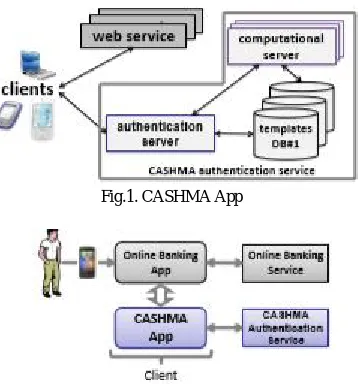
The overall system is composed of the CASHMA authen- tication service, the clients and the web services (Fig. 1), connected through communication channels. Each com- munication channel in Fig. 1 implements specific security measures which are not discussed here for brevity. The CASHMA authentication service includes: i) an authentication server, which interacts with the clients, ii) a m the set of adopted countermeasures.
B. Sample Application Scenario
ISSN(Online): 2320-9801
ISSN (Print): 2320-9798
International Journal of Innovative Research in Computer
and Communication Engineering
(An ISO 3297: 2007 Certified Organization)
Vol. 3, Issue 8, August 2015
session open: it transparently acquires bio- metric data from the user, and sends them to the CASHMA authentication server to get a new certificate. Such certificate, which includes a new timeout, is for- warded to the web service to further extend the user ses- sion. 3.3 The CASHMA certificate In the following we present the information contained in the body of the CASHMA certificate transmitted to the client by the CASHMA authentication server, necessary to understand details of the protocol. Timestamp and sequence number univocally identify each certificate, and protect from replay attacks.
C. OnlineBankingApp
Fig.1. CASHMA App
D. CASHMAAuthenticationService
Fig. 2. Example scenario: accessing an online banking service using a smartphone.
set of high-performing computational servers that perform comparisons of biometric data for verification of the en- rolled users, and iii) databases of templates that contain the biometric templates of the enrolled users (these are re- quired for user authentication/verification). The web ser- vices are the various services that use the CASHMA au- thentication service and demand the authentication of en- rolled users to the CASHMA authentication server. These services are potentially any kind of Internet service or ap- plication with requirements on user authenticity. They have to be registered to the CASHMA authentication ser- vice, expressing also their trust threshold. If the web ser- vices adopt the continuous authentication protocol, dur- ing the registration process they shall agree with the CASHMA registration office on values for parameters h, k and s used in Section 4.2. Finally, by clients we mean the users’ devices (laptop and desktop PCs, smartphones, tablet, etc.) that acquire the biometric data (the raw data) corresponding to the vari- ous biometric traits from the users, and transmit those da- ta to the CASHMA authentication server as part of the authentication procedure towards the target web service. A client contains i) sensors to acquire the raw data, and ii) the CASHMA application which transmits the biometric data to the authentication server. The CASHMA authenti- cation server exploits such data to apply user authentica- tion and successive verification procedures that compare the raw data with the stored biometric templates. Transmitting raw data has been a design decision ap- plied to the CASHMA system, to reduce to a minimum the dimension, intrusiveness and complexity of the appli- cation installed on the client device, although we are aware that the transmission of raw data may be restricted for example due to National legislations. CASHMA includes countermeasures to protect the bi- ometric data and to guarantee users’ privacy, including policies and procedures for proper registration; protec- tion of the acquired data during its transmission to the authentication and computational servers and its storage; robustness improvement of the algorithm for biometric verification [24]. Privacy issues still exist due to the acqui- sition of data from the surrounding environment as for example voices of people nearby the CASHMA user, but are considered out of scope for this paper. The continuous authentication protocol explored in this paper is independent from the selected architectural choices and can work with no differences if templates and feature sets are used instead of transmitting raw data, or independently from the set of adopted countermeasures.
ISSN(Online): 2320-9801
ISSN (Print): 2320-9798
International Journal of Innovative Research in Computer
and Communication Engineering
(An ISO 3297: 2007 Certified Organization)
Vol. 3, Issue 8, August 2015
It is composed of three steps re- peated iteratively: • When at time ti the client application acquires fresh (new) raw data (corresponding to one biometric trait), it communicates them to the CASHMA au- thentication server (step 5). The biometric data can be acquired transparently to the user; the user may however decide to provide biometric data which are unlikely acquired in a transparent way (e.G., finger- print). Finally when the session timeout is going to expire, the client may explicitly notify to the user that fresh biometric data are needed. • The CASHMA authentication server receives the bi- ometric data from the client and verifies the identity of the user. If verification is not successful, the user is marked as not legitimate, and consequently the CASHMA authentication server does not operate to
Fig. 3. Maintenance phase in case of successful user verification.
Refresh the session timeout. This does not imply that the user is cut-off from the current session: if other biometric data are provided before the timeout expires, it is still possible to get a new certificate and refresh the timeout. If verification is successful, the CASHMA authentication server applies the algorithm detailed in Section 4.2 to adaptively compute a new timeout of length Ti, the expiration time of the session at time Ti + ti and then it creates and sends a new certificate to the client (step 6). • The client receives the certificate and forwards it to the web service; the web service reads the certificate and sets the session timeout to expire at time ti + Ti (step 7). The steps of the maintenance phase are represented in Fig. 4 for the case of successful user verification (step 6b). 4.2 Trust Levels and Timeout Computation The algorithm to evaluate the expiration time of the session executes iteratively on the CASHMA authentication server. It computes a new timeout and consequently the expiration time each time the CASHMA authentication server receives fresh biometric data from a user. Let us assume that the initial phase occurs at time t0 when biometric data is acquired and transmitted by the CASHMA application of the user u, and that during the maintenance phase at time ti > t0 for any i=1, … m new biometric information is bought by way of the CASHMA application of the user u (we expect these knowledge are transmitted to the CASHMA authentication server and result in effective verification i.E., we are in the conditions of Fig. Four). The steps of the algorithm described hereafter are accomplished. To ease the readability of the notation, within the following the person u is mainly ignored; for instance g(ti) = g(u, ti).
F. Computation of believe within the Subsystems
The algorithm begins computing the believe within the subsystems. Intuitively, the subsystem trust level might be simp- ly set to the static price m(Sk, t)=1-FMR(Sk) for every unimodal subsystem Sk and any time t (we anticipate that expertise on the subsystems used, together with their FMRs, is contained in a repository obtainable with the aid of the CASHMA Authentication Server). Instead we observe a penalty function to calibrate the trust in the subsystems on the foundation of its usage. Sincerely, in our procedure the extra the subsystem is used, the less it's depended on: to restrict that a malicious consumer is required to control only one bio- metric trait (e.G., via sensor spoofing [17]) to keep authenticated to the web carrier, we diminish the trust in these subsystems which are again and again used to accumulate the biometric data. Within the preliminary section m(Sk, t0) is set to 1-FMR(Sk) for each subsystem Sk used. During the maintenance phase, a penalty perform is related to consecutive authentications carried out utilizing the same subsystem as follows:
penalty (x, h) = ex∙h
ISSN(Online): 2320-9801
ISSN (Print): 2320-9798
International Journal of Innovative Research in Computer
and Communication Engineering
(An ISO 3297: 2007 Certified Organization)
Vol. 3, Issue 8, August 2015
computation of the subsystem trust level. If the equal sub- system is utilized in consecutive authentications, the subsystem believe degree is a multiplication of i) the subsystem trust stage m(Sk, ti-1) computed within the prior execution of the algorithm, and ii) the inverse of the penalty perform (the greater is the penalty, the scale back is the subsystem believe lev- el): m(Sk, ti) = m(Sk, ti-1) ∙ (penalty (x, h))-1.
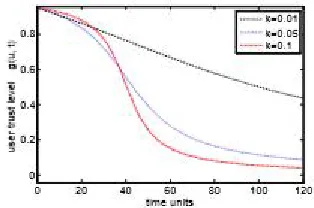
Otherwise if the subsystem is used for the primary time or in non-consecutive consumer identification verification, m(Sk, ti) is set to 1-FMR(Sk). This computation of the penalty is intuitive but fails if multiple subsystem are compromised (e.G., two fake biometric information can be offered in an alternate manner). Different formulations that incorporate the history of subsystems utilization may also be identified however are external the scope of this paper. the probability that an attacker substituted to the legitimate person raises i.E., the level of trust in the user decreases. This leads us to mannequin the person believe level by way of time using a perform which is asymptotically decreasing towards zero. Among the feasible items we chosen the function in (1), which: i) asymptotically de- creases closer to zero; ii) yields believe(ti-1) for Δti=0; and iii) can also be tuned with two parameters which manipulate the de- lay (s) and the slope (okay) with which the believe stage de- creases over time (Fig. 5 and Fig. 6). Distinct services is also desired beneath distinct stipulations or customers re- quirements; on this paper we focus on introducing the protocol, which can be realized also with different features. Throughout the initial section, the user believe stage is simply set to g(t0) = 1. In the course of the upkeep section, the user believe stage is computed for each and every received recent
biometric information. The user believe stage at time ti is given by means of: value Δti=ti-ti-1 is the time interval
between two data transmissions; trust(ti-1) rather is the worldwide believe level computed within the previous iteration of the algorithm. Pa- rameters k and s are introduced to tune the decreasing perform: k affects on the inclination closer to the falling inflection factor, whilst s translates the inflection factor hor- izontally i.E., allows expecting or delaying the decay.
IV.EXEMPLARYRUNS
This part studies java executions of the protocol. Four distinct biometric features acquired by means of 4 different subsystems are considered for biometric verification: voice, keystroke, fingerprint, and face. We accomplice the next FMRs to each of them: zero.06 to the voice awareness process (vocal information is acquired via a microphone), 0.03 to the fingerprint recognition approach (the concerned sensor is a fingerprint reader; the corresponding biometric knowledge should not obtained transparently but are explicitly provided by using the consumer), zero.05 to the facial attention procedure (the involved sensor is a cam- era), and 0.08 to keystroke recognition (a keyboard or a touch/tactile-screen can be used for data acquisition). Note that the FMRs need to be set on the basis of the sensors and technologies used. We additionally assume that the preliminary section of the protocol wants only one raw data. The first state of affairs, depicted in Fig. 8, is an easy however representative execution of the protocol: in 900 time models, the CASHMA authentication server receives 20 recent biometric data from a person and performs victorious verifications. The higher part of Fig. 8 suggests the behavior of the consumer trust degree (the steady line) with the gmin thresh- historic (the dashed line) set to gmin = zero.7. Within the scale back graph the evolution of the session timeout is shown (it is the steady line). When the continuous line intersects the dashed line, the timeout expires. The time units are re- ported on the x-axis. The ok and s parameters are set to ok = 0.05 and s = 100. The first authentication is at time unit 112, followed by using a second one at time unit 124. The worldwide trust degree after these first two authentications is zero.Ninety four. The corresponding session timeout is set to run out at time unit 213: if no contemporary biometric data are got before time unit 213, the global trust stage intersects the brink gmin. Indeed, this surely occurs: the session closes, and the global believe level is about to 0. Session stays closed until a brand new authentication at time unit 309 is carried out. The rest of the experiment runs in a an identical manner.
ISSN(Online): 2320-9801
ISSN (Print): 2320-9798
International Journal of Innovative Research in Computer
and Communication Engineering
(An ISO 3297: 2007 Certified Organization)
Vol. 3, Issue 8, August 2015
describes the continuous authentication proto- col utilized to an internet carrier with severe safety requirements. In this case, session safety is favored to session availability or transparency to the user: the protocol is tuned to keep the session open provided that biometric data are supplied most likely and with enough alternation between the available biometric traits. Fig. 10 represents the global believe level of a session in which authentication data are provided forty instances in 1000 time models using gmin = zero.9, and the parameters s = ninety and okay = zero.003 set for fast cut back. Keeping the session open requires very fre- quent transmissions of biometric information for authentication. This comes on the fee of decreased usability, because a person which does not use the device continuously will definitely incur in timeout expiration.
V. SECURITYANALYSIS
A whole evaluation of the CASHMA process used to be implemented in the course of the CASHMA task [1], complementing traditional protection analysis procedures with procedures for quantitative security evaluation. Qualitative security evaluation, having the objective to identify threats to CASHMA and opt for countermeasures, was guided by using basic and approved schemas of biometric assaults and assault points as [9], [10], [11], [21]. A quantitative safety evaluation of the entire CASHMA process was also per- shaped [6]. As this paper focuses on the steady authentication protocol as a substitute than the CASHMA architecture, we in brief summarize the principal threats to the method recognized inside the task (section 6.1), whilst the rest of this part (section 6.2) specializes in the quantitative secu- rity evaluation of the steady authentication protocol.
Threats to the CASHMA process
which permit creating executable items for quantitative evaluation. The adversary profile defines the set of objects which might be in the beginning owned with the aid of the adversary, as well as his proficiency in attack skills. The adversary starts while not having reached any intention, and works towards them. To each assault goal it's assigned a payoff value, which speci- fies the value that the adversary assigns to achieving that purpose. Three weights define the relative preference of the adversary in: i) maximizing the payoff, ii) minimizing charges, or iii) minimizing the probability of being detected. Sooner or later, the planning horizon defines the quantity of steps sooner or later that the adversary is in a position to take into ac- count for his choices; this price will also be concept to mod- el the “smartness” of the adversary. The endorse execution algorithm evaluates the attain- capable states centered on enabled assault steps, and selects probably the most appealing to the adversary centered on the above de- scribed weights. The execution of the attack is then simulated, main the model to a new state. Metrics are de- fined using reward constructions [14]. By means of the Rep/join composition formalism [15] suggest models will also be composed with items expressed in other formal- isms supported by using the Möbius framework, and in particular with Stochastic pastime Networks (SAN) [16] items.
Three Modeling process
The mannequin that's used for the evaluation combines an advert- VISE mannequin, which takes into account the attackers’ behavior, and a SAN mannequin, which units the evolution of believe over time due to the steady authentication protocol. Each items incorporate a collection of parameters, which al- low evaluating metrics below unique stipulations and performing sensitivity analysis. Protocol parameters used for the analysis are said within the upper labels of Fig. Thirteen and Fig. 14; parameters describing attackers are shown in table 1 and their values are discussed in part 6.2.4. Advocate mannequin. The AEG of the recommend mannequin consists of 1 assault purpose, 3 attack steps, three assault competencies, and 5 access domains. Its graphical illustration is proven in Fig. 11, making use of the notation introduced in [12].
Definition of attackers
ISSN(Online): 2320-9801
ISSN (Print): 2320-9798
International Journal of Innovative Research in Computer
and Communication Engineering
(An ISO 3297: 2007 Certified Organization)
Vol. 3, Issue 8, August 2015
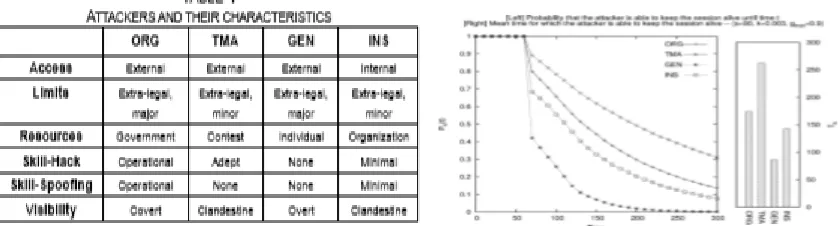
create new assaults inside a slim area) and “adept” (extensive knowledgeable in such technological know-how). The “Limits” dimension describes legal and moral limits that will con- strain the attacker. “resources” dimension defines the or- ganizational stage at which an attacker operates, which in turn determines the quantity of resources available to it for use in an attack. “Visibility” describes the extent to which the attacker intends to hide its identification or assaults. Agent threats within the TAL can be mapped to suggest adversary profiles with slightly low effort. The “entry” attribute is reproduced via assigning distinct sets of ac- cess domains to the adversary; the “advantage” attribute is mapped to one or more attack abilities; the “assets” at- tribute can be utilized to set the weight assigned to reducing expenses in the advise mannequin. Similarly, “visibility” is mod- eled through the load assigned to the adversary in averting the possibility of being detected. The attributes “out- comes” and “goals” are reproduced by attack goals, their payoff, and the load assigned to maximixe the payoff. Ultimately, the “limits” attribute can also be idea as a special assault ability describing the extent to which the at- tacker is all set to break the law. In this paper, it's rep- resented by the “Lawfulness” attack talent. In our work we have now abstracted four macro-marketers that summarize the agents identified in TAL, and we now have mapped their characteristics to adversary profiles within the advise formalism. Moreover, in our work we keep in mind opposed risk marketers best (i.E., we do not recollect retailers 1, 2 and 3 in [1]), versus non-adverse ones, which comprise for instance the “Untrained employee”. The attributes of the four identified dealers are summa- rized in table 1. As mentioned in [1], names have the on- ly purpose to determine agents; their characteristics should SAN model for the steady authentication mechanism.
Attackers and Their Characteristics
ORG TMA GEN INS access outside external inner Limits additional-legal, foremost additional-legal, minor extra-legal, predominant extra-authorized, minor resources govt Contest character institution ability-Hack Operational Adept None Minimal skill-Spoofing Operational None Minimal Visibility Covert Clandestine Overt Clandestine be devised from agent residences. “antagonistic Organization” (ORG) represents an outside attacker, with government-degree assets (e.G., a terrorist organization or an opposed nation-state entity), and having just right proficiency in each “Hack” and “Spoofing” competencies. It intends to maintain its identification secret, although it does not intend to cover the assault itself. It does no longer have certain limits, and is ready to make use of violence and commit principal additional- authorized moves. This attacker maps marketers 6, 7, 10, 15, and 18 in [7]. “science master character” (TMA) represents the attacker for which the term “hacker” is mostly used: an external individual having high technological capabilities, reasonable/low assets, and strong will in disguise himself and its attacks. This attacker maps marketers 5, 8, 14, 16, and 21 in [7]. “general person” (GEN) is an outside in- dividual with low skills and assets, however high motivation either rational or not that can lead him to make use of vi- olence. This type of attacker does not maintain hiding its movements. The GEN attacker maps four, 13, 17, 19, and 20 in [7]. Finally, the “Insider” attacker (INS) is an inner attacker, having minimal talent talent and institution- degree assets; it's prepared to commit simplest minimal extra-authorized actions, and one in all its main concerns is warding off him or its assaults being detected.
ISSN(Online): 2320-9801
ISSN (Print): 2320-9798
International Journal of Innovative Research in Computer
and Communication Engineering
(An ISO 3297: 2007 Certified Organization)
Vol. 3, Issue 8, August 2015
Fig. 7. Result of the steady authentication mechanism on different attackers.
VI.PROTOTYPEIMPLEMENTATION
The implementation of the CASHMA prototype involves face, voice, iris, fingerprint and on-line dynamic handwrit- ten signature as biometric characteristics for biometric kiosks and PCs/laptops, relying on on-board contraptions when available or pluggable accessories if wanted. On smartphones most effective face and voice consciousness are utilized: iris cognizance was once discarded due to the difficulties in obtaining high- satisfactory iris scans making use of the camera of commercial contraptions, and handwritten signature cognizance is impractical on most of smartphones in these days available on market (greater shows are required). Finally, fingerprint awareness was once discarded for the reason that few smartphones comprise a fin- gerprint reader. The chosen biometric features (face and voice) go well with the must be acquired transparently for the continuous authentication protocol described. A prototype of the CASHMA architecture is currently to be had, supplying cell add-ons to entry a se- cured net-utility. The customer is centered on the Adobe Flash [1] technological know-how: it is a particular purchaser, written in Adobe movements Script three, able to access and manage the on- board gadgets with a view to acquire the uncooked information needed for biometric authentication. In case of smart phones, the CASHMA purchaser factor is realized as a native Android application (utilizing the Android SDK API 12). Exams have been carried out on smart phones Samsung Galaxy S II, HTC wish, HTC wish HD and HTC Sensation with OS Android 4.0.X. On normal from the accomplished checks, for the smart phones regarded we performed FMR=2,fifty eight% for face consciousness and FMR=10% for voice. The dimensions of biometric information obtained making use of the considered smart phones and exchanged are approximately 500 KB. As anticipated from such confined dimension of the information, the acquisition, compression and transmission of those knowledge using the mentioned smart phones didn't raise issues on performance or verbal exchange bandwidth. In particular, the time required to establish a relaxed session and transmit the biometric information was deemed sufficiently quick to now not compromise usability of the cellular device. Regarding the authentication carrier, it runs on Apache Tomcat 6 servers and Postgres 8.4 databases. The net offerings are, instead, realized using the Jersey library (i.E., a JAX-RS/JSR311 Reference Implementation) for building RESTful net services. Eventually, the illustration application is a customized portal developed as a rich internet application using Sencha ExtJS four JavaScript framework, integrating exceptional external on-line offerings (e.G. Gmail, Youtube, Twitter, Flickr) made accessible dynamically following the current trust value of the continuous authentication protocol.
VII. CONCLUSION & FEATURE WORK
ISSN(Online): 2320-9801
ISSN (Print): 2320-9798
International Journal of Innovative Research in Computer
and Communication Engineering
(An ISO 3297: 2007 Certified Organization)
Vol. 3, Issue 8, August 2015
where only one face (the biggest one rusting from the face detection section straight on the customer gadget) is considered for identification verification and the others deleted. 1/3, when data is acquired in an uncontrolled environment,
In our procedure, the purchaser device uses a part of its sensors extensively through time, and transmits data on the Inter- internet. This introduces tricky of battery consumption, which has now not been quantified in this paper: we developed and exercised a prototype to verify the feasibility of the procedure but a whole assessment of the answer via experimental analysis shouldn't be reported. Additionally, the frequency of the acquisition of biometric knowledge is principal for the protocol usage; if biometric knowledge are got an excessive amount of sparingly, the protocol could be clearly useless. This usually is dependent upon the profile of the purchaser and consequently on his utilization of the device.
REFERENCES
1. BioID, ”Biometric Authentication as a Service (BaaS), “BioID press release, 3 March 2011, https://www.bioid.com [online].
2. T. Sim, S. Zhang, R. Janakiraman, and S. Kumar, “Continuous Verification Using Multimodal Biometrics,” IEEE Trans. Pattern Analysis and Machine Intelligence, vol. 29, no. 4, pp. 687-700, April 2007.
3. L. Montecchi, P. Lollini, A. Bondavalli, and E. La Mattina, “Quantitative Security Evaluation of a Multi-Biometric Authentication System,” Com- puter Safety, Reliability and Security, F. Ortmeier and P. Daniel (eds.), Lecture Notes in Comuter Science, Springer, vol. 7613, pp. 209-221, 2012.
4. CASHMA - Context Aware Security by Hierarchical Multilevel Architectures, MIUR FIRB 2005. [2] L. Hong, A. Jain, and S. Pankanti, “Can Multibiometrics Improve Per- formance?,” Proc. AutoID’99, Summit, NJ, pp. 59–64, 1999.
5. M. Cinque, D. Cotroneo, R. Natella, A. Pecchia, "Assessing and improv- ing the effectiveness of logs for the analysis of software faults," International Conference on Dependable Systems and Net- works (DSN), pp. 457-466, 2010.