SEI Layer on Reduced Graphene Oxide
Michal Leskes, Gunwoo Kim, Tao Liu, Alison L Michan, FabienAussenac, Patrick Dorffer, Subhradip Paul, and Clare P. Grey
J. Phys. Chem. Lett., Just Accepted Manuscript • DOI: 10.1021/acs.jpclett.6b02590 • Publication Date (Web): 14 Feb 2017
Downloaded from http://pubs.acs.org on February 17, 2017
Just Accepted
Surface Sensitive NMR Detection of the SEI Layer on
Reduced Graphene Oxide
Michal Leskes
(1)*, Gunwoo Kim
(2,3), Tao Liu
(2), Alison L. Michan,
(2)Fabien Aussenac
(4), Patrick
Dorffer
(4), Subhradip Paul
(5), Clare P. Grey
(2)*
(1)
Department of Materials and Interfaces, Weizmann Institute of Science, Rehovot, 76100 Israel
(2)
Department of Chemistry, University of Cambridge, Lensfield Road, Cambridge, CB2 1EW, UK
(3)
Cambridge Graphene Centre, University of Cambridge, Cambridge, CB3 0FA, UK
(4)
Bruker BioSpin, 34 rue de l’Industrie BP 10002, 67166 Wissembourg Cedex, France
(5)
DNP MAS NMR Facility, Sir Peter Mansfield Magnetic Resonance Centre, University of Nottingham,
Nottingham, NG7 2RD, UK
*[email protected], [email protected]
3Abstract
The solid electrolyte interphase (SEI) is detrimental for rechargeable batteries’ performance and
lifetime. Understanding its formation requires analytical techniques that provide molecular level insight.
Here dynamic nuclear polarization (DNP) is utilized for the first time for enhancing the sensitivity of
solid state NMR (ssNMR) spectroscopy to the SEI. The approach is demonstrated on reduced-graphene
oxide (rGO) cycled in Li-ion cells in natural abundance and
13C-enriched electrolyte solvents. Our
results indicate that DNP enhances the signal of outer SEI layers, enabling detection of natural
abundance
13C spectra from this component of the SEI at reasonable timeframes. Furthermore,
13C-enriched electrolytes measurements at 100K provide ample sensitivity without DNP due to the vast
amount of SEI filling the rGO pores, thereby allowing differentiating the inner and outer SEI layers
composition. Developing this approach further will benefit the study of many electrode materials,
equipping ssNMR with the needed sensitivity to efficiently probe the SEI.
TOC GRAPHICS
Keywords
solid electrolyte interphase, SEI, dynamic nuclear polarization, DNP, solid state NMR, reduced
graphene oxide
The performance and cycle life of many electrode materials used in rechargeable batteries depend on the
formation of a stable and passivating surface layer called the solid electrolyte interphase (SEI)1,2. The formation of
this layer, as a result of electrolyte reduction (on the anode) or oxidation (on the cathode), is a complex process
which leads to irreversible capacity loss and can impede ion transport to the electrode, thus affecting the rate
performance of the cell. The properties of the SEI and its effect on the cell’s performance depend on the chemistry
of the surface layer formed, namely its chemical composition and structure. Since this surface layer is often a few
nanometers thick, disordered and heterogeneous (composed of amorphous mixture of organic and inorganic
phases), it is challenging to characterize by conventional structural tools such as X-ray diffraction. Instead,
techniques such as X-ray photoelectron spectroscopy3 (XPS), infrared4 (IR) and mass spectrometry5 (MS) are
commonly used to obtain a compositional map of the SEI. Another approach that is not as commonly applied in
the study of the SEI is solid state nuclear magnetic resonance (ssNMR) spectroscopy, which is advantageous as it
is a quantitative and chemically specific approach. Moreover, it can potentially provide structural information by
employing a wide range of nuclear magnetic interactions and correlations between nuclei. However, the main
drawback of ssNMR is its low sensitivity, which generally restricts its use in the study of SEI layers to the
detection of nuclei with high gyromagnetic ratio and natural abundance such as 1H, 19F, 31P and 7Li6–9, while other,
lower sensitivity, nuclei such as 13C and 17O are only accessible via the use of expensive isotope enrichment and
even then often require long experimental times10–13.
Given the wealth of information that can be extracted from the 13C NMR spectra of the organic components of the
SEI10,12,13, which have a crucial role in ion transport to the electrode and providing elasticity, methods for
improving the sensitivity of detection of these components are particularly important. Here we demonstrate one
approach to overcome these issues by using low temperature and dynamic nuclear polarization (DNP), the latter
being a technique in which the large polarization of unpaired electrons is transferred to surrounding coupled
nuclear spins by microwave (MW) irradiation. DNP in combination with magic angle spinning (MAS) ssNMR is
typically achieved by introducing nitroxide biradicals into the system of interest, cooling the resultant mixture to
cryogenic temperatures (about 100K) and performing the MAS-ssNMR experiment while continuously irradiating 3
the sample with MWs. This results in substantial NMR signal enhancements (up to two fold increase to date) and
significant reduction in experiment time, opening the way for studies of systems that were so far limited or
completely out of reach for NMR14–16, as well as providing sufficient sensitivity for performing multidimensional
experiments needed for chemical assignment and structural investigations17,18.
The aim of this work is to explore the applicability of MAS-DNP for probing the composition of the organic
components in the SEI. The approach is demonstrated on reduced graphene oxide (rGO) anodes following the
first electrochemical cycle in half cell configuration in a lithium ion cell. Graphene has many desirable properties
such as good electrical conductivity (about 2000S/cm), mechanical strength and extremely high surface areas
(about 1500m2/g)19, therefore many have suggested that it can be used in energy storage devices20. In this work,
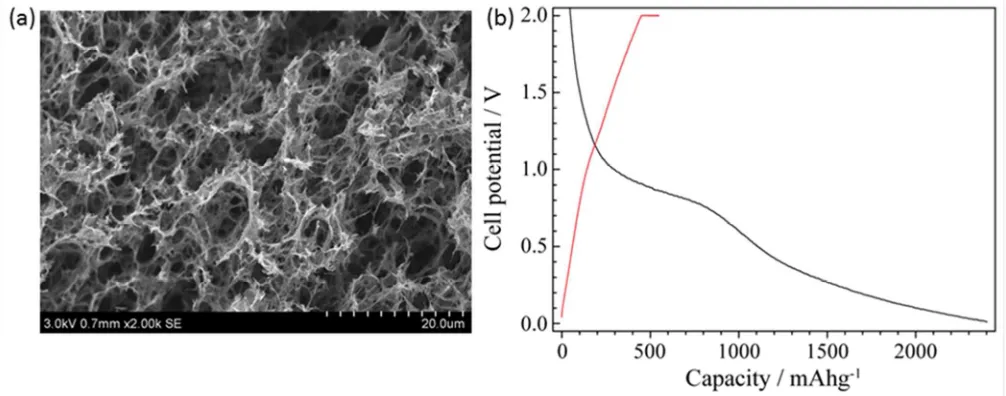
the high surface area is a result of the hierarchical macroporous structure of the rGO (see scanning electron
microscope, SEM, image in Figure 1a), which also allows the material to be cycled without the addition of
binders or conductive carbon. However, its surface area also leads to large irreversible capacities (2000mAh/g on
the first cycle, Figure 1b) associated with electrolyte degradation which leads to cell failure21. Thus, it is our
opinion that rGO is a good model compound for SEI studies, and an ideal material with which to develop a
Figure 1 (a) SEM image of pristine rGO electrode. (b) Typical voltage – capacity profile of a cell containing rGO cycled at a galvanostatically (lithiated during discharge in black and delithiated on charge in red) vs. Li metal in 1M LiPF6 ethylene carbonate (EC)/
dimethyl carbonate (DMC) electrolyte with a current of 50mA/g.
[image:5.612.54.557.453.651.2]surface sensitive NMR approach for characterizing the carbon-containing degradation products formed on the
basal planes of graphitic structures; the material as currently formulated does not make a good anode material.
A critical step in the application of MAS-DNP is sample preparation22. Three approaches are generally taken to
introduce nitroxide biradicals into the system of interest: (i) dissolving the material of interest in a glass forming
radical solution (glass forming solvent is required to prevent aggregation of the radicals) (ii) impregnating a
porous material with the radical solution and (iii) impregnating a nonporous material such that the radical solution
uniformly wets its surface18. Either aqueous or organic (non-aqueous) solvents can be used, depending on their
compatibility with the material of interest, however, organic solvents were shown to have a strong effect on the
enhancement (for example solvents containing methyl groups result in poor performance) with halogenated
solvents leading to superior results so far23. Furthermore, the detection of 13C NMR in the presence of an organic
solvent adds complexity to the experiment due to the presence of the large solvent signal. The effect of the
solvent on the SEI structure and stability, and the stability of the DNP radicals are important considerations that
need to be addressed; for example, we cannot use water-based solvents and organic solvents need to be carefully
checked with respect to SEI solubility. In the case of rGO we found that impregnating unrinsed cycled rGO
electrodes with a minimal amount of 16mM TEKPol24 solution in a mixture of partially deuterated
tetrachloroethane (TCE) and deuterated chloroform (see experimental section) was a good compromise between
achieving significant signal enhancement from the surface layer on cycled rGO and the dynamic range of the
detection in the presence of the dominant solvent resonance. In addition, due to the conductive nature of rGO and
the small sample harvested from cycled cells (5-7mg), samples were diluted with KBr powder (20-30mg) prior to
the addition of about 7µl of radical solution The mixture, packed in a 3.2mm sapphire rotor, was then spun
outside the NMR magnet and inserted into the MAS-DNP probe, which was kept at 100K. As a goal of this work
was to examine the feasibility and limitations of the DNP experiment, the samples were handled in air. Due to the
reactive nature of the SEI air exposure will leads to some changes in the SEI composition25,26 and these were
assessed by preliminary experiments on samples handled in a N2 filled glove box. We note that discharged (i.e.,
lithiated) samples should be packed in an Ar-filled glove box, as Li is reacting with N2 to form Li3N.
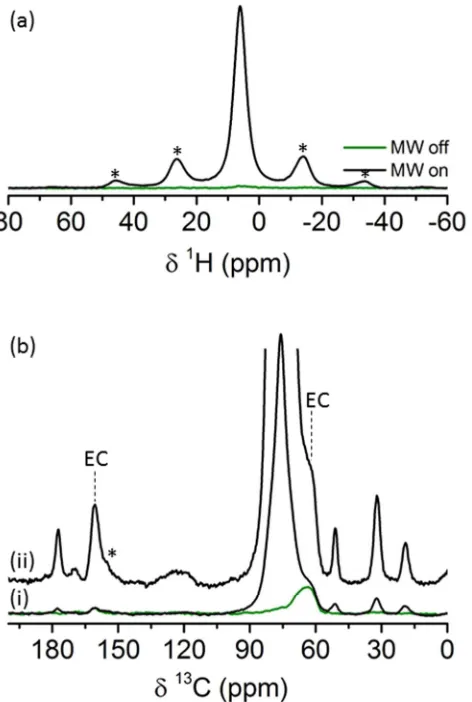
A comparison of the signals obtained with and without MW irradiation is shown in Figure 2. The 1H NMR Hahn
echo spectrum (Figure 2a) shows that the MW irradiation significantly enhances the 1H TCE solvent signal (a
ratio of about 74 between the ‘MW on’ and ‘MW off’ experiments) while other contributions from the rGO are
not enhanced or are masked by the dominant solvent signal and the poor spectral resolution achieved at the slow
spinning frequency used (8kHz). The 13C NMR spectra (Figure 2b(i)) were obtained using cross-polarization
(CP) from surrounding 1H nuclei. In the ‘MW off’
spectrum (green), two resonances are identified at 65
and 161ppm assigned to ethylene carbonate (EC) from
residual electrolyte trapped in the rGO pores as well as
possible SEI products such as alkyl carbonates and
polyethylene oxide (PEO) type oligomers13 . In addition,
minor signal from the TCE solvent is observed at about
75ppm. The much weaker solvent resonance compared
to the dominant EC and SEI signals indicate it is
unlikely to cause any significant SEI dissolution. When
the MW irradiation is turned on, the solvent signal is
substantially enhanced while only a minor change is
observed in the signal intensity of the 65 and 161ppm
EC resonances. However, at least four new 13C
resonances can be detected at 177, 51, 32 and 19ppm
which were absent from the ‘MW off’ spectrum. The
comparison experiment (Figure 2b(i)) was performed
with 200 transients and took about 23 minutes. An
[image:7.612.63.299.226.577.2]optimized 1H-13C CP MAS-DNP spectrum is shown in
Figure 2 (a) 1H rotor synchronized Hahn echo spectra of a cycled rGO sample impregnated with a radical solution (see experimental details) acquired with and without MW irradiation. (b) (i) MW on (black)/off (green) 1H-13C cross polarization spectra of the same sample acquired with a contact time of 1ms and 200 transients. (ii) The enlarged spectrum was acquired with a contact time of 3ms and 3072 transients. Asterisks are used to label spinning sidebands.
Figure 2b(ii) acquired with longer CP contact time and 3072 transients (acquired in about 8 hours). Nine
resonances can now be clearly identified, the two from EC and alkyl carbonates (65 and 161 ppm) and
-OCH2CH2O- containing species (broad resonance at 65 ppm), three new (weaker) resonances at 183, 170 and
122ppm, and the four resonances observed previously (at 177, 51, 32 and 19ppm); these resonances are from the
different functional groups in the organic phases of the SEI on rGO (discussed below), the SEI also trapping EC.
A reference experiment performed at similar conditions on a pristine rGO electrode did not reveal any signals
beyond the solvent resonances (see Figure S1 in supporting information).
[image:8.612.69.526.296.665.2]The signal enhancement obtained under these experimental conditions was sufficient to allow the acquisition of
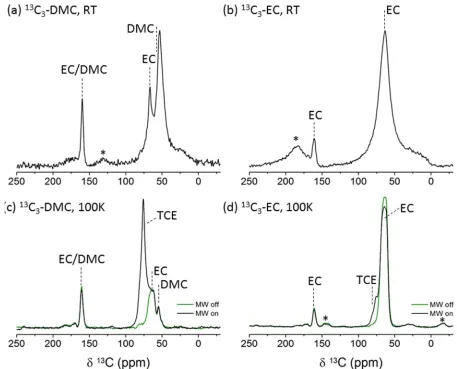
Figure 3 1H-13C CP spectra of rGO electrodes cycled in 13C enriched electrolyte solvents containing either 13C
3-DMC (and NA EC) (a,c) or
EC (and NA DMC) (b,d) and acquired at RT on a 11.4T magnet (a,b) or 100K on 9.4T DNP – NMR with and without MW (c,d). The contact times and number of transients used were (a) 0.1ms, 8272 (b) 0.5ms, 7504 (c) 1ms, 160 and (d) 0.5ms, 128. Relaxation delays varied between 7-10s. Spinning sidebands are marked with asterisks.
two-dimensional (2D) correlation experiments – 1H-13C heteronuclear correlation (acquired in 20 minutes) and a
13
C-13C homonuclear correlation (using radio frequency driven recoupling, RFDR27, acquired in 11 hours) shown
in Figure S2 and S3. The heteronuclear correlation reveals at least three types of 1H environments, in addition to
the TCE solvent, at 4.6ppm correlating with the two EC carbon resonances, at about 3.8ppm correlating with the
carbon resonance at 51ppm and at about 3ppm correlating with the carbon resonances at 32 and 177ppm. The
homonuclear correlation did not reveal any significant cross peaks (with a mixing time of 10ms), presumably
because of the low natural abundance (NA) of 13C (and hence low probability of nearby 13C spins), however, it
does indicate the feasibility of acquiring such spectra in a reasonable time and with sufficient S/N.
It is important to note that these experiments were performed on rGO electrodes that were cycled in NA 13C
electrolyte solvents (1:1 EC/DMC) resulting in NA decomposition products in the SEI. Measurements performed
at room temperature (RT) on similar samples did not reveal any signals from the SEI. When cells were cycled
with 13C enriched electrolyte solvents, more than a day is required to achieve sufficient S/N in standard 1H-13C CP
spectra (Figure 3a-b) acquired at RT. Even with a day-long acquisition the main signals detected are of residual
electrolyte solvents (and SEI products resonating in the same region) with some contributions from the SEI
resonating at 177, 51 and 25ppm in a sample cycled in 13C3-DMC enriched electrolyte (Figure 3a) and at 169 and
21ppm when cycled in 13C3-EC enriched mixture (Figure 3b). Interestingly, the SEI signals detected from these
samples are much broader than those acquired in the DNP experiments. Spectral broadening can be a result of fast
spin-spin relaxation (T2) and/or heterogeneity in the sample leading to a wide distribution of chemical shifts. A
significant source of broadening likely arises from distributions in local fields due to the significant anisotropic
magnetic susceptibility of the graphene sheets. This does not fully explain the increased linewidths since
heterogeneity in the sample would lead to broadening at both RT and low T experiments. Thus at least some of
the increased broadening in the RT measurements is ascribed to increased dynamics of some of the SEI
components.. An additional indication of motion at room temperature is given by the much shorter contact times
used (100-500µs at 298K compared to a few ms at 100K) for achieving efficient CP transfer, the use of shorter
contact times reflecting short rotating frame relaxation times of the protons (T1ρ). In addition, significant 3
broadening in the RT 13C3-EC spectrum would be expected from residual 13
C-1H coupling as this spectrum was
acquired at 15kHz MAS with no 1H decoupling due to probe arcing; that any signal is observable from of the
functional groups under these conditions, again strongly suggests mobility.
Samples that were cycled in 13C enriched electrolytes were also characterized by MAS-DNP as they allow the
decomposition products of EC and DMC to be differentiated as was recently demonstrated in silicon anodes12,13.
CP spectra acquired at 100K from rGO cycled in either 13C3-DMC or 13
C3-EC enriched electrolytes are shown in
Figure 3c-d, respectively, with and without MW irradiation. Surprisingly, only the TCE solvent signal is
enhanced when the MW irradiation is turned on and there is no enhancement of the electrolyte or SEI resonances
(the EC signal is even slightly reduced probably due to the slight increase in temperature when the MW is turned
on, see supporting info Figure S4). While the lack of enhancement was not expected, it can be rationalized if we
consider the structure of the rGO electrode before and after cycling. The pristine rGO with its open porous
framework (Figure 4a and cross-sectional SEM in Figure S5a) provides plenty of surface area for unhindered
electrolyte decomposition. Upon lithiation, and without limiting the discharge voltage/capacity, electrolyte
Figure 4 SEM images of the rGO electrode before (a) and after cycling (b,c) with cartoons (the rGO structure is represented by the black shape) illustrating regions of the SEI which are detected in the various NMR experiments. The SEM image after cycling was taken from a sample cycled in na electrolyte and was duplicated for illustrative reasons.
[image:10.612.61.533.422.644.2]decomposition products accumulate within the pores until these become severely clogged (Figure 4b and
cross-sectional SEM in Figure S5b). When the nitroxide radicals are added to the samples they can only access the
external surface area of the covered rGO electrodes. Thus DNP enhancements can only be expected from the
[image:11.612.48.551.211.566.2]outer layer of the degradation products (and to a lesser extent from fresh surfaces that may be created by
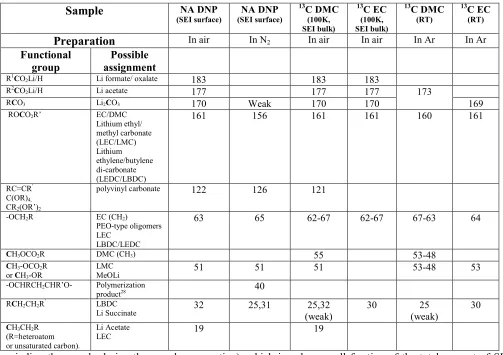
Table 1 A list of the 13C resonances detected in the CP experiments on various samples assigned to carbon functional groups and possible SEI components.
Sample
NA DNP(SEI surface)
NA DNP
(SEI surface)
13C DMC
(100K, SEI bulk)
13C EC
(100K, SEI bulk)
13C DMC
(RT)
13C EC
(RT)
Preparation
In air In N2 In air In air In Ar In ArFunctional group
Possible assignment
R1CO2Li/H Li formate/ oxalate
183 183 183
R2CO2Li/H Li acetate
177 177 177 173
RCO3 Li2CO3 170 Weak 170 170 169
ROCO2R’ EC/DMC Lithium ethyl/ methyl carbonate (LEC/LMC) Lithium ethylene/butylene di-carbonate (LEDC/LBDC)
161 156 161 161 160 161
RC=CR’ C(OR)4, CR2(OR’)2
polyvinyl carbonate 122 126 121
-OCH2R EC (CH2)
PEO-type oligomers LEC
LBDC/LEDC
63 65 62-67 62-67 67-63 64
CH3OCO2R DMC (CH3) 55 53-48
CH3-OCO2R or CH3-OR
LMC
MeOLi 51 51 51 53-48 53
-OCHRCH2CHR’O- Polymerization
product28 40
RCH2CH2R’ LBDC
Li Succinate 32 25,31 25,32
(weak)
30 25 (weak)
30
CH3CH2R (R=heteroatom or unsaturated carbon).
Li Acetate
LEC 19 19
grinding the sample during the sample preparation), which is only a small fraction of the total amount of SEI
formed, a much larger fraction being buried within the rGO pores. For samples cycled in non-enriched electrolyte
solvents, which contain the 1% NA NMR active 13C isotope, this results in a weak NMR signal from the entire
SEI. When the MW irradiation is on, a significant signal enhancement of the non- enriched SEI products in the
outer layers is observed (highlighted in Figure 4b). However, when the electrolyte solvents and therefore SEI are
resulting in only a negligible overall enhancement of the
signal due to the DNP enhancement of the outer SEI layers
(Figure 4c). We note that our ability to enhance the signal
from SEI components deposited directly on the electrode’s
surface may also be limited by shortening of longitudinal
relaxation times caused by magnetic fields originating from
the conductive graphene (which will not affect the outer
layers). Such effects may also explain the lack of signal
enhancement from the pristine rGO electrode (Figure S1).
Future experiments on samples that are only partially
clogged by the SEI will be performed to explore these
effects in more detail. Furthermore, the results suggest that
very little, if any SEI (and EC) is dissolved into the TCE
solvent, under the conditions used here as a signal
enhancement from any dissolved component would be expected.
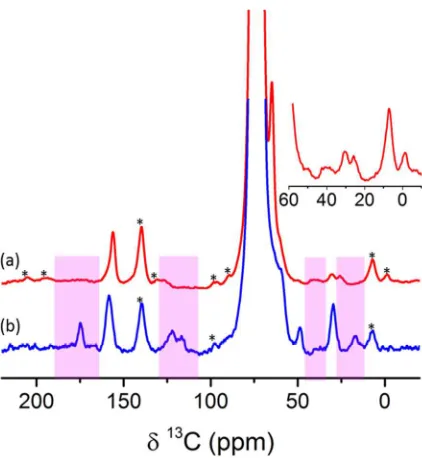
In order to assess the effect of air exposure on the signals detected from the SEI preliminary experiments were
performed on samples packed for DNP experiments in a nitrogen filled glove box. A comparison of the 13C
spectra acquired from samples that were cycled in NA electrolyte with and without air exposure is shown in
Figure 5 (full spectrum shown in Figure S6 and detected resonances listed in Table 1) and reveals several
differences: The sample packed in nitrogen does not contain any significant contributions from carboxylate
groups (resonating above 175 ppm) or Li2CO3 (around 170 ppm); the sp 2
type carbons resonate at 126ppm,
shifting to 122ppm with air exposure, while the aliphatic region contains resonances at 51, 40, 31 and 25 ppm,
compared to 51, 30 and 17 ppm following air exposure. We note that the products observed with air exposure
were consistently detected across several samples (Figures 5, 4 and S7), one of which was acquired using a
[image:12.612.64.275.74.303.2]different polarizing radical solution (see experimental details in the SI). Across all samples we observe variations
Figure 51
H-13C CP spectra of an rGO electrode cycled with natural abundance electrolyte and prepared for DNP experiments (a) under inert N2 atmosphere (the aliphatic
region is shown in the inset), and (b) in air. DNP experiments were performed on a 14.1T spectrometer, with a contact time of 2ms, relaxation delay of 10 s and 800 (a) and 256 (b) transients. The main differences between the two samples are highlighted in purple. Spinning sidebands are marked with asterisks.
in the amount of residual EC which is caused by differences in the amount of electrolyte initially added to the cell,
contributions from EC in pieces from the glass fiber separator caught on the rGO particles and the extent of
sample drying (solvent evaporation) prior to the NMR measurements. Another control experiment was performed
on an electrode that was measured before the addition of the radical solution (Figure S8) displaying at least five
of the resonances that are more clearly observed in the DNP enhanced measurement. These data indicate that the
detected changes in the SEI composition are due to reactivity with oxygen, moisture and carbon dioxide and that
the DNP approach equips us with the sensitivity to detect them.
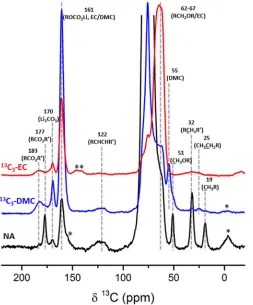
Keeping in mind the effects of air exposure, we turn to analyze the differences in composition observed between
the NA, 13C-DMC and 13C-EC spectra which allow us to distinguish the products formed from DMC and EC
reduction (Figure 6). The different resonances and their possible assignment are listed in Table 1 supported by
previous extensive studies on the SEI formed on the Si system12,13. Since the resonances in the 20 ppm area, 51
and 122 ppm are only observed in samples cycled in 13C enriched DMC electrolyte (as was also observed in the
RT NMR experiments) they must originate from DMC decomposition. These resonances can arise due to
decomposition products such as lithium acetate and lithium methoxide (at 20 and 51ppm, respectively),with
acetate possibly forming due to reactivity of alkoxy species with air (indicated by the pronounced appearance of
the resonances around 20 and 177 ppm and the decrease in the resonance around 25 ppm in figure 5b compare to
5a). Resonances in the sp2 region can be assigned to unsaturated polycarbonate; mixtures of alkoxy carbons such
as those found in acetals, orthoesters and orthocarbonates have also been proposed to be responsible for
resonances with similar chemical shifts10 to that of the broad signal at 122ppm.
As the enhancement achieved by DNP seems to be limited to the external SEI layer covering the electrode it can
provide insight into the structure of the SEI. This can be used to distinguish the composition in the inner pores
close to the carbon surface, dominating the spectra of 13C enriched samples, from the outer layers enhanced by
DNP. Here the DNP enhanced spectrum has a much higher contribution from aliphatic carbons (19-32ppm) as
well as higher carboxylate content resonating at 177ppm.. The higher intensity of the resonance at 183ppm in the
13
C enriched samples implies the bulk contains more carboxylate species such as formate or oxalate, although we 3
note that further NMR experiments, performed under
inert conditions, are required before definitive
assignments can be made. Furthermore, the signal
intensity in the DNP experiments should be
interpreted with care as it depends on the transfer of
polarization from the frozen solvent molecules to the
sample via spin-diffusion29 which is not necessarily
uniform. Significant differences between the various
samples are also observed in the region of 62-67ppm-
which contains contributions from EC, alkyl
carbonates and PEO species. The low resolution in
the 1D experiment, especially in this crowded region,
does not allow distinguishing the various
components. However, the increased sensitivity
offered by the low temperature and DNP
enhancement can potentially be used for assigning these resonances via 2D correlation experiments, as was
recently demonstrated for the SEI on Si13.
S6)
Our results demonstrate the increased sensitivity offered by the MAS-DNP approach to the surface layer of the
SEI. Significant signal enhancement can be achieved in reasonable experiment time with no isotope enrichment,
suggesting that further assignments of the various SEI components and structural studies are possible via
multidimensional experiments. In the case of rGO, due to its extremely large porosity, the use of 13C labeled
electrolytes in combination with the low temperature experiments result in substantial signal from the internal
layers which form the majority of the SEI. In this case, the DNP enhancement of the outermost surface layers
Figure 6 1H-13C CP spectra of rGO electrode cycled in NA electrolyte (black, 3072 transients) and in electrolyte with 13C3-DMC (blue, 3072 transients) and
13
C3-EC (red,
800 transients). All spectra were acquired with a contact time of 3ms, relaxation delay of 7s and MW irradiation. 3
[image:14.612.62.315.77.382.2]becomes negligible but can be used to compare the inner and outer SEI layers. Our experiments suggest that the
organic components of the SEI cannot be viewed as rigid salt crystals, but rather the various functional groups
display considerable mobility/dynamics (at RT). The fluxionality of some of the SEI components will likely play
an important role in controlling Li+ transport through the SEI. These measurements also provide clear evidence
for the formation of SEI products containing saturated carbon groups (as seen in the SEI of Si), which must
originate from extensive radical reactions involving more than one electrolyte molecule. We expect further
development of this approach will benefit the study of the surface layers formed in many electrode materials,
equipping solid state NMR with the needed sensitivity to efficiently probe the chemical and structural
compositional changes in the SEI layer.
Experimental Section
Graphene oxide (GO) was synthesized by a modified Hummer’s method, the exact details of the synthesis are
given elsewhere30. The resulting GO solution was hydrothermally reduced at 180oC for 6 hours and then
freeze-dried for 48 hours to provide a porous rGO. The rGO was further characterized by solid state 13C CPMG NMR31
and Raman spectroscopy (see Figure S9). The prepared rGO was further dried under vacuum at 150 oC and then
immediately transferred into an Ar glove box and assembled into coin cells. Further details of electrochemical
processes are provided in the SI.
NMR experiments were performed on cycled rGO powder extracted from the coin cell and dried under vacuum
for at least 15 hours in the glove box pre-chamber. The resulting unrinsed and dry powder was packed in the
glove box for MAS NMR measurements or thoroughly mixed with dry KBr powder and packed in air for
MAS-DNP. For the latter about 7µl of 16mM TEKPol in TCE (20% CDCl3, 24% d4-TCE, 56% TCE) were centrifuged
into the rotor (see SI).
Acknowledgements
The work was supported by a research grant from Dana and Yossie Hollander, the Israel National Research
Center for Electrochemical Propulsion and the Alon fellowship from Israel council of higher education (ML). 3
This project has received funding from the European Unions’s Horizon 2020 research and innovation programme
under grant agreement No. 696656 – GrapheneCore1 (GK and CPG). We thank Dr. Wanjing Yu (Central South
University, China) for graphene synthesis and related discussions. GK thanks Dr. Duhee Yoon (Cambridge
Graphene Centre) for Raman measurements and helpful discussions. The research is made possible in part by the
historic generosity of the Harold Perlman family. We thank Dr. Frederic Mentink-Vigier for helpful
suggestions.DNP experiments at 14.1 T were performed at the DNP MAS NMR Facility at the University of
Nottingham, with thanks to the EPSRC for funding of pilot studies (EP/L022524/1).
Supporting Information Available: Experimental details on electrochemistry, sample preparation for NMR and
DNP experiments. Additional results from pristine and cycled rGO samples, 2D 1H-13C correlation and 2D 13
C-13
C homonuclear correlation, temperature calibration, cross sectional SEM images, results from samples that were
not exposed to air and characterization of pristine rGO by NMR and RAMAN spectroscopy.. 3
References
(1) Peled, E. The Electrochemical Behavior of Alkali and Alkaline Earth Metals in Nonaqueous Battery Systems-- The Solid Electrolyte Interphase Model. J. Electrochem. Soc.1979, 126 (12), 2047–2051.
(2) Xu, K. Electrolytes and Interphases in Li-Ion Batteries and Beyond. Chem. Rev.2014, 114, 11503–11618.
(3) Philippe, B.; Dedryvère, R.; Allouche, J.; Lindgren, F.; Gorgoi, M.; Rensmo, H.; Gonbeau, D.; Edström, K. Nanosilicon Electrodes for Lithium-Ion Batteries: Interfacial Mechanisms Studied by Hard and Soft X-Ray Photoelectron Spectroscopy. Chem. Mater.2012, 24 (6), 1107–1115.
(4) Nie, M.; Abraham, D. P.; Chen, Y.; Bose, A.; Lucht, B. L. Silicon Solid Electrolyte Interphase (SEI) of Lithium Ion Battery Characterized by Microscopy and Spectroscopy. J. Phys. Chem. C2013, 117 (26), 13403–13412.
(5) Lu, P.; Li, C.; Schneider, E. W.; Harris, S. J. Chemistry, Impedance, and Morphology Evolution in Solid Electrolyte Interphase Films during Formation in Lithium Ion Batteries. J. Phys. Chem. C2014, 118 (2), 896–903.
(6) Meyer, B. M.; Leifer, N.; Sakamoto, S.; Greenbaum, S. G.; Grey, C. P. High Field Multinuclear NMR Investigation of the SEI Layer in Lithium Rechargeable Batteries. Electrochem. Solid-State Lett.2005, 8
(3), A145–A148.
(7) Dupré, N.; Cuisinier, M.; Guyomard, D. Electrode/Electrolyte Interface Studies in Lithium Batteries Using NMR. Interface2011, No. Fall, 61–67.
(8) Cuisinier, M.; Dupré, N.; Martin, J.-F.; Kanno, R.; Guyomard, D. Evolution of the LiFePO4 Positive Electrode Interface along Cycling Monitored by MAS NMR. J. Power Sources2013, 224, 50–58.
(9) Murakami, M.; Yamashige, H.; Arai, H.; Uchimoto, Y.; Ogumi, Z. Direct Evidence of LiF Formation at Electrode/Electrolyte Interface by 7Li and 19F Double-Resonance Solid-State NMR Spectroscopy.
Electrochem. Solid-State Lett.2011, 14 (9), A134–A137.
(10) Leifer, N.; Smart, M. C.; Prakash, G. K. S.; Gonzalez, L.; Sanchez, L.; Smith, K. a.; Bhalla, P.; Grey, C. P.; Greenbaum, S. G. 13C Solid State NMR Suggests Unusual Breakdown Products in SEI Formation on Lithium Ion Electrodes. J. Electrochem. Soc.2011, 158 (5), A471–A480.
(11) Delpuech, N.; Dupré, N.; Mazouzi, D.; Gaubicher, J.; Moreau, P.; Bridel, J. S.; Guyomard, D.; Lestriez, B. Correlation between Irreversible Capacity and Electrolyte Solvents Degradation Probed by NMR in Si-Based Negative Electrode of Li-Ion Cell. Electrochem. commun.2013, 33, 72–75.
(12) Michan, A. L.; Leskes, M.; Grey, C. P. Voltage Dependent Solid Electrolyte Interphase Formation in Silicon Electrodes: Monitoring the Formation of Organic Decomposition Products. Chem. Mater.2016, 28
(1), 385–398.
(13) Michan, A. L.; Divitini, G.; Pell, A. J.; Leskes, M.; Ducati, C.; Grey, C. P. Solid Electrolyte Interphase Growth and Capacity Loss in Silicon Electrodes. J. Am. Chem. Soc.2016, 138 (25), 7918–7931.
(14) Sangodkar, R. P.; Smith, B. J.; Gajan, D.; Rossini, A. J.; Roberts, L. R.; Funkhouser, G. P.; Lesage, A.; Emsley, L.; Chmelka, B. F. Influences of Dilute Organic Adsorbates on the Hydration of Low-Surface-Area Silicates. J. Am. Chem. Soc.2015, 137 (25), 8096–8112.
(15) Lilly Thankamony, A. S.; Lion, C.; Pourpoint, F.; Singh, B.; Perez Linde, A. J.; Carnevale, D.; Bodenhausen, G.; Vezin, H.; Lafon, O.; Polshettiwar, V. Insights into the Catalytic Activity of Nitridated 3
Fibrous Silica (KCC-1) Nanocatalysts from 15 N and 29 Si NMR Spectroscopy Enhanced by Dynamic Nuclear Polarization. Angew. Chemie Int. Ed.2015, 54 (7), 2190–2193.
(16) Johnson, R. L.; Perras, F. A.; Kobayashi, T.; Schwartz, T. J.; Dumesic, J. A.; Shanks, B. H.; Pruski, M. Identifying Low-Coverage Surface Species on Supported Noble Metal Nanoparticle Catalysts by DNP-NMR. Chem. Commun.2016, 52 (9), 1859–1862.
(17) Ni, Q. Z.; Daviso, E.; Can, T. V; Markhasin, E.; Jawla, S. K.; Swager, T. M.; Temkin, R. J.; Herzfeld, J.; Griffin, R. G. High Frequency Dynamic Nuclear Polarization. Acc. Chem. Res.2013, 46 (9), 1933–1941.
(18) Rossini, A. J.; Zagdoun, A.; Lelli, M.; Lesage, A.; Copéret, C.; Emsley, L. Dynamic Nuclear Polarization Surface Enhanced NMR Spectroscopy. Acc. Chem. Res.2013, 46 (9), 1942–1951.
(19) Raccichini, R.; Varzi, A.; Passerini, S.; Scrosati, B. The Role of Graphene for Electrochemical Energy Storage. Nat. Mater.2014, 14 (3), 271–279.
(20) Xu, C.; Xu, B.; Gu, Y.; Xiong, Z.; Sun, J.; Zhao, X. S. Graphene-Based Electrodes for Electrochemical Energy Storage. Energy Environ. Sci.2013, 6 (5), 1388.
(21) Vargas, Ó.; Caballero, Á.; Morales, J.; Rodríguez-Castellón, E. Contribution to the Understanding of Capacity Fading in Graphene Nanosheets Acting as an Anode in Full Li-Ion Batteries. ACS Appl. Mater. Interfaces2014, 6 (5), 3290–3298.
(22) Lee, D.; Hediger, S.; De Paëpe, G. Is Solid-State NMR Enhanced by Dynamic Nuclear Polarization? Solid State Nucl. Magn. Reson.2015, 66–67, 6–20.
(23) Zagdoun, A.; Rossini, A. J.; Gajan, D.; Bourdolle, A.; Ouari, O.; Rosay, M.; Maas, W. E.; Tordo, P.; Lelli, M.; Emsley, L.; et al. Non-Aqueous Solvents for DNP Surface Enhanced NMR Spectroscopy. Chem. Commun.2012, 48 (5), 654–656.
(24) Zagdoun, A.; Casano, G.; Ouari, O.; Schwarzwälder, M.; Rossini, A. J.; Aussenac, F.; Yulikov, M.; Jeschke, G.; Copéret, C.; Lesage, A.; et al. Large Molecular Weight Nitroxide Biradicals Providing Efficient Dynamic Nuclear Polarization at Temperatures up to 200 K. J. Am. Chem. Soc.2013, 135 (34), 12790–12797.
(25) Schroder, K. W.; Celio, H.; Webb, L. J.; Stevenson, K. J. Examining Solid Electrolyte Interphase Formation on Crystalline Silicon Electrodes: In Fl Uence of Electrochemical Preparation and Ambient Exposure Conditions. J. Phys. Chem. C2012, 116, 19737–19747.
(26) Malmgren, S.; Ciosek, K.; Lindblad, R.; Plogmaker, S.; Kühn, J.; Rensmo, H.; Edström, K.; Hahlin, M. Consequences of Air Exposure on the Lithiated Graphite SEI. Electrochim. Acta2013, 105, 83–91.
(27) Bennett, A. E.; Rienstra, C. M.; Griffiths, J. M.; Zhen, W.; Lansbury, P. T.; Griffin, R. G. Homonuclear Radio Frequency-Driven Recoupling in Rotating Solids. J. Chem. Phys.1998, 108 (22), 9463–9479.
(28) Michan, A. L.; Parimalam, B. S.; Leskes, M.; Kerber, R. N.; Yoon, T.; Grey, C. P.; Lucht, B. L. Fluoroethylene Carbonate and Vinylene Carbonate Reduction: Understanding Lithium-Ion Battery Electrolyte Additives and Solid Electrolyte Interphase Formation. Chem. Mater. 2016, 28 (22), 8149– 8159.
(29) Van Der Wel, P. C. a; Hu, K. N.; Lewandowski, J.; Griffin, R. G. Dynamic Nuclear Polarization of Amyloidogenic Peptide Nanocrystals: GNNQQNY, a Core Segment of the Yeast Prion Protein Sup35p. J. Am. Chem. Soc.2006, 128, 10840–10846.
(30) Liu, T.; Leskes, M.; Yu, W.; Moore, A. J.; Zhou, L.; Bayley, P. M.; Kim, G.; Grey, C. P. Cycling Li-O2 Batteries via LiOH Formation and Decomposition. Science (80-. ).2015, 350 (6260), 530–533.
(31) Hung, I.; Rossini, A. J.; Schurko, R. W. Application of the Carr−Purcell Meiboom−Gill Pulse Sequence for the Acquisition of Solid-State NMR Spectra of Spin- 1 / 2 Nuclei. J. Phys. Chem. A 2004, 108 (34), 7112–7120.