There is a growing intrigue of gang involvement amongst school-aged students, and
educators, traditionally from very different cultural and socio-economic backgrounds, are
poorly trained to address these deviant interests. School completion data indicate that
increasing numbers of students are becoming disengaged with the educational system. This is
particularly true for those students participating in deviant behaviors. The value systems of
educators and the authoritarian organizational structure from which schools typically operate
are often at odds with the micro-culture of gang-involved youth and may actually serve as a
factor in the failure to educate this group. The purpose of this ethnographic study is to
investigate the experiences of schooling from the perspective of gang members in an effort to
find a more suitable educational presentation for these deviant youth. Using a critical social
justice perspective, this study will suggest that an awareness of gang intrigue and gang life
with an emphasis on personal relationships will improve the success of all students,
by
Charles Edwin Price
A dissertation submitted to the Graduate Faculty of North Carolina State University
in partial fulfillment of the requirements for the Degree of
Doctor of Education
Educational Administration and Supervision
Raleigh, North Carolina
2014
APPROVED BY:
_________________________ ________________________
Chair of Advisory Committee Dr. Lance D. Fusarelli
Dr. Bonnie C. Fusarelli Committee Member
_________________________ _________________________
Dr. Greg Hicks Dr. Fran Riddick
BIOGRAPHY
I am the son of farming parents. My father did not finish high school, and he and my
mother married one month after her high-school graduation. My parents were the products of
farmers with little formal education as well. In fact, the need to get an education was not
emphasized. It was rarely discussed in our immediate family setting. My father raised me as
he was raised. There was no talk of education but much of hard work. Men farmed and were
without emotions. His volatile nature and poor farming skills persuaded me that I did not
want to follow in his shoes. There were many nights I fell asleep listening to fighting parents
and the clicking of the adding machine that just would not give the right answers to my
father. Usually these “incorrect answers” resulted in the fighting between my parents to
intensify.
When I graduated high school, attending college was not a difficult decision for me to
make. I attended college in order to escape my home life. It certainly wasn’t because I loved
the college life. I had been to a college campus only one time previously in my life! I had not
excelled academically in high school, and there was no reason for me to enroll other than
flight from a dysfunctional family life. I had a need to belong, to fit in somewhere. Although
the decision to leave was not difficult, I knew there would be financial issues associated with
my need to belong to something. It was clear to me that my family did not have the money or
interest to pay for post-secondary education, so I worked a job and borrowed money to pay
the tuition cost. Working while attending college was not difficult as for much of my life, my
am not sure that I ever discovered the derivation of this term other than anything away from
the farm must have been “public.”
I was the first person in my family to earn a four-year college degree, and I am the
only person in my family with a master’s degree. Presently, I am in the process of acquiring
an EdD in Educational Leadership. I have been employed as a public school educator for
twenty-one years.
As I reflect on a childhood marred with a void of a male role model, coaches and
male teachers often took the place of an often missing or inadequate father-figure in my life.
It was at school I found a sense of need and belonging, and also where I found a haven from
a volatile home life. My eleven years of teaching and ten years of administration have
provided me with immeasurable reward as I can only imagine that, in these years, I have
provided that same safety and belonging to other students in need.
As a teacher, I influenced only those students I taught. It became my objective to
influence all teachers and students. As an assistant principal and principal, I have had the
ability to change the climate and culture of an entire building instead of one classroom. I
have used the school improvement process to change educational philosophies to be more
student-oriented.
Looking at professional goals and interests, it is apparent to me that I desired to affect
large numbers of educators and students. I want to be more than a change agent for a
classroom or a school. I desire to be a change agent for a system. My pursuit of a doctorate in
completion of my doctoral work, I will be better equipped to research, propose, and publish
educational literature that will serve to provide educational districts with innovative and
research-based programs and ideas.
Many of the educators at my school come from white, middle-class lives. They were
taught by white, class educators, and they have raised or are raising white
middle-class children. There is nothing wrong with this perspective, but if you consider the
demographics of most schools, it is clear that a sizable percentage of the school populations
do not come from this background. At the high school where I am the principal, there are a
number of faculty members who are compassionate and work to understand a student’s
background; creating relationships as a part of teaching. However, there are a large number
of teachers who do not recognize the background of their students, do not develop
relationships, and fail in their attempt to properly socialize and educate their students.
Because of my background, I want to learn more about the relationship between student
background and student achievement and the affect that instruction from those with different
values and cultures has on outlier subgroups and/or deviant youth. I want to determine
individual student needs based on background factors all in an effort to create effective and
customized programs. These programs would hopefully lead to higher student achievement
and success in the “outlier” groups of students. In addition and in relation to my interest with
student background and need, I wish to research the growing gang intrigue prevalent in
students today. I want to determine student needs and provide programs that align the
On a small scale during my career in education, I have attempted to create programs
that provide a sense of belonging for the students who have social needs. I have sponsored a
program for the male at-risk population called Men of Distinction. As a result of this club, I
have seen potential drop-outs become involved in school, a pay-off more valuable than any
other in this occupation. A smaller, less important product of my sponsorship of this club is
recognition that I received. I was voted Administrator of the Year for my district in
2006-2007 and in 2010-2011, where my ability and desire to create relationships with faculty,
staff, and students was referenced a number of times. Also in 2006, I was featured in The
News and Observer’s Spotlight on Education section. I was selected the Wells Fargo Principal of the Year in my district in 2013-2014.
If my concern to develop relationships with students fuels my ability to impact
greater numbers, I wish to take advantage of the opportunity! I desire to become the most
effective educator I can become, not in hopes of receiving personal accolades, but in hopes of
benefiting students.
In regards to my personal life, I am happily married with three children – Elijah,
Bailey, and Charley. My wife, Kathy, and I constantly read and complete school assignments
or conduct Bible lessons so that our children will realize the value of education; however, I
have never worked two jobs at one time, I do not own an adding machine, and my children
have seen me cry when happy and when sad.
I am not ashamed of my past nor do I consider myself unfortunate. My wife and
many opportunities to address the needs of disenfranchised subgroups. Thus, it is my primary
desire to use my position to afford all students the opportunity to learn. It is my moral
obligation as a public school administrator to improve the public educational system so that
the disenfranchised, as well as those found within the societal norm, have equitable
opportunities to be successful in life. For if not, those found within deviant youth groups
known as gangs will perpetuate and multiple, creating generational gang membership that
erodes not only the educational system but society as well. I must impact instructional
practices at the building-level while emphasizing educator relationships with students. I am
certain that my scrutiny of the educational setting in regards to the service provided to all
students, including the disenfranchised, will be tempered by the fact that I am a life-long
educator who believes in the benefits of public education. In other words, I do not plan to
ride my desire to influence educational service to the degree of blaming any of society’s ills
on the educational system. I am searching not for the Holy Grail, but for a formula and
balance between schools, community, and society that will provide all micro-cultures an
ACKNOWLEDGMENTS
There is no doubt that faith and perseverance are staples in writing a dissertation. For
me at least, I give credit to Jesus Christ who made all things possible in my life. From a more
worldly perspective, I thank my parents who instilled a work ethic that I often interpret as
unhealthy. My father’s problem solving ability and my mother’s dogged determination are
evidenced in my daily life. I know no other individual who works like my mother. She has
battled cancer for nearly three years while continuing her life’s endeavors without resting. I
thank my sister and brother-in-law for modeling the meaning of family and the walk of faith
that we all should follow. I thank my loving wife, Kathy, who has endured for several years
with a stressed husband or one who is absent from family events. My three children Eli,
Bailey, and Charley are truly adorable. I am a blessed man.
Additionally, I thank Dr. Bonnie Fusarelli for being the most inspiring professor I
have ever met. I always want to thank her for having faith in a less than polished country boy
who wasn’t certain that he could complete a doctoral program. To you I owe everything!
Finally, I would like to thank several educators who had a lasting impact on my career in
some way: Jeff Adams, Gary Fowler, Daryl Barnes, and Debbie Woodruff. Mr. Adams, I am
grateful that you illustrated the importance of self-discipline. Coach Fowler, I thank you for
being a father to me in years that I struggled to make decisions. Coach Barnes, I will always
be thankful that you taught me the importance of being prepared and organized. To Mrs.
Woodruff, my administrative career may not have been possible had you not taken a chance
dissertation is a completed dissertation.” I owe many people as my journey has been one of
great length and trials. It is my hope that one day I make an impact on the educational
profession that has afforded me the opportunity to provide for my family and to influence so
TABLE OF CONTENTS
LIST OF FIGURES ... xiii
CHAPTER ONE: INTRODUCTION ... 1
Background of the Study ... 1
Scale of the Problem ... 4
Purpose of the Study ... 9
Definition of Terms... 12
Significance of the Study ... 16
Conceptual Framework ... 18
Overview of Approach ... 19
Organization of the Study ... 20
CHAPTER TWO: LITERATURE REVIEW ... 21
Introduction ... 21
Goals 2000 and School Safety ... 22
School Violence and Gangs ... 24
Culture and Micro-Culture Definitions ... 25
Gang Definition, Data, and Intrigue ... 26
A Brief History of Gangs in the US ... 29
Gang Intrigue: Strain Theory and Disorganization Theory ... 33
School Organizational Structure – Authoritarian ... 36
A New Ecology of Schooling ... 40
Control Theory ... 42
Pedagogy of the Oppressed – Liberation Theory ... 44
School Response to Gangs... 45
Gangs: A Moving Target ... 47
Punitive Measures ... 48
Educators and Gangsters: Two Different Subcultures ... 50
Professional Learning Communities and a Response to Intervention ... 53
Literature Review Chapter Summary ... 56
Introduction ... 58
Research Questions ... 59
Methodological Approach ... 59
Research Design ... 60
Site Selection and Participants ... 62
Data Collection: Interviews and Documents ... 66
Interviews ... 67
Documents ... 70
Data Analysis: Interviews and Documents ... 70
Interview Analysis ... 71
Document Analysis ... 73
Research Validity, Reliability, and Trustworthiness in an Ethnographic Study ... 73
Triangulation ... 76
Journaling ... 76
Response Confirmation ... 77
Safeguards Against Researcher Bias and Subjectivity Statement ... 77
Ethical Issues ... 83
Limitations of the Study ... 84
Critical Case Sampling and Sample Size ... 84
Novice Researcher ... 85
Researcher Occupation ... 85
Immersion for Rich Data ... 86
Who Am I – School Administrator ... 87
Chapter Summary ... 88
CHAPTER FOUR: RESULTS ... 89
Introduction ... 89
A Time-Line of a Gang Member’s Life ... 92
Rashieve: My Introduction to Gang Life ... 92
Lessons Learned from Rashieve ... 94
The Process and Respect ... 94
You Have to Pay to Play ... 98
Current Results: Multiple Case Study ... 99
Grand Tour Questions ... 100
Story Questions ... 103
Native Language Questions ... 106
The Importance of Education ... 108
Gang Lifestyle ... 108
Disconnect With Educators: School Life and Street Life Collide ... 109
Inability to Accomplish Life Goals and Monetary Influences ... 110
Unstable Home Environment ... 110
Positive Human Influences ... 111
So, Who Am I – Student and Gang Member ... 111
Common Themes ... 113
Summary... 114
CHAPTER FIVE: DISCUSSION ... 116
Introduction... 116
Summary of Results ... 117
Common Themes ... 118
Connection to Prior Research and Discussion of Findings ... 118
Implications for Policy and Practice ... 123
A Possible Solution: A Three-Tiered Policy. ... 123
Prevention – Mentors and the Inoculation Theory. ... 124
Identification: A Need for Uniform Gang Definition. ... 129
Interventions: Faith-Based Partnerships and/or Community Mentors. ... 135
Suppression: Utilitarianism. ... 136
Goals, Measurement, and Accountability ... 136
Figure 5.1 Three-Tiered Approach to Youth Gangs in Schools ... 138
Cost Analysis ... 138
Implications for Future Research ... 139
Conclusion: Policy Implementation and the Window of Opportunity ... 142
APPENDICES ... 162
APPENDIX A. Interview Questions ... 163
APPENDIX B. Gang Survey ... 165
APPENDIX C. Gang Definition ... 166
APPENDIX D. Policy Implementation ... 167
APPENDIX E. Book of Knowledge ... 168
APPENDIX F. Informed Consent ... 191
LIST OF FIGURES CHAPTER THREE
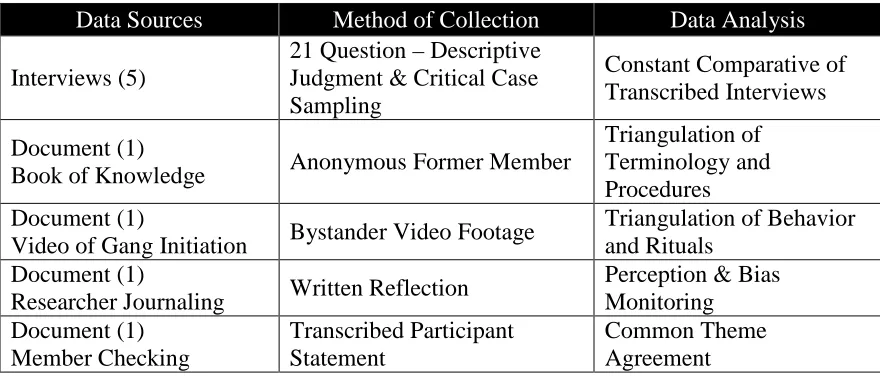
Figure 1. Data Collection and Analysis ...65
CHAPTER FOUR
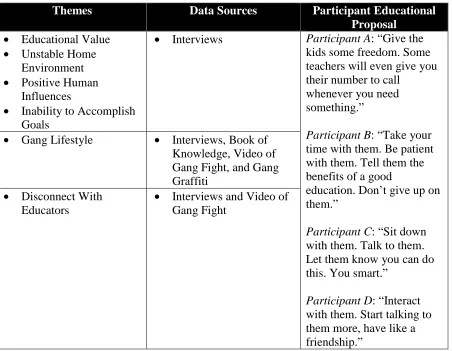
Figure 1. Common Themes...122
CHAPTER 5
CHAPTER ONE: INTRODUCTION
Background of the Study
In August 2013, the city of Chicago set a new all-time record for the number of
gun-related homicides at 506. Likewise, in the same year in Detroit, there were 2,137 violent
crimes per 100,000 people (“The 10 Most Dangerous U.S. Cities,” 2013). Detroit’s violent
crimes actually are five times greater than the national average. Violent criminal activity in
Chicago and Detroit has been attributed primarily to gang activity. These numbers are
shocking even for cities with a long history of gang violence and may thrust the issue of
criminal gangs once again into the national spotlight, with widespread coverage on network
newscasts. National newscasts reports are on the uptick of gang violence in urban centers, but
they fail to expose the exponential growth of gangs and gang-affiliated suburban and rural
communities. Once seen as a malady of high-poverty urban centers, criminal gangs have
established a multigenerational foothold in all types of communities across the U.S.
Consequently, gang-affiliated youth are active in high schools and many educators feel
unprepared to serve this student population.
While not a new phenomenon, the gang presence in educational settings has become
more alarming in the last decade due to the number of violent incidents that have been
attributed to gang activity. At the 12th Annual Gangs Across the Carolinas Conference in
Greensboro, North Carolina in August 2013, Sarah Newell Williamson reported Crime
Commission data that revealed there are more than 40 gangs operating in Guilford and
and, approximately 40 gangs in Alamance County (para. 4). Jon Paul Guarino, a gang
management analyst with the NC Government Crime Commission, recounted a variety of
gang-related stories but none as disturbing as a story of a seventh grader who was severely
beaten because he unknowingly sat in a gang member’s desk at school (Williamson, para. 2).
The physical location chosen as a focus of this research is neither historically known
for violence or an urban area. However, in the last five years, there has been a drive-by
shooting on a school campus, multiple drive-by shootings that have resulted in serious
injuries, and one assassination of a gang member – all students in public schools or of school
age who chose to drop out. These violent crimes that are unresolved in the community
usually linger into the school setting. Educators are unprepared as education is predominantly
dependent on relationship building. How does an educator relate to a subculture of gang
activity and violence? It was not in the teacher preparation program, and very few teachers
have lived a life even remotely similar to that of student gang members. Gang members do
not find the authoritarian setting of educational settings palatable, nor do they respect the
unwillingness of educators to recognize them as students with acceptable behaviors. The
result of this mal-alignment – frustrated educators, violence in schools, frustrated students,
and an increase in dropouts.
In the 2005 State of the Union Address, President George Bush issued a commitment
to addressing adolescent gang involvement in the United States.
Now we need to focus on giving young people, especially young men in our
three-year initiative to help organizations keep young people out of gangs, and show
young men an ideal of manhood that respects women and rejects violence.
Taking on gang life will be one part of a broader outreach to at-risk youth,
which involves parents and pastors, coaches and community leaders, in
programs ranging from literacy to sports.
President Bush championed transforming the environment of at-risk youth. Although his
State of the Union Address vowed national attention to the gang issue, there has been little
progress made in regards to the number of gang members and the amount of gang-related
crimes across the nation.
If educators continue to respond to this phenomenon without regards to underlying
causal factors, the gang micro-culture will experience failure in the educational arena,
perpetuating a class of poverty and violence. During a conversation with a self-proclaimed
gang member, the student explained that he was not “in it to win it” in regards to school. He
further explained that he was completely committed to gang life, or in other words, “in it to
win it.” If educators do not address the increase in gang activity in schools, individuals will
grow more disengaged with school activities and become more interested in activities
traditionally considered at-risk.
Adolescent intrigue with gang affiliation has grown dramatically in recent years, and
adults, especially educators, have ignored this epidemic for a variety of reasons. In fact, in
the 2013 Governor’s Crime Commission analysis of N.C. GangNET data, there were
communities, and parents are either unaware, in denial, or afraid of the issue. As a result of
proactive policy-making, school systems that introduce gang policy fear that the schools will
be perceived as unsafe. Community leaders fear that recognizing and addressing gang
presence will result in hysteria and have a damaging effect on community growth. Parents
denounce gang presence because school leaders and community leaders have not advertised
the phenomenon as a problem. With such a fear of gang recognition producing a fragmented
network of adults, how can gang presence be addressed? In addition, with policy
implementation focused on elimination of deviant students as a suppression tactic, how can
educational systems ignore the possibility of interventions? There have been few studies
conducted with the intent of identifying gang members’ definitions and perceptions of basic
needs in order to reconstruct the school setting in a way to provide a more positive
experience for deviant or misguided youths.
The issue of gang activity includes a battle of semantics. With the emergence of gang
members in the community and schools, many officials argue over whether or not we have
“gang representation,” “gang presence,” “gang intrigue,” a “gang problem,” or just “deviant
juvenile behavior.” However defined, there is a void in the research for educators who are
interested in providing services for these youth.
Scale of the Problem
The recent high media profile for gangs has generated debate and conversation about
the numbers of youth involved with gangs. It has been reported that “even in highly
(Bodinger-deUriarte, 1993, as cited in Burnett & Walz, 1994, p. 1). In a more recent survey, a similar
determination was made as “randomly selected people in eleven cities throughout the United
States were administered questionnaires to determine just how rampant gangs have become”
(Matusitz & Breen, 2007, p. 7). From this survey, it was found that “9% of the respondents
reported that they were presently associated with gangs…[and] additionally, 17% reported
that they had participated in a gang at some point in their lives (Smith, Berg, & Langford,
2002, as cited in Matusitz & Breen, 2007, p. 7). More specifically, in the Governor’s Crime
Commission’s analysis of N.C. GangNET data, gangs appear most present “along the
interstate highways or drug corridors of the state” (p. 3).
Unfortunately, the numbers of gang involved youth “may camouflage the impact that
the presence of gangs has on a school” (Burnett & Walz, 1994, p. 2). Students who do not
feel safe in schools do not learn, which again beckons doubt in whether or not support would
be given to a school that chooses to reconstruct its delivery and purpose. Is this
reconstruction of school purpose any different from the fact that “the process of being a
leader involves consistent reinvention of self, especially in the wake of major defeats”
(English, 2008, p. 6)? Should schools continue the act of education even when all subgroups
fail to be served? Communities refuse to admit gang activity as a problem, and schools are
reluctant to provide interventions for youth gang members due to the fear of damaging
publicity and decline in support for public education. As much an issue to identifying the
problem of gang presence, inaccurate data reporting may be a problem as well. The 2012-13
long-term suspensions and the use of corporal punishment continue their downward trend
although the number of expulsions increased according to the 2012-13 Consolidated Data
Report presented to State Board of Education members. The total number of acts of school crime and violence was the lowest reported since 2008-09 while the number of students in
North Carolina public schools was at an all-time high - 1,492,793.
State Superintendent June Atkinson was pleased that students are more focused on
academic achievement and that schools are striving hard to provide a positive learning
environment. This data possibly indicates that administrators are removing unwanted
students from the school system. The report does not indicate that schools are safer.
The fear of damaging publicity is not the only rationale for the refusal of gangs as a
problem. Many argue that gangs are not a problem unless there is criminal activity involved.
If gang criminal activity becomes the measure used to define the problem, gangs may
flourish because, according to Bodinger-deUriarte (1993), “…less than 2 percent of all
juvenile crime is gang related” (as cited in Burnett & Walz, 1994, p. 2). However, in 2011,
the National Gang Intelligence Center reported through the National Gang Threat
Assessment that nearly 48% of all violent crimes today are gang-related (Key Findings, para.
1).
Supporting criminal activity as the prufrock of gang presence, Clay and Aquila posit
that a juvenile’s intent must not determine that there is a problem. They suggest that the
determining factor of whether or not your community or school has a gang problem is
measure of the problem exists merely in the amount of criminal activity present and the
criminal activity is minimally related to gangs, why place so much emphasis on juvenile
gang interest? First, gang-related crimes are difficult to define and to identify. If the
community leaders denounce the gang problem, the local police department will reluctantly
frame the crime as “gang related.” In fact, criminal activity often associated with gang
membership – theft, drive-by shootings, intimidation, assaults, and murder – cannot be
termed gang-related unless the person committing the crime proclaims gang membership and
gang motivation. Second, early gang presence indicates the arrival of an emerging epidemic
that must be addressed in the infancy stages in order to suppress wide spread growth. The
evolution of gangs occurs over time, and when the deviant behavior produces felonious acts
of theft and murder, it is often too late.
In 1996, Rick Larson, a public school administrator in Arizona, detailed the arrival of
gangs in his school:
At first I denied to myself and others that my school had a gang problem.
When the nature of the campus violence began to change in the mid-1980’s, it
was hard to imagine that my school, with its reputation of being the best high
school in town, could be changing so dramatically before my eyes. Even
though I realized that campus conflicts were becoming increasingly violent
and more frequent, I tended to dismiss these incidents as exaggerated versions
me to unwittingly become a part of the problem, to actually contribute to the
conditions that help gangs flourish. (p. 30)
Rick Larson’s initial response of denial is not unlike the response from other administrators,
the community, and parents. Trump (2007) suggests a justification for this response when he
explains that “the most common initial response to gangs in almost all communities and
schools is denial because public officials are more focused on image for their organizations”
(p. 3). Furthermore, the website declares that this “condition makes the school environment
most ripe for gang activity” (Trump, 2007, p. 3). This response has proven to contribute to
gang establishment in our communities and schools as “gangs thrive on anonymity, denial,
and lack of awareness by school personnel” (Trump, 2007, p. 3). Denying gang existence
allows for “the gang member whose notebook graffiti goes unaddressed” to become involved
in “initiations, assaults, and drug sales in the near future” (Trump, 2007, p. 3). With a
reported 10,651 gang members in North Carolina in 2013 according to the N.C. GangNET
system, how can any community deny gang existence?
Gang members do not see schools as an educational opportunity but as a socialization
field for recruitment. Schools systematically address academic learning; however, “in
addition to learning about topics in the curriculum, students learn the values of the culture in
which they live” (Carlie, 2009, p. 1). For this reason, schools must implement a policy that
addresses all facets of deviant gang behavior to include a three-tiered approach: prevention,
identification, intervention, and suppression. All too often, public schools implement a policy
consequences) or overwhelmingly passive (choosing to ignore the problem). Most policies
addressing deviant behavior of the disenfranchised portray more of a desire for authorities to
rid themselves of a problem instead of a mission to provide assistance to those in need. The
objective should be to keep students in schools and not on the streets. Creating policy that
assigns consequences without appropriate prevention and intervention stages pushes students
to the streets and in effect, to gangs. Suppression overlooks the reasoning for youth
membership in gangs, and choosing to ignore the reasoning behind gang presence actually
compounds the problem. Schools that ignore gang presence become a part of the problem.
Ironically, one obstacle that faces public schools in the fight against gang activity is itself as,
according to the Gang Education and Resource Guide, “gang activity flourishes because of
denial by parents, communities, school districts, and law enforcement until…a tragedy
occurs” (GWC, Inc., 1997, p. 1).
Purpose of the Study
The purpose of this study was to gain a better, more complete understanding of gang
culture through an exploration of gang member value systems in comparison to those of
traditional educational settings. This study attempted to provide educators with a picture of
gang life through the eyes of gang members so that the educators can understand how this
deviant youth group views school, society, and themselves. It is apparent that the traditional
educational setting is failing to educate and to assimilate students from deviant youth groups
for success. Without understanding the gang member perspectives of the “school business,”
created by cultural factors, this study served to define the “youth gang” as an organization of
deviant behavioral youths who are looking for respect and notoriety. The definition of
“gangs” that includes “criminal activity” is relative to the setting and/or environment. As the
definition of “gangs” used by the judicial system presently includes “criminal activity,”
schools often struggle with school policy that does not include “criminal activity” as part of
the definition. A collection of this data affords the schools the opportunity to respond to the
needs of a subgroup that traditionally experiences little success in the school environment.
This study introduced the existence of discrimination in the educational setting.
Discrimination, as defined by Sonia Nieto (2000), “denotes negative or destructive behaviors
that can result in denying some groups life’s necessities as well as the privileges, rights, and
opportunities enjoyed by other groups” (p. 35). Intent differentiates discrimination from
naïve realism. According to McCurdy, Spradley, and Shandy (2005), naïve realism is
defined as “culture [that] causes us to see the world in a particular way, one we come to
believe is real” (p. 9). This perception or chosen culture drives curricular and policy choices,
and it is quite obvious that those making these decision do not have the life experiences or
the perceptions of the deviant youth who are affected by the outcomes. This hidden
curriculum found in schools often has a very detrimental impact on students of marginal
groups.
These messages may be positive (e.g., the expectation that all students are
are capable of high-quality work) or negative (e.g., that children of working-class
term is generally used to refer to negative messages. (Nieto, 2000, p. 40)
In fact, there seems to be a disconnect between the intent of educators and the micro-culture
classified as gangs. In response to this misinterpretation and misunderstanding, educators
have created gang policies that are vague and extremely aggressive in an attempt to eliminate
gang activity. These policies have attracted media attention due to the surge in public school
suspensions and expulsions; however, “of even greater concern is the overrepresentation of
minorities, especially African-American students, in the use of punitive school discipline”
(Skiba, 2000, p. 11). With little cultural diversity among faculty and staff in educational
settings, it is without surprise that “teachers who are prone to accepting stereotypes of
adolescent African-American males as threatening or dangerous may react more quickly to
relatively minor threats to authority, especially if such fear is paired with a misunderstanding
of cultural norms of social interaction” (Skiba, 2000, p. 12). The schools’ responses are
typically suppressive in nature and do no more than transfer the gang presence to the streets
and community as “each new outbreak of violence seems to yield collateral increase in
get-tough discipline” (Skiba, 2000, p. 1).
This study provides educators with vital insight into the perspectives of gang members’
belief systems. With this insight, the study enabled educators the ability to adjust
instructional presentation to address social skills and deviant behavior, curricular design in
regards to character education, and the methods of social service provisions in order to
to a more positive experience, schools can make a more valid attempt at influencing these
students to become functional citizens. The following questions frame this study:
1. What are the gang members’ perceptions of school?
2. How do these perceptions align with the organizational structure used in
traditional public schools?
3. In what ways do their community and the rules of gang life contribute to their
gang involvement and academic performance?
Definition of Terms
Following is a list of terms essential to understand this purpose of this research. The terms
are defined by the researcher or as noted in the citations.
1. Authoritarian Organizational Structure: One of the best known theories of parenting styles or schooling procedures was developed by Diana Baumrind. She
proposed that parents and/or teachers fall into one of three categories: authoritarian
(telling their children or students exactly what to do), indulgent (allowing their
children or students to do whatever they wish), or authoritative (providing rules and
guidance without being
2. Cultural Relativism: The differing ways one learns to be human. These differences are not superior or inferior to one another. This concept also refers to the idea that
cultural norms and values are derived from a specific social context. Understanding
ignorant to the values of other societies and less likely to judge others with differing
values. (Banks & Banks, 2010).
3. Cultural Themes: In 1945, Morris Opler coined the term, cultural theme, to mean recurrent ideas that integrated parts of a culture (McCurdy, Spradley, & Shandy,
2005).
4. Ethnography: A description and interpretation of a social group or system. It requires an immersion into the social group being studies. As a process, ethnography
requires participant observation where the researcher is involved in the daily lives of
the participants (Klenke, 2008).
5. Critical Ethnography Case Study: Hancock and Algozzine (1996) refer to case studies as an analysis and description of a single unit bounded by space and time.
Klenke (2008) adds that the critical theory is a critique of the culture, adding an
advocacy perspective to the ethnography.
6. Dean Alienation Scale: A tool created by Dwight Dean (1961) to measure the three components of alienation: isolation, normlessness, and powerlessness. It is a 24-item,
five point Likert-type scale (Soho, 1996).
7. Deviant Youth Group: Many people who live in low-income communities have to fight their environment to find relief from the burden it imposes. According to
Sanchez-Jankowski (2003), one of the products of this battle is a deviant individualist
8. Expulsion: A disciplinary sanction imposed for prohibited conduct committed by a student, resulting in the permanent removal of the student from the school system.
This removal may be indefinite (permanent) or for a determined period of time (one
year).
9. Ethnocentrism: This term is defined as the belief that one’s culture is best (McCurdy, Spradley, & Shandy, 2005).
10. Gangs: There are a variety of definitions for gangs; however, found within these definitions are common components. Gangs are most commonly defined as three or
more individuals who engage in criminal activity and identify themselves with a
common name or sign.
11. Gang Suppression: Refers to the perspective of the judicial systems’ approach to enforcing laws – arrest.
12. Informant: According to McCurdy, Spradley, and Shandy (2005), anthropologists refer to the people they study as informants. In this study, the researcher debated
using the terminology due to the negative connotation that it has with gang members.
13. Micro-Culture: Smaller groups and their knowledge that exist inside of society (McCurdy, Spradley, & Shandy, 2005).
14. Naïve Realism: Often referred to as a blindspot, naïve realism is the unconscious belief that the way we culturally see the world is actually the way it is (McCurdy,
15. Oppositional Subculture Model: In this model, lower class communities generate distinctive values and beliefs that endorse aggressive behavior and law violation
(Kubrin & Weitzer, 2003).
16. Pulls and Pushes: The Push Out theory suggests that internal factors such as disciplinary actions and conflict with teachers or peers might work to push students
out of school. The Pull Out theory suggests that outside factors create an internal
conflict for the students (Glennie & Stearns, 2006).
17. Response to Intervention: Reed, Wexler, and Vaughn (2012) define RtI as a “school wide service delivery system that is multi-tiered, including all students in a core
curriculum but moving them to intensive interventions in an effort to achieve
success” (p. 15).
18. Self-Fulfilling Prophesy: As coined by Robert Merton, self-fulfilling prophecy refers to the fact that students perform in ways that teachers expect.
19. Social Constructivism: Creswell (2007) “compares social constructivism to interpretivism in that, in this worldview, individuals are seeking to understand the
world in which they live and work” (p. 20).
20. Social Disorganization Theory: This theory is the inability of a community or a neighborhood to understand and realize common goals and from there to solve
continuing problems or issues occurring in the area (Kubrin & Weitzer, 2003).
way of acting against unfairness and inequity while enhancing freedom and
possibility for all. It is primarily focused on how people, policies, practices,
curricula, and institutions may be used to liberate rather than oppress the
disenfranchised by our decision making. (Patton, 2002).
22. Strain Theory: Frustration is created when goals do not match opportunities for a micro-culture (Sanchez-Jankowski, 2003).
23. Suspension: A disciplinary action that is administered as a consequence of a
student’s inappropriate behavior, requiring that a student absent him/herself from the
classroom or from the school for a specified period of time.
24. Zero Tolerance: Intended primarily as a method of sending a message that certain behaviors will not be tolerated - punishing all offenses severely - no matter how
minor (Skiba, 2000).
Significance of the Study
With the 2002 reauthorization of the Elementary and Secondary Act, or No Child Left
Behind (NCLB), and a federal emphasis on success for all students, schools must create
individualized opportunities so that each child can be portrayed as successful. Traditional
schools operate from an authoritative organizational structure and there are few prevention
and intervention programs for identified gang members. The authoritative approach does not
allow the student to have a perspective. In other words, school becomes something done to
the student and not with the student. Without care for the causal factors or the well-being of
Schools must entertain alternative models in order to meet the needs of all subgroups. There
are alternative models like the “open and experimental approaches to education [that] offer
diverse activities to achieve diverse and individualized outcomes” (Patton, 2002, pp.
155-156).
This study provides an opportunity to measure the effectiveness of educational
provisions for gang members by analyzing basic member beliefs and perceptions about their
schooling experiences. This analysis of the values of typical youth gang members was done
with the idea that “by describing and understanding the details and dynamics of program
processes, it is possible to isolate critical elements that have contributed to program successes
and failures” (Patton, 2002, p. 160). By stereotyping and categorizing youth in gangs as
violent criminals, educators are beginning a process that forces this marginal group into a
self-fulfilling prophecy where “student performance is based on both overt and covert
messages from teachers about student’s worth, intelligence, and capability” (Nieto, 2000, p.
43). Educators must realize that they “can do nothing to change the conditions in which their
students may live, but they can work to change their own biases as well as the institutional
structures that act as obstacles to student learning” (Nieto, 2000, p. 49). It was the objective
of this study to enlighten educators to the different values of youth gang members, bring an
awareness of the gang members’ perceptions of school in comparison to family and the gang
environment, and identify the potential of a self-fulfilling prophecy experienced by gang
officials were empowered to make changes to the educational structure and provisions that
improve the opportunity of success for gang and potential gang members.
Conceptual Framework
This study was a multi-case study conducted using an ethnographical lens. It
incorporated a social constructivist critical perspective with a primary purpose of identifying
issues such as power, inequality, and suppression, and to address an inequity in the
educational setting for certain groups. The constructivist theory is applicable in this study as
Klenke (2008) posits that “the social world cannot be described without investigating how
people use language, symbols, and meaning to construct social practice” (p. 21). With regard
to the study’s purpose, some researchers may argue that the conceptual framework more
closely resembles “an alternative worldview, advocacy/participatory, because the
postpositivist imposes structural laws and theories that do not fit marginalized individuals or
groups and the constructivists do not go far enough in advocating for action to help
individuals” (Creswell, 2007, p. 21). Klenke (2008) defines ethnography as “a description of
a social group or system” (p. 200). With the ethnographical lens, it is paramount that the
researchers, “seek to gain an emic or the native’s point of view without imposing their own
conceptual framework as opposed to the etic or outsider’s view of the cultural group they are
studying” (Klenke, 2008, p. 200).
Case study approaches are “different from other types [of qualitative research] in that
they are intensive analyses and descriptions of a single unit or system bounded by space and
A critical social justice framework “seeks not just to study and understand society but rather
to critique and change society” (Patton, 2002, p. 131). In regards to the differing value
systems, one might reference the inability of the deviant youth group to function in
traditional educational systems due to cultural “blind spots.” If the dysfunctional behavior
can be attributed to cultural “blind spots,” there should be a socially appropriate presentation
used by educational settings to acclimate the deviant youth to the expected and normal
behavior patterns. According to Patton (2002), “one of the most influential orientational
frameworks is ‘critical theory,’ which focuses on how injustice and subjugation shape
people’s experience and understandings of the world” (p. 120). The qualitative approach
better enables the researcher to “describe the nature of a belief, attitude, event, or behavior,”
much less the disparity of those concepts as defined by gang members in comparison to those
of the traditional educational setting (Merriam, 1988, p. 68).
Overview of Approach
In order to address the research questions, this study employed a qualitative
methodology. More specifically, the study used a critical case study approach through the
ethnographical lens with a social constructivist perspective. The critical theory in this study
was necessary to focus on “how injustice and subjugation shape people’s experiences and
understandings of the world” (Patton, 2002, p. 130). This theory specifically addressed the
“issues of power and justice” as experienced by some micro-cultures found within public
educational settings (Patton, 2002, p. 130). I chose to combine the critical perspective with
findings for change” (Patton, 2002, p. 131). Finally, when the constructivist perspective is
combined with a social justice framework, “added weight [is given] to the perspectives of
those with less power and privilege in order to ‘give voice’ to the disenfranchised, the
underprivileged, the poor, and others outside the mainstream (Weiss & Greene, 1992, as
cited in Patton, 2002, p. 98). Hence, the critical case study approach through the
ethnographical lens with a social justice framework was necessary in order to identify
cultural and value defined differences between teachers and students self-identified as gang
members. I have provided intervention and prevention, and promoted possible change in the
educational services for marginalized subgroups.
Organization of the Study
Chapter 1 provides an overview of the study, including background information, the
study’s purpose, definitions of key terms, the study’s significance, the theoretical
perspective, and a description of the approach. Chapter 2 is a presentation of the most
relevant scholarly literature on gang activity and the perceptions of gangs. This chapter also
revealed the theoretical frameworks that explain gang involvement and existence. Chapter 3
CHAPTER TWO: LITERATURE REVIEW
Introduction
In the current public school system, students must attend school, but learning is
optional and unfortunately, dictated to a large degree, by the students’ willingness and
intrinsic motivation to learn. If a student has not been taught to value education and has few
support resources outside of school, the student may not find success in the present
educational system. Success in our public schools may have more to do with a student’s
culture and his/her motivation and desire to learn than a teacher’s ability to teach. Since the
early 20th century, American anthropologists have defined “culture” as an alternative
explanation for “why people around the world differed in their actions and beliefs” (Banks &
Banks, 2010, p. 34). Cultural Relativism does not suggest that one set of beliefs or behaviors
is superior to another. In fact, this concept identifies differences as simply differences. With
student beliefs and values differing so greatly, Hutchins (1953) suggested that society should
be presented with a more complete understanding of the role of compulsory education. Are
all students simply required to attend school or are they guaranteed to learn? Giving clarity to
this concept, Lezotte (1997) proffered that “we are now talking about compulsory learning
and will no longer settle for compulsory schooling” (p. 3).
In an effort to make possible this daunting task, Gagne suggested that “the essential
task of the teacher is to arrange conditions of the learner’s environment, so that the process of
learning will be activated, supported, enhanced, and maintained” (Gagne, 1972 as cited in
NCLB, we should examine how successful modern educational systems have been in regards
to successfully educating ALL students. Critics would argue 21st Century education has
continued to “work to reproduce the existing social order with all of its built-in social
inequalities and inequities” (Brantlinger, 2003, as cited in English, 2008, p. 204). Fenwick
English (2008) continues the analysis of schooling by adding that “the inadequacy of schools
is not because they don’t work as they currently exist, because they were never intended to
work for some families and children anyway” (p. 204).
Goals 2000 and School Safety
Beyond educating ALL, one of the goals of America 2000 (US Department of
Education, 1991) was that America’s schools will be safe, disciplined, drug-free places by
the year 2000. The US Department of Education recommended no instrument to
comparatively measure these objectives; however, with the rise in violent crimes over the last
decade, there is little doubt that these objectives have not been achieved. There is no doubt
that schools have room for improvement in regards to safety and ultimately, student
achievement. Stephens (1994) describes the state of our school campuses:
Reading, writing, and retaliation have become common themes on
many of the nation’s campuses. Far too often, this retaliation involves
the ducking of bullets or other serious violent situations. Students are
or to intimidate others. Fistfights are being replaced by gunfights. Fire
drills are being replaced by crisis, bullet, and drive-by shooting drills.
(p. 29)
A 1978 Safe School Study Report to Congress caused alarm within society as
“approximately 282,000 students and 5,200 teachers were physically assaulted in secondary
schools every month” (National Institute of Education, 1978 as cited in Elliot, Hamburg, &
Williams, 1998, p. 4). Evidence that this situation is not improving can be found in a similar
1996 report that “revealed that nearly half (47%) of all teens believe their schools are
becoming more violent, and one of every ten reported a fear of being shot or hurt by
classmates who carry weapons to school” (Children’s Institute International, 1996 as cited in
Elliot, Hamburg, & Williams, 1998, p. 4). The increased violence in schools actually mirrors
that of society. In society between 1984 and 1994, “the homicide rate for adolescents
doubled” and “on a typical day in 1992, seven juveniles were murdered” (Elliot, Hamburg, &
Williams, 1998, pp. 4-5). Even more shocking is the fact that “in 1991, more than half (56%)
of juvenile victimizations occurred at school or on school grounds” (Elliot, Hamburg,
Williams, 1998, p. 6). An increase in violence beckons the question of the impact of the fear
of violence on student achievement and especially the educational system’s inability to close
the achievement gap within the various subgroups.
The achievement gap between socio-economic and racial lines illustrates this
inability; however, there are many less advertised micro-cultures found within minority and
traditionally ignored because the group is stereotypically associated with violence and
abnormal behaviors. This micro-culture is either doomed to fail or is failing due to the fact
that it is not being served in today’s educational setting.
School Violence and Gangs
Nearly 48% of all violent crimes today are gang-related (National Gang
Intelligence Center, para. 1). Griffin and Meacham (2002) highlight the growing
concerns of not only violence but gangs in school systems by stating:
Small gangs, unattached to larger organizations, have proven to be a
deadly problem as evidenced by school shootings and violent levels
unheard of generations ago. Larger, more organized gangs may
become violent threats as well, but also may be behind much of the
illegal drugs, thefts, intimidation, extortion, and increases in
armament in schools today. (p. 1)
A 1995 School Crime Supplements survey was analyzed by Chandler and colleagues
in 1998. They found that 28% of nearly 100,000 students polled admitted that they
were aware of gang activity in their schools (Howell & Lynch, 2000). With gang
involvement growing among school-age adolescents, “it is imperative that teachers,
counselors, administrators, and social service professionals recognize the variables
which contribute to an adolescent’s decision to join a gang.” (Omizo, Omizo, &
Culture and Micro-Culture Definitions
People learn from people. This is not different for adolescents. Adolescents’ “major
source of learning is from informal groups with whom they associate at one another’s houses,
at local malls, at schools, or on the streets” (Laursen, 2005, p. 138). Unfortunately for many
at-risk adolescents, “what they learn from these groups is dependent on the norms of the
group” (Laursen, 2005, p. 138). These groups can ultimately evolve into an adolescent’s
micro-culture. There are many definitions of culture. Anthropologists have used broad and
very vague definitions for culture, but for the purposes of this research, a simple but clear
definition is provided by McCurdy, Spradley, and Shandy (2005) - “knowledge that is
learned and shared and that people use to generate behavior and interpret experience” (p. 5).
Likewise, it is important to understand that there are micro-cultures or the “cultures
associated with groups that form for a variety of reasons but do not consume every hour of
their members’ time” (McCurdy, Spradley, & Shandy, 2005, p. 15). It is paramount to this
study to realize that “everything in education relates to culture – to its acquisition, its
transmission, and its invention” (Banks & Banks, 2010, p. 35). Ethnographic researchers are
well aware of the issues facing various micro-cultures. For example, McCurdy et al (2005)
explain that “many of the conflicts and inefficiencies that plague government agencies and
private corporations occur because of cross-cultural misunderstandings between members of
different micro-cultures within such groups” (p. 16). Schools are no different in that growing
diverse student demographics have seemed to disable maximum efficiency in regards to
in considering gangs a micro-culture worthy of educating, especially if these individuals have
criminal backgrounds; however, there are more self-proclaimed gang members who are not
convicted criminals than those who are convicted criminals.
Gang Definition, Data, and Intrigue
As referenced in Dickens’ Oliver Twist, gang presence has been a problem in urban
areas and inner cities since the 1830’s. Recently, gangs have begun to move to the sprawling
suburbs and to rural areas. With this movement, gangs have infiltrated the school systems,
“which historically have been considered ‘neutral turf’” (Burnett & Waltz, 1994, p. 1). Gangs
have been glamorized in movies such as Scar Face, Blood In – Blood Out, Colors, City of
God, and Boyz in the Hood. It is the “image of the violent, anti-social gangster” that has become “part of the American landscape, often romanticized and glamorized by popular
culture” (Ingels, 2005, Overview). Youth join gangs for a variety of reasons, “but the primary
attraction of gangs is their ability to respond to student needs that are not otherwise being
met” (Burnett & Waltz, 1994, p. 2). All too often, the gang “provide[s] youth with a sense of
family and acceptance otherwise lacking in their lives” or for immigrant populations, “a way
of maintaining strong ethnic unity” (Burnett & Waltz, 1994, p. 2). According to Gary Burnett
from the William Gladden Foundation (1992), there are four primary factors in the formation
of juvenile gangs:
First, youth experience a sense of alienation and powerlessness because of a
lack of traditional support structures, such as family and school. Second, gang
of identity for its members. In turn, gang membership affords a youth a sense
of power and control, and gang activities become an outlet for anger. Third,
the control of turf is essential to the well-being of the gang, which often will
use force to control both its territory and members. Fourth, new members and
expansion of territory are essential if a gang is to remain strong and powerful.
Both “willing” and “unwilling” members are drawn into gangs to feed the
need for more resources and gang members. (p. 2)
The reasoning for the youth intrigue in gangs has been defined by Decker and Van
Winkle (1996) as “pulls” and “pushes” (as cited in Matusitz & Breen, 2007, p. 6). The
“pulls” can be closely aligned to external attractions like popularity and money albeit from
illicit sources. The “pushes” are outside factors that are not within the control of the
individual affected. These include “social, ethnic, and financial drives that lead youths in the
direction of gangs” (Segal, Pelo, & Rampa, 2001, as cited in Matusitz & Breen, 2007, p. 6).
However, a much more prevalent and frustrating factor has emerged in regard to gang
attraction – the influence of family. Many gang specialists argue “that some individuals are
appealed to gangs because they are exposed to the gang world in early life due to where they
grow up and the people in their milieu (Thornberry, 1998, as cited in Matusitz & Breen,
2007, p. 6). For this simple fact, schools and community must partner with one another to
battle gang intrigue. Yet, for school officials, law enforcement, parents and other adults,
defining gang characteristics has become a struggle as “gang indicators can be quite subtle”
One common gang indicator is the presence of various gang identifiers. Gang
identifiers may include graffiti, tattoos, gang literature, initiations, hand-signs, and behavior.
It is imperative that school personnel receive regular training from law enforcement in order
to maintain up-to-date trends and behavior of gangs. “Due to the ever-evolving nature of
gang identifiers, and the increasingly common trend of gang members going lower profile
with fewer visible signs of gang membership to avoid detection by authorities,” training
should be conducted on a regular basis and by local law enforcement agents who specialize
in gang behavior (Trump, 2007, p. 3). The identification of gang members or those interested
in gangs becomes extremely difficult because it seems that educators stay a step behind gang
members in their local trends. Gang members are difficult to identify, which results in
insufficient data for tracking gang impact on schools, but it is known that “when gangs exist
in a community, they consequently impact schools using them as recruitment centers and
claiming them as gang territory” (Gang Violence Prosecution, para. 1).
In some cases, schools work without the support of parents either because parents are
in denial or surprisingly, due to the fact many parents of gang members are also gang
affiliated. Without the support of the parent, identification can become litigious. Veronika
Belenkaya of the New York Daily News, reported that this violent lifestyle is more often
passed down from parent to child than imagined by educators. Belenkaya’s shocking 2008
news report included pictures of infants adorned in gang attire. She explained that the social
media pages of some Blood gang members often depict their children as “blood drops,”
originating in California and traditionally wearing the color red, are represented under the
five-pointed star and are known for their rivalry with Crips. Although gang presence is
destined to increase due to, in part, the perpetual cycle of gang affiliation in the home, Jesse
Katz and Elizabeth Venant report that most “gang members do not wish any of this on their
children” (para. 8).
A Brief History of Gangs in the US
Research suggests that gangs appeared in the United States during one of three
periods: after the American Revolution (Howell, 1998), after the Mexican migration
(Redfield, 1941), or as a result of the Mexican youth acculturation in the school systems
(Vigil, 1988). During the Industrial Revolution, the United States experienced a growth in
street gangs comprised of Irish, Jewish, or Italian immigrants (Howell, 1997). Gangs have
transitioned from fist-fights to more violent and deadly altercations involving knives and
firearms (Howell, 1998). A typical gang member is an inner-city minority male (Esbensen,
2000). Gang members’ age ranges from 12-24 years old (Howell, 1998). Howell (2000)
suggests that gangs are difficult adversaries because they “grow, dissolve, and disappear for
reasons that are poorly understood” (p. 6).
It is difficult to project the number of gang members who are also students in public
educational settings. In the National Center for Educational Statistics Report of 2006, Gary
and Denise Gottfredson penned that 24% of students reported gangs in schools, up from 21%
in 2003. They also claimed that Hispanic and Black students reported a higher recognition of
least 200,000 gang members in America shortly after 1990. His data did not include gang
members who had not been convicted of a crime. Including these self-proclaimed gang
members would dramatically increase this number. Making the epidemic more difficult to
identify and resolve is the fact that the very definition of gangs has changed throughout its
existence.
The definition of gangs has been disputed over time. From an educational setting
perspective, “a typical gang member was defined as an adolescent with problems” (Soho,
2001, p. 4 as cited in Klein, 1971). Malcolm Klein (1998) suggests that gangs have varying
unity and take different forms, making identification difficult. Currently, federal law defines
the term “criminal street gang” as “an ongoing group, club, organization, or association of
five or more persons
• that has as one of its primary purposes the commission of one or more of the criminal
offenses described in subsection (c);
• the members of which engage, or have engaged within the past five years, in a
continuing series of offenses described in subsection (c); and
• the activities of which affect interstate or foreign commerce.” 18 USC § 521(a).
The National Youth Gang Center (2006), more clearly defines gangs:
There is no single, accepted nationwide definition of youth gangs. It has been
firmly established that the characteristics and behaviors of gangs are
exceptionally varied within and across geographical areas and that a
and inherently homegrown. Thus, state and local jurisdictions tend to develop
their own definitions. The terms youth gang and street gang are often used
interchangeably, but use of the latter label can result in the confusion of youth
gangs with adult criminal organizations. (para. 1)
In the last thirty years, researchers have reduced the definitions to two schools of
thought: a collection of individuals with negative personal attributes and/or a collection of
individuals who perform deviant acts. Sanchez-Jankowski (2003) urges that there are
problems with both approaches “in their common underestimation of connections between
the structural conditions of society at large and the form of collective behavior that is ‘the
gang,’ and their similar (and sometimes unwitting) recycling of individualistic thought
rampant in American culture” (p. 191)
The teaching pool in the United States is becoming more and more middle class and
white. This teacher force will be attempting “to educate students who come from different
cultural, ethnic, and socioeconomic backgrounds” (Patton, 1998, p. 49). If we are to
successfully educate all students, leaving none behind, “these teachers must understand the
conditions, values, and cultural heritage that molds such students – especially when those
factors may be completely alien to those from the dominant culture” (Patton, 1998, p. 49).
Crozier and Davies (2008) indicated that there was an issue with minority students
integrating into the dominant culture of schooling. In other words, these students “do not see
a place for themselves,” and “ethnocentrism together with racist harassment serves to
Noboa (1995) argue that the school’s inability to positively acclimate and serve students with
multiple value structures proves to be a source for gang membership. Soho (1996) further
validates this concept as he posits, “by denying the role of schools in the alienation of
adolescents, educators become unconscious contributors (rather than inhibitors) to adolescent
dysfunction” (p. 3).
There are many factors that lead youth to gang membership. According to youth gang
members surveyed as to why they joined a gang, two answers are consistently given: social
and protection (Thornberry et al., 2003). Moore (1998) suggests there are four community
conditions that precede gang involvement: 1) there is a lack of adult supervision, 2) youth
have considerable free time, 3) there is little opportunity for moving into a good job, and 4)
gang members can congregate and operate. Thornberry (2003) and Gottfredson (2001)
suggest that the perception of poor school safety has driven some youth to gravitate toward
the students with deviant behavior in an effort to align themselves with the potential for
safety. Finally, Prothrow-Stith and Weissman (1991) argue that gang membership stems
from 1) a sense of community, 2) self-esteem, 3) recognition, 4) sexual identity, and 5) a
moral code. Affecting gang intrigue and providing an often sensationalized picture of gang
life, modern media and pop culture do more damage than good. Violent gang movies and
modern music artists like Snoop Dog and Fifty Cents depict gang life as glamorous and gang
leaders as larger than life. This type of advertisement explains the lure of gang life for