Adaptive Stabilization of Uncontrolled Rectifier
Based AC–DC Power Systems Feeding Constant
Power Loads
12
3
Kongpan Areerak, Theppanom Sopapirm, Serhiy Bozhko, Member, IEEE, Christopher Ian Hill, Member, IEEE,
Apichai Suyapan, and Kongpol Areerak
4 5
Abstract—It is known that, when tightly regulated, actively con-6
trolled power converters behave as constant power loads (CPLs). 7
These loads can significantly degrade the stability of their feeder 8
system. The loop-cancelation technique has been established as 9
an appropriate methodology to mitigate this issue within dc–dc 10
converters that feed CPLs. However, this has not yet been applied 11
to uncontrolled rectifier based ac–dc converters. This paper there-12
fore details a new methodology that allows the loop-cancelation 13
technique to be applied to uncontrolled rectifier based ac–dc 14
converters in order to mitigate instability when supplying CPLs. 15
This technique could be used in both new applications and easily 16
retrofitted into existing applications. Furthermore, the key con-17
tribution of this paper is a novel adaptive stabilization technique, 18
which eliminates the destabilizing effect of CPLs for the studied 19
ac–dc power system. An equation, derived from the average 20
system model, is introduced and utilized to calculate the adaptable 21
gain required by the loop-cancelation technique. As a result, 22
the uncontrolled rectifier based ac–dc feeder system is always 23
stable for any level of CPL. The effectiveness of the proposed adap-24
tive mitigation has been verified by small-signal and large-signal 25
stability analysis, simulation, and experimental results. 26
Index Terms—AC–DC converters, constant power load (CPL), 27
loop-cancelation technique, negative impedance instability. 28
I. INTRODUCTION 29
A
CTIVELY controlled power converters are widely used in30
many applications. Unfortunately, when tightly regulated,
31
actively controlled power converters behave as constant power
32
loads (CPLs) [1], [2]. These CPLs can significantly degrade
33
the stability of their feeder system [3]–[5]. It can be seen from
34
previous publications [6]–[10], that unstable system operation
35
can be predicted from dynamic mathematical models via
con-36
trol theory. In order to derive models in such a way as to be
37
Manuscript received July 25, 2017; revised October 19, 2017; accepted November 25, 2017. This work was supported in part by Suranaree University of Technology and in part by the office of the Higher Education Commission under NRU Project of Thailand. Recommended for publication by Associate Editor F. J. Azcondo. (Corresponding author: Kongpan Areerak.)
K. Areerak, T. Sopapirm, A. Suyapan, and K. Areerak are with the School of Electrical Engineering, Suranaree University of Technology, Nakhon Ratchasima 30000, Thailand (e-mail: [email protected]; kongpan@sut. ac.th; [email protected]; [email protected]).
S. Bozhko and C. I. Hill are with the Department of Electrical and Electronic Engineering, University of Nottingham, Nottingham NG7 2RD, U.K (e-mail: [email protected]; [email protected]).
Color versions of one or more of the figures in this paper are available online at http://ieeexplore.ieee.org.
Digital Object Identifier 10.1109/TPEL.2017.2779541
suitable for stability analysis the averaging technique [9], [10] 38
can be utilized. However, mathematical prediction only states 39
when the system will become unstable. In order to eliminate the 40
destabilizing effect, mitigation techniques are required. 41
In terms of mitigation techniques, there are three possible 42
ways to apply a compensating signal for eliminating the desta- 43
bilizing effect. The first is to generate the mitigating signal on 44
the feeder side [11]–[20]. In this case, the system can be stabi- 45
lized without conciliating the load performance. However, this 46
way cannot be applied to a feeder system that utilizes an un- 47
controlled rectifier based ac–dc rectifier due to the absence of 48
the control loop in the feeder subsystem. In this situation, a 49
second mitigation technique can be used in which the compen- 50
sating signal is injected into the CPL control loop to modify the 51
load impedance for stable operation [21]–[27]. The drawback of 52
mitigation on the CPL side is that the additional compensating 53
signal may deteriorate the load performance. The final way to 54
eliminate the destabilizing effect is by connecting an auxiliary 55
circuit between the feeder and load subsystems [28]–[30]. This 56
method is suitable for power systems having existing feeder and 57
load subsystems that are impossible to modify. In this paper, 58
the feeder system includes an uncontrolled rectifier in which 59
the output voltage cannot be adjusted. Hence, the additional 60
auxiliary circuit approach for mitigation is selected. 61
In terms of the control techniques to create the compensating 62
signal, there are two well-known approaches. The first is the 63
active damping method [11], [15]–[30]. In this case, a virtual 64
resistance is used to increase the damping of the filter circuit. 65
However, the power level of the CPL(PCPL)that can be mit- 66 igated is limited [12], [14]. Therefore, a second approach was 67
introduced, namely the loop-cancelation technique [12], [14]. 68
This technique can mitigate system instability at higher values 69
ofPCPL than those compensated by active damping. However, 70
this technique has only been applied to dc–dc converters, as 71
described in [12]. The application of the loop-cancelation tech- 72
nique to uncontrolled rectifier based ac–dc power systems via 73
an auxiliary circuit has not been reported in previous publica- 74
tions, e.g., [12]. Hence, in this paper, instability mitigation for 75
uncontrolled rectifier based ac–dc power systems via the loop- 76
cancelation technique is presented. Moreover, this paper also 77
presents a novel adaptive stabilization technique based on an 78
equation that can be derived from the average system model. 79
The equation is used to determine the adaptable gain required 80
Fig. 1. AC–DC power system feeding an ideal CPL.
for loop cancelation. This gain depends on the power level of the
81
CPL, which can be calculated from voltage and current sensors
82
on the dc bus. As a result of this methodology, the system can
83
automatically ensure stability under all operating conditions.
84
The stability study presented in this paper, using small-signal
85
and large-signal stability analysis, confirms that the mitigated
86
system is always stable. In addition, simulation and
experimen-87
tal results are also presented to verify the proposed adaptive
88
stabilization technique that eliminates the destabilizing effect
89
of the CPL.
90
The paper is structured as follows. In Section II, an ac–dc
91
power system feeding an ideal CPL is introduced to illustrate
92
the effect of CPLs. In Section III, the loop-cancelation technique
93
for ac–dc power systems feeding ideal CPLs is explained. An
ex-94
planation of how to apply the loop-cancelation technique to the
95
ac–dc power system, the derivation of mathematical model, the
96
system stability analysis via the eigenvalue theorem and
97
the phase-plane plot, the concept of the adaptive stabilization,
98
and the simulation results are all addressed in Section III. A
99
realistic ac–dc power system is then analyzed in Section IV. In
100
this case, parallel controlled buck converters are used as CPLs
101
instead of the ideal CPLs. Simulation and experimental results
102
are also presented in Section IV to confirm that the proposed
103
mitigation technique can eliminate the destabilizing effect of
104
the CPL. Finally; Section V concludes and discusses the
bene-105
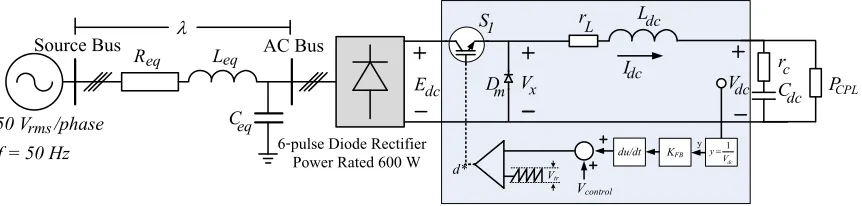
fits of the adaptive stabilization technique for the ac–dc power
106
system.
107
II. AC–DC POWERSYSTEMFEEDING ANIDEALCPL
108
The ac–dc power system investigated in this study is depicted
109
in Fig. 1. An ac–dc power system including an uncontrolled
110
rectifier is considered in this paper because it is still widely
111
used in many applications. It consists of a balanced three-phase
112
voltage source, a transmission line represented byReq, Leq, and
113
Ceq, a six-pulse diode rectifier, dc-link filters represented by
114
rL, Ldc, rc, andCdc, and an ideal CPL represented by a
depen-115
dent current source. The parameters of the system in Fig. 1 are
116
given in Table I. Note that the inductance value has been chosen
117
in order for stability to occur at a power level that is able to be
118
verified experimentally.
119
It is known that CPLs can degrade the stability of their feeder
120
systems via the dc-link filter [3]–[5]. Many research works have
121
already presented how to predict unstable operation using a
122
mathematical model of the system. For three-phase systems with
123
six-pulse diode rectifiers, the DQ method [6]–[8] can be applied
124
in order to analyze the three-phase rectifier circuit and obtain
125
a dynamic model suitable for stability study. The eigenvalue
126
theorem [8] can then be applied to the linearized model for
127
TABLE I
PARAMETERS OF THESYSTEM INFIG. 1
Parameters Value
Vs 50 Vrm s/p h a se
ω 2π×50 rad/s
Req 0.1Ω
Leq 0.21 mH
Ceq 2 nF
rL 0.57Ω
rc 2.97Ω
[image:2.594.312.548.89.400.2]Ld c(ΔId c≤0.5 A) 37.7 mH Cd c(ΔVd c≤5 V) 237.35µF
Fig. 2. Eigenvalue plot of the system before applied the proposed mitigation technique.
stability analysis. Based on the procedure in [9], the eigenvalue 128
plot of the system shown in Fig. 1, with the parameters in 129
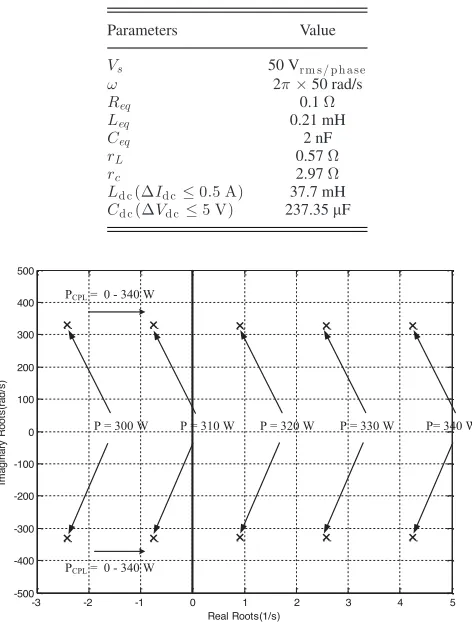
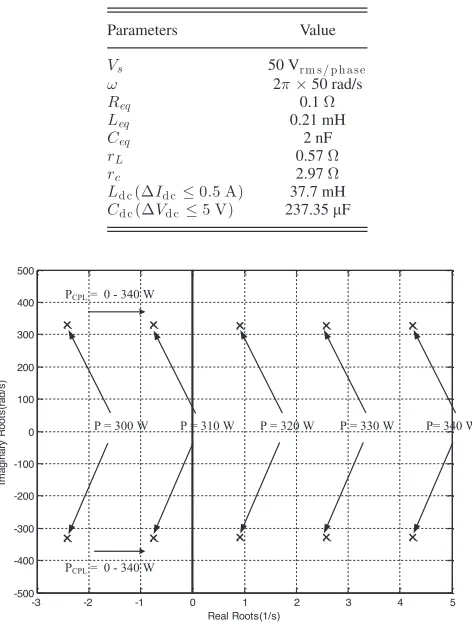
Table I, is depicted in Fig. 2. It can be seen from Fig. 2 that 130
the system will be unstable when the value of PCPL reaches 131
320 W. In this paper, it will be shown that as a result of the 132
techniques used, the ac–dc system shown in Fig. 1 can provide 133
power exceeding 320 W, in this case up to 600 W (rated power), 134
without instability occurring. The details of the technique used 135
for the stabilization of the uncontrolled rectifier based ac–dc 136
power system will be explained in Section III. Moreover, the 137
novel adaptive stabilization for ac–dc power systems feeding 138
the CPLs is also explained. 139
III. LOOP-CANCELATIONSTABILIZATION OF ANAC–DC 140
POWERSYSTEMFEEDING ANIDEALCPL 141
Within this section, the new methodology for the application 142
of the loop-cancelation technique to uncontrolled rectifier based 143
ac–dc converters will be detailed. The established ac–dc con- 144
verters will be detailed. The established ac–dc power system, 145
on which this study is based, is shown in Fig. 1. The newly 146
proposed ac–dc power system, including the loop-cancelation 147
technique, is depicted in Fig. 3. An ideal CPL is considered ini- 148
tially in order to facilitate the calculation of the adaptable gain, 149
Fig. 3. AC–DC power system with the loop-cancelation technique.
Within dc–dc converters, the control of output dc voltage is
151
a natural feature. The loop-cancelation method [12] can
there-152
fore be conveniently applied to introduce a corrective action by
153
adjusting the converter duty cycle. In contrast, the ac–dc power
154
system in this study employs an uncontrolled rectifier in which
155
the output voltage cannot be adjusted and is defined by the ac
156
voltage magnitude only. Therefore, this study proposes a new
157
approach by introducing into the dc link a controlled switchS1
158
to both control the output voltage and introduce the proposed
159
loop-cancelation technique. Only switchS1 and diodeDm are
160
added into the system, whereasrL, Ldc, rc, andCdc are the
ex-161
isting dc-link filter of the rectifier circuit. Therefore, the effect
162
ofS1andDmon the overall system power loss and cost is very
163
small. The duty cycled∗is used to control the switchS1.d∗can
164
be calculated using
165
d∗= 1 Vtr
Vcontrol+KFB d
dt 1 Vdc (1)
whereVtris the amplitude of a triangular signal that can be set
166
by the user. Based on the loop-cancelation technique reported
167
in [12] for dc–dc converters, it is known that the feedback gain
168
KFBis a vital parameter that enables the designer to determine
169
the characteristic of output dc-link filter damping. Moreover, if
170
the designer can determine the appropriate value forKFB, the
171
desired time-domain response can be obtained and the
destabi-172
lizing effect can be completely eliminated.
173
First, for the proposed uncontrolled rectifier based ac–dc
174
power system, the mathematical model will be derived. From
175
this, the equation for calculatingKFB can be obtained. As
de-176
tailed in previous publications [6]–[10], feeder systems with
177
three-phase rectifiers can be analyzed using the DQ method,
178
while the behavior of S1 can be eliminated by using the
179
generalized state-space averaging (GSSA) method [6]. The
180
equivalent circuit of the system in Fig. 3, represented in the
181
dq-frame, is shown in Fig. 4. After applying the DQ method, 182
the three-phase diode rectifier can be treated as a transformer
183
in the dq-frame [10]. The GSSA is then used to eliminate the
184
switching behavior of S1. Applying Kirchhoff’s voltage law
185
and Kirchhoff’s current law to the circuit shown in Fig. 4,
186
withd∗given by (1), the mathematical model of the proposed
187
ac–dc power system under continuous conduction mode,
us-188
ing the loop-cancelation technique, is defined by the following
189 equation: 190 ⎧ ⎪ ⎪ ⎪ ⎪ ⎪ ⎪ ⎪ ⎪ ⎪ ⎪ ⎪ ⎪ ⎪ ⎪ ⎪ ⎪ ⎪ ⎪ ⎪ ⎨ ⎪ ⎪ ⎪ ⎪ ⎪ ⎪ ⎪ ⎪ ⎪ ⎪ ⎪ ⎪ ⎪ ⎪ ⎪ ⎪ ⎪ ⎪ ⎪ ⎩ •
Ids =−RLeqeqIds+ωIq s−L1eqVbus,d+L1eqVsd
•
Iq s=−ωIds−RLeqeqIq s−L1eqVbus,q+L1eqVsq
•
Vbus,d =C1eqIds+ωVbus,q
−3 2 ·
2√3Vt r
π Ceq Vcontrol+KF Bd td V1d c
Idc
•
Vbus,q =−ωVbus,d+C1eqIq s
•
Idc =
3 2 · 2
√ 3Vcontrol
π Ld cVt r Vbus,d−
(rμ+rL+rc)
Ld c Idc− 1
Ld cVdc
+rcPC P L
Ld cVd c +
3 2 · 2
√ 3
π Ld cCd c
KF BVb u s, d
Vt r
d dt V1d c
•
Vdc = C1d c Idc−CPd cC P LVd c
.
(2)
191
A new variableIdc1, as given by (3), can be used to simplify 192
the system model 193
•
Idc1= •
Idc−
3 2 .
2√3 πLdc
KFBVbus,d
Vtr d dt 1 Vdc . (3)
Hence, (2) can be written as the following equation: 194 ⎧ ⎪ ⎪ ⎪ ⎪ ⎪ ⎪ ⎪ ⎪ ⎪ ⎪ ⎪ ⎪ ⎪ ⎪ ⎪ ⎪ ⎪ ⎪ ⎨ ⎪ ⎪ ⎪ ⎪ ⎪ ⎪ ⎪ ⎪ ⎪ ⎪ ⎪ ⎪ ⎪ ⎪ ⎪ ⎪ ⎪ ⎪ ⎩ •
Ids =−RLeqeqIds+ωIq s−L1eqVbus,d+L1eqVsd
•
Iq s=−ωIds−RLeqeqIq s−L1eqVbus,q+L1eqVsq
•
Vbus,d =C1eqIds+ωVbus,q −
3 2 · 2
√ 3Vt r
π CeqVcontrolIdc1
+ 18KF B
π2C
eqLd cVcontrol
Vb u s, d
Vd c •
Vbus,q =−ωVbus,d+C1eqIq s
•
Idc1 =
3 2 · 2
√ 3Vcontrol
π Ld cVt r Vbus,d−
(rμ+rL+rc)
Ld c Idc1− 1
Ld cVdc −3
2 ·
2√3(rμ+rL+rc)KF B
π L2 d cVt r
Vb u s, d
Vd c +
rcPC P L
Ld cVd c •
Vdc = C1d c Idc1−CPd cC P LVd c +
3 2 · 2
√ 3
π Ld cCd c
KF B
Vd cVt r
Vbus,d
.
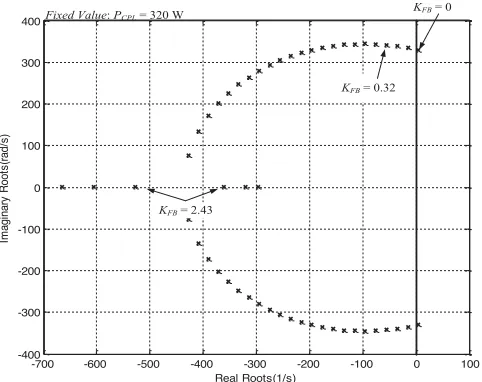
(4) It can be seen from (4) thatKFB is presented in the system 195 model. The effect of KFB can be assessed via a plot of the 196 dominant eigenvalues. These eigenvalues were calculated from 197
the linearization of (4). The system parameters for this plot are 198
given in Table I withVcontrol=2.9 V, Vtr=3 V, andPCPL = 199
320 W. The dominant eigenvalue plot when gainKFBis varied 200
from 0 to 2.45 is shown in Fig. 5. The plot within Fig. 5 can 201
be used to determine the best value ofKFB to avoid unstable 202
Fig. 4. Equivalent circuit of the ac–dc power system with the loop-cancelation technique in the dq-frame.
Fig. 5. Eigenvalue plot for the ac–dc power system with the loop-cancelation technique by varyingKF B.
the location of dominant poles. However, the plot will change
204
whenPCPL changes. Therefore, the appropriate value ofKFB
205
to mitigate the instability problem should be adapted according
206
to the variation ofPCPL.
207
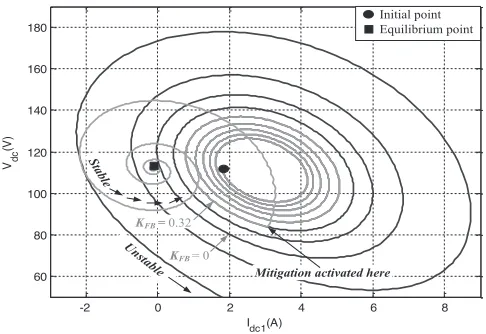
Large-signal stability analysis of the example system is shown
208
in Fig. 6 via a phase-plane plot. Initially,PCPLis set at 200 W.
209
Subsequently,PCPLis increased to 320 W. IfKFB = 0(without
210
mitigation), huge oscillation occurs, as shown by the blue line
211
in Fig. 6. Conversely, if the proposed mitigation is applied with
212
KFB =0.32, the system can regain stability as depicted by the
213
green line in Fig. 6. It can be seen from Figs. 5 and 6 that there
214
is good agreement between the eigenvalue plot and phase-plane
215
plot. Both methodologies confirm that stability is achieved when
216
KFB =0.32. However,KFB = 0.32is forPCPL =320 W. If
217
PCPL is increased, KFB should be increased to ensure that
218
the system maintains stable operation. Hence, KFB must be
219
adaptable depending on the level ofPCPL. In this paper, a novel
220
equation is used to calculate the adaptable gain. The derivation
221
of this equation is detailed as follows.
222
Considering only the characteristics of output dc-link filter
223
damping, the differential equationsI˙dc1andV˙dcin (4) will now
224
be analyzed. It can be seen that the nonlinear terms ofKFBoccur
[image:4.594.48.289.246.437.2]225
Fig. 6. Phase-plane plot of the ac–dc power system.
in both I˙dc1 and V˙dc. However, normally (rμ+rL+r)<< 226
Ldc, therefore only the nonlinear terms ofKFB withinV˙dc are 227
required. If parameterP1is defined as 228
P1 =
3 2
2√3Vbus,d
πLdcCdcVtr
KFB− 1 2√3.
2 3
πLdcVtrPCPL
Vbus,d
(5) thenV˙dcin (4) can be written as 229
˙ Vdc = 1
Cdc Idc1+
P1
Vdc.
(6)
According to (6), ifP1= 0, the nonlinear termP1/Vdc can 230
be canceled. Therefore,KFB in order to guarantee thatP1 = 0 231
can be defined from (5). The adaptable value ofKFB can then 232 be calculated in order to stabilize the system according to 233
KFB = 1 2√3.
2 3
πLdcVtrPCPL
Vbus,d .
(7)
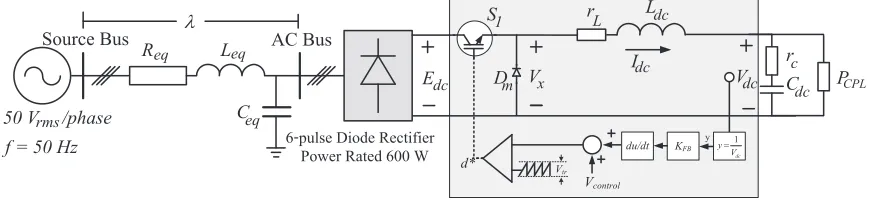
The final system, with adaptive stabilization based on the 234
loop-cancelation technique, is shown in Fig. 7. It can be seen 235
in Fig. 7 that the loop cancelation gainKFBis calculated as in 236
(7).KFB will be adapted depending on the value of the system 237
operating point defined byPCPL. From (7), the adaptableKFB 238
Fig. 7. System with the adaptive stabilization based on the loop-cancelation technique.
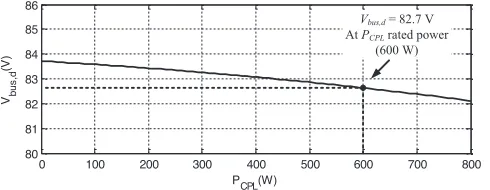
Fig. 8. Vb u s,dvalues forPC P Lwhen varied from 0 to 800 W.
example system used in this paper,Ldc =37.7 mH; however,
240
in other systems this can be determined by the measurement or
241
identified by artificial intelligence techniques [31]. The value of
242
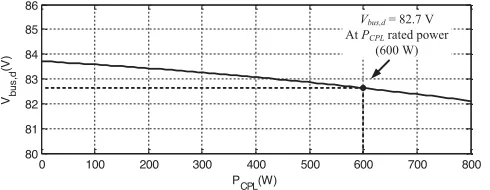
Vbus,dcan be determined by using the power flow equation [9]
243
based on the ac side. TheVbus,d values of the example system
244
in Fig. 1, when thePCPL is varied from 0 to 800 W (the rated
245
power is 600 W), are shown in Fig. 8.
246
According to Fig. 8 at the rated power of 600 W, the value
247
ofVbus,dfor the example system is 82.7 V. It can be seen from
248
Fig. 8 that the higher the value ofPCPL, the lower the value of
249
Vbus,d. This in turn results in a higher value ofKFB. Finally,
250
PCPLcan be determined according to (8). The required values of
251
ICPLandVdccan be obtained from current and voltage sensors,
252
respectively
253
PCPL =VdcICPL. (8)
To ensure that condition (7) can provide the appropriate value
254
ofKFB, a phase-plane analysis of the system in Fig. 7 was
per-255
formed. The phase-plane plots forPCPL =400, 500, and 600 W
256
are shown in Fig. 9(a)–(c), respectively. It can be seen that if
257
thePCPL is increased, the value ofKFB is also automatically
258
increased based on (7). It can be seen from Fig. 9(a) that the
259
system without the proposed mitigation technique(KFB = 0)
260
is unstable; this is represented by the blue line. However, when
261
the mitigation is activated att= 0.1s, withKFB = 0.405, the
262
system settles to a new stable operating point. This stabilization
263
trajectory is represented by the green line in Fig. 9(a). Similarly,
264
as shown in Fig. 9(b) and (c), the system withPCPL =500 W
265
and 600 W becomes stable withKFB = 0.506 and 0.607,
re-266
spectively. These analytical results, via phase-plane analysis,
267
Fig. 9. Phase-plane plots of the system with the proposed adaptive stabiliza-tion. (a)PC P L=400 W. (b)PC P L=500 W. (c)PC P L=600 W.
confirm that the adaptable KFB calculated from (7) ensures 268
stable operation. 269
Time-domain simulation results whenPCPL is varied from 270
[image:5.594.315.534.243.646.2]Fig. 10. Time-domain simulation results with adaptive stabilization based on the loop-cancelation technique.
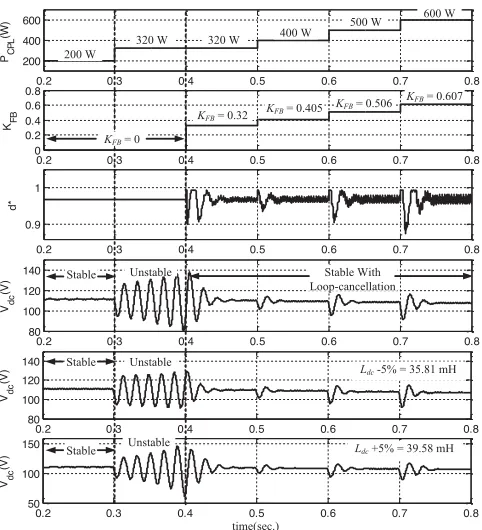
can be seen from Fig. 10 that the system is initially unstable
272
between 0.3 and 0.4 s whenKFB = 0. However, once the
loop-273
cancelation technique is activated at 0.4 s the system becomes
274
stable and remains stable under all subsequent values ofPCPL.
275
After 0.4 s, current and voltage sensors are used to continuously
276
monitor the value ofPCPLin order to recalculate the appropriate
277
KFB. This can be seen in Fig. 10. The duty cycle ofS1 is also
278
included in Fig. 10. This value cannot exceed one for practical
279
implementation. Hence, this limitation has already been added
280
in the simulation, as can be seen in Fig. 10. The simulation
281
results using the same value ofKFBforLdc−5% =35.81 mH
282
andLdc+ 5% =39.58 mH are also shown. It can be seen that
283
even thoughLdc is changed to 35.81 or 39.58 mH, the system
284
can remain stable by using theKFBcalculated from fixedLdc =
285
37.7 mH. It means that the parameter robustness of the proposed
286
control method does not affect the mitigation result.
287
IV. EXPERIMENTALVERIFICATION 288
It has been established in the previous sections that the
pro-289
posed ac–dc power system shown in Fig. 1 becomes unstable
290
whenPCPL is equal to 320 W. Adaptive loop cancelation has
291
been analytically proven to mitigate the instability, as shown
292
in Fig. 7. The simulation results shown in Fig. 10 have also
293
confirmed that the system is always stable with adaptableKFB.
294
In this section, experimental verification is reported in order to
295
support the proposed adaptive stabilization concept. The same
296
ac–dc system is used as shown in Fig. 7. However, within the
297
experimental rig, two parallel tightly controlled buck
convert-298
ers are used to represent the ideal CPL. More details on these
299
converters can be found in [9]. In addition, as the time-domain
300
simulation results presented in the previous section were per- 301
formed with an ideal CPL, they were repeated also using two 302
paralleled buck converters. A diagrammatic representation of 303
the ac–dc power system examined in this section, with the pro- 304
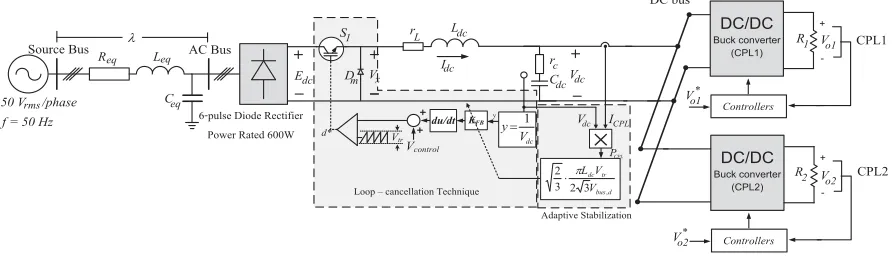
posed adaptive stabilization, is shown in Fig. 11. 305
The experimental rig is shown in Fig. 12. The MOSFET 306
IRFP250N and the diode MUR1560G were added into the sys- 307
tem to represent theS1 andDm, respectively. Moreover, the 308
low-pass filter was already embedded to eliminate the noise 309
generated from the derivative term. The bandwidth of the low- 310
pass filter is set equal to ten times the resonance frequency [12]. 311
In this paper, the resonance frequency is equal to 343.3 rad/s, 312
calculated from theLdc andCdc values shown in Table I. The 313
proposed adaptive stabilization, based on the loop-cancelation 314
technique, was implemented using an Atmaga1280 microcon- 315
troller with analog circuits. This is highlighted by the number 3 316
in Fig. 12. As for both controlled buck converters highlighted by 317
the number 5 and 7, a damping ratio(ζ)and a natural frequency 318
(ωn)for a voltage loop were set to 0.7 and 2π(400) rad/s, re- 319
spectively. For a current loop, these values were equal to 0.7 and 320
2π(4000) rad/s. Hence, following on these damping ratios and 321
natural frequencies,Kpv, Kiv, Kpi, andKii are equal to 0.05, 322
20, 0.6819, and 1948, respectively. In addition, the switching 323
frequencies for switch S1 and switches inside the controlled 324
buck converters were equal to 10 kHz. 325
Both the simulation model and the experimental rig were 326
subjected to the same test scenario. The resultingVdcwaveforms 327
are shown in Fig. 13. The test scenario can be summarized as 328
follows. 329
1) Initially, the total load power was set to 250 W; CPL1= 330
250 W, CPL2=0 W. 331
2) At t=0.11 s, an additional load of 24.2 W is introduced 332
by the second converter CPL2, as a result the total CPL 333
becomes 274.2 W. From the experimental results, it can 334
be seen that the system response is now poorly damped 335
indicating that the stability margin is approaching. The 336
simulation also shows a very oscillatory response, how- 337
ever of a much smaller magnitude. This discrepancy can 338
be explained by unaccounted parasitic effects and mod- 339
eling assumptions. Hence, both the simulation model and 340
the experimental setup indicate that the system is close to 341
instability. 342
3) At t=0.43 s, CPL2 is increased to 80 W. As predicted 343
from the analytical analysis presented in the previous sec- 344
tion, at a total load power of 330 W, the system becomes 345
unstable. It can be seen from Fig. 13 that in both simula- 346
tion and experimental results, the dc voltage exhibits an 347
expanding oscillatory behavior. 348
4) At t=1.05 s, the proposed algorithm is activated and the 349
system stabilizes. 350
5) At t=1.15 s, the load power is further increased (CPL 351
total power becomes 380 W). The system maintains stable 352
operation due to the stabilizing effect of proposed adaptive 353
stabilization technique. 354
6) Finally, to confirm that the system maintains stability even 355
with higher loads, two further CPL step increases are 356
Fig. 11. AC–DC power system with the proposed adaptive stabilization feeding paralleled controlled buck converters.
[image:7.594.43.285.394.532.2]Fig. 12. Testing rig based on the system in Fig. 11.
Fig. 13. (a) Simulation and (b) experimental results.
and at t =1.38 s (600 W total). It is clearly seen from
358
Fig. 13 that the dc bus voltage responses are stable and
359
that the voltage drops at each load step according to the
360
system’s internal resistance.
361
Overall, it can be concluded that there is a very good match
362
between the simulation and experiment results during the test
363
scenario. The capability of the system to return to stable
opera-364
tion using the proposed technique is clearly shown. Furthermore,
365
once the proposed mitigation has been activated, the results in
366
Fig. 13 confirm that the system is always stable even when the
367
total CPL is equal to 600 W (the rated power of feeder
sys-368
tem). The experimental results confirm that the proposed
adap-369
tive stabilization algorithm, based on the loop-cancelation
tech-370
nique, fully mitigates the ac–dc feeder system instability caused
371
by CPLs. In addition, Fig. 13 validates the developed system 372
model and the assumptions made during the development of this 373
effective technique. 374
V. CONCLUSION 375
In this paper, adaptive stabilization of an uncontrolled recti- 376
fier based ac–dc converter has been introduced. The proposed 377
mitigation technique has been used to eliminate the destabi- 378
lizing effect of CPLs. As a result, the ac–dc feeder system is 379
always stable for any level of CPL. The theoretical results from 380
the eigenvalue theorem and the phase-plane analysis confirm 381
that the uncontrolled rectifier based ac–dc power system, with 382
the proposed adaptive stabilization, is always stable. Moreover, 383
simulations and experimental results have been used to verify 384
the theoretical results. Agreement between theoretical, simula- 385
tion, and experimental results has been shown. The proposed 386
adaptive mitigation is therefore a very powerful and flexible 387
technique, which can be used to guarantee the stable opera- 388
tion of uncontrolled rectifier based ac–dc feeder systems when 389
supplying CPLs. 390
REFERENCES 391
[1] V. Grigore, J. Hatonen, J. Kyyra, and T. Suntio, “Dynamics of a buck 392 converter with a constant power load,” in Proc. IEEE 29th Power Electron. 393
Spec. Conf., Fukuoka, Japan, May 1998, pp. 72–78. 394
[2] A. Emadi, M. Ehsani, and J. M. Miller, Vehicular Electric Power Systems: 395
Land, Sea, Air, and Space Vehicle. New York, NY, USA: Marcel Dekker, 396
2003. 397
[3] R. D. Middlebrook, “Input filter consideration in design and application 398 of switching regulators,” in Proc. Conf. Record IEEE IAS Annu. Meeting, 399
1967, pp. 366–382. 400
[4] A. M. Rahimi and A. Emadi, “An analytical investigation of DC/DC 401 power electronic converters with constant power loads in vehicular power 402 systems,” IEEE Trans. Veh. Technol., vol. 58, no. 6, pp. 2689–2702, 403
Jul. 2009. 404
[5] A. Emadi, A. Khaligh, C. H. Rivetta, and G. A. Williamson, “Constant 405 power loads and negative impedance instability in automotive systems: 406 Definition, modeling, stability, and control of power electronic con- 407 verters and motor drives,” IEEE Trans. Veh. Technol., vol. 55, no. 4, 408
pp. 1112–1125, Jul. 2006. 409
[6] A. Emadi, “Modeling of power electronic loads in AC distribution systems 410 using the generalized state-space averaging method,” IEEE Trans. Ind. 411
Electron., vol. 51, no. 5, pp. 992–1000, Oct. 2004. 412
[8] K.-N. Areerak, T. Wu, S. V. Bozhko, G. M. Asher, and D. W. P. Thomas, 417
“Aircraft power system stability study including effect of voltage control 418
and actuators dynamic,” IEEE Trans. Aerosp. Electron. Syst., vol. 47, 419
no. 7, pp. 2574–2589, Oct. 2011. 420
[9] T. Sopapirm, K.-N. Areerak, and K.-L. Areerak, “Stability analysis of 421
AC distribution system with six-pulse diode rectifier and multi-converter 422
power electronic loads,” Int. Rev. Elect. Eng., vol. 6, no. 7, pt. A, 423
pp. 2919–2928, Nov./Dec. 2011. 424
[10] K.-N. Areerak, S. V. Bozhko, G. M. Asher, L. De lillo, and D. W. P. 425
Thomas, “Stability study for a hybrid AC-DC more-electric aircraft power 426
system,” IEEE Trans. Aerosp. Electron. Syst., vol. 48, no. 1, pp. 329–347, 427
Jan. 2012. 428
[11] A. M. Rahimi and A. Emadi, “Active damping in dc/dc power elec-429
tronic converters: A novel method to overcome the problems of constant 430
power loads,” IEEE Trans. Ind. Electron., vol. 56, no. 5, pp. 1428–1439, 431
Feb. 2009. 432
[12] A. M. Rahimi, G. A. Williamson, and A. Emadi, “Loop-cancellation 433
technique: A novel nonlinear feedback to overcome the destabilizing ef-434
fect of constant-power loads,” IEEE Trans. Veh. Technol., vol. 59, no. 2, 435
pp. 650–661, Feb. 2010. 436
[13] M. Cespedes, L. Xing, and J. Sun, “Constant-power loads system sta-437
bilization by passive damping,” IEEE Trans. Power Electron., vol. 26, 438
no. 7, pp. 1832–1836, Jul. 2011. 439
[14] X. N. Zhang, D. M. Vilathgamuwa, K. J. Tseng, B. S. Bhangu, and 440
G. Chandana, “A loop cancellation based active damping solution for con-441
stant power instability in vehicular power systems,” in Proc. 2012 IEEE 442
Energy Convers. Congr. Expo., Raleigh, NC, USA, 2012, pp. 1182–1187.
443
[15] Y. Li, L. R. Vannorsdel, A. J. Zirger, M. Norris, and D. Makismovic, 444
“Current mod control for boost converters with constant power loads,” 445
IEEE Trans. Circuits Syst. I, Reg. Papers, vol. 59, no. 1, pp. 198–206,
446
Jan. 2012. 447
[16] A. A. A. Radwan and Y. R. Mohamed, “Linear active stabilization of 448
converter-dominated dc microgrid,” IEEE Trans. Smart Grid, vol. 3, 449
no. 1, pp. 203–216, Mar. 2012. 450
[17] A. A. A. Radwan and Y. Mohamed, “Assessment and mitigation of inter-451
action dynamics in hybrid ac/dc distribution generation systems,” IEEE 452
Trans. Smart Grid, vol. 3, no. 3, pp. 1382–1393, Sep. 2012.
453
[18] R. Ahmadi and W. Ferdowsi, “Improving the performance of a line reg-454
ulating converter in a converter-dominated dc microgrid system,” IEEE 455
Trans. Smart Grid, vol. 5, no. 5, pp. 2553–2563, Sep. 2014.
456
[19] M. Wu and D. D. Lu, “A novel stabilization method of LC input filter 457
with constant power loads without load performance compromise in dc 458
microgrid,” IEEE Trans. Ind. Electron., vol. 62, no. 7, pp. 4552–4562, 459
Jul. 2015. 460
[20] H. Mahmoudi, M. Aleenejad, and R. Ahmadi, “A new modulated model 461
predictive control method for mitigation of effects of constant power 462
loads,” in Proc. Power Energy Conf. Illinois, 2016, pp. 1–5. 463
[21] Y. R. Mohamed, A. A. A. Radwan, and T. Lee, “Decoupled refer-464
ence voltage-based active dc-link stabilization for PMSM drives with 465
tight-speed regulation,” IEEE Trans. Ind. Electron., vol. 59, no. 12, 466
pp. 4523–4536, Dec. 2012. 467
[22] P. Magne, B. Nahid-Mobarakeh, and S. Pierfederici, “General active global 468
stabilization of multiloads dc-power networks,” IEEE Trans. Power Elec-469
tron., vol. 27, no. 4, pp. 1788–1798, Apr. 2012.
470
[23] P. Magne, D. Marx, B. Nahid-Mobarakeh, and S. Pierfederici, “Large-471
signal stabilization of a dc-link supplying a constant power load using a 472
virtual capacitor: Impact on the domain of attraction,” IEEE Trans. Ind. 473
Appl., vol. 48, no. 3, pp. 878–887, May/Jun. 2012.
474
[24] P. Magne, B. Nahid-Mobarakeh, and S. Pierfederici, “Active stabilization 475
of dc microgrids without remote sensors for more electric aircraft,” IEEE 476
Trans. Ind. Appl., vol. 49, no. 5, pp. 2352–2360, Sep./Oct. 2013.
477
[25] W. J. Lee and S. K. Sul, “DC-link voltage stabilization for reduced DC-link 478
capacitor inverter,” IEEE Trans. Ind. Appl., vol. 50, no. 1, pp. 404–414, 479
Jan./Feb. 2014. 480
[26] P. Magne, B. Nahid-Mobarakeh, and S. Pierfederici, “Dynamic consid-481
eration of dc microgrids with constant power loads and active damping 482
system a design method for fault-tolerant stabilizing system,” IEEE J. 483
Emerg. Sel. Topics Power Electron., vol. 2, no. 3, pp. 562–570, Sep. 2014.
484
[27] H. Mosskull, “Optimal stabilization of constant power loads with input 485
LC-filters,” Control Eng. Pract., vol. 27, pp. 61–63, 2014. 486
[28] K. Inoue, T. Kato, M. Inoue, Y. Moriyama, and K. Nishii, “An oscillation 487
suppression method of a dc-bus supply system with a constant power load 488
and a LC filter,” in Proc. 2012 IEEE 13th Workshop Control Model. Power 489
Electron., 2012, pp. 1–4.
490
[29] M. S. Carmeli, D. Forlani, S. Grillo, R. Pinetti, E. Ragaini, and E. Tironi, 491 “A stabilization method for dc networks with constant-power loads,” in 492
Proc. 2012 IEEE 36th Int. Energy Conf. Exhib., 2012, pp. 617–622. 493
[30] O. Pizniur, Z. Shan, and J. Jatskevich, “Ensuring dynamic stability of 494 constant power loads in dc telecom power systems and data centers using 495 active damping,” in Proc. 2014 IEEE 36th Int. Telecommun. Energy Conf., 496
2012, pp. 1–8. 497
[31] T. Sopaprim, K.-N. Areerak, and K.-L. Areerak, “The identification of AC- 498 DC power system parameter using an adaptive tabu search technique,” Int. 499
Rev. Elect. Eng., vol. 7, no. 4, pp. 4655–4662, Jul./Aug. 2012. 500
Kongpan Areerak received the B.Eng. and M.Eng. 501 degrees from Suranaree University of Technology 502 (SUT), Nakhon Ratchasima, Thailand, in 2000 and 503 2001, respectively, and the Ph.D. degree from the 504 University of Nottingham, Nottingham, U.K., in 505 2009, all in electrical engineering. 506 In 2002, he was a Lecturer with the Electrical and 507 Electronic Department, Rangsit University, Lak Hok, 508 Thailand. Since 2003, he has been a Lecturer with 509 the School of Electrical Engineering, SUT, and since 510 2015 he has been an Associate Professor in electrical 511 engineering. His research interests include system identifications, artificial in- 512 telligence applications, stability analysis of power systems with constant power 513 loads, modeling and control of power electronic based systems, and control 514
theory. 515
516
Theppanom Sopapirm was born in Saraburi, 517 Thailand, in 1988. He received the B.Eng., M.Eng., 518 Ph.D. degrees in electrical engineering from Surana- 519 ree University of Technology, Nakhon Ratchasima, 520 Thailand, in 2009, 2011, and 2017, respectively. 521 His research interests include stability analysis, 522 modeling of power electronic systems, digital con- 523 trol, FPGA, and AI applications. 524 525
Serhiy Bozhko received the M.Sc. (Hons.) and Ph.D. 526 degrees in electromechanical systems from the Na- 527 tional Technical University of Ukraine, Kyiv City, 528 Ukraine, in 1987 and 1994, respectively. 529 Since 2000, he has been with the Power Electron- 530 ics, Machines and Controls Research Group, Univer- 531 sity of Nottingham, Nottingham, U.K., where he is 532 currently a Professor with the Aircraft Electric Power 533 Systems Innovations Laboratory. He is leading sev- 534 eral EU- and industry-funded projects dealing with 535 the electric power systems for aerospace applications. 536 His research interests include their control, power quality and stability issues, 537 power management and optimization, as well as advanced modeling and simu- 538
lations methods. 539
540
Christopher Ian Hill (M’08) received the M.Eng. 541 and Ph.D. degrees from The University of Not- 542 tingham, Nottingham, U.K., in 2004 and 2014, 543
respectively. 544
In March 2012, he joined the Power Electronics, 545 Machines and Control Research Group, University of 546 Nottingham, as a Research Fellow. In 2017, he was 547 promoted to Senior Research Fellow at The Univer- 548 sity of Nottingham and currently leads several Eu- 549 ropean projects totaling more than€2 million. His 550 current research interests include hybrid and fully 551 electric aircraft; future aircraft electrical power system design, sizing, and op- 552 timization; onboard energy management and optimization; superconducting 553 electrical power systems; advanced multilevel modeling; and advanced fault 554
and loss modeling. 555
Apichai Suyapan was born in Chiang Mai, 557
Thailand, in 1991. He received the B.Eng. and M.Eng. 558
degrees in electrical engineering, in 2013 and 2016, 559
respectively, from Suranaree University of Technol-560
ogy, Nakhon Ratchasima, Thailand, where he is cur-561
rently working toward the Ph.D. degree in electrical 562
engineering. 563
His research interests include stability analysis of 564
power systems with constant power loads, modeling 565
and control of power electronic based systems, and 566
control theory. 567
568
Kongpol Areerak received the B.Eng., M.Eng., 569 and Ph.D. degrees in electrical engineering from 570 Suranaree University of Technology (SUT), Nakhon 571 Ratchasima, Thailand, in 2000, 2003, and 2007, 572
respectively. 573
Since 2007, he has been a Lecturer and Head of 574 the Power Quality Research Unit with the School 575 of Electrical Engineering, SUT. In 2009, he was an 576 Assistant Professor in electrical engineering. His re- 577 search interests include active power filters, harmonic 578 elimination, AI applications, motor drives, and intel- 579
ligence control system. 580
Adaptive Stabilization of Uncontrolled Rectifier
Based AC–DC Power Systems Feeding Constant
Power Loads
12
3
Kongpan Areerak, Theppanom Sopapirm, Serhiy Bozhko, Member, IEEE, Christopher Ian Hill, Member, IEEE,
Apichai Suyapan, and Kongpol Areerak
4 5
Abstract—It is known that, when tightly regulated, actively con-6
trolled power converters behave as constant power loads (CPLs). 7
These loads can significantly degrade the stability of their feeder 8
system. The loop-cancelation technique has been established as 9
an appropriate methodology to mitigate this issue within dc–dc 10
converters that feed CPLs. However, this has not yet been applied 11
to uncontrolled rectifier based ac–dc converters. This paper there-12
fore details a new methodology that allows the loop-cancelation 13
technique to be applied to uncontrolled rectifier based ac–dc 14
converters in order to mitigate instability when supplying CPLs. 15
This technique could be used in both new applications and easily 16
retrofitted into existing applications. Furthermore, the key con-17
tribution of this paper is a novel adaptive stabilization technique, 18
which eliminates the destabilizing effect of CPLs for the studied 19
ac–dc power system. An equation, derived from the average 20
system model, is introduced and utilized to calculate the adaptable 21
gain required by the loop-cancelation technique. As a result, 22
the uncontrolled rectifier based ac–dc feeder system is always 23
stable for any level of CPL. The effectiveness of the proposed adap-24
tive mitigation has been verified by small-signal and large-signal 25
stability analysis, simulation, and experimental results. 26
Index Terms—AC–DC converters, constant power load (CPL), 27
loop-cancelation technique, negative impedance instability. 28
I. INTRODUCTION 29
A
CTIVELY controlled power converters are widely used in30
many applications. Unfortunately, when tightly regulated,
31
actively controlled power converters behave as constant power
32
loads (CPLs) [1], [2]. These CPLs can significantly degrade
33
the stability of their feeder system [3]–[5]. It can be seen from
34
previous publications [6]–[10], that unstable system operation
35
can be predicted from dynamic mathematical models via
con-36
trol theory. In order to derive models in such a way as to be
37
Manuscript received July 25, 2017; revised October 19, 2017; accepted November 25, 2017. This work was supported in part by Suranaree University of Technology and in part by the office of the Higher Education Commission under NRU Project of Thailand. Recommended for publication by Associate Editor F. J. Azcondo. (Corresponding author: Kongpan Areerak.)
K. Areerak, T. Sopapirm, A. Suyapan, and K. Areerak are with the School of Electrical Engineering, Suranaree University of Technology, Nakhon Ratchasima 30000, Thailand (e-mail: [email protected]; kongpan@sut. ac.th; [email protected]; [email protected]).
S. Bozhko and C. I. Hill are with the Department of Electrical and Electronic Engineering, University of Nottingham, Nottingham NG7 2RD, U.K (e-mail: [email protected]; [email protected]).
Color versions of one or more of the figures in this paper are available online at http://ieeexplore.ieee.org.
Digital Object Identifier 10.1109/TPEL.2017.2779541
suitable for stability analysis the averaging technique [9], [10] 38
can be utilized. However, mathematical prediction only states 39
when the system will become unstable. In order to eliminate the 40
destabilizing effect, mitigation techniques are required. 41
In terms of mitigation techniques, there are three possible 42
ways to apply a compensating signal for eliminating the desta- 43
bilizing effect. The first is to generate the mitigating signal on 44
the feeder side [11]–[20]. In this case, the system can be stabi- 45
lized without conciliating the load performance. However, this 46
way cannot be applied to a feeder system that utilizes an un- 47
controlled rectifier based ac–dc rectifier due to the absence of 48
the control loop in the feeder subsystem. In this situation, a 49
second mitigation technique can be used in which the compen- 50
sating signal is injected into the CPL control loop to modify the 51
load impedance for stable operation [21]–[27]. The drawback of 52
mitigation on the CPL side is that the additional compensating 53
signal may deteriorate the load performance. The final way to 54
eliminate the destabilizing effect is by connecting an auxiliary 55
circuit between the feeder and load subsystems [28]–[30]. This 56
method is suitable for power systems having existing feeder and 57
load subsystems that are impossible to modify. In this paper, 58
the feeder system includes an uncontrolled rectifier in which 59
the output voltage cannot be adjusted. Hence, the additional 60
auxiliary circuit approach for mitigation is selected. 61
In terms of the control techniques to create the compensating 62
signal, there are two well-known approaches. The first is the 63
active damping method [11], [15]–[30]. In this case, a virtual 64
resistance is used to increase the damping of the filter circuit. 65
However, the power level of the CPL(PCPL)that can be mit- 66 igated is limited [12], [14]. Therefore, a second approach was 67
introduced, namely the loop-cancelation technique [12], [14]. 68
This technique can mitigate system instability at higher values 69
ofPCPL than those compensated by active damping. However, 70
this technique has only been applied to dc–dc converters, as 71
described in [12]. The application of the loop-cancelation tech- 72
nique to uncontrolled rectifier based ac–dc power systems via 73
an auxiliary circuit has not been reported in previous publica- 74
tions, e.g., [12]. Hence, in this paper, instability mitigation for 75
uncontrolled rectifier based ac–dc power systems via the loop- 76
cancelation technique is presented. Moreover, this paper also 77
presents a novel adaptive stabilization technique based on an 78
equation that can be derived from the average system model. 79
The equation is used to determine the adaptable gain required 80
Fig. 1. AC–DC power system feeding an ideal CPL.
for loop cancelation. This gain depends on the power level of the
81
CPL, which can be calculated from voltage and current sensors
82
on the dc bus. As a result of this methodology, the system can
83
automatically ensure stability under all operating conditions.
84
The stability study presented in this paper, using small-signal
85
and large-signal stability analysis, confirms that the mitigated
86
system is always stable. In addition, simulation and
experimen-87
tal results are also presented to verify the proposed adaptive
88
stabilization technique that eliminates the destabilizing effect
89
of the CPL.
90
The paper is structured as follows. In Section II, an ac–dc
91
power system feeding an ideal CPL is introduced to illustrate
92
the effect of CPLs. In Section III, the loop-cancelation technique
93
for ac–dc power systems feeding ideal CPLs is explained. An
ex-94
planation of how to apply the loop-cancelation technique to the
95
ac–dc power system, the derivation of mathematical model, the
96
system stability analysis via the eigenvalue theorem and
97
the phase-plane plot, the concept of the adaptive stabilization,
98
and the simulation results are all addressed in Section III. A
99
realistic ac–dc power system is then analyzed in Section IV. In
100
this case, parallel controlled buck converters are used as CPLs
101
instead of the ideal CPLs. Simulation and experimental results
102
are also presented in Section IV to confirm that the proposed
103
mitigation technique can eliminate the destabilizing effect of
104
the CPL. Finally; Section V concludes and discusses the
bene-105
fits of the adaptive stabilization technique for the ac–dc power
106
system.
107
II. AC–DC POWERSYSTEMFEEDING ANIDEALCPL
108
The ac–dc power system investigated in this study is depicted
109
in Fig. 1. An ac–dc power system including an uncontrolled
110
rectifier is considered in this paper because it is still widely
111
used in many applications. It consists of a balanced three-phase
112
voltage source, a transmission line represented byReq, Leq, and
113
Ceq, a six-pulse diode rectifier, dc-link filters represented by
114
rL, Ldc, rc, andCdc, and an ideal CPL represented by a
depen-115
dent current source. The parameters of the system in Fig. 1 are
116
given in Table I. Note that the inductance value has been chosen
117
in order for stability to occur at a power level that is able to be
118
verified experimentally.
119
It is known that CPLs can degrade the stability of their feeder
120
systems via the dc-link filter [3]–[5]. Many research works have
121
already presented how to predict unstable operation using a
122
mathematical model of the system. For three-phase systems with
123
six-pulse diode rectifiers, the DQ method [6]–[8] can be applied
124
in order to analyze the three-phase rectifier circuit and obtain
125
a dynamic model suitable for stability study. The eigenvalue
126
theorem [8] can then be applied to the linearized model for
127
TABLE I
PARAMETERS OF THESYSTEM INFIG. 1
Parameters Value
Vs 50 Vrm s/p h a se
ω 2π×50 rad/s
Req 0.1Ω
Leq 0.21 mH
Ceq 2 nF
rL 0.57Ω
rc 2.97Ω
[image:11.594.312.548.89.401.2]Ld c(ΔId c≤0.5 A) 37.7 mH Cd c(ΔVd c≤5 V) 237.35µF
Fig. 2. Eigenvalue plot of the system before applied the proposed mitigation technique.
stability analysis. Based on the procedure in [9], the eigenvalue 128
plot of the system shown in Fig. 1, with the parameters in 129
Table I, is depicted in Fig. 2. It can be seen from Fig. 2 that 130
the system will be unstable when the value of PCPL reaches 131
320 W. In this paper, it will be shown that as a result of the 132
techniques used, the ac–dc system shown in Fig. 1 can provide 133
power exceeding 320 W, in this case up to 600 W (rated power), 134
without instability occurring. The details of the technique used 135
for the stabilization of the uncontrolled rectifier based ac–dc 136
power system will be explained in Section III. Moreover, the 137
novel adaptive stabilization for ac–dc power systems feeding 138
the CPLs is also explained. 139
III. LOOP-CANCELATIONSTABILIZATION OF ANAC–DC 140
POWERSYSTEMFEEDING ANIDEALCPL 141
Within this section, the new methodology for the application 142
of the loop-cancelation technique to uncontrolled rectifier based 143
ac–dc converters will be detailed. The established ac–dc con- 144
verters will be detailed. The established ac–dc power system, 145
on which this study is based, is shown in Fig. 1. The newly 146
proposed ac–dc power system, including the loop-cancelation 147
technique, is depicted in Fig. 3. An ideal CPL is considered ini- 148
tially in order to facilitate the calculation of the adaptable gain, 149
Fig. 3. AC–DC power system with the loop-cancelation technique.
Within dc–dc converters, the control of output dc voltage is
151
a natural feature. The loop-cancelation method [12] can
there-152
fore be conveniently applied to introduce a corrective action by
153
adjusting the converter duty cycle. In contrast, the ac–dc power
154
system in this study employs an uncontrolled rectifier in which
155
the output voltage cannot be adjusted and is defined by the ac
156
voltage magnitude only. Therefore, this study proposes a new
157
approach by introducing into the dc link a controlled switchS1
158
to both control the output voltage and introduce the proposed
159
loop-cancelation technique. Only switchS1 and diodeDm are
160
added into the system, whereasrL, Ldc, rc, andCdc are the
ex-161
isting dc-link filter of the rectifier circuit. Therefore, the effect
162
ofS1andDmon the overall system power loss and cost is very
163
small. The duty cycled∗is used to control the switchS1.d∗can
164
be calculated using
165
d∗= 1 Vtr
Vcontrol+KFB d
dt 1 Vdc (1)
whereVtris the amplitude of a triangular signal that can be set
166
by the user. Based on the loop-cancelation technique reported
167
in [12] for dc–dc converters, it is known that the feedback gain
168
KFBis a vital parameter that enables the designer to determine
169
the characteristic of output dc-link filter damping. Moreover, if
170
the designer can determine the appropriate value forKFB, the
171
desired time-domain response can be obtained and the
destabi-172
lizing effect can be completely eliminated.
173
First, for the proposed uncontrolled rectifier based ac–dc
174
power system, the mathematical model will be derived. From
175
this, the equation for calculatingKFB can be obtained. As
de-176
tailed in previous publications [6]–[10], feeder systems with
177
three-phase rectifiers can be analyzed using the DQ method,
178
while the behavior of S1 can be eliminated by using the
179
generalized state-space averaging (GSSA) method [6]. The
180
equivalent circuit of the system in Fig. 3, represented in the
181
dq-frame, is shown in Fig. 4. After applying the DQ method, 182
the three-phase diode rectifier can be treated as a transformer
183
in the dq-frame [10]. The GSSA is then used to eliminate the
184
switching behavior of S1. Applying Kirchhoff’s voltage law
185
and Kirchhoff’s current law to the circuit shown in Fig. 4,
186
withd∗given by (1), the mathematical model of the proposed
187
ac–dc power system under continuous conduction mode,
us-188
ing the loop-cancelation technique, is defined by the following
189 equation: 190 ⎧ ⎪ ⎪ ⎪ ⎪ ⎪ ⎪ ⎪ ⎪ ⎪ ⎪ ⎪ ⎪ ⎪ ⎪ ⎪ ⎪ ⎪ ⎪ ⎪ ⎨ ⎪ ⎪ ⎪ ⎪ ⎪ ⎪ ⎪ ⎪ ⎪ ⎪ ⎪ ⎪ ⎪ ⎪ ⎪ ⎪ ⎪ ⎪ ⎪ ⎩ •
Ids =−RLeqeqIds+ωIq s−L1eqVbus,d+L1eqVsd
•
Iq s=−ωIds−RLeqeqIq s−L1eqVbus,q+L1eqVsq
•
Vbus,d =C1eqIds+ωVbus,q
−3
2 · 2
√ 3Vt r
π Ceq Vcontrol+KF Bd td V1d c
Idc
•
Vbus,q =−ωVbus,d+C1eqIq s
•
Idc =
3 2 · 2
√ 3Vcontrol
π Ld cVt r Vbus,d−
(rμ+rL+rc)
Ld c Idc− 1
Ld cVdc
+rcPC P L
Ld cVd c +
3 2 · 2
√ 3
π Ld cCd c
KF BVb u s, d
Vt r
d dt V1d c
•
Vdc = C1d c Idc−CPd cC P LVd c
.
(2)
191
A new variableIdc1, as given by (3), can be used to simplify 192
the system model 193
•
Idc1= •
Idc−
3 2 .
2√3 πLdc
KFBVbus,d
Vtr d dt 1 Vdc . (3)
Hence, (2) can be written as the following equation: 194 ⎧ ⎪ ⎪ ⎪ ⎪ ⎪ ⎪ ⎪ ⎪ ⎪ ⎪ ⎪ ⎪ ⎪ ⎪ ⎪ ⎪ ⎪ ⎪ ⎨ ⎪ ⎪ ⎪ ⎪ ⎪ ⎪ ⎪ ⎪ ⎪ ⎪ ⎪ ⎪ ⎪ ⎪ ⎪ ⎪ ⎪ ⎪ ⎩ •
Ids =−RLeqeqIds+ωIq s−L1eqVbus,d+L1eqVsd
•
Iq s=−ωIds−RLeqeqIq s−L1eqVbus,q+L1eqVsq
•
Vbus,d =C1eqIds+ωVbus,q −
3 2 · 2
√ 3Vt r
π CeqVcontrolIdc1
+ 18KF B
π2C
eqLd cVcontrol
Vb u s, d
Vd c •
Vbus,q =−ωVbus,d+C1eqIq s
•
Idc1 =
3 2 · 2
√ 3Vcontrol
π Ld cVt r Vbus,d−
(rμ+rL+rc)
Ld c Idc1− 1
Ld cVdc −3
2 ·
2√3(rμ+rL+rc)KF B
π L2 d cVt r
Vb u s, d
Vd c +
rcPC P L
Ld cVd c •
Vdc = C1d c Idc1−CPd cC P LVd c +
3 2 · 2
√ 3
π Ld cCd c
KF B
Vd cVt r
Vbus,d
.
(4) It can be seen from (4) thatKFB is presented in the system 195 model. The effect of KFB can be assessed via a plot of the 196 dominant eigenvalues. These eigenvalues were calculated from 197
the linearization of (4). The system parameters for this plot are 198
given in Table I withVcontrol=2.9 V, Vtr=3 V, andPCPL = 199
320 W. The dominant eigenvalue plot when gainKFBis varied 200
from 0 to 2.45 is shown in Fig. 5. The plot within Fig. 5 can 201
be used to determine the best value ofKFB to avoid unstable 202
Fig. 4. Equivalent circuit of the ac–dc power system with the loop-cancelation technique in the dq-frame.
Fig. 5. Eigenvalue plot for the ac–dc power system with the loop-cancelation technique by varyingKF B.
the location of dominant poles. However, the plot will change
204
whenPCPL changes. Therefore, the appropriate value ofKFB
205
to mitigate the instability problem should be adapted according
206
to the variation ofPCPL.
207
Large-signal stability analysis of the example system is shown
208
in Fig. 6 via a phase-plane plot. Initially,PCPLis set at 200 W.
209
Subsequently,PCPLis increased to 320 W. IfKFB = 0(without
210
mitigation), huge oscillation occurs, as shown by the blue line
211
in Fig. 6. Conversely, if the proposed mitigation is applied with
212
KFB =0.32, the system can regain stability as depicted by the
213
green line in Fig. 6. It can be seen from Figs. 5 and 6 that there
214
is good agreement between the eigenvalue plot and phase-plane
215
plot. Both methodologies confirm that stability is achieved when
216
KFB =0.32. However,KFB = 0.32is forPCPL =320 W. If
217
PCPL is increased, KFB should be increased to ensure that
218
the system maintains stable operation. Hence, KFB must be
219
adaptable depending on the level ofPCPL. In this paper, a novel
220
equation is used to calculate the adaptable gain. The derivation
221
of this equation is detailed as follows.
222
Considering only the characteristics of output dc-link filter
223
damping, the differential equationsI˙dc1andV˙dcin (4) will now
224
be analyzed. It can be seen that the nonlinear terms ofKFBoccur
[image:13.594.48.289.247.437.2]225
Fig. 6. Phase-plane plot of the ac–dc power system.
in both I˙dc1 and V˙dc. However, normally (rμ+rL+r)<< 226
Ldc, therefore only the nonlinear terms ofKFB withinV˙dc are 227
required. If parameterP1is defined as 228
P1 =
3 2
2√3Vbus,d
πLdcCdcVtr
KFB− 1 2√3.
2 3
πLdcVtrPCPL
Vbus,d
(5) thenV˙dcin (4) can be written as 229
˙ Vdc = 1
Cdc Idc1+
P1
Vdc.
(6)
According to (6), ifP1= 0, the nonlinear termP1/Vdc can 230
be canceled. Therefore,KFB in order to guarantee thatP1 = 0 231 can be defined from (5). The adaptable value ofKFB can then 232 be calculated in order to stabilize the system according to 233
KFB = 1 2√3.
2 3
πLdcVtrPCPL
Vbus,d .
(7)
The final system, with adaptive stabilization based on the 234
loop-cancelation technique, is shown in Fig. 7. It can be seen 235
in Fig. 7 that the loop cancelation gainKFBis calculated as in 236
(7).KFB will be adapted depending on the value of the system 237
operating point defined byPCPL. From (7), the adaptableKFB 238
Fig. 7. System with the adaptive stabilization based on the loop-cancelation technique.
Fig. 8. Vb u s,dvalues forPC P Lwhen varied from 0 to 800 W.
example system used in this paper,Ldc =37.7 mH; however,
240
in other systems this can be determined by the measurement or
241
identified by artificial intelligence techniques [31]. The value of
242
Vbus,dcan be determined by using the power flow equation [9]
243
based on the ac side. TheVbus,d values of the example system
244
in Fig. 1, when thePCPL is varied from 0 to 800 W (the rated
245
power is 600 W), are shown in Fig. 8.
246
According to Fig. 8 at the rated power of 600 W, the value
247
ofVbus,dfor the example system is 82.7 V. It can be seen from
248
Fig. 8 that the higher the value ofPCPL, the lower the value of
249
Vbus,d. This in turn results in a higher value ofKFB. Finally,
250
PCPLcan be determined according to (8). The required values of
251
ICPLandVdccan be obtained from current and voltage sensors,
252
respectively
253
PCPL =VdcICPL. (8)
To ensure that condition (7) can provide the appropriate value
254
ofKFB, a phase-plane analysis of the system in Fig. 7 was
per-255
formed. The phase-plane plots forPCPL =400, 500, and 600 W
256
are shown in Fig. 9(a)–(c), respectively. It can be seen that if
257
thePCPL is increased, the value ofKFB is also automatically
258
increased based on (7). It can be seen from Fig. 9(a) that the
259
system without the proposed mitigation technique(KFB = 0)
260
is unstable; this is represented by the blue line. However, when
261
the mitigation is activated att= 0.1s, withKFB = 0.405, the
262
system settles to a new stable operating point. This stabilization
263
trajectory is represented by the green line in Fig. 9(a). Similarly,
264
as shown in Fig. 9(b) and (c), the system withPCPL =500 W
265
and 600 W becomes stable withKFB = 0.506 and 0.607,
re-266
spectively. These analytical results, via phase-plane analysis,
267
Fig. 9. Phase-plane plots of the system with the proposed adaptive stabiliza-tion. (a)PC P L=400 W. (b)PC P L=500 W. (c)PC P L=600 W.
confirm that the adaptable KFB calculated from (7) ensures 268
stable operation. 269
Time-domain simulation results whenPCPL is varied from 270
[image:14.594.43.288.243.338.2]