SECURITY FOR DATA LEAKAGE
Haifa Mohammed Al Nasseri
A Thesis Submitted for the Degree of PhD
at the
University of St Andrews
2019
Full metadata for this item is available in
St Andrews Research Repository
at:
http://research-repository.st-andrews.ac.uk/
Please use this identifier to cite or link to this item:
http://hdl.handle.net/10023/17524
Security for Data Leakage
Haifa Mohamed Al Nasseri
This thesis is submitted in partial fulfilment for the degree of
Doctor of Philosophy at the University of St Andrews
To Allah, who provides me with unlimited strength and guidance, and who was beside me all the time when no one was able to understand me and when the PhD stress reached its peak. To you, my lord, my profound gratitude and thanks.
To my late father, Mohamed, and my mother, Aisha, the most precious gifts I have in this life, who have instilled the love of learning in me and my nine siblings, Khalid, Mahfoodah, Samya, Ibrahim, Laila, Ashraf, Omar, Isaa and Khamis. We are a big family with a big heart and strong bonds. My thanks to my lovely family.
To whom prayed for me secretly. To my grandparents, my uncle and aunt that I lost during my PhD journey.
My further acknowledgement and thanks to my beloved country Oman for supporting me in my higher education since my BSc (Sultan Qaboos University, 2004) and providing full scholarships for both my MSc (Loughborough, 2006) and PhD (St Andrews, 2018).
To all my teachers throughout my life who have participated in building my teaching and learning skills.
To my supervisor Dr.Ishbel Duncan, who has given me her best guidance and support.
To St Andrews University, School of computer science, and all its student support fa-cilities.
Candidate’s Declaration
I, Haifa Mohamed Khamis Al Nasseri, do hereby certify that this thesis, submitted for the degree of PhD, which is approximately 66265words in length, has been written by me, and that it is the record of work carried out by me, or principally by myself in collaboration with others as acknowledged, and that it has not been submitted in any previous application for any degree.
I was admitted as a research student at the University of St Andrews in September 2013.
I received funding from an organisation or institution and have acknowledged the funder(s) in the full text of my thesis.
Date:30 January 2019
Signature of candidate:
Supervisor’s Declaration
I hereby certify that the candidate has fulfilled the conditions of the Resolution and Regulations appropriate for the degree of PhD in the University of St Andrews and that the candidate is qualified to submit this thesis in application for that degree.
Date:30 January 2019
In submitting this thesis to the University of St Andrews we understand that we are giving permission for it to be made available for use in accordance with the regulations of the University Library for the time being in force, subject to any copyright vested in the work not being affected thereby. We also understand, unless exempt by an award of an embargo as requested below, that the title and the abstract will be published, and that a copy of the work may be made and supplied to any bona fide library or research worker, that this thesis will be electronically accessible for personal or research use and that the library has the right to migrate this thesis into new electronic forms as required to ensure continued access to the thesis.
I, Haifa Mohamed Khamis Al Nasseri, confirm that my thesis does not contain any third-party material that requires copyright clearance.
The following is an agreed request by candidate and supervisor regarding the publication of this thesis:
Printed copy
No embargo on print copy.
Electronic copy
No embargo on electronic copy.
Date:30 January 2019
Signature of candidate:
Date:30 January 2019
Contents i
List of Figures v
List of Tables vii
Glossary ix
1 Introduction and Overview 1
1.1 Background Facts . . . 1
1.2 Importance of the Field . . . 3
1.3 The Research Gap . . . 5
1.4 Contributions . . . 7
1.5 Research Hypothesis . . . 11
1.6 Problem Statement . . . 11
1.7 Thesis Map . . . 13
1.8 Thesis Structure . . . 14
1.9 Publications . . . 14
2 Context Survey 15 2.1 Cloud Computing . . . 15
2.1.1 Infrastructure as a Service (IaaS) . . . 16
2.1.2 IaaS Examples . . . 17
2.2 Terminology Definitions . . . 18
2.3 Cloud Networks . . . 19
2.3.1 SAIL and CloNE . . . 20
2.4 SDN . . . 20
2.4.1 OpenFlow . . . 21
2.4.2 Control plane and Data Plane . . . 22
2.4.3 Abstraction . . . 23
2.4.4 Northbound and Southbound interfaces . . . 23
2.5 Network Function Virtualization (NFV) . . . 23
2.6 Virtual Networks . . . 24
2.7 Network as a Service . . . 28
2.7.1 VN Technologies . . . 29
2.7.2 Network Management . . . 31
2.7.3 Customer Requirements . . . 31
2.7.4 Cloud Networking in CloudStack and OpenStack . . . 33
2.8 SDN Management . . . 34
2.9 Virtual Network Isolation . . . 36
2.9.1 VN Isolation Approaches . . . 38
2.10 Isolation Configuration Issues . . . 45
2.10.1 Attacks . . . 49
2.10.2 Security Aspects . . . 51
2.10.3 Testing and Evaluation . . . 54
2.10.4 Open Issues in Isolation . . . 54
2.10.5 Data Leakage . . . 55
2.11 Penetration Testing . . . 60
2.11.1 Security Testing Methodologies . . . 62
2.11.2 Examples in Academic Research . . . 63
2.11.3 Kali Linux . . . 65
2.12 Conclusions . . . 67
3 OpenStack Testbed and Infrastructure Deep Dive 69 3.1 Overview . . . 69
3.2 Testbed Building . . . 72
3.2.1 Cloud Environment Preparation . . . 72
3.2.2 OpenStack Environment . . . 74
3.2.3 Cloud Network Configuration . . . 74
3.2.4 External connection . . . 75
3.2.5 Preparing the Testing Scenario . . . 75
3.3 Technologies and Terminologies . . . 77
3.3.1 OpenStack Networking . . . 77
3.3.2 Virtual Network and Isolation Mechanisms . . . 78
3.3.3 Instance . . . 78
3.3.4 Linux Bridges . . . 79
3.3.5 Open vSwitch (OVS) . . . 79
3.3.6 Namespaces . . . 81
3.4 The OpenStack Cloud Network Infrastructure DeepDive . . . 83
3.4.1 Sources to Collect Information . . . 84
3.4.2 The DeepDive Diagram of the Cloud . . . 85
3.4.3 Cloud Ports and vRouter Commands Used . . . 89
3.4.4 Initial Important Findings . . . 89
3.4.5 Compute Node . . . 92
3.4.6 Controller Node . . . 99
3.5 Technical Implications . . . 104
3.5.1 OpenStack Testbed Construction . . . 104
3.5.2 OpenStack DeepDive Application . . . 105
3.6 Conclusions . . . 106
4.1 CloudStack Testbed . . . 109
4.1.1 Requirements . . . 110
4.1.2 Testbed Setup . . . 113
4.2 CloudStack Terminologies . . . 115
4.3 Preparing the Testing Scenario . . . 117
4.3.1 Network and Routers . . . 119
4.3.2 Instances . . . 121
4.4 CloudStack Infrastructure DeepDive . . . 121
4.4.1 Cloud Network Infrastructure Map . . . 123
4.4.2 DeepDive Analysis . . . 124
4.5 Technical implications . . . 138
4.5.1 Testbed Constructing Obstacles . . . 138
4.5.2 The DeepDive Obstacles . . . 139
4.6 Conclusions . . . 140
5 Penetration Testing for Data Leakage 143 5.1 Penetration testing and tools . . . 143
5.1.1 Tools Used . . . 145
5.2 OpenStack Penetration Testing . . . 146
5.2.1 External Pentesting . . . 148
5.2.2 Internal Pentesting . . . 158
5.3 CloudStack Penetration Testing . . . 162
5.3.1 External Pentesting . . . 163
5.3.2 Internal Pentesting . . . 169
5.4 Summary of Findings . . . 174
5.5 Technical Difficulties . . . 174
5.5.1 OpenStack . . . 174
5.5.2 CloudStack . . . 178
5.6 Conclusion . . . 178
6 Results and Discussion 181 6.1 IaaS Cloud Platform Testbeds Discussion . . . 181
6.1.1 Cloud Testbed Setup . . . 181
6.1.2 The DeepDive Methodology . . . 182
6.1.3 Penetration Testing . . . 182
6.1.4 Mitigation and Recommendation Guidelines . . . 184
6.1.5 OpenStack Results Discussion . . . 184
6.1.6 CloudStack Results Discussion . . . 188
6.2 Hypothesis . . . 193
6.3 Mitigation Strategies Suggested by Nessus . . . 195
6.3.1 Potential Attack Scenarios . . . 195
6.4 Potential Solutions Derived from Literature . . . 197
6.5 Cloud Infrastructure Design Mitigation and Guidelines . . . 200
7 Conclusion 203
7.1 Overview . . . 203
7.1.1 Research Question . . . 203
7.2 Contribution . . . 204
7.3 Attained Objectives . . . 204
7.4 Future Work . . . 206
7.5 Conclusion . . . 209
Appendix A Appendix-A Testbeds Setup and Deep Dive Methodology Extra Details 211 A.1 OpenStack Testbed Setup and Deep Dive . . . 211
A.2 CloudStack Testbed Setup and Deep Dive . . . 212
Appendix B Appendix-B Penetration Test Extra Details 217 B.1 Penetration Test Analyses Information . . . 217
B.2 Nessus Targets, Vulnerabilities and Solutions . . . 220
1.1 Thesis Research Path in Cloud Computing . . . 2
1.2 Thesis Contribution Scope . . . 10
1.3 Thesis Aim and Objectives . . . 11
1.4 Research Map . . . 13
2.1 Cloud Service Models [8] . . . 16
2.2 SDN Architecture and its Fundamental Abstractions[64]. . . 23
2.3 Overview of the SDN Security Survey[27]. . . 56
2.4 The penetration testing life-cycle[126]. . . 60
2.5 Kill Chain penetration test approach [137]. . . 64
3.1 Infrastructure Plan of the Test Tenant. . . 71
3.2 Infrastructure Plan of Tenant1 and Its Users. . . 72
3.3 OpenStack Mitaka Cloud 2-Nodes. . . 73
3.4 Dashboard View of Tenant1 User 1 Network Topology . . . 83
3.5 Dashboard View of Tenant1 User 2 Network Topology . . . 84
3.6 Dashboard View of Test Network Topology . . . 84
3.7 OpenStack Cloud Network Infrastructure DeepDive Diagram. . . 87
4.1 Infrastructure Plan of Test Tenant. . . 111
4.2 Infrastructure Plan for Tenant1 and its Users. . . 112
4.3 CloudStack Cloud 2-Nodes. . . 113
4.4 CloudStack Deployment Model [148]. . . 116
4.5 CloudStack Management Server Console. . . 123
4.6 Tenants and Users Network Privacy. . . 124
4.7 CloudStack Network Infrastructure DeepDive . . . 125
4.8 CloudStack Management Server Console – Infrastructure. . . 132
5.1 Research Map . . . 144
5.2 The OpenStack Bi-directional Penetration Testing Methodology . . . 147
5.3 Zenmap External Pentesting Output Graphical Representation of OpenStack Cloud Active Resource Topology. . . 151
5.4 VNCViewer of instance-00000004. . . 154
5.5 VNCViewer of instance-00000001. . . 154
5.6 VNCViewer of instance-00000003. . . 155
5.7 VNCViewer of instance-00000002. . . 155
5.8 Zenmap Internal Pentesting Output: a Graphical Representation of the OpenStack Cloud Active Resource Topology. . . 159 5.9 CloudStack; Bi-directional Penetration Testing Methodology. . . 163 5.10 Zenmap External Pentesting Output; Graphical Representation of the CloudStack
Cloud Active Resource Topology. . . 165 5.11 Zenmap Internal Pentesting Output; Graphical Representation of CloudStack Cloud
Active Resource Topology. . . 170
3.1 OpenStack Cloud Networking Configuration . . . 73
3.2 OpenStack Nodes Configuration Details. . . 74
3.3 Projects (Tenants) Listed With Their Corresponding Users. . . 76
3.4 Tenant Network Components and Configurations. . . 76
3.5 List of the Projects Used in the OpenStack Testbed Cloud. . . 88
3.6 Network Details. . . 88
3.7 OpenStack Command to Display the Cloud Network Devices and Ports Details. . . 90
3.8 Compute Node Ports List. . . 93
3.9 Output of the Commands Nova List and Nova Show for the Two Tenants: Test and Tenant1 . . . 94
3.10 Instances Definition File Significant Information. . . 95
3.11 Linux Bridge Lists and Details. . . 96
3.12 Compute Node OVS Details. . . 98
3.13 Controller Node ports list. . . 99
3.14 Controller Node OVS Command List. . . 100
3.15 Controller Node OVS Bridges and Interface Details. . . 101
3.16 Controller Node DHCP Namespaces Details. . . 102
3.17 Controller Node vRouter Namespaces Details. . . 103
4.1 CloudStack Nodes Configuration Details. . . 114
4.2 CloudStack Advance Zone Structure Setup. . . 118
4.3 CloudStack Tenants(accounts) and Users. . . 118
4.4 CloudStack Tenants Network Components and Configuration. . . 120
4.5 CloudStack Tenants Instances and Their Configuration Details. . . 121
4.6 KVM Host Node OVS Command List. . . 127
4.7 KVM Host Node OVS Details. . . 128
4.8 v-1-VM and s-2-VM XML Information Details. . . 130
4.9 r-3-VM, r-5-VM and r-7-VM XML Information Details. . . 130
4.10 i-3-4-VM, i-4-6-VM and i-4-8-VM XML Information Details. . . 131
4.11 Tenants Network Details from Management Server Console. . . 133
4.12 VPC Virtual Router Details. . . 134
4.13 Virtual Router System VMs Details. . . 136
4.14 Console Proxy and Secondary Storage System VMs Details. . . 137
4.15 Tenants VMs Details from Instance Tab. . . 137
5.1 Zenmap Analysis of Openstack Management Network 192.168.3137.0/24 . . . 149
5.2 External Pentesting Zenmap Analysis of Openstack External Network 192.168.100.0/24150 5.3 Sparta: External Pentesting Analysis of OpenStack Management Network
192.168.137.0/24 and External Network 192.168.100.0/24 . . . 152
5.4 Sparta: VNCViewer Finding from VNC Ports in the Target 192.168.137.11. . . 153
5.5 Nessus Scan: Vulnerabilities of 192.168.137.0/24 - Management Network Targets. 156 5.6 Nessus Scan: Vulnerability classes of 192.168.100.0/24 - External Network Targets. 157 5.7 Internal Pentesting: Zenmap Analysis of the Openstack Test Private Network 10.0.0.0/24. . . 158
5.8 Internal Pentesting Zenmap Analysis of Openstack External network 192.168.100.0/24.160 5.9 Internal Pentesting Sparta Analysis; OpenStack Test Private Network 10.0.0.0/24 and External Network 192.168.100.0/24. . . 162
5.10 External Pentesting; Zenmap Analysis of the CloudStack Active Network 192.168.31.0/24 . . . 164
5.11 External Pentesting; Sparta Analysis of the CloudStack Active Network 192.168.31.0/24. . . . 166
5.12 CloudStack External Nessus Scan; Vulnerabilities of 192.168.31.0/24 Network Targets.168 5.13 Internal Pentesting Zenmap; Analysis of the CloudStack Test Private Network 192.168.1.0/24. . . 170
5.14 CloudStack Internal Testing; the Number of Nessus Scan Vulnerabilities in the 192.168.31.0/24 Public Network Target. . . 172
5.15 CloudStack Internal Nessus Scan; the Number of Vulnerabilities in the 192.168.1.0 Internal Network Targets. . . 173
5.16 Finding Comparison of OpenStack Testbed Penetration Testing. . . 175
5.17 Finding Comparison of CloudStack Testbed Penetration Testing. . . 176
6.1 OpenStack Testbed Attack Scenarios . . . 196
6.2 CloudStack Testbed Attack Scenarios . . . 197
A.1 Mitaka Cloud packages installed in each node. . . 212
A.2 OpenStack Mitaka Cloud Configuration Files Options. . . 213
A.3 Tenant Instances and Their Configuration Details . . . 214
A.4 CloudStack Packages Installed in Each Node. . . 214
A.5 CloudStack Network Files and Commands Configuration. . . 215
A.6 KVM Host Node Port List. . . 216
B.1 Internal Pentesting Zenmap; Analysis of the CloudStack Active Network 192.168.31.0/24. . . 218
API Application Program Interface
br-ex External Bridge
br-int Integration Bridge
br-tun Tunnel Bridge
CNG Cloud Networking Gateway
CVNI Cloud Virtual Network Isolation
DHCP Dynamic Host Configuration Protocol
DNS Domain Name System
EDM Evolving Defense Mechanism
ext-net external Network
FEs Forwarding Elements
FITS Future Internet Testbed with Security
GRE Graduate Record Examinations
HPC High Performance Computing
IaaS Infrastructure as a Service
InP Infrastructure Provider
KVM Kernel-based Virtual Machine
LB Load Balancer
NaaS Network as a Service
NAT Network Address Translation
NFV Network Functions Virtualization
NVP Network Virtualization Platform
OVS Open vSwitch
OVX OpenVirteX
PaaS Platform as a Service
PdP Parallelizing data plane
QEMU Quick Emulator
QoS Quality of Service
SaaS Software as a Service
SAVI Smart Applications on Virtual Infrastructure
SDN Software Defined Network
SEC2 Secure Elastic Cloud Computing
SG Security Group
SR-IOV Single Root Input/ Output Virtualization
TAP Test Access Point
TVDs Trusted Virtual Domains
VBOX VirtualBox
VDE Virtual Distributed Ethernet
Veth Virtual Ethernet
VLAN Virtual Local Area Network
VM Virtual Machine
VN Virtual Network
VNC Virtual Network Computing
VND Virtual Network Diagnosis
VNE Virtual Network Embedding
vNIC Virtual Network Interface Card
VPC Virtual Router Configuration
vSDN virtual Software Defined Networks
1
C
HAPTER
O
NE
I
NTRODUCTION AND
O
VERVIEW
1.1
Background Facts
"Cloud Computing is defined by a large-scale distributed computing paradigm that is driven by
economies of scale, in which a pool of abstracted, virtualized, dynamically-scalable, managed
computing power, storage, platforms and services are delivered on demand to external customers
over the Internet"[1].
Cloud computing is often described by two models; the deployment model[2] and the service
model[3]. Clouds can be deployed as private, public or hybrid meaning they are for private or public use or a mix of both. Service models are identified as Infrastructure as a Service (IaaS),
Platform as a Service (PaaS) or Software as a Service (SaaS) [1][2][3][4] [5] [6][7]. These
concepts intersect with each other so that, for example, an IaaS service model can be deployed
as private, public or hybrid. These decisions are for the cloud provider to make [2].
A simple definition of IaaS is "Infrastructure as a Service (IaaS): Cloud infrastructure services,
whereby a virtualized environment is delivered as a service over the Internet by the provider.
The infrastructure can include servers, network equipment, and software [8]." IaaS became an on-demand service built on virtualizing its resources (server, network and storage) and this led to
"dynamically changeable topology infrastructure"[9].
Very well known IaaS examples, each with their specific technology aspects, are: physically
built (e.g., Emulab) or virtually built (e.g., Amazon EC2) and services delivered in forms of
storage (e.g., GoogleFS), network (e.g., Openflow), or computational capability (e.g. Hadoop
MapReduce)[10].
Other IaaS are categorised as Open Source cloud technologies such as OpenStack , CloudStack,
OpenNebula, Eucalyptus, OpenShift, and Cloud Foundry[11]. Some are more popular than
others, OpenStack is between 60% to 97% of the business drive choice of cloud technology users
according to their user survey of 2016 [12].
The early concepts of Cloud Computing started with the Data Center which was based on Storage
and Computing power. Networking was not yet an adaptable technology and it is the newest aspect among the infrastructure resources provisioning within IaaS. As with other infrastructure
resources, networking shared the concept of offering shared resources through virtualization and
provided similar benefits such as on-demand provisioning with network load, latency decrease
and optimising network performance[9].
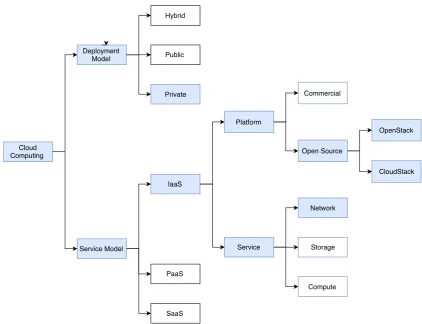
In this research we selected IaaS as the service model and private as the deployment model of
concern to investigate our research questions. The blue blocks in Figure 1.1 frames our research
focus on Network Services within the IaaS, investigated using two Open Source Cloud Platforms: OpenStack and CloudStack.
Cloud Computing
Deployment Model
Service Model
Hybrid
Public
Private
IaaS
PaaS
SaaS
Platform
Service
Commercial
Open Source
Network
Storage
Compute
OpenStack
[image:24.595.109.532.385.709.2]CloudStack
Figure 1.1: Thesis Research Path in Cloud Computing
isolated network information leakage be detected?. As the title indicates we aim to evaluate
Cloud Virtual Network Isolation (CVNI) Security (Data Leakage) via a Penetration Testing
Methodology. We used the Package Software model, as detailed in Chapter 2 Figure 2.1 , to
build the Testbed, however, we used the IaaS model to test Virtual Network Isolation (VNI)
security (Data Leakage).
1.2
Importance of the Field
Virtual Network (VN) solutions have enabled networking abstraction, yet the compromise
between isolation, performance and scalability is an endless battle[13]. VN is the best solution,
so far, for network isolated slices co-existence in "a shared network environment"[14].
Multi-tenancy is a vital requirement in cloud environments and therefore isolation between the
tenants is necessary and expected. Through isolation, tenant security should be implemented to a
different degree depending on the tenant demands via physical and logical isolation[15].
The evolution of Virtual Networks was a result of the demand of compute (processing)
virtualization, where the goal was to provide multi-tenancy to users sharing the same physical
environment[16]. Compute (Virtual Machine) isolation technology is far more than developed
VN isolation technology. The latter is still under development to be more scalable and
manageable. In spite of this, Moraes et al[17] and Riggio et al[18] stated that the success
of the tenant VN is due to the success of their VN isolation[17].
The need to introduce network virtualization is to isolate shared resources in a form of slices
that prevents against tenant resource interference [19]. Isolation is a must have condition in a
multi-tenancy network environment and is responsible for mapping between the physical and
logical structures[20].
Network virtualization applies a logical isolation between multi-tenant networks in shared
physical environments and allows independent address scheme configurations and traffic routing implementation in each tenant network[21].
The success of Virtual Networks is due to isolation. Developers need to use low level system
features such as Virtual Local Area Network (VLAN) or use complex hypervisors in the control
panel[22].
Cloud providers raised the level of cloud competencies after including networking provisioning
along with compute and storage provisioning. Tenants were now able to create their own
service.
Existing cloud facilities pose challenges including the compute and network isolation of their
tenants[23]. The rapidly changing and scalable computing and virtualization led to an inevitable
development and mixing of Software Defined Networking (Software Defined Network (SDN))
and Network Functions Virtualization (NFV) technologies to form modern network structures.
These are only feasible through Open Source Application Program Interface (API)s with network application services that are applicable to cloud infrastructures[24]. Several solutions, such as
CloudNaaS, CNG, CloNe, SAIL, DCPortals(Ng), NaaS, SilverLine, NVP have been proposed to
facilitate Cloud Networking for cloud tenants. These solutions are described in detail in Chapters
2 and 6 .
Many clients believe that vendors and providers will keep their network protected. Some clients
do not have the understanding to know if they are vulnerable or where the vulnerabilities lie.
Therefore, they are still likely to suffer from disruption, Data Leakage, DoS, etc [25]. A common security concern for clients is in regard to their Data Leakage or damage[26]. A case of SDN
Data Leakage is caused by security isolation failure of "logical networks and their credentials",
which end in VN deterioration[27]. Therefore, an important security aim is to prevent "Data
Leakage" between isolated modules via implementing isolation between "data and process" over
the abstraction layers of the cloud[28].
Doubts have been raised about cloud providers keeping the cloud security state under audit and
questions raised included, "Does the provider carry out penetration testing?", "How often?", "What is actually tested during the penetration test - for example, do they test the security
isolation of each image to ensure it is not possible to break out of one image into another and
also gain access to the host infrastructure?" and "Can the Virtual Machine (VM) gain access to
the cloud infrastructure?"[29]. Most clients will be worried about their personal data, but they
should also be concerned about client personal Data Leakage and their network operational data.
Although clients do not necessarily know about network operational data, it is essential for the
operation of the client network and, if exposed by unauthorized parties, will lead to attacks to
destroy the tenant system including the theft of personal information.
Privacy between tenants in the cloud is another motive to implement isolated networks. Concerns
of tenants sharing physical environments include unfair resource consumption, data leaking or
stealing, and the tenant side-channel attack[15]. Network security and network isolation are two
separate concerns but they are two aspects that are strongly related, which makes them crucial to
tenant protection[15].
service, applications and communications are isolated in the shared infrastructure [30]. Even
Google, a public cloud environment, is seeking a solution to lower the physical and operational
isolation costs and find better security mechanisms[23].
Virtualized environments do not work well with fixed security plans, introduced for traditional
networks, and therefore analysts should apply regular penetration tests to evaluate the current
security state of the infrastructure and defend it from newly introduced threats [31]. However, among the three cloud modules IaaS, PaaS and SaaS; only IaaS and PaaS permit a penetration
testing methodology. This is because SaaS providers do not allow tenants to run any penetration
testing tools on their cloud environment[32]. However, this thesis scope covers only IaaS Configuration.
The importance of penetration test security lies in performing it on a cloud to evaluate cloud
security and test the cloud processes and its implementation independently via an outsourced
security entity. The granting of a cloud system security certificate should be a standard [33].
1.3
The Research Gap
Although the obvious challenge of virtual networks is in isolation, researchers are concerned
with two main isolation aspects; performance isolation and security isolation [18]. The isolation
mechanisms in the compute process have reached a mature level, however with network
technologies, isolation remains a big challenge[34].
Accomplishing security in virtual networks is about configuring the solution to assure the primary
security aspects such as confidentiality, integrity and isolation performance, hence, improving the
underlying layer structure elements would prevent VN constriction [35]. However, VN isolation
failure, avoidance and restoration are research area gaps in VN isolation "are all open research
challenges" [36].
We therefore believe that our research is topical and urgently required to make a significant contribution to the above mentioned research topics of cloud security; Cloud Virtual Network Isolation (CVNI) and data leakage. We aim to investigate CVNI failure by leaking CVNI information and configuration details and determining what can be detected.
One fact needs to be clarified; VN multi-tenancy isolation, even if it is supported with methods
such as tunnelling and encapsulating, does not mean that enough security is achieved to
eliminate frequent attacks on the network infrastructure in order to gain control of it [37].
what are the preparations cloud providers and Cloud developers are required to do to enhance isolation from any attack that will expose the infrastructure and break VN isolation?
Carapinha et al.[38] listed several "Technical gaps and open issues" related to VN and isolation as:
Scalability, Interoperability of virtual networks, Interoperability with legacy networks, Isolation
of Resources and Security and Privacy. Security and privacy is our main research focus as protecting the VN administration and its governor operations is a necessity.
The reason for considering security as one of the VN challenges is due to the dynamic and
changing nature of VN. It is highly difficult to anticipate the best security mechanism. As VNs
co-exist in a shared environment, information privacy is a high priority concern as well as to
properly define isolation implementation to prevent risks by, and from, any VNs [38][38].
Carapinha et al.[38] also represented a table of "network virtualisation challenges vs. use cases",
where seven scenarios are listed against ten VN challenges. In the Cloud Computing scenarios,
four VN challenges received three stars meaning "Crucial challenge; will surely represent an
obstacle against deployment if an appropriate solution cannot be found". Those challenges are:
Carrier-grade reliability, Isolation, Security and Operational complexity. Continuously hosting
new VNs in the provider networks endlessly modifies the isolation and security requirements.
Part of the VN research gap is the "security and resource isolation" standardization, which makes the solution to "shared resource strict isolation", attack risk and misconfiguration migration
prevention more adaptable to any environment that is capable of implementing VNs [38].
Due to the obvious research gaps in VN isolation security and the limited published evidence in the field, this research aims to contribute by enriching the knowledge bank of the field and to perform empirical evidence to determine proposed potential solutions for VN security.
Scott-Hayward et al[27] noted that the research field of "Virtual Network Data Leakage" is novel
and topical. We do not claim that we produced a complete solution to the noted research gap, but we confidently declare that we have made the first empirical step in structuring a solution for Data Leakage and potential attacks in SDN. To be more precise, we extended the scope by replacing SDN with cloud networking of the IaaS platform, as cloud networking consists of SDN, NFV and other services and components. Moreover, we believe that our research is a relevant contribution to Data Modification, based on the theory of data leakage and identification to gain knowledge about how that data could be modified. Chapter 2 expands the details of the gap presented by Scott-Hayward et al [27].
Scott-Hayward et al also strongly encouraged security researchers to adopt two "Open Challenges:
challenges, SDN Data Leakage, which in our research we term Cloud Virtual Network Data leakage.
1.4
Contributions
Our testbed is a hybrid network infrastructure with KVM, Open vSwitch (OVS), bridging,
OVSDrive plugins and firewalls security, Virtual Extensible Local Area Network (VXLAN), VLAN, NFV (VM, namespace) for Dynamic Host Configuration Protocol (DHCP), routing and
Domain Name System (DNS) (see glossary for terms which are explained further in Chapter
2). The testbeds demonstrate multi-tenancy and service provisioning in Ubuntu OpenStack and
CloudStack environments with KVM as hypervisor and SDN/OpenFlow software technologies,
as well as, dynamic on-demand provisioning for computing and networking services.
In order to clarify the contribution of this research we will list the most relevant research and
illustrate where this thesis research differs from them.
1. IaaS security issue is, as Bouayad et al[39] described, the "VM boundaries" where the VM
as virtualized entities share the underlying resources with other VMs. If isolation is not
as demanded, co-existence is a major security issue.They investigate the Compute service while we consider network services. Hence, we can confidently state that securing the VN boundaries is an IaaS issue that needs investigated.
2. Srivastava[40] researched a Proof of Concept implementation of networking agents
config-ured by the OpenStack Networking module Neutron with SDN. The aim of their research was to investigate the performance of the networking functionality of an OpenStack cloud
in order to lower the TCP/IP stack load. The implementation of their cloud network was
based on Overlay L2 & L3 routing and included iptables and a Linux kernel with virtualized
networks using OVS and OpenFlow protocols as SDN technology. We share a similar approach to the overarching area and the implemented testbed; yet the aim of our research is different. We built similar testbeds to investigate the CVNI security for information leakage. Moreover, we expanded their cloud research approach by implementing another IaaS cloud, CloudStack, using the exact same methodologies to test our research question.
3. From the security perspective in OpenStack, the network isolation is appropriate if the VM reacts with an NMAP scan according to how the Security Group (SG) has been configured.
Anisetti et al [41] successfully tested the management between the SG and the iptable
rules implementation in OpenStack networks when a network security enquiry was run.
confidentiality.We furthered the experiment by using two IaaS Cloud Computing testbeds - OpenStack and CloudStack- with penetration tests including NMAP amongst other tools,
and analysing the collected data to to establish whether important data knowledge can be detected to cause CVNI breakage.
4. Aderholdt et al[24] used NMAP from one tenant area to another known tenant in order to
verify the "tenant isolation with respect to Compute and Storage". They tested the network
management externally by attacking common ports such as Telnet, HTTP, HTTPS, NMAP
and SSH as well as any API interfaces with potential vulnerabilities.We performed a similar testing approach, except that we adopted a full penetration test and aimed for verification of tenant isolation with respect to cloud networking.
5. Bechtsoudis and Sklavos[25] is one of the few papers that fully applies penetration testing
on a general network system as a research methodology, as is more popular in commercial,
business and industrial worlds. It presents rough penetration test phases and consists of
four stages: "planning, discovery, exploitation and reporting". Although the general scope is similar to ours, they aimed to "expose common traditional-network misconfiguration", their research did not focus on cloud virtualized networking, leaking VN information, Tenants VN multi-tenancy breakage or detecting the cloud virtual network isolation security vulnerabilities via pentesting as does this thesis.
6. Scott-Hayward et al[27] listed the research gap with regard to the security aspects of leaking
the SDN/OpenFlow (OpenStack rule) switches, data flow and forwarding rules. No empirical
research that we know of has been done in this area. Therefore, we had no research base
to build on. We took a basic, logical step of exposing the cloud network, as a whole, by penetration testing and aimed to determine what information can be leaked from the cloud network information. We did not reach our expectation of leaking lower level information such as OpenFlow rules, actions or controller messages. However, this clarified for us our approach limitation and gives more clarity about how to plan for deeper data leakage experiments. This is not presented in this thesis due to time limitations, but is stated in the future work section 7.3(Chapter 7).
7. Moreover, Scott-Hayward et al[27] encourages researchers to use "Cross-VM Side Channel
Attacks" to cause Data Leakage and target the OpenFlow virtual switches and their
8. The Ristenpart et al [42] presented attacks where the attacker installs a mischievous VM in
the same shared environment as the targeted tenants and launches attacks to gain knowledge
about the co-existence VMs. Our empirical security testing includes internal cloud testing similar to[42] except that we specifically installed a Kali VM as our mischievous VM to perform penetration testing against the co-existing cloud resources in order to discover the co-existing VN components and VN information leakage. Moreover, we supported our test with external penetration tests. We also repeated the whole process with another Cloud testbed, CloudStack. We collected some network information including the network distance as an example of how to measure the distance between victim tenants and the attacker tenant.
9. Mirantis OpenStack[43] is another academic research paper discussed a case where
penetration testing tools are used by attackers to search for a weak company account via
scanning the business network. The difference of this research from our research is that they
applied a security assessment to the OpenStack dashboard and provided recommendations
to enhance the dashboard security, i.e. through the user dashboard interface called Horizon.
However, we applied penetration tests on the Cloud Network Infrastructure to leak VN information and configuration.
10. Labarge and McGuire[44] also used penetration tests on the OpenStack Horizon dashboard to detect vulnerabilities. This research recommended that OpenStack Clouds require regular
penetration tests to clear up the weaknesses of the platform and proved the weakness of the
dashboard for gaining access to the tenants’ information. We have not encountered any other
research that targeted the cloud network and revealed their mis-design, misconfiguration
or vulnerabilities via penetration testing. However, our research was extended to verify the methodology by applying it on a similar cloud, namely CloudStack, and we compared the results between the two testbeds. We wished to determine if there was a pattern that indicates if issues occur in different platforms, which leads into a general design issue.
11. Wang et al. [45] declared little interesting research has been invested on virtual network security, hardly any in cloud networking security, and almost none on virtual network
information leakage of cloud computing.Therefore, the presented research in this thesis is a major step forward in empirical Cloud Virtual Network Isolation research.
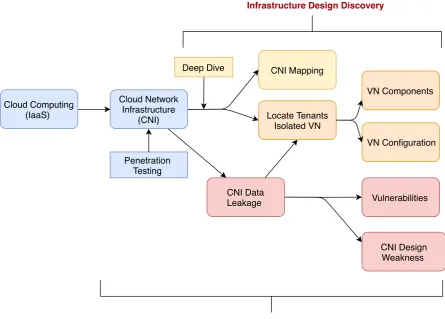
In general and as Figure 1.2 presents below, we summarize our research contribution as the
following:
• One of the few empirical works on penetration testing methodology for cloud network infrastructure (applied to both CloudStack and OpenStack) and a demonstration of cloud
network isolation vulnerabilities.
• Discovery of cloud network infrastructuremis-design/ misconfiguration, as is illustrated in Chapter 5 and 6.
These points are colour coded yellow, orange and red in Figure 1.2 to indicate different aspects of the thesis contribution. The yellow bocks represent the DeepDive method and Cloud Network
Infrastructure graphical representation. The orange blocks represent another DeepDive outcome
which we termed the Cloud Infrastructure Knowledge Guide, where VN Components and
configurations were identified as well as locating the tenant isolated VNs. Finally, the red blocks
show the Cloud infrastructure security tests, using Penetration Testing, in order to detect the
Cloud Network Infrastructure Data Leakage, Vulnerabilities and Design weakness.
Cloud Computing (IaaS)
Cloud Network Infrastructure
(CNI)
CNI Mapping
Locate Tenants Isolated VN
VN Components
VN Configuration
CNI Data
Leakage Vulnerabilities
CNI Design Weakness Deep Dive
Penetration Testing
Infrastructure Security Test
[image:32.595.75.521.358.677.2]Infrastructure Design Discovery
1.5
Research Hypothesis
We consider whether current penetration testing tools can detect Cloud Virtual Network Isolation
issues. Hence, our basic H1 Hypothesis is as follows:
H1:Using common penetration testing tools, an attacker can discover Data Leakage of Cloud tenant information due to poor Cloud Virtual Network Isolation and infrastructure design.
Therefore, the Null Hypothesis follows as:
H0: Null hypothesis: The security of the IaaS Cloud Virtual Network Isolationis robustagainst
Data Leakage caused by the current penetration tools.
1.6
Problem Statement
Figure 1.3:Thesis Aim and Objectives
Figure 1.3 summarises the thesis aim and objectives; however, detailed information is elaborated
Research Aim: evaluate or detect information leakage of cloud virtually isolated networks.
Objectives: given the lack of existing methods to reach to the research aim, the objectives of our
study were designed to address the following questions:
1. What cloud platforms could be a possible environment to apply the research question on?
2. What are the required resources to evaluate CVNI?
3. What is the best methodology to identify the construction of the cloud network infrastructure,
VN components and Isolation mechanism?
4. How can Data Leakage be detected or determined? And what are the characteristics of the
data leaked?
5. How can we improve the security of CVNI in the presence of Data Leakage?
To answer the questions that drive the objectives of this research we state the following:
1. Cloud platform environment:
• We used a private single server IaaS Cloud to investigate the occurrence of Virtual Network (VN) configuration and functionality information leakage.
2. Required resources:
• To build two IaaS cloud Testbeds (OpenStack and CloudStack) with advanced VN isolation provisioning services and compare their structures.
3. The bestmethodologyto identify the construction of the cloud network infrastructure, VN components and Isolation mechanisms
• DeepDive Methodology(our own version of White box Testing).
4. Data leakagedetection and characteristicsidentification:
• Collect leaked information from runningPenetration Tests (Internally and Externally) andanalyse information to determinethe components and configuration of the tenant VNs within the Cloud Network infrastructure of the two Testbeds.
5. Improve the security of CVNI:
1.7
Thesis Map
Cloud VN Info.
(2) Identify Vulnerabilities
Input Process OutcomesOutput/
Tenant1
Tenant2
TenantN
(1) Penetration Testing Tools: to test the Cloud VN vulnerabilities
for possible info. leakage
(3) Type of Data Leaked. (4) Suggest possible
prevention/Mitigation
Figure 1.4:Research Map
The research was mapped as shown in Figure 1.4 to show the flow of the empirical work to
answer our research questions and problems. We divided the research into several stages, which
included:
• To build the advanced VN Cloud Testbeds with multi-tenancy scenarios.
• To select one tenant to be a rogue tenant and use the initial information to perform
bi-directional pentesting attacks (External and Internal attacks).
• To enable the rogue tenant to launch currently available penetration tools, we used Kali Tool
kits, to test Cloud VN Vulnerabilities for possible information leakage.
• To identify the vulnerabilities, their relevance to VN and the impacts on identifying the
co-existing VN of the other tenants, or of breaking VN Isolation. At this stage we make our
decision to accept or reject the Null Hypothesis as stated above.
• To demonstrate leaked data and their characteristics as well as their source and the cause of
• And finally, based on the results above, we suggest possible prevention or mitigation
guidelines.
1.8
Thesis Structure
This thesis consists of six chapters and two appendices.
Chapter 2: The literature review and background is presented in this chapter.
Chapter 3: This chapter is reserved for illustrating the OpenStack Testbed construction and the
DeepDive methodology used on the OpenStack Cloud Testbed.
Chapter 4: Focuses on the CloudStack Cloud Testbed with the same DeepDive Methodology
used to map the Cloud Networking Infrastructure.
Chapter 5: Discusses the Penetration Testing applied to determine the Cloud Virtual Network
Data Leakage on both testbeds (OpenStack and CloudStack) and presents the results found.
Chapter 6: Discusses the results found in Chapter 5 for both testbeds and lists the vulnerability mitigation strategy and potential solutions.
Chapter 7: presents the thesis conclusion and potential future work.
1.9
Publications
Published Conference Proceedings
Al Nasseri , H M K & Duncan , I M M 2016 , ’ Investigation of Virtual Network Isolation
Security in Cloud computing : Data Leakage Issues ’ Paper presented at International Conference
2
C
HAPTER
T
WO
C
ONTEXT
S
URVEY
This chapter covers many areas including cloud computing, virtualisation, virtual networks,
network components, security testing and data leakage. It also notes the technologies currently
available and explains why decisions were made as to the experimental testbed and test
requirements. Subsequently, the chapter is long and detailed but grounds the experimental
evidence in current theory and practice. Indicators of decisions made for the research described
in this thesis are written initalics.
2.1
Cloud Computing
Cloud Computing was introduced in Chapter1 as comprising two models which are the
deployment model and the service model. One of the service models is Infrastructure as a Service (IaaS) which is the focus of this research. This section discusses more of the terminology
and outlines the complexity of a cloud system.
Argyropoulos et al[2] showed that the highest energy usage layer of the cloud stack was in the
Iaas and PaaS with 75% of a cloud’s energy consumption. As the cloud model, Figure 2.1[8],
is built on a hierarchical concept [4], enhancing the lower layer (IaaS) will enhance the upper
layers (PaaS and SaaS).Consequently, Although we constructed the Cloud Testbed using the Package Software - we managed everything-, the security research described in this thesis is focussed on the IaaS layer.
Clientsare tenants of a cloud and each tenant can host many users and many VMs. An individual
user could be a client hosting tenants or they could be a user of one or more VMs within a tenancy.
There are presumed isolation of storage, compute and networking services. Users are expected to
be isolated from each other and tenants should be isolated from each other, i.e. isolation through
physical or logical, virtual or non-virtual components is a basic security requirement.
Figure 2.1:Cloud Service Models [8]
Multi-tenancy in cloud service models is the construct of many tenants and many users
through policy-driven enforcement, segmentation, isolation, governance, service levels, and
chargeback/billing models for different consumer constituencies [32].
Network virtualizationis a networking environment that allows service providers to
dynami-cally compose multiple heterogeneous virtual networks that coexist together in isolation from
each other [36].
2.1.1
Infrastructure as a Service (IaaS)
The IaaS layer offers hardware, software and services as shown in Figure 2.1. This is represented
to the users as software applications [1] [8]. On-demand provisioning of infrastructure is sometimes calledHardware as a Service[8]. The significance of this service as a solution lies with its virtualization usability, which leads to cost reduction via resource utilization effectiveness
[1]. The users do not need to consider the infrastructure below as they launch and manage their
own VMs [4], which are configured with their choices of OS, software and applications [46].
User control starts from their own VMs but is never extended to the infrastructure underneath
[47]. Infrastructure resources such as storage, virtualization, hardware and network are only
2.1.2
IaaS Examples
IaaS by itself is divided into different categories either by their deployment, offering or source.
For example, a well known, publicly deployed IaaS with a para-virtualization offering is Amazon
EC2 (Elastic Cloud Computing), with a storage offering service is S3 (Simple Storage Service), with full virtualization (GoGrid, Skytap), or with grid computing (Sun Grid), or with management
(RightScale) [1][4].
Some other very well known IaaS examples are services delivered in forms of storage (e.g.,
GoogleFS), network (e.g., Openflow), or computational capability (e.g. Hadoop MapReduce)
[10].
Sefraoui et al’s comparison study [48]was done on Open Source cloud technologies. The
study was a comparative study of four open source cloud technologies: Eucalyptus, OpenStack,
OpenNebula and Cloudstack. The comparative study was focussed on the following parameters:
storage, network, security, hypervisor, scalable, installation, documentation and code openness.
Both CloudStack and OpenStack received the highest rating with only one point difference
between the two in the favour of OpenStack.This study had a major impact on our decision to select CloudStack and OpenStack to be our private cloud IaaS testbeds.
2.1.2.1 CloudStack
CloudStack is an open source IaaS cloud stack, established by cloud.com and later taken over
by the Apache Software Foundation. It supports multiple hypervisors such as VMware, Oracle
VM (OVM), KVM , Xen and XenServer. It is scripted mostly in Java and the code is licenced
under Apache2. It supports EC2, S3 and Vclouds API besides its own APIs [48]. Due to its
hierarchical structures CloudStack has the ability to manage physical resources, networks and
VMs. The CloudStack architecture is structured into Zones, Pods, Clusters and Hypervisors [49].
2.1.2.2 OpenStack
OpenStack has been a major focus for researchers in cloud computing and networking.
OpenStack is a computing and storage IaaS which uses Open Source software enabling
functionality, infrastructure, resource management and solution monitoring [50]. It was
established by Rackspace and NASA, then became the OpenStack Foundation [49]. Amazon
Compute and Storage provider infrastructure are alternative solutions, mostly developed in
python and licensed under Apache2. Due to its popularity, it has gained a good reputation in the field and is considered “a standard in effect” [8] . It supports a wide range of hypervisors
a hierarchical architecture and yet it has been designed to support very large infrastructures.
Its main architectural component consists of interconnected modules representing services and
they are Nova (compute), Glance (image service), Keystone (authentication and authorisation),
Neutron (network), Horizon (dashboard) and Swift (storage) [48].
OpenStack cloud networking uses a variety of networking functions and mechanisms such as
Overlay L2 routing & L3 routing (Network Address Translation, NAT), Linux kernel namespaces, Linux bridges and Open vSwitch (OVS) bridges. Most the L2 and L3 routing are processed
by namespaces, which are effectively the isolated containers of network devices. Although
the network functions run inside the namespaces, physically they are run by the physical
infrastructure IP/TCP stack and IPtables. This is viewed as load on the underlying cloud
structure as all the traffic generated by the VMs and directed to namespaces are processed while
sustaining the isolation on the host machine [40].
In OpenStack the integration of several network technologies and implementation gives the system the ability to react to customer demands. For example, the VLAN and Namespaces
provide tenant isolation, Security Groups are responsible for the VM security against illegal
access. VXLAN and GRE are L2-to-L3 tunnelling implementation to extend multi-tenancy
and isolation beyond the tenant local VN and the single host. All the above and the isolation
assurance are managed and monitored by a module calledNeutron. The path of communication from VMs to the Internet and back starts from the traffic generated by the VM in a compute. This
is sent to the L2 vSwitches with their designated VLAN. Leaving the compute to the network
node, the traffic goes across the L3 vRouter which is, in effect, a namespace, in order to route
the traffic via the gateway to the Internet. The process is reversed in the other direction [51].
2.2
Terminology Definitions
There are many terminologies in cloud computing, virtual networking, isolation and security and
therefore the following definitions are the most important for the research fields.
A sliceis a user-defined subset of virtual networking and computing resources. A slice has the basic property of being isolated from other slices defined over the same physical resources, and
is dynamically extensible across multiple domains. On top of each slice, a specific set of control
tools can be instantiated, depending on the specific domains it traverses [52].
AVirtual Local Area Network(VLAN) provides elevated levels of trust, security, and isolation
[36].
address space, independent Layer 1 resource view, independent policies, and complete isolation
[36]. A VPN is usually a solution for traffic isolation in a bigger network environment, but can
be used in VNs [53].
A VPNis defined [38] as a generic term that covers the use of public or private networks to create groups of users that are separated from other network users that may communicate among
them as if they were on a private network. There are two basic types of VPN including the Customer Edged (CE) based VPN, in which the shared service provider network does not have
any knowledge of the VPN. The VPN specific procedures are performed in the CE devices
and Provider Edge (PE) Based VPN, in which the service provider network is used to connect
customer sites using shared resources and the Provider Edge device (PE) maintains the VPN
state, isolating users of different VPNs.
Enhanced layer 2 switches, are referred to asForwarding Elements (FE). These are deployed only at certain aggregation points to provide the required virtualization functions. FEs are basically Ethernet switches with enhanced Application Programming Interfaces (API) that allow
them to be controlled [23].
In order to allow multiple external parties to run, possibly conflicting, code on the same network
elements, active and programmable networks also provide isolated environments to avoid
conflicts and network instability [36].
2.3
Cloud Networks
In addition to the cloud computing benefits of Iaas, PaaS and SaaS, an additional service of cloud
networking was added which provisioned network functionality to the cloud tenants (and users)
in a similar way to the compute and storage services. The new service delivers advantages such
as lowering the network delay and connection creation. However, it adds more challenges to the
security aspects [54].
AData Centre(DC) is a facility composed of networked machines for processing and storage.
main goal of the IaaS is to effect users accessing a DC’s physical resources over the Internet using
VMs. Adding virtual networks to the IaaS management system ensures efficacy for users and
cloud providers giving compute and storage services and supporting DCs with a static network
infrastructure that supports basic, preliminary network features [9]. Later, the cloud service was
revolutionized though interface standardization to include a network infrastructure able to cope
with the escalated demands of technology [55].
capabilities and requirements from the users rather than the cloud admin/provider roles [55].
Providing networking services to cloud users leverages multi-tenancies through virtualizations.
Moreover, it gives an on-demand, scalable service with less delays. There are also more benefits
to the cloud providers in terms of service performance assurance [9].
Virtualization is a main component of IaaS and includes a hypervisor, virtual switches and VMs.
These are often commonly called the Cloud Virtual Infrastructure (CVI) [46]. The focus of this research is this area; the virtualization that covers the networking service such as vSwitches.
2.3.1
SAIL and CloNE
A current service requirement of a cloud is on-demand available network resources and cloud
resource network management. Hence the need to create a system/module/service to address
networking in the cloud and orchestrate it within the cloud management system. This was the
main aim of the SAIL project when it was established [9].
Originally cloud services were introduced from a business perspective to rent resources as a
service such as renting storage or compute resources as service from IaaS through on-demand & pay-as-you-go lease. The SAIL project goal was to provide a similar facility for the network
service within the cloud and leverage such services by empowering the cloud network capabilities
to exceed the static basic cloud networking the DCs used to have and offer [55].
CloNe [56] was one of the early projects to add cloud networking provisioning and a facilitating
approach, similar to the compute and storage resource provisioning in the cloud, through a
web-based interface or API.
Before the SAIL project, cloud networking only satisfied the multi-tenancy requirement by
virtualizing the cloud infrastructure and introducing several virtual elements such asvRouters
andvLinks. This merely managed the virtual network in a similar fashion to managing a physical network, and users were not able to have their on-demand, dynamic network requirement fulfilled.
The SAIL project combined the capability of managing cloud computing and network facilities
between the cloud distributed resources along with cloud network utilization rather than just
focusing on improving only the cloud networking [57].
2.4
SDN
According to Kloti et al [58], Software Defined Networking(SDN) “has been proposed as a drastic shift in the networking paradigm, by decoupling network control from the data plane and
from the Open Networking Foundation [59] states "In the SDN architecture, the control and data
planes are decoupled, network intelligence and state are logically centralized, and the underlying
network infrastructure is abstracted from the applications. As a result, enterprises and carriers
gain unprecedented programmability, automation, and network control, enabling them to build
highly scalable, flexible networks that readily adapt to changing business needs".
Cloud computing increasingly attracted more customers which led to raised demands and services specifically for IaaS cloud providers. One of the main demands was for providing multi-tenant
networks with traffic isolation assurance. SDN was the proffered solution to make the new
demands feasible, as it does not demand specific hardware networking devices, but merely
requests the cloud physical servers to be configured with SDN vSwitches [60].
The key ideas of SDN functionality are [58]:
• The network logically splits into two planes; control and data.
• A programmable centralized controller, which is resident between the control and data planes
and uses standard defined interfaces and protocols to serve the communication.
• Controller protocols are created based on the abstraction concept to serve the distributed
system environment.
One of many advantages of SDN is promoting is tenancy and as clouds are based on multi-tenancy with tenant resources isolation, SDN is a good combination of functions to leverage the
efficiency of such systems. Tenant resources are connected via virtualized sliced networks (VN)
created by SDN, which is then capable of managing them [61].
2.4.1
OpenFlow
Ibrahim [46] stated that, “The OpenFlow architecture is a proposal from the Clean Slate initiative
to define an open protocol that sets up forward tables in switches. It is the basis of the Software
Defined Network (SDN) architecture, where the network can be modified by the user. This
proposal tries to use the most basic abstraction layer of the switch; it is the definition of forward
tables, in order to achieve better performance”.
OpenFlow [7] is now a standardized protocol [4]. It is used for the interaction between a network
switch, constituting the data plane, and a controller, constituting the control plane [58]. Switches
in the data plane execute the traffic communication based on L2 & L3 switching as determined
by the flow rules installed in the flow tables. Each switch is associated with a set of flow tables
headers with the flow rules and used an associated action section to determine how to forward
the traffic. The controller, which exists in the controller plane, installs the flow rules in the tables
either as pre-configured or as a response to the switch alert of unmatched traffic received.
OpenFlow is added as a feature to commercial Ethernet switches, routers and wireless access
points and provides a standardized hook to allow researchers to run experiments, without
requiring vendors to expose the internal workings of their network devices. OpenFlow is implemented by major vendors, with OpenFlow-enabled switches now commercially available
[62][24].
SDN allows network programmability via a software controller. Hence, proposing the OpenFlow
protocol along with OpenFlow switches and controllers and the communication strategy between
the switches and controller was a major step forward for SDN [45].
As noted earlier, flow rules are defined by the SDN controller via flow tables within the OpenFlow
switches. SDN executes those flow rules as a form of access control to traffic forwarding/handling
through the OpenFlow switches using defined rules based on the inbound and outbound trusted
domain traffic. Security can be enhanced by forwarding the traffic to a firewall that works with
the OpenFlow switch, where the traffic is analyzed and dropped or passed to the forwarding
rules. Note that the firewall does not distinguish between the data plane and the control traffic,
so the SDN controller must take responsibility in handling that traffic by itself [58]. Flow rule
configuration may be defined by policies set by the SDN administrator or a third party developer.
SDN/OVS switches isolate the traffic via VLAN tagging that is added into the packet Ethernet
header [63]. We are interested in the security aspect of SDN isolation components for this research because of the multitude of different technologies and methods used by users and providers.
2.4.2
Control plane and Data Plane
In traditional networking, the control plane and data plane traffic share the same path. In SDN, the
control and data are separated to facilitate an abstract network design. The control plane traffic
consists of L2 and L3 protocols, management traffic such as the Simple Network Management
2.4.3
Abstraction
The concept of network abstraction is primarily focused on supporting network policies and
controls rather than specific methods that can be used to deploy the controls through physical
hardware. In the context of SDN, it refers to connections, ports and data flow policies rather than the physical connection descriptions such as VLANs, IP addresses, and physical networking
devices. This network abstraction layer facilitates APIs that can be used to configure details
about the network [24].
2.4.4
Northbound and Southbound interfaces
Aderholdt et al [24] introduced the concept of North and Southbound- Figure2.2 [64] - traffic
which refers to the information exchanged between the decoupled control and data planes of the
SDN. Northbound specifically refers to information from the data plane to the control plane, and
Southbound refers to information from the control plane to the data plane.
Figure 2.2:SDN Architecture and its Fundamental Abstractions[64].
2.5
Network Function Virtualization (NFV)
The NFV initiative defined standard elementary building blocks to implement service chains
capable of adapting to the rapidly changing user requirements [46]. SDN is another important
thus providing a more flexible and programmatic control of network devices [7] [62]. In the
OpenStack User survey in 2016 [12] 95% of the cloud users showed interest in SDN and NFV
as evolving technologies to the cloud.
Networking virtualization in the cloud was necessary for multi-tenancy, flexibility, manageability,
performance and configuration. Yet it was not straightforward to plug in virtual networking
within a cloud. This required diverse protocol layer implementations; VLANs for local implementation, VPN for public connections, overlay networks and tunneling for distributed
cloud hosts, embedding NFV and SDNs in the cloud to provide the integration vision of the cloud
networking and satisfy the demands of the cloud users. Adapting multiple network technologies,
mechanisms and functionalities shifted the network architecture to a whole new level [51].
To distinguish between the two we can think of NFV as the upper layer of the network as it
represents the network services through virtualizing the services of load balancing, firewalls,
gateways etc. SDN is the lower layer of the network where it handles the network functions and processes through separating the forward plane from the control plane. This means slicing the
network into multiple flexible, programmable and manageable virtual network slices [51].
Argyropoulos et al [2] noted an SDN and NFV in clouds survey, in which VLAN technology was
placed first for traffic isolation used by NRENs (National Research and Education Networking
organisations), followed by bothVXLANandGREwith equal weight. Other mechanisms used were MAC address space separation, proxy ARP or MPLS. Some clouds used specific isolation
implementation and tools such as OpenStack Neutron, ML2, OVS, FlowVisor, Cisco Boxes and OpenNaaS/OpenVirteX above Floodlight.
A full virtualization technique may result in considerable overheads that will affect the
performance negatively. The use of hybrid-SDN (an SDN and NFV combination) not only
improves the performance because of its lower overheads but implements an instant security and
isolation for provisioned compute and storage resources via L2 and L3 configuration [24].
We did not use a hybrid approach because we wanted to focus on single virtual network building blocks before investigating more complex combinations of strategies.
2.6
Virtual Networks
Virtual Networks(VN) are defined as a “Networking environment that allow one or multiple
service providers to compose (in a dynamic or static way) multiple heterogeneous virtual
by effectively sharing and utilising underlying network resources leased from one or multiple
infrastructure providers” [38].
A VN is a separation of the control and data planes. A traditional network would have one
control and one data plane, however another approach is to virtualize the control plane only
where every virtual network has its own control plane but shares the data plane with other
networks (sharing-weak isolation). Several approaches are possible to build different levels of VN by virtualizing and slicing one or both planes. The control plane handles network control
applications such as routing protocols like ICMP. The data plane handles the forwarding tables
and the flow rules for traffic forwarding decisions. Another approach is to virtualize both planes
where each network has its own control and data plane (slicing – strong isolation) [65].
The benefits of using VNs are [9]:
• On-demand customized network launching, establishment and creation.
• User defined requirement network creation: bandwidth, delay threshold, security feature and
specific protocol supporting.
• Realtime connected network reconfiguration.
• Realtime connected virtual component migration
As an extension of introducing VNs within the cloud, beyond the above list, cloud service capabilities have been enhanced in two ways; the cloud services to user connectivity and the
geographically separated cloud service interconnections [9].
Parts of the user requirement flexibility given by cloud networks that users can define [9] are:
• The network and computing requirements.
• The networking assets and the way it is configured for cloud resource connectivity.
• Their infrastructure component location, and how to connect them or to them.
All of these should be easily accessible by users through one comprehensive interface that is
friendly and clear, complete with reporting. Other services were added for scaling, reconfiguring,
and reclaiming unused resources by the cloud management system without user interaction.
VN of different tenants, possibly rival businesses, concurrent on a shared infrastructure should be
prevented unless the isolation mechanism is assured and tenant data is not redirected to another
![Figure 2.4: The penetration testing life-cycle[126].](https://thumb-us.123doks.com/thumbv2/123dok_us/8676762.377714/82.595.139.512.354.620/figure-the-penetration-testing-life-cycle.webp)