Survey and Analysis of Current Methods of Image
Encryption Algorithm based on DNA Sequencing
1
Priyanka,
2Deepika Arora
1,2Dept. of Computer Science and Engineering , RPIIT, Bastara Karnal, Karnal, Haryana, India
Abstract
The normal software system reliability estimation ways typically believe assumptions like statistical distributions that are typically unrealistic. The power to predict the amount of faults throughout development part and a correct testing method helps in specifying timely unharnessed of software system and economical management of project resources. The normal approach of fault prediction using software system reliability growth models needs an outsized variety of failures which could not be on the market at the start of the testing. models when compared for results, revealed that the Goel-Okumoto model performed better than Yamada Delayed S-Shaped model for estimation of failures for given data.
Keywords
Survey and Analysis, Image Encryption Algorithm, DNA Sequencing
A, Introduction
Many virtual offerings require dependable protection in storage and transmission of virtual photos. Due to the fast increase of the net within the virtual world nowadays, the safety of virtual images has end up greater crucial and attracted much attention. The incidence of multimedia generation in our society has promoted digital pix to play a more extensive position than the conventional texts, which demand serious protection of customers’ privateness for all applications.
Digital photos are exchanged over numerous types of networks. It is often true that a big a part of this record is either exclusive or personal. Encryption is the favored technique for defensive the transmitted data. There are numerous encryption structures to encrypt and decrypt picture record; however, it may be argued
that there is no unmarried encryption set of rules which satisfies
the one of a kind photo kind.
Unlike textual content messages, picture information have special functions together with bulk capacity, high redundancy, and high correlation among pixels, no longer to say that they normally are big in length, which collectively make conventional encryption
[1] methods difficult to use and sluggish to technique. Sometimes
picture applications additionally have their very own necessities like real-time processing, constancy reservation, photo format consistence, and information compression for transmission.
Simultaneous fulfillments of those requirements, together with excessive safety and excessive first-class demands, have offered
exceptional challenges to actual-time imaging practice.
To control multi-dimensional signals with system that range from easy virtual circuits to advanced parallel computers, has been made viable by using modern digital generation. The purpose of
this manipulation may be classified in to three
classes:-Image Processing image in image out
Image Analysis image in measurements out Image Understanding image in high-level description
out
Here, the fundamental concepts of photograph processing might be main recognition folks, because space does not permit us to make various introductory comments about picture analysis.
Fundamentally, a specific approach is required to recognize.
Besides this our examine might be restrained to the 2 dimensional (2D) image processing although most of the concepts which might be to be discussed may be extended to a few or more dimensions easily.
A photograph can be defined in unique manners. In the real world
an picture is considered to be a characteristic of real variables for example, a (x, y) with a as the amplitude i.e. Brightness of the photograph at the actual coordinates positions (x, y). A photo may be taken into consideration to carry sub-photos, which also can be referred to as areas-of-hobby, ROIs or areas. The fact that picture often include collections of objects every of which may be the basis for a place is contemplated with the aid of this concept. It is viable to use precise photo processing operations to selected place in a sophisticated photograph processing device. Thus one a part of an photograph (place) should be processed to suppress movement blur at the same time as any other component have to be processed to enhance colour rendition [2].
The amplitude of picture may be constantly being either real numbers or integer numbers. Integer wide variety is generally an end result of quantization manner that converts a continuous range (between 0 and one hundred %) to a discrete range of ranges. However, in sure photograph forming techniques, the sign may also involve photon counting which means that the amplitude would be inherently quantized. In different photo forming strategies, consisting of magnetic resonance imaging, a complex number in form of a actual value and a actual segment is yielded with the aid of the direct physical dimension.
II. Literature Survey
[17] Yicong Zhou et al, in “Image encryption the usage of
binary key-snap shots” 2009, the author(s) described a brand new
concept for photo encryption using a binary ÃÂ key-picture ÃÂ. The key-photograph is either a bit plane or a part map generated from any other image, which has the same size as the original image to be encrypted. In addition, they introduce two new lossless photo encryption algorithms using this key-picture technique. The performance of these algorithms is mentioned towards common assaults which include the brute pressure assault, cipher text assaults and plaintext assaults. The analysis and experimental outcomes show that the proposed algorithms can fully encrypt all varieties of images. This makes them suitable for securing multimedia applications and suggests they have the ability to be used to at ease communications in a diffusion of stressed/Wi-Fi scenarios and real-time utility such as cellular Smartphone offerings.
[18] Yicong Zhou et al, in “(n, k, p)-Gray code for picture
systems” 2013, the author(s) described a brand new parametric
ternary, and (n, ok)-Gray codes. The new (n, ok, p)-Gray code has potential programs in virtual communications and signal/ photograph processing structures. This paper makes a specialty of
three illustrative programs of the (n, ok, p)-Gray code, specifically,
photograph bit-plane decomposition, picture de-noising, and encryption. The pc simulations show that the (n, okay, p)-Gray code shows higher overall performance than different conventional Gray codes for these programs in picture systems.
[19] Ya-Lin Lee et al, in “A New Secure Image Transmission Technique thru Secret-Fragment-Visible Mosaic Images by
using Nearly Reversible Color Transformations” 2014, the
author(s) described a new cozy photograph transmission approach is proposed, which transforms routinely a given big-quantity mystery photograph right into a so-referred to as secret-fragment-visible mosaic image of the same size. The mosaic image, which appears just like an arbitrarily selected target photograph and can be used
as a camouflage of the name of the game photograph, is yielded by
using dividing the secret photograph into fragments and reworking their color characteristics to be those of the corresponding blocks of the goal photo. Skillful techniques are designed to conduct the color transformation system so that the name of the game picture can be recovered nearly lossless. A scheme of coping with the
overflows/underflows in the converted pixels’ shade values by
recording the color differences in the untransformed shade space is likewise proposed. The facts required for recovering the secret image is embedded into the created mosaic picture by way of a lossless information hiding scheme the usage of a key. Good experimental consequences display the feasibility of the proposed technique.
[20] Jinping Fan et al, in “Color Image Encryption and Decryption Based on Double Random Phase Encoding
Technique” 2009, the author(s) described a new method of color
photo encryption primarily based on double random segment encoding method is proposed. The coloration photograph to be
encrypted is first separated into 3 shade channels: crimson (R),
green (G) and blue (B). Each of these channels is encrypted using
double random section encoding technique after which 3 new
coding photo matrixes are constructed. They choose a large enough absolute symmetric picture as host image which additionally been segregated into tricolor channels to hide the real and imaginary elements of the encoding information and speak the technique a way to assemble the entire symmetrical host photograph. In the receipted side simple extracted and decryption operations can be hired to attain the reconstructed picture that is similar to the original image. Computer simulations had been performed in MATLAB and the end result indicates that the method is powerful for coloration photograph encryption and decryption.
[21] Wenjun Lu et al, in “Confidentiality-Preserving Image
Search: A Comparative Study Between Homomorphic Encryption and Distance-Preserving Randomization” 2014,
the author(s) described recent years have visible increasing reputation of storing and handling non-public multimedia data
the use of online services. Preserving confidentiality of on line non-public statistics even as presenting efficient functionalities
as a result turns into a crucial and pressing research problem. In this paper, they look at the trouble of content-primarily based search of photo information archived on-line at the same time
as maintaining content material confidentiality. The problem has
extraordinary settings from the ones typically considered in the
secure computation literature, because it deals with records in
rank-ordered seek, and has a specific protection-efficiency requirement.
Secure computation techniques, which include homomorphic encryption, can potentially be used on this application, at a cost of excessive computational and verbal exchange complexity.
Alternatively, efficient strategies based totally on randomizing
visible characteristic and seek indexes had been proposed lately to enable similarity comparison between encrypted pix. This paper makes a specialty of evaluating those essential paradigms
of strategies, specifically, homomorphic encryption-primarily
based techniques and feature/index randomization-primarily based
techniques, for confidentiality-preserving image search. They
develop novel and systematic metrics to quantitatively evaluate security power in this precise form of records and programs. They compare these paradigms of techniques in phrases in their search overall performance, safety electricity, and computational performance. The insights received thru this paper and contrast will help design sensible algorithms suitable for privateness-conscious cloud multimedia structures.
[22] Yong Feng et al, in “A novel symmetric photo encryption method based on an invertible two-dimensional map” 2009 [22],
the author(s) described a brand new invertible two-dimensional map, called Line map, for picture encryption and decryption. It maps a picture to an array of pixels after which, maps it returned from the array to a same sized photograph. A Line map consists of
sub maps: the left Line map and the right Line map, which might
be used for photo encryption and decryption. In order to overcome the lack of traditional photograph encryption procedures based on dimensional (2-D) maps which may be used best for permutation, this paper presents a novel photo encryption technique primarily based on the Line maps, that could perform methods of photograph encryption concurrently, permutation and substitution, the use of the same maps. The proposed picture encryption does now not have facts loss. Other blessings include that its miles fast and there’s no restriction at the duration of security key that is perfect
for specific security requirements. Simulation outcomes display
the effectiveness of the brand new picture encryption scheme.
[23] Xiaoqiang Zhang et al, in “Image similarity evaluation
on MIE encryption set of rules” 2010, the author(s) described
secure transmission of exclusive virtual photographs has come to be a common interest in each studies and programs. As proven in their preceding studies, Mixed Image Element (MIE) encryption set of rules is a brand new and promising photograph encryption algorithm, however, its protection is suffering from
the unreasonable desire of camouflaged images. To analyze this aspect, the definitions of photo crucial similarity, photograph partial
similarity and MIE class assault, in addition to their mathematic
models are proposed in this paper. They examine the influence
[24] Sankpal, P.R. Et al, in “Image Encryption Using Chaotic
Maps: A Survey” 2014, the author(s) described as the exchange of
information over the open networks and Internet is unexpectedly
developing, security of the data will become a main difficulty.
One viable method to this trouble is to encrypt the records. The statistics can be textual content, photograph, audio, video and many others. In cutting-edge global maximum of the multimedia applications involve pix. Earlier photo encryption techniques like AES, DES, RSA and so forth. Show off low levels of safety and also weak anti assault capacity. This hassle turned into triumph over by using chaos based cryptography. The chaotic structures are very sensitive to preliminary situations and control parameters which lead them to appropriate for photo encryption. Many works were completed in the area of chaos based image encryption. In this survey paper try has been made to review the factors and tactics of the design used for image encryption.
A. MATLAB:
MATLAB is a high-performance language for technical computing. It integrates computation, visualization, and programming in an easy-to-use environment where problems and solutions are expressed in familiar mathematical notation.
Typical uses include Math and computation
•
Algorithm developmentS
•
Data acquisition
•
Modeling, simulation, and prototyping
•
Data analysis, exploration, and visualization
•
Scientific and engineering graphics •
Application development, including graphical user interface
•
building.
MATLAB is an interactive machine whose basic statistics detail is an array that doesn’t require dimensioning. This lets in us to resolve many technical computing troubles, in particular people with matrix and vector formulations, in a fraction of the time it might take to put in writing software in a scalar non-interactive language which include C or FORTRAN.
The name MATLAB stands for matrix laboratory. MATLAB become originally written to offer smooth get entry to matrix software program evolved by the LINPACK and EISPACK tasks. Today, MATLAB engines include the LAPACK and BLAS libraries, embedding the state of the artwork in software program for matrix computation.
MATLAB features a family of add-on software-specific solutions
known as toolboxes. Very crucial to most customers of MATLAB, toolboxes allow us to examine and follow specialized technology.
Toolboxes are complete collections of MATLAB features (M-files)
that amplify the MATLAB surroundings to resolve precise lessons of troubles. Areas wherein toolboxes are available include sign processing, manage systems, neural networks, fuzzy good judgment, wavelets, simulation, and plenty of others.
1. The MATLAB System
The MATLAB system consists of five main parts:
(i). Development Environment
This is the set of gear and centers that assist we use MATLAB
capabilities and files. Many of those tools are graphical person
interfaces. It consists of the MATLAB computing device and Command Window, a command records, an editor and debugger, and browsers for viewing help, the workspace, documents, and
the quest path.
(ii). The MATLAB Mathematical Function Library
This is a widespread series of computational algorithms ranging from fundamental functions, like sum, sine, cosine, and complicated arithmetic, to extra sophisticated capabilities like matrix inverse, matrix Eigen values, Bessel features, and speedy Fourier transforms.
(iii). The MATLAB Language
This is a excessive-stage matrix/array language with manipulate
flow statements, functions, information systems, input/output,
and item-orientated programming functions. It lets in both “programming inside the small” to swiftly create short and dirty throw-away programs, and “programming in the large” to create large and complex utility applications.
(iv). Graphics
MATLAB has massive centers for showing vectors and matrices as graphs, as well as annotating and printing these graphs. It includes excessive-stage capabilities for two-dimensional and three-dimensional information visualization, picture processing, animation, and presentation snap shots. It also consists of low-stage functions that permit we to fully personalize the arrival of portraits as well as to construct complete graphical person interfaces on MATLAB programs.
(v). The MATLAB Application Program Interface (API)
This is a library that allows we to write C and Fortran packages that engage with MATLAB. It includes centers for calling routines from MATLAB (dynamic linking), calling MATLAB as a computational engine, and for studying and writing MAT-documents.
2. Creating an M-File
M-files are created using a text editor. MATLAB provides a built-in
editor, but we can use any text editor like. Once we have written
and saved the M-file, we can run the program as we would any
other MATLAB function or command.
The process looks like this:
1. Create an m-file using a text editor
2. Call m-file from the command line or within the another m-file
3. Working with M-Files
MATLAB affords a full programming language that allows we to write down a series of MATLAB statements right into a document after which execute them with a single command. We write our
application in a normal textual content document, giving the file a call of filename .m. The term we use for filename becomes
the brand new command that MATLAB associates with the program. The document extension of .M makes this a MATLAB M-report.
4. Types of M-Files
M-files can be scripts that simply execute a series of MATLAB
statements, or they can be functions that also accept input arguments and produce output.
Function c=myfile(a,b) C=sqrt((a.^2)+(b.^2))
A= 7.5
B=3.342
(i). MATLAB scripts
Are useful for automating a series of steps we need to perform many times. Do not accept input arguments or return output arguments. Store variables in a workspace that is shared with other scripts and with the MATLAB command line interface.
(ii). MATLAB functions
Are useful for extending the MATLAB language for our application. Can accept input arguments and return output arguments. Store variables in a workspace internal to the function.
5. Basic Parts of an M-File
This simple function suggests the primary parts of an M-record.
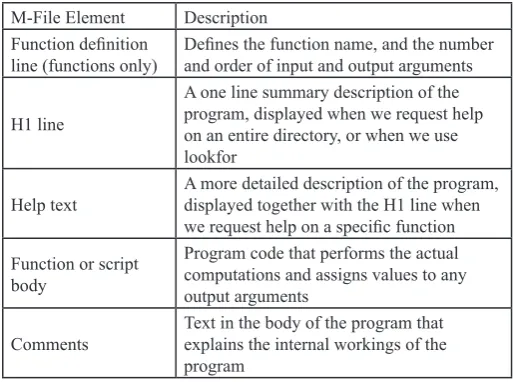
Note that any line that starts with % isn’t always executable: The desk underneath in short describes each of those M-file
elements. Both features and scripts can have all of those
components, except for the function definition line which applies to functions handiest. These parts are defined in more element
following the table.
Table 1: Basic Parts of M-File
M-File Element Description Function definition
line (functions only) Defines the function name, and the number and order of input and output arguments
H1 line
A one line summary description of the program, displayed when we request help on an entire directory, or when we use lookfor
Help text A more detailed description of the program, displayed together with the H1 line when we request help on a specific function Function or script
body
Program code that performs the actual computations and assigns values to any output arguments
Comments Text in the body of the program that explains the internal workings of the program
6. Saving M-Files:
Save any M-files we create and any Math Works provided M-files
that we edit in directories outdoor of the directory tree wherein the MATLAB software is established. If we hold our documents in any of the set up directories, our documents can be overwritten whilst we install a new edition of. MATLAB installs its software into directories beneath matlabroot/toolbox. To see what s matlabroot is on our device, type MATLAB root at the MATLAB command activates.
Also be aware that locations of files within the Matlabroot/toolbox
listing tree are loaded and cached in reminiscence at the beginning of every MATLAB consultation to enhance overall performance. If we store documents to Matlabroot/toolbox directories the use
of an outside editor, or if we add or dispose of files from these directories the use of file machine operations, enter the commands
clear function name and rehash toolbox earlier than we use the documents within the modern session.
B. Program Development:
This section covers the following topics:
Planning the Program
•
Using Pseudo-Code
•
Selecting the Right Data Structures
•
General Coding Practices
•
Naming a Function Uniquely
•
The Importance of Comments
•
Coding in Steps
•
Making Modifications in Steps •
Functions with One Calling Function
•
Testing the Final Program
•
1. Planning the Program
When planning a way to write a application, take the hassle we are looking to resolve and smash it down into a sequence of smaller, impartial duties. Implement each venture as a separate characteristic. Try to preserve features pretty brief, each having a single reason.
2. Using Pseudo-Code
We may also find it useful to put in writing the initial draft of
our application in a dependent format the use of our own herbal language. This pseudo-code is frequently less complicated to assume via, overview, and regulate than the use of a proper programming language, yet it’s far without problems translated into a programming language inside the next stage of development.
3. Selecting the Right Data Structures
Look at what facts types and facts structures are to be had to us in MATLAB and decide which of those pleasant match our wishes in storing and passing our facts.
4. General Coding Practices
A few suggested programming practices:
Use descriptive characteristic and variable names to make
•
our code simpler to apprehend.
Order sub features alphabetically in an M-file to make them •
simpler to locate.
Precede every sub characteristic with a block of help textual content describing what that sub feature does. This no longer only explains the sub capabilities, but additionally facilitates to visually separate them.
Don’t make bigger strains of code beyond the 80th column.
•
Otherwise, it will be hard to study while we print it out. Use full Handle Graphics® assets and price names.
•
Abbreviated names are often allowed, however can make our code unreadable. They also could be incompatible in destiny releases of MATLAB.
5. Naming a Function Uniquely
To avoid choosing a name for a new function that might conflict
with a name already in use, check for any occurrences of the name
using this command: which -all functionname
6. The Importance of Comments
Be sure to document our programs well to make it easier for we or someone else to maintain them. Add comments generously, explaining each major section and any smaller segments of code that are not obvious. We can add a block of comments as shown here.
7. Coding in Steps
Don’t try to write the entire program all at once. Write a portion of it, and then test that piece out. When we have that part working the way we want, then write the next piece, and so on. It’s much
easier to find programming errors in a small piece of code than
8. Making Modifications in Steps
When making modifications to a working program, don’t make
widespread changes all at one time. It’s better to make a few small changes, test and debug, make a few more changes, and so
on. Tracking down a difficult bug in the small section that we’ve changed is much easier than trying to find it in a huge block of
new code.
9. Functions with One Calling Function
If we have a function that is called by only one other function,
put it in the same M-file as the calling function, making it a
sub-function.
10. Testing the Final Program
One advised exercise for trying out a brand new application is to step through the program inside the MATLAB debugger even as preserving a report of every line that gets performed on a broadcast reproduction of the program. Use unique combos of inputs till we’ve got located that each line of code is completed at least as soon as.
C. M-File Functions
Functions are application workouts, usually applied in M-documents, that receive enter arguments and return output arguments. They perform on variables inside their own workspace. This workspace is cut loose the workspace we access on the
MATLAB command activates. The fields of the go back shape
are indexed within the following desk.
Table 2: M-File Functions
Field Name Field Description Function Function name
Type Function type (e.g., simple, overloaded)
File The file to be executed when the function handle is evaluated with a non overloaded data type
D. Image Information
1. imageinfo-Create Image Information tool
Syntax
imageinfo imageinfo(h)
imageinfo(filename)
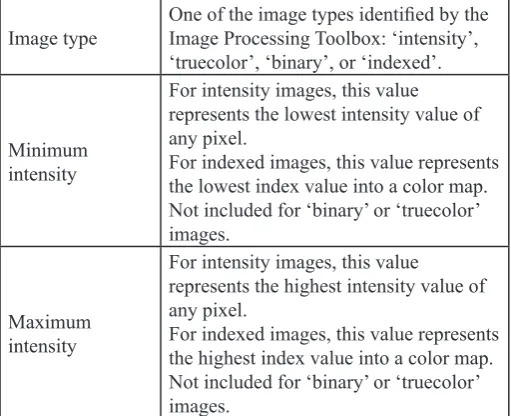
The following table lists the basic image information included in the Image Information tool display. Note that the tool contains
either four or six fields, depending on the type of image.
Table 3: Image Information
Attribute Name Value
Width (columns) Number of columns in the image Height (rows) Number of rows in the image
Class
Data type used by the image, such as uint8.
Note: For single or int16 images,
imageinfo returns a class value of double, because image objects convert CData of these classes to double.
Image type One of the image types identified by the Image Processing Toolbox: ‘intensity’, ‘truecolor’, ‘binary’, or ‘indexed’.
Minimum intensity
For intensity images, this value represents the lowest intensity value of any pixel.
For indexed images, this value represents the lowest index value into a color map.
Not included for ‘binary’ or ‘truecolor’
images.
Maximum intensity
For intensity images, this value represents the highest intensity value of any pixel.
For indexed images, this value represents the highest index value into a color map.
Not included for ‘binary’ or ‘truecolor’
images.
Imageinfo creates an Image Information tool associated with the picture in the cutting-edge Fig. The device shows in a separateFig statistics about the fundamental attributes of the target photo. Imageinfo gets the photo attributes through querying the photograph object’s CData.
Imageinfo(information) creates an Image Information device containing the photo metadata i-n the shape info. Data is a shape
lower back by means of the features imfinfo or dicominfo, or info
may be a person-created structure. Example
imageinfo(‘peppers.png’) h = imshow(‘bag.png’);
2. Image Types
The capabilities that use interpolation take an argument that
specifies the interpolation approach. For maximum of these
capabilities, the default technique is nearest-neighbor interpolation. This method produces acceptable outcomes for all photo kinds, and is the handiest method this is suitable for indexed photos. For depth and RGB images, however, we should generally specify bilinear or bicubic interpolation, because these strategies produce higher effects than nearest-neighbor interpolation.
For RGB photos, interpolation is completed on the purple, green, and blue picture planes in my view.
For binary photographs, interpolation has effects that we should be privy to. If we use bilinear or bicubic interpolation, the computed values for the pixels in the output image will now not all is 0 or 1. The impact on the ensuing output image relies upon at the class
of the input picture:
If the class of the enter photograph is double, the output
•
picture is a grayscale image of sophistication double. The output image is not binary, as it includes values apart from zero and 1.
If the class of the input image is uint8, the output image is
•
a binary photo of class uint8. The interpolated pixel values are rounded off to zero and 1 so the output image can be of class uint8.
If we use nearest-neighbor interpolation, the result is constantly
•
binary, due to the fact the values of the interpolated pixels are taken directly from pixels within the enter image.
3. Reading Images
Read image from graphics file
A = imread(filename,fmt) [X,map] = imread(filename,fmt)
Some of the formats of images we use in MATLAB are: 1. ‘bmp ‘Windows Bitmap (BMP)- 1-bit, 4-bit, 8-bit, 16-bit, 24-bit, and 32-bit uncompressed images and 4-bit and 8-bit run-length
encoded (RLE) images
2. ‘gif’ -Graphics Interchange Format (GIF)1-bit to 8-bit
images
3. ‘jpg’ or ‘jpeg’Joint Photographic Experts Group (JPEG)-Any baseline JPEG image or JPEG image with some commonly used
extensions.
E. Observations
We have used two images in our project for comparison of image encryption schemes on the three parameters- Encryption Quality,
Correlation Coefficient, Entropy. Images used
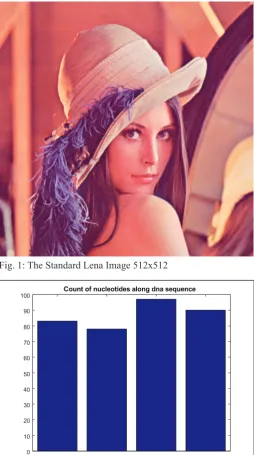
are-Fig. 1: The Standard Lena Image 512x512
A C G T
0 10 20 30 40 50 60 70 80 90
100 Count of nucleotides along dna sequence
Fig. 2: Frequency Distribution of DNA Nucleotides
0 50 100 150 200 250 300 350 0
0.2 0.4
0.6 Nucleotide density
A C G T
0 50 100 150 200 250 300 350 0
0.5
1 density of nucleotides along sequence A-T C-G
Fig. 3: Nucleotides Density of DNA Generated Sequence
0 50 100 150 200 20
40 60 80 100 120 140 160 180 200
220Correlation Between Original Image Pixels
0 50 100 150 200 250 20
40 60 80 100 120 140 160 180
Correlation Betwwen Pixels of Encrypted Image
Fig. 4: Correlation Between Pixels of Encrypted Image and
Original Image
0 500 1000 1500 2000 2500 3000
Histogram of Original Image
0 50 100 150 200 250
0 2000 4000 6000 8000 10000 12000
Histogram of Encrypted Image
0 50 100 150 200 250
Fig. 5: Histogram Analysis of Proposed Work
Fig. 6: Encrypted Image Alongside the Decrypted Image using
Table 4: Comparative Analysis of Entropy of Proposed work with
Existing System
Image Existing System Proposed Work
Lena 7.2933 7.99954391
Vegetables 7.7971 7.99954396
Baboon 7.7007 7.99954372
Fig 7: Comparative Analysis of Entropy of Proposed work with
basepaper
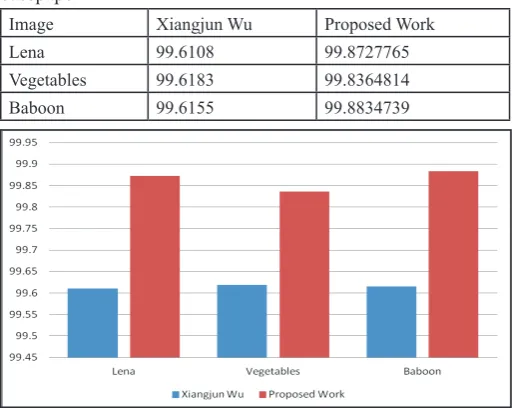
Table 5: Comparative Analysis of NPCR of Proposed work with
basepaper
Image Xiangjun Wu Proposed Work
Lena 99.6108 99.8727765
Vegetables 99.6183 99.8364814
Baboon 99.6155 99.8834739
Fig. 8: Comparative Analysis of NPCR of Proposed Work with
Basepaper
Table 6: Comparative Analysis of UACI of Proposed work with
basepaper
Image Xiangjun Wu Proposed Work
Lena 33.4525 33.69722
Vegetables 33.4971 42.61083
Baboon 33.4696 33.37505
Fig. 9: Comparative Analysis of UACI of Proposed work with
basepaper
Table 7: PSNR Original vs Encrypted comparison with Base Paper
(lower is better)
Image Xiangjun Wu Proposed Work
Lena 8.1349 5.2889747
Vegetables 8.0132 5.31434
Baboon 8.7853 7.81684
Fig. 10: PSNR Original vs Encrypted comparison with Base Paper
(lower is better)
VI. Conclusion
The Counseled DNA based Image Encryption algorithm has proven to be one of the most interesting key allocation schemes in use today. Though, one have to be cognizant of the fact that even though the algorithm is harmless opposing passive eavesdropping and supplementary aggressions, it is protected from alert attacks. Disadvantage of employing existing established image Encryption cryptography for encryption is speed. There are countless secret-key encryption methods that are considerably faster than each presently obtainable existing picture Encryption method. Nevertheless, existing picture cryptography can be utilized alongside secret-key cryptography to become the best of both worlds. For encryption, the best resolution is to join public- and secret-key arrangements in order to become both the protection gains of existing picture arrangements and the speed gains of secret-key systems. Existing picture cryptography could
be vulnerable to impersonation, even if users’ confidential keys are not available. A prosperous attack on a certification power will
permit an antagonist to impersonate whomever he or she chooses
by employing an existing picture certificate from the compromised
power to attach a key of the adversary’s choice to the term of one more user. In this work we counsel a novel low-complexity symmetric cryptographic algorithm. It is industrialized established on the block encryption structure. The Proposed DNA encryption portion can be requested by employing a easy design that merely consists of frank mathematical procedures (AND, OR, XOR, XNOR, advancing, swapping). The Algorithm outperformed all the picture encryption algorithms encompassing existing. Even the period intricacy of the algorithm is enhanced considerably,
the algorithm is in finished 2-3x faster than existing established
Picture Encryption. We evaluated the DNA based Encryption mechanism for Correlation, Entropy and various other metrics and the proposed method works better for all.
VII. Future Perspective
Nevertheless hypothetically it is probable to find the public
hidden from the obtainable area data, it will seize exponentially longer period making it usefully impossible. It is the belief in age-old mathematics, that discovering a facile method for reverse procedure of one-way purpose is unlikely, keeps the area key cryptography going. In upcoming we will work on multimedia
Encryption such as AVI, MPEG and H.264 established videos,
there additionally exists a potential of working on block astute video encryption whereas a little portions are area and a little are private. We can endeavor to apply the counseled algorithm for the same.
References
[1] Stallings, William. Cryptography and network security: principles and practices. Pearson Education India, 2006.
[2] Gonzalez, Rafael C., and Richard E. Woods. “Image processing.” Digital image processing 2 (2007).
[3] Young, Ian T., Jan J. Gerbrands, and Lucas J. Van Vliet. Fundamentals of image processing. Delft: Delft University
of Technology, 1998.
[4] Lakshmi, Ms J. Venkata, and Mrs G. Neelima. “Network
Security with Cryptography.”
[5] Devi, Ms Usha, Ms Preeti, and Ms Nisha Rani. “Network Security using Cryptography.” (2017).
[6] Delfs, Hans, and Helmut Knebl. “Symmetric-key encryption.”
Introduction to Cryptography. Springer, Berlin, Heidelberg,
2007. 11-31.
[7] Standard, Data Encryption. “Data encryption standard.” Federal Information Processing Standards Publication (1999).
[8] Heron, Simon. “Advanced encryption standard (AES).”
Network Security 2009.12 (2009): 8-12.
[9] Qi, Dongxu, Wei Ding, and Huashan Li. “Tangram algorithm:
Image transformation for storing and transmitting visual secrets.” Proc. Of the 5th International Conference on Computer-Aided Design & Computer Graphics, International Academic Publishers. Vol. 1. 1997.
[10] Balazs, Nandor L., and André Voros. “The quantized baker’s
transformation.” Annals of Physics 190.1 (1989): 1-31.
[11] Stanek, Wolfram, and Maralo Sinaga. “Magic Mathematics
Based on New Matrix Transformations (2D and 3D) for
Interdisciplinary Physics, Mathematics, Engineering and Energy Management.” Products and Services; from R&D to Final Solutions. InTech, 2010.
[12] Wang, Fangchao, et al. “An image encryption algorithm
based on n-dimension affine transformation.” Computer and
Information Science, 2009. ICIS 2009. Eighth IEEE/ACIS International Conference on. IEEE, 2009.
[13] Courtois, Nicolas T. “Fast algebraic attacks on stream ciphers
with linear feedback.” Annual International Cryptology
Conference. Springer, Berlin, Heidelberg, 2003.
[14] Mao, Wenbo. Modern cryptography: theory and practice. Prentice Hall Professional Technical Reference, 2003. [15] Diffie, Whitfield, and Martin Hellman. “New directions in
cryptography.” IEEE transactions on Information Theory