www.wjpr.net Vol 4, Issue 05, 2015.
2718
FORMULATION AND EVALUATION OF FLOATING MINI MATRIX
TABLETS OF THIAMINE MONONITRATE
Kiran Kumar1*, P.srikanth2, M.Ajitha3 Madhusudan Rao.Y4
1,2,4
Department of Pharmaceutics Vaagdevi Institute of Pharmaceutical Sciences, Bollikunta,
Warangal – 506005, Telangana State. India.
3
R&D Cell Jntuh Kukatpally Hyderabad-500085.
ABSTRACT
Oral route is the most common route of administration of drugs
because of the several advantages this offers. The advantages include
the ease of administration, least aseptic constraints and the ease of the
manufacture of the dosage form. In the present research Floating mini
matrix tablets of Thiamine mono nitrate were successfully prepared
with hydrophilic polymers like HPMC K4M, HPMC K15M and HPMC
K100M with 5% sodium bicarbonate by wet granulation method with
drug: polymer ratios of 1:2,1:3,1:4,1:5,1:6. The buoyancy of mini
tablets might be due to release and entrapment of carbon dioxide gas in
the polymer matrix. Evaluation parameters of powder blend like bulk
density, tapped density, Hausner’s ratio, Compressibility index, Angle
of repose were carried out and results showed that the powder has good
flow properties The mechanism of drug release was found to be fickian
diffusion except for F1 and F3 which followed erosion and all the formulations followed
first-order release kinetics. X-ray radiography studies indicated that the optimized
formulations floated in the stomach for sufficient time period without any adhesion to the
walls of the stomach. Formulated tablets gave satisfactory results for various evaluation
parameters like thickness(4mm), hardness(5-6Kg/cm2), weight variation( +/- 10%),
friability(less than 0.9%), content uniformity(90%-110%), in vitro buoyancy properties
(around 12hrs)and in vitro drug release. F4,F9,F13 formulations were found to be within
desired drug release and floating characteristics and among these formulation F9 with lesser
floating lag time and drug release more than 90 % was considered to be optimized
formulation.
Volume 4, Issue 5, 2718-2736. Research Article ISSN 2277– 7105
Article Received on 16 March 2015,
Revised on 07 April 2015, Accepted on 01 May 2015
*Correspondence for Author
Kiran Kumar
Department of
Pharmaceutics Vaagdevi
Institute of Pharmaceutical
Sciences, Bollikunta,
Warangal – 506005,
www.wjpr.net Vol 4, Issue 05, 2015.
2719 INTRODUCTION
Oral route is the most common route of administration of drugs because of the several
advantages this offers. The advantages include the ease of administration, least aseptic
constraints and the ease of the manufacture of the dosage form. Another great advantage that
oral route offers for formulation design is it has variable and versatile physiological
conditions at different parts starting from mouth. These enabling developing formulations
that can be selectively release the medicament for optimal absorption and therapeutic
advantage. Among the oral dosage forms tablets remain popular as a dosage form because of
the advantages afforded both to the manufacturer. Tablets account for more than 80% of all
pharmaceutical dosage forms administered to people.[1]
Controlled release dosage forms (CRDF) have been developed for over three decades. They
have increasingly gained popularity over other dosage forms in treating disease.[2]
Conventional drug therapy typically involves the periodic dosing of a therapeutic agent that
has been formulated in a manner to ensure its stability, activity and bioavailability. But an
ideal drug delivery system is one which provides the drug only when and where it is needed,
and in the minimum dose level required to elicit the desired therapeutic effects. The goal in
designing controlled drug delivery systems is to reduce the frequency of the dosing or to
increase effectiveness of the drug by localization at the site of action, reducing the dose
required or providing uniform drug delivery.
GASTRORETENTIVE DRUG DELIVERY SYSTEMS[3] ANATOMICAL AND PHYSIOLOGICAL FEATURES
Gastro-retentive dosage forms are drug delivery systems which remain in the stomach for an
extended period of time and allow both spatial and time control of drug liberation. Basically,
gastroretentive system retains in the stomach for a number of hours and continuously releases
the incorporated drug at a controlled rate to preferred absorption sites in the upper intestinal
tract. The retention of oral dosage forms in the upper GIT causes prolonged contact time of
drug with the GI mucosa, leading to higher bioavailability, and hence therapeutic efficacy,
reduced time intervals for drug administration, potentially reduced dose size and thus
improved patient compliance. Therefore, Sustained release DDS possessing gastric retention
www.wjpr.net Vol 4, Issue 05, 2015.
2720 APPROACHES TO GASTRIC RETENTION[4,5]
Various approaches have been pursued to increase the retention of an oral dosage form in the
stomach shown in the following figure.
These systems include A. Floating systems
B. Bioadhesive systems
C. Swelling and expanding systems
D. High density systems and
E. Modified systems
Mini tablet system
Mini tablets are compressed to 2-3 mm in diameter may be prepared are coated with
conventional coating pan to have varying drug release characteristics. Then they may be
placed in a gelatin capsule shell to provide a desired pattern of drug release.[6]
This approach consists of 3 steps.
• Wet granulation
• Compression
• Coating
As we all previous know the process of wet granulation which include either aqueous or non
aqueous granulation it depends on the characteristic of the drug and further the compression
is done by using 3-4 mm punch with the help of the compression machine, further if
necessary coating is included the polymers used depends upon the delivery of the drug. The
reason for the application of coating on mini tablets to provide chemical stability, improve
physical characteristics and enhance patience acceptance. On the whole we can say that the
preparation of the mini tablets is comparatively easier[7]
Thiamine is a vitamin, also called vitamin B1. Vitamin B1 is found in many foods including
yeast, cereal grains, beans, nuts, and meat. It is often used in combination with other B
vitamins, and found in many vitamin B complex products. Vitamin B complexes generally
include vitamin B1 (thiamine).[8,9] People take thiamine for conditions related to low levels of
www.wjpr.net Vol 4, Issue 05, 2015.
2721 outside the brain (peripheral neuritis) associated with pregnancy or with a vitamin-deficiency
disease called pellagra.[10]
MATERIALS AND METHODS
Thaimine mononitarte is Gift sample from AET Labs, Hyderabad ,HPMC K4M, HPMC
K15M and HPMC K100M were gift samples from Dr.Reddy’s lab,Hyderabad.Lactose
(Anhydrous) Sodium bicarbonate, Talc, PVP K30 and Magnesium stearate Finar reagents,
are from local chemical suppliers, Warangal.
FORMULATION DEVELOPMENT
PREPARATION OF MINI MATRIX TABLETS OF THIAMINE MONO NITRATE Technology Applied : Wet Granulation.
The key ingredients included in the formulations are:
• Hydrophilic Polymers: HPMC K4M, HPMC K15M and HPMC K100M to modify the
pattern of drug release from matrix.
• Effervescent agent: Sodium bicarbonate
• Filler: Anhydrous lactose
• Antiadherant: Talc
• Lubricant: Magnesium Stearate.
PREPARATION OF MINITABLETS
The mini tablets of this work were prepared by using wet granulation technique. In a mortar
the drug along with all the excipients like polymers, lactose, sodium bicarbonate were mixed
according to geometric dilution and passed through sieve No.12.Then the nonaqueous
granulation is done by using the 10% of PVP solution.The wet mass was passed through
sieve No.16.The obtained granules were dried and magnesium stearate , talc were added.
Compression was done using 4mm punch. In this work according to the tablet weight ten
www.wjpr.net Vol 4, Issue 05, 2015.
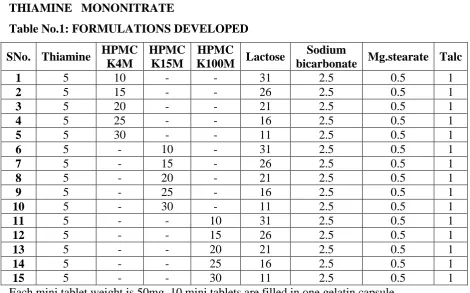
[image:5.595.63.534.92.385.2]2722 TABLET COMPOSITION OF FLOATING MINI MATRIX TABLETS OF THIAMINE MONONITRATE
Table No.1: FORMULATIONS DEVELOPED SNo. Thiamine HPMC
K4M
HPMC K15M
HPMC
K100M Lactose
Sodium
bicarbonate Mg.stearate Talc
1 5 10 - - 31 2.5 0.5 1
2 5 15 - - 26 2.5 0.5 1
3 5 20 - - 21 2.5 0.5 1
4 5 25 - - 16 2.5 0.5 1
5 5 30 - - 11 2.5 0.5 1
6 5 - 10 - 31 2.5 0.5 1
7 5 - 15 - 26 2.5 0.5 1
8 5 - 20 - 21 2.5 0.5 1
9 5 - 25 - 16 2.5 0.5 1
10 5 - 30 - 11 2.5 0.5 1
11 5 - - 10 31 2.5 0.5 1
12 5 - - 15 26 2.5 0.5 1
13 5 - - 20 21 2.5 0.5 1
14 5 - - 25 16 2.5 0.5 1
15 5 - - 30 11 2.5 0.5 1
Each mini tablet weight is 50mg, 10 mini tablets are filled in one gelatin capsule.
In -Vitro Drug Release Characteristics:
The in vitro drug release study was performed for the single- & multiple-unit tablets using
USP Type II dissolution apparatus under the following conditions.
Dissolution test parameters
Medium : 900ml of 01.N HCl
Rotation speed : 50 rpm
Temperature : 37±0.1ºC
Sampling Volume : 5ml
Sampling Time : 0.5, 1, 1. 5, 2, 3, 4,5, 6, 8, 10, 12 hours
At predetermined time intervals samples (5 ml) were collected and replenished with same
volume of fresh media. The drug content in the samples was estimated using
www.wjpr.net Vol 4, Issue 05, 2015.
2723 RESULTS AND DISCUSSION
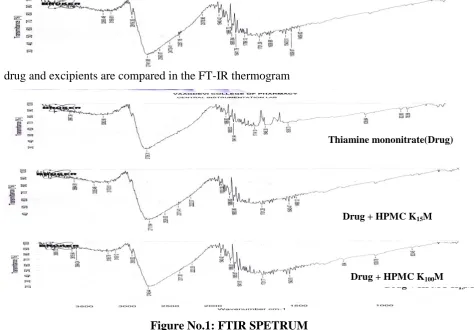
DRUG-EXCIPIENT COMPATIBILITY STUDIES Fourier Transform Infrared Spectroscopy (FT-IR)
The thermal behavior of pure drug and the respective excipients and the binary mixture of
[image:6.595.68.543.179.509.2]drug and excipients are compared in the FT-IR thermogram
Figure No.1: FTIR SPETRUM Table No.2: FTIR Results
Functional group Absorption range
Pure drug
Drug+HPMC K 4M
Drug+HPM C K 15M
Drug+HPM C K 100M
Alcohol/phenol
O-H(stretch) 3550 3200 3667.39 3564.91 3283.4 3584.24
Amine N-H(stretch) 3500-3300 3262.90 3335.48 3169.81 3195.79
C-O(bending) 1300-1000 1038.64 1098.71 1340.42 1038.78
-C=C-(stretch) 2260-2100 2139.31 2222.37 2078.96 2223.38
-C-H-(scissoring,bending) 1470-1380 1409.73 1499.12 1459.62 1226.64
FT-IR was employed to ascertain the compatibility of thiamine with polymers.The individual
drug and drug with polymers were separately scanned and the spectras were compared for
conformation of common peaks. Thiamine with polymers showed no significant variation in
height, intensity and position of peaks, suggesting that drug and excepients were compatible.
Thiamine mononitrate(Drug)
Drug + HPMC K4M
Drug + HPMC K15M
Drug + HPMC K100M
www.wjpr.net Vol 4, Issue 05, 2015.
2724 There is no interaction between drug and polymer. Hence it can be concluded that the drug is
in free state and can release easily from the formulation.
PHYSICAL PROPERTIES OF PREPARED POWDER BLENDS
Physical properties like Compressibility index (CI), Angle of repose and Hausner ratio were
calculated and tabulated.The results were in the limits and comply with the standard.
Table No.3: Precompression Results of powder blend.
EVALUATION OF PHYSICAL PARAMETERS OF FLOATING MINITABLETS OF THIAMINE MONONITRATE.
All the prepared formulations were tested for Physical parameters like Hardness, thickness,
Weight Variation, Friability and found to be within the Pharmacopoeial limits. Results of
the tests were tabulated. The drug content of all the formulations was determined and was
found to be within the permissible limit. This study indicated that all the prepared
formulations were good.
Formulation CI Angle of Repose
Hausner ratio
Bulk density (gm/cm3)
Tapped density(gm/cm3)
F1 12.3 26.8o 1.14 0.396 0.465
F2 15.9 27.5o 1.18 0.394 0.456
F3 12.8 28.0o 1.13 0.382 0.449
F4 15.7 29.4o 1.18 0.391 0.459
F5 12.4 28.5o 1.14 0.387 0.441
F6 11.2 29.4o 1.13 0.395 0.468
F7 13.6 28.4o 1.02 0.399 0.474
F8 12.5 26.9o 1.16 0.393 0.460
F9 14.6 27.5o 1.15 0.388 0.456
F10 12.9 28.5 1.12 0.396 0.459
F11 12.4 28.7 1.11 0.392 0.465
F12 14.1 29.1 1.05 0.387 0.442
F13 15.5 27.5 1.14 0.394 0.469
F14 14.7 28.8 1.18 0.392 0.450
www.wjpr.net Vol 4, Issue 05, 2015.
[image:8.595.166.431.596.767.2]2725 Table No.4: Results of Hardness, Thickness, Weight variation, Friability:
Formulations
Hardness(kg/cm2) (kg/cm2 )± S.D
n=6
Thickness(mm) (mm) ± S.D
n=10
Weight Variation(mg)
(mg)± S.D n=20 Friability (%) n=20 Drug content (%)±SD n=3
F1 5.15 ± 0.01 2.99 ± 0.04 50 ± 1.12 0.14 99.23± 1.2
F2 5.11 ± 0.05 2.99 ± 0.03 49 ± 1.15 0.15 100.12± 1.5
F3 5.20 ± 0.02 2.98 ± 0.06 49± 1.12 0.18 99.82± 2.0
F4 5.15 ± 0.02 2.99 ± 0.05 50 ± 1.10 0.15 99.98± 1.0
F5 5.18 ± 0.01 2.98 ± 0.02 50.5±1.15 0.17 99.43± 2.1
F6 5.15 ± 0.03 2.97 ± 0.03 50.1±1.12 0.15 99.67± 1.4
F7 5.17 ± 0.05 2.99 ± 0.04 50 ± 1.01 0.16 98.89± 1.1
F8 5.23 ± 0.05 2.98 ± 0.07 49 ± 1.14 0.18 100.23± 1.2
F9 5.11 ± 0.05 2.99 ± 0.05 50 ± 1.13 0.19 99.95± 2.1
F10 5.06 ± 0.09 2.99 ± 0.02 50.2±1.10 0.16 101.10± 1.1
F11 5.18 ± 0.08 2.98 ± 0.04 48 ± 1.11 0.18 98.88± 2.2
F12 5.14 ± 0.01 2.98 ± 0.03 49 ± 1.10 0.17 100.14± 1.0
F13 5.08 ± 0.07 2.99 ± 0.06 51 ± 1.0 0.14 100.01± 1.1
F14 5.21 ± 0.02 2.98 ± 0.02 49 ± 1.15 0.13 98.99± 2.1
F15 5.16 ± 0.06 2.99 ± 0.04 50 ± 1.14 0.14 101.21±1.0
SD=standard deviation.
The results of the physical tests of the formulations were in the limits and comply with the
standards. Hence it was considered that they have good physical properties and can withstand
the mechanical shocks.
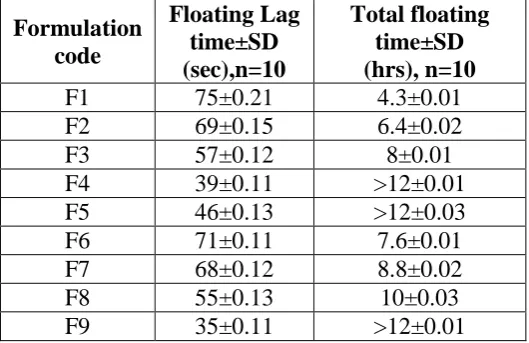
FLOATING PROPERTIES OF FLOATING MINI MATRIX TABLETS OF THIAMINE MONONITRATE
All the formulations were tested for floating properties like floating lag time and total floating
time. The results of the tests were tabulated. All the batches showed good in vitro buoyancy.
Table No.5: Floating Properties of Mini Tablets Formulation code Floating Lag time±SD (sec),n=10 Total floating time±SD (hrs), n=10
F1 75±0.21 4.3±0.01
F2 69±0.15 6.4±0.02
F3 57±0.12 8±0.01
F4 39±0.11 >12±0.01
F5 46±0.13 >12±0.03
F6 71±0.11 7.6±0.01
F7 68±0.12 8.8±0.02
F8 55±0.13 10±0.03
www.wjpr.net Vol 4, Issue 05, 2015.
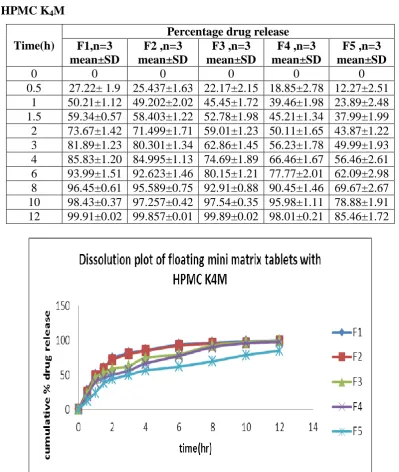
2726 Table No.6: Percentage drug release of mini matrix tablets of thiamine mononitrate with HPMC K4M
Time(h)
Percentage drug release F1,n=3
mean±SD
F2 ,n=3 mean±SD
F3 ,n=3 mean±SD
F4 ,n=3 mean±SD
F5 ,n=3 mean±SD
0 0 0 0 0 0
0.5 27.22± 1.9 25.437±1.63 22.17±2.15 18.85±2.78 12.27±2.51
1 50.21±1.12 49.202±2.02 45.45±1.72 39.46±1.98 23.89±2.48
1.5 59.34±0.57 58.403±1.22 52.78±1.98 45.21±1.34 37.99±1.99
2 73.67±1.42 71.499±1.71 59.01±1.23 50.11±1.65 43.87±1.22
3 81.89±1.23 80.301±1.34 62.86±1.45 56.23±1.78 49.99±1.93
4 85.83±1.20 84.995±1.13 74.69±1.89 66.46±1.67 56.46±2.61
6 93.99±1.51 92.623±1.46 80.15±1.21 77.77±2.01 62.09±2.98
8 96.45±0.61 95.589±0.75 92.91±0.88 90.45±1.46 69.67±2.67
10 98.43±0.37 97.257±0.42 97.54±0.35 95.98±1.11 78.88±1.91
[image:9.595.97.497.186.659.2]12 99.91±0.02 99.857±0.01 99.89±0.02 98.01±0.21 85.46±1.72
Figure No.2: Dissolution plot of floating mini matrix tablets with HPMC K4M
F10 44±0.21 >12±0.02
F11 67±0.15 9.1±0.01
F12 53±0.13 11.2±0.03
F13 36±0.11 >12±0.01
F14 42±0.12 >12±0.02
www.wjpr.net Vol 4, Issue 05, 2015.
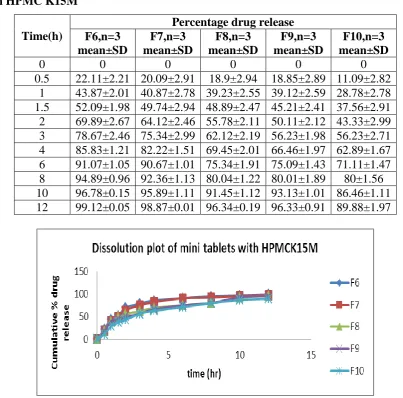
2727 Table No.7: Percentage drug release of mini matrix tablets of thiamine mononitrate with HPMC K15M
Time(h)
Percentage drug release F6,n=3
mean±SD
F7,n=3 mean±SD
F8,n=3 mean±SD
F9,n=3 mean±SD
F10,n=3 mean±SD
0 0 0 0 0 0
0.5 22.11±2.21 20.09±2.91 18.9±2.94 18.85±2.89 11.09±2.82
1 43.87±2.01 40.87±2.78 39.23±2.55 39.12±2.59 28.78±2.78
1.5 52.09±1.98 49.74±2.94 48.89±2.47 45.21±2.41 37.56±2.91
2 69.89±2.67 64.12±2.46 55.78±2.11 50.11±2.12 43.33±2.99
3 78.67±2.46 75.34±2.99 62.12±2.19 56.23±1.98 56.23±2.71
4 85.83±1.21 82.22±1.51 69.45±2.01 66.46±1.97 62.89±1.67
6 91.07±1.05 90.67±1.01 75.34±1.91 75.09±1.43 71.11±1.47
8 94.89±0.96 92.36±1.13 80.04±1.22 80.01±1.89 80±1.56
10 96.78±0.15 95.89±1.11 91.45±1.12 93.13±1.01 86.46±1.11
12 99.12±0.05 98.87±0.01 96.34±0.19 96.33±0.91 89.88±1.97
Figure No.3: Dissolution plot of floating mini matrix tablets with K15M
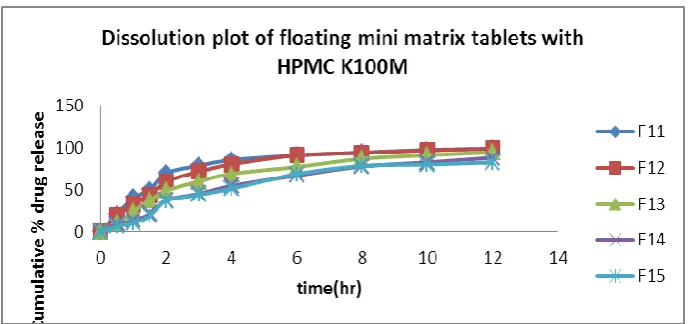
Table No.8: Percentage drug release of floating mini matrix tablets of thiamine mononitrate with HPMC K100M
Time(h)
Percentage drug release F11,n=3
mean±SD
F12,n=3 mean±SD
F13,n=3 mean±SD
F14,n=3 mean±SD
F15,n=3 mean±SD
0 0 0 0 0 0
0.5 21.46±2.62 19.67±2.51 11.13±2.99 9.59±2.99 6.95±2.94
1 40.89±2.15 33.56±2.26 24.67±2.56 13.7±2.22 11.06±2.89
1.5 50.09±2.54 43.65±2.67 37.78±2.45 21.62±2.45 19.27±2.78
2 69.98±1.99 59.89±2.88 48.98±2.58 37.75±2.58 37.17±2.66
3 78.67±1.78 71.67±2.14 60.07±2.51 45.38±2.81 44.21±2.53
4 85.38±1.57 80.32±2.23 69.12±1.96 54.77±2.93 51.54±2.39
6 91.01±1.24 90.99±1.58 77.32±1.99 67.09±2.89 68.85±2.43
8 94.22±1.11 94.02±1.78 86.88±2.01 77.89±2.16 78.54±2.16
10 97.56±1.05 96.98±1.01 91.09±1.78 82.64±2.71 80.13±1.97
[image:10.595.92.496.99.497.2] [image:10.595.107.488.565.770.2]www.wjpr.net Vol 4, Issue 05, 2015.
[image:11.595.126.471.69.231.2]2728 Figure No.4: dissolution plot of floating mini matrix tablets with HPMC K100M Table No.9: In Vitro dissolution kinetics of floating mini matrix tablets of thiamine mononitrare
Formulation No.
Correlation coefficient (r2)
Diffusional exponent,n Zero
order
First order
Korsemeyer peppas
Higuchi plot
F4 0.847 0.982 0.949 0.978 0.309
F9 0.835 0.9634 0.941 0.9728 0.246
F13 0.826 0.9931 0.915 0.952 0.238
SWELLING STUDIES
Determination of swelling index of tablets
Radial swelling of the matrices was monitored by immersing the tablet in beaker containing
dissolution medium (250ml, 370 C). At predefined time interval, an increase in the tablet
diameter was determined over a specified period of time. The same measured in atleast two
different axes perpendicular to each other and their mean value is taken.
Method
The temperature of beaker containing 250ml double distilled water (dissolution medium) was
maintained at 37.5 ± 0.5 0 C. The scale was placed below the beaker so that scale could be
easily shown. The diameter of the tablet was initially measured and then it was put inside the
beaker. The tablet was placed such that diameter could be measured at specific time interval
[image:11.595.96.488.315.404.2]www.wjpr.net Vol 4, Issue 05, 2015.
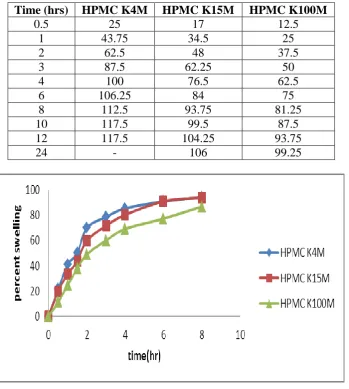
[image:12.595.126.476.111.501.2]2729 Table No.10: Swelling Index of HPMC K4M, HPMC K15M and HPMC K100M Polymer
tablets.
Time (hrs) HPMC K4M HPMC K15M HPMC K100M
0.5 25 17 12.5
1 43.75 34.5 25
2 62.5 48 37.5
3 87.5 62.25 50
4 100 76.5 62.5
6 106.25 84 75
8 112.5 93.75 81.25
10 117.5 99.5 87.5
12 117.5 104.25 93.75
24 - 106 99.25
Figure No.5: Percent swelling Vs time for HPMC K4M, HPMC K15M and HPMC K100M polymer
STABILITY STUDIES
The best formulation of Thiamine mononitrate floating mini matrix tablets containing HPMC
and HPMC K100M were subjected to stability study by keeping them at 40 °C/75% RH for 1
month to assess their stability with respect to their physical appearance, drug content, floating
properties and release characteristics. The physical characteristic like weight variation,
hardness, friability, percent drug content and in vitro release profile were determined at
interval of 2 weeks and 4 weeks.
www.wjpr.net Vol 4, Issue 05, 2015.
[image:13.595.156.439.546.732.2]2730 Table No.11: Physicochemical Characteristics of Thiamine floating mini matrix tablets during stability study period (40 °C/75% RH)
Formulation Stability study period Weight Variation (mg) S.D (n=10)
Hardness (kg/cm2 )
S.D (n=10) Friability (%) (n=20) Drug content (%) S.D (n=3) F4
0 day 501.1 5.150.02 0.150.01 99.980.56
2nd week 502.1 5.50.15 0.250.15 100.260.64
4th week 491.17 5.00.35 0.320.35 101.570.47
F9
0 day 501.13 5.110.05 0.190.02 99.950.39
2nd week 491.86 5.40.53 0.220.53 101.530.76
4th week 501.12 5.20.67 0.520.67 100.20.51
F13
0 day 511.0 5.080.07 0.140.04 100.10.39
2nd week 501.1 5.40.53 0.450.53 101.50.76
4thweek 491.3 5.20.67 0.250.67 99.70.51
Table No. 12: Floating parameters during stability study period (40 °C/75% RH) Formulation Stability
study period Floating lag time (min) Floating time (hrs) F4
0day 0.39 12
2nd week 0.41 12
4th week 0.38 12
F9
0 day 0.35 12
2nd week 0.42 12
4th week 0.32 12
F13
0 day 0.36 12
2nd week 0.38 12
4thweek 0.41 12
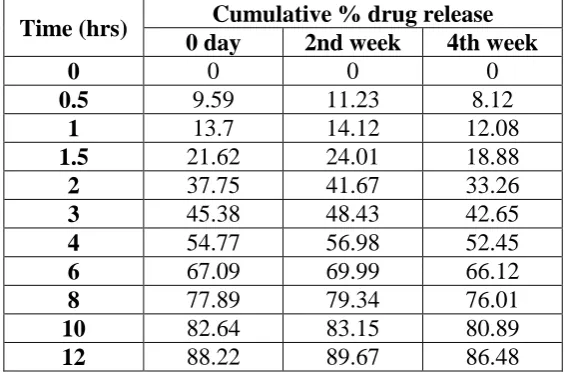
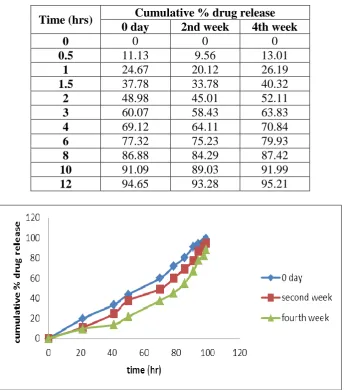
Table No:13 Dissolution profile of F9 at 0, 2nd week and 4th week during the stability period
Time (hrs) Cumulative % drug release 0 day 2nd week 4th week
0 0 0 0
0.5 9.59 11.23 8.12
1 13.7 14.12 12.08
1.5 21.62 24.01 18.88
2 37.75 41.67 33.26
3 45.38 48.43 42.65
4 54.77 56.98 52.45
6 67.09 69.99 66.12
8 77.89 79.34 76.01
10 82.64 83.15 80.89
www.wjpr.net Vol 4, Issue 05, 2015.
2731
Figure No.6: Dissolution plot of F9 at 0, 2nd week and 4th week during the stability period.
Table No.14: Dissolution profile of F9 at 0,2ndand 4th week during the stability period Time (hrs) Cumulative % drug release
0 day 2nd week 4th week
0 0 0 0
0.5 11.13 9.56 13.01
1 24.67 20.12 26.19
1.5 37.78 33.78 40.32
2 48.98 45.01 52.11
3 60.07 58.43 63.83
4 69.12 64.11 70.84
6 77.32 75.23 79.93
8 86.88 84.29 87.42
10 91.09 89.03 91.99
[image:14.595.133.475.68.253.2]12 94.65 93.28 95.21
[image:14.595.127.472.329.719.2]www.wjpr.net Vol 4, Issue 05, 2015.
2732 X-RAY STUDIES OF FORMULATION F9
[image:15.595.98.506.415.734.2]
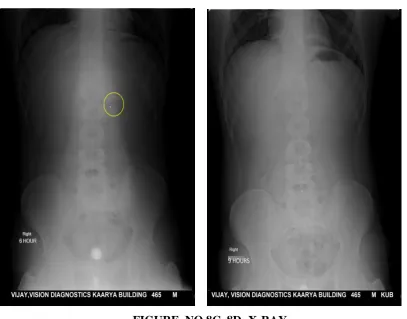
FIGURE .NO 8A, 8B -X-RAY
www.wjpr.net Vol 4, Issue 05, 2015.
2733 The in-vivo X-ray studies were approved by the institutional ethical committee with approval
No.IHEC/VGOPC/028/2013.Tablets were administered to 2 healthy human volunteers aged
20-25 years and weighing 50-60kgs were selected for these studies. For these studies,
optimized floating formulation F4 was modified by replacing 3 mg of Thiamine mononitrate
with X-ray grade barium sulfate which is a radio-opaque substance, keeping all other
ingredients constant. The in-vivo gastric residence time determination was carried out in fed
conditions. In fed state, the tablet was administered to the volunteer after taking a standard fat
and Protein meal with 200ml of water and for next 4hrs at 30min interval 200ml of water was
given.The mini tablets floated efficiently for 6hrs in the stomach without any adhesion to the
walls of the stomach.
DISCUSSION
• Floating mini matrix tablets of Thiamine mono nitrate were successfully prepared with
hydrophilic polymers like HPMC K4M, HPMC K15M and HPMC K100M with 5% sodium
bicarbonate by wet granulation method with drug : polymer ratios of 1:2,1:3,1:4,1:5,1:6. The buoyancy of mini tablets might be due to release and entrapment of carbon dioxide
gas in the polymer matrix.
• Evaluation parameters of powder blend like bulk density, tapped density, Hausner’s ratio,
Compressibility index, Angle of repose were carried out and results showed that the
powder has good flow properties.
• FT-IR studies showed no incompatibility between drug, polymer and various excipients
used in the formulations. The optimized formulations were subjected to FTIR studies to
confirm that there are no drug polymer interactions. .The result indicated the absence of
interaction because the major functional groups which were present in the pure drug were
also present in the mixtures of drug and polymer without any much variations in the peak
values. It presumably suggests that the drug molecule is present in an unchanged state in
the formulation.
• Formulated tablets gave satisfactory results for various evaluation parameters like
thickness(4mm), hardness(5-6Kg/cm2), weight variation( +/- 10%), friability(less than
0.9%), content uniformity(90%-110%), in vitro buoyancy properties (around 12hrs)and in
vitro drug release.
• Since in the preparation of floating tablets, the floating parameters are most important.
Hence formulations which show minimum floating lag time with maximum total floating
www.wjpr.net Vol 4, Issue 05, 2015.
2734 F13 with 39sec,35sec,36sec respectively. Even the total floating time was found to be
more than 12hrs for F4, F9, F13 formulations with more than 90%drug release upto 12hrs.
• The thiamine floating mini matrix tablets were subjected to in vitro drug release studies in
0.1N HCl (pH1.2) for 12 hours to access the ability of the formulation for providing
controlled drug delivery using USP Type2 (paddle) apparatus , maintained at 37 ± 0.50C
with 50rpm.
• Formulations with HPMC K4M, F1 to F3 released more than 90% of drug within 6 hrs
whereas formulation F4 and F5 released 98.01% and 85.46% respectively in 12 hours. As
F4 released more drug than F5, hence F4 is considered as an optimized formulation in the
case of HPMC K4M.
• Formulations with HPMC K15M, F6 and F7 released more than 90% of drug within 6 hrs
whereas formulation F8,F9 and F10 released 96.32%,96.33% and 89.88% respectively in
12 hours. As F9 released more drug than F8 and F10 and FLT of F9 is less when
compared to others F9 is considered as an optimized formulation in the case of HPMC K15M.
• Formulations with HPMC K100M, F11and F12 released more than 90% of drug within 6
hrs whereas formulation F13, F14 and F5 released 94.65%, 88.22% and 82.64%
respectively in 12 hours. As F13 released more drug than F14 and F15 it is considered as
an optimized formulation in the case of HPMC K100M.
• The correlation of coefficient (r2) of the HPMC K4M , HPMC K15M and HPMC K100M
floating mini matrix tablets for first order release kinetics was found to be higher when
compared to that of zero order release kinetics indicating that drug release followed first
order kinetics.
• The dissolution data were further characterized by fitting the data into Higuchi’s square
root time model. The correlation coefficient values of Higuchi plot of formulations F1 to
F15 were found to be in the range of 0.8607 to 0.9736. As the correlation coefficient
values are close to one, it indicates that the drug release is by diffusion mechanism.
When the log cumulative percent of drug released was plotted against time on log scale,
the diffusional exponent values (n) were found to be less than 0.45 for all the
formulations except F1 and F3 indicating that the release from F1 and F3 followed
non-fickian diffusion i.e.,erosion and remaining all the formulations followed non-fickian
diffusion.From the above observations it was in vitro drug release. F4,F9,F13
www.wjpr.net Vol 4, Issue 05, 2015.
2735 and among these formulation F9 with lesser floating lag time and drug release more than
90 % was considered to be optimized formulation.
• The swelling studies were carried for 24 hrs. The results indicate that the selected
polymers were of swellable type and HPMC K4M have marginally more swellability than
HPMC K15M and HPMC K100M matrices.
• X-ray studies were conducted invivo by replacing 3gm of drug with barium sulphate in
F4 formulation and found that the mini tablets floated efficiently for 6hrs in the stomach
without any adhesion to the walls of the stomach.
CONCLUSION
The following conclusions can be drawn from the results obtained.
Preformulation studies of the drug were reported within the Pharmacopeial limits and the
drug excipient compatibility FT-IR studies indicated no interactions. Floating lag time
and total floating period for the optimized formulations were found to be acceptable. The
hardness, thickness, friability, weight variation, drug content, swelling index and in-vitro
release were uniform and reproducible and reported within the Pharmacopeial limits. The mechanism of drug release was found to be fickian diffusion except for F1 and F3
which followed erosion and all the formulations followed first-order release kinetics.
X-ray radiography studies indicated that the optimized formulations floated in the
stomach for sufficient time period without any adhesion to the walls of the stomach.
Hence it is concluded that the adopted method successfully yielded uniform and reproducible
floating mini matrix tablets of thiamine mononitrate with HPMC K4M,K15M,K100M polymers
which was confirmed by in-vitro and in-vivo studies., Thiamine mononitrate.
REFERENCES
1. Chein YW. Oral Drug Delivery and Delivery systems. In, Novel drug delivery
systems,Vol. 50, Marcel Dekker, Inc., New York, 1992; 50: 139-177.
2. Allan S. Hoffman, The Origins and Evolution of “Controlled” Drug Delivery Systems,
Journal of Controlled Release, 2008; 132: 153-163.
3. Bardonnet.P.L. a,b, V.Faivre a, W.J. Pugh c, J.C. Piffaretti d, F. Falson., Gastroretentive
dosage forms: Overview and special case of Helicobacter pylori, Journal of Controlled
Release., 2006 111: 1 – 18.
4. Shweta Arora, Javed Ali, Alka Ahuja, Roop K Khar and Sanjula Baboota, Floating Drug
www.wjpr.net Vol 4, Issue 05, 2015.
2736 5. Mayavanshi. A.V, Gajjar. S.S, “Floating drug delivery systems to increase gastric
retention of drugs: A Review” Research J. Pharm. and Tech., Oct.-Dec. 2008; 1(4).
6. Sunil R, Vinay K. Formulation and evaluation of eplerenone mini tablets – A novel
approach in designing sustained release matrix tablets, JGPT., 2009; 15 – 21.
7. Hernandez BY, McDuffie K, Wilkens LR, et al. Diet and premalignant lesions of the
cervix: evidence of a protective role for folate, riboflavin, thiamin, and vitamin B12.
Cancer Causes Control/. 2003; 14: 859-70.
8. Wilkinson TJ, Hanger HC, Elmslie J, et al. The response to treatment of subclinical
thiamine deficiency in the elderly. Am J Clin Nutr., 1997; 66: 925-8.
9. Singleton, C.K., and Martin, P.R. Molecular mechanisms of thiamine utilization. Current
Molecular Medicine., 2001; 1(2): 197–207.
10.Vimokesant S, Nakornchai S, Rungruangsak K, et al. Food habits causing thiamine